


Introduction
Lifetime prevalence rates of social anxiety disorder (SAD) in Western countries vary between 7 and 13% (Furmark, Reference Furmark2002). Onset typically occurs in adolescence (Kessler et al., Reference Kessler, Berglund, Demler, Jin and Walters2005) and it follows a chronic course if untreated (Wittchen and Fehm, Reference Wittchen and Fehm2003). SAD is associated with increased rates of depression (Kessler et al., Reference Kessler, Stang, Wittchen, Stein and Walters1999), suicidal ideation (Wunderlich et al., Reference Wunderlich, Bronisch and Wittchen1998) and alcohol abuse (Grant et al., Reference Grant, Hasin, Blanco, Stinson, Chou and Goldstein2005), along with poor quality of life (Stein and Kean, Reference Stein and Kean2000) and interferences in social and occupational functioning (Falk Dahl and Dahl, Reference Falk Dahl and Dahl2010). High economic costs are incurred by loss of productivity in the workplace and absenteeism (Lipsitz and Schneier, Reference Lipsitz and Schneier2000), and increased use of social (Patel et al., Reference Patel, Knapp, Henderson and Baldwin2002) and healthcare services (Acarturk et al., Reference Acarturk, Cuijpers, van Straten and de Graaf2009a,b). Consequently, providing effective SAD treatment options is a priority (Egger et al., Reference Egger, Konnopka, Beutel, Herpertz, Hiller and Hoyer2015).
The current NICE (2013) clinical guideline (CG159) for SAD discourages group over individual cognitive behavioural therapy (CBT), as individual formats are more clinically and cost-effective. Whilst individual CBT is the most cost-effective psychological intervention for SAD (Mavranezouli et al., Reference Mavranezouli, Mayo-Wilson, Dias, Kew, Clark, Ades and Pilling2015), many researchers have not found significant differences between group and individual CBT (e.g. Barkowski et al., Reference Barkowski, Schwartze, Strauss, Burlingame, Barth and Rosendahl2016; Fedoroff and Taylor, Reference Fedoroff and Taylor2001; Gould et al., Reference Gould, Buckminster, Pollack, Otto and Yap1997; Mayo-Wilson et al., Reference Mayo-Wilson, Dias, Mavranezouli, Kew, Clark, Ades and Pilling2014; Powers et al., Reference Powers, Sigmarsson and Emmelkamp2008; Taylor, Reference Taylor1996). Meta-analyses have included individual and group formats of CBT (Acarturk et al., Reference Acarturk, Cuijpers, van Straten and de Graaf2009a; Barkowski et al., Reference Barkowski, Schwartze, Strauss, Burlingame, Barth and Rosendahl2016; Chambless and Hope, Reference Chambless, Hope and Salkovskis1996; Federoff and Taylor, Reference Fedoroff and Taylor2001; Feske and Chambless, Reference Feske and Chambless1995; Gould et al., Reference Gould, Buckminster, Pollack, Otto and Yap1997; Mayo-Wilson et al., Reference Mayo-Wilson, Dias, Mavranezouli, Kew, Clark, Ades and Pilling2014; Powers et al., Reference Powers, Sigmarsson and Emmelkamp2008; Taylor, Reference Taylor1996). One focused specifically on the controlled efficacy of CBGT (Wersebe et al., Reference Wersebe, Sijbrandij and Cuijpers2013). According to these meta-analyses, CBGT was superior to wait list control groups: with medium to large effect sizes on social anxiety measures; medium effect sizes on anxiety and depression measures; and small to medium effect sizes on social anxiety measures up to 18-month follow-up.
Evidence on CBGT’s effectiveness in routine clinical settings is increasing (Gaston et al., Reference Gaston, Abbott, Rapee and Neary2006; Marom et al., Reference Marom, Gilboa-Schechtman, Aderka, Weizman and Hermesh2009; McCarthy et al., Reference McCarthy, Hevey, Brogan and Kelly2013; McEvoy, Reference McEvoy2007; McEvoy et al., Reference McEvoy, Nathan, Rapee and Campbell2012; Watanabe et al., Reference Watanabe, Furukawa, Chen, Kinoshita, Nakano and Ogawa2010). Some researchers (e.g. Gaston et al., Reference Gaston, Abbott, Rapee and Neary2006; McEvoy, Reference McEvoy2007; McEvoy et al., Reference McEvoy, Nathan, Rapee and Campbell2012) benchmarked effectiveness against efficacy trials, concluding that comparable outcomes were achieved in clinical settings to those found efficacious in randomized controlled trials (RCTs). At post-assessment, these studies yielded medium to large effect sizes on social anxiety measures; large effect sizes on depression measures; medium effect sizes on anxiety measures; and large effect sizes on social anxiety, anxiety and depression measures up to 1 year follow-up.
Little is known about CBGT treatment outcomes in real-life clinical settings beyond 1 year after treatment. To date, one long-term follow-up efficacy study (Heimberg et al., Reference Heimberg, Salzman, Holt and Blendell1993) indicated maintenance of gains at 5-year follow-up. The study had an initial small sample (N = 40) and approximately half (n = 19) participated in follow-up. Analysis of the differences between completers and non-completers revealed that follow-up participants were not representative of the original study sample. Furthermore, the study did not use standardized social anxiety measures. Consequently, the generalizability of the findings is limited.
Although approximately three-quarters of treatment completers show significant improvement (Coles et al., Reference Coles, Turk, Jindra and Heimberg2004), many drop out (e.g. Hofmann and Suvak, Reference Hofmann and Suvak2006; 26%), do not respond (e.g. Davidson et al., Reference Davidson, Foa, Huppert, Keefe, Franklin and Compton2004; 48%) and fail to achieve clinically significant improvement (e.g. McCarthy et al., Reference McCarthy, Hevey, Brogan and Kelly2013; 70–72%). Managing those who do not respond sufficiently to treatment remains challenging. Developing evidence-based strategies for improving group therapy’s benefits is important in clinical practise. Individuals with SAD may require additional support as a treatment adjunct.
Research evaluating the effectiveness of additional supports has focused on additional support between sessions (e.g. Delsignore et al., Reference Delsignore, Rufer, Emmerich, Weidt, Brühl and Moergeli2016; Shingleton et al., Reference Shingleton, Richards and Thompson-Brenner2013) and after treatment discontinuation in the form of aftercare. An aftercare online support group following psychiatric hospitalization was evaluated in an RCT (Ebert et al., Reference Ebert, Tarnowski, Gollwitzer, Sieland and Berking2013). Aftercare with treatment-as-usual (outpatient CBT) was superior to treatment-as-usual alone in reducing symptoms of anxiety and depression from discharge to 1 year follow-up. Another study evaluated the efficacy of an intervention following attempted suicide (Gysin-Maillart et al., Reference Gysin-Maillart, Schwab, Soravia, Megert and Michel2016). Patients receiving three sessions followed by regular personalized letters over 2 years in addition to treatment-as-usual showed significantly lower rates of suicide attempts compared with those receiving regular treatment. Aftercare programs have proven effective for addiction (Ekendahl, Reference Ekendahl2007). Little is known, however, about the impact of adjunctive support following treatment discontinuation for SAD; the literature indicates that additional support once treatment discontinues improves outcomes in the broad context of adult mental health.
The present climate in healthcare provision emphasizes the importance of empirically validated and cost-effective treatments. Although individual CBT is the gold standard treatment for SAD (Hofmann and Scepowski, Reference Hofmann and Scepowski2006), group psychotherapy might be a promising alternative as group formats cost less per patient to deliver. Although the evidence shows that CBGT is not as cost-effective as individual CBT (Mavranezouli et al., Reference Mavranezouli, Mayo-Wilson, Dias, Kew, Clark, Ades and Pilling2015), it is worth examining the extent to which group-based programs can deliver clinically beneficial improvements that can be sustained long-term. Examination of the long-term effects has implications for determining the economic efficiency in managing service waiting-lists (Butler et al., Reference Butler, Chapman, Forman and Beck2006). Clinicians need to understand the degree to which individuals receiving CBGT treatments for SAD maintain gains. It is also important to understand if adjunctive support following treatment influences outcomes.
Given the necessity of empirically validated treatments for SAD and the paucity of effectiveness research, investigation is needed to evaluate CBGT’s long-term effects in routine clinical settings. This study evaluates the long-term effectiveness of a community-based CBGT program based on Clark and Wells’ (Reference Clark, Wells, Heimberg and Liebowitz1995) model with a sample of individuals who met DSM-IV (APA, 2000) criteria for SAD. It was predicted that gains achieved at post-assessment would be maintained at long-term follow-up. Furthermore, although research shows that there is variation in improvement among studies examining the impact of additional support on treatment outcomes, there is a lack of evidence regarding the directionality of the relationship between treatment outcomes and aftercare support. Given the absence of such literature on the impact of aftercare support on treatment outcomes, we also explored the relationship between aftercare support group attendance and degree of improvement from post-treatment severity to long-term follow-up.
Method
Participants
Individuals (N = 487) were referred to the CBGT program via two routes: (i) from adult mental health teams within the study hospital; and (ii) self-referral. The majority (91%) self-referred. Participants were selected based on meeting DSM-IV (APA, 2000) criteria for SAD, which was established by a senior clinical psychologist during a structured diagnostic interview based on the ADIS-IV-L (DiNardo et al., Reference DiNardo, Brown and Barlow1994). Exclusion criteria were established using the same diagnostic interview and included the following co-morbidities: psychosis; post-traumatic stress disorder; addiction; body dysmorphic disorder; autism spectrum disorder; social evaluative concerns related to medical or mental illness; and schizotypal, schizoid, or borderline personality disorder.
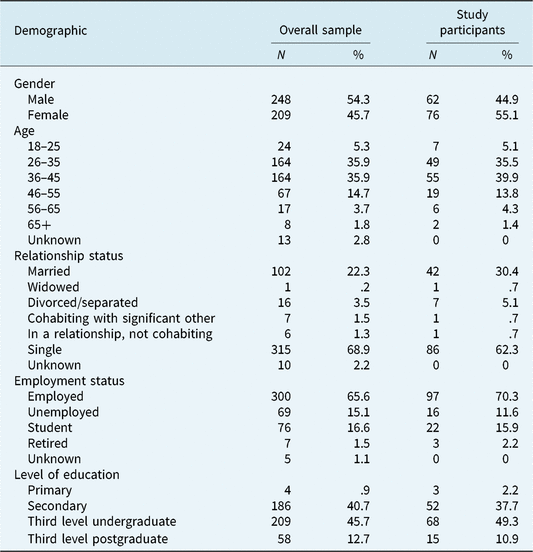
Of the overall sample, 457 completed pre-intervention data. The overall sample were aged between 19 and 72 years (mean = 38.68, SD = 9.59). The majority were single (n = 315), approximately two-thirds (n = 300) were employed and over half (n = 267) achieved a third level of education. Of the initial 457, 30 dropped out of the program, 19 refused to participate, 11 were uncontactable, 259 did not respond and 138 participated. The response rate was 33%. Drop-out and completion rates were 6 and 81%, respectively. Those who completed time 1 only data accounted for 13%. Study participants were aged between 19 and 72 years (mean = 38.72, SD = 9.45). Over half were single (n = 86) and achieved a third level of education (n = 83), and over two-thirds (n = 97) were employed. Demographic details of the participants are given in Table 1.
Demographic details of overall sample and study participants

Measures
Social anxiety
The Social Phobia Scale (SPS; Mattick and Clark, Reference Mattick and Clarke1998) assesses anticipation of being observed by other people and when undertaking certain activities in the presence of others. A high level of internal consistency (Cronbach’s α > .88) was reported (Mattick and Clark, Reference Mattick and Clarke1998). The same level was found in the current study (Cronbach’s α = .88). The Social Interaction Anxiety Scale (SIAS; Mattick and Clark, Reference Mattick and Clarke1998) measures cognitive, affective and behavioural reactions to social interaction situations. A high level of internal consistency (Cronbach’s α > .88) was reported (Mattick and Clark, Reference Mattick and Clarke1998); a similarly high level was found in the current study (Cronbach’s α = .85).
Anxiety and depression
The Beck Anxiety Inventory (BAI; Beck et al., Reference Beck, Epstein, Brown and Steer1988) measures the extent to which the respondent has been bothered by physiological and cognitive symptoms of anxiety. A high level of internal consistency (Cronbach’s α = .92) was reported (Beck et al., Reference Beck, Epstein, Brown and Steer1988); the same level was found in the current study (Cronbach’s α = .92). The Beck Depression Inventory – Second Edition (BDI-II; Beck et al., Reference Beck, Steer and Brown1996) assesses depressive symptoms. A high level of internal consistency (Cronbach’s α =.86) was reported by the scale’s authors (Beck et al., Reference Beck, Steer and Brown1996). A higher level was found in the current study (Cronbach’s α =.93).
Procedure
From 2005 to 2016, measures were administered before (time 1) and after (time 2) the program. The present study collected data at follow-up (time 3). A minimum of 120 participants were required for follow-up based on a power calculation. Anyone who was accepted onto the program up to 12 years (N = 457) was included in the study based on an assumed response rate of 30%. The mean follow-up time was 4.6 years (SD = 2.82), ranging from 9 months to 12 years. Participants were recruited via email, post, text message and advertisements on the service’s social media. Emails and text messages were sent fortnightly over 8 weeks. Participants were remunerated with a €5 donation to the service made by the principal researcher on their behalf. Demographic details (age, gender, marital status, level of education and employment status) were collected at each time point. Frequency of attendance (0–5, 6–10, 11–15, 16–20, 20+) at the aftercare support group was collected at follow-up.
CBGT program and aftercare support group
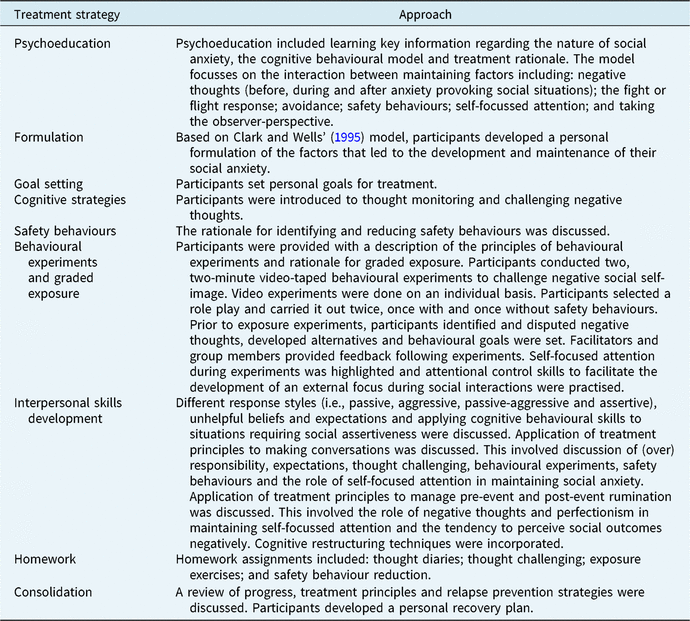
The CBGT program consists of fourteen, 2.5-h weekly sessions facilitated by a senior clinical psychologist and co-facilitated by psychologists in clinical training (i.e. doctoral level). Groups (N = 55) consisted of 5–10 participants. Table 2 provides an outline of the key treatment components adopted to address maintaining factors proposed by Clark and Wells (Reference Clark, Wells, Heimberg and Liebowitz1995).
Key components of the CBGT program
The support group was established based on consistent requests for an aftercare service made by participants during structured feedback. The support group consists of bi-monthly, 2.5-h semi-structured sessions facilitated by a counselling psychologist or a psychologist in clinical training. Support group sessions are service-user led as they are designed by participants in consultation with the program director. Sessions encompass participants talking about their progress (or otherwise) and discussing strategies that work in maintaining their recovery.
Data analyses
The sample was categorized into groups at baseline. Consistent with Gaston et al. (Reference Gaston, Abbott, Rapee and Neary2006), participants who attended at least eight sessions and provided time 1 and 2 data on social anxiety measures were included in completer analyses. Pre-treatment demographic and clinical differences between completers, those who completed time 1 data only and those who dropped out were tested using ANOVA and Tukey’s post-hoc tests. Follow-up analyses examined statistically significant differences in mean scores between groups. Differences between those who provided data at all three time points and those who provided data for times 1 and 2 only or times 1 and 3 only were tested using the same method. Repeated measures ANOVA and Sidak post-hoc tests determined the statistical significance of changes over time on outcomes. Effect sizes were calculated using changes in mean scores divided by baseline standard deviation (SD): Cohen’s d determined treatment effects at post- and follow-up assessments.
Pearson’s correlation coefficient (r) examined the relationship between all measures at time 1. After controlling for covariates, the main effects of time for social anxiety specific outcomes was examined using a repeated measures ANCOVA. After controlling for pre- and post-treatment scores, the relationship between length of time to follow-up on follow-up scores was examined using Pearson’s partial correlation coefficient (r). The effect of group size on outcome was examined using group size as a between-subjects factor in a mixed ANOVA.
Following Oei and Boschen (Reference Oei and Boschen2009), participants were evaluated as ‘recovered’ if they met four criteria: (i) completed times 1 and 2 BAI; (ii) have a baseline BAI score ≥11; (iii) [to establish reliable change (RC)] show decreases of 10 points on the BAI; and (iv) [to establish clinically significant change (CSC)] have a final BAI score ≤10. The same criterion was used for the BDI-II. The reliable change index (RCI) (Jacobson and Truax, Reference Jacobson and Truax1991) for the SPS and SIAS was calculated using test–retest reliability coefficients (SPS = .93, SIAS = .92) reported by the scales’ authors (Mattick and Clarke, Reference Mattick and Clarke1998). The criteria for CSC of ≤24 on the SPS and ≤34 on the SIAS (Heimberg et al., Reference Heimberg, Mueller, Holt, Hope and Liebowitz1992) was adopted. McNemar’s test assessed for statistically significant changes in categorical variables over time.
ANOVAs compared means on psychological variables at times 2 and 3 for groups according to frequency of aftercare attendance. Pearson’s r examined the relationship between frequency of aftercare attendance and improvement from post-treatment severity. Bootstrapped multinomial regression analyses examined the relationship between frequency of aftercare attendance (defined as never; low = 1–5 sessions; moderate 6–15 sessions; or high = 15+ sessions) and (a) degree of change in outcome variables and (b) severity at the end of treatment.
Results
Pre-intervention group comparisons
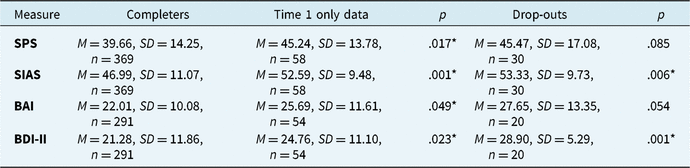
Completers, drop-outs and those who completed time 1 data only did not differ significantly on any demographic measure at time 1 (see Table 3). Groups differed significantly on psychological measures: SPS, F (2,454) = 5.51, p = .004, η2 = .02; SIAS, F (2,454) = 10.47, p = .001, η2 = .04; BAI, F (2,362) = 4.98, p = .007, η2 = .03; BDI-II, χ2(2) = 13.35, p = .001, η2 = .04. Post-hoc comparisons showed that mean scores on all measures were significantly lower for completers than those who completed time 1 only data. Mean scores on the SIAS and BDI-II were significantly lower for completers than drop-outs. Of completers, those who provided data at all three time points were not significantly different at time 1 to those who provided data at times 1 and 2 or times 1 and 3 on any demographic or psychological measure: SPS, F (2,371) = .99, p = .37, η2 = .01; SIAS, F (2,371) = .09, p = .91, η2 = .001; BAI, F (2,288) = 1.48, p = .23, η2 = .01; BDI-II, F (2,288) = .16, p = .85, η2 = .001.
Pre-treatment group comparisons on psychological measures

Notes: SPS = Social Phobia Scale; SIAS = Social Interaction Anxiety Scale; BAI = Beck Anxiety Inventory; BDI-II = Beck Depression Inventory – 2nd Edition; M = mean; SD = standard deviation; n = number of participants; p = significance value; * = the mean difference is significant at the .05 level.
Symptom severity
The sample was characterized by a high level of initial symptoms: most participants were above the clinical cut-off on social anxiety measures [SPS (n = 117, 85%); SIAS (n = 119, 86%)] and over one-third were in the moderate to severe ranges on anxiety and depression measures [BAI (n = 45, 46%); BDI-II (n = 40, 41%)] at time 1. The sample was characterized by a relatively low level of symptoms at follow-up: less than half were above the clinical cut-off on social anxiety measures [SPS (n = 60, 43%); SIAS (n = 64, 46%)] and approximately one-quarter were in the moderate to severe ranges on anxiety and depression measures [BAI (n = 41, 30%); BDI-II (n = 33, 24%)] at time 3.
Changes in psychological variables over time
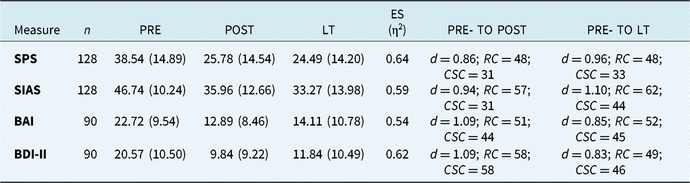
There was a significant main effect of time on all psychological measures: SPS, F (2,254) = 81.12, p = .001, η2 = 0.64; SIAS, F (2,254) = 74.92, p = .001, η2 = 0.59; BAI, F (1.72,152.97) = 48.14, p = .001, η2 = .54; BDI-II, F (2,178) = 54.78, p = .001, η2 = 0.62. Post-hoc analyses revealed a consistent pattern: time 1 scores were significantly higher than times 2 and 3 scores on all measures. There were no significant differences between times 2 and 3 scores. Cohen’s d values for changes from time 1 to times 2 and 3 were large, ranging from 0.83 to 1.10 (see Table 4). Correlations at time 1 revealed a significant relationship between the BAI and SPS (r = .47, p < .001) and the BDI-II and SIAS (r = .37, p < .001). After controlling for these covariates, the main effects of time were still significant for the SPS [F (2,174) = 3.00, p < .05] and SIAS [F (2,174) = 3.78, p < .05].
Means (standard deviations), effect sizes, Cohen’s d, reliable change, and clinically significant change in psychological measures over time

Notes: PRE = pre-intervention; POST = post-intervention; LT – long-term follow-up; PRE- TO POST; pre-intervention to post-intervention; PRE- TO LT; pre-intervention to long-term follow-up; SPS = Social Phobia Scale; SIAS = Social Interaction Anxiety Scale; BAI = Beck Anxiety Inventory; BDI-II = Beck Depression Inventory – 2nd Edition; n = number of participants; ES = effect size; d = Cohen’s d effect size; RC = reliable change; CSC = clinically significant change.
Impact of length of time to follow-up and group size on long-term outcomes
There was no statistically significant relationship between length of time to follow-up on follow-up scores: SPS (r = –.08); SIAS (r = –.09); BAI (r = .03); BDI-II (r = –.11). Controlling for pre- and post-treatment scores revealed the same pattern: there was no statistically significant relationship between length of time to follow-up on follow-up scores: SPS (r = –.06); SIAS (r = –.13); BAI (r = –.07); BDI-II (r = –.18). There was no significant interaction between group size and follow-up scores: SPS, F (6,248) = 1.72, p = .14; SIAS, F (6,248) = 1.49, p = .18; BAI, F (6,172) = 1.66, p = .15; BDI-II, F (6,172) = 0.49, p = .82.
Reliable and clinically significant change
On the SPS, 61 (48%) at post- and 66 (48%) at follow-up showed RC, and 39 (31%) at post- and 46 (33%) at follow-up met CSC criterion. On the SIAS, of 73 (57%) at post- and 85 (62%) at follow-up showed RC, and 40 (31%) at post- and 61 (44%) at follow-up met CSC criterion. Higher rates of CSC were found for general anxiety and depression. On the BAI, 36 (44%) at post- and 39 (45%) at follow-up showed CSC. On the BDI-II, 43 (58%) at post- and 37 (46%) at follow-up showed CSC.
McNemar’s test revealed statistically significant changes in categorical variables over time. For example, 46% were classified in the moderate to severe range on the BAI at time 1, with the rate significantly (p < .001) decreasing to 17% at time 2 and 30% at time 3. Moderate to severe depression deceased significantly (p < .001) from 41% at time 1 to 10% at time 2 and 24% at time 3. On the SPS, 85% were classified in the clinical range at time 1, with the rate significantly (p < .001) decreasing to 47% at time 2 and 43% at time 3. On the SIAS, 86% were classified in the clinical range at time 1, with the rate significantly (p < .001) decreasing to 56% at time 2 and 46% at time 3. Rates of RC and CSC over time are given in Table 4.
Aftercare support
Aftercare support groups consisted of an average of eight participants, ranging from 2 to 28. Attendance for the participants who took part in the study was as follows: 39 (28%) did not attend; 47 (34%) 1–5 times; 24 (17%) 6–10 times; 11 (8%) 11–15 times; 5 (4%) 16–20 times; 12 (9%) 20+ times. There were no significant differences in mean scores on any psychological measure at times 2 or 3 between groups according to frequency of aftercare attendance. There was no statistically significant relationship between frequency of aftercare attendance and improvement from post-treatment severity on any measure: SPS (r = –.03); SIAS (r = 0.01); BAI (r = .04); BDI-II (r = –.17). There was no relationship between frequency of aftercare support attendance and (a) degree of change in any of the outcome variables [χ2(12) = 13.14, p = .36] and (b) severity at the end of treatment [χ2(12) = 10.99, p = .53].
Discussion
CBGT was effective at maintaining large effect sizes at post-assessment for an average of 4.6 years following treatment. Large follow-up effect sizes for social anxiety correspond with those reported in effectiveness studies (Gaston et al., Reference Gaston, Abbott, Rapee and Neary2006; Marom et al., Reference Marom, Gilboa-Schechtman, Aderka, Weizman and Hermesh2009; McCarthy et al., Reference McCarthy, Hevey, Brogan and Kelly2013; McEvoy, Reference McEvoy2007; McEvoy et al., Reference McEvoy, Nathan, Rapee and Campbell2012) and compare favourably with those reported in efficacy studies (Acarturk et al., Reference Acarturk, Cuijpers, van Straten and de Graaf2009a,b; Barkowski et al., Reference Barkowski, Schwartze, Strauss, Burlingame, Barth and Rosendahl2016; Wersebe et al., Reference Wersebe, Sijbrandij and Cuijpers2013). CBGT also demonstrated maintenance of large effect sizes on anxiety and depression measures, corresponding with large effect sizes on depression measures (McCarthy et al., Reference McCarthy, Hevey, Brogan and Kelly2013; McEvoy, Reference McEvoy2007) and anxiety (McCarthy et al., Reference McCarthy, Hevey, Brogan and Kelly2013) reported previously. Large follow-up effect sizes compare favourably with medium effect sizes at post-assessment on anxiety and depression measures (Acarturk et al., Reference Acarturk, Cuijpers, van Straten and de Graaf2009a,b; Barkowski et al., Reference Barkowski, Schwartze, Strauss, Burlingame, Barth and Rosendahl2016; Powers et al., Reference Powers, Sigmarsson and Emmelkamp2008) reported in efficacy studies. After controlling for the effect of anxiety and depression, changes over time in social anxiety outcomes remained significant. The absence of a relationship between length of time to follow-up on follow-up scores indicates that participants benefited equally from CBGT irrespective of treatment discontinuation time frames. This finding supports the idea that CBT treatment effects persist after treatment discontinuation given its focus on transferring skills learned during therapy to everyday (i.e. making the individual their own therapist) (Beck, Reference Beck1995). In addition, the 7% drop-out rate compares favourably with those reported in the literature [e.g. Hofmann and Suvak (Reference Hofmann and Suvak2006), 26%; McEvoy (Reference McEvoy2007), 18%], suggesting that the program was acceptable to participants.
Whilst the findings indicate that approximately half of treatment completers experience reliable improvement on social anxiety measures over time, less fell within the functional range at follow-up (SPS, 33%; SIAS, 44%). Samples with more severe pre-treatment symptoms require larger mean changes before achieving CSC: it is therefore important to consider pre-treatment symptom severity before interpreting CSC as an indicator of treatment effectiveness. Furthermore, there was a considerable shift from the majority before treatment to less than half at follow-up scoring above the clinical cut-off on social anxiety measures. Nonetheless, the lower proportion of participants achieving CSC on the SPS than the SIAS suggests that CBGT treatment protocol may benefit from modules targeting phobic social situations. Treatment outcomes may be enhanced by in vivo exposure modules adopting an imagery-enhanced CBGT protocol (IE-CBGT), which has demonstrated large effect sizes in community samples (e.g. McEvoy and Saulsman, Reference McEvoy and Saulsman2014; McEvoy et al., Reference McEvoy, Erceg-Hurn, Saulsman and Thibodeau2015).
The highest rates of CSC were found for the BDI-II at post- and follow-up assessments (58 and 46%). Participants with initial moderate levels of depressive symptoms responded well to treatment that focused exclusively on social anxiety, consistent with research demonstrating effectiveness of cognitive therapy for individuals with SAD and depression (Smits et al., Reference Smits, Minhajuddin and Jarrett2009). Consequently, such individuals need not be excluded from accessing CBGT interventions for SAD.
The findings that there was no relationship between frequency of aftercare attendance and: (a) improvement from post-treatment severity; (b) degree of change in any outcome variable; or (c) severity at the end of treatment, and that groups did not differ on measures before and after attending, indicate that participants benefited equally from CBGT treatment irrespective of the amount of aftercare they received. However, despite not demonstrating continued effects on symptom-specific outcome measures, aftercare support group attendance may have had trans-diagnostic beneficial effects. Worrall et al. (Reference Worrall, Schweizer, Marks, Yuan, Lloyd and Ramjan2018) found that support groups are effective at reducing symptoms, substance misuse, hospitalizations and use of services, as well as improving social competence and increasing healthy behaviours, self-esteem and perceptions of overall wellbeing. In addition, participants across studies reported many of the same perceived benefits from attending support groups: fostering hope; learning coping strategies; building social and support networks; learning from successful role models; feeling more in control of their situation; and overcoming stigma (Worrall et al., Reference Worrall, Schweizer, Marks, Yuan, Lloyd and Ramjan2018). Anecdotally, people have attended the support group intermittently for many years, suggesting an intrinsic motivation to participate. Future research could explore the factors influencing the processes of change among group members proposed by Yalom (Reference Yalom1995). For example, McCarthy et al. (Reference McCarthy, Hevey, Brogan and Kelly2013) reported that CBGT participants noted that membership of the group fostered solidarity and reduced their sense of isolation (i.e. group cohesiveness). Future research could explore the impact of aftercare support on transdiagnostic secondary outcomes that maintain overall well-being.
Similar to Heimberg et al. (Reference Heimberg, Salzman, Holt and Blendell1993), the finding that completers differed at baseline to drop-outs demonstrates that study participants were less impaired prior to treatment. Pre-treatment symptom severity (Lincoln et al., Reference Lincoln, Rief, Hahlweg, Frank, von Witzleben, Schroeder and Fiegenbaum2003) and co-morbid depression (Ledley et al., Reference Ledley, Huppert, Foa, Davidson, Keefe and Potts2005) are associated with drop-out. However, reliable predictors of attrition for SAD remain elusive (see Eskildsen et al., Reference Eskildsen, Hougaard and Rosenberg2010). Research needs to examine the factors that contribute to treatment attrition, as the ability to match individuals to specific interventions optimizes resource provision and treatment outcomes.
The present results need to be interpreted with caution. Excluding individuals with social evaluative concerns related to medical or mental illness restricted the sample and compromises the generalizability of the findings. The majority (91%) of participants self-referred, indicating that the sample may represent a more motivated cohort. Follow-up data are based on less than one-third of the original treatment group. Those who completed data at all three time points may therefore be biased in terms of their current functioning and findings may not generalize to the wider population of individuals with SAD. Follow-up responders differ from non-responders in sociodemographic and clinical characteristics. Sociodemographic variables associated with non-response to longitudinal studies include being male (Mein et al., Reference Mein, Johal, Grant, Seale, Ashcroft and Tinker2012), younger in age (Lamers et al., Reference Lamers, Hoogendoorn, Smit, van Dyck, Zitman, Nolen and Penninx2012), being unemployed and unmarried (Bjerkeset et al., Reference Bjerkeset, Nordahl, Larsson, Dahl and Linaker2008) and having a lower level of education (Curtin et al., Reference Curtin, Presser and Singer2005). In this study, marginally more females (55%) than males participated, younger participants between the age of 18 and 35 years were marginally under-represented (41%) and the sample was moderately biased towards participants achieving a third level of education (60%) and those who were employed (70%). In contrast, most participants were unmarried (69%). Psychological factors may also influence response to long-term follow-up. Lamers et al. (Reference Lamers, Hoogendoorn, Smit, van Dyck, Zitman, Nolen and Penninx2012) reported that co-morbid depression and anxiety predict non-response to longitudinal research involving psychiatric populations. An important question, however, when examining long-term attrition, is whether those who participate and those who do not differ on psychological variables at baseline. In this study, long-term follow-up participants did not differ at baseline to treatment completers who provided baseline and post-treatment data on any psychological measure. Nonetheless, even if responders and non-responders are similar at baseline, they may be different at follow-up. The trend in the present study regarding characteristics of responders reflects findings in the literature. Although non-participation in this study probably introduced bias into the findings, follow-up non-response is inevitable in the context of psychiatric populations (Lamers et al., Reference Lamers, Hoogendoorn, Smit, van Dyck, Zitman, Nolen and Penninx2012). The extent to which non-response biases results is a methodological issue of ongoing concern.
Several methodological limitations are acknowledged. Outcomes were assessed by self-report, albeit with psychometrically robust measures. Although self-report measures are standard in clinical practice, they may elicit biased responding (Sato and Kawahara, 2011). It is unclear how scores on self-report measures relate to actual behaviour changes (e.g. use of safety behaviours) and cognitive processes (e.g. self-focused attentional biases) associated with SAD. Future studies should make use of behavioural and implicit measures associated with SAD. Reasons for dropping out were not systematically recorded. Future research should collect data on drop-outs to inform screening protocols and clinical decision making. The same clinical psychologist with approximately 18 years of experience using CBT to treat SAD facilitated every group. The findings may therefore not generalize to clinicians who are less experienced and future research evaluating the long-term effectiveness of CBGT with less experienced clinicians would be beneficial. Lastly, there is a lack of knowledge regarding life events and (potentially) interventions that may have occurred between treatment discontinuation and follow-up. Such information will further our understanding of the factors contributing to changes in distress following treatment.
The long-term effects of CBGT reported in this follow-up study in a routine clinical setting compare favourably with efficacy trials and verify that CBGT based on Clark and Wells’ (Reference Clark, Wells, Heimberg and Liebowitz1995) model is associated with good long-term clinical outcomes for social anxiety, anxiety and depression. CBGT can provide an economic way of treating a greater number of patients (Gould et al., Reference Gould, Buckminster, Pollack, Otto and Yap1997). Stepped care interventions, where individual CBT is offered to those with more severe symptoms before group treatment or to those whose symptoms do not remit following CBGT, could capitalize on the benefits of both treatment formats to provide optimal gains for less cost. To conclude, CBGT should be considered as a valid treatment option for SAD.
Acknowledgements
We are very grateful to the individuals who participated in this long-term follow-up study.
Conflicts of interest
Ciara Fogarty, David Hevey and Odhrán McCarthy have no conflicts of interest with respect to this publication.
Ethical statements
The authors have abided by the Ethical Principles of Psychologists and Code of Conduct as set out by the APA (2010). This research study was approved by the School of Psychology, Trinity College Dublin and Social Anxiety Ireland Research Ethics Committees.
Financial support
This research received no specific grant from any funding agency, commercial or not-for-profit sectors.



Comments
No Comments have been published for this article.