INTRODUCTION
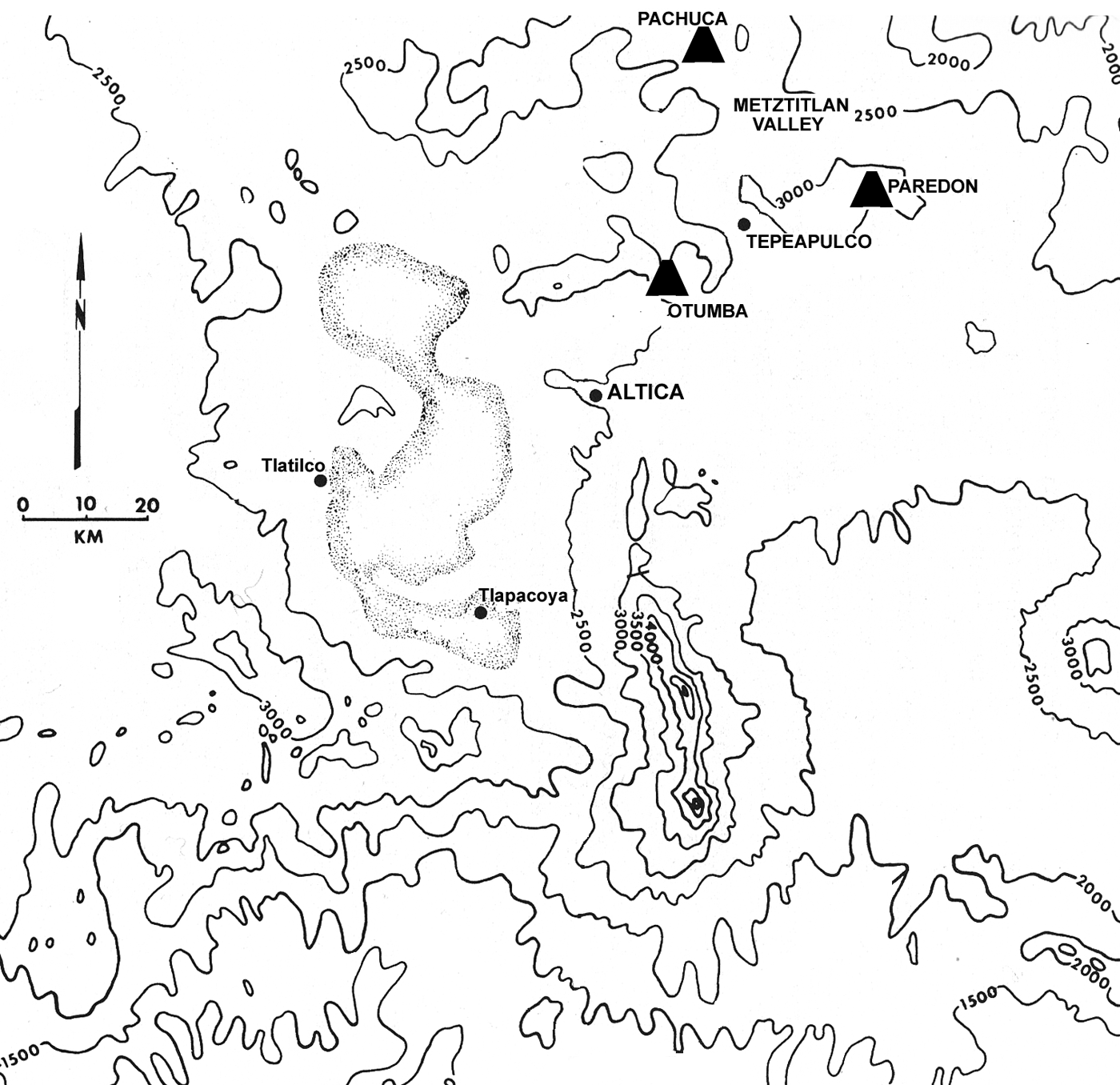
Altica is an Early–Middle Formative site located in the Teotihuacan valley in the northeast corner of the Basin of Mexico (Figure 1), discovered by Sanders (Sanders et al. Reference Sanders, West, Fletcher and Merino1975) during the Teotihuacan Valley Survey in the early 1960s, revisited by Tolstoy (Tolstoy et al. Reference Tolstoy, Fish, Boksenbaum and Vaughn1977), and later surface collected (Boksenbaum et al. Reference Boksenbaum, Tolstoy, Harbottle, Kimberlin and Neivens1987:65). Both Sanders and Tolstoy noted an unusually large quantity of surface obsidian at the site compared to contemporaneous sites in other parts of the basin, which they believed indicated that Altica had been involved in large scale obsidian artifact production for export. Altica has long been a site of considerable interest given its notably large obsidian assemblage, and was included in Boksenbaum's (Reference Boksenbaum1980; Boksenbaum et al. Reference Boksenbaum, Tolstoy, Harbottle, Kimberlin and Neivens1987) comparative study of Formative-period lithic assemblages in the Basin of Mexico.
Map of the Basin of Mexico, showing Altica and other sites and localities mentioned in the text (map from Charlton Reference Charlton and Hirth1984:Figure 2).

In the summer of 2014, Stoner and Nichols conducted controlled, systematic surface survey followed by exploratory excavation at the site (Nichols and Stoner Reference Nichols and Stoner2019). Preliminary survey results (Stoner and Nichols Reference Stoner, Nichols, Alex and Crider2015) indicated the Formative-period occupation covered approximately six hectares and indeed contained a large quantity of surface obsidian. Exploratory excavation, initially guided by surface artifact density and other characteristics, encountered a relatively thin soil layer overlying tepetate, a consolidated volcanic tuff comprising the local bedrock, and considerable destruction and disturbance of archaeological features by modern agriculture. Subsequent excavation was guided by a magnetic gradient survey conducted on site that identified numerous anomalies, many of which were revealed by excavation to be pits excavated into bedrock (Mejía Ramón et al. Reference Mejía Ramón, Barba, Ortiz and Blancas2019). In the course of both survey and excavation, numerous artifacts were recovered, including ceramics, ground stone, and flaked stone. Based on ceramics, the predominant phase of occupation at Altica pertains to the Manantial phase of the Basin of Mexico sequence (Stoner and Nichols Reference Stoner and Nichols2019).
Obsidian comprised the vast majority (approximately 96 percent) of flaked stone artifacts, with basalt comprising most of the remaining four percent. Very few chert artifacts, consisting of a single uniface and small flakes, were recovered. Obsidian recovered from survey and excavation, referred to in this paper as “the collection,” includes nearly 29,000 specimens collectively weighing over 207 kg (“specimen” refers to a single object, whether whole or not, while “individual” refers specifically to a whole object). About 30 percent of all specimens was recovered from survey and the rest from excavation.
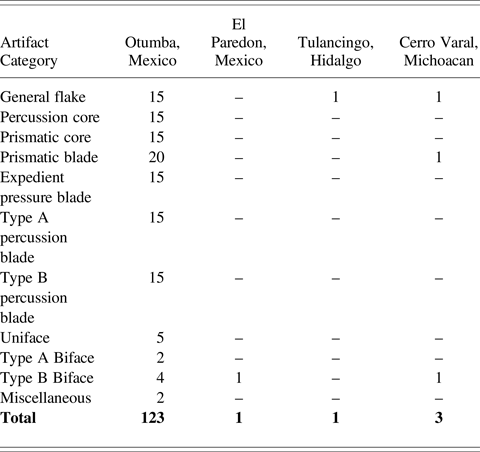
Virtually all of the collection is gray in color, and geochemical sourcing on a stratified (by category) sample of 123 specimens from the Altica Project excavations performed by the Missouri University Research Reactor facility (Table 1) identified 96 percent as from the Otumba source located approximately 17 kilometers to the northeast (Figure 1). Otumba was likewise identified as the principal source in two previous sourcing studies using neutron activation analysis (Boksenbaum et al. Reference Boksenbaum, Tolstoy, Harbottle, Kimberlin and Neivens1987) and X-ray fluorescence (Stoner et al. Reference Stoner, Nichols, Alex and Crider2015), in which it comprised 99 percent and 87.3 percent of 31 and 330 specimens, respectively. Both of these studies were based on unsystematic surface samples, and therefore may have included specimens from a later Aztec occupation at the site.
Results of sourcing by the University of Missouri Research Reactor (MURR) facility.

The collection also contains 119 green obsidian artifacts presumed to be from the Pachuca source, of which 100 were prismatic blade segments compared to only 274 out of the approximately 29,000 gray artifacts in the collection. Of 16 green prismatic blade proximal segments, nine exhibited ground platform preparation, a Postclassic horizon marker in central Mexico, while the other seven exhibited single facet platforms characteristic of the earlier periods. It thus appears that Altica's Formative-period obsidian assemblage included some Pachuca obsidian, but a large proportion at the site, perhaps the majority, is probably associated with the Late Postclassic Aztec occupation when Pachuca was the principal source utilized. It appears that the Aztec occupation did not spatially overlap with the Formative-period settlement (Stoner et al. Reference Stoner, Nichols, Alex and Crider2015:20), but a disproportionately large portion (54 percent) of green specimens in the collection was from the surface collection that covered a much larger area of the site than did the excavation.
METHODOLOGY
In 2014 and 2015, I analyzed the flaked stone assemblage recovered from the investigation, the results of which are the subject of this paper. My goal in studying the collection was to identify the various industries present and reconstruct the lithic reduction sequence or sequences, or chaîne opératoire, associated with each industry, the latter defined as a set of specific reduction activities associated with specific types of material input, byproduct, and output. Classification and analysis followed an explicitly technological approach which, because of its primary concern with how things were made and used, is as much concerned with byproducts of manufacture as it is products. Flaked stone artifact manufacture involves the reduction of durable raw material by flaking, a process whose fractal properties (Brown Reference Brown2001) result in far greater amounts of byproduct or debitage than intended product, an inequality exacerbated in manufacturing loci where finished items may be exported while debitage is left behind.
Classification and analysis involved a two-phase program of formal classification followed by attribute analysis of representative samples of each of the major categories identified during formal classification. Formal classification was itself a two-phase operation, beginning with a trial classification in the summer of 2014 of a large sample of excavated material in order to examine the nature and variability of the collection and to develop an appropriate system of classification. During the trial classification the scheme underwent constant refinement and revision as existing categories were modified and new ones added. This was not an iterative process; that is, revisions were not retroactively applied by reexamining previously examined lots since this was a trial process, and the contents of each lot sampled was reboxed in an unsorted state.
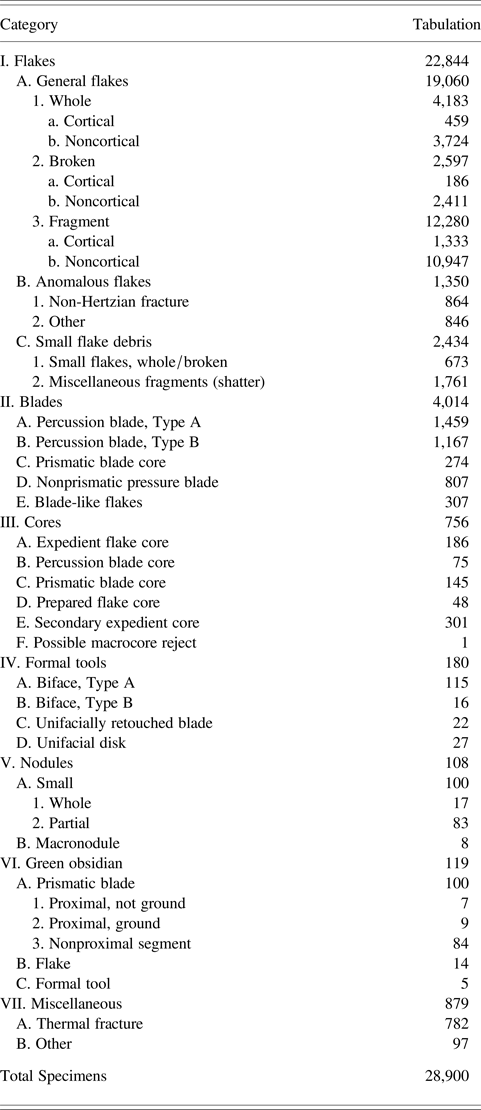
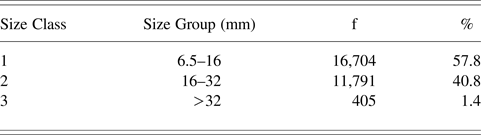
Formal classification of the entire collection was performed in the fall of 2014 using the classification scheme that was developed during the trial classification (Table 2). This included all lots from both survey and excavation, including those examined during the trial sort. Prior to classification, the contents of each excavation and survey lot were size sorted using three U.S. Standard sieves with approximate mesh sizes of 6.5 (1/4″), 16 (5/8″), and 32 (1 1/4″) millimeters, producing four possible size groups, of which the largest three are listed in Table 3. The smallest size class of the four (i.e., <6.5 mm) contained very little material, an artifact of having screened backdirt with quarter-inch screens during excavation, and this material, much of which may have resulted from post-recovery damage, was not examined or recorded. For each of the other three size classes, designated 1–3 in Table 3, the number of specimens and their collective weight were recorded for each category present.
General categories and tabulations of obsidian artifacts recovered by the Altica project.

Obsidian specimens by size group.

I performed the formal classification with the help of one assistant, using the following procedures: the contents of an individual survey or excavation lot was size sorted, after which I would examine the contents of each size class and sort them into groups corresponding to the various categories in Table 2 that were present. I would then do the same with another lot on an adjacent table while the assistant counted and weighed each pile on the table that I had previously sorted, recorded the information, and then reboxed the material. Each category was bagged and labelled separately before reboxing to facilitate retrieval for the subsequent attribute analysis.
Comparative analysis showed little difference in the inventories of the survey and excavation lithic collections. This was not surprising given the extensive modern chisel plowing that left little of the soil cover intact, as noted by Stoner and Nichols (Reference Stoner and Nichols2019). Thus, the frequencies in Table 2 are those for survey and excavation combined.
Attribute analysis of samples of the various categories was performed in the fall of 2015, with the following goals: (1) to explore the nature and range of variability within each category; (2) to obtain information needed to address specific research questions; and (3) to collect metric and nonmetric data to facilitate estimation of various population parameters. Stratified random sampling was employed to adequately sample the various areas of the site covered in both survey and excavation, and to ensure representative sampling of material in each of the three size classes. Each category included in the attribute analysis was sampled separately, that is, each involved a separate and independent sampling operation. The lots selected for each sample were retrieved by the assistant using lists generated by computer.
Examples of all artifact categories were photographed using a 35-mm reflex digital camera, including the images seen in Figures 2–11. All specimens were photographed in indirect sunlight using a polarizing filter, and in many cases were slightly inclined in order to maximize illumination of certain features. This induced some parallax distortion, but it was considered more important to highlight the features in question than provide an undistorted plan view of the object.
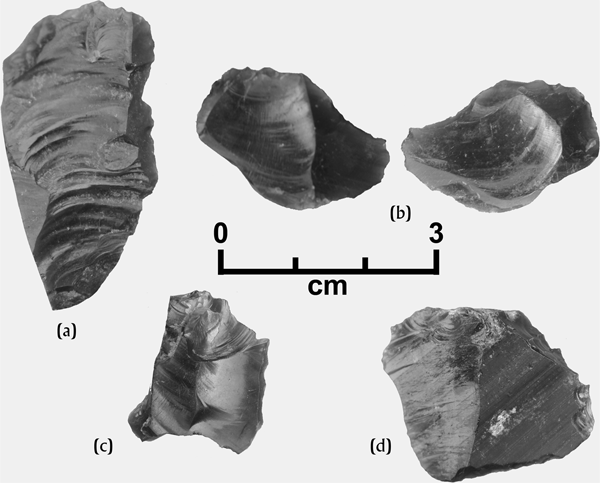
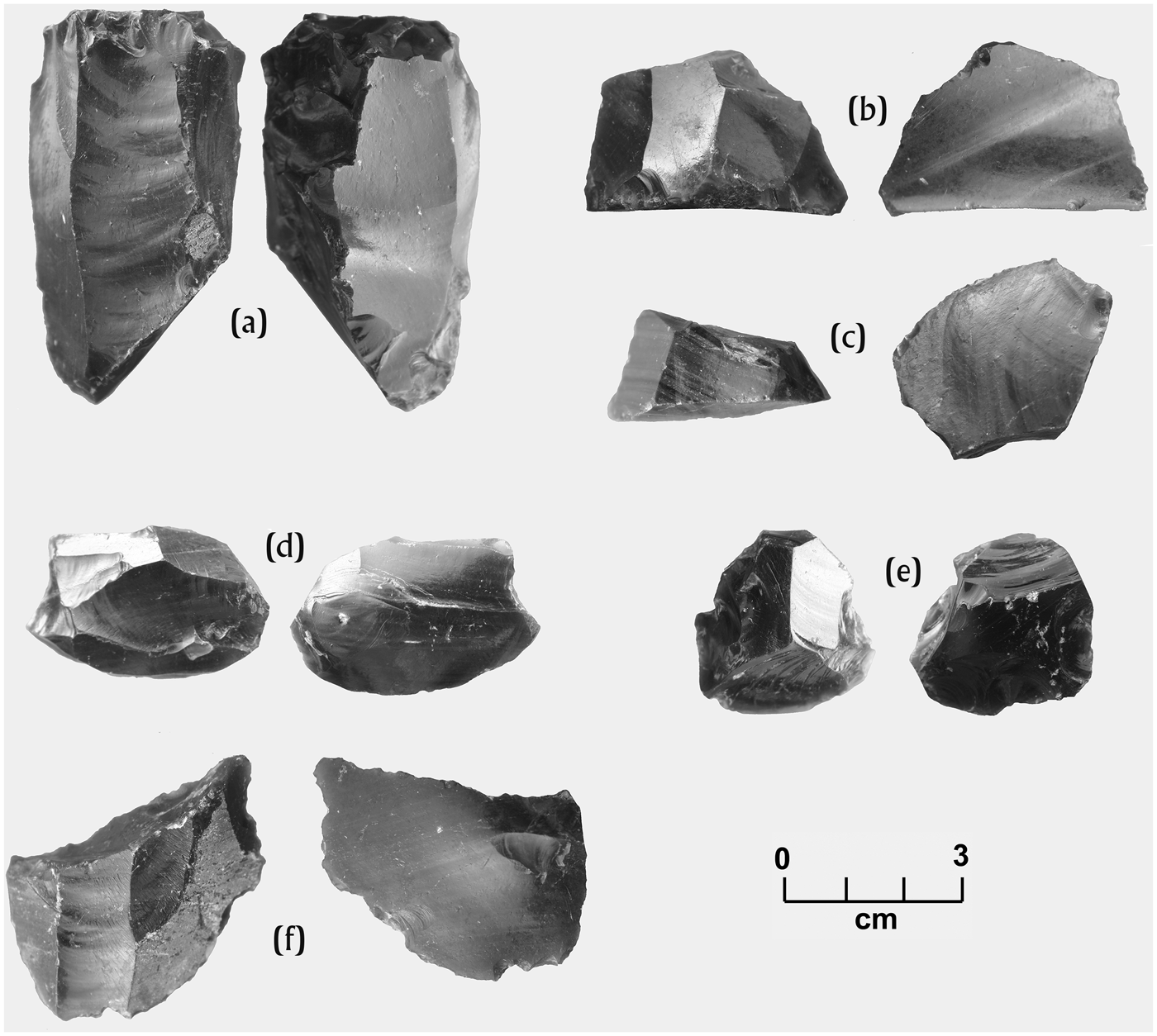
Non-Hertzian and other anomalous flakes: (a) bipolar; (b) flake with scars of two other, simultaneous removals on dorsal and ventral surfaces; and (c and d) flakes with compound ventral surfaces. Photograph by author.

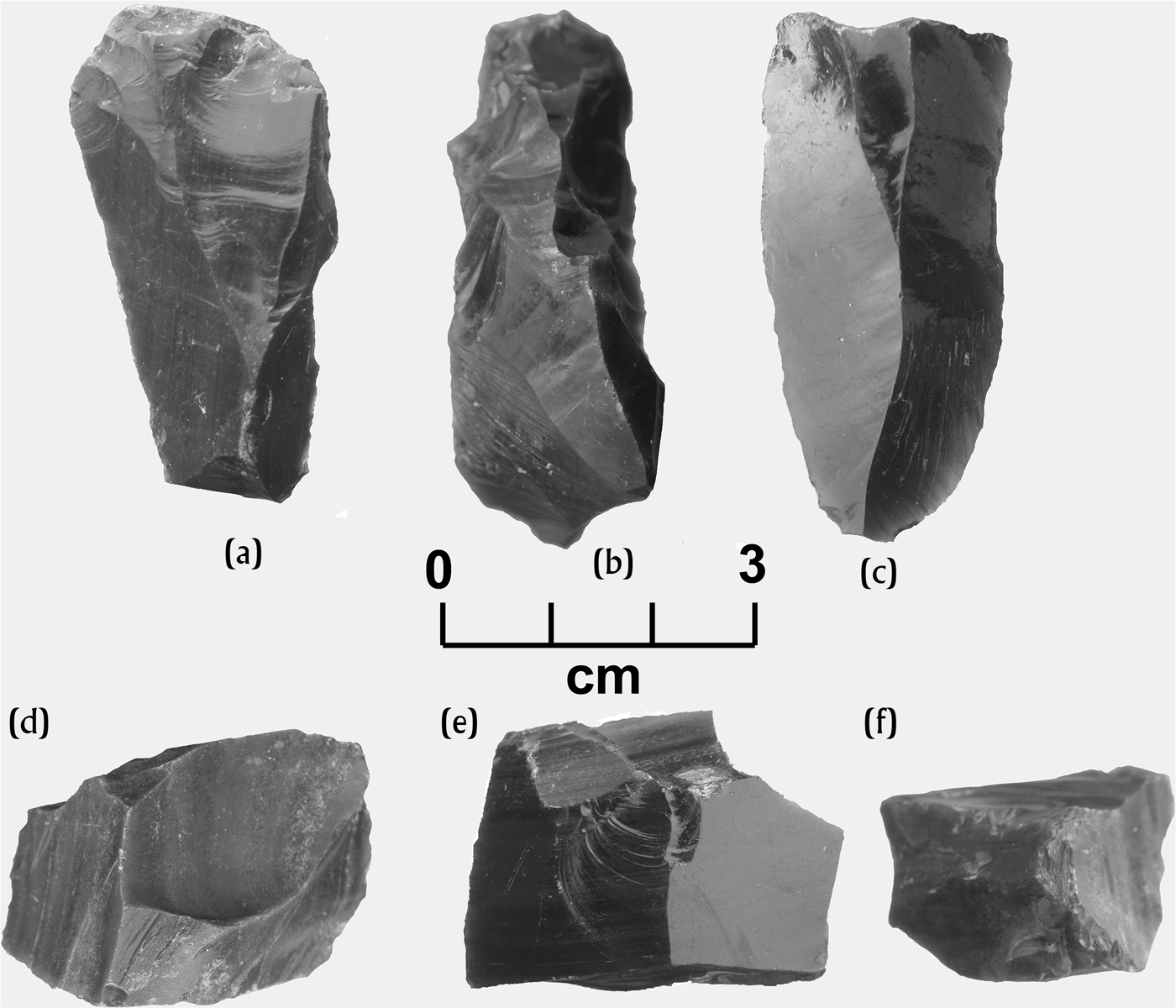
(a–c) Type A and (d–f) Type B percussion blade specimens. Photograph by author.

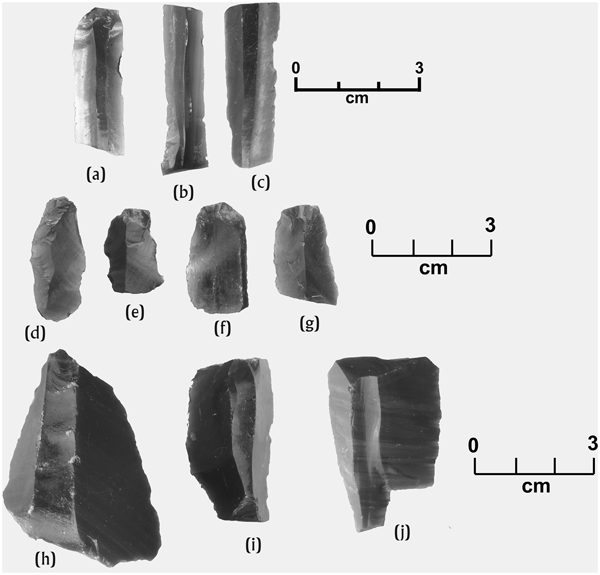
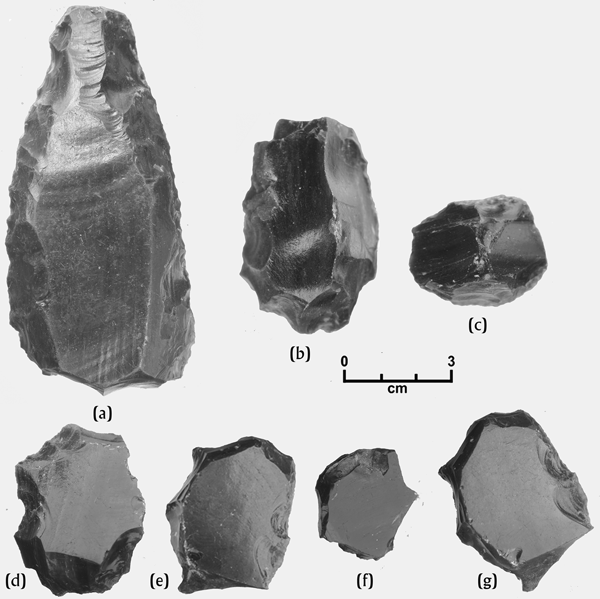
Pressure blades and expedient pressure cores: (a–c) Third-series prismatic blades. (d–g) Non-prismatic pressure blades. (h–j) Percussion blades with removal scars of possible non-prismatic pressure blades. Photograph by author.

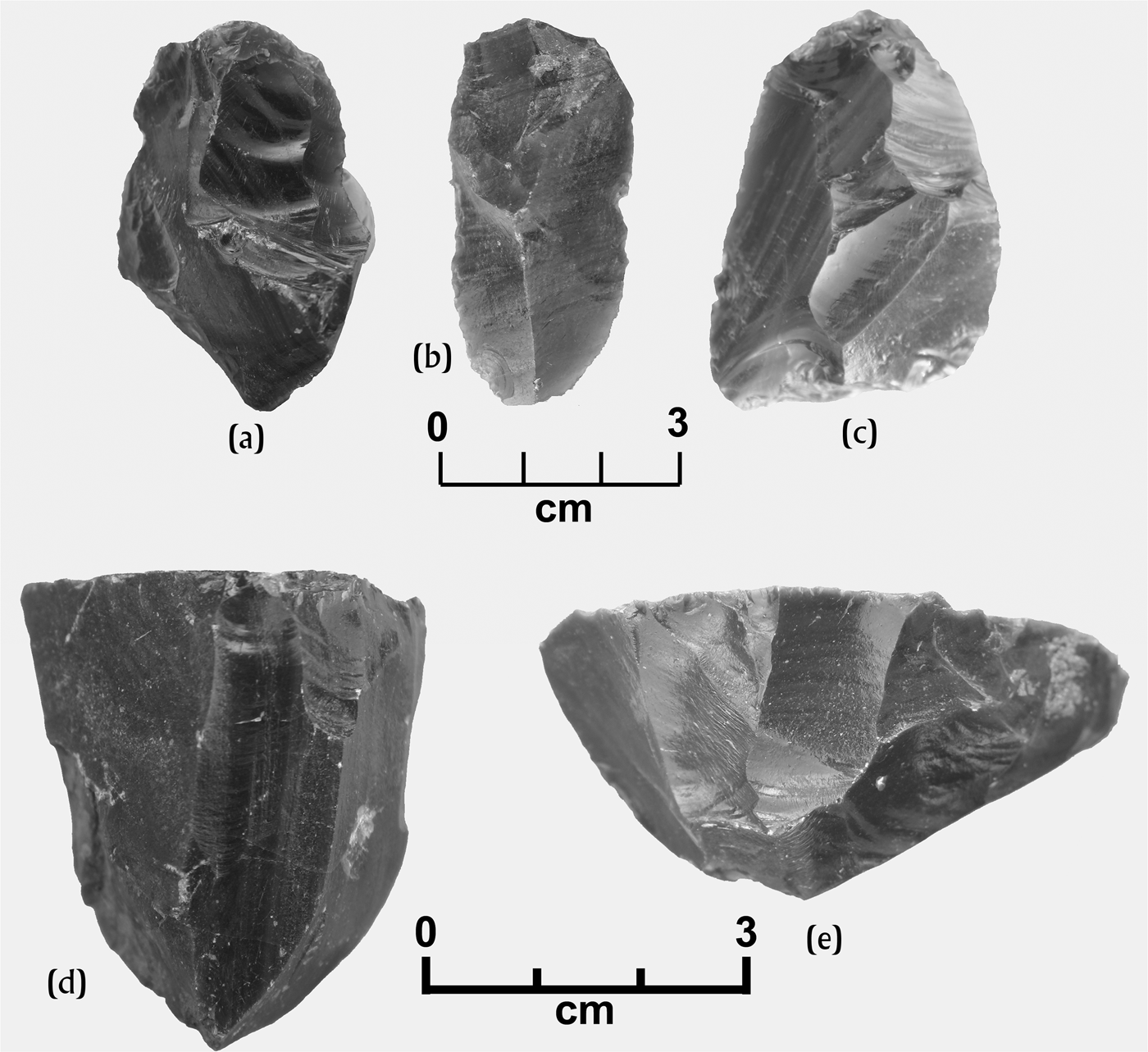
(a–c) Blade-like flakes. (d and e) Prepared flake cores. Photograph by author.

Unprepared (expedient) flake cores, front and back views. Photograph by author.

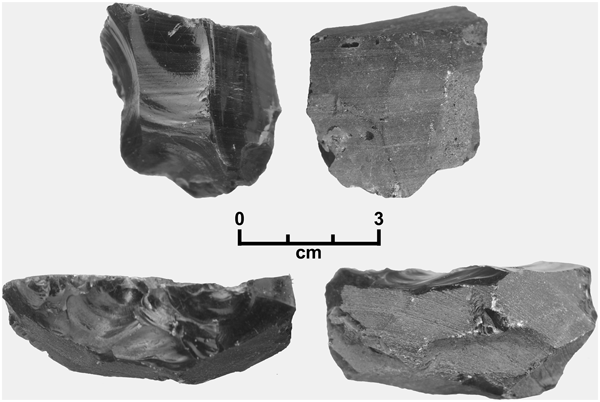
Fragmentary blade cores. (a–c) Percussion core-derived flakes, dorsal and ventral views. (d–f) Prismatic core-derived flakes, dorsal and ventral views. Photograph by author.

Unifacial objects. (a–c) Unifacially retouched percussion blade specimens. (d–g) Unifacially retouched discoids, possibly used as mirrors or jewelry. Photograph by author.

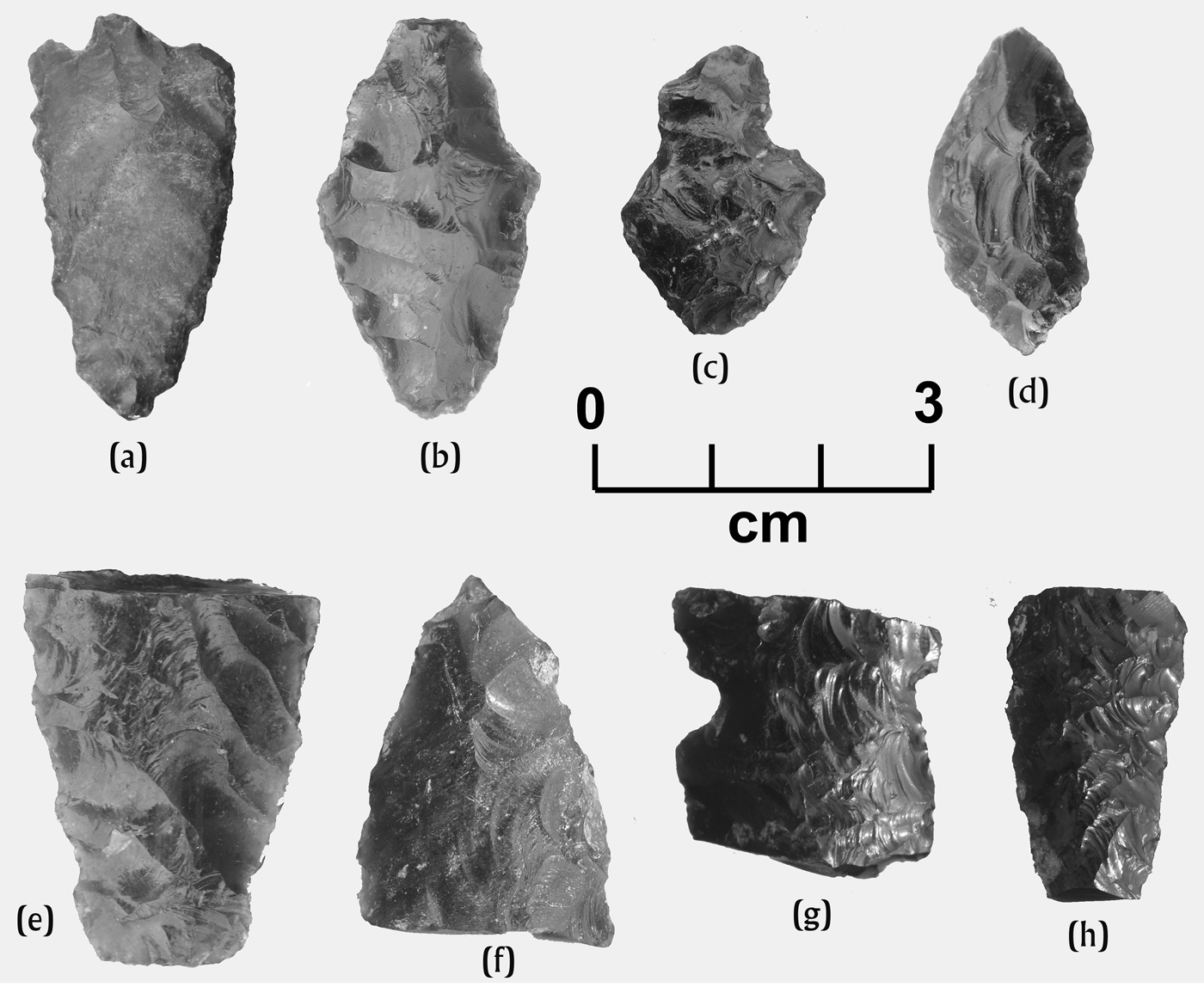
Bifacial objects. (a–d) Type A bifaces. (e–h) Type B bifaces. Photograph by author.

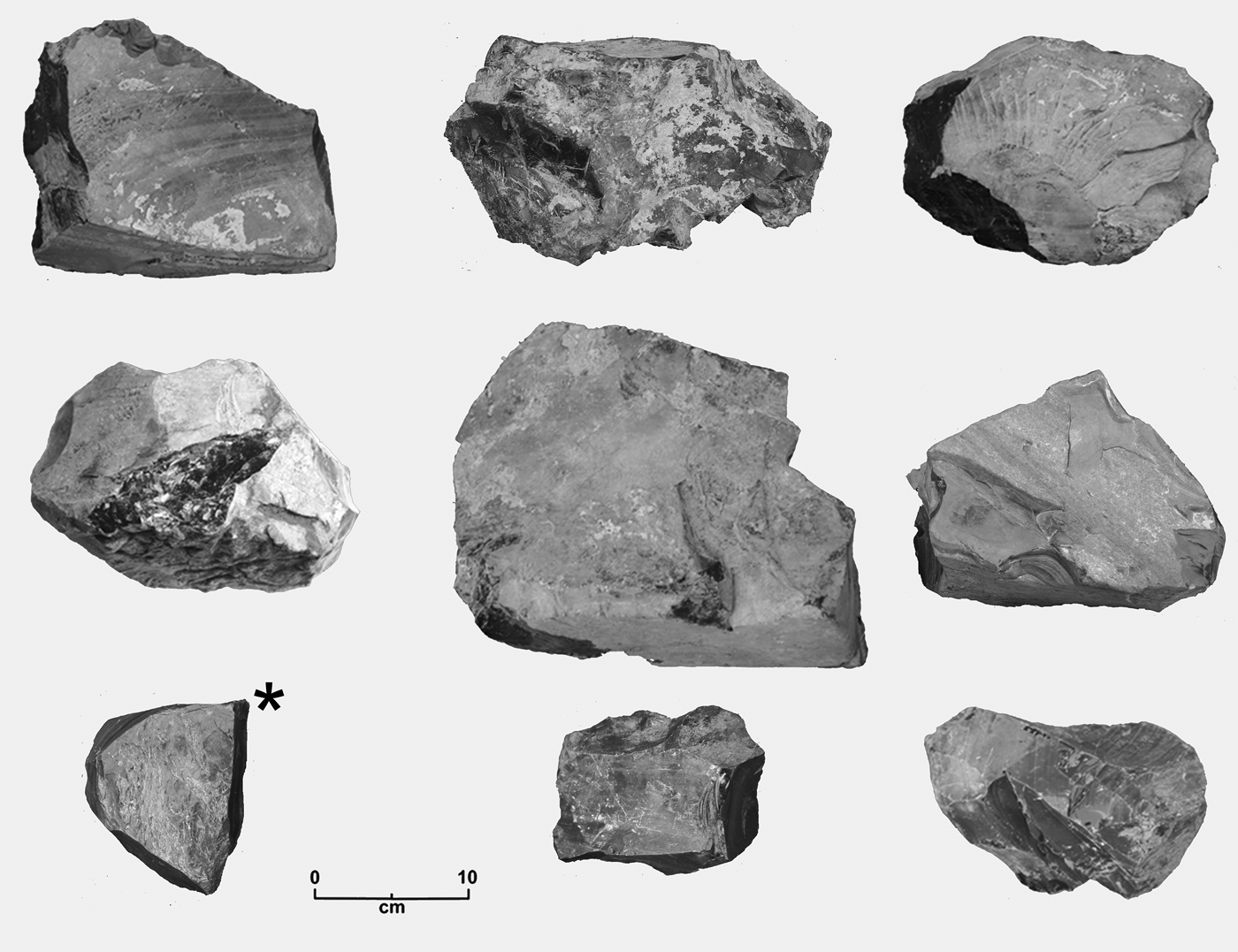
Cache of macronodules recovered from two storage pits. Asterisk indicates possible macrocore reject. Photograph by author.

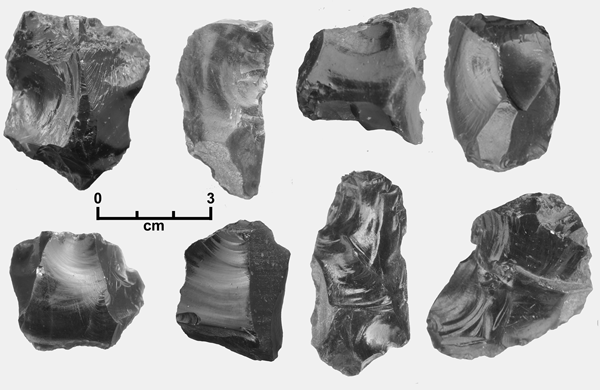
Flake and percussion blade specimens exhibiting one or more secondary flake removals, possibly secondary expedient flake cores. Photograph by author.

Results of both the formal classification and the attribute analyses were recorded as matrices using Minitab v.14 and Microsoft Excel. Tallies by general category are included in Table 2.
In October 2016, I was given the opportunity to examine obsidian collections recovered by Tolstoy (Tolstoy et al. Reference Tolstoy, Fish, Boksenbaum and Vaughn1977) and others from seven Early–Middle Formative sites in other parts of the Basin of Mexico that have been the subject of previous study (Boksenbaum Reference Boksenbaum1978, Reference Boksenbaum1980; Boksenbaum et al. Reference Boksenbaum, Tolstoy, Harbottle, Kimberlin and Neivens1987). In addition to a surface collection from Altica, these included samples recovered from excavations at Coapexco, El Arbolillo East, El Arbolillo West, Loma de Atoto, Santa Catarina, Tlapacoya, and Tlatilco (only Altica and the latter two sites are shown in Figure 1). These collections are currently housed in the Department of Anthropology, Dartmouth University. My observations on these collections, some of which are included in this paper, generally agree with those of these various authors.
RESULTS
Virtually all specimens in the collection are artifacts, that is, objects modified by humans. Very few nodules or other unworked pieces were recovered, and there appears to be a relatively low incidence of cortex, as discussed below. As seen in Table 3, 98.6 percent of the collection fell in size classes 1 and 2, and most of the specimens in class 3 were not much larger than its 32-mm minimum. This does not include two caches collectively containing eight macronodules and a possible macrocore reject, described below and seen in Figure 10, that appear to be unrelated to the rest of the collection.
Some 782 specimens exhibited one or more fracture surfaces with crazing and other non-Hertzian features consistent with thermal fracture. This phenomenon occurs across all major categories and in both survey and collection lots. Some 85 percent of these specimens are material from excavation, which might suggest they are not the product of surface fires, but extensive chisel plowing and conventional tractor plowing have negated much of the distinction between surface and subsurface material.
Flakes (Table 2, I)
By far the most prominent category, flakes comprise almost 80 percent of the collection. Most (Table 2, IA) exhibit classic features of Hertzian fracture (i.e., bulb, striations, and ripples) on the ventral surface, and generally unaligned dorsal arrises, suggesting their removal in an unsystematic fashion from unprepared cores. Such flakes are commonly associated with expedient core/flake industries typically involving the reduction of unmodified nodules to produce flakes that are customarily used in a unmodified form as informal tools. Indeed, nearly half of the specimens sampled for attribute analysis exhibited at least some edge attrition, of which nearly one-third had systematic and/or pronounced attrition suggestive of use.
During formal classification, all flake specimens were separated into whole, broken, and fragmentary categories (Sullivan and Rosen Reference Sullivan and Rosen1985) and processed separately. Likewise, cortical and noncortical specimens were processed separately. Full cortical and partial cortical specimens, commonly called primary and secondary flakes, respectively, were not separated because of the extremely low frequency, probably fewer than 20, of full cortical specimens. About 10.4 percent of all flake specimens in the collection exhibited cortex, the significance of which is addressed below. The collection also included some 1,350 anomalous flake specimens, most of which exhibit non-Hertzian fracture or other atypical features (Figure 2), but different from that of specimens with thermal fracture. Many of these features correspond to those that Boksenbaum (Reference Boksenbaum1980) attributed to “nodule smashing,” a characteristic he described for lithic assemblages from Formative sites in the Basin of Mexico that involves a number of distinctive, nonstandard forms including simultaneous multiple removals, flakes with multiple fracture surfaces, and classic bipolar cores and flakes. This method of lithic reduction, or what is more commonly called bipolar reduction, appears to have been a common method of producing flakes in other Early–Middle Formative-period sites in Mesoamerica (Clark Reference Clark, Johnson and Morrow1987; Parry Reference Parry1987). While the Altica assemblage includes a significant number of such flakes, they are not nearly as common as they apparently are in the Basin of Mexico. Moreover, it is not at all certain that it was nodules that were being reduced in this fashion at Altica.
The material in size class 1 includes approximately 2,500 unusually small whole, broken, and fragmentary flakes just large enough to have remained in the smallest mesh sieve. These specimens were examined and tallied (Table 2, IC), but are not included in the discussion of flakes that follows. Several other artifact categories are technically also flakes, but are classified as other entities based upon their derivation, as described below.
Blades (Table 2, II)
The collection contains four distinct types of blades, including the following.
Percussion Blades (Figures 3a–3f)
Although the next most common artifact category after flakes, these are far fewer in number. Two distinct types were noted, informally designated A and B. Type A specimens (Figures 3a–3c) represent “typical” removals from polyhedral percussion cores in terms of overall size (approximately 55 centimeters long on average) and parallel but somewhat irregular margins and dorsal arris or arrises. Type B specimens (Figures 3d–3f) are generally wider, thicker, and quite regular in form, and most (approximately 95 percent) are segmentary specimens, of which medial segments are the most common.
Prismatic Blades (Figures 4a–4c)
Only 274 specimens, all third-series pressure blades, were identified in the collection. The complete absence of both first- and second-series blades and debitage associated with blading error and error correction indicates these blades were almost certainly not produced on site, although all but one of 20 blades sourced were of Otumba obsidian (Table 1).
Non-prismatic Pressure Blades (Figures 4d–4g)
Like prismatic blades, these are relatively thin, narrow blade specimens that appear to have been removed by pressure, but are less regular in form and shorter than whole third-series prismatic blades in the collection. Their defining characteristic is a dorsal surface with only two facets whose flatness indicates their removal from a broader, flatter surface than a fluted prismatic core face. It must be emphasized that these are not first-series prismatic blades, the distinctive initial pressure blades removed from a polyhedral percussion core in the process of transforming it into a prismatic pressure core, that I first identified, named, and formally described in 1979 (Healan Reference Healan1979; Healan et al. Reference Healan, Kerley and Bey1983).
During attribute analysis, I noted some 37 percussion blade specimens with a ribbon-like scar along the dorsal arris that appears to represent the removal of such blades (Figures 4h–4j). Unfortunately, this feature was not systematically recognized during formal classification, hence the overall frequency of these opportunistic cores, which might be called expedient pressure blade cores, is not known. Since each such “core” would probably have only one such removal, the number of non-prismatic pressure blade specimens (807) is probably a minimum estimation of their overall number.
Blade-Like Flakes (Figures 5a–5c)
Sometimes called “flake blades,” these elongated flakes with relatively parallel sides and aligned dorsal surface features resemble percussion blades but lack their defining ≥ 2:1 ratio of length to width. Virtually all are whole specimens, almost certainly an artifact of the difficulty of distinguishing broken or fragmentary specimens from general flakes.
Cores (Table 2, III)
Five distinct types of cores were identified, each associated with one of the above flake or blade categories.
Unprepared (Expedient) Flake Cores (Figure 6)
Nodule or chunky mass of obsidian with one or more, typically unpatterned flake removals usually from various locations on the piece. Such cores would seem a likely source of the general flakes in the collection, given the generally unaligned dorsal surface features of the latter, but surprisingly few specimens (n = 144) were identified. While commonly made on nodules, virtually any flakeable mass can be a source of expedient flakes, as discussed below.
Percussion Blade Cores (Figures 7a–7c)
No whole or even partial specimens were recovered, and in fact most specimens are flakes struck from the core face or platform. As these specimens were the only concrete evidence of such cores in the collection, they were classified as cores rather than flakes (they were, however, included in the various counts of flakes that follow). Only 75 specimens were identified, and considering their highly fragmentary nature, the number of individual cores they collectively represent is probably even smaller. This category does not include the possible macrocore reject that exhibits what appears to be a failed attempt at percussion core preparation (Figure 10).
Prismatic Blade Cores (Figures 7d–7f)
Likewise, no whole or even partial specimens of these cores were recovered, and again most are flakes struck from the face or platform. Only 145 specimens were identified.
Prepared Flake Cores (Figures 5d and 5e)
Sometimes called “flake blade cores,” these are unidirectional cores with a single prepared platform, a typically conical shape, and fluted face quite similar in form to percussion blade cores but shorter in length. These are the kind of cores that would have produced the blade-like flakes described above and seen in Figures 5a–5c. All are whole or partial specimens, suggesting that blade-like flakes were produced on site, although the flake-to-core ratio is rather low (6.4:1). This may, however, be an artifact of the difficulty of distinguishing non-whole specimens from broken or fragmentary flakes.
Formal Tools (Table 2, IV)
Unifaces
Some 49 unifacial tool specimens were identified, consisting of two types. Twenty-two specimens (Figures 8a–8c) were whole or segmentary percussion blades with unifacial retouch at one end (i.e., “endscrapers”), and/or along a margin. Their small number is surprising given the number of percussion blades in the collection. Particularly notable is the near absence of the distinctive thick, planoconvex endscraper with high angle unifacial flaking that Parsons and Darling (Reference Parsons and Andrew Darling2000:87) suggested were used for maguey sap (aguamiel or pulque) extraction, a major tribute item during Aztec times. In fact, the one good example of this tool in the collection is of green obsidian, and hence probably dates to the Aztec period occupation.
The other 27 uniface specimens were discoidal objects with unifacial and in some cases bifacial retouch to shape and thin the blank, some of which were clearly Type B percussion blade segments. Thirteen of these discoidal objects (Figures 8d–8g) had an unmodified ventral surface whose flatness or slight concavity and high luster suggest they could have been used as jewelry or small mirrors. Similar objects have been reported from undated workshops located around obsidian outcrops in Jalisco (Clark and Weigand Reference Clark, Weigand, Mirambell and Arratia2009).
Bifaces
Some 131 bifaces were identified, comprising two distinct types informally designated A and B. Most Type A specimens (Figures 9a–9d) are stemmed triangular points of relatively unsophisticated workmanship given their characteristically thick, asymmetrical form and irregular flaking. Type B bifaces (Figures 9e–9h) are thin, symmetrical specimens of varying form exhibiting extremely regular pressure retouch typical of fine, well-finished bifaces. Some Type A specimens appear unfinished, and during attribute analysis some percussion blade specimens were found with bifacial retouch suggestive of Type A bifaces in the initial stages of manufacture. Type A bifaces thus appear to have been made on site, while many if not all Type B bifaces may have been imported. In fact, two of four Type B specimens that were sourced were not Otumba obsidian (Table 1).
Macronodules and Possible Macrocore
A particularly unusual component of the collection are eight macronodules (Figure 10) recovered from two pits in bedrock located approximately six meters apart in an extensive excavation near the site center (Nichols and Stoner Reference Nichols and Stoner2019: Figure 3). The specimens weigh between 1.4 and 9.6 kilograms each and include both blocky pieces and somewhat rounded forms. All but one had been flaked, some extensively, and several exhibit inclusions and/or abnormal flake terminations that would compromise their utility. A ninth specimen, smaller than the others, appears to be a percussion macrocore blank that was rejected after an unsuccessful attempt at platform preparation.
DISCUSSION
Although it includes representatives of a number of lithic industries, the vast majority of obsidian specimens in the collection appear to be derived from expedient core/flake reduction involving the generally unsystematic removal of flakes from unprepared cores, presumably for use as informal tools. Three decades ago, Parry and Kelly (Reference Parry, Kelly, Johnson and Morrow1987:302–303) proposed that the shift from a mobile to sedentary lifeway was accompanied by “a shift from lithic industries dominated by formal core reduction (chiefly bifacial tool manufacture), to a greater use of unretouched expedient flake tools struck from unstandardized cores.” This premise has been met with some criticism, particularly in terms of whether it is universally applicable (Railey Reference Railey2010), but a dependence upon expedient core/flake reduction appears to be a characteristic of early sedentism throughout Mesoamerica (Clark Reference Clark1981; Parry and Kelly Reference Parry, Kelly, Johnson and Morrow1987:293).
Altica's near exclusive reliance upon expedient core/flake artifacts is therefore a characteristic shared with other early Mesoamerican villages, including seven other sites in the Basin of Mexico, that were part of a larger study that included Altica (Boksenbaum Reference Boksenbaum1980; Boksenbaum et al. Reference Boksenbaum, Tolstoy, Harbottle, Kimberlin and Neivens1987; Tolstoy et al. Reference Tolstoy, Fish, Boksenbaum and Vaughn1977). One notable difference between Altica's expedient core/flake industry and that of the other Basin of Mexico sites was the relatively low occurrence at Altica of flakes indicative of what Boksenbaum (Reference Boksenbaum1980) called “nodule smashing” or bipolar reduction, which he says was the predominant source of flakes for the Basin of Mexico sites. By contrast, the vast majority of flakes in the Altica Project obsidian collection exhibit standard Hertzian fracture features commonly associated with the use of handheld direct percussion. Although expedient core/flake reduction can involve the use of either bipolar or handheld percussion, they are quite distinct technologies and should not be confused.
With some exceptions, most of the other lithic industries represented in the collection do not appear to have been local, i.e., based on site. This is almost certainly the case for prismatic core/blade, but even the percussion core/blade industry lacks diagnostic preparation and production debitage and includes even fewer, highly fragmentary core specimens. At least one core/blade industry, namely blade-like flakes and associated prepared flake cores, may have been a local industry given the presence of both cores and flakes in relative frequencies that may approximate an expected core-to-flake ratio. But if neither prismatic nor percussion blades were produced on site, then why does the collection contain specimens of cores as well as blades?
Two of four Type B bifaces included in the sourcing study were not Otumba obsidian (Table 1), and given their small number and distinctive quality of workmanship it seems likely that most such specimens, even those of Otumba obsidian, were not made on site. Type A bifaces, on the other hand, do appear to have been made on site given the presence of percussion blades exhibiting early stages of bifacial thinning and shaping. Their less sophisticated workmanship compared to that of Type B bifaces is striking, but similar bifaces are common in Formative period and later assemblages in Western Mesoamerica (Healan Reference Healan2010) and are probably more appropriately described as “expedient.” Unifaces, mostly endscrapers on blades, were also probably manufactured locally, although there are rather few in the collection.
That nearly four percent of the 128 specimens in Table 1 were not sourced as Otumba obsidian indicates that Altica was engaged to some extent in long- distance exchange that included obsidian prismatic blades and Type B bifaces. Not surprisingly, this included specimens from the nearby Tulancingo and El Paredón sources, but three of the five nonlocal specimens were identified as obsidian from Cerro Varal, Michoacan.
Altica's expedient core/flake assemblage exhibits two rather problematic features, including an apparent underrepresentation of cortex. Aside from the two previously mentioned caches containing eight macronodules, nodules are limited to 17 whole and 83 partial specimens of small, rounded cobbles, most of which if whole would measure three centimeters or less in diameter. Only about 10.4 percent of the flake specimens in the collection exhibit any cortex, but this may or may not be significant depending upon a number of factors. Following the suggestion by Dibble et al. (Reference Dibble, Schurman, Iovita and McLaughlin2005) that estimating cortical area is a more accurate measure of its prevalence than the ratio of cortical to noncortical flakes, I estimated cortical area for all flake specimens in the collection in the following manner: during attribute analysis of samples of the various flake categories in Table 2, I estimated the surface area of each specimen and then calculated mean area by size class for each category sampled. Applying these sample means to all specimens in the collection by category and size class produced an estimated total surface area for all flake specimens in the collection of 12,482,010 mm2. At the same time, I estimated the proportion of flake area that was cortical for each cortical specimen, which was then multiplied by surface area to obtain a measure of cortical area. Mean cortical area was then computed by size class for each category sampled and applied to all cortical specimens by category and size class in the collection. This yielded an estimated total cortical surface area for all flakes in the collection of 574,714 mm2. Estimated cortical area thus comprises less than five percent of estimated total flake surface area, seemingly a very small value.
In order to place these calculations in a more meaningful perspective, I utilized data provided by Dibble et al. (Reference Dibble, Schurman, Iovita and McLaughlin2005:Table 12) that included surface area (i.e., cortical area) and weight for a sample of 34 nodules, for which there was a high correlation (r = .919, p < .001) after specimen number 12, an outlier, was removed. Obviously, the relationship between cortical area of a nodule and its weight remains constant regardless of how much it is reduced, as long as all flakes and remnant core are considered. Using these data, I performed least-squares linear regression to predict total cortical area for the combined weight of the flake and expedient flake core specimens in the collection, which yielded a predicted value of approximately 1,953,050 mm2, well over three times the estimated cortical area in the collection. That is, estimated total cortical area was less than a third of what was expected, assuming that all flakes and expedient cores in the collection come from the reduction of nodules similar in size and shape to those in the Dibble et al. (Reference Dibble, Schurman, Iovita and McLaughlin2005) sample.
These are at best crude extremely crude calculations susceptible to sampling error and based on questionable assumptions. There are obvious problems with assuming that combined flake and core weight in the collection would equal the combined weight of the hypothetical nodules that produced them, but most violations of this assumption would involve missing flakes that would much more likely be tertiary (noncortical) flakes by their sheer number, thus making number of cortical flakes disproportionately larger than it should be and the above estimated cortical area for the flakes in the collection an overestimation. The assumption that these hypothetical Altica nodules would have been comparable in size and shape to those in the Dibble et al. (Reference Dibble, Schurman, Iovita and McLaughlin2005) sample is addressed below.
Even allowing for a considerable margin of error, the magnitude of difference between observed and expected values suggests that the amount of cortex among flakes in the collection is too low to have been the product of nodular reduction for more than a small portion. The apparent underrepresentation of cortex and the relatively small size of specimens in the overall collection are consistent with material generally derived from later rather than earlier stages of lithic reduction.
The other problem pertains to what might be called “missing cores,” which emerged after I estimated the number of individual flakes collectively represented by the whole, broken, and fragmentary specimens in the collection, which equaled approximately 17,600 individuals (estimated number of individuals was calculated by category and size class as the number of whole and broken specimens, plus sum of fragment weight divided by average whole flake weight). Considering that only 144 expedient core specimens were identified, the resulting flake-to-core ratio (roughly 122:1) is well beyond the normal yield of expedient flake cores, which by their nature typically involve relatively few removals (the 33 specimens sampled for attribute analysis averaged approximately 3.5 removals per core). Thus, it appears that a huge number of expedient cores are missing, misidentified, or otherwise unaccounted for.
Evidence of other expedient cores in the collection came to light during the formal classification, when I noticed that many large flakes and percussion blade specimens exhibited secondary flaking (i.e., flake removals that postdate removal of the flake or blade itself; Figure 11). Some secondary flaking, as noted above, was identified as intentional unifacial or bifacial retouch, but most instances involved unsystematic removal of one or two relatively large flakes (mean scar width = 24.6 mm, n = 115). These were classified as possible secondary expedient flake cores, that is, percussion blades and large flakes recycled as expedient cores, of which 301 specimens were identified (Table 2, IIIE).
Evidence of other secondary expedient flake cores appeared during attribute analysis when examination of 752 Type A and Type B percussion blade specimens revealed that 152 exhibited one or more secondary flake removals, hence should have been classified as secondary core specimens during the formal classification. Many of these specimens exhibited scars between 20 and 30 mm in width, and a disproportionately large number (79 percent) were Type B blade specimens. If these 152 specimens are a representative sample, there may be an estimated 500 other percussion blades in the collection that escaped detection, having been used as secondary cores.
Still more evidence emerged when attribute analysis of 36 percussion core and 80 prismatic core specimens confirmed their largely fragmentary nature (Figure 7). For both kinds of cores, most specimens (74 and 81 percent, respectively) were flakes removed from the face or other surface of a whole or broken core, while the remainder included a few core face slabs, medial segments, and amorphous core fragments. It thus appears that percussion and prismatic blade cores were likewise recycled as expedient flake cores and, given the lack of evidence for local blade production, raises the intriguing prospect that they were imported specifically as flake stock.
Finally, examination of 33 of the 144 expedient core specimens themselves revealed that, of 23 specimens whose parent stock could be identified, only 10 were made on nodules, while 10 of the remainder were made on large flakes or percussion blades and the other three were made on percussion blade cores. Thus, perhaps half of even what were identified as “classic” expedient flake cores on nodules were in fact secondary cores made on flakes, blades, and blade cores.
The use of blades, flakes, and blade cores as secondary cores agrees with the generally small size of material and the apparent low incidence of cortex in the collection and suggests that much, perhaps most, of Altica's expedient core/flake industry was based on reduction of recycled artifact material. This may also explain the low incidence of bipolar reduction, given the apparent desire to obtain large, conchoidal flakes from this recycled material. Curiously, prepared flake cores (Figures 5d and 5e) do not appear to have been among the material recycled as expedient flake cores.
Systematic use of secondary cores would thus account for a portion of the “missing” cores implied by the excessively high ratios of flakes to expedient cores noted above. Estimations of the total number of removal scars on percussion blades and flakes in the collection together with the estimated flake yield from reducing the prismatic and percussion cores present (even assuming that each core flake was from a different core), however, account for only a small percentage of the estimated 17,600 individual flakes in the collection. Like the preceding estimations of cortical area, these are at best extremely crude calculations, but even allowing for a considerable margin of error, the sheer magnitude of difference indicates there are more flakes than can be accounted for by all potential cores in the collection. This could be sampling error, i.e., flakes and cores are probably not evenly distributed across the site, but another possible explanation is considered in the section “Raw Material” Acquistion.
While it would seem intuitively obvious that the two caches of macronodules are clear evidence that, contrary to the preceding paragraph, nodules were indeed the primary raw material input for Altica's expedient flake/core industry, in fact these nine specimens appear to have little to do with the rest of the collection. They collectively equal almost 20 percent of the total mass (weight) of the rest of the collection, hence all of the other artifacts in the collection could be derived from reduction of only about 45 such specimens. Clearly macronodules like these were either a rare occurrence or were not brought in for reduction on site, since doing so would have drastically altered the generally small specimen size and low incidence of flake cortex characteristic of the rest of the collection. Moreover, basing the preceding regression analysis on measurements of weight and surface area for these nine specimens (r = .989, p < .001) did not significantly lower estimated cortical surface area from what was obtained based on the nodules provided by Dibble et al. (Reference Dibble, Schurman, Iovita and McLaughlin2005), although calculation of surface area for these specimens was problematic.
“Raw Material” Acquisition
Evidence that Altica's expedient core/flake industry was based at least in part on recycled artifacts that must have been imported from elsewhere raises the obvious question of where these artifacts were obtained from. Since sourcing studies conducted to date indicate that the vast majority of Altica's obsidian came from Otumba, a logical answer would be sites located somewhere else near the source. Informal survey at the Otumba source itself (Charlton Reference Charlton1978; Charlton and Spence Reference Charlton and Spence1982; Clark Reference Clark1979; Nieto Calleja and López Aguilar Reference Nieto Calleja, Aguilar and de los Delores Soto de Arechavaleta1990) encountered both mines and quarries and evidence of nearby workshops, but much of this appears to be Aztec in date that may have covered most evidence of earlier exploitation. My own investigations in the Ucareo-Zinapécuaro, Michoacan obsidian source area (Healan Reference Healan1997) found that workshops located around extraction sites, or what might be called primary workshops for the present discussion, mostly performed initial processing that would not have produced the more refined (in terms of reduction) material imported by Altica. The latter material was likely produced in what might be called secondary workshops, which would have imported initially processed obsidian from primary workshops and produced finished items such as cores, blades, and formal tools, in addition to production waste including flakes, rejects, and spent cores. Such workshops presumably lay somewhere else in the area in proximity to both primary workshops and Altica, although proximity to primary workshops, hence the Otumba source, would probably have been important.
Altica is one of about nine sites with evidence of Early–Middle Formative occupation that were identified in the Teotihuacan Valley Project survey, one of which (TF-17), located approximately four kilometers northeast of Altica, was estimated to be about the same size as Altica and was reported to have “abundant” obsidian artifacts (Sanders et al. Reference Sanders, West, Fletcher and Merino1975:150). Unfortunately, no other information is available that could help determine if this may have been a secondary workshop site. Besides Altica and TF-17, four other Formative-period sites were described as having large amounts of surface obsidian, but all of these were dated to the Late/Terminal Formative period and again lack sufficient information to determine if they may have been secondary workshop sites.
Though somewhat later in time, other potential evidence of such workshops in the region include Charlton's (Reference Charlton1978) identification of numerous surface concentrations of obsidian debitage believed to represent secondary or what he called “factory” workshops at Tepeapulco, a Teotihuacan-period regional center situated approximately 33 kilometers east of Teotihuacan, 30 kilometers northeast of Altica, and roughly equidistant to the Otumba, Pachuca, and El Paredón obsidian sources (Figure 1). Associated ceramics spanning the Terminal Formative Tezoyuca/Patlachique phases through the Middle/Late Classic Metepec phase periods was interpreted as evidence of direct Teotihuacan control (Charlton Reference Charlton1978:1232–1234). Similar surface concentrations were encountered in the Metztitlan valley immediately to the north. Based on these data, Charlton formulated a model in which initially processed obsidian from primary workshops at each of the three obsidian sources was transported to the Tepeapulco and Metztitlan secondary workshops and processed into finished items, which subsequently entered formal trade networks under the control of Teotihuacan. Charlton's model views obsidian production as a decentralized process in which the bulk of state-controlled obsidian workshops were situated outside Teotihuacan rather than within the city so that, to paraphrase Charlton, the only aspect of this production that would have entered the city was the profits, in whatever form they may have been.
In a later paper, Charlton (Reference Charlton and Hirth1984) suggested that similar workshops had existed in the area during earlier time periods given the presence of obsidian from these three sources at Early–Middle Formative sites in other parts of Mesoamerica. He in fact proposed models for Early and Middle Formative obsidian exchange that featured the existence of secondary workshops in the Tepeapulco area that produced blades, cores, and formal tools that were transported to sites in the Basin of Mexico, including Tlapacoya and Tlatilco (Figure 1) that he believed functioned as gateway communities where these and other goods entered relatively informal exchange systems probably based on trade partnerships. Given the restrictions imposed by the mountainous terrain, Charlton was able, with the help of colonial documents, to identify several likely routes from the Tepeapulco region into the Basin of Mexico along which obsidian from secondary workshops was likely to pass. One of these he noted would have passed through Altica, where he suggested obsidian loads were lightened before traversing hazardous terrain, leaving behind “less essential and less usable fragments of obsidian,” perhaps a reference to the abundant expedient core/flake material he apparently mistook as waste (Charlton Reference Charlton and Hirth1984:24). Although subsequent investigations have confirmed the existence of specialized obsidian production sites at Tepeapulco during the Late Aztec period (Parry Reference Parry2001), no additional light has been shed upon the Teotihuacan-associated and possibly earlier production sites previously identified by Charlton.
CONCLUSIONS
A reexamination of the northern part of the Basin of Mexico between the sources and the population concentrations may yield evidence of specialized industries located outside residential areas. I would expect to find within a community only traces of those obsidian production activities related to tools produced for that community. (Charlton Reference Charlton and Hirth1984:34)
The identification of Otumba obsidian in Early–Middle Formative contexts in Morelos, Oaxaca, Guerrero, and the Gulf Coast in the form of prismatic blades, flakes, formal tools, and nodules bespeaks its importance in interregional exchange networks (Cobean Reference Cobean2002:55; Ebert et al. Reference Ebert, Dennison, Hirth, McClure and Kennett2014; Hirth et al. Reference Hirth, Cyphers, Cobean, De Leon and Glascock2013). Given its proximity to the Otumba source and the large quantity of obsidian on the site surface, it is not surprising that some authors believe Altica played a major role in both the production and the exchange of processed obsidian, describing the site as “a factory workshop ” (Charlton Reference Charlton and Hirth1984:31) and “a community engaged in producing preforms for exchange” (Tolstoy et al. Reference Tolstoy, Fish, Boksenbaum and Vaughn1977:202). As detailed in this paper, however, the vast majority of Altica's obsidian consists of unmodified flakes whose patterned and unpatterned-but-heavy edge attrition observed in a large sample suggests their common use as informal tools, consistent with the low frequency of formal tools in the collection. The only formal tools that appear with near certainty to have been produced on site are Type A bifaces made on percussion blade blanks, which as projectiles would obviously have performed functions that simple flakes could not. Blade-like flakes and prepared flake cores approximate a flake-to-blade ratio that suggests local production of the blade-like flakes. Moreover, unlike percussion and prismatic blade cores, prepared flake cores do not appear to have been recycled as secondary expedient flake cores, further suggesting their use on site for what they were made for, i.e., producing blade-like flakes. Unifacially retouched discoids that may represent mirrors or jewelry (Figures 8d–8g) are intriguing but few in number, and their consistently fragmentary and/or unfinished state suggests they were unfinished rejects from workshops located elsewhere.
Despite its proximity to the Otumba source, the bulk of the material Altica acquired for expedient flake production was not raw or initially processed obsidian but rather finished items and manufacturing byproducts presumably obtained from secondary workshops located elsewhere in the region. It appears that Altica acquired both products and byproducts from secondary workshops, much of which immediately or eventually wound up as secondary cores. Thus, percussion blades were acquired for use as unmodified blades or blanks for unifaces and bifaces and many later recycled as secondary cores, while byproducts such as spent cores and probably flakes were used or immediately recycled. The likelihood that Altica-imported flakes as well as other workshop byproducts may account for the persistently high flake-to-expedient core ratio that was interpreted in the preceding sections as missing cores. The large quantity of obsidian at Altica compared to its contemporaries in the Basin of Mexico may simply be a function of its proximity and access not to the Otumba source itself but to secondary workshops likewise located in the general area of the source. The greater quantity of obsidian at Altica compared to sites in the Basin of Mexico may be a result of its more direct accessibility to these workshops and perhaps the greater skill of Altica's inhabitants that allowed them to make efficient use of available and probably abundant workshop waste products. For example, the numerous non-prismatic pressure blades in the collection, which outnumber third-series prismatic blades nearly 4:1, may be a response to the need for such blades and reflect the ability to circumvent restricted access to third-series prismatic blades by fabricating facsimiles from available stock.
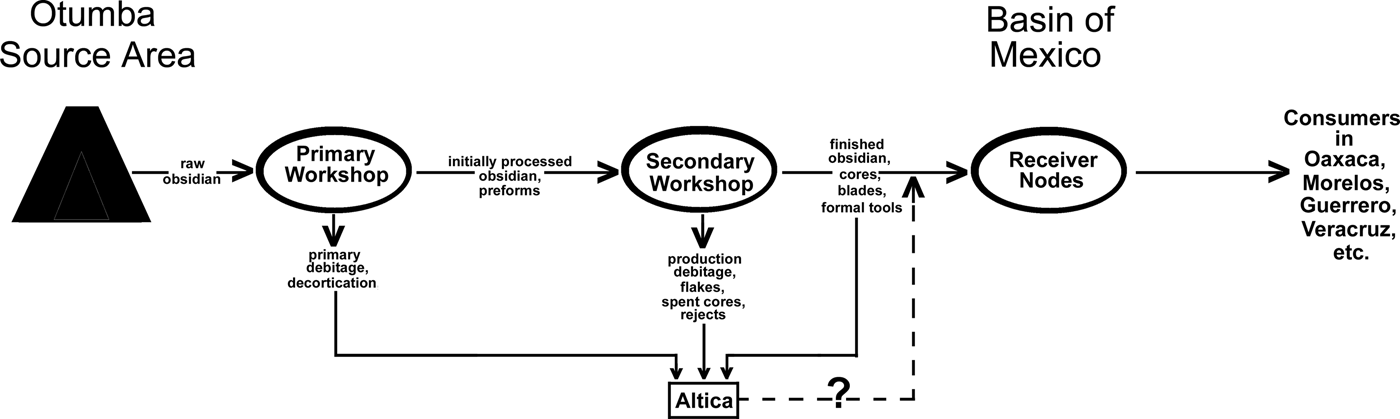
Figure 12 is a schematic representation of Altica's proposed role in the system or systems of Early–Middle Formative obsidian acquisition, production, and exchange based on what has been presented in this paper. Only material input from the Otumba source is considered, although Table 1 suggests that a small but significant proportion of Altica's obsidian was obtained from other sources, including Cerro Varal, Michoacan located some 320 km to the west. Another West Mexican source, Ucareo-Zinapécuaro, Michoacan, was identified as a major source of obsidian in a sample of 589 artifacts from excavations at the six Early–Middle Formative sites in the Basin of Mexico reported by Boksenbaum et al. (Reference Boksenbaum, Tolstoy, Harbottle, Kimberlin and Neivens1987). These authors suggest that one of these sites (Coapexco) served as a “middleman” in acquiring obsidian from various sources and distributing it to other communities, perhaps including Altica.
Schematic diagram of Altica's possible role in Early–Middle Formative obsidian acquisition, production, and exchange systems. Image by author.

In Figure 12, two of the three incoming arrows linking Altica to this system represent the movement of products and byproducts from secondary workshops to Altica under the scenarios presented in the preceding paragraphs. The primary workshops indicated in Figure 12 were presumably located adjacent to or very near extraction sites at the Otumba source. The third incoming arrow links Altica directly to primary workshops, which pertains specifically to the two caches of macronodules and macrocore reject recovered in excavation (Figure 10). That these specimens do not represent the type of material that was reduced on site suggests another activity involving obsidian unrelated to that represented by the rest of the collection. Obsidian nodules are a known item of Formative-period obsidian exchange, including nodules of Otumba obsidian that have been identified at other sites including San Lorenzo, Veracruz (Hirth et al. Reference Hirth, Cyphers, Cobean, De Leon and Glascock2013:2792; Kenneth Hirth, personal communication 2017), suggesting that these macronodules represent material temporarily stockpiled for export. This raises the prospect that Altica was in fact an active participant in the Early–Middle Formative obsidian acquisition, production, and exchange system proposed by others, specifically exchange involving nodules that were temporarily stored at the site on their way to the Basin of Mexico. This is, in fact, what Charlton essentially suggested some 44 years before the discovery of these two caches, when he noted that Altica's strategic location at the juncture of good and bad terrain that would make stockpiling of nodules there prior to moving them to receiver nodes a reasonable and appropriate strategy.
This possible role in long-distance trade involving obsidian nodules is indicated in Figure 12 by the outgoing dashed line and arrow that links Altica directly to the larger production, transport, and exchange system. That the line is dashed and bears a question mark reflects the considerable uncertainty on my part that stockpiling of nodules was a regular activity at Altica. On the one hand, the pits containing the caches are only two of 13 such pits in an area of about 60 m2 exposed by excavation after magnetometry survey of the entire site revealed a particularly significant magnetic anomaly in that locality. The logical possibility that these other pits were also used for storage of nodules would suggest that Altica was indeed a transshipment center for nodules between the Otumba source and the Basin of Mexico, and thus did play a major role in production and exchange systems involving Otumba obsidian. On the other hand, it is difficult to believe that even only storing nodules on a regular basis would not have resulted in some accumulation of large, heavily cortical debris through accident or intentional modification that would have been noticeable in the collection. The material recovered from excavation in and around these pits, however, does not show an unusually large number of either large (size class 3) or cortical flake specimens, nor do their occurrence in the surface collections show any tendency to cluster in this area.
There is also the fact that the macronodules in the two caches have a shopworn or second hand appearance: most had been flaked, presumably not on site, some extensively, including the one that appears to be a rejected macrocore blank, and several exhibit inclusions or other anomalies that would compromise their value both in terms of workability and yield. Supporters of the view that Altica was not involved in the larger exchange system could argue that, rather than goods stockpiled for transshipment, these objects are rejects or less desirable raw material, including a macrocore reject, acquired from primary workshops perhaps as an unusual (for Altica) source of flakes or for exchange outside of the larger system. On the other hand, supporters of the view that Altica was a transshipment center could argue that their inferiority is precisely why these specimens were left behind.
In summary, despite its considerably larger size, Altica's lithic assemblage shares a number of features with its contemporaries in the Basin of Mexico, including a preference for obsidian over other types of flaked stone, a low occurrence of prismatic blades (with the exception of Coapexco and El Arbolillo East), and the predominance of expedient core/flake artifacts. Distinctive features of Altica's expedient core/flake industry include the predominance of hand held percussion over bipolar flaking and an overall small specimen size and low incidence of cortex, both consistent with material derived from later stages of reduction. In fact it appears that Altica's expedient core/flake industry was based not on the reduction of nodules but rather spent cores, percussion blades, and other artifacts recycled as secondary cores that were presumably obtained from workshops located elsewhere in the area. Although previous authors have suggested that Altica was engaged in specialized lithic production as a node in the larger Formative-period exchange system, no such evidence was seen in the Altica Project lithic collection. Much of the flake material that dominated the collection appears to have been used in unmodified form as informal tools, thus it appears that the principal “market” for Altica's predominant obsidian industry was Altica itself and, like that of other Early–Middle Formative villages, was focused on performing domestic and subsistence tasks.
Nevertheless, the discovery of a cache of macronodules in two of 13 pits in one area of the site at least suggests the possibility that Altica was involved in the larger exchange system as a center for temporary storage and transshipment of obsidian nodules, but which apparently left few, if any, traces outside of the caches themselves in the rest of the site's lithic assemblage.
RESUMEN
Casi 29,000 artefactos de obsidiana se recuperaron durante el reconocimiento y las excavaciones efectuados por el Proyecto Altica, superando el número de artefactos de cerámica recuperados y consistiendo casi todos los artefactos de piedra tallada. Análisis geoquímico sugiere que la gran mayoría procedió del yacimiento de Otumba ubicado aproximadamente a 17 km en línea recta al noroeste. El presente artículo describe los resultados de un estudio llevado a cabo en dos fases que consistieron en la clasificación formal de toda la colección lítica, seguida de un análisis de atributos que reveló una serie de industrias líticas distintas representadas en la colección de obsidiana. Aunque una industria lítica se define como un conjunto de actividades de reducción específicas asociadas con tipos específicos de materia prima, desechos de trabajo y productos finales, la mayoría de las industrias de obsidiana en Altica están representadas por objetos terminados que no se produjieron en el sitio, incluyendo un pequeño cantidad de navajas prismáticas. La mayoría del material consiste en lascas que se utilizaban sin modificación como herramientas informales. Una gran parte de dichas lascas se produjeron en núcleos expedientes que no consistían en nódulos, sino navajas de percusión, núcleos agotados de navajas y artefactos que fueron reciclados como núcleos secundarios, mientras que probablemente se importaron lascas adicionales. Propongo que Altica adquirió su obsidiana de talleres secundarios posiblemente ubicados en un área donde aparentemente tales talleres existían en tiempos posteriores y también podían haber existido durante el formativo temprano/medio. A pesar de su abundancia en el sitio, prácticamente toda la obsidiana de Altica probablemente se usaba para actividades domésticas y de subsistencia en lugar de estar involucrada en sistemas de producción e intercambio que se creía que existían en ese momento. El descubrimiento de un escondite inusual de nódulos grandes proporciona cierta evidencia que Altica podría haber sido un centro de transbordo de nódulos de obsidiana.
ACKNOWLEDGMENTS
The Altica Project was supported in part by the National Geographic Society and the National Science Foundation (collaborative proposal: Deborah Nichols 1424132; Wesley Stoner 1424184). I am grateful to both Nichols and Stoner as codirectors for providing me the opportunity and support in the field to study the project's lithic collection. I also appreciate the invaluable assistance provided me by Vicente Aguirre Ortega during both the formal classification and the attribute analysis, and by my wife Nancy during the final weeks, with whom I relived our long-ago days as young students living in a delightful town in Mexico.