Introduction
Paleozoic stromatoporoids were one of the most abundant organisms in reef complexes and associated facies from the Ordovician to the Late Devonian (Kershaw, Reference Kershaw and Selden2015; Stearn, Reference Stearn and Selden2015; Kershaw et al., Reference Kershaw, Munnecke and Jarochowska2018). They lived in warm, shallow, tropical to subtropical marine environments, exhibiting a variety of growth forms (Stock et al., Reference Stock, Nestor, Webby and Selden2015; Webby et al., Reference Webby, Stearn, Nestor and Selden2015) and are commonly found associated with other organisms, including many cases of intergrowth with other organisms such as tabulate and rugose corals, brachiopods, bryozoans, and worm tubes in reef environments (e.g., Kershaw, Reference Kershaw1987; Young and Noble, Reference Young and Noble1989; Zhen and West, Reference Zhen and West1997; Lin and Webby, Reference Lin and Webby1998; Nestor et al., Reference Nestor, Copper and Stock2010; Da Silva et al., Reference Da Silva, Kershaw and Boulvain2011; Vinn and Wilson, Reference Vinn and Wilson2012; Vinn and Mõtus, Reference Vinn and Mõtus2014; Stearn, Reference Stearn and Selden2015; Lee et al., Reference Lee, Elias, Choh and Lee2016; Kershaw et al., Reference Kershaw, Munnecke and Jarochowska2018).
Many associations between stromatoporoids and other organisms may be interpreted as spatial competition with, or predation by, the associated other organisms; some cases have been considered to be symbiotic interactions on the basis of modification of the adjacent skeletal structure of the host stromatoporoid (Kershaw et al., Reference Kershaw, Munnecke and Jarochowska2018). Most intergrowth associations are known from Silurian and Devonian strata (e.g., Mori, Reference Mori1970; Kershaw, Reference Kershaw1987; Young and Noble, Reference Young and Noble1989; Nestor et al., Reference Nestor, Copper and Stock2010; Da Silva et al., Reference Da Silva, Kershaw and Boulvain2011; Vinn and Wilson, Reference Vinn and Wilson2012; Vinn and Mõtus, Reference Vinn and Mõtus2014; Vinn et al., Reference Vinn, Toom and Mõtus2015; Vinn, Reference Vinn2016a, b), with a few recorded from Ordovician rocks (e.g., Lin and Webby, Reference Lin and Webby1998; Lee et al., Reference Lee, Elias, Choh and Lee2016).
These symbiotic interactions resulting from the associated organisms caused interruption of stromatoporoid growth (Webby and Kershaw, Reference Webby, Kershaw and Selden2015; Kershaw et al., Reference Kershaw, Munnecke and Jarochowska2018), which is important for understanding growth control of stromatoporoids (Kershaw et al., Reference Kershaw, Munnecke and Jarochowska2018). However, interactions between different stromatoporoids have rarely been described from the fossil record although intergrowth between the skeletons of two or more stromatoporoids frequently occurs in reefal environments (Stearn, Reference Stearn and Selden2015). Prosh and Stearn (Reference Prosh and Stearn1996) briefly mentioned the interaction between two Devonian species of stromatoporoids and interpreted their relationship as spatial competition. However, more detailed investigation of the interactions between two or more stromatoporoids is required to fully verify the nature of the relationship.
In this study, we document and interpret the intergenera interactions between two species of Late Ordovician stromatoporoid, Clathrodictyon Nicholson and Murie, Reference Nicholson and Murie1878 and Labechia Milne-Edwards and Haime, Reference Milne-Edwards and Haime1851 from the Upper Ordovician Xiazhen Formation at Zhuzhai, Jiangxi Province, China. The aim of study is to assess the nature of the earliest known spatial interaction between stromatoporoids, thus providing new information to understand the paleoecology and growth behaviors of early stromatoporoids.
Geological setting
The Jiangshan–Changshan–Yushan (JCY) triangle region of South China is located in the border area between Jiangxi and Zhejiang provinces (Fig. 1.1). The JCY triangle is a representative region for studying the Ordovician System in South China (Zhang et al., Reference Zhang, Chen, Yu, Dan and Liu2007). The Ordovician carbonate successions in the region were deposited on the Zhe-Gan Platform in the northern part of the Cathaysian landmass (Chen et al., Reference Chen, Rong, Qiu, Han, Li and Li1987; Rong and Chen, Reference Rong and Chen1987; Wu, Reference Wu2003; Zhan and Jin, Reference Zhan and Jin2007; Zhang et al., Reference Zhang, Chen, Yu, Dan and Liu2007; Rong et al., Reference Rong, Zhan, Xu, Huang and Yu2010). The Upper Ordovician Xiazhen Formation at Zhuzhai, Yushan County is one of the best-exposed Ordovician carbonate successions in the region and is considered to be correlated to the Sanqushan and Changwu formations in Jiangshan and Changshan counties (Zhang et al., Reference Zhang, Chen, Yu, Dan and Liu2007). The stratigraphy of the 190 m thick formation has been revised on the basis of detailed lithological and paleontological data (Lee et al., Reference Lee2012).
(1) Map of China and enlargement of the location of the border area between Jiangxi and Zhejiang provinces. (2) Geological map of the Xiazhen Formation near the town of Zhuzhai. The locality from which the specimen NIGP169634 was collected is indicated by the white arrow. (3) Stratigraphic columns of the upper part of the Xiazhen Formation. S = shale; M = mudstone; W = wackestone; P = packstone; G = grainstone; F = floatstone. All figure parts are modified after Lee et al. (Reference Lee2012). (4) Field photograph of outcrop showing limestone–shale couplets in mudstone to packstone. Pen for scale is 12.5 cm long.

The depositional environments of the Xiazhen Formation are interpreted as shallow-marine deposits of an epicontinental sea north of the Cathaysian landmass of South China (Li et al., Reference Li, Kershaw and Mu2004; Lee et al., Reference Lee2012). Judging from fossils and correlation with the Sanqushan and Changwu Formation, the age of the Xiazhen Formation is estimated to be middle to late Katian (Zhang et al., Reference Zhang, Chen, Yu, Dan and Liu2007). In addition, the finding of the graptolite Anticostia uniformis (Mu and Lin in Mu et al., Reference Mu, Li, Ge, Chen, Lin and Ni1993) in the upper shale member of the formation (Chen et al., Reference Chen, Kim, Choh, Lee and Chen2016) indicates that the upper part of the Xiazhen Formation at Zhuzhai is within the range of the Dicellograptus complanatus (middle Katian) to Normalograptus persculptus (late Hirnantian) graptolite biozones (Chen et al., Reference Chen, Kim, Choh, Lee and Chen2016).
Materials and methods
More than 400 stromatoporoid specimens were collected and examined by thin sections, but only one specimen shows clear interactions between two stromatoporoids. This studied rock sample is from the uppermost interval of the Xiazhen Formation, above the upper shale member (arrows in Fig. 1.2, 1.3). The interval, which is characterized by limestone–shale couplets in mudstone to packstone (Fig. 1.4), contains abundant patch reefs that are composed of mainly dendroid clathrodictyids in a variety of orientations and the tabulate corals Agetolites, Catenipora, Heliolites, and Plasmoporella.
For better observation of the stromatoporoid growth patterns, 20 serial sections of the specimens were prepared at intervals ranging from 1.0 to 1.2 mm. The taxonomic assignments of stromatoporoids follow Webby (Reference Webby and Selden2015b) and Nestor (Reference Nestor and Selden2015).
Repository and institutional abbreviation
All serial thin sections used in this study are deposited in Nanjing Institute of Geology and Palaeontology (NIGP), Chinese Academy of Sciences, Nanjing, China, as specimen number NIGP 169634-1–20.
Results
Intergrown stromatoporoid species
Stromatoporoids are common sessile organisms in the Xiazhen Formation. Three genera of clathrodictyids and eight genera of labechiids are recorded from the formation (Jeon et al., Reference Jeon, Liang, Park, Choh and Lee2018). The stromatoporoid assemblage is characterized by the dominance by Clathrodictyon, which has the longest stratigraphic range throughout the formation of the diverse stromatoporoid fauna (Jeon et al., Reference Jeon, Liang, Park, Choh and Lee2018). The two stromatoporoid species involved in the interaction are identified as Clathrodictyon cf. C. mammillatum (Schmidt, Reference Schmidt1858) and Labechia sp.
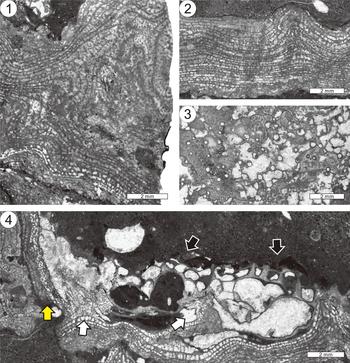
Clathrodictyon is characterized by its continuous laminae, which are commonly irregularly wrinkled, with short, funnel-shaped, rod-like, or oblique pillars (Nestor, Reference Nestor and Selden2015). The Clathrodictyon species involved in the syn-vivo interaction is identified as Clathrodictyon cf. C. mammillatum (Schmidt, Reference Schmidt1858; Fig. 2.1, 2.2). Longitudinal sections (Fig. 2.2) reveal that its laminae are well developed and continuous, showing slight undulations between rare short, rod-like pillars. Lamina thickness ranges from 0.10 to 0.32 mm (mean = 0.19 mm, n = 50), and there are commonly 9 to 12 laminae in a vertical thickness of 2 mm (Fig. 2.2). Mamelon columns are common, although partially dissolved due to diagenesis. Pillars are short, rod-like, and restricted to interlaminar spaces, forming irregular galleries. This species is also reported from the Sanjushan Formation at Yushan (Lin and Webby, Reference Lin and Webby1988).
(1–3) Thin section photomicrographs showing normal skeletal elements, NIGP 169634-4. (1) Transverse view of Clathrodictyon cf. C. mammillatum showing small circular to elliptical pillars. (2) Longitudinal view of Clathrodictyon cf. C. mammillatum characterized by continuous and slightly undulating laminae. (3) Transverse view of Labechia sp. characterized by well-developed flanged and hollow pillars with ellipsoidal to circular shapes. (4) Vertical view of the relationship between two species of stromatoporoids. Note short, stout, and round pillars of Labechia sp. in the vertical view. Note large-sized and irregular-shaped cysts of Labechia sp. (black arrows), distortions of Clathrodictyon cf. C. mammillatum (white arrow) within the cyst interspaces of Labechia sp., and crumpled laminae of Clathrodictyon cf. C. mammillatum (yellow arrow), NIGP 169634-18.

The other stromatoporoid species is characterized by well-developed upwardly convex cyst plates and pillars, which are diagnostic of labechiids (Webby, Reference Webby and Selden2015b). Most cyst plates have an irregular outline in transverse view (Fig. 2.3), and some are moderately to highly convex in vertical section (Fig. 2.4). In transverse view, pillars are ellipsoidal to circular in shape, and most are preserved hollow and flanged, locally solid, with a thickness of 0.15–0.36 mm (mean = 0.24 mm, n = 45; Fig. 2.3). In longitudinal section, stout, round pillars are developed intermittently (Fig. 2.4). In this study, the taxon is reasonably identified as Labechia sp. from the direct evidence of the morphological features, including convex cyst plates with round and stout pillars (Fig. 2.3, 2.4), which are characteristic of Labechia rather than Labechiella and different from any other labechiid genera.
Ecological interactions between stromatoporoids
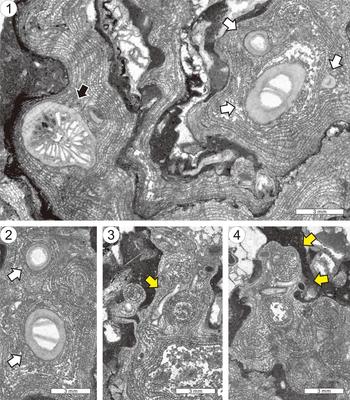
In the Xiazhen Formation, Clathrodictyon and Labechia co-occur in four of the total 18 stromatoporoid-bearing intervals (Jeon et al., Reference Jeon, Liang, Park, Choh and Lee2018), but their intergrowth is recognized only from the uppermost interval of the formation, which is interpreted as a patch reef environment. A single specimen (NIGP 169634) shows that the beginning of the intergrowth started with the settlement of Labechia sp. on the growth surface of Clathrodictyon cf. C. mammillatum (Figs. 2.4, 3, 4). Ecological interactions can be judged from the thicker-than-normal growth of the cyst plates of Labechia sp. (Figs. 2.4, 3.1–3.3, 4.6–4.8) and the highly distorted character of the interaction between the two stromatoporoids (Figs. 2.4, 3, 4). Subsequently, larger-sized, irregularly shaped cysts, which are indicative of rapid growth after initial settlement, appeared in the basal portion of Labechia sp. Such cyst malformations (abnormally thick cyst plates and large, irregular cysts) are commonly observed not only in the initial portion of the skeleton but also in subsequent growth stages (Figs. 2.4, 3, 4).
Typical distorted structures of Clathrodictyon cf. C. mammillatum and Labechia sp. during their interactions with schematic drawings. (1) Abnormal large cyst of Labechia sp. (black arrow) and distorted laminae of zigzag-crumpled shapes in Clathrodictyon cf. C. mammillatum, by the settlement of Labechia sp. and possibly by sediment interruption (yellow arrow), NIGP 169634-14. (2) Enlarged photograph of the rectangular area in (1). Note antagonistic behavior indicated by the distorted laminae of Clathrodictyon cf. C. mammillatum (white arrow) in the cyst interspaces of Labechia sp. and abnormal large cysts of Labechia sp. (black arrow) near their physical contacts. (3) Enlarged photograph of the rectangular areas in (1) showing the physical contact between Clathrodictyon cf. C. mammillatum and Labechia sp. Skeletal malformation of Labechia sp. is manifest by unevenly thickened cyst plate and abnormal large cysts (black arrows) and zigzag crumpled laminae (yellow arrow) in Clathrodictyon cf. C. mammillatum near the physical contacts of the two stromatoporoids. (4–9) Schematic drawings to illustrate the process of ecological interactions between two stromatoporoids in (1).

(1–5) Transverse serial sections showing distorted skeletal elements in Labechia sp. and Clathrodictyon cf. C. mammillatum during their ecological interactions, each interval ranging from 1.0 to 1.2 mm, respectively, exhibiting upward growth of the studied specimen, NIGP 169634-8–12. (6) Enlargement of the right rectangular area in (2). (7) Enlargement of the left rectangular area in (2). (8) Enlargement of the rectangular area in (3). Space occupation of the laminae of Clathrodictyon cf. C. mammillatum is reflected by their skeletal distortions (white arrows in 7 and 8) in the cyst interspaces of Labechia sp. Large-sized and irregular-shaped cysts of Labechia sp. are indicated by black arrows; crumpled laminae of Clathrodictyon cf. C. mammillatum are indicated by yellow arrows.

Distorted skeletal structure in Clathrodictyon cf. C. mammillatum is commonly observed where its skeleton is in contact with Labechia sp. and possibly by sediment interruptions (Figs. 2.4, 3, 4). The distortion in Clathrodictyon cf. C. mammillatum appears to be weaker than that in Labechia sp. The abnormal development of Clathrodictyon cf. C. mammillatum is manifest as zigzag crumpled distorted structure (Figs. 2.4, 3.3). Even within one stromatoporoid specimen, the structure can vary significantly in relation to disturbing influences during its growth. In some instances, the laminae of Clathrodictyon cf. C. mammillatum occupy the cyst interspaces of Labechia sp., and its interskeletal structure exhibits distorted growth, which is considered to represent antagonistic behavior (Figs. 2.4, 3.2, 4.7, 4.8).
The occurrence of abnormal growth in both stromatoporoids indicates that their intergrowth occurred while both organisms were alive. Finally, their intergrowth ceased because Clathrodictyon cf. C. mammillatum overgrew Labechia sp. (Figs. 3, 4). It is apparent that the Clathrodictyon cf. C. mammillatum individual lived longer than the Labechia sp. individual and may have ultimately had a faster growth rate.
In addition to the interaction with Labechia sp., Clathrodictyon cf. C. mammillatum served as a host for various endobionts, including the tabulate coral Bajgolia and the solitary rugose corals Tryplasma and Streptelasma (Fig. 5). However, there was no distortion of skeletal elements in Clathrodictyon cf. C. mammillatum, suggesting that the growth of the stromatoporoid was not greatly affected by the coral intergrowth or that the stromatoporoid grew around preexisting coral skeletons.
Thin section photographs of coral endobionts within the skeleton of Clathrodictyon cf. C. mammillatum. (1) Oblique cut of three solitary rugose coral Tryplasma (white arrows) and a solitary rugose coral Streptelasma (black arrow) surrounded by Clathrodictyon cf. C. mammillatum, NIGP 169634-8. (2) Two solitary rugose coral Tryplasma (white arrows) near the mamelon column of Clathrodictyon cf. C. mammillatum, NIGP 169634-11. (3, 4) Transverse views of mamelon columns of Clathrodictyon cf. C. mammillatum and the neighboring endobiont tabulate coral Bajgolia (yellow arrows). Note that no distortion of Clathrodictyon cf. C. mammillatum is observed near the contacts with diverse endobionts, NIGP 169634-7, 6, respectively.

Discussion
Earliest known stromatoporoid spatial competition
Intergrowth associations have previously been interpreted as an adaptation to seek shelter from adverse environmental conditions (e.g., competition, predation, or depositional environments; Webby and Kershaw, Reference Webby, Kershaw and Selden2015; Kershaw et al., Reference Kershaw, Munnecke and Jarochowska2018) or enhanced substrate stability (Vinn and Mõtus, Reference Vinn and Mõtus2014; Lee et al., Reference Lee, Elias, Choh and Lee2016; Vinn et al., Reference Vinn, Liang and Toom2017). It has been proposed that stromatoporoids with well-developed laminae probably provided more favorable substrates than other stromatoporoids for the settlement of tabulate corals (Mori, Reference Mori1970). This phenomenon applies particularly to Ordovician stromatoporoids, in which intergrowth commonly occurs between corals and stromatoporoids possessing well-developed laminae, such as the clathrodictyids (e.g., Lin and Webby, Reference Lin and Webby1988; Lee et al., Reference Lee, Elias, Choh and Lee2016). In this study, Clathrodictyon cf. C. mammillatum, which possesses well-developed mamelon columns, possibly provided a suitable substrate for the growth of Labechia sp. The serial sections demonstrate a competitive interaction between Clathrodictyon cf. C. mammillatum and Labechia sp. and that both stromatoporoids were significantly affected, as judged by the distorted skeletal structures. We speculate that the settlement of Labechia sp. caused a reduction in the feeding surface of Clathrodictyon cf. C. mammillatum. Therefore, the distortion (Figs. 2.4, 3, 4) and consequent change in growth habit produced distorted structures indicative of soft tissue reaction of Clathrodictyon cf. C. mammillatum (Fig. 6.1–6.3). By contrast, abundant apparent endobionts Bajgolia are associated with Clathrodictyon, especially around mamelon columns, but no distortion of skeletal structures is observed in Clathrodictyon cf. C. mammillatum in these cases (Fig. 5.3, 5.4). In addition, densely spaced Bajgolia are commonly observed to occupy a relatively large area of the center of the mamelon columns of clathrodictyids (Lee et al., Reference Lee, Elias, Choh and Lee2016, figs. 2h, 3c, 6). It is obvious that interaction with Bajgolia was not critical to the feeding of Clathrodictyon cf. C. mammillatum, whereas the settlement of Labechia sp. significantly affected the skeleton of Clathrodictyon cf. C. mammillatum. In the same horizon, not only Bajgolia but also other tabulate corals, including Heliolites and solitary rugose corals Streptelasma and Tryplasma, occur. The solitary rugose corals have been reported and interpreted as endobionts in species of Clathrodictyon on the basis of longitudinal sections (Lee et al., Reference Lee, Elias, Choh and Lee2016, fig. 2; Fig. 5). None of the Clathrodictyon skeletons exhibit malformation from their coral endobionts. Therefore, this difference suggests that the modifications of Clathrodictyon cf. C. mammillatum and Labechia sp. are due to spatial competition between them rather than being an example of commensalism or parasitism, as reported from the endobiotic corals and other organisms (e.g., Zapalski and Hubert, Reference Zapalski and Hubert2011; Vinn et al., Reference Vinn, Toom and Mõtus2015, Reference Vinn, Liang and Toom2017; Lee et al., Reference Lee, Elias, Choh and Lee2016). This is the earliest known interpreted spatial competition between stromatoporoids, occurring in the uppermost interval of the Xiazhen Formation at Zhuzhai, South China, within the range of the Dicellograptus complanatus (middle Katian) to Normalograptus persculptus (late Hirnantian) graptolite biozones (Chen et al., Reference Chen, Kim, Choh, Lee and Chen2016).
Schematic drawings to show the process of ecological interactions between two stromatoporoids. (1) Settlement of Labechia sp. on the growth surface of Clathrodictyon. (2) With the growth of Labechia sp., distorted skeleton of Clathrodictyon cf. C. mammillatum appears. (3) Labechia sp. is overgrown by Clathrodictyon cf. C. mammillatum. (4) Vertical view of Clathrodictyon and its endobionts, including Labechia sp. and rugose and tabulate corals.

Of the two stromatoporoids involved in the intergrowth, the skeleton of Labechia sp. possesses irregularly spaced, large cysts different from normal forms, whereas the skeleton of Clathrodictyon cf. C. mammillatum exhibits rather regularly spaced laminae, similar to the other skeletons of the species from this interval except for showing crumpled, distorted skeletal structure. This difference is possibly related to the different growth rates of the two species as Clathrodictyon cf. C. mammillatum is likely to have grown faster than Labechia sp.
Few previous studies concern the intergrowth between different stromatoporoids. The association between Gerronostroma septentrionalis Prosh and Stearn, Reference Prosh and Stearn1996 and Stromatopora polaris (Stearn, Reference Stearn1983) was reported from the Lower Devonian (Emsian) of Arctic Canada, and their relationship is described as competitive (Prosh and Stearn, Reference Prosh and Stearn1996). Judging from the illustration, none of the distorted skeletal structures occurred by the interfingering contact (Prosh and Stearn, Reference Prosh and Stearn1996, pl. 4, fig. 4), which is different from the present study. As little is known about the intergrowth between different stromatoporoids, further studies on other formations are necessary to understand the growth behaviors of stromatoporoids.
Paleoecological implications
Both Clathrodictyon and Labechia are widely distributed in Late Ordovician sedimentary sequences (Nestor and Webby, Reference Nestor, Webby, Harper and Servais2013; Stock et al., Reference Stock, Nestor, Webby and Selden2015). The labechiids appeared in the late Early Ordovician (Li et al., Reference Li, Li and Kiessling2017) and initially diversified in the late Middle Ordovician (Webby, Reference Webby, Webby, Paris, Droser and Percival2004; Nestor and Webby, Reference Nestor, Webby, Harper and Servais2013; Stock et al., Reference Stock, Nestor, Webby and Selden2015; Webby, Reference Webby and Selden2015a), which was earlier than the clathrodictyids. The clathrodictyids, however, spread rapidly and achieved a circumequatorial distribution in the Late Ordovician (Nestor and Webby, Reference Nestor, Webby, Harper and Servais2013). Later, they became a major cosmopolitan group after a rapid radiation in the Silurian, which was crucial to the evolution of Paleozoic stromatoporoids (Nestor, Reference Nestor1997). A recent study on the intergrowth between stromatoporoids and the tabulate coral Bajgolia revealed that only two clathrodictyid genera (Clathrodictyon and Ecclimadictyon) contained various endobionts such as tetradiids, tabulate corals, and solitary rugose corals (Lee et al., Reference Lee, Elias, Choh and Lee2016). In addition, Clathrodictyon is the most abundant stromatoporoid genus in the Xiazhen Formation, occupying a long stratigraphic distribution and a wide range of lithofacies (Jeon et al., Reference Jeon, Liang, Park, Choh and Lee2018). The long stratigraphic range of Clathrodictyon in the formation is a potential indication that clathrodictyids, especially Clathrodictyon, had broader ecological plasticity and more flexible growth strategies than did labechiids (Jeon et al., Reference Jeon, Liang, Park, Choh and Lee2018). Correspondingly, the spatial competition between Clathrodictyon cf. C. mammillatum and Labechia sp. provides direct evidence that Clathrodictyon could outcompete Labechia as a result of its flexible growth behaviors (Fig. 6).
Compared with the coral–stromatoporoid association, the interaction between Clathrodictyon and Labechia occurs more rarely in the formation. Their relationship seems to be facultative rather than obligatory, which is similar to the coral–stromatoporoid and tabulate–rugose corals associations (Lee et al., Reference Lee, Elias, Choh and Lee2016; Vinn et al., Reference Vinn, Liang and Toom2017). Due to lack of clear evidence, the nature of the relationship between various endobionts and the hosting stromatoporoids is difficult to explore, as very often there are no skeletal distortions among the organisms. The intergrowth between corals and stromatoporoids was commonly interpreted to be commensalism as their growth seems unaffected (e.g., Mori, Reference Mori1970; Kershaw, Reference Kershaw1987; Vinn, Reference Vinn2016a), whereras tubeworm endobionts, including Cornulites, Streptindytes, and Torquaysalpinx, seem to be more complex to evaluate (Vinn, Reference Vinn2016b). On the basis of the downwardly curved laminae of stromatoporoids in the vicinity of the symbiont tube, the Torquaysalpinx–stromatoporoid relationship is interpreted to be parasitism (Zapalski and Hubert, Reference Zapalski and Hubert2011). Downwardly or upwardly curved laminae near the contact with the endobionts has been considered as a criterion to judge whether it is positive or negative to the hosting stromatoporoids (Kershaw, Reference Kershaw1987, Reference Kershaw2013; Young and Noble, Reference Young and Noble1989; Lee et al., Reference Lee, Elias, Choh and Lee2016). This study shows that evaluation of distorted structures in the intergrown organisms is also important for analyzing their ecological relationship. In addition, the fact that spatial competition between different stromatoporoids in the reefs appeared as early as in the Late Ordovician suggests that spatial competition, which has been studied extensively in modern marine communities, deserves greater emphasis in the understanding of Paleozoic reef ecosystems.
Conclusions
We report the earliest known spatial competition between two species of stromatoporoids, Clathrodictyon cf. C. mammillatum and Labechia sp., from the Upper Ordovician Xiazhen Formation at Zhuzhai, South China. Labechia sp. exhibits large-sized and irregularly shaped cysts, indicative of rapid growth after initial settlement on the surface of Clathrodictyon cf. C. mammillatum. Alteration of the growth pattern of Clathrodictyon cf. C. mammillatum to produce crumpled distorted skeletal structure occurs during the interaction with Labechia sp. Intergrowth between Clathrodictyon cf. C. mammillatum and tabulate and solitary rugose corals suggests that corals did not significantly affect the growth of stromatoporoids and thus did not cause distortion of the stromatoporoid skeleton. Obviously distorted skeletal elements are present at the physical contact between the different stromatoporoids, indicating spatial competition between the organisms. This study of competitive interaction between stromatoporoids increases our understanding of the paleoecology and growth behaviors of early stromatoporoids. The spatial competition between Clathrodictyon cf. C. mammillatum and Labechia sp. provides direct evidence that species of Clathrodictyon have more flexible growth behaviors than those of Labechia.
Acknowledgments
Funds from the Chinese Academy of Sciences (XDB26000000) and the National Science Foundation of China (Grant No. 41402013 and J1210006) to KL, Korea Polar Research Institute to ML (PE19160), and the Chinese Academy of Sciences (CAS) ‘One Belt and One Road’ Master Fellowship Program and a CAS President's International Fellowship Initiative (PIFI) to JJ are acknowledged. We appreciate the journal editor, B. Hunda, and J. Botting for constructive reviews. We thank O. Vinn and an anonymous reviewer for providing valuable comments. We are also grateful to Y.D. Zhang, H. Park, and J. Park for their assistance on the manuscript. We deeply appreciate the warm hospitality and assistance during field work of the residents of Zhuzhai village. This paper is a contribution to IGCP 653 ‘The Onset of the Great Ordovician Biodiversification Event.’