





Background
Co-location is the delivery of discrete services within the same physical space. This can involve health, social, legal or community services and occurs on healthcare premises, and in other public and community spaces (Baskin et al., Reference Baskin, Duncan, Adams, Oliver, Samuel and Gnani2023). Co-location is considered to promote collaboration, effective communication, improved professional relationships, and improved outcomes for patients (Cameron and Lart, Reference Cameron and Lart2003; Lalani and Marshall, Reference Lalani and Marshall2022). Additionally, there is evidence that co-locating non-primary healthcare services can improve access to health and social care and reduce health inequity (Kates et al., Reference Kates, Mcpherson-Doe and George2011; Baskin et al., Reference Baskin, Duncan, Adams, Oliver, Samuel and Gnani2023; De Sam Lazaro et al., Reference De Sam Lazaro, Nitschke Durben and Kline2023).
Health inequities are systematic differences in health outcomes and health care and are the result of multiple disadvantages people experience in relation to a variety of characteristics such as race, ethnicity, disability, sexuality, and socioeconomic status (Gkiouleka et al., Reference Gkiouleka, Wong, Sowden, Bambra, Siersbaek, Manji, Moseley, Harmston, Kuhn and Ford2023). The main driver of health inequity is an unequal distribution of the social determinants of health (SDoH) (The World Health Organisation, 2023). Well-established evidence demonstrates that socioeconomically disadvantaged communities have poorer health (Mccartney et al., Reference Mccartney, Popham, Mcmaster and Cumbers2019; Marmot, Reference Marmot2020; Watt et al., Reference Watt, Raymond and Rachet-Jaquet2022). These communities are more likely to suffer from chronic disease (Watt et al., Reference Watt, Raymond and Rachet-Jaquet2022) and be medically underserved with reduced quality of care (Tudor Hart, Reference Tudor Hart1971; Ford et al., Reference Ford, Sowden, Olivera, Bambra, Gimson, Aldridge and Brayne2021). This applies to both healthcare facilities (Gulliford et al., Reference Gulliford, Figueroa-Munoz, Morgan, Hughes, Gibson, Beech and Hudson2002) and agencies providing social programmes and welfare-relief: intricately linked with wider SDoH (Ben-Shlomo et al., Reference Ben-Shlomo, White and Marmot1996; Mechanic, Reference Mechanic2002).
Co-location of services has the potential to address these inequitable determinants of poor health through multiple pathways; reducing barriers to access, reducing stigma, improving trust in services, delivering person-centred care, and improving sustainability of services through pooling of resources (Baskin et al., Reference Baskin, Duncan, Adams, Oliver, Samuel and Gnani2023). Co-location of community services and healthcare may also facilitate more integrated care(Lalani and Marshall, Reference Lalani and Marshall2022): facilitating health equity. Disadvantaged populations tend to have greater multimorbidity and complex bio-psycho-social needs and require higher levels of collaboration, continuity and coordination (Øvretveit, Reference Øvretveit2011; Goodwin et al., Reference Goodwin, Smith, Davies, Perry, Rosen, Dixon, Dixon and Ham2012; Kajaria-Montag et al., Reference Kajaria-Montag, Freeman and Scholtes2024).
There are thousands of primary care buildings and premises in the UK National Health Service (NHS); including 7,500 in England (Corben, Reference Corben2024). Primary care is ideally placed to offer holistic community-based care as a trusted organization and often the first point of contact for people seeking help. General Practitioners in the UK spend 1 in 5 appointments addressing social issues not principally about health (Citizens Advice, 2015). This is higher in disadvantaged areas with more complex social issues (Marmot, Reference Marmot2010).
Existing evidence syntheses look at co-location of services in a range of health care settings or for one type of service only. In this review, at a time of increasing focus on health inequalities and healthcare system restructuring, we ask specifically how can co-locating multi-sector services in primary care improve health, social or healthcare utilization outcomes for patients in disadvantaged groups?
Methods
We undertook an umbrella review, registered with PROSPERO (CRD42024509220), and reported in line with the PRISMA 2020 guidelines (Page et al., Reference Page, Mckenzie, Bossuyt, Boutron, Hoffmann, Mulrow, Shamseer, Tetzlaff, Akl, Brennan, Chou, Glanville, Grimshaw, Hróbjartsson, Lalu, Li, Loder, Mayo-Wilson, Mcdonald, Mcguinness, Stewart, Thomas, Tricco, Welch, Whiting and Moher2021).
We conducted a systematic search of Ovid Medline and Ovid Embase up to 1st February 2024 using a search strategy (supplementary material [1] & [2]) designed to identify any review of co-located services in primary care. Titles and abstracts were screened by one reviewer using Rayyan software (Ouzzani et al., Reference Ouzzani, Hammady, Fedorowicz and Elmagarmid2016). A second reviewer reviewed the full texts of potentially included studies. This approach optimized consistency of screening and generated concordance on the highest impact decisions. Conflicts were resolved within the team. At the screening stage reviewers judged whether the review was relevant to disadvantaged groups. A grey literature search using Google Scholar and citation tracking supplemented database searches. Studies were included based on the following eligibility criteria:
Inclusion criteria:
-
• Study design: systematic review, narrative review, evidence synthesis, and meta-analysis.
-
• Population: disadvantaged populations.
-
• Intervention: A distinct service co-located in primary care.
-
• Outcomes: Health, social, healthcare utilization and experience and activity and processes, e.g. implementation measures. We included broad outcomes, reflecting expected heterogeneity of study designs and services.
-
• Setting: Primary care. Only primary care accessible to the general population was included.
Exclusion criteria:
-
• Based in low- or middle-income countries (to limit variation in the context of interventions).
-
• Published before 2010.
-
• Reviews not including interventions based in primary care.
-
• Reviews describing forms of integrated or collaborative care but without co-location.
We defined disadvantage to include characteristics (e.g. ethnicity) conditions (e.g. mental health, chronic obstructive pulmonary disease, cardiovascular disease (Watt et al., Reference Watt, Raymond and Rachet-Jaquet2022)), risk factors (e.g. smoking, obesity, alcohol, substance misuse (Singh-Manoux et al., Reference Singh-Manoux, Nabi, Shipley, Guéguen, Sabia, Dugravot, Marmot and Kivimaki2008; Capewell and Graham, Reference Capewell and Graham2010)) and social circumstances (e.g. low income or poor housing) associated with inequity in health outcomes as well as inclusion health groups.
Data extraction and synthesis
A pre-defined data extraction tool was piloted in Microsoft Excel. One researcher conducted data extraction, and a second conducted an accuracy check for all studies. Where possible, for reviews that included primary studies based outside of primary care or of integrated but not co-located services only data relevant to the research question were extracted.
Data were synthesized using a convergent integrated approach to capture both qualitative and quantitative data with heterogenous outcome measures (Stern et al., Reference Stern, Lizarondo, Carrier, Godfrey, Rieger, Salmond, Apóstolo, Kirkpatrick and Loveday2020). After initial familiarization with the data, categorization of co-located service, and outcomes (supplementary material [3]) allowed formulation of aggregate themes for integrated narrative synthesis through discussion within the research team.
Quality assessment
Two reviewers used the Joanna Briggs Institute (JBI) checklist for systematic reviews and research synthesis to independently assess quality (Aromataris et al., Reference Aromataris, Fernandez, Godfrey, Holly, Khalil and Tungpunkom2015), conflicts resolved by discussion. While to our knowledge there is no validated critical appraisal tool for both systematic and scoping reviews, this tool was chosen as it assesses qualitative and quantitative evidence syntheses and offers the option to tailor the appraisal according to study design (Tricco et al., Reference Tricco, Lillie, Zarin, O’Brien, Colquhoun, Levac, Moher, Peters, Horsley, Weeks, Hempel, Akl, Chang, Mcgowan, Stewart, Hartling, Aldcroft, Wilson, Garritty, Lewin, Godfrey, Macdonald, Langlois, Soares-Weiser, Moriarty, Clifford, Tunçalp and Straus2018).
Results
Study characteristics
The database search identified 2626 articles with 2611 after removal of duplicates. After title and abstract screening there were 176 articles eligible for full-text screening and of those 9 met the eligibility criteria (Overbeck et al., Reference Overbeck, Davidsen and Kousgaard2016; Elrashidi et al., Reference Elrashidi, Mohammed, Bora, Haydour, Farah, Dejesus, Murad and Ebbert2018; Platt et al., Reference Platt, Spencer, Burkey, Vidal, Polk, Bettencourt, Jain, Stratton and Wissow2018; Richardson et al., Reference Richardson, Richard, Gunter, Cunningham, Hamer, Lockett, Wyeth, Stokes, Burke, Green, Cox and Derrett2020; Reece et al., Reference Reece, Sheldon, Dickerson and Pickett2022; Young and Bates, Reference Young and Bates2022; Glover-Wright et al., Reference Glover-Wright, Coupe, Campbell, Keen, Lawrence, Kinner and Young2023; Alur et al., Reference Alur, Hall, Smith, Zakrison, Loughran, Cosey-Gay and Kaufman2024; Johnson et al., Reference Johnson, Asay, Keegan, Wu, Zietowski, Zakrison, Muntz, Pillai and Tung2024). A further four articles were found through citation tracking and grey literature searching (Maslin-Prothero and Bennion, Reference Maslin-Prothero and Bennion2010; Beardon et al., Reference Beardon, Woodhead, Cooper, Ingram, Genn and Raine2021, Honisett et al., Reference Honisett, Loftus, Hall, Sahle, Hiscock and Goldfeld2022, Jomaa et al., Reference Jomaa, Ranasinghe, Raymer, Leering and Bayoumi2023) providing a total of 13 articles included (Figure 1).
PRISMA 2020 flow diagram.
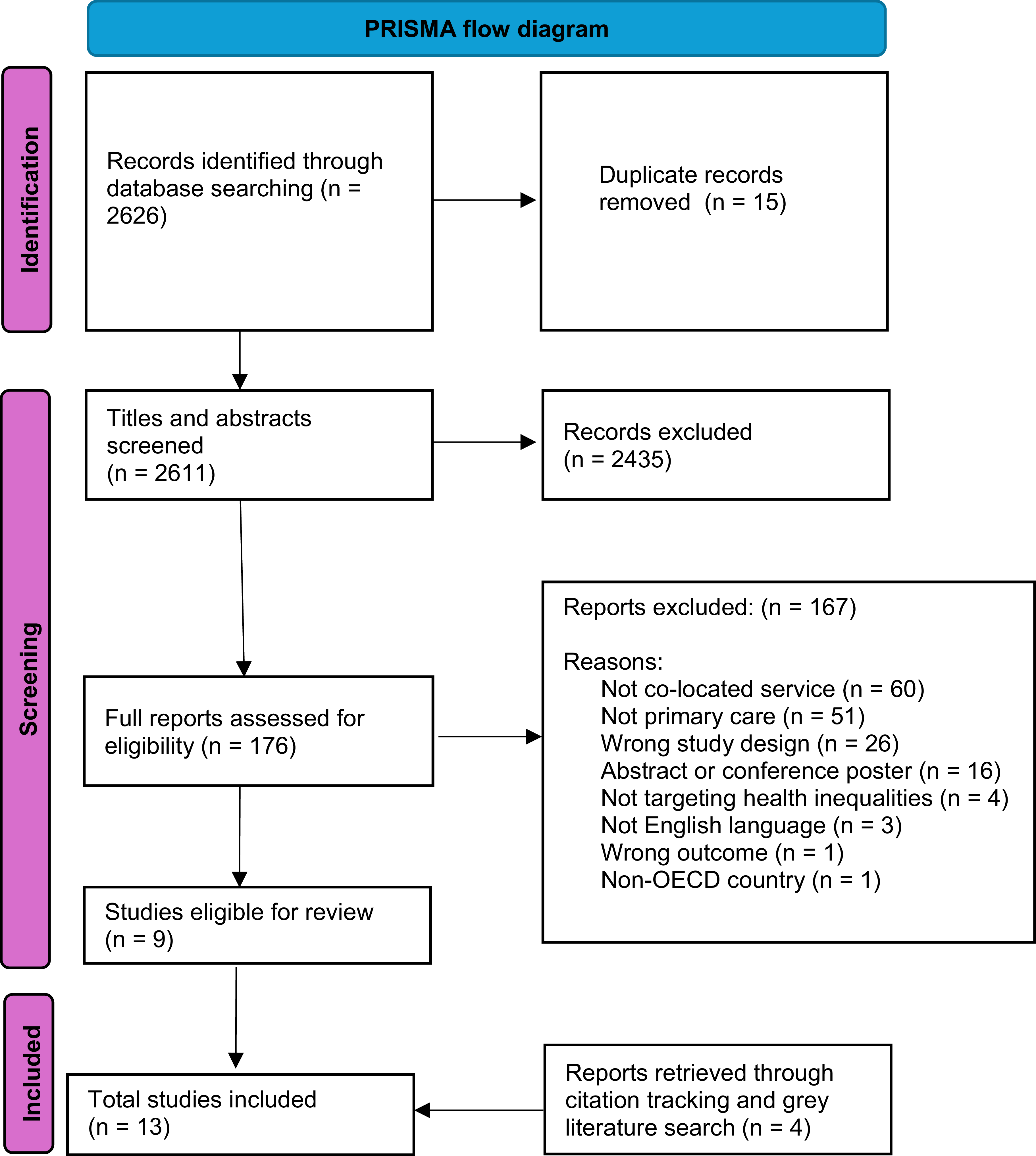
Figure 1. Long description
A flowchart illustrating the stages of a systematic review process, including identification, screening, and inclusion of studies. The process begins with the identification phase, where records are identified through database searching. The first step involves identifying 2626 records, followed by the removal of 15 duplicate records. The next step is the screening phase, where titles and abstracts of 2611 records are screened. This results in the exclusion of 2435 records. Full reports of the remaining 176 records are then assessed for eligibility. During this assessment, 167 reports are excluded for various reasons, including not being co-located service, not primary care, wrong study design, abstract or conference poster, not targeting health inequalities, not English language, wrong outcome, and non-OECD country. This leaves 9 studies eligible for review. Finally, in the inclusion phase, 4 additional reports are retrieved through citation tracking and grey literature search, resulting in a total of 13 studies included in the review.
Twelve included studies were a narrative synthesis of which five were systematic reviews (Table 1); one was a systematic review and partial meta-analysis of randomized controlled trials (RCTs) and observational studies (Elrashidi et al., Reference Elrashidi, Mohammed, Bora, Haydour, Farah, Dejesus, Murad and Ebbert2018).
Characteristics of included studies
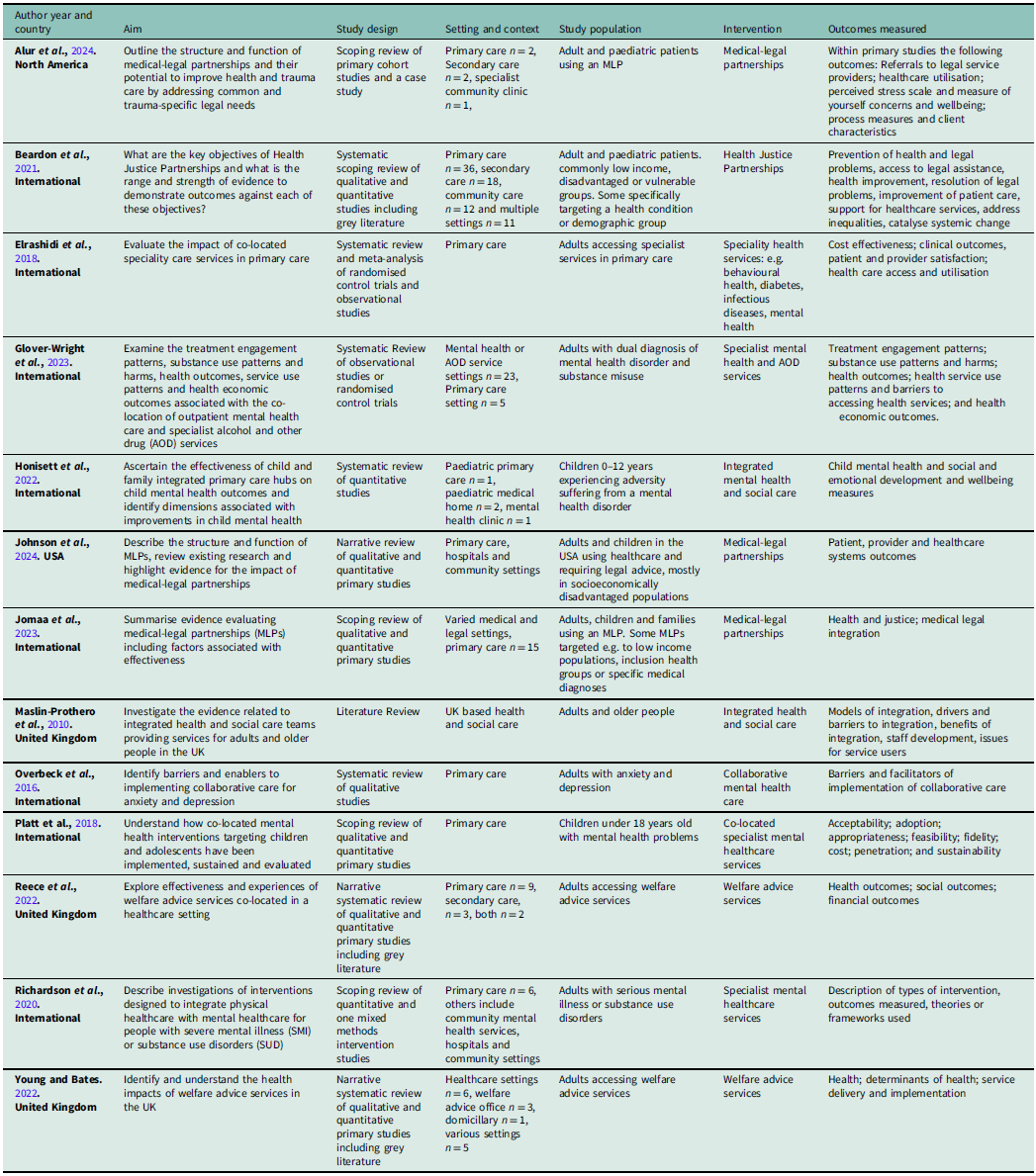
Table 1. Long description
The table presents a detailed summary of twelve included studies, focusing on their design, setting, population, intervention, and outcomes measured. It has twelve rows and six columns. The columns are labeled Author, Year and Country, Aim, Study design, Setting and context, Study population, Intervention, and Outcomes measured. Each row corresponds to a different study, providing specific details about each aspect. For example, the first row describes a study by Alur et al. from 2016 in the USA, which outlines the structure and function of medical-legal partnerships (MLPs) and their impact on medical and legal outcomes. The study design is a scoping review of cohort studies and case series, conducted in primary care and secondary care settings, involving adult and pediatric patients using an MLPs. The intervention is medical-legal partnerships, and the outcomes measured include referral to legal services, legal resolution, and health outcomes. The table continues with similar detailed descriptions for each study, highlighting the diversity in study designs, settings, populations, interventions, and outcomes measured.
Three reviews focused on legal advice services, predominantly in the USA known as medical legal partnerships (MLPs) (Jomaa et al., Reference Jomaa, Ranasinghe, Raymer, Leering and Bayoumi2023; Alur et al., Reference Alur, Hall, Smith, Zakrison, Loughran, Cosey-Gay and Kaufman2024; Johnson et al., Reference Johnson, Asay, Keegan, Wu, Zietowski, Zakrison, Muntz, Pillai and Tung2024). Two were reviews of welfare advice in the UK (Reece et al., Reference Reece, Sheldon, Dickerson and Pickett2022; Young and Bates, Reference Young and Bates2022) and one international review included both legal and welfare advice services (Beardon et al., Reference Beardon, Woodhead, Cooper, Ingram, Genn and Raine2021). These services predominantly support people from socially disadvantaged backgrounds. Seven reviews explored complementary health services, mostly in the USA and UK. Four of these explored specialist medical care normally delivered in secondary care; of these three focused on mental health (Elrashidi et al., Reference Elrashidi, Mohammed, Bora, Haydour, Farah, Dejesus, Murad and Ebbert2018; Platt et al., Reference Platt, Spencer, Burkey, Vidal, Polk, Bettencourt, Jain, Stratton and Wissow2018; Richardson et al., Reference Richardson, Richard, Gunter, Cunningham, Hamer, Lockett, Wyeth, Stokes, Burke, Green, Cox and Derrett2020; Glover-Wright et al., Reference Glover-Wright, Coupe, Campbell, Keen, Lawrence, Kinner and Young2023) and one included a range of specialties treating conditions or risk factors associated with inequalities in health outcomes (including behavioural health, mental illness, diabetes, infectious diseases) (Elrashidi et al., Reference Elrashidi, Mohammed, Bora, Haydour, Farah, Dejesus, Murad and Ebbert2018). The other three complementary health service reviews explored co-location as one component in a model of integrated or collaborative care targeting people with mental illness, living with adversity or requiring social care (Maslin-Prothero and Bennion, Reference Maslin-Prothero and Bennion2010; Overbeck et al., Reference Overbeck, Davidsen and Kousgaard2016; Honisett et al., Reference Honisett, Loftus, Hall, Sahle, Hiscock and Goldfeld2022). Seven reviews evaluated services for adults (Maslin-Prothero and Bennion, Reference Maslin-Prothero and Bennion2010; Overbeck et al., Reference Overbeck, Davidsen and Kousgaard2016; Elrashidi et al., Reference Elrashidi, Mohammed, Bora, Haydour, Farah, Dejesus, Murad and Ebbert2018; Richardson et al., Reference Richardson, Richard, Gunter, Cunningham, Hamer, Lockett, Wyeth, Stokes, Burke, Green, Cox and Derrett2020; Reece et al., Reference Reece, Sheldon, Dickerson and Pickett2022; Young and Bates, Reference Young and Bates2022; Glover-Wright et al., Reference Glover-Wright, Coupe, Campbell, Keen, Lawrence, Kinner and Young2023), two explored specialist mental health services for children (Platt et al., Reference Platt, Spencer, Burkey, Vidal, Polk, Bettencourt, Jain, Stratton and Wissow2018; Honisett et al., Reference Honisett, Loftus, Hall, Sahle, Hiscock and Goldfeld2022), and four reviews considered both adults and children (Beardon et al., Reference Beardon, Woodhead, Cooper, Ingram, Genn and Raine2021; Jomaa et al., Reference Jomaa, Ranasinghe, Raymer, Leering and Bayoumi2023; Alur et al., Reference Alur, Hall, Smith, Zakrison, Loughran, Cosey-Gay and Kaufman2024, Johnson et al., Reference Johnson, Asay, Keegan, Wu, Zietowski, Zakrison, Muntz, Pillai and Tung2024).
Quality assessment
Nine studies fulfilled more than 85% of the relevant JBI critical appraisal criteria and were considered to be high quality (Overbeck et al., Reference Overbeck, Davidsen and Kousgaard2016; Platt et al., Reference Platt, Spencer, Burkey, Vidal, Polk, Bettencourt, Jain, Stratton and Wissow2018; Beardon et al., Reference Beardon, Woodhead, Cooper, Ingram, Genn and Raine2021; Honisett et al., Reference Honisett, Loftus, Hall, Sahle, Hiscock and Goldfeld2022; Reece et al., Reference Reece, Sheldon, Dickerson and Pickett2022; Young and Bates, Reference Young and Bates2022; Glover-Wright et al., Reference Glover-Wright, Coupe, Campbell, Keen, Lawrence, Kinner and Young2023; Jomaa et al., Reference Jomaa, Ranasinghe, Raymer, Leering and Bayoumi2023). Two studies fulfilled at least 75% of criteria (Elrashidi et al., Reference Elrashidi, Mohammed, Bora, Haydour, Farah, Dejesus, Murad and Ebbert2018; Johnson et al., Reference Johnson, Asay, Keegan, Wu, Zietowski, Zakrison, Muntz, Pillai and Tung2024), and two low quality studies fulfilled less than 75% of relevant criteria (Maslin_Prothero and Bennion, Reference Maslin-Prothero and Bennion2010; Alur et al., Reference Alur, Hall, Smith, Zakrison, Loughran, Cosey-Gay and Kaufman2024) ([supplementary material [4]). The two lower quality studies were of only moderate relevance to the research question and therefore relatively fewer data were extracted and contributed to synthesis.
Narrative synthesis
Five aggregate themes emerged to describe how co-locating services within primary care estates can be used to support disadvantaged groups: access and engagement, quality of care, efficiency, improved health, and improved social factors. Themes and types of service were inter-related and, in particular, welfare and legal advice services shared common outcomes and are often presented together in the narrative synthesis. Table 2 offers an overview of the evidence in each domain.
Summary of evidence for outcomes in co-located services in primary care

Table 2. Long description
A table summarizing evidence for outcomes in co-located services in primary care. The table has 3 rows and 5 columns. The columns are labeled as follows: Type of co-located service, Theme, Access and engagement, Quality of care, Efficiency, Improved health, Improved social factors. The rows are labeled as follows: Welfare advice, Legal advice, Complementary Health services. Row 1: Welfare advice, Access and engagement, +, Quality of care, +, Efficiency, +-, Improved health, +, Improved social factors, +. Row 2: Legal advice, Access and engagement, +, Quality of care, +, Efficiency, +/, Improved health, +/, Improved social factors, +. Row 3: Complementary Health services, Access and engagement, +-, Quality of care, +, Efficiency, +-/, Improved health, +, Improved social factors, +.
+ = positive impact, − = negative impact, / = no impact, blank = no evidence.
Access and engagement
Welfare and legal advice
Four included reviews of co-located welfare and legal advice found access to care improved; and physical proximity, familiarity, and trust of the healthcare setting were important drivers of this (Beardon et al., Reference Beardon, Woodhead, Cooper, Ingram, Genn and Raine2021; Reece et al., Reference Reece, Sheldon, Dickerson and Pickett2022; Young and Bates, Reference Young and Bates2022) . Clinicians were more able to identify those in need and referral from a healthcare professional was seen by patients to legitimize their need for help (Beardon et al., Reference Beardon, Woodhead, Cooper, Ingram, Genn and Raine2021; Reece et al., Reference Reece, Sheldon, Dickerson and Pickett2022; Young and Bates, Reference Young and Bates2022; Johnson et al., Reference Johnson, Asay, Keegan, Wu, Zietowski, Zakrison, Muntz, Pillai and Tung2024). Illustrating these factors, one review presented evidence that most of those referred by healthcare professionals for co-located legal advice would not have otherwise sought support (Beardon et al., Reference Beardon, Woodhead, Cooper, Ingram, Genn and Raine2021), and another found self-referral was a less common access route (Reece et al., Reference Reece, Sheldon, Dickerson and Pickett2022). Beardon et al. found evidence that co-location particularly improved access for older people and those with poor physical or mental health, though the one primary study noted that targeting housebound patients was more effective in addressing unmet need (Beardon et al., Reference Beardon, Woodhead, Cooper, Ingram, Genn and Raine2021). One review of studies based in the UK reported that engagement with health services and adherence to treatment plans was higher with co-location of welfare advice services, particularly for patients with chronic, complex disease (Reece et al., Reference Reece, Sheldon, Dickerson and Pickett2022).
Complementary health services
Two reviews found evidence to suggest when specialist mental health services were co-located, access was improved (Elrashidi et al., Reference Elrashidi, Mohammed, Bora, Haydour, Farah, Dejesus, Murad and Ebbert2018; Platt et al., Reference Platt, Spencer, Burkey, Vidal, Polk, Bettencourt, Jain, Stratton and Wissow2018). A pooled analysis of three co-located services found waiting times for mental health services were reduced compared to non-co-located care (OR 0.20 95% CI 0.010–0.41) (Elrashidi et al., Reference Elrashidi, Mohammed, Bora, Haydour, Farah, Dejesus, Murad and Ebbert2018).
Two reviews reported consistently increased treatment engagement where speciality mental health services were co-located in primary care (Platt et al., Reference Platt, Spencer, Burkey, Vidal, Polk, Bettencourt, Jain, Stratton and Wissow2018; Glover-Wright et al., Reference Glover-Wright, Coupe, Campbell, Keen, Lawrence, Kinner and Young2023). Patients were more likely to attend mental health appointments where care was co-located (Platt et al., Reference Platt, Spencer, Burkey, Vidal, Polk, Bettencourt, Jain, Stratton and Wissow2018; Richardson et al., Reference Richardson, Richard, Gunter, Cunningham, Hamer, Lockett, Wyeth, Stokes, Burke, Green, Cox and Derrett2020; Glover-Wright et al., Reference Glover-Wright, Coupe, Campbell, Keen, Lawrence, Kinner and Young2023); for example, one primary randomized control trial found that individuals treated in a co-located mental health and substance misuse service were almost three times as likely to engage in treatment compared to usual care (OR 2.6; 95% CI 2.1–3.1) (Glover-Wright et al., Reference Glover-Wright, Coupe, Campbell, Keen, Lawrence, Kinner and Young2023).
In one scoping review derived largely from studies based in the USA, Platt et al. found that co-located services did not engage people of all sociodemographic backgrounds equally. Examples include; evidence of higher treatment engagement for females compared to males; improved access for black and Latino young people compared to usual care but not for non-Latino white patients; and increased treatment rates demonstrated only amongst English speaking families (Platt et al., Reference Platt, Spencer, Burkey, Vidal, Polk, Bettencourt, Jain, Stratton and Wissow2018).
Quality of care
All types of co-located services consistently demonstrated high levels of patient and provider satisfaction (Elrashidi et al., Reference Elrashidi, Mohammed, Bora, Haydour, Farah, Dejesus, Murad and Ebbert2018; Platt et al., Reference Platt, Spencer, Burkey, Vidal, Polk, Bettencourt, Jain, Stratton and Wissow2018; Richardson et al., Reference Richardson, Richard, Gunter, Cunningham, Hamer, Lockett, Wyeth, Stokes, Burke, Green, Cox and Derrett2020; Beardon et al., Reference Beardon, Woodhead, Cooper, Ingram, Genn and Raine2021; Reece et al., Reference Reece, Sheldon, Dickerson and Pickett2022; Young and Bates, Reference Young and Bates2022; Jomaa et al., Reference Jomaa, Ranasinghe, Raymer, Leering and Bayoumi2023; Johnson et al., Reference Johnson, Asay, Keegan, Wu, Zietowski, Zakrison, Muntz, Pillai and Tung2024). Five included reviews considered factors that would facilitate success of a co-located service and common themes included; interprofessional collaboration; clinical integration; shared values and vision; establishment of clear roles and simple protocols; adequate resources; mutual trust and respect; cross-disciplinary training; effective communication and monitoring and evaluation (Maslin_Prothero and Bennion, Reference Maslin-Prothero and Bennion2010; Overbeck et al., Reference Overbeck, Davidsen and Kousgaard2016; Platt et al., Reference Platt, Spencer, Burkey, Vidal, Polk, Bettencourt, Jain, Stratton and Wissow2018; Honisett et al., Reference Honisett, Loftus, Hall, Sahle, Hiscock and Goldfeld2022; Reece et al., Reference Reece, Sheldon, Dickerson and Pickett2022).
Welfare and legal advice
Positive patient and provider experiences with co-located welfare and legal advice services were related to patients feeling greater trust and sense of confidentiality (Beardon et al., Reference Beardon, Woodhead, Cooper, Ingram, Genn and Raine2021; Reece et al., Reference Reece, Sheldon, Dickerson and Pickett2022), improved the doctor-patient relationship (Beardon et al., Reference Beardon, Woodhead, Cooper, Ingram, Genn and Raine2021), improved interprofessional collaboration (Reece et al., Reference Reece, Sheldon, Dickerson and Pickett2022), and simplified referral pathways (Reece et al., Reference Reece, Sheldon, Dickerson and Pickett2022; Johnson et al., Reference Johnson, Asay, Keegan, Wu, Zietowski, Zakrison, Muntz, Pillai and Tung2024).
A consistently described benefit of co-located services is the increase in knowledge of health, legal, and welfare systems among health and non-health staff through formal training and interdisciplinary collaboration (Alur et al., Reference Alur, Hall, Smith, Zakrison, Loughran, Cosey-Gay and Kaufman2024), which enables staff to deal more confidently with issues outside their usual scope (Reece et al., Reference Reece, Sheldon, Dickerson and Pickett2022; Jomaa et al., Reference Jomaa, Ranasinghe, Raymer, Leering and Bayoumi2023; Johnson et al., Reference Johnson, Asay, Keegan, Wu, Zietowski, Zakrison, Muntz, Pillai and Tung2024) and develop new pathways to identify and address social and legal needs (Jomaa et al., Reference Jomaa, Ranasinghe, Raymer, Leering and Bayoumi2023).
Complementary health services
In pooled analysis of two studies of co-located specialist health care Elrashidi et al. found increased provider satisfaction (OR 6.49 (95% CI 4.28–9.85) and in pooled analysis of four studies found increased patient satisfaction (OR = 2.04 95% CI 1.04–3.98) (Elrashidi et al., Reference Elrashidi, Mohammed, Bora, Haydour, Farah, Dejesus, Murad and Ebbert2018). Among children and families in paediatric mental health services, Platt et al. found high levels of patient and family acceptability of co-location, and that this was primarily due to convenience (Platt et al., Reference Platt, Spencer, Burkey, Vidal, Polk, Bettencourt, Jain, Stratton and Wissow2018).
In co-located paediatric mental health services high provider acceptability was related to increased interprofessional collaboration, improved quality of care, improved continuity of care, improved access to services, and increased knowledge (Platt et al., Reference Platt, Spencer, Burkey, Vidal, Polk, Bettencourt, Jain, Stratton and Wissow2018).
Three reviews provide evidence that for people with mental health problems, requiring social care or living with adversity co-location supports better care integration (Maslin-Prothero and Bennion, Reference Maslin-Prothero and Bennion2010; Overbeck et al., Reference Overbeck, Davidsen and Kousgaard2016; Honisett et al., Reference Honisett, Loftus, Hall, Sahle, Hiscock and Goldfeld2022), relating to more face-to-face interactions facilitating shared understanding, case discussions, and care optimization (Overbeck et al., Reference Overbeck, Davidsen and Kousgaard2016).
Efficiency
Welfare advice
Two reviews of studies conducted in the UK found inconclusive evidence on the impact of co-located welfare advice on healthcare utilization. Some primary studies within reviews demonstrated positive impacts such as; reduced number of prescriptions for mental ill health (Reece et al., Reference Reece, Sheldon, Dickerson and Pickett2022); clinician reported time saving (Reece et al., Reference Reece, Sheldon, Dickerson and Pickett2022; Young and Bates, Reference Young and Bates2022); a non-significant reduction in nurse consultation rates (Reece et al., Reference Reece, Sheldon, Dickerson and Pickett2022) and reduction in GP consultation rates of up to 13% (Reece et al., Reference Reece, Sheldon, Dickerson and Pickett2022; Young and Bates, Reference Young and Bates2022). Conversely, a quasi-experimental control study found no difference in GP consultation rates at 3 months (Reece et al., Reference Reece, Sheldon, Dickerson and Pickett2022; Young and Bates, Reference Young and Bates2022), and qualitative studies also found evidence of increased service use (Reece et al., Reference Reece, Sheldon, Dickerson and Pickett2022). One review found the number of appointments for mental health-related problems and referrals to mental health services increased (Young and Bates, Reference Young and Bates2022), where another found no impact (Reece et al., Reference Reece, Sheldon, Dickerson and Pickett2022).
In terms of cost-effectiveness, in the UK, one review presented an average cost per client of £272 (range £124–£421) and found that for every £1 invested in co-located welfare advice there was a £27 (range £15–£39) of social health economic benefit generated (Reece et al., Reference Reece, Sheldon, Dickerson and Pickett2022).
Legal advice
While two reviews found examples of reduced hospital admissions correlated to co-located legal advice (Alur et al., Reference Alur, Hall, Smith, Zakrison, Loughran, Cosey-Gay and Kaufman2024; Johnson et al., Reference Johnson, Asay, Keegan, Wu, Zietowski, Zakrison, Muntz, Pillai and Tung2024) another review reported inconsistent results in a variety of interventions (Beardon et al., Reference Beardon, Woodhead, Cooper, Ingram, Genn and Raine2021). Notably most primary studies lacked a comparison group.
MLPs in the USA had high-cost benefit ratios based on recovery of Medicaid funding (Jomaa et al., Reference Jomaa, Ranasinghe, Raymer, Leering and Bayoumi2023; Johnson et al., Reference Johnson, Asay, Keegan, Wu, Zietowski, Zakrison, Muntz, Pillai and Tung2024) and through reduced hospitalizations (Johnson et al., Reference Johnson, Asay, Keegan, Wu, Zietowski, Zakrison, Muntz, Pillai and Tung2024).
Complementary health services
The evidence for impact of co-located specialty medical services on healthcare utilization is inconsistent. In one review of co-located mental health services providers reported time saving (Platt et al., Reference Platt, Spencer, Burkey, Vidal, Polk, Bettencourt, Jain, Stratton and Wissow2018), however quantitative primary studies evaluating co-located speciality clinics treating conditions or risk factors associated with health inequality found increased frequency of primary care visits (Elrashidi et al., Reference Elrashidi, Mohammed, Bora, Haydour, Farah, Dejesus, Murad and Ebbert2018; Platt et al., Reference Platt, Spencer, Burkey, Vidal, Polk, Bettencourt, Jain, Stratton and Wissow2018).
Elrashidi et el found onsite specialist services had no impact on hospitalization rates (OR 0.75, 95% CI 0.53–1.07) or frequency of specialty outpatient visits (OR 1.83 95% CI 0.9–3.38) compared to usual care (Elrashidi et al., Reference Elrashidi, Mohammed, Bora, Haydour, Farah, Dejesus, Murad and Ebbert2018). They did however report one primary study showing a reduced referral rate to specialty mental health services (Elrashidi et al., Reference Elrashidi, Mohammed, Bora, Haydour, Farah, Dejesus, Murad and Ebbert2018). Whilst one retrospective cohort study reported by Platt et al. found a 245% increase in emergency department attendance during the study period for a co-located paediatric mental health service (Platt et al., Reference Platt, Spencer, Burkey, Vidal, Polk, Bettencourt, Jain, Stratton and Wissow2018), two reviews reported primary studies of co-located mental health services showing reduced hospital attendance (Richardson et al., Reference Richardson, Richard, Gunter, Cunningham, Hamer, Lockett, Wyeth, Stokes, Burke, Green, Cox and Derrett2020; Glover-Wright et al., Reference Glover-Wright, Coupe, Campbell, Keen, Lawrence, Kinner and Young2023). Glover-Wright et al. found a trend towards reduced admissions, length of stay, and emergency department presentations with co-located models of mental health services, though the evidence was noted to be high risk of bias and additionally other studies in the same review found no impact, or indeed increased inpatient service use (Glover-Wright et al., Reference Glover-Wright, Coupe, Campbell, Keen, Lawrence, Kinner and Young2023).
There were no formal cost-effectiveness analyses however decreased health system expenditure was suggested by three reviews (Elrashidi et al., Reference Elrashidi, Mohammed, Bora, Haydour, Farah, Dejesus, Murad and Ebbert2018; Platt et al., Reference Platt, Spencer, Burkey, Vidal, Polk, Bettencourt, Jain, Stratton and Wissow2018; Glover-Wright et al., Reference Glover-Wright, Coupe, Campbell, Keen, Lawrence, Kinner and Young2023).
Improved health
Welfare and legal advice
There is evidence to suggest that both co-located welfare and legal advice can improve health and well-being outcomes, through reducing external stressors such as financial insecurity (Beardon et al., Reference Beardon, Woodhead, Cooper, Ingram, Genn and Raine2021; Reece et al., Reference Reece, Sheldon, Dickerson and Pickett2022; Young and Bates, Reference Young and Bates2022), though this is based on often low quality primary studies and heterogeneous interventions and study designs (Beardon et al., Reference Beardon, Woodhead, Cooper, Ingram, Genn and Raine2021; Young and Bates, Reference Young and Bates2022).
The evidence for mental health impact is also based on heterogenous interventions and outcomes, though is generally more consistent and higher quality (Young and Bates, Reference Young and Bates2022). Six reviews found evidence for improved mental health in people using co-located welfare or legal advice services. Outcomes included reductions in anxiety and depression symptoms, prescriptions for psychiatric medication, perceived stress, sleep problems, and substance misuse (Beardon et al., Reference Beardon, Woodhead, Cooper, Ingram, Genn and Raine2021; Reece et al., Reference Reece, Sheldon, Dickerson and Pickett2022; Young and Bates, Reference Young and Bates2022; Jomaa et al., Reference Jomaa, Ranasinghe, Raymer, Leering and Bayoumi2023; Johnson et al., Reference Johnson, Asay, Keegan, Wu, Zietowski, Zakrison, Muntz, Pillai and Tung2024; Alur et al., Reference Alur, Hall, Smith, Zakrison, Loughran, Cosey-Gay and Kaufman2024). A positive impact of co-located legal advice on mental health was seen specifically in disadvantaged groups such as homeless populations, low-income families, ethnic minorities, and people with mental illness (Reece et al., Reference Reece, Sheldon, Dickerson and Pickett2022; Jomaa et al., Reference Jomaa, Ranasinghe, Raymer, Leering and Bayoumi2023; Johnson et al., Reference Johnson, Asay, Keegan, Wu, Zietowski, Zakrison, Muntz, Pillai and Tung2024). Qualitative primary studies elicited concern among providers about whether improvements in mental health, resulting from a temporary boost in financial circumstances, can be maintained over time (Reece et al., Reference Reece, Sheldon, Dickerson and Pickett2022). Reece et al. also reported improved physical health and a resumption of daily activities (Reece et al., Reference Reece, Sheldon, Dickerson and Pickett2022).
The impact of co-located welfare and legal advice on engagement in preventative healthcare is less clear. One primary study conducted in the UK showed improved self-reported engagement in health promotion such as smoking cessation and improved diet (Beardon et al., Reference Beardon, Woodhead, Cooper, Ingram, Genn and Raine2021), although in other examples MLPs had no impact on immunization rates among children and the impact on attendance at preventative health visits was inconsistent (Jomaa et al., Reference Jomaa, Ranasinghe, Raymer, Leering and Bayoumi2023).
Complementary health services
Multiple narrative reviews reported a positive impact on mental health outcomes through co-locating mental health services in primary care for both adults and children. Two reviews reported reduced depression and anxiety severity scores (Honisett et al., Reference Honisett, Loftus, Hall, Sahle, Hiscock and Goldfeld2022; Glover-Wright et al., Reference Glover-Wright, Coupe, Campbell, Keen, Lawrence, Kinner and Young2023) and another included a primary study that found reduced disease relapses (Richardson et al., Reference Richardson, Richard, Gunter, Cunningham, Hamer, Lockett, Wyeth, Stokes, Burke, Green, Cox and Derrett2020).
Nine out of eighteen studies in a narrative systematic review assessing co-located substance misuse and mental health services reported statistically significant reductions in substance misuse measures, though only two of these studies were conducted in primary care and only five had a comparison group (Glover-Wright et al., Reference Glover-Wright, Coupe, Campbell, Keen, Lawrence, Kinner and Young2023). Furthermore, in one of the studies the impact was not significant after adjusting for important confounders (Glover-Wright et al., Reference Glover-Wright, Coupe, Campbell, Keen, Lawrence, Kinner and Young2023).
Elrashidi et al. conducted a pooled analysis of three studies of co-located mental health services that showed improved quality of life scores compared to usual care (OR 1.36, 95% CI 1.1–1.7) (Elrashidi et al., Reference Elrashidi, Mohammed, Bora, Haydour, Farah, Dejesus, Murad and Ebbert2018). They found a trend towards a reduction in depression severity scores compared to usual care (OR 0.7, 95% CI 0.41–1.18) (Elrashidi et al., Reference Elrashidi, Mohammed, Bora, Haydour, Farah, Dejesus, Murad and Ebbert2018).
Within the same review two RCTs compared co-located diabetes services to usual care and found a significant reduction in systolic blood pressure (OR = 0.31, 95% CI 0.22–0.44) and total cholesterol (OR = 0.56 95% CI 0.39–0.80) (Elrashidi et al., Reference Elrashidi, Mohammed, Bora, Haydour, Farah, Dejesus, Murad and Ebbert2018), but no impact on Haemoglobin A1c or triglyceride levels or physical functioning (Elrashidi et al., Reference Elrashidi, Mohammed, Bora, Haydour, Farah, Dejesus, Murad and Ebbert2018). Improved blood pressure control has also been described following interventions co-locating mental health services (Richardson et al., Reference Richardson, Richard, Gunter, Cunningham, Hamer, Lockett, Wyeth, Stokes, Burke, Green, Cox and Derrett2020).
Honisett et al. reported improvements in child social and emotional well-being scores among children with a mental illness and living with adversity, including one prospective cohort study among children from socioeconomically disadvantaged (68.9%) and ethnic minority groups (82.1%) enrolled in an onsite integrated hub compared with an off-site control (Honisett et al., Reference Honisett, Loftus, Hall, Sahle, Hiscock and Goldfeld2022).
Improved social factors
Welfare advice
Two reviews of studies conducted in the UK of co-located welfare advice services found consistent improvements in financial circumstances and housing (Reece et al., Reference Reece, Sheldon, Dickerson and Pickett2022; Young and Bates, Reference Young and Bates2022), and Recce et al. additionally described better understanding of one’s own rights, ability to deal with finances and relationships (Reece et al., Reference Reece, Sheldon, Dickerson and Pickett2022). Reece et al. found that income increased, on average, £2757 per household per year and clients received an average one-off payment of £1840, predominantly related to optimizing benefits and providing debt advice (Reece et al., Reference Reece, Sheldon, Dickerson and Pickett2022).
Legal advice
Providing advocacy into the legal system, through MLPs can improve people’s social circumstances through access to benefits and debt relief, legal representation, employment, education, food support programmes and secure housing (Jomaa et al., Reference Jomaa, Ranasinghe, Raymer, Leering and Bayoumi2023; Alur et al., Reference Alur, Hall, Smith, Zakrison, Loughran, Cosey-Gay and Kaufman2024; Johnson et al., Reference Johnson, Asay, Keegan, Wu, Zietowski, Zakrison, Muntz, Pillai and Tung2024). Multiple reviews report increases in people’s knowledge, confidence and empowerment, and improved relationships among participants (Beardon et al., Reference Beardon, Woodhead, Cooper, Ingram, Genn and Raine2021; Jomaa et al., Reference Jomaa, Ranasinghe, Raymer, Leering and Bayoumi2023; Johnson et al., Reference Johnson, Asay, Keegan, Wu, Zietowski, Zakrison, Muntz, Pillai and Tung2024). Beyond individual impact, MLPs also can additionally assess the population level-needs of the community they serve and advocate for social policy or legislative change (Beardon et al., Reference Beardon, Woodhead, Cooper, Ingram, Genn and Raine2021; Alur et al., Reference Alur, Hall, Smith, Zakrison, Loughran, Cosey-Gay and Kaufman2024; Johnson et al., Reference Johnson, Asay, Keegan, Wu, Zietowski, Zakrison, Muntz, Pillai and Tung2024).
A survey of 232 MLPs in the USA showed a median financial benefit to patients of $81,595 per MLP, broadly attributed to support in accessing benefits and funding for healthcare (Johnson et al., Reference Johnson, Asay, Keegan, Wu, Zietowski, Zakrison, Muntz, Pillai and Tung2024).
Discussion
Summary of principle findings
This is the first umbrella review that adds to the evidence around co-location through a novel focus on the opportunities for co-location to support disadvantaged groups. We have identified examples co-located services in primary care and have developed five themes for understanding how these can improve care for disadvantaged groups. The majority of the evidence assessed services providing welfare advice, legal advice or mental health care. We found evidence to suggest that co-locating services in primary care is popular with patients and providers and can improve access, engagement, quality of care, health, and social circumstances. Though these findings were consistent, the extent to which they can be generalized is limited by the heterogenous evidence base.
The evidence was most robust in co-located mental health services where pervasive inequities in mental health care exist through differences in prevalence, access to care, and differential outcomes (Public Health England, 2018; Watt et al., Reference Watt, Raymond and Rachet-Jaquet2022; Gilburt, Reference Gilburt2024). We found that co-located services can improve access and reduce waiting times for mental health services; highlighted as a priority in an investigation of NHS services (Darzi, Reference Darzi2024). Furthermore, our review, in line with wider literature (Mackie and Darvill, Reference Mackie and Darvill2016), indicates that co-location may augment the benefits of collaborative care models which are especially beneficial for disadvantaged groups due to often complex co-morbidity and challenging social circumstances requiring multi-sector support (Øvretveit, Reference Øvretveit2011).
Providing welfare and legal advice addresses one of the root causes of health inequity directly. We found that co-locating these services improves identification of those in need and reduces the agency required to access care. Agency is known to be an important driver in engagement and is generally lower among disadvantaged groups (White et al., Reference White, Adams, Heywood and Babones2009; Adams et al., Reference Adams, Mytton, White and Monsivais2016). Knowledge gained through these services leads to greater empowerment which is a driver in reducing inequity (Popay et al., Reference Popay, Whitehead, Ponsford, Egan and Mead2021). Population level improvements in SDoH are required to address root causes of inequity (Scott-Samuel and Smith, Reference Scott-Samuel and Smith2015), and we found co-located multi-sector services can act as a powerful advocates for policy change.
The impact of co-location on efficiency is inconclusive. While seemingly a negative indictor, increased healthcare utilization may reflect better identification of those in need and an appropriately increased demand (Platt et al., Reference Platt, Spencer, Burkey, Vidal, Polk, Bettencourt, Jain, Stratton and Wissow2018). Inconsistent findings are likely a result of varied outcomes measures and study designs and wider contextual factors that influence success. Simply placing two services together in one place is not sufficient for joint working and co-location should not be seen as a proxy for, but rather a facilitator of integrated care (Lalani and Marshall, Reference Lalani and Marshall2022). Our evidence reinforced key factors required for meaningful collaborative co-location described in the literature including; shared vision, co-production and effective communication (Lalani and Marshall, Reference Lalani and Marshall2022). Importantly, co-location does not improve access by default, and we have found examples where key marginalized groups did not see the benefits of an onsite service.
Strengths and limitations
Our umbrella review used rigorous methodology and employed a thorough search yielding over 2000 titles, supplemented by citation tracking and grey literature searching; however, by only including systematic reviews, we may have missed evidence from primary studies. We did not find evidence pertaining to voluntary or community sector co-location, despite searching grey literature. This highlights the potential for publication bias, as services that have published an evaluation may differ from those without resources, skills, and incentives to do so. For example, a well-integrated and successful service may find no value in evaluation, or conversely, services in disadvantaged communities, may be more likely to be under-resourced and lack capacity to do so.
While the aim of the umbrella review was to provide a comprehensive overview, the heterogeneity of the evidence included could limit generalizability of conclusions. Even within a type of service, interventions were highly variable in their design and likely had contextual factors driving successes or failures, with few multisite studies demonstrating more generalizable results. Findings were generally consistent across countries, though the impact of differing health and care systems was not considered in depth. Few included reviews focused solely on primary care and some included primary studies that evaluated integrated but not co-located services leading to the possibility of misidentifying outcomes relevant to our research question. Eleven out of thirteen included studies were of high or moderate quality; however frequently conclusions were limited by few high-quality control studies within the primary evidence.
Implications for research, policy, practice
Recent trends in primary care policy are towards delivering general practice at scale with stronger links between multi-disciplinary teams (Fuller, Reference Fuller2022). Primary care mental health workers already operate within English primary care (NHS England, 2024) and the 2025 NHS 10-year plan focussed on neighbourhood health, including plans to co-locate a wide range of health and welfare services together in neighbourhood health centres (Department of Health and Social Care, 2025). This review reinforces the value of co-locating particularly mental health and welfare advice services and we support prioritizing these services in areas of greatest need, while also acknowledging the challenge of negotiating responsibility for funding and service delivery across multiple agencies.
We have drawn conclusions from international evidence, however policy makers should consider the impact of contextual differences in primary care systems that will impact success. For example, in the UK, underinvestment and lack of physical space in primary care premises (Royal College of General Practitioners, 2023) could limit opportunity for co-location. While co-location may hold benefits for disadvantaged communities, moving to a larger-scale centralized system, separate from local GP practices risks impacting continuity of care. A strength of primary care is the ability to develop long-lasting relationships which support better patient experience and outcomes, particularly for disadvantaged groups (Fraser and Clarke, Reference Fraser and Clarke2023). When developing co-located services, policymakers should be mindful of preserving continuity of care by co-designing services and building on existing strengths in the community. We would also highlight the importance of inclusive, culturally competent service design to avoid excluding those with barriers (for example language) to accessing care. Importantly, co-location should be considered as one component among many required for a collaborative, integrated primary care team, with close attention to building mutual trust and respect, effective communication, and aligned processes. Equally, the potential for a short-term increase in demand for services due to co-location must be considered in service planning.
Stronger evidence is needed on the impact of co-located services in primary care. Existing services, particularly in the voluntary and community sector, should be supported to conduct evaluations and future research should consider methods to improve generalizability such as realist evaluation or multi-site studies. The impact of co-location on healthcare utilization is unclear and health-economic analysis is required to explore the long-term impacts of co-location.
Conclusion
Our review provides some evidence to suggest that co-location in primary care is an opportunity to optimize collaborative multi-sector care that reaches and supports disadvantaged groups. Co-location is only one facet of high-quality integration and considered, tailored, collaborative design of services will be paramount to success. The conclusions in this review are limited by a scattered and mixed-quality evidence base and further high-quality evaluations of existing services are required to better understand the impact for patients and healthcare systems.
Supplementary material
The supplementary material for this article can be found at https://doi.org/10.1017/S1463423626101728.
Data availability statement
No new data were generated or analysed in support of this research.
Author contributions
HP: Study design, search strategy, article screening, data extraction, data analysis and interpretation, manuscript drafting and finalizing. JH: Search strategy, article screening, manuscript reviewing. AA: Data extraction, manuscript reviewing. LJ: Data analysis, manuscript reviewing. ADL: Data interpretation for practice and policy, manuscript reviewing. LL: Data interpretation for practice and policy, manuscript reviewing. RR: Data interpretation for practice and policy, manuscript reviewing. JF: Study design, search strategy, data analysis and interpretation, manuscript review.
Funding statement
This research received no specific grant from any funding agency in the public, commercial or not-for-profit sectors.
Competing interests
Authors have no competing interests.
Ethical standards
No new data were generated or analysed in support of this research therefore neither patient consent nor ethical approval were obtained.



 Open access

