INTRODUCTION
The demand for high protein food is increasing, especially in developing countries (Woodcock & Benkendorff, Reference Woodcock and Benkendorff2008), encouraging the exploration of unconventional or underutilized resources. Several studies highlight the importance of marine resources and, particularly, marine gastropods on human diet (Manzano & Aranda, Reference Manzano and Aranda1998; Leiva & Castilla, Reference Leiva and Castilla2002; Vasconcelos et al., Reference Vasconcelos, Carvalho, Castro and Gaspar2008). Marine gastropods represent high values on international markets, playing an important social role in artisanal fisheries (Leiva & Castilla, Reference Leiva and Castilla2002; Vasconcelos et al., Reference Vasconcelos, Carvalho, Castro and Gaspar2008) and contain low proportions of saturated fatty acids and high levels of unsaturated ones that are the most favourable for a healthy diet (Rudin, Reference Rudin1982; Isay & Busarova, Reference Isay and Busarova1984; Manzano & Aranda, Reference Manzano and Aranda1998; Valenzuela & Nieto, Reference Valenzuela and Nieto2003; D'Armas et al., Reference D'Armas, Yáñez, Reyes and Salazar2010). Nevertheless, many gastropods could be unsafe for human consumption due to their ability to accumulate contaminants.
In Argentina, official gastropod landings have been reported since 1936 (Sánchez et al., Reference Sánchez, Navarro and Rozycki2012) but no catch regulations have not yet been implemented. In Atlantic northern Patagonian coasts, gastropods consumption and exploitation occur locally (Bigatti & Ciocco, Reference Bigatti and Ciocco2008), and commercialization to national and international markets is starting to develop but without any official regulation. Therefore, many efforts have been made in order to increase information and studies aimed to propose gastropod fishery policies in this region (Bigatti et al., Reference Bigatti, Penchaszadeh and Cledón2007, Reference Bigatti, Marzinelli and Penchaszadeh2008; Bigatti & Ciocco, Reference Bigatti and Ciocco2008; Penchaszadeh et al., Reference Penchaszadeh, Sánchez Antelo, Zabala and Bigatti2009; Averbuj et al., Reference Averbuj, Bigatti and Penchaszadeh2010; Cumplido et al., Reference Cumplido, Averbuj and Bigatti2010, Reference Cumplido, Pappalardo, Fernandez, Averbuj and Bigatti2011; Zabala et al., Reference Zabala, Penchaszadeh, Panarello, Brogger and Bigatti2013; Averbuj et al., Reference Averbuj, Rocha and Zabala2014). Some gastropods, such as Odontocymbiola magellanica, Buccinanops cochlidium, Buccinanops globulosus and Trophon geversianus, are seen as potential species for consumption and massive commercialization (Narvarte, Reference Narvarte2006; Bigatti & Ciocco, Reference Bigatti and Ciocco2008; Narvarte et al., Reference Narvarte, Willers, Avaca and Echave2008; Averbuj et al., Reference Averbuj, Bigatti and Penchaszadeh2010; Cumplido et al., Reference Cumplido, Averbuj and Bigatti2010). Small gastropod species such as the genus Tegula and limpets of the genus Nacella are exploited in Chile and the latter is captured manually in the Atlantic coasts from 43°S (Conti et al., Reference Conti, Stripeikis, Botrè and Tudino2012a). Although those resources are abundant in all the Patagonian coasts, gastropod fisheries are restricted by weather conditions, closures by red tide and fluctuations (Elías & Pereiro, Reference Elías and Pereiro2003), while contaminants accumulated in the edible portion could lead to human intoxication or diseases.
Oceans contain traces of more than 30 chemical elements resulting from anthropogenic activity (Pérez et al., Reference Pérez, Fajardo, Farías, Pérez, Strobl and Roses2011), and molluscs are biological monitors of seawater metal pollution due to their capacity to accumulate (Rainbow, Reference Rainbow1995; Ahn et al., Reference Ahn, Lee, Kim, Shim and Kim1996; Gil et al., Reference Gil, Torres, Harvey and Esteves2006; Conti et al., Reference Conti, Bocca, Lacobucci, Finoia, Mecozzi, Pino and Alimonti2010; Giarratano et al., Reference Giarratano, Gil and Malanga2013). Studies in northern Patagonian coasts showed high concentrations of cadmium (Cd) in mussels associated with natural sources (Gil et al., Reference Gil, Torres, Harvey and Esteves2006). Cd is a non-essential element and it may be highly toxic even at low concentrations. The effects of intoxication by Cd in humans can affect blood pressure, producing kidney damage, destruction of red blood cells and testicular tissues (Manahan, Reference Manahan2000; Pérez et al., Reference Pérez, Fajardo, Farías, Pérez, Strobl and Roses2011; Conti et al., Reference Conti, Stripeikis, Botrè and Tudino2012a). For this reason, metals determination in edible marine gastropod tissues becomes overriding.
Harmful algal blooms (HABs), being toxin producers, are one of the most important problems which affect the shellfishes' resources. Among the genera responsible for HABs, the dinoflagellate Alexandrium is one of the most important in terms of the severity, diversity and distribution of bloom impacts (Anderson et al., Reference Anderson, Alpermann, Cembella and Collos2012). Alexandrium tamarense is the most frequently identified species in the north Patagonian coastal waters (Esteves et al., Reference Esteves, Santinelli, Sastre, Diaz and Rivas1992; Andrinolo et al., Reference Andrinolo, Santinelli, Otaño, Sastre and Lagos1999; Santinelli et al., Reference Santinelli, Sastre, Esteves, Sar, Ferrario and Reguera2002), where it increases in density during spring and summer. This event is coupled with the accumulation of paralytic shellfish poison (PSP) in the molluscs, that can be fatal for people who consume them. The documented history of HABs occurrence in north Patagonian shores dates back to 1980, when there were two human fatalities due to PSP from an outbreak of Gonyaulax excavata (Braarud) Balech (= Alexandrium tamarense (Lebour) Balech) in the tidal front of Valdés Peninsula (Carreto et al., Reference Carreto, Lasta, Negri and Benavides1981). Since 1980, eight human fatalities and 17 human illnesses have been reported in Chubut coastal waters (Carreto et al., Reference Carreto, Lasta, Negri and Benavides1981, Reference Carreto, Benavides, Negri and Glorioso1986; Vecchio et al., Reference Vecchio, Gómez, Orosco, Tartaglione and Gricman1986; Esteves et al., Reference Esteves, Santinelli, Sastre, Diaz and Rivas1992; Andrade, Reference Andrade2001, Reference Andrade2002; Baulde, Reference Baulde2010a, Reference Bauldeb, Reference Baulde2011). Since 1985, the Ministry of Fisheries of Chubut province have a shellfish sampling programme in the coastal zone, principally in San José Gulf, which is one of the main suppliers of bivalve molluscs in Argentina (Ciocco, Reference Ciocco1995; Orensanz et al., Reference Orensanz, Ciocco and Palacios1996). Coastal bivalves and gastropods extraction is suspended during the spring and summer seasons due to blooms of A. tamarense (Andrinolo et al., Reference Andrinolo, Santinelli, Otaño, Sastre and Lagos1999; Reguera, Reference Reguera, Sar, Ferrario and Reguera2002; Gayoso & Fulco, Reference Gayoso and Fulco2006). Consequently, the beds are closed for harvesting when levels of PSP are above the maximum limit of consumption of 800 µg STX eq kg−1 body weight established by the Argentine Food Code.
The aim of this work was to determine lipid concentration, fatty acid (FA) profile and some safety food parameters of six edible gastropod species that are being consumed without government regulation in Patagonian Argentina. Our results are useful to increase the knowledge of the food quality of a new marine resource.
MATERIALS AND METHODS
Sampling
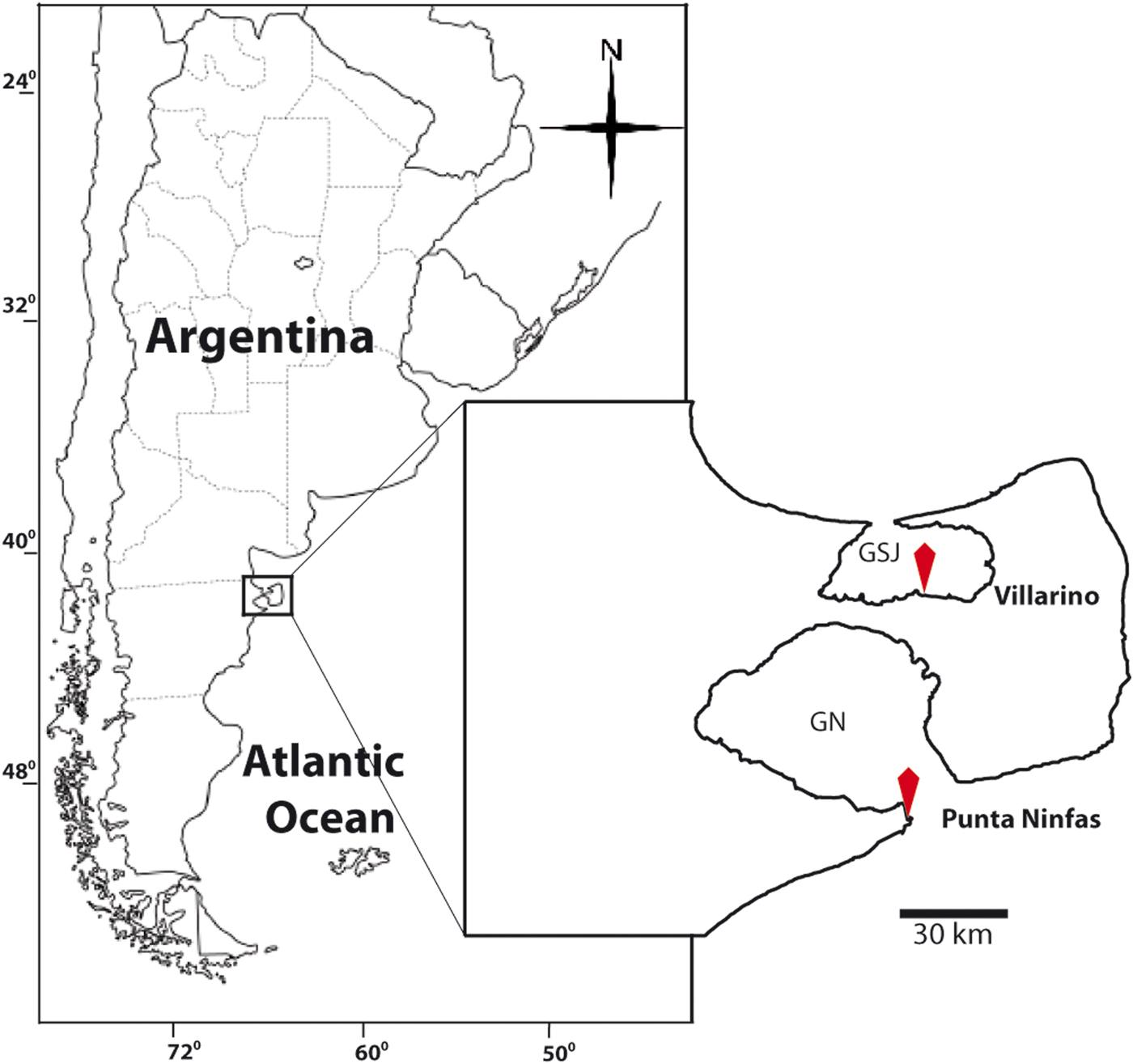
From September 2010 to July 2011, 83 specimens of Odontocymbiola magellanica, 149 of Buccinanops cochlidium and 644 of Trophon geversianus were collected monthly in Playa Villarino (San José Gulf) (42°24′10″S 64°17′26″W) by scuba diving, and 102 specimens of Buccinanops globulosus were captured by baited traps. Additionally, 170 specimens of Tegula patagonica and 50 of Nacella patagonica were caught monthly by hand-picking from January to December in 2012, in the rocky intertidal zone of Punta Ninfas (42°58′42″S 64°18′33″W) during low tides. Sampling was not done in August 2011 and in May 2012, due to adverse weather conditions (Figure 1). In San José Gulf artisanal fisheries of molluscs have been developed since the 1970s, capturing mainly scallops, but also gastropods of the species studied here. Punta Ninfas is an isolated place with very little human incidence. All the species studied were mature and are being consumed in the Patagonian coast or were established as potential fisheries resources (Bigatti et al., Reference Bigatti, Cumplido and Averbuj2015).
Sampling areas, Nuevo Gulf (GN): Punta Ninfas; San José Gulf (GSJ): Villarino.

Total lipids
Total lipids were determined using the colorimetric method of Zöllner & Kirsch (Reference Zöllner and Kirsch1962), with cholesterol as standard. Samples were dried at 60°C to constant weight and ground to a powder in a mortar. About 10 mg samples were weighed and boiled for 10 min in concentrated sulphuric acid. After cooling to room temperature, 50 µl of the solution received 1 ml colour reagent (containing 11.9 mol l−1 phosphoric acid and 8 mmol l−1 vanillin). The absorbance at 530 nm was measured using a SmatSpec 3000 spectrophotometer. Results were expressed as per cent dry weight of tissues. Analyses were performed in triplicate over a composite sample for each species. Precision values, expressed as the coefficient of variation were: T. geversianus: 13.1%; B. cochlidium: 9.8%; B. globulosus: 26.2%; O. magellanica: 2.0%; N. patagonica: 10.9%; and T. patagonica: 13.1%. In order to test accuracy, a combined sample of individuals of O. magellanica was submitted to addition of 5 ml (4.432 g) of olive oil to 50.0 g dried ground sample and the added sample was split into six replicates. The replicates were then analysed following the same method and the percentage of recovery was 110%.
Fatty acid profile
This analysis was performed over a composite sample for each species. About 30 mg of sample were subjected to methanolysis at 100°C for 1 h, with acetyl chloride/methanol reagent, according to Lepage & Roy (Reference Lepage and Roy1986). Previously, a solution of tricosanoic acid (C23:0) in toluene was added to each sample as internal standard, making 120 µg per sample. After cooling to room temperature, 5 ml of 6% K2CO3 aqueous solution was added. Fatty acid methyl esters (FAME) were extracted with n-hexane and separated by centrifugation, and the FAME samples were preserved in glass vials under N2 at −80°C. They were quantified using a gas chromatograph (Trace GC Ultra, Thermo Electronic Corporation) equipped with a mass spectrometer detector, split-splitless injection system and automatic injector (Triplus AS). FAME peaks were identified by comparing their retention times with those of 37 authentic FAME standards (Supelco Inc.). The mass spectra of FAME not present in the standard mix were compared with those from the National Institute of Standards and Technology mass spectra library (NIST) and Lipid Library data (Christie, Reference Christie2012). Quantification was done in SIM mode, using the Supelco mixture of FAME (CRM47885) making a calibration curve with the standards (5 points). To quantify recovery, 2-Br-hexanoic acid methyl ester was added, and the recovery was 72%. Results are presented in per cent abundance of total FAME and in concentration in the tissues, in μg mg−1. FA were grouped into saturated FA (SFA: FA with no double bond in the carbon chain), monounsaturated FA (MUFA: FA with one double bond in the carbon chain), polyunsaturated FA (PUFA: FA with two or three double bonds in the carbon chain) and highly unsaturated FA (HUFA: FA with four or more double bonds in the carbon chain).
Trace metals analysis
Before analysis, the gastropods were dried at 60°C to constant weight and carefully homogenized. Approximately 0.5 g of dried tissue was placed in a crucible in a muffle furnace and the temperature was slowly increased from room temperature up to 400°C for 6 h. After the sample was cooled down, 2 ml of concentrated HNO3 (Merck, PA) were added and evaporated to dryness on a sand bath at 80°C. This procedure was repeated until white ashes were obtained and then were resuspended with a mixture of HNO3 (3% v/v) and HCl (6% v/v) (Merck, PA) up to 10 ml (BOE, 1991). Two blanks were also prepared as samples. Measurements were performed in an IL-457 atomic absorption spectrophotometer with air-acetylene flame. Results are expressed in μg g−1 wet weight (μg g−1 ww).
Reference material NIST-SRM 1566a (oyster tissue) was used for the quality control of trace metal analysis. The precision for both metals, expressed as coefficient of variation, was below 7%. The accuracy, expressed as percentage of recovery, was 90 and 102% for Pb and Cd respectively. Detection limits were 0.8 (Pb) and 0.05 (Cd) μg g−1 ww.
Paralytic shellfish poison
The presence and concentration of paralytic shellfish poison (PSP) was determined monthly by mouse bioassay following the protocol of the AOAC (1995) on whole organisms of each species. Each sample was analysed in the Laboratory of Food Science of the Provincial Department of Environmental Health (Secretaría de Salud, Chubut-Argentina). The bioassay requires more than 100 g of wet sample. Thus, the analysis could not be performed in B. globulosus because of the low catches.
RESULTS
The mean shell length for each species was 14.47 ± 1.23 cm for O. magellanica, 8.09 ± 0.76 cm for B. cochlidium, 3.14 ± 0.59 cm for B. globulosus, 3.34 ± 0.69 cm for T. geversianus, 2.78 ± 1.15 g for T. patagonica and 3.03 ± 0.31 cm for N. magellanica. On the other hand, the mean weight for each species was 324.94 ± 91.37 g for O. magellanica, 60.41 ± 17.60 g for B. cochlidium, 6.13 ± 2.85 g for B. globulosus, 6.05 ± 3.78 g for T. geversianus, 3.5 ± 1.2 g for T. patagonica and 10.8 ± 3.8 g for N. magellanica.
Total lipids
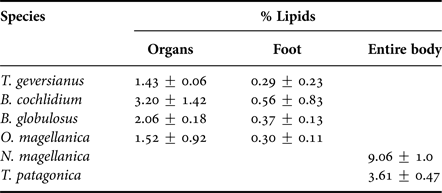
Total lipid concentration was higher in the whole body of N. magellanica (9.06%) while the foot of the other species showed the lowest values (0.29–0.56%) and the organs, 1.43–3.2% (Table 1).
Per cent total lipid concentration (dry weight ± SD).

Fatty acid concentration
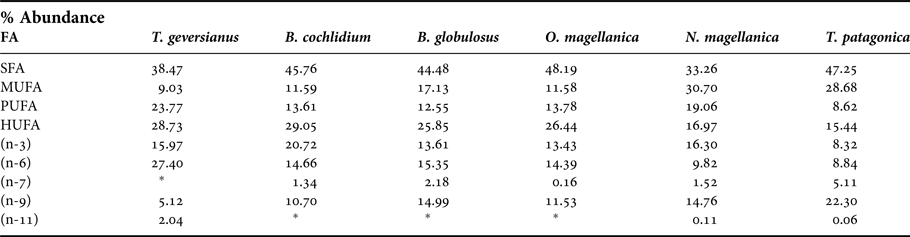
Species differed significantly in the concentration of the main FA. Nacella magellanica showed concentrations about five times higher than those of T. geversianus, B. cochlidium, B. globulosus and O. magellanica, and about twice higher than those of T. patagonica. Even when HUFA abundance was higher in T. geversianus, B. cochlidium, B. globulosus and O. magellanica, the concentrations of the nutritionally important HUFA AA and EPA were significantly higher in N. magellanica (Table 2).
Percentage of FA classes and families, expressed over the total FA in a composite annual sample.

* Non detected.
Considering relative abundances over the total of FA, SFA were the dominant FA class in all the species, ranging from 33.26% in N. magellanica to 48.19% in O. magellanica (Table 2). The dominance of SFA was due to the high abundance of palmitic acid (C16:0), which was the major FA in the six species, ranging from 17.72% in T. geversianus to 28.12% in T. patagonica. The second SFA in abundance was stearic acid (C18:0) ranging from 13.49% in T. geversianus to 18.56 in O. magellanica. However, it reached low abundances in N. magellanica (4.01%) and in T. patagonica (6.41%).
MUFA were abundant in N. magellanica (30.70%) and in T. patagonica (28.68%) and showed the minimum value in T. geversianus (9.03%) (Table 2). In this FA class, the common oleic acid (C18:1(n-9c)) showed variable abundances: 1.80% in O. magellanica, 4% in T. geversianus and B. cochlidium and it reached 7.74% in T. patagonica. Strikingly, it was not found in N. magellanica, which, instead, showed a high abundance of its trans-isomer, elaidic acid (C18:1(n-9t)). Another remarkable MUFA was C20:1(n-9), which showed high abundances in B. cochlidium (6.13%), B. globulosus (9.46%) and O. magellanica (9.22%) but had low abundance in T. patagonica (2.54%) and was not detected in N. magellanica. C22:1(n-11) was detected only in T. geversianus (2.04%) and in very low abundance in N. magellanica (0.11%). Two of the three unidentified C22 MUFA (which differed in their retention times as eluted from the chromatographic column) were found in fairly high abundances (ranging from 4.51% in B. globulosus to 9.02% in T. geversianus) except in N. magellanica.
PUFA were abundant, 23.77% in T. geversianus and in N. magellanica 19.06%, and showed low values in the other species (Table 2). It was remarkable that the essential FA linolenic acid (C18:3(n-3)) was not detected in any of the species, whereas its precursor, linoleic acid (C18:2(n-6)) was present in low percentages in all the species (ranging from 1.14% in O. magellanica to 2.64% in B. globulosus).
HUFA were the second class in abundance in T. geversianus, B. cochlidium, B. globulosus and O. magellanica (around 27%) while they were lower in N. magellanica and T. patagonica (around 16%) (Table 2). The high values of HUFA were due to the fairly high abundances of arachidonic acid (AA, C20:4(n-6)) and eicosapentaenoic acid (EPA, C20:5(n-3)) in most species and of C22:5(n-3) in B. cochlidium, B. globulosus and O. magellanica. AA abundances were high in T. geversianus (11.64%, B. globulosus (9.25%) and O. magellanica (9.98%)), while they did not exceed 7% in the other two species. EPA abundances were about 9% in T. geversianus, B. cochlidium and N. magellanica, but very low in O. magellanica (2%). Only T. geversianus showed a fairly high abundance of docosahexaenoic acid (DHA, C22:6(n-3)).
As for families of FA, (n-6) FA were dominant in T. geversianus, while (n-3) FA were dominant in B. cochlidium and both families showed similar levels in the other species. (n-9) FA were dominant in T. patagonica, showed high values in B. globulosus and N. magellanica but showed low values in T. geversianus. (n-7) FA were relevant only in T. patagonica and only one (n-11) FA was present in T. geversianus and in very low values in N. magellanica and T. patagonica (Table 2).
Trace metals analysis
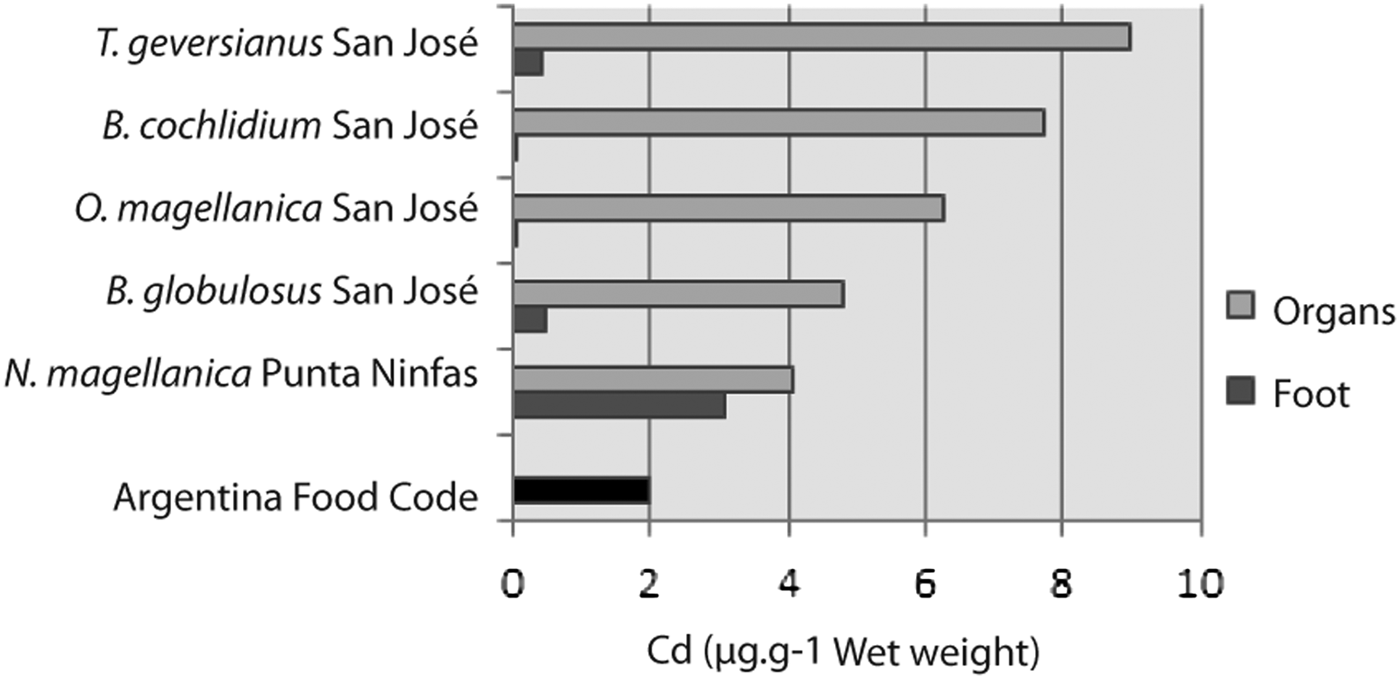
Lead (Pb) was not detectable (<0.8 µg g−1 wet weight) in any gastropod species analysed. On the contrary, cadmium (Cd) was detected in all the species, being more concentrated in organs than in the foot (Figure 2).
Cadmium concentrations in gastropods from Golfo San José and Punta Ninfas.

A maximum weekly consumption of foot was established as 5800 g for O. magellanica, 1450 g for B. cochlidium, 193 g B. globulosus and 290 g for T. geversianus, relative to the trace metal concentration for each species.
Paralytic shellfish poison
Organs of O. magellanica accumulating PSP exceeded the maximum limit of consumption (MLC = 800 µg STX eq kg−1 snail flesh) during January (1100 µg STX eq kg−1), February (1020 µg STX eq kg−1) and June (947 µg STX eq kg−1); while in the foot the PSP limit was exceeded only in February (838 µg STX eq kg−1). The accumulation of PSP in organs of B. cochlidium exceeded the limit of PSP in December with 4805 µg STX eq kg−1, while in the foot there was no accumulation of PSP, consumption of the foot thus being suitable throughout the year. The whole body of T. geversianus accumulated PSP below the maximum limit in October, December, April and May, meaning it is suitable for consumption throughout the year. PSP was not detected by bioassay in T. patagonica and N. magellanica.
DISCUSSION
Marine gastropods are consumed around the world; England, France, Mexico and Korea recorded the largest catches in recent years (FAO, 2015). Although in Argentina the resource has been commercially captured and declared since 1936 (Sánchez et al., Reference Sánchez, Navarro and Rozycki2012), it is consumed in low quantities in the local market but exports are reported. The implementation of new resources for the fishery is important to the regional economies, for the export of the resource and for human consumption.
Lipids play an important role in an animal's life history, due to their structural function in cells as a substrate to catabolism (Wiegand, Reference Wiegand1996). The percentage of body lipids are important in molluscs such as mussels because biochemical and gametogenic cycles are closely associated (Bayne, Reference Bayne1976). The percentage of lipids detected in the edible tissues of the species in this study (0.29–9.06%), was similar to that detected for commercial species worldwide (0.70–7.0%), such as Strombus gigas, Strombus gracilior, Thais haemastoma, Nacella macquarensis, Haliotis varia, Bursa spinosa, among others (Belisle & Stickle, Reference Belisle and Stickle1978; Simpson, Reference Simpson1982; Aranda & Marrufo, Reference Aranda and Marrufo1999; Najmudeen, Reference Najmudeen2007; Babu et al., Reference Babu, Venkatesan and Rajagopal2011).
Lipid deposition and metabolism are closely connected with the biogenesis of some specialized membranes, such as myelin, clearly indicating a role for lipids in neural function (Sastry, Reference Sastry1985; Akhlaq et al., Reference Akhlaq, Horrocks and Farooqui2000). The polyunsaturated and highly polyunsaturated fatty acids (PUFA and HUFA) have essential properties in human health, in particular ω-6, arachidonic acid, and ω-3, docosahexaenoic acid, are fundamental in the formation of the structure and the function of the human nervous and visual systems (Sastry, Reference Sastry1985; Valenzuela & Nieto, Reference Valenzuela and Nieto2003). All species under study had SFA as the main FA class, as these FA accounted for no less than 33% of total FA. The most abundant FA in all species was palmitic acid. The FA profile of the species under study differed in the degree of unsaturation. Trophon geversianus had the most unsaturated profile, since PUFA plus HUFA accounted for more than half of the total FA. However, this species had one of the lowest total FA concentrations; although these FA were relatively abundant, their actual concentrations in the tissues were low and their importance as essential FA suppliers could be minimal for human health. On the other hand, the sum of the abundances of PUFA plus HUFA in N. magellanica hardly reached 36% of total FA. However, the concentration of AA nearly doubled that of T. geversianus, where AA was relatively more abundant. A similar situation was found for EPA: the highest relative abundances of this FA were found in T. geversianus and in B. cochlidium. However, the actual concentration of EPA in these species was nearly four times lower than that in N. magellanica. Other FA important for human food are the essential oleic, linoleic (ω−6 unsaturated) and α-linoleic acids (ω−3 unsaturated), because mammals cannot synthesize them from carbon precursors and they are precursors to the biosynthesis of the longer chained polyunsaturated fatty acids (Mahaffey, Reference Mahaffey2004). Nacella magellanica had the highest concentration value of linoleic acid and was the only species that had linolenic acid in the FA profile, however in very low concentration. On the other hand, oleic acid was not detected in this species, whereas it showed high concentration of the trans isomer, elaidic acid.
The phylum Mollusca displays a variety of lipid and fatty acid components (Ackman et al., Reference Ackman, Hooper and Ke1971; Joseph, Reference Joseph1982). Babu et al. (Reference Babu, Kesavan, Annadurai and Rajagopal2010) found a similar distribution of FA classes to that reported in this work in the marine gastropod Bursa spinosa, with preponderance of SFA, followed by polyunsaturated FA (comprising what we consider PUFA plus HUFA). The dominant FA in that species was palmitic acid, with high abundances of EPA. A study reporting on Patella depressa found the same pattern, a preponderance of SFA (Morais et al., Reference Morais, Boaventura, Narciso, Ré and Hawkins2003).
A dietary source of ω-3 fatty acids is needed, since human enzyme systems cannot insert a double bond closer than the ω-9 position of a fatty acid of 18 carbons in length (Mahaffey, Reference Mahaffey2004). Linoleic acid cannot be synthesized by humans and a lack of it results in adverse clinical symptoms, including a scaly rash and reduced growth (IOM, Reference Board2001). Taking into account the high concentration of FA in N. magellanica, this species is the most suitable to be considered as a good human dietary supplement of essential FA.
Molluscs may accumulate different pollutants from the environment. Among them, Cd and Pb are two of the inorganic contaminants for which concentrations are limited by national and international regulations aimed at protecting biota and human health (SENASA, 2000; MERCOSUR, Reference Argentino2011). While the consumption of some species of marine gastropods has been growing in the region in recent years, the study of the presence of trace elements in their tissues is still limited (Primost et al., Reference Primost, Gil and Bigatti2017). These authors have detected some metals (aluminium, iron, zinc, copper, cadmium and lead) in the edible marine gastropods Adelomelon ancilla, Buccinanops globulosus and Trophon geversianus and their surrounding sediments and prey in Nuevo Gulf. In this research we analysed Pb and Cd levels in five different species, four from San José Gulf and one from Punta Ninfas, where human activities are incipient or null. Pb was undetectable in all samples, indicating that regarding this element, consumption of this species is not harmful for humans. However, Cd exceeded the maximum allowable limit by the ACC (2 µg g−1 wet weight) in all organ samples and in foot samples of N. magellanica (Punta Ninfas). Bioavailability of this metal in Patagonian coastal waters has already been reported and attributed to natural sources from the upwelling process. Cd retained in biota is generally stored in metallothioneins (MT), due to their high cysteine content. These low molecular weight and non-enzymatic proteins play a key role in the homeostatic control of the essential metals Zn and Cu (necessary to fulfil metabolic demands), but Cd and other elements are able to displace them. In this way, MT is also thought to be involved in the detoxification of non-essential trace metals and excess amounts of essential ones. Expression of MT genes shows interspecific diversity and this would influence Cd storage. In mammals, Cd is sequestered almost exclusively in liver and kidney, but in invertebrates Cd-binding proteins appear to be distributed in several tissues, including the foot (Amiard et al., Reference Amiard, Amiard-Triquet, Barka, Pellerin and Rainbow2006). Different authors have reported MT expression in the foot of different gastropods, such as the marine gastropod Littorina littorea (English & Storey, Reference English and Storey2003), the freshwater gastropod Melanopsis dufouri (Ureña et al., Reference Ureña, Bebianno, del Ramo and Torreblanca2010) and the terrestrial gastropod Helix pomatia (Chabicovsky et al., Reference Chabicovsky, Niederstätter, Thaler, Hödl, Parson, Rossmanith and Dallinger2003). The uptake of metals through the foot may be mainly via diffusion, however there is evidence of active take up by snails through the cells in the epithelial tissues of the foot. In general, the accumulation of Cd in the foot of gastropods is lower than in the visceral complex where organs such as the gills, digestive tract, digestive gland and the kidney comprise the entry, accumulation and detoxification sites of the metals (Bebianno & Langston, Reference Bebianno and Langston1992, Reference Bebianno and Langston1998; Langston et al., Reference Langston, Bebianno, Burt, Langston and Bebianno1998). The foot is composed of muscle and nervous tissue, so its participation in metal metabolism is much lower (Ureña et al., Reference Ureña, Bebianno, del Ramo and Torreblanca2010). In agreement with this, the ratio of Cd concentration for organ/foot obtained in this study was between ~10 and ~400 in species from San José Gulf and ~1 in gastropods from Punta Ninfas. The different patterns are probably related to the different environmental conditions of both sites and to specific characteristics of each species (animal size, growth rate, nutritional state, prey type and physiological condition). On the one hand, and contrary to San Jose Gulf stations, Punta Ninfas is directly influenced by the open ocean. Gastropods exhibit a wide range of feeding behaviours, making a generalization difficult even within the same family. The herbivorous gastropods are dominant grazers in Patagonian rocky intertidals and present a characteristic radula which allows the penetration of hard substrates (Hawkins et al., Reference Hawkins, Watson, Hill, Harding, Kyriakides, Hutchinson and Norton1989). Tegula patagonica generally feeds on the biofouling adhered to the seaweed Undaria pinnatifida (Teso et al., Reference Teso, Bigatti, Casas, Piriz and Penchaszadeh2009) and other algae, whereas N. magellanica feed over the rocky shores biofilm (Nieto Vilela, Reference Nieto Vilela2013), like many intertidal herbivores (Hawkins et al., Reference Hawkins, Watson, Hill, Harding, Kyriakides, Hutchinson and Norton1989). Gastropods as N. magellanica could accumulate concentrations from tens (muscle) to hundreds of thousand times (organs) higher levels of metals than those present in the seawater (Conti et al., Reference Conti, Stripeikis, Grazia Finoia and Tudino2012b). This is probably related with the alimentation of the species: it is known that N. magellanica feeds on the biofilm present on the hard bottoms this species inhabits (Nieto Vilela, Reference Nieto Vilela2013), and it is known that this is a source of concentration of many metals (Arribére et al., Reference Arribére, Campbell, Rizzo, Arcagni, Revenga and Guevara2010).
Beyond the reported distribution patterns between foot and organs, it is clear that human intake of gastropods may be related to the foot as well as to the whole soft tissues. Therefore, and on the basis of our results, the biomonitoring of Cd concentration in the analysed gastropods is highly recommended.
The accumulation of PSP in the tissues of gastropods coincided with the frequency of the harmful algal blooms, these being between late winter/early spring and late summer/early autumn in the southern hemisphere (Santinelli et al., Reference Santinelli, Sastre, Esteves, Sar, Ferrario and Reguera2002).The feeding habits and habitat of the gastropods suggested that the primary source of the toxins was a benthic organism (Kotaki et al., Reference Kotaki, Oshima and Yasumoto1981). In Patagonia, PSP accumulation in carnivorous gastropods (O. magellanica, B. cochlidium, B. globulosus and T. geversianus) could be related to the ingestion of bivalve prey, such as Aequipecten tehuelchus, Ensis macha, Leukoma antiqua, Mytilus edulis and Brachidontes spp. In herbivorous gastropods (N. magellanica and T. patagonica), this accumulation occurs due to browsing over biofouling with accumulated cysts. Since T. patagonica scraped off biofouling, it could accumulate PSP by ingesting A. tamarense cysts trapped in the biofilm. However, this toxin was not detected in T. patagonica during the period of sampling although closures were established for the harvesting of bivalves and gastropods in Chubut coastal waters during the sampling period. This could be related to the fact that A. tamarense was not epiphytic, and it was therefore not associated with sheets of macroalgae, thus, cysts were not in contact with the biofilm. On the other hand, although N. magellanica feeds on the bottom, toxin was not detected in its body. Probably, the dynamic conditions of Punta Ninfas, exposed to a regime of constant waves (open sea), made cysts accumulation difficult.
Our results can be used to give guidelines to ensure the safety of these resources as food, since they are being consumed in the zone and may be commercialized massively in the near future. Monitoring these and other food resources is essential and should be performed in any established fishery of the species reported upon here prior to human consumption.
ACKNOWLEDGEMENTS
This is publication #87 of the Laboratorio de Reproducción y Biología Integrativa de Invertebrados Marinos (LARBIM).
FINANCIAL SUPPORT
The authors acknowledge CONICET (PIP 067) and ANPCyT (PICT 1232 and 2709) for financial support of this work.