The Amplatzer Septal Occluder is one of the most frequently used percutaneous devices for the closure of atrial septal defect type II – secundum atrial septal defect. Complications of this procedure include device embolisation/malposition, arrhythmias, cardiac perforation, thrombus formation, and device erosion, with infection being the least common.Reference Masura, Gavora and Podnar 1 , Reference Majunke, Bialkowski and Wilson 2 Late bacterial endocarditis after Amplatzer Septal Occluder treatment has been reported rarely.Reference Slesnick, Neugent, Fraser and Cannon 3 – Reference Aruni, Sharifian and Herrera 5 We describe a case of incomplete endothelialisation of an Amplatzer Septal Occluder device followed by meningitis and late acute bacterial endocarditis in a young woman.
Case description
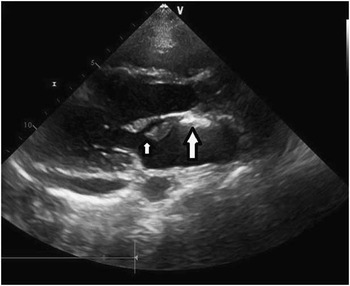
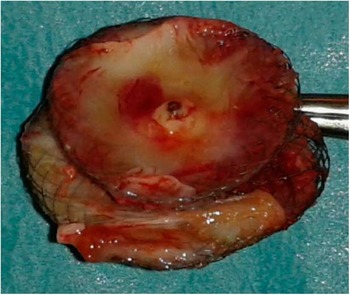
A 17-year-old girl with a history of moderate-sized secundum atrial septal defect underwent transcatheter closure with a 24-mm Amplatzer Septal Occluder device (ASO-AGA Medical Corporation, Golden Valley, Minnesota, United States of America). The stretch diameter of the atrial septal defect was 24 mm, and there was no residual shunt after implantation. Approximately 24 months later, the patient was admitted to the Infectious Disease Department with symptoms of acute bacterial meningitis, such as unconsciousness, headache, vomiting, and nuchal rigidity, confirmed by lumbar puncture. Antibiotics treatment with ceftriaxon, ampicillin, metronidazol, and fluconazol was initiated. Owing to the positive blood culture for Staphylococcus aureus, vancomycin was introduced. Significant clinical improvement was achieved within a few days. In the transthoracic echocardiogram, a mobile echogenic mass (14×7 mm) suggestive of vegetation/infected thrombus in the left atrial surface of the device was observed (Fig 1). Low molecular weight heparin was included to the therapy. The patient in a stable condition was transferred to our centre. Antibiotics and low molecular weight heparin therapy were continued. In the following echocardiography examinations, the vegetation disappeared but moderate mitral regurgitation with prolapse of the posterior leaflet appeared. After normalisation of acute biochemical infection markers, the patient was operated. The device was removed, the atrial septal defect was closed with a pericardial patch, and mitral valvuloplasty in the basal part of the posterior leaflet was performed. In the removed device, there was a lack of endothelialisation signs in the peripheral parts of the device and the left hub (Fig 2). The post-surgical course was uneventful. In the echocardiographic examination, only a trivial mitral regurgitation was seen. At 1 month follow-up, the patient remained in good condition, without any additional complications.
Transthoracic echocardiographic image in the parasternal long-axis plane showing the device (bigger arrow), parallel to the mitral valve vegetation starting from the lower ridge of the left atrial device disc (smaller arrow).

Explanted Amplatzer septal occluder device 2 years after implantation showing incomplete endothelialisation of the device.

Comment
Device infection may occur in two ways: either through introduction of microbes during the procedure or secondary to seeding of microorganisms at a later time. After device implantation, it is assumed that it takes 6 months for complete endothelialisation, which reduces the risk of infective endocarditis.Reference Wilson, Taubert and Gewitz 6 Nevertheless, if one counts the reported incidence of bacterial endocarditis with respect to the number of implanted devices, it may show an even lower incidence compared with the incidence within the general population.
The diagnosis of meningitis was established in our patient because of suggestive neurological symptoms. It is impossible to exclude that endocarditis was the underlying neuroinfection, especially when considering the fact that the young, healthy woman had no obvious reason for streptococcal meningitis; however, the patient had an incomplete implant endothelialisation, and this could have been a risk factor for endocarditis.
In cases described in the literature thus far, late endocarditis after Amplatzer Septal Occluder application appears both in children and adults. In our case, it was present in a 19-year-old woman without any additional co-morbidity 2 years after Amplatzer Septal Occluder implantation. We found in the literature three similar cases of late bacterial endocarditis. Slesnick et alReference Slesnick, Neugent, Fraser and Cannon 3 presented a 4-year-old child with mitral valve prolapse with endocarditis appearing 12 months after Amplatzer Septal Occluder placement. Zahr et al described a 66-year-old man with extended co-morbidity and endocarditis 30 months after the procedure. Aruni et al in another publication reported a 59-year-old man with congestive heart failure and an implanted cardioverter defibrillator. Time of appearance of late endocarditis was not mentioned precisely (probably years).Reference Zahr, Katz, Toyoda and Anderson 4 , Reference Aruni, Sharifian and Herrera 5 In two studies, it was mentioned that devices were removed surgically and poor endothelialisation was observed in both, as in our case.Reference Zahr, Katz, Toyoda and Anderson 4 , Reference Wilson, Taubert and Gewitz 6 If delayed or missing endothelialisation may play a key role in these cases, one could speculate it in two ways. The incidence of partial misendothelialisation must be very low among the implanted devices, otherwise a higher endocarditis rate should be found or the missing endothelialisation may be only a co-factor of endocarditis.
Another problem was the infective endocarditis in Amplatzer Septal Occluder that presented shortly, <6 months, after the procedure.Reference Balasundaram, Anandaraja, Juneja and Choudhary 7 , Reference Bullock, Menahem and Wilkinson 8 The latter emphasises the significance of aseptic precautions during cardiac catheterisation and interventional procedures.
No human studies defining the endothelialisation of Amplatzer Septal Occluder devices exist. Considering worldwide acceptance and increasing utilisation of nitinol wire mesh occluders, certain number of patients with delayed endothelialisation should be expected. They might be at risk of late infectious complications.
A 6-month-long bacterial endocarditis prophylaxis dedicated for patients after device implantation was arbitrarily determined, and that treatment schedule has been continued as standard of care. The above-mentioned singular cases of late endocarditis after implantation of an Amplatzer Septal Occluder device illustrate the need for long-term follow-up of patients who have received nitinol wire mesh occluders, as well as an increased level of suspicion for device complications if these patients present with septic or embolic phenomenon. It is not proven whether a prolongation of the prophylaxis may have avoided the described endocarditis episode. These rare incidences may not influence the recommendation for endocarditis prophylaxis after device implantation.
We present the following conclusions:
-
∙ In any patient with a septal occluder and generalised infection, transthoracic echocardiography or in doubtful cases transoesophageal echocardiography should be performed as soon as possible to exclude endocarditis.
-
∙ In our opinion, surgical removal of the device is mandatory in such cases.
Acknowledgements
None.
Financial Support
This research received no specific grant from any funding agency, commercial, or not-for profit sectors.
Conflicts of Interest
None.