INTRODUCTION
Host range is a key element of parasite evolution (Combes, Reference Combes2001). For example, host-generalists have a lower risk of going extinct, as they are not dependent on the long-term survival of a particular host lineage. On the other hand, specialization on one host species is expected to result in greater local adaptation, including the evolution of more effective strategies to circumvent the defences of a particular type of host. Particularly interesting is the potential connection between host range and parasite virulence: the ability to infect multiple hosts has been associated with lower replication rates on any particular host species, resulting in reduced virulence for generalist parasites (Benmayor et al. Reference Benmayor, Hodgson, Perron and Buckling2009; Leggett et al. Reference Leggett, Buckling, Long and Boots2013).
Mites of the genus Demodex provide a compelling system to investigate the effect of host-specificity on parasite evolution. They live in the hair follicles and sebaceous glands of mammals (Desch and Nutting, Reference Desch and Nutting1972). Although the vast majority of hosts are asymptomatic, the pathogenic potential of Demodex is well-documented (Lacey et al. Reference Lacey, Raghallaigh and Powell2011). For example, high Demodex densities are associated with two medically important disorders of the skin in humans – marginal blepharitis (Zhao et al. Reference Zhao, Wu, Hu and Xu2012) and acne rosacea (Jarmuda et al. Reference Jarmuda, O'Reilly, Zaba, Jakubowicz, Szkaradkiewicz and Kavanagh2012). In other mammals, demodicosis, also called demodectic mange, results from over-proliferation of these mites (e.g. Bukva et al. Reference Bukva, Vitovec, Moucha and Vahala1988; Matthes, Reference Matthes1994; Singh and Dimri, Reference Singh and Dimri2014; Kim et al. Reference Kim, Lee and Kwak2015). Treatment with acaricides, such as ivermectin, is generally curative for these diseases. High mite densities, resulting in skin diseases, have been observed to occur more often when the host immune system is compromised (e.g. Ivy et al. Reference Ivy, Mackall, Gore, Gress and Hartley1995), suggesting an antagonistic relationship between mites and host. Indeed, there is some evidence that the mites may even suppress the host immune system (Barriga et al. Reference Barriga, Al-Khalidi, Martin and Wyman1992). Taken together, these results suggest that Demodex are opportunistic parasites, typically having little effect on the host, but expressing higher levels of virulence in some host environments.
Demodex species have been described from hosts in three of the seven marsupial orders, and in 11 of the 18 eutherian orders (Desch, Reference Desch2009). They have evolved morphological specializations for residence in the constricted spaces of the pilosebaceous complex – their bodies are just 100–300 µ m long and cylindrical in shape, with extremely reduced legs and setation. Estimates of the divergence time between the two species living on humans, based on relaxed molecular clock analyses of mitochondrial proteins, suggest that these mites have inhabited mammalian skin for at least 136 million years (Palopoli et al. Reference Palopoli, Minot, Pei, Satterly and Endrizzi2014). These observations indicate an ancient association between mammals and Demodex mites, although surprisingly little is known about the evolution of this relationship.
Demodex species have long been thought to be strictly host-specific. First, there is no direct evidence that they are transmitted by vectors, and only one report that they can persist outside of the host (Spickett, Reference Spickett1961). This suggests that direct contact between hosts is required for transmission, which would make movement across species boundaries much less likely. Second, different host species generally have mites with distinct morphologies (Nutting and Desch, Reference Nutting, Desch and Rodriguez1979), which is predicted if hosts and parasites cospeciate. More recently, the strict host-specificity of Demodex has been challenged by the discovery that mites with the same morphology can be found on multiple host species (e.g. Desch et al. Reference Desch, Lukoschus and Nadchatram1984; Desch, Reference Desch1987). In particular, the morphospecies Demodex kutzeri has been isolated from several host species within the family Cervidae, including hosts belonging to different subfamilies (Bukva, Reference Bukva1987; Desch et al. Reference Desch, Andrews, Baeten, Holder, Powers, Weber and Ballweber2010). If mites from such divergent hosts are indeed members of the same species, this would suggest that D. kutzeri has an effective mechanism for host-switching, even allowing movement across host-species boundaries. This and other examples of mites that appear to inhabit multiple host species, however, could be explained if these mites are actually cryptic species. This would not be unusual – there are many examples of morphologically indistinguishable organisms that have turned out to represent distinct species (Bickford et al. Reference Bickford, Lohman, Sodhi, Ng, Meier, Winker, Ingram and Das2007).
In the present study, we sequenced portions of the mitochondrial genome from mites found on two host species within different subfamilies of the Cervidae – Rocky Mountain elk (Cervus elaphus nelsoni) and mule deer (Odocoileus hemionus hemionus) – that last shared a common ancestor more than 7 million years ago (Pitraa et al. Reference Pitraa, Fickela, Meijaardb and Groves2004; Gilbert et al. Reference Gilbert, Ropiquet and Hassanin2006). We used these data to test the hypothesis that Demodex are strictly host-specific, which would be expected to result in these mites cospeciating with their hosts. We tested this model at two levels: First, we estimated the divergence time between mites found on elk vs humans; cospeciation would predict that the divergence time between parasites should mirror closely that between host lineages. Second, we estimated the level of sequence divergence between mites found on elk vs mule deer; if these mite lineages separated when their host lineages split, then this should be recorded as substantial divergence in their mitochondrial genomes.
MATERIALS AND METHODS
Mite samples and DNA extraction
Samples of mites isolated from elk and mule deer were provided in 70% ethanol (EtOH) by Clifford E. Desch. Both elk and mule deer hosts were from Colorado, and were hunter-harvested by game management units (Desch et al. Reference Desch, Andrews, Baeten, Holder, Powers, Weber and Ballweber2010). In both cases, the mites were sampled from demodectic nodules, and represented pure populations of what was identified morphologically as D. kutzeri, based on specimens mounted in Hoyer's medium and viewed with phase contrast optics (C.E. Desch, 2008 personal communication).
Ten mites from each host species were pipetted individually into 0·5 mL microcentrifuge tubes, each in 5 µL of 70% EtOH. To each tube was added 95 µL of nanopure water, then the tubes were heated to 90 °C for 15 min with their caps open in order to evaporate as much of the EtOH as possible. Finally, each mite was ground against the side of the tube with a P10 pipette tip under a dissecting microscope. Finally, total genomic DNA was isolated from each mite sample using the DNeasy Blood and Tissue Kit (QIAGEN, Valencia, CA).
Primers used for amplification of four mitochondrial genes from the follicle mite Demodex kutzeri in two cervid host species
Original fragment of COX2:
TGATACTGAACNTACWMCTACCCA
CCGCANAWTTCTGAGCATTGNCCT
Long-range PCR:
CTAAAAATCGACTCAATCCCAGGACG
CTCGTACTCATGTTTTTCTTGGGGC
Full-length Elk-mite genes:
COX1F: CTACCTCACACACCATTC
COX1R: GGTAGTCTCTTCATCTGG
COX2F: CCAACAGAAAGCCACAC
COX2R: GTGGGGTGAGATTTGAGGTA
COX3F: CCAACCCACTCATTATTCC
COX3R: GAGGCTGTTAATGGGATTG
CYTBF: CACATCAACCATCTTATGCTTCC
CYTBR: GGTTTTGGAAAGATTTGTTAGTG
Elk and Mule Deer gene fragments:
COX1-399F: ATACCACAACAACCTATCTGTAGA
COX1-898R: CTCGTGTGTCTACATCTATTCCTA
COX2-143F: AATCCAGATGAAGAGACTACCTAG
COX2-617R: TGGATTGTTGATGGTATAAATCTGT
COX3-154F: TCATCCATACTCTGATGAAACAAC
COX3-666R: CCTATATCTAACGAATAACACGCC
CYTB-350F: TACTAATCCTAATAGCAACAGCCT
CYTB-837R: TCGTAAGATTGAGTATGCGAATAG
PCR amplification and sequencing
To amplify a fragment of the mitochondrial genome from the elk mites that were identified morphologically as D. kutzeri, a variety of degenerate primer pairs were designed based on alignments of known mitochondrial DNA sequence from two human mites, Demodex brevis and Demodex folliculorum (Palopoli et al. Reference Palopoli, Minot, Pei, Satterly and Endrizzi2014). Step-down PCR was used, with annealing temperatures of 54 °C × 3, 52 °C × 3, 50 °C × 3 and 48 °C × 25. Successful amplification was achieved for a fragment of the cytochrome c oxidase subunit II (COX2) gene from an elk mite (see Box 1 for the degenerate primers used), and this PCR product was sequenced directly via Sanger sequencing. Overlapping forward- and reverse-strand sequences were obtained.
Based on this sequence, long-range PCR primers (Box 1) were designed to amplify the rest of the D. kutzeri mitochondrial genome from an elk mite. Takara LA Taq (Clontech Laboratories, Mountain View, CA) was used with step-down PCR: annealing temperatures of 68 °C × 3, 64 °C × 3, 60 °C × 3 and 58 °C × 3 and extension times of 15 min for each cycle. The result was a PCR product >10 kb in length that was sent to the University of Delaware Sequencing and Genotyping Center, where BluePippin size selection of DNA >10 kb was followed by Pacific Biosciences library preparation and SMRT cell sequencing. The result was a low-quality sequence; nevertheless, alignments with D. brevis and D. folliculorum suggested that these reads covered the complete mitochondrial genome of an elk mite.
To obtain high-quality sequence for portions of the mitochondrial genome, primers (Box 1) were designed to amplify the complete coding sequences of four protein-coding genes: cytochrome c oxidase subunit I (COX1), COX2, cytochrome c oxidase subunit III (COX3) and cytochrome b (CYTB). Sequencing primers (not listed) were used to generate overlapping forward- and reverse-strand sequences for the entire length of each gene.
Finally, to measure sequence variation among mites from the two cervid hosts, PCR products were generated and sequenced using primers (Box 1) that amplified approximately 500 bp fragments of each gene. Ten mites were sampled from each host species. Of these, eight samples amplified consistently from elk, and nine from mule deer. For each mite sample that amplified successfully, a corresponding negative control (lacking template) failed to amplify, insuring that we were not generating repeated amplifications of a contaminating template.
The new mitochondrial gene sequences reported in this paper are available in the GenBank repository, accession numbers KY063074–KY063081.
Phylogenetic analysis
Complete DNA sequences from an elk mite for the four genes of interest were used for phylogenetic analysis. The maximum clade credibility tree, together with estimates of divergence times, was generated using the approach detailed in Palopoli et al. (Reference Palopoli, Minot, Pei, Satterly and Endrizzi2014). Briefly, mitochondrial DNA sequences from a collection of Acariformes, including D. brevis and D. folliculorum from humans, were downloaded from the NCBI database for comparison. Sequence from the horseshoe crab were included as an outgroup. All DNA sequences were translated into amino acid sequences to minimize the influence of mutation saturation on the results. Amino acid sequences of all four genes were aligned using the MAFFT algorithm as implemented in the GUIDANCE web server (Penn et al. Reference Penn, Privman, Ashkenazy, Landan, Graur and Pupko2010). Based on the concatenated alignment, phylogenetic analysis was conducted using a Markov chain Monte Carlo search of parameter space as implemented in BEAST (v. 1.7.4) (Drummond et al. Reference Drummond, Suchard, Xie and Rambaut2012). To calibrate the molecular clock, we used a fossil calibration density as the prior for the age of the Acariformes, based on the appearance of members of this group in the fossil record approximately 410 mya (Dunlop and Selden, Reference Dunlop and Selden2009). The analysis was run with three different fossil calibration densities to insure that divergence time estimates were not influenced by the specific calibration density chosen. Adequate mixing and effective sample sizes of model parameters were confirmed using Tracer (version 1.5). Finally, TreeAnnotator (version 1.7.4), FigTree (version 1.4.0), and Adobe Illustrator (CS5) were used for generation of the final phylogeny figure.
Sequence variation
Sequences of the four mitochondrial genes were compared among eight elk mites, and separately among nine mule deer mites. Levels of sequence divergence between the mites from these two different cervid host species were also estimated for these genes. For comparison, the level of sequence divergence for the host species themselves was estimated based on mitochondrial sequences downloaded from the NCBI database. Estimates of silent-site sequence divergence were calculated using the method of Kimura (Reference Kimura1980) as implemented in MEGA (version 6.0) (Tamura et al. Reference Tamura, Stecher, Peterson, Filipski and Kumar2013). The bar chart comparing silent-site divergence among hosts vs among parasites was generated in Prism (Graphpad Software) and modified in Adobe Illustrator (CS5).
RESULTS
Phylogeny and divergence time
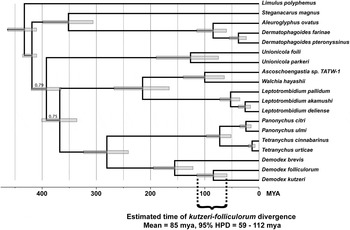
Phylogenetic analysis placed D. kutzeri as a sister taxon to D. folliculorum, with high Bayesian posterior probability (Fig. 1). Traditional groupings within the Acari were also supported. For example, the maximum clade credibility tree recovered the Acariformes as monophyletic, with the expected deep split into Trombidiformes and Sarcoptiformes. Within the Trombidiformes, the Eleutherengona and Parasitengona were recovered as monophyletic groups. As expected, the Demodex taxa fell within the Eleutherengona.
Phylogenetic analysis using a relaxed molecular clock to estimate the age of divergence among Demodex species. Except where noted, each node had a posterior probability of 1·0. The 95% highest probability densities for time to most recent common ancestor are depicted as grey rectangles. Traditional groupings within the Acari were recovered. Fossil calibration is based on the minimum age of 410 mya for the origin of the Acariformes. The estimated mean time to the most recent common ancestor of the D. kutzeri and D. folliculorum lineages was 85 mya, with a 95% highest probability density of 59–112 mya.

Based on the relaxed molecular clock analysis, the common ancestor of D. kutzeri and D. folliculorum existed 85 mya, with the 95% highest posterior density for this estimate ranging from 59 to 112 mya (Fig. 1).
Sequence variation within the morphospecies D. kutzeri
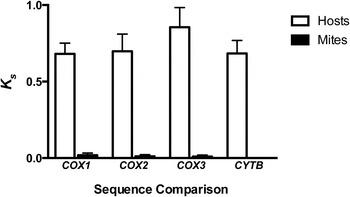
All eight sequences generated from elk mites were identical to each other for all four genes examined. The same was true for the nine mule deer mites. Low levels of silent-site divergence were observed when the sequences from mites on the separate host species were compared. Across all four genes compared between these mite populations, four silent sites were consistently different; no replacement substitutions were observed. Silent-site divergence was much lower for mites isolated from the two different host species than for the hosts themselves (Fig. 2).
Comparison of silent-site divergence between mites and their cervid hosts. In all cases, divergence was much lower for mites isolated from the two different host species than for the hosts themselves.

DISCUSSION
The relaxed molecular clock analysis indicated that the common ancestor of D. kutzeri from elk and D. folliculorum from humans diverged 85 mya (Fig. 1). This result agrees very closely with the molecular clock estimate of 84 my separating the primate and Artiodactyla host lineages (dos Reis et al. Reference dos Reis, Inoue, Hasegawa, Asher, Donoghue and Yang2012), as predicted by the cospeciation model. In other words, the close agreement between divergence times of parasites and hosts indicates that the mite lineages split at the same time as their host lineages. Since host-specialists are expected to cospeciate with their hosts, whereas host-generalists are not, these results are consistent with the hypothesis that Demodex tend to specialize on one particular host lineage.
On the other hand, the extremely low levels of sequence divergence observed between elk and mule deer mites suggest strongly that these mites are actually members of the same species, which has been identified as D. kutzeri based on morphology. Elk and mule deer have been separated for more than seven million years (Pitraa et al. Reference Pitraa, Fickela, Meijaardb and Groves2004; Gilbert et al. Reference Gilbert, Ropiquet and Hassanin2006). If the mites had speciated together with their hosts, this divergence time should have been reflected by the accumulation of extensive differences in their mitochondrial genomes. Indeed, given the fact that the parasites have a much shorter generation than their hosts (approximately 14·5 days; Spickett, Reference Spickett1961), it is expected that sequence divergence between the mites should rise to at least the level of sequence divergence between their hosts (e.g. Johnson et al. Reference Johnson, Allen, Olds, Mugisha, Reed, Paige and Pittendrigh2014); instead, mite divergence was observed to be much lower (Fig. 2). Furthermore, our estimate of silent-site divergence for D. kutzeri on the two cervid host species falls well within the levels of sequence variation observed within another Demodex species (Palopoli et al. Reference Palopoli, Fergus, Minot, Pei, Simisond, Fernandez-Silvad, Thoemmes, Dunn and Trautwein2015). We conclude that there has been recent movement of the parasite species D. kutzeri across host species boundaries. Apparently the environment of the pilosebaceous complex, together with any interaction between D. kutzeri and the host immune system, are sufficiently conserved to allow the mite to successfully inhabit the skin of these two host species.
Demodex movement between host species has been demonstrated using DNA sequence data for one other species, D. canis. This mite species normally lives on the skin of the domestic dog (Canis familiaris; Nutting, Reference Nutting1976). Surprisingly, however, DNA sequence from D. canis has been detected on hosts as phylogenetically distant as domestic cats (Felis catus; Ferreira et al. Reference Ferreira, Sastre, Ravera, Altet, Francino, Bardagí and Ferrer2015) and big brown bats (Eptesicus fuscus; Lankton et al. Reference Lankton, Chapman, Ramsay, Kania and Newkirk2013). These results for D. canis, considered together with our results for D. kutzeri, suggest that movement across species boundaries is not necessarily a rare event for follicle mites.
The results of the molecular clock analysis of D. kutzeri are consistent with long-term host fidelity and cospeciation; on the other hand, the lack of sequence divergence between mites from elk and mule deer indicate the ability to move across host species boundaries. These results can be reconciled if the evolution of host-specificity has been gradual in D. kutzeri – over relatively short timescales (i.e. at least seven million years, in this case), movement across species boundaries has remained frequent enough that gene flow prevented speciation; over much longer timescales, however, movement across host species became unlikely, resulting in cospeciation when viewed at this level. This pattern is common among parasites, with host range generally restricted to more closely related species (Perlman and Jaenike, Reference Perlman and Jaenike2003; Sorenson et al. Reference Sorenson, Balakrishnan and Payne2004; Streicker et al. Reference Streicker, Turmelle, Vonhof, Kuzmin, McCracken and Rupprecht2010; Longdon et al. Reference Longdon, Hadfield, Webster, Obbard and Jiggins2011), although this is the first time that this pattern has been observed for mites of the genus Demodex.
The mechanism of D. kutzeri transfer between hosts is unclear. Demodex are known to be transferred via direct physical contact between hosts (e.g. Bukva, Reference Bukva1990), such as occurs during mating, nursing or mutual grooming. In the case of elk and mule deer, although their geographic ranges overlap (Valerius, Reference Valerius1998), direct physical contact seems unlikely. Nevertheless, it remains possible that elk and mule deer will occasionally mate with each other, as has been demonstrated between other species of the Cervidae (e.g. Abernethy, Reference Abernethy1994). If interspecific matings indeed occur, D. kutzeri could move across host species boundaries during these brief periods of direct physical contact. Alternatively, D. kutzeri may have evolved an alternative mechanism of host-switching that enables it to move between hosts of different species. For example, perhaps D. kutzeri can be transmitted among host species via a mobile vector (e.g. eggs sticking to deer fly bristles). Alternatively, it is possible that at least one life stage (e.g. eggs) of D. kutzeri are shed into the environment, such as onto dense foliage, and can then be picked up by other hosts.
Movement across species boundaries reduces the risk of extinction, since the parasite's fate is not tied to the survival of any particular host lineage. On the other hand, specialization on one particular host can lead to greater local adaptation. D. kutzeri seems to have evolved a mixed strategy – by moving between relatively closely related host species, the risk of extinction is reduced over the short term; however, long-term host fidelity presumably allows for greater local adaptation and a competitive advantage on one particular host lineage.
More-virulent parasites have been observed to have narrower host ranges than less-virulent parasites (e.g. Garamszegi, Reference Garamszegi2006). This can be interpreted as evidence for greater local adaptation, including the ability to circumvent host defences. Although Demodex can be pathogenic in some hosts, they generally exhibit extremely low levels of virulence. The apparent long-term host specificity of D. kutzeri suggests that specialist parasites do not necessarily evolve greater virulence. However, the observed low levels of virulence can perhaps be explained by a mixed parasite strategy, with retention of the ability to move between host species for a protracted period of time. This could reduce the extent of local adaptation to a particular host environment, thereby reducing the tendency to evolve high levels of virulence.
Additional studies of Demodex host range, ideally using molecular markers to confirm that the same mite species exists on separate host species, are needed. At present, the results for Demodex are mixed. The general observation that mites isolated from phylogenetically distant hosts tend to be morphologically distinct from each other indicates that the mites on separate host lineages represent separate species, with host-specialization being common. Recent molecular results, however, indicate that the situation is more complex, with host-generalism as a more common strategy for Demodex than has been appreciated. If it is common for Demodex species to evolve as host-generalists, then this could help to explain the low virulence observed in this host–parasite system.
ACKNOWLEDGEMENTS
We thank Clifford E. Desch for providing the mite samples used in this study. We also thank Janet Gannon and the students of Biology 216 for helping to provide some preliminary results.
FINANCIAL SUPPORT
This project was supported by grants from the National Center for Research Resources (grant number 5P20RR016463-12), National Institute of General Medical Sciences (grant number 8 P20 GM103423-12) from the National Institutes of Health, the HHMI Undergraduate Science Program, and Bowdoin College.