

In recent years, political scientists have used insights from psychology in conjunction with new experimental tools to investigate how emotions guide political behavior. As a result, there is now a thriving literature focused on the effects of emotions in political contexts (e.g. Brader Reference Brader2006; Gadarian and Albertson Reference Gadarian and Albertson2014; Marcus et al. Reference Marcus, Neuman and MacKuen2000; Neuman, Marcus, Crigler, and MacKuen Reference Neuman, Marcus, Crigler and MacKuen2007; Redlawsk Reference Redlawsk2006; Ryan Reference Ryan2012; Valentino et al. Reference Valentino, Banks, Hutchings and Davis2009; Zeitzoff Reference Zeitzoff2013). While the literature on the effects of emotions is now quite developed, scholars know less about the political antecedents of emotions: what circumstances cause an emotion to occur—or not. This deficit is an obstacle, because it limits what researchers can say about dynamic conceptions of politics—how emotions “ebb and flow as a function of changes in real-world conditions” (Nardulli and Kuklinski Reference Nardulli, Kuklinski, Neuman, Marcus, Crigler and MacKuen2007, 331). Here, we begin to examine how personality traits moderate the emotions citizens experience when they read the news. We focus on one trait in particular: need for affect (NFA). Using a survey experiment conducted on a national sample, we find that citizens high in NFA have an especially vivid emotional experience when they read disturbing political news. The moderating relationship is large both substantively and in comparison to a number of symbolic attachments.
We begin by reviewing the literature that motivates our conjectures about NFA, before turning to our empirical test.
PERSONALITY, EMOTIONS, AND THE NEED FOR AFFECT
What literature there is on the antecedents to politically relevant emotions can be divided into two broad categories. First, there are studies that focus on the emotion elicitor (e.g. what kinds of events trigger anger versus fear).Footnote 1 Separate from these are studies that focus on individual traits that might moderate the emotional experience, even holding aspects of the trigger constant.Footnote 2 For instance, researchers have examined the moderating role of partisanship (Brader and Valentino Reference Brader, Valentino, Neuman, Marcus, MacKuen and Crigler2007), political sophistication (Gadarian Reference Gadarian, Sinclair and Antonius2013), and race (Albertson and Gadarian Reference Albertson, Gadarian, Freeman, Hansen and Leal2013). Although there is a substantial literature in psychology finding processing styles to regulate the emotional experience (Bolger and Schilling Reference Bolger and Schilling1991; John and Eng Reference John, Eng and Gross2013; Matthews et al. Reference Matthews, Deary and Whiteman1998), and although personality has received renewed interest in political science (Gerber et al. Reference Gerber2010; Reference Gerber, Huber, Doherty and Dowling2012; Mondak Reference Mondak2010), there are few if any studies suited to test how personality characteristics moderate the experience of political emotions.
The large number of personality traits—there are potentially hundreds (John and Robbins Reference John, Robins, Craik, Hogan and Wolfe1993, for a discussion)—necessitates limiting the scope of inquiry. We focus on one personality trait that might be particularly useful in predicting which citizens are most likely to experience vivid emotions in response to political news: NFA. Following the insight (Cacioppo and Petty Reference Cacioppo and Petty1992) that individuals vary in the extent to which they enjoy effortful thinking (the need for cognition (NFC)), Maio & Esses developed an NFA scale that is theorized to capture “the general motivation of people to approach or avoid situations and activities that are emotion inducing for themselves and others” (Maio and Esses Reference Maio and Esses2001, 585; see also Britt et al. Reference Britt, Millard, Sundareswaran and Moore2009; Haddock et al. Reference Haddock, Maio, Arnold and Huskinson2008). People high in the NFA trait enjoy experiencing emotions, think that emotions are useful in guiding judgments and behavior, and tend to seek out emotion-inducing experiences (Maio et al. Reference Maio, Esses, Arnold, Olson, Haddock and Maio2004). The trait and its measurement have been validated in several ways. For instance, NFA has been shown to be distinct from other individual differences in cognitive style, such as NFC, need to evaluate, need for closure, and need for structure (Maio and Esses Reference Maio and Esses2001; Maio et al. Reference Maio, Esses, Arnold, Olson, Haddock and Maio2004).
There are three reasons we think NFA is an auspicious starting point to investigate how personality characteristics moderate the emotions citizens feel as they experience the political world. First, we expect any effects we identify to be reasonably general. Individuals high in NFA might experience more intense emotional arousal when processing many different kinds of emotion-inducing messages.Footnote 3 Second, given the close conceptual connection between NFA and emotions, we expect it to be a potent moderator of emotional arousal. It thus might point to a rough upper bound on the magnitude of the relationships that scholars are likely to identify by incorporating personality traits into their research. Third, studying NFA as an antecedent to political emotions complements work that has begun to show that NFA underpins the extent to which political attitudes carry an affective charge (Arceneaux and Vander Wielen Reference Arceneaux and Vander Wielen2013; Reference Arceneaux and Vander Wielen2014).Footnote 4
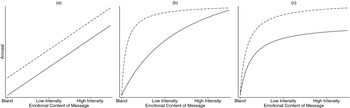
Examining how NFA moderates emotional responses to political news can also address two open questions about the trait itself. First, as we note above, NFA is defined as a motivation to seek out situations that induce emotions. As such, the trait might predict arousal among people exposed to the same stimuli (if high-NFA people focus more intently on the messages, for instance). Or it might not (if its effects are limited to decisions about what to read and watch).Footnote 5 Second, supposing that high-NFA individuals experience different arousal than low-NFA individuals, we can imagine three patterns that might characterize the differences. We present stylized depictions of each in Figure 1. First, high-NFA individuals might generally focus more on their emotions than their low-NFA counterparts, meaning they will experience greater arousal irrespective of what messages are being processed (panel a). Alternatively, high-NFA individuals might be indistinguishable from low-NFA individuals in the absence of an emotional stimulus (panels b and c). We find it plausible that high-NFA individuals would be especially sensitive to low-intensity messages, but that the gap between low and high-NFA individuals would narrow as the emotional content of the stimulus becomes more difficult to ignore (panel b). But it also seems plausible that the differences between personality types might persist even as message intensity increases (panel c).
Hypothetical Models of Personality-Driven Emotional Responses

RESEARCH DESIGN
Our analyses come from a randomized experiment conducted on a national sample (N = 990) of Americans collected by Survey Sampling International (SSI).Footnote 6 SSI maintains a diverse national panel of research subjects through targeted recruitment in various online communities, and our sample compares favorably with a U.S. Census benchmark in several demographic dimensions (Supplementary Material, Section 1). The study was fielded in May of 2014.
Measures
Our instrument included a number of items to isolate the distinct role played by NFA. It began with a standard 7-point measure of party identification, which we folded at its midpoint to construct a measure of strength of party identification.Footnote 7 We also measured liberal/conservative identification using a standard 7-point measure.
Following the partisan measure, there was a four-item battery measuring NFA. Given constraints on the length of an instrument we could field on a national sample, it was necessary to shorten the usual battery, which has twenty-six items. To do this, we chose the two naturally-coded and the two reverse-coded items with the highest factor loadings reported in Maio and Esses (Reference Maio and Esses2001, 591). The scale derived from these questions had acceptable reliability (α = 0.67).
We also included a pre-treatment measure of NFC. NFC is not our main theoretical focus, but NFC is sometimes presented as NFA's foil,Footnote 8 since the two measures intuitively map onto a psychological distinction between cognitive vs. affective processes (Bargh and Chartrand Reference Bargh and Chartrand1999). To measure NFC, we selected two naturally-coded and two reverse-coded items from the short-form NFC scale (Cacioppo et al. Reference Cacioppo, Petty, Feinstein and Jarvis1996, 253). Although we used these standard and popular items, the reliability for our four-item battery was disappointing (α = 0.29). We conducted additional analyses to address this issue.Footnote 9
After our experimental treatment (described below), subjects answered a standard (American National Election Study) question tapping overall attention to politics. We included this item to address the concern that the role of NFA might be confounded with this more familiar individual-level trait. We also asked subjects to report their gender, based on the idea that males and females might have different emotional responses to political events.
Experiment
In the middle of the instrument, subjects were asked to read a recent news story and answer some questions about it. They were randomly assigned to one of four conditions. The Control condition described a news event we selected for being bland with respect to emotional content. (It described the use of sonar to locate a steamship that sank in San Francisco Bay in 1888.)
There were three different treatment stories, all of which were constructed to be of nearly identical length to the Control story. The stories were designed to present the same substantive information, but in increasingly disturbing ways. All three focused on the deaths of American troops at the hands of terrorists in Afghanistan. (We thought a scenario focused on foreign affairs provided an opportunity to manipulate the intensity of political news while also downplaying a possibly confounding role of partisan considerations.) The least disturbing condition, which we label Deaths, described a bomb that exploded in a bazaar in Kabul, killing eleven American troops who were present. The more graphic Vivid condition described the same deaths, but small changes were made to make the description more disturbing. For instance, the headline changed from “Explosive Device Kills 11 American Troops in New Attack” to “Explosive Device Kills 11 American Troops in Bloody Attack,” and the text included disturbing descriptions (“workers were summoned to clear smoldering wreckage, blood, and body parts”). The Photo condition had identical text to the Vivid condition, but also included a graphic photo of blood on a city street.Footnote 10
After subjects read a news story, they were asked to report, using a grid, the extent to which the story made them feel disgusted, sad, angry, outraged, anxious, frustrated, afraid, and proud, an array that was designed to capture differences in distinct emotions of the same valence (e.g. fear as distinct from sadness). The response options ranged from “Not at all” to “Extremely.”
Separate from these emotions, we also sought to measure the objective intensity of the emotional content in the stories (a manipulation check). To do this, we asked subjects to think about the article they read and report “how graphic (as in vivid, powerful) do you remember it being?” The response options for this question ranged from “Not graphic at all” to “Extremely graphic.”
RESULTS
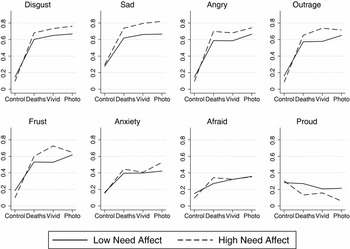
As we report in the Supplementary Material (Section 4), our instrumentation passes the manipulation check. Conditions are ranked in the expected order in terms of graphicness, and all differences statistically significant. For our main analysis, we estimate (OLS) each emotion experienced as a function of the treatment condition, individual-level traits (strength of party identification, ideology, NFA, NFC, attention to politics, and gender), and all condition × trait interactions. Figure 2 conveys the main results as concern NFA by showing the predicted values for each treatment condition, at high and low values of NFA, with other measures held at their means.Footnote 11
Experiment Results

There is evidence that individuals high in NFA process the news differently than individuals low in NFA. Controlling for other traits, high-NFA respondents exhibit more reactivity to the disturbing news stories. This result manifests as separation between the solid and dashed lines within the Deaths, Vivid, and Photo conditions. (It exists, to varying degrees, for all emotions except Afraid.)
Figure 2 is diagnostic of the possibilities outlined in Figure 1. Examining the Control condition, for all but two emotions (Sad and Proud, the latter of which we discuss in more detail below), high-NFA individuals report lower arousal than low-NFA individuals. These results are at odds with the possibility shown in Figure 1, panel (a). Also, there is little evidence that the gap between high-NFA and low-NFA individuals narrows as the message becomes more disturbing (as in Figure 1, panel b). Instead, our results most closely match the pattern depicted in panel (c) of Figure 1.
In the Supplementary Material (Section 5), we present analyses that elaborate on the observed patterns. First, we assess whether the greater reactivity of high-NFA to the three disturbing news stories is attributable to chance. It is not. In both sparse and rich regression models specified to examine Disturbing News × NFA interactions, NFA significantly (p < 0.05, two-tailed) moderates treatment effects for six of the eight emotions we examine.Footnote 12 We also consider the magnitude of the Disturbing News × NFA interactions. They are substantively large, suggesting that two individuals at opposite ends of the NFA scale would differ by approximately one-quarter of the theoretical range of each emotion scale (though the exact magnitude varies). In contrast, the symbolic and other individual-level traits exhibit smaller and less stable interactions.Footnote 13
Two emotions—Afraid and Anxiety—were significantly affected by the treatment, but exhibit insignificant (if directionally consistent) interactions with NFA. This result reminds us of past work emphasizing the different roles played by specific emotions (e.g. Smith and Ellsworth Reference Smith and Ellsworth1985). The lack of statistically significant interactions here might not be an aberration. Instead, it might reflect the distinct functional role of fear and anxiety as “avoidance” emotions (Huddy et al. Reference Huddy, Feldman, Cassese, Neuman, Marcus, Crigler and MacKuen2007, for one discussion). Perhaps because these emotions are more primitive, their activation is less dependent on personality traits, and more species-typical.
We also wish to remark on the results for Proud. For this emotion—the only positive-valence emotion we examine—the overall pattern is a mirror image of the negative-valence emotions. Substantively, it means that reading disturbing political news dampened feelings of pride more for high-NFA subjects than low-NFA subjects. This result suggests that the NFA measure predicts emotional responsiveness—including dampening from a moderate baseline—and not strictly emotional increases.
DISCUSSION AND CONCLUSION
The idea that citizens’ personality traits make them more or less reactive to emotional political messages has a firm grounding in psychology. Drawing on this notion, we find that the personality trait NFA predicts the emotions citizens experience in response to disturbing political news. They are more likely to have negative emotions—disgust, anger, sadness—animated, and they are more likely to have feelings of pride become dampened.
We think the results above demonstrate promise in investigating how individual-level processing styles matter for politics. As we note, the moderation effects we identify are large—larger than those generated by familiar traits such as partisanship, ideology, and gender. We acknowledge that there is a limitation here: our experiment was not designed to generate a schism along these other dimensions. (A study that manipulated whether a message came from a Republican or a Democrat might well generate more impressive difference along the partisan division.) But this limitation does not mean that our study was unrealistic. Many of the political messages citizens receive—updated economic figures, the occurrence of natural disasters, reports on the success of foreign interventions—are a step removed from partisan concerns. And yet the way citizens respond to these events would have partisan implications. With respect to our finding, the significant correlation between NFA and Democratic Party identification (r = 0.09, p < 0.01 in our data) might imply that the passions of those on the political left are somewhat easier to foment and is consistent with the idea that conservative ideology is associated with affect-avoidance (cf. Leone and Chirumbolo Reference Leone and Chirumbolo2008). Relatedly, strategic political actors might find it behooves them to adopt more of a hot or cool messaging style, depending on the traits typical of their intended audience.Footnote 14
One significant limitation of the results we present here is that they focus on a foreign policy news event. This focus was a design choice we made to situate our experiment in a context where individual differences beyond our scope (e.g. partisanship) would be less likely to dominate responses. Still, one promising avenue for future work is more systematically to examine the interplay between personality and partisan attachments as predictive of emotions—including in response to news with clearer partisan overtones.
Finally, we think the results herein point to promise in studies that examine the emotionality of political messages. Within psychology, researchers have examined the effect of strong (as in logical and well thought out) versus weak arguments, including with attention to how processing styles moderate responses (Cacioppo et al. Reference Cacioppo, Petty, Feinstein and Jarvis1996; Petty and Cacioppo Reference Petty and Cacioppo1986). Within political science, too, there is much research on the substantive information citizens receive. (As we think of it, a vast literature on framing effects focuses mostly on substantive information.) In this work, the emphasis is on higher-order cognition. To focus on the emotional content of a message, as we do here, provides a natural counterpart.
It is clear that emotions matter in politics, and political scientists have only begun to untangle the personal and situational factors that interact to foment emotional responses among the public. Taking account of personality characteristics is a promising step in service of that task.
SUPPLEMENTARY MATERIAL
To view supplementary material for this article, please visit http://dx.doi.org/10.1017/XPS.2015.22.