Introduction
The burden of mental disorders
It is estimated that approximately half of all Americans meet diagnostic criteria for a psychiatric disorder at some point in their lives.Reference Kessler, Berglund and Demler 1 Nearly one in five children suffer from a mental disorderReference Costello, Foley and Angold 2 , Reference Offord, Boyle and Szatmari 3 and up to 50% of adult psychiatric patients met diagnostic criteria for these disorders in childhood.Reference Kim-Cohen, Caspi and Moffitt 4 The experience of mental illness can result in great suffering for the individual as well as enormous costs for healthcare systems and society as a whole. The World Health Organization reports that mental health services account for up to 23% of all healthcare costs in developed nations. 5 Despite these staggering personal and societal costs, just one in five adults and one in six children receive treatment.Reference Gandhi, Chiu and Lam 6 , Reference Wang, Lane and Olfson 7
Developmental origins of health and disease (DOHaD) and mental illness
The DOHaD hypothesis posits that adverse pre and early postnatal exposures can alter an organism’s physiology and increase the risk of disease across the lifespan.Reference Gluckman, Hanson, Cooper and Thornburg 8 , 9 The process by which physiological alterations result from exposure to intrauterine conditions is referred to as prenatal programming.Reference Gluckman, Hanson, Cooper and Thornburg 8 , 9 As most of the neuroanatomical and neurochemical mediators of cognition and emotion develop in utero, it is reasonable to expect that maternal exposure to physiological and/or psychological stresses during gestation could increase the risk for psychopathology in postnatal life. Given the ubiquity of these stresses in today’s world, the potential impact of intrauterine adversities on neurodevelopment and psychiatric risk is significant.
Optimal infant and child cognitive and emotional development are precursors to good mental health across the lifespan, integral to the attainment of one’s full academic, social and vocational potential, and represent society’s best chance to boost the mental health of the population.Reference Heckman and Masterov 10 Indeed, landmark early postnatal intervention studies like the Elmira Nurse Home Visiting Program, and the Abecedarian and Perry Preschool Projects have shown that interventions undertaken in early life can have significant, positive long-term effects on the mental health of children.Reference Mervis 11 , Reference Muennig, Robertson and Johnson 12 In fact, follow-up studies of these children have shown that for every dollar invested in these programs, society reaps an average return of $8 over the life of the individual, an annual return rate of 17%.Reference Rolnick and Grunewald 13 As brain plasticity decreases over timeReference Levitt 14 , prenatal interventions may be poised to produce similar or even more impressive gains.
However, not all early intervention programs have yielded positive results. For example, a recent study of the Family Nurse Partnership intervention in the UK reported no benefits on primary maternal and infant health outcomesReference Robling, Bekkers and Bell 15 during gestation and at 2 years of age. Important lessons can be learned from less successful early postnatal intervention studies, including the importance of longitudinal follow-up, minimizing attrition, collecting data from multiple informants, and properly standardizing interventions.Reference Mendelson and Tandon 16 – Reference Wachs, Georgieff, Cusick and Mcewen 20 Despite the null results seen in some studies, early interventions have generally been shown to be much more effective and far less expensive than corrective measures applied later on.Reference Campbell, Ramey, Pubgello, Sparling and Miller-Johnson 21
Despite the accumulation of evidence supporting the usefulness of early intervention, the massive clinical and public health potential of intervening during gestation remains unrealized as nearly all human DOHaD research into mental illness is observational in nature. In this review, we argue that more rigorous experimental study designs are needed to determine the clinical applicability and preventive potential of the DOHaD hypotheses to mental disorders.
The preventive potential of intervening during pregnancy
Interventions undertaken during the prenatal period may have multiple advantages over those applied in postnatal life for preventing or reducing the prevalence and/or severity of mental disorders. First, women appear to be more motivated during pregnancy to make healthy changes than at any other time in life.Reference Olson 22 Second, as two of the three biggest concerns women have about their children are their educational attainment and alcohol and substance problemsReference Erickson and Aird 23 , if they are made aware that changes made during pregnancy can reduce these difficulties, they may be especially motivated to improve their health. Third, pregnancy is a time when women regularly interact with healthcare providers (e.g. physicians, nurses, midwives), increasing the likelihood that they will be exposed to positive messages about their health and potentially comply with interventions. In addition to motivation, access and compliance, women may also be more able to fully engage in interventions prenatally than after delivery.
In the early postnatal period many demands are put on women by their infants, their other children, and their partners, and some may even have to return to work outside of the home. When these realities are combined with sleep deprivation, compliance with even the simplest interventions may become quite difficult. Finally, after delivery, transactional processes extant between women, their children and their families become more complex. Indeed, the postnatal environment may pose additional challenges, particularly with respect to the number of unpredictable factors that can affect intervention effectiveness. Therefore, prenatal interventions may have the potential to yield greater effects than postnatal interventions in-part, due to the nature of earlier intervention and the number of factors present in pregnancy that can increase compliance. Moreover, while compliance is not likely to be perfect postnatally, the development of healthy behaviors in pregnancy will increase the likelihood that lifestyle improvements will continue into postnatal life.
Prenatal programming and mental health
A large body of evidence has linked prenatal environmental adversity to mental health and cognitive problems later in life. As reliable measurements of the intrauterine environment can be difficult to obtain, the role of prenatal programming of offspring outcomes had, until recently, largely relied on proxies of sub-optimal intrauterine exposures such as birth weight and preterm birth.Reference Schlotz and Phillips 24 – Reference Van Lieshout and Boyle 26 This research has shown that variation in birth weight and gestational age across their spectrums have been linked to decreased intelligence quotient (IQ), attention deficit hyperactivity disorder (ADHD), and mood, anxiety, psychotic, and personality disordersReference Schlotz and Phillips 24 , Reference Kim, Bale and Epperson 27 – Reference Colman, Ploubidis, Wadsworth, Jones and Croudace 29 throughout life.
As an alternative to investigating proxies of sub-optimal intrauterine environments, more recent research has considered the effects of specific pregnancy exposures and mechanisms that are associated with an increased risk of offspring psychiatric and cognitive problems. Intrauterine conditions including sub-optimal maternal nutritional intake, physical inactivity, obesity, excessive gestational weight gain (GWG), elevated levels of psychological stress, environmental toxins, and smoking, alcohol, and recreational substance use have all been linked to impaired neurodevelopment and later psychopathology in offspring.Reference Bale, Baram and Brown 30 – Reference Keyes, Davey Smith and Susser 33 Evidence from animal models has shown that these exposures share a number of common physiological pathways including increased inflammation, oxidative stress and hypothalamic–pituitary–adrenal (HPA) axis and neurotransmitter dysregulation.Reference Rivera, Christiansen and Sullivan 31 , Reference Golan, Lev, Hallak, Sorokin and Huleihel 34 , Reference Ramsay, Ferrell and Crawford 35 Modifications to these pathways are thought to occur via epigenetic mechanisms. For example, the offspring of rat dams exposed to high-fat diets have been observed to have significant epigenetic alterations in genes regulating dopamine and serotonin.Reference Vucetic, Kimmel, Totoki, Hollenbeck and Reyes 36 , Reference Sullivan, Grayson and Takahashi 37
Despite the accumulation of this impressive body of evidence, the vast majority of research to date has utilized observational study designs. The use of this type of study methodology limits causal inference and so the true clinical utility of intervening on these exposures is still not known.
In the absence of causal associations and an unawareness of the true effect size of interventions undertaken to optimize offspring mental health, it is difficult for funders to justify expenditures aimed at supporting interventions aimed at reducing the prevalence and severity of mental disorders. Likewise, it is difficult for clinicians to confidently recommend treatments to women, and for women to invest their time, energy and money to follow them.
Limitations of observational designs in establishing the clinical utility of perinatal interventions
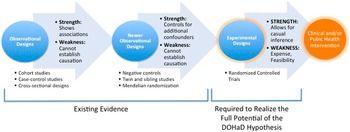
The most significant limitation of observational study designs involves confounding variables. Confounders are the most significant threats to establishing causal associations between maternal pregnancy exposures and offspring mental health. Observational studies must attempt to adjust for all confounding variables, however, as these variables must be accounted for ahead of time and measured without error, adjustment is usually incomplete.Reference Gage, Munafò and Davey Smith 38
Newer observational designs have been utilized to attempt to address some of these methodological limitations and increase our confidence in their findings. These include the use of negative controls, twin and family studies and Mendelian randomization.Reference Gage, Munafò and Davey Smith 38 For example, Keyes et al.Reference Keyes, Davey Smith and Susser 33 investigated the association between maternal smoking in utero and offspring ADHD utilizing paternal smoking as a negative control. Following adjustment, symptoms of ADHD were more strongly associated with maternal smoking, increasing confidence that intrauterine exposure to smoking is linked to ADHD.
Twin and family studies have also been used to attempt to control for genetic and shared environmental confounders.Reference Gage, Munafò and Davey Smith 38 , Reference D’Onofrio, Class, Lahey and Larsson 39 In one twin study, maternal adiposity was associated with aggression in offspring even when heritability factors were accounted for.Reference Antoniou, Fowler and Reed 40 However, in a sibling design, associations between maternal obesity and offspring hyperactivity were no longer statistically significant in full sibling comparisons.Reference Chen, Sjolander and Langstrom 41 In another study utilizing a sibling design, a link between autism spectrum disorders and low birth weight within sibling pairs was observed, however, links between birth weight and substance abuse were fully attenuated following sibling comparisons.Reference Class, Rickert, Larsson, Lichtenstein and D’Onofrio 42 Although there are many advantages to using these designs to infer causal associations, both twin and sibling designs cannot rule out potential non-shared environmental influences.Reference Chen, Sjolander and Langstrom 41
Finally, Mendelian randomization has also been used to attempt to address potential genetic confounding of associations between offspring mental health and maternal adiposity, smoking and alcohol use.Reference Gage, Munafò and Davey Smith 38 , Reference Smith 43 Despite their usefulness in addressing the limitations of more classical observational designs, these studies are still significantly limited in their ability to predict the clinical utility of intervening on particular maternal exposures for reducing mental disorders.
It’s time: using experimental designs to determine preventive and therapeutic potential
Experimental designs provide the best evidence for the causal effects of early life exposures on offspring outcomes (Fig. 1).Reference Gage, Munafò and Davey Smith 38 The utilization of experimental studies like randomized controlled trials (RCTs) in humans therefore provides us with the best chance to determine if (a) a perinatal intervention can positively impact offspring mental health and (b) determine if the magnitude of these changes is clinically meaningful. Currently, there is very limited experimental evidence of the effectiveness of perinatal interventions on the health of offspring, let alone their mental health.
Limitations of observational designs and the need for randomized controlled trials to determine the clinical applicability of developmental origins of health and disease (DOHaD).

RCTs in pregnancy
The use of experimental designs in high-risk pregnancies
The majority of RCTs that have been conducted with pregnant women to determine the impact of interventions on offspring health have been conducted in those with specific, known disease conditions. Although these are important to demonstrate the preventive potential of intervening during pregnancy, they may be limited in terms of their generalizability.
Interventions that have attempted to address maternal nutritional deficiencies in order to improve offspring anthropometric outcomes are the most common. Indeed, RCTs conducted in low- and middle-income countries found that nutritional interventions for malnourished women can reduce fetal growth restriction, and the prevalence of low birth weight and stillbirth.Reference Christian, Mullany, Hurley, Katz and Black 44 , Reference Macleod, Tang and Hobbs 45 In addition, in women with a previous macrosomic birth, central adiposity in offspring was optimized by providing low glycemic index dietary advice in pregnancy.Reference Horan, McGowan, Gibney, Donnelly and McAuliffe 46 Another trial designed to help women abstain from smoking during pregnancy, the prevalence of low birth weight (<2500 g) was significantly reduced in offspring born to women receiving its smoking cessation intervention.Reference Higgins, Bernstein and Washio 47
RCTs have also reported offspring outcomes following interventions for various problems like prenatal atopy, where omega-3 fatty acid supplementation led to improvements in offspring respiratory functioningReference Escamilla-Nuñez, Barraza-Villarreal and Hernández-Cadena 48 , and mood disorders where women randomized to a cognitive behavioral stress management intervention had offspring with improved 1 and 5 min Apgar scores.Reference Karamoozian and Askarizadeh 49 However, not all of these trials have shown beneficial effects. For example, one recent RCT investigating the efficacy of a lifestyle intervention in obese women did not find beneficial changes in metabolic risk factors in 3 year-old offspring.Reference Tanvig, Vinter and Jørgensen 50 Although data from these studies appears promising, it is important that future RCTs measure clinically relevant outcome variables and follow-up participants into early and later childhood (and beyond) in order to extend upon these findings.
RCTs of interventions applied to general population samples
Even though pregnancy interventions applied to the general population have the most potential to improve the mental health of offspring across the lifespan, RCTs of this nature are very limited (and completely lacking when it comes to mental health as an outcome). A recent RCT examining the impact of a lifestyle intervention aimed at optimizing metabolic health failed to show significant benefit for offspring outcomes at birth even though it did improve maternal diet.Reference Sagedal, Øverby and Bere 51 However, while a number of RCTs of similar interventions aimed at optimizing maternal GWG have been successful at improving outcomes in women, none have measured offspring outcomes past birth.Reference Thangaratinam, Rogozinska and Jolly 52 This lack of offspring follow-up, despite promising evidence of maternal benefit, thwarts our ability to determine if exposing women in the general population to interventions designed to optimize the intrauterine environment can improve child health beyond delivery. This is important as these lifestyle interventions are efficacious in addressing risk factors for mental disorders like maternal pre-pregnancy and pregnancy adiposity and excess GWG.Reference Van Lieshout 53 , Reference Van Lieshout, Taylor and Boyle 54
The case for RCTs of comprehensive nutrition+exercise interventions to optimize offspring neurodevelopment and mental health
Maternal gestational health, nutrition and physical activity are among the most potent and modifiable environmental determinants of offspring intelligence, emotion regulation and behavior,Reference Monk, Georgieff and Osterholm 55 , Reference Nyaradi, Li, Hickling, Foster and Oddy 56 and are important predictors of mental health across the lifespan. Sub-optimal nutrition in pregnancy appears to significantly affect the trajectory of offspring neurodevelopment, impacting the emerging neural circuitry required for optimal cognitive and behavioral outcomes.Reference Georgieff 57 For example, three large cohort studies reported associations between an unhealthy prenatal diet and offspring externalizing, and emotion regulation problems in children up to age 7 years.Reference Jacka, Ystrom and Brantsaeter 32 , Reference Steenweg-de Graaff, Tiemeier and Steegers-Theunissen 58 , Reference Pina-Camacho, Jensen, Gaysina and Barker 59 In addition, exercise in pregnancy is associated with optimal neurobehavioral outcomes in offspring, potentially through reduced inflammation, upregulation of neurotrophic factors and increased maternal psychological well-being. This evidence is significant as a sizable proportion of pregnant women in developed countries still consume unhealthy diets, are sedentary, overweight and/or manifest nutrient deficiencies.
Excess GWG in pregnancy is also a major clinical challenge, affecting up to 50% of women.Reference Bartholomew 60 As both excess GWG and maternal adiposity have been linked to mental disorders in children, a state-of-the-art maternal nutrition+exercise program that optimizes maternal weight and GWG in all pregnant women may be the most effective means by which offspring neurodevelopment can be improved and the impact of future mental disorders reduced.
Maternal nutrition
Much of the evidence that supports links between poor nutrition during pregnancy and offspring cognitive and emotional problems in humans comes from observational studies of deficiencies of specific nutrients (e.g. protein, iodine, zinc, folate, iron).Reference Georgieff 57 , Reference Grantham-McGregor and Baker-Henningham 61 , Reference Tamura, Goldenberg and Hou 62 Unfortunately, despite the simplicity and ease of compliance with single nutrient supplements, RCTs in humans have failed to find conclusive evidence of positive effects of single nutrient supplementation on offspring cognition and behavior.Reference Hamadani, Fuchs, Osendarp, Huda and Grantham-McGregor 63 , Reference Murcia, Rebagliato and Iinguez 64
That more favorable outcomes have been seen in observational studies of diets high in fish compared with omega-3 fatty acid supplementation alone, and that RCTs that supplement women with multiple nutrients have had more positive effectsReference Nyaradi, Li, Hickling, Foster and Oddy 56 , Reference Leung, Wiens and Kaplan 65 on offspring cognition and psychopathology, suggest that complete diets may be more effective at optimizing offspring brain development than single nutrients by themselves.Reference Leung, Wiens and Kaplan 65 As nutrient deficiencies rarely occur in isolation, and as combinations of foods may contain other compounds that could act synergistically to promote neurodevelopment, it is important to consider overall maternal diet as a potential point of intervention. Indeed, observational studies in developed nations have also shown that infants and children who consume healthier diets have IQs ⩾5 points higher and fewer emotion regulatory and behavioral problems.Reference Jacka, Ystrom and Brantsaeter 32 , Reference Smithers, Golley and Mittinty 66 , Reference Theodore, Thompson and Waldie 67 However, the observational nature of these studies limit causal inference.
Experimental research in animal models has shown that maternal consumption of a ‘western’ diet (i.e. high in fats and sugars) during pregnancy adversely affects offspring cognition, emotion regulation and behavior. Indeed, the offspring of these animals manifest more problems with learning, memory, anxiety, aggressionReference Sullivan, Grayson and Takahashi 37 , Reference Ong and Muhlhausler 68 as well as altered reward pathwaysReference Vucetic, Kimmel, Totoki, Hollenbeck and Reyes 36 , and abnormalities in brain regions implicated in emotion regulation.Reference Oades 69
Taken together, this work suggests that nutritional interventions undertaken during pregnancy have the potential to enhance neurodevelopment in offspring, but should focus on the promotion of overall diet quality rather than single micronutrients or specific dietary components in isolation.
Maternal exercise
The American College of Obstetrics and Gynaecology (2015) and exercise guidelines based on the PARmed-X studyReference Davies, Wolfe and Mottola 70 recommend that pregnant women engage in regular moderate-intensity aerobic activity (such as brisk walking) weekly. In some cases, women that regularly engaged in more vigorous physical activity before pregnancy may be able to continue these activities, following consultation with their obstetrical care provider. 71 However, contact sports and activities with a high risk of falling are potentially harmful and are not recommended. Overall, current evidence suggests that the benefits of moderate exercise in uncomplicated pregnancies greatly outweigh the risks.
Optimizing maternal physical activity during pregnancy has also been linked in observational studies to optimal offspring neurodevelopment. In three separate case-control studies, Clapp et al. compared the offspring of women who had been active before pregnancy but then (a) reduced their level of exercise during gestation or (b) remained just as active.Reference Clapp, Simonian, Lopez, Appleby-Wineberg and Harcar-Sevcik 72 – Reference Clapp, Lopez and Harcar-Sevcik 74 Women who continued to exercise had infants who had superior emotion regulation at 5 days of age, and higher cognitive scores (up to 8 IQ points) at 1 and 5 years of age.Reference Clapp, Simonian, Lopez, Appleby-Wineberg and Harcar-Sevcik 72 More recently, the 1-month-old offspring of exercising women were shown to have more adaptive emotion regulation than infants born to non-exercisers.Reference May, Scholtz, Suminski and Gustafson 75
Interestingly, in a single small RCT, Ellemberg et al. recently showed that women randomized to an exercise intervention during the second trimester of pregnancy had infants with superior auditory memory at 8–12 days of age compared with the offspring of women who were not.Reference Labonte-Lemoyne, Curnier and Ellemberg 76 This evidence provides support for the beneficial effects of exercise in pregnancy on offspring neurodevelopment. However, the single outcome measure limits its predictive ability of offspring cognitive and mental health outcomes.
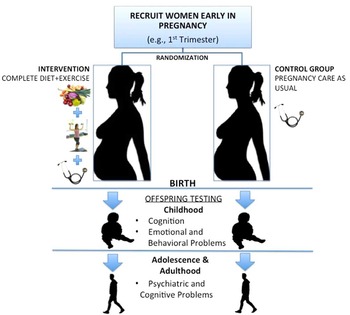
Despite the fact that studies that have intervened on overall maternal diet and exercise separately provide tantalizing evidence of effectiveness on early neurodevelopment, previous RCTs of perinatal interventions suggest that integrated treatments may be more effective than simpler ones, despite their complexity. As a result, a state-of-the-art nutrition plus exercise intervention that optimizes overall maternal diet and physical activity during pregnancy may represent our best chance to reduce the prevalence and severity of the precursors of mental disorders in children and perhaps mental illness across the lifespan (Fig. 2). Indeed, RCTs of diet+exercise interventions for pregnant women already underway further support this approach to determining the full clinical applicability of the DOHaD hypotheses.
Design of a complete diet+exercise intervention to optimize mental health across the lifespan.

Clinical applicability of the nutrition+exercise RCT for optimal neurodevelopment
Although there are potential challenges to improving diet and increasing physical activity at any time in life, women are more highly motivated to improve their health during pregnancy, receive high levels of support from the healthcare system during this time, and studies have shown that such lifestyle interventions are not only well-accepted by women, but are likely to positively impact multiple developing physiological systems in offspring. Indeed, both healthy maternal diet and exercise represent proven means of ameliorating a number of the biological mechanisms shown to link adverse intrauterine exposures and offspring mental health including inflammation, oxidative stress and HPA axis dysregulation.
However, in order to fully harness the clinical and public health potential of these RCTs, a number of challenges must be addressed. Although women are more likely to be compliant with interventions during pregnancy than at any other time in their lives, compliance and participant attrition could limit the size of the effects of these intervention, and therefore investigators must focus on monitoring and optimizing compliance, and recruit samples that take attrition into account. Ecologically valid ambulatory assessment methods should be considered to assess and monitor diet and exercise throughout the intervention.Reference Trull and Ebner-Priemer 77 The use of pedometers, actigraphs and daily exercise logs would increase intervention adherence and provide objective measures of exercise behavior. In addition, food diaries completed using ecological momentary assessment methods collected through smartphone applications could be used to quantify nutrition intake and to monitor intervention adherence to the dietary component.Reference Dunton, Liao and Dzubur 78 These methods are also advantageous in that they reduce potential for retrospective bias.
Currently, the gold standard for assessing and monitoring intake involves the use of diet weighed food records.Reference Flynn, Dalrymple and Barr 79 In addition, quality measures of diet such as the Diet Quality Index for pregnancy, or the Healthy Eating Index (2010) could be used to objectively monitor diet and allow researchers to tease apart specific effects of dietary components on relevant outcomes.Reference Martin, Zhou and Flynn 80 Two systematic reviews of diet interventions in pregnancy recommend that the diet component be comprised of (i) individualized nutrition plans catered to estimated energy needs, (ii) provision of certain foods that are essential to the intervention and (iii) information sessions with a dietician to provide dietary advice.Reference Flynn, Dalrymple and Barr 79 , Reference Kuhlmann, Dietz, Galavotti and England 81 Overall, investigators must determine which type of interventions are likely to be the most effective, the doses required and the women and children who will benefit most.
Finally, valid and reliable measurements of clinically relevant outcomes are important to establish the preventative applicability of these interventions. This is a particularly perplexing issue in studies of mental disorders given our imperfect diagnostic methods, reliance on self-reports, evolving classification and nosological systems, issues of clinical heterogeneity and comorbidity, and the presence of heterotypic continuity in youth mental disorders. Researchers should consider the use of more proximal phenotypic markers of behavioral systems and multiple informant reports help address these limitations and complement traditional measures.
Perhaps the most efficient way to determine if nutrition+exercise lifestyle interventions have the potential to optimize mental health is to follow the offspring of women already enrolled in existing trials into childhood and beyond. The Maternal Obesity Management (MOMs) trial,Reference Adamo, Ferraro and Goldfield 82 a structured physical activity and nutrition program designed to optimize GWG, and other prenatal lifestyle interventions such as the Fit for Delivery trial,Reference Sagedal, Øverby and Lohne-Seiler 83 and the UK Pregnancy better eating and activity (UPBEAT trial), the Be Healthy in Pregnancy (BHIP), and the Lifestyle in Pregnancy (LiPO) trialsReference Tanvig, Vinter and Jørgensen 50 , Reference Poston, Briley and Barr 84 are examples of existing RCTs that could be utilized. Finally, as more benefits of specific diet+exercise interventions accrue, it will be important to consider the ethical implications of randomization during pregnancy. In the meantime, control group participants should receive prenatal care as usual from healthcare providers.
Conclusions
The impact that mental illness can have on individuals, families and society, and difficulties individuals have in accessing treatments highlight the need to make the prevention of mental disorders a primary clinical and public health priority.Reference Whiteford, Degenhardt and Rehm 85 Despite consistently noted associations in observational studies between sub-optimal intrauterine conditions and offspring mental health problems, no experimental studies in humans have attempted to intervene on these adversities and assess their clinical impact. However, maternal nutrition+exercise interventions are acceptable to women and may have the potential to truly test the clinical utility of acting during pregnancy to optimize the brain development and mental health of offspring across the lifespan. Within the next 20 years, the global effect of mental disorders could amount to US $16 trillion.Reference Bloom, Cafiero and Jané-Llopis 86 Combined with the impact these disorders have on human capital and lost potential, we believe that the time is now to act on sub-optimal maternal diet and physical inactivity in an attempt to elucidate the clinical potential of the DOHaD hypothesis. If prenatal nutrition+exercise interventions leads to improved neurodevelopmental outcomes in infants, it could provide the scope for the primary prevention or amelioration of mental disorders very early in life with significant benefits for offspring and society.
Acknowledgments
None.
Financial Support
Dr Van Lieshout is the Albert Einstein/Irving Zucker Chair in Neuroscience at McMaster University.
Conflicts of Interest
None.
Ethical Standards
All procedures performed in studies involving human participants were in accordance with the ethical standards of the institutional and/or national research committee and with the 1964 Helsinki declaration and its later amendments or comparable ethical standards.