A central concern in the study of gender in Judaism is the status of women and the relationship between partners in a marriage. In this article I explore a concealed dialogue, or perhaps more accurately, a dialogue that has been condemned to silence, on that subject.
My analysis follows in the path of Judith Hauptman's research, among others.Footnote 1 Hauptman discussed the relationships among different halakhic sources that address the issue of a woman's obligation to procreate. She demonstrated that the Tosefta—a source redacted relatively late—preserves an early halakhic tradition that presumed men and women to be under equal obligation.Footnote 2 Conversely, the Mishnah, which was edited earlier than the Tosefta, deliberately redacts the tradition so that halakhic discourse negates the woman's role in procreation and presumes that the purpose of marriage is for the man to fulfill the commandment of pru urvu (be fruitful and multiply). Such seems to be the case, for the Mishnah in Yevamot 6:6 states נשא אשה ושהה עמה עשר שנים ולא ילדה אינו רשאי ליבטל—“If one married a woman and remained with her ten years and had no children, he is not permitted to refrain [from procreating].” According to the Mishnah, a man must fulfill this commandment; should this prove impossible in his current marriage, he must marry another woman, and apparently must divorce his current wife.Footnote 3
In this article, I will delineate a process similar to Hauptman's. However, unlike Hauptman, I will focus on aggadic sources. These sources simultaneously conduct a dialogue along two distinct axes: an aggadic–halakhic axis, namely with the Mishnah, and an aggadic–aggadic one, linking the sources themselves. Michael L. Satlow, Daniel Boyarin, Adiel Schremer, and Admiel Kosman have already addressed the topic of dialogue between aggadic sources and the Mishnah.Footnote 4 While my approach may differ from theirs in both major and minor ways, my primary goal is to address the second axis, the dialogue between the two aggadic sources.
Two sources in the Midrash Aggadah contain parallel versions of a narrative homily that cites and addresses the substance of the relevant Mishnah.Footnote 5 This Mishnah rules that a man cannot neglect his obligation to procreate, and implies a solution should he find himself in a childless marriage after ten years. The homily contains a story about a couple from SaidaFootnote 6 who found themselves in such a situation, but surprises us by not ending in the way the Mishnah would have us expect. In both sources, the narrative homily addresses the halakhic citation and sheds new light on it.
The interaction between halakhah and Aggadah in rabbinic sources most frequently takes place within halakhic contexts, for example in the Talmudic sugyot, where aggadic segments are embedded within halakhic discussions. These types of interactions have received a great deal of critical attention, particularly in the analyses of Jeffrey Rubenstein.Footnote 7 In our example, we are faced with a much rarer, possibly complementary, phenomenon: an embedded halakhic segment within an aggadic–midrashic context.
A comparative analysis of the sources' content and structure shows that the original homily is preserved in Midrash Shir Hashirim Rabbah, which is actually considered the later of the two works, while the homily in Pesikta de-Rav Kahana, the earlier source, is actually reworked.Footnote 8 The narrative derasha in the latter work is restructured to match the halakhic rhetoric of the Mishnah. The woman is deposed from her central role in the story as well as from her elevated status in the marital frameworkFootnote 9.
In Shir-Hashirim Rabbah 1:2, an aggadic narrative is imposed on the verse נגילה ונשמחה בך to interpret its words as an expression of the love between the nation of Israel and God. Within the homily itself is a reference to the Mishnah cited earlier, and a story is told in the name of Rabbi Idi and is connected to this Mishnah. The reference to the Mishnah in this midrash serves a similar purpose to that of the reference to a “verse from afar” in the petiḥta (proem) style of classical midrashic works. In classical petiḥtaot, a reference to biblical verses from afar creates an intertextual relationship between different texts, engendering a tension that serves as the core for a homily. Here too, the reference to the Mishnah creates an intertextual link between the verse being expounded and the halakhic source. This generates tension and is the basis for the homily. The interpreted verse expresses, in its biblical context, an expression of love between a woman and her mate that has value in and of itself, whereas the halakhic source views marriage pragmatically as a tool for fulfilling man's obligation to procreate.
Let us follow the narrative homily's development as a function of the tension between the verse and the halakhah. The story begins with the words מעשה באשה אחת בצידן ששהתה עשר שנים עם בעלה ולא ילדה (There was a case of a woman in Saida, who remained ten years with her husband and did not give birth). The story is about a woman. In choosing this formulation, the darshan focuses our attention on the woman's perspective. As opposed to the mishnaic formulation that focuses on the “man who married a woman and remained with her” (נשא אשה ושהה עמה), here it is the woman who has waited and not given birth. Hence, the problem goes beyond the man's inability to fulfill the commandment to procreate.
אתון גבי ר′ שמעון בן יוחאי בעיין למשתבקא דין מדין (They came before Rabbi Shimon Ben Yohai; they requested to get divorced one from the other)—the couple, who seem to understand that they have a halakhic problem, come before Rashbi and apparently request that he initiate their divorce. It is worth noting that the words למשתבקא דין מדין literally mean to release them from each other, namely, from their distress.Footnote 10 As I understand it, they are not only requesting the rabbi's assistance with the technicalities of getting divorced, but rather are fervently asking him to help resolve the complicated predicament in which they, as a couple, find themselves. Rashbi then gives the couple guidelines that are not, in essence, halakhic: אמר להון חייכון כשם שנזדווגתם זה לזה במאכל ובמשתה כך אין אתם מתפרשים אלא מתוך מאכל ומשתה (On your lives, just as you came together to each other with feasting and drinking, so too you should not part without feasting and drinking). It seems to me that Rashbi is attempting to ease the couple's way into the divorce process. The goal of the unusual discussion is to help them internalize the insight that the divorce will allow them to rebuild their lives and will provide them with a new opportunity to procreate, as had been their intention.Footnote 11
It seems that the guidelines are effective, for the husband, when he proceeds to become drunk, is able to quite literally “settle his mind” and is able to initiate the divorce procedure in a loving and generous manner:Footnote 12הלכו בדרכיו ועשו לעצמן י"ט ועשו סעודה גדולה ושכרתו יותר מדאי, כיון שנתיישבה דעתו עליו אמר לה בתי ראי כל חפץ טוב שיש לי בבית וטלי אותו ולכי לבית אביך (They followed his suggestion, and they made for themselves a festival and a feast, and she got him too drunk. When his mind was settled he said to her, “My daughter, see any good object that I have in this house. Take it and go to your father's house”). However, the woman still refuses to accept the notion of “separating” from him, and she demonstrates this through her actions: מה עשתה היא לאחר שישן רמזה לעבדיה ולשפחותיה ואמרה להם שאוהו במטה וקחו אותו והוליכוהו לבית אבא (What did she do? When he was asleep, she told her slaves and maidservants and she said to them, “Lift him in the bed and take him and bring him to the house of [my] father”). The husband's state of inebriation paradoxically allows his wife to express her determined opposition. When he is once again sober, she even explicitly declares this to him: בחצי הלילה ננער משנתיה כיון דפג חמריה אמר לה בתי היכן אני נתון אמרה ליה בבית אבא אמר לה מה לי לבית אביך, אמרה ליה ולא כך אמרת לי בערב כל חפץ טוב שיש בביתי טלי אותו ולכי לבית אביך אין חפץ טוב לי בעולם יותר ממך (In the middle of the night he woke up. When his wine had worn off, he said to her, “My daughter, where am I?”
She said, “In father's house.” He said, “What am I doing in your father's house?” She said to him, “Did you not say to me this very evening, ‘Any good object which you have in your house, take and go to your father's house’? There is no object in the world which is better for me than you!”). The term ḥefetz here holds dual meaning. In the mouth of the husband it means “object,” but for the wife it refers to her deepest and most fundamental desire. In contrast to the story of Rachel in the Bible, wherein Rachel declares, “Give me children and if not I shall die” (implying that marriage and life are meaningless without children), in this story the wife's primary objective in marriage is to maintain a relationship with her husband. The husband seems to internalize his wife's lesson, and together they return to Rashbi. At this point, Rashbi adopts a new approach, not taking on the role of a halakhic decisor as he did before, but rather taking on the role of a tzaddik who prays for those who have turned to him for help: הלכו להם אצל רבי שמעון בן יוחאי ועמד והתפלל עליהם ונפקדו (They went to Rabbi Shimon Ben Yohai. He stood and prayed for them, and they were remembered).
While the darshan mentions Rashbi's role and prayers in the salvation of the couple, ללמדך מה הקב"ה פוקד עקרות אף צדיקים פוקדים עקרות (To teach you that just as God helps sterile women, so too do the righteous help sterile women), the woman's actions are the main concern, for they lead to the couple's preservation: והרי דברים קל וחומר ומה אם בשר ודם על שאמר לבשר ודם שכמותו אין לי חפץ בעולם טוב ממך נפקדו, ישראל המחכים לישועת הקב"ה בכל יום ואומרים אין לנו חפץ טוב בעולם אלא אתה עאכ"ו (Indeed, all the more so, if a flesh and blood said to his fellow flesh and blood, “There is no object in the world which is better for me than you,” were saved, Israel who are waiting for the God's salvation every day, and say, “There is no object in the world which is better for me than you,” how much more so!). The darshan concludes by citing the verse with which he began: הוי נגילה ונשמחה בך. The woman's commitment to her marital relationship is compared to the commitment between the nation of Israel and God.
The darshan seems to experience the tension existing between the halakhic statement—which primarily defines marriage as a tool for the male's fulfillment of the mitzvah of procreation—and the biblical–aggadic notion that places love at the center of the (marital) relationship, an idea expressed by the woman from Saida.Footnote 13 The woman in the story challenges the halakhah by teaching her husband and Rashbi—who represents the law—that the halakhah is not applicable when it contradicts the woman's feelings of love, and certainly should not be implemented in a sweeping or forceful way.Footnote 14
A look at a parallel version of the derasha in Midrash Pesikta de-Rav Kahana, the earlier work, reveals a different picture, one in which the tension between the halakhah in the Mishnah and the love reflected by the verse is never stressed. The story lacks the tragic-romantic undertones found above, and the Rabbis mute whatever challenge there might be to the halakhah by having Rashbi himself take up the potentially subversive argument aimed at saving the marriage. In fact, though Rashbi may hint to the woman that there is a way to save her marriage, this does not grant her a voice, status in the marriage, or even necessarily imply the validity of a marriage containing love and a relationship but not children. Indeed, the marriage only continues because Rashbi takes the initiative, using both his wisdom and prayers to give the couple's marriage a second chance.Footnote 15
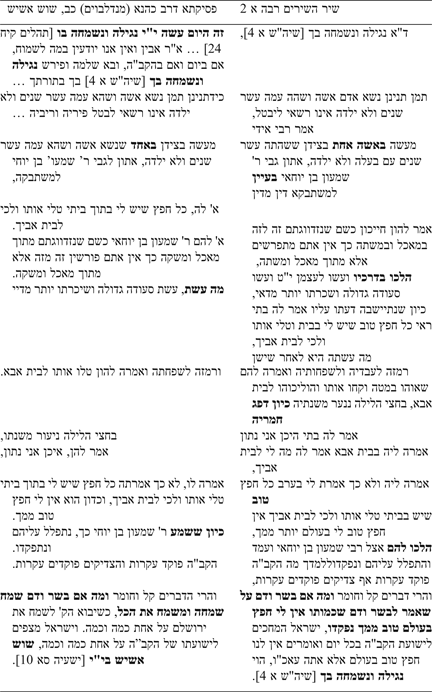
The text begins:
זה היום עשה י"י נגילה ונשמחה בו [תהלים קיח 24] … א"ר אבין ואין אנו יודעין במה לשמוח, אם ביום ואם בהקב"ה, ובא שלמה ופירש נגילה ונשמחה בך [שיה"ש א 4] בך בתורתך … כידתנינן תמן נשא אשה ושהא עמה עשר שנים ולא ילדה אינו רשאי לבטל פיריה וריביה...
In this version, which commences with a verse from Psalms, the verse from Song of Songs is not set up in petiḥta format to contrast with the Mishnah. Indeed, the Mishnah is cited merely to explain the verse from Song of Songs (which has been cited to explain the verse from Psalms).
The homily of the man and the woman follows the Mishnah in order to illustrate it, not to contradict it. Thus, in contrast to the parallel version in which the woman's voice is stressed—מעשה באשה אחת בצידן ששהתה עשר שנים עם בעלה ולא ילדה—in this account the story begins by emphasizing the man's predicament:מעשה בצידן באחד שנשא אשה ושהא עמה עשר שנים ולא ילדה (There was a case in Saida of one who married a woman and remained with her ten years and she did not give birth). As in the Mishnah, נשא אשה ושהה עמה, the man's difficulty in performing the mitzvah of procreation takes center stage, and the woman's voice is silenced; no challenge is issued to the regnant halakhah.
The couple itself (particularly the husband) does not exhibit the poignant behavior found in Shir Hashirim Rabbah. When the husband and wife consult Rashbi, they do not ask him to separate them “from one another” as they did in Shir Hashirim Rabbah; rather, they come to follow the law and to obtain a divorce: אתון לגבי ר' שמעו' בן יוחי למשתבקה. Moreover, in this version the husband does not need to become inebriated to initiate the divorce process through his words:א' לה, כל חפץ שיש לי בתוך ביתי טלי אותו ולכי לבית אביך (He said to her, “Any object that I have in this house. Take it and go to your father's house”). Rather, he makes his declaration immediately upon meeting Rashbi. The husband also does not endearingly tell his wife to take “a precious object.” He refers, instead, to just “an object.”
Most significantly, in this version it is Rashbi who adopts the potentially subversive position, championing continuation of the marriage. He does this in an unexpected way that seems intended to prevent its dissolution: א' להם ר' שמעון בן יוחאי כשם שנזדווגתם מתוך מאכל ומשקה כך אין אתם פורשין זה מזה אלא מתוך מאכל ומשקה (Rabbi Shimon Ben Yohai said to them, “Just as you came together with feasting and drinking, so too you should not part without feasting and drinking”). After Rashbi offers his advice—the purpose of which is to prevent the divorce—the woman understands what is expected of her and acts accordingly: מה עשת, עשת סעודה גדולה ושיכרתו יותר מדיי ורמזה לשפחתה ואמרה להון טלו אותו לבית אבא (What did she do? She prepared a great feast, and she got him too drunk).
The husband's inebriation in this version sheds no light on his mental status; it only enables his wife to carry out her plans and express her love to him. This differs from the version in Shir Hashirim Rabbah; there, the role of the husband's drunkenness is more complex as it both sheds light on his mental status by enabling him to initiate the divorce procedure in a loving manner and allows his wife to show her determined opposition to receiving a divorce.
The description of the husband waking up is similar in each version. However, even though the husband has presumably internalized his wife's message, in this rendition the couple does not romantically unite and return to Rashbi, as they do in Shir Hashirim Rabbah. The voice has been taken away from the woman and, by extension, the couple. Rashbi, having championed the marriage, hears about the outcome of his plan and takes the next step: כיון ששמע ר' שמעון בן יוחי כך, נתפלל עליהם ונתפקדו (since Rabbi Shimon Ben Yohai heard it, he prayed for them, and they were remembered). Rashbi realizes that his plan has been successful and now believes that the conditions are ripe for his prayers, which will enable the couple finally to procreate. The darshan, in this version, focuses solely on the role of Rashbi, הקב"ה פוקד עקרות והצדיקים פוקדים עקרות (God helps sterile women, and the righteous help sterile women) and makes no further mention of the words spoken by the wife to her husband, thus de-emphasizing the importance of love in their relationship.
The forced connection between the homily and the concluding verse from Isaiah, which reads והרי הדברים קל וחומר ומה אם בשר ודם שמח שמחה ומשמח את הכל, כשיבוא הק' לשמח את ירושלם על אחת כמה וכמה. וישראל מצפים לישועתו של הקב"ה על אחת כמה וכמה, (Indeed, all the more so, if a flesh and blood is able to rejoice and bring joy to everybody, when God will come to bring joy to Jerusalem, how much more so. And Israel who for so many ages have been looking forward to deliverance by God, how much more so!) is another indication of the secondary nature of the version found in Pesikta de-Rav Kahana.Footnote 16
In conclusion, it is Pesikta de-Rav Kahana, the composition that was redacted earlier and is usually ascribed to perhaps the fifth century in the land of Israel, which brings the reworked and secondary text. Shir Hashirim Rabbah, which is the later, seventh-century redaction, preserves the earlier text, the one more challenging from a halakhic perspective.Footnote 17 The originary nature of the derasha in Shir Hashirim Rabbah is attested to not only by the principle of lectio difficilio Footnote 18 but also by additional structural elements that are not strictly relevant to our discussion.Footnote 19 This narrative homily underwent a redaction prompted by the desire to make it comply with the legal rhetoric of the Mishnah and the accepted halakhic norms of the time.Footnote 20 In this process, the woman was removed from her central place in the story and from her status within the marital framework. That Rashbi saved the marriage does not imply his championing of the woman's voice or her status; it is the combination of his wisdom and his prayer that gives the marriage a second chance.Footnote 21
The process described here is analogous to that depicted by Hauptman in her analysis of the relationship between the Mishnah in Yevamot and the Tosefta that parallels it. In the aggadic sources as well, the earlier and more authoritative source is actually reworked to accommodate the story to the prevailing halakhic norms. Moreover, the earlier source silences the subversive “other” voice that is heard in the original homily. Perhaps such a step did not need to be taken in the later and less authoritative source, for Shir Hashirim Rabbah by its very nature was less threatening. However, it seems to me that the voice calling out from the Aggadah (preserved in Shir Hashirim Rabbah) and the dialogue, which that Aggadah has with the mishnaic halakhah, ring out crystal clear. Even though authoritative sources attempted to silence this voice and consign its argument to oblivion, it seems quite likely that the Aggadah made its mark on halakhic practice throughout history. Indeed, the halakhic establishment, contra the Mishnah, traditionally did not force childless couples to divorce.Footnote 22
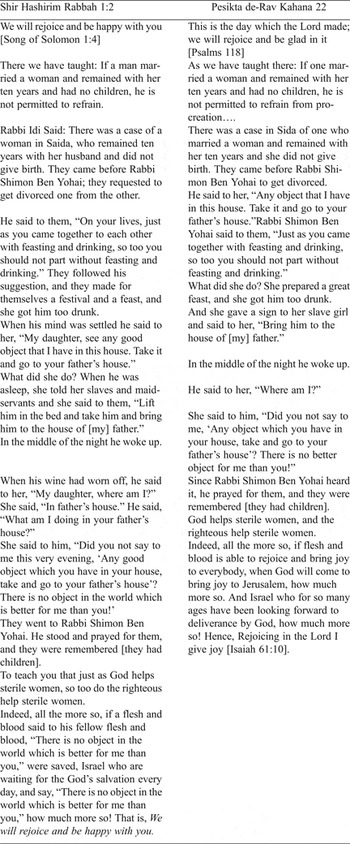
The sources in English translation

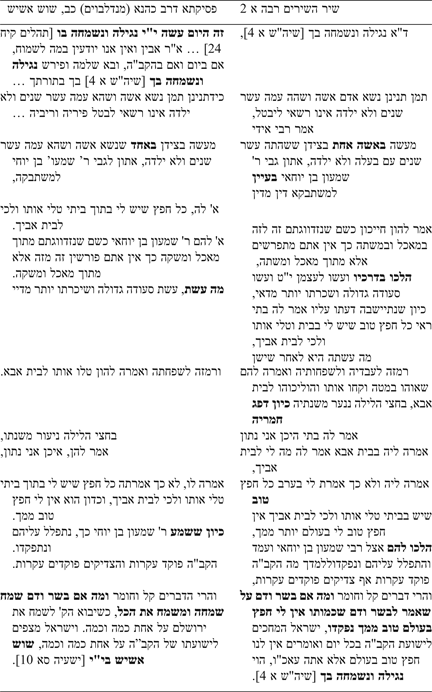
The sources in the original Hebrew