I. INTRODUCTION
The melt-growth control of intermetallic compounds (IMCs) is of practical interest because of the significance of IMCs with appropriate morphologies, sizes, distributions, and volume fractions introduced in alloys for optimizing properties. Reference Stoloff, Liu and Deevi1–Reference Wang, Luo, Su, Guo and Fu6 However, IMCs exhibiting complex crystal structure and directional bonding commonly show a faceted growth with a strong anisotropy during solidification. Reference Li, Wu, Li and Liu7,Reference Kang, Li, Su, Liu, Guo and Fu8 Growth discrepancies of different crystal planes, originated from the inherent crystal structure and external environment, usually lead to complicated morphologies of IMCs. Especially, a potential transition is predicted theoretically from faceted IMCs to nonfaceted IMCs then quasicrystals or noncrystals with increasing cooling rates. Reference Kurz and Fisher9,Reference Kang, Li, Wang, Liu, Su, Hu, Guo and Fu10 However, further accumulation of experimental evidences is required for understanding the detailed pattern formation of melt-growth IMCs.
Several attempts Reference Li, Wu, Li and Liu7,Reference Kang, Li, Su, Liu, Guo and Fu8,Reference Hyde, Norman and Prangnell11–Reference Fu and Yang15 have been made for this purpose. For instance, deep-etching and extracting techniques were used to characterize the three-dimensional (3D) morphologies of primary Al3Sc IMCs in casting aluminum–scandium (Al–Sc) alloys. Reference Hyde, Norman and Prangnell11 The growth of primary Mg2Si IMCs in casting aluminum–magnesium–silicon (Al–Mg2Si) alloys was highly dependent on its crystal structure and growth conditions. Reference Li, Wu, Li and Liu7 Recently, we have investigated the 3D morphologies of Al6Mn IMCs at a growth rate of 1 µm/s in directionally solidified Al–3 at.% Mn alloys. Reference Kang, Li, Su, Liu, Guo and Fu8 It is found that directional solidification is an appropriate technique to reveal the growth of IMCs due to the defined conditions of crystal growth. In this article, further efforts have been made to clarify potential growth transition of Al6Mn IMCs from faceted to nonfaceted growth with increasing growth rates and to explain the various faceted growth morphologies by a growth-rate ratio between different crystal planes. Al6Mn IMC is the most common stable phase in Al–Mn system alloys which has significant effects on the performance of these alloys. For investigating the faceted–nonfaceted growth transition and 3D morphological evolution of primary Al6Mn microcrystals, we select a typical off-eutectic-type alloy (Al–3 at.% Mn alloy) as a model alloy in this study.
II. MATERIALS AND METHODS
Al–3 at.% Mn master ingot was prepared by induction melting aluminum (99.9 wt.%) and manganese (99.9 wt.%) under an argon atmosphere. The as-cast samples with size of D3 mm × 110 mm were obtained from the ingot by electrical discharge machining. The samples were placed into a high purity alumina tube of 3.5 mm inner diameter, which was connected with a motor. Then the sample was pulled at growth rates of (1–1000 μm/s) after initial melting and thermal stabilization together with alumina tube. After a growth distance of 30 mm, the samples were quenched into the gallium–indium–tin (Ga–In–Sn) liquid alloy to preserve the solid–liquid interface. Temperature profiles were measured separately using a PtRh30-PtRh6 thermocouple inserted within a fine alumina tube (0.6 mm internal diameter) down to the center of the samples. During the pulling process, the thermocouple moved downwards with the sample at the same pulling rate. The temperature gradient can be calculated from the measured temperature profiles and is estimated about 25 ± 0.5 K/mm in the present work.
The microstructure was characterized by scanning electron microscope (SEM; Model No. SEM-Quanta 200FEG, FEI Company, Hillsboro, OR). Primary Al6Mn IMCs and its structure were identified by transmission electron microscopy (TEM; Model No. TEM-TECNAI F30, FEI Company, Hillsboro, OR). The samples for TEM observation were prepared by a standard combination of mechanical and ion-beam thinning techniques. An etchant of NaOH-aqueous solution was used to dissolve the eutectic matrix and preserve Al6Mn IMCs whose 3D morphologies were characterized by secondary electron image.
III. RESULTS AND DISCUSSION
A. Microstructures in directionally solidified Al–3 at.% Mn alloy
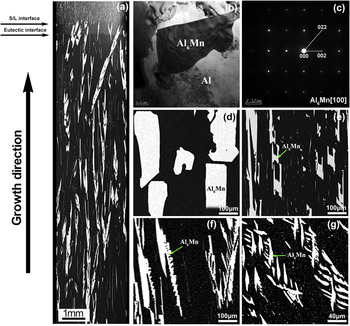
Figure 1(a) shows the structure of directionally solidified Al–3 at.% Mn alloy at a typical growth rate of 10 μm/s. Lath-like Al6Mn IMCs (bright contrast) are preferentially aligned to the growth direction and distributed into the (Al + Al6Mn) eutectic matrix (dark contrast). The quenching interface reveals that primary Al6Mn first precipitates from melt, followed by an eutectic reaction during solidification of Al–3 at.% Mn alloy, as expected in Al–Mn binary diagram. Reference Jansson16 Al6Mn IMCs display faceted morphologies with planar, angular surfaces, and diverged tips. Figure 1(b) shows the TEM image of the mixture of Al6Mn and Al solid solution. A sharp interface appears without observable diffusion layer between them. It may be attributed to the fact that Al6Mn is a typical ionic compound with a strict stoichiometric ratio. Reference Liu, Li, Su, Luo, Guo and Fu17 The corresponding selected area diffraction pattern of Al6Mn in Fig. 1(c) confirms its orthorhombic structure with lattice parameters of a = 0.7545 nm, b = 0.6490 nm, and c = 0.8681 nm. Reference Yamamoto and Matsuo18 Figures 1(d)–1(g) show the typical SEM morphologies of primary Al6Mn IMCs at selected growth rates. With increasing growth rates, a morphological transition is observed from solid block [Fig. 1(d)] to V-shaped structure [Fig. 1(e)], and then to dendrites with slight arms [Fig. 1(f)] and finally dendrites with abundant arms [Fig. 1(g)]. This implies a faceted–nonfaceted growth transition. The decrease in sizes of primary Al6Mn is also observed with increasing growth rates.
Longitudinal structure (a), TEM bright field image (b) of directionally solidified Al–3 at.% Mn alloy at a growth rate of 10 μm/s, corresponding selected area electron diffraction pattern of Al6Mn IMCs (c), and the typical SEM morphologies of primary Al6Mn IMCs at selected growth rates: (d) 3 μm/s; (e) 20 μm/s; (f) 100 μm/s; (g)1000 μm/s.

B. Three-dimensional morphology of Al6Mn at various growth rates
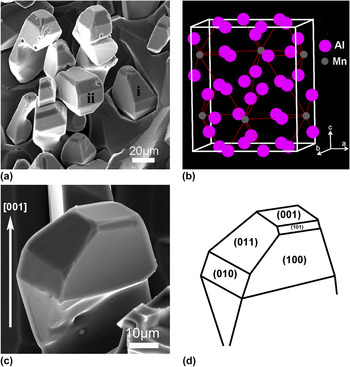
For revealing the 3D morphologies of Al6Mn IMCs, a deep etching technique was used by eliminating eutectic matrix. Figure 2(a) shows the 3D morphologies of primary Al6Mn IMCs at 1 μm/s. Various solid truncated polyhedrons elongated in growth direction are observed. Most of Al6Mn IMCs are found to form as “clusters” composed of series of 20–30 μm truncated polyhedrons, which were also observed in casting Al–Sc alloys at a slow cooling rate. Reference Hyde, Norman and Prangnell11 These polyhedrons own similar construction (indices) of crystal planes, but a slight difference in external morphologies, such as crystals (i) and (ii) marked in Fig. 2(a). It is attributed to growth discrepancies of different planes. Generally speaking, the final morphology of a crystal is mainly determined by both its intrinsic lattice structure and external conditions for growth. Reference Li, Wu, Li and Liu7,Reference Kurz and Fisher9,Reference Nie, Wu, Li, Li and Liu19 The former determines the relative growth rates of various crystal planes which are significant for crystals with high entropy of fusion. And the latter includes solute concentration in melt, the direction of heat flow and solute rejected fields caused by competition growth between adjacent crystals, etc. Figure 2(b) shows the unit cell of Al6Mn IMCs with an orthorhombic structure. Reference Yamamoto and Matsuo18 There are 28 atoms in a unit cell, including 4 manganese atoms and 24 aluminum atoms. Our previous work Reference Kang, Li, Su, Liu, Guo and Fu8 reveals that (011) and (101) planes are the relatively close-packed planes and the growth direction is close to the [001] crystallographic direction at a low growth rate. So, the crystal-plane indices of the above polyhedrons can be deduced. For example, for an individual Al6Mn crystal in Fig. 2(c), its Miller indices of planes are deduced, as shown in Fig. 2(d). Similar construction can be derived for other crystals. It suggests that these polyhedrons are bounded by {100} and {110} planes and the growth discrepancies of planes mainly affect external morphologies of polyhedrons.
3D morphologies of primary Al6Mn IMCs at 1 μm/s (a) and (c), unit cell of Al6Mn IMCs (b), and indices of crystal planes corresponding to Fig. 2c (d).

Figure 3 shows the 3D morphologies of Al6Mn IMCs at higher growth rates. With increasing growth rates, a morphological transition can be clearly observed from solid quadrangular prism [Fig. 3(a)], then to hollow quadrangular prism [Figs. 3(b) and 3(c)] and concave cylinder [Fig. 3(d)], and finally to dendrites [Figs. 3(e) and 3(f)], which is similar to what is observed for faceted snow crystals. Reference Kenneth20 Again these results confirm a transition from faceted (lower than 60 μm/s) to nonfaceted growth (higher than 100 μm/s). A transient growth between them appears at growth rates of (60–100 μm/s). For example, at 100 μm/s, morphologies of both slim cylinder with surface pits and dendrites with slight arms are found. The mechanism of the growth transition is also observed for other faceted materials. Reference Li, Wu, Li and Liu7,Reference Kenneth20,Reference Li, Quan, Li and Fu21 In addition, some growth details can be observed in Fig. 3, such as the large growth steps in insets of Figs. 3(a) and 3(b), and the growth-orientation change of secondary dendrite arms in insets of Figs. 3(e) and 3(f).
3D morphologies of Al6Mn IMCs at various growth rates: (a) 3 μm/s; (b) 10 μm/s; (c) 20 μm/s; (d) 60 μm/s; (e) 100 μm/s; (f) 1000 μm/s. Inserts are enlarged images corresponding to the square areas drawn by solid lines.

C. Mechanism of faceted–nonfaceted growth transition for Al6Mn
Generally, crystal growth morphology results from the interplay of crystallographic anisotropy and growth kinetics. According to the thermodynamics principle of crystal growth and Wulff's theorem, the equilibrium crystal morphology results from minimizing the anisotropic surface free energy of a crystal under the constraint of constant volume. Reference Dobrushin, Kotecý and Shlosman22 Once a nucleus with its equilibrium shape is formed and the long-range transport is not an issue, it will grow toward its “kinetic Wulff shape”, finally becoming bounded by surfaces of the more slowly growing orientations. For Al6Mn IMCs, the “kinetic Wulff shape” should be the regular octahedron bounded by eight (011) and (101) planes. In fact, in many growth processes, long-range transport of heat or solute is important, or even dominant, such as the growth at fast growth rate. In this case, the morphological instabilities will be occurred due to the nature of long-range transport processes. Reference Sekerka, Müller, Métois and Rudolph23 Therefore, for Al6Mn IMCs, at a low growth rate (lower than 60 µm/s), the crystal morphology is mainly dictated by the anisotropies of interfacial energy and attachment kinetics (important for IMCs), leading to the formation of faceted morphology with sharp edges and corners, as shown in Figs. 3(a)–3(d). According to the Al–Mn binary diagram, Reference Jansson16 Al–3 at.% Mn alloy is a typical off-eutectic-type alloy (k > 1). During the growth of the Al6Mn IMCs at a high growth rate (higher than 100 µm/s), the Al atoms are rejected into the melt, where it accumulates into Al boundary layer ahead of S/L interface. As a result, long-range diffusion of Al gives rise to the morphological instabilities of Al6Mn IMCs at a high growth rate. In this case, small bulges appear at the edges and corners of the faceted Al6Mn where the saturation attains its highest level, and protrude further into the solute-rich regions. This process is self-sustained, and continuous growth of the branches leads to the formation of dendritic morphologies, as shown in Figs. 3(e) and 3(f). Finally, Al6Mn IMCs undergo a faceted–nonfaceted growth transition as the growth rate increases.
In addition, to reveal the potential mechanism of the above faceted–nonfaceted growth transition in the process of directional solidification, detailed information about the kinetics of atom/cluster attachment to the solid/liquid (S/L) interface is needed during growth of Al6Mn. For IMCs with a strict stoichiometric ratio like Al6Mn, the S/L interface generally shows sharp shape with defined composition distribution. Thus, the atomic cluster in the liquid attachment to the S/L interface with same composition and structure is the major growth method. Reference Waku, Nakagawa, Wakamoto, Ohtsubo, Shimizu and Kohtoku24 Recently, Su et al. proposed a physical model of the faceted Al2O3/YAG eutectic growth based on the atomic cluster elementary process. Reference Su, Zhang, Liu, Eckert and Fu25 It can be improved to reveal the single-phase growth of IMCs, as shown in Fig. 4. Four representative regions (marked as 1, 2, 3, and 4) exist in the liquid ahead of the faceted interface. In region 1 next to the S/L interface, the liquid is composed of high density of large Al6Mn-like clusters (name Al6Mn-like clusters (Big/Small) as in Ref. Reference Su, Zhang, Liu, Eckert and Fu25) with same composition and structure. When the liquid is gradually far away from the S/L interface, small clusters are dominant, as shown in regions 2 and 3. In region 4 which is farthest away from S/L interface, the liquid is composed of completely mixed Al, Mn atoms or ions, and or their small clusters. When at a low growth rates (lower than V1 in Fig. 4), the large clusters in region 1 stacking to the solid are enough to maintain the low-speed growth of the solid into the liquid. Furthermore, the inherently rough, high-index planes of the solid accept the large clusters readily and grow quickly relative to the low-index planes. Therefore, the S/L interface still remains sharp, and four regions in the liquid ahead of interface always exist to maintain such growth. The Al6Mn IMCs show a faceted growth with a strong anisotropy. However, with increasing growth rates, both the large and small clusters (in regions 1 and 2, even 3) are needed to stack to the solid fast so that the solid reaches the growth rates growing into the liquid. This kind of stacking tends to be low selective to interfacial positions. Especially, plenty of clusters trapped by the interface (name cluster trapping) cause the S/L interface to be diffusive (rough), and weaken the growth discrepancies of planes. Typically at a critically high growth rate (V3), complete cluster trapping happens, and only completely mixed region 4 exists in the liquid ahead of the diffusive interface. Therefore, under rapid solidification, the Al6Mn IMCs shows a nonfaceted growth with dendritic morphologies.
A growth model of Al6Mn IMCs based on the atomic cluster attachment.

D. 3D morphological evolution of Al6Mn
As mentioned above, when growth rates are lower than 60 µm/s, primary Al6Mn whose geometrical morphologies are mainly dominated by the competitions of different planes, shows a typical faceted growth. The competition is mainly determined by the anisotropies of interfacial energy and attachment kinetics. A relationship was built between growth morphologies and growth-rate ratios of different planes for many cubic crystals respectively by a geometric method based on the lattice parameters of their cubic structures. Reference Wang, Lu and Hogan12,Reference Wang26,Reference Jin, Shen, Zou and Jiang27 Herein a similar work can be done for primary Al6Mn. Due to the asymmetric lattice parameters (a ≠ b ≠ c) of Al6Mn, the relationship is more complicated than that of cubic crystals. For simplicity, we mainly focus on three important planes of (001), (011), and (101) planes dominating the external shape of Al6Mn (Fig. 2) and suppose R (101) = (D (101)/D (011))R (011) and D (101)/D (011) = 0.944 except with special illustration, where R (hkl) is the growth rate of (hkl) plane and D (hkl) is the center-to-plane distance in a unit cell. In this case, (011) and (101) planes can be regarded as equivalent.
Figures 5(a)–5(d) schematically show the morphological evolution of Al6Mn dependent on the growth-rate ratios of (001), (011), and (101) planes. If R (001)/R (101) ≤ 0.761 and R (001)/R (011) ≤ 0.807, Al6Mn will grow as a perfect cubic. All {100} planes remain and {110} planes grow out, as shown in Fig. 5(a). When 0.761 < R (001)/R (101) < 1.314 and 0.807 < R (001)/R (011) < 1.240, {100} planes gradually shrink, but (011) and (101) planes appear, forming a truncated polyhedron bounded by (001), (011), and (101) planes, as shown in Fig. 5(b). This morphology is presented in Figs. 2(a) and 2(c). If R (001)/R (101) > 1.314 and R (001)/R (011) > 1.240, all {100} planes degenerate into corners and disappear, forming a perfect octahedron bounded by (011) and (101) planes, as shown in Fig. 5(d). The above analysis is based on the assumption of R (101) = 0.944R (011), when R (101) < 0.944R (011), 0.761 < R (001)/R (101) < 1.314, and 0.807 < R (001)/R (011) < 1.240, some {100} planes will degenerate into lines and ultimately disappear, as shown in Fig. 5(c). For example, the various polyhedrons in Fig. 2(a) fall in between that in Figs. 5(b) and 5(c). And the quadrangular prism in Fig. 3(a) falls in between that in Figs. 5(a) and 5(b) due to the gradually diminished {110} planes.
Morphological evolution of Al6Mn IMCs dependent on the growth-rate ratios of (001), (011), and (101) planes (a)–(d), schematic representations of the angular accelerated growth process (e) and a faceted–nonfaceted growth transition for Al6Mn IMCs (f).

Increasing growth rates lead to an accelerated angular growth mechanism mainly determined by volume diffusion. Reference Kang, Li, Su, Liu, Guo and Fu8,Reference Bögels, Buijnsters, Verhaegen, Meekes, Bennema and Bollen28 In this case, atoms (clusters) near edges and corners of crystals are easier to diffuse than that near the center of a plane. Therefore, compared to the center, the edges and corners have large growth rates, that is R Corner > R Center and R Edge > R Center. Thus, a hollow quadrangular prism or concave cylinder appears [Figs. 3(b)–3(d)]. The growth process is schematically shown in Fig. 5(e). This kind of growth mechanism is also observed in other facet crystals. Reference Li, Wu, Li and Liu7,Reference Wang, Lu and Hogan12 However, further increasing growth rates lead to a large undercooling ahead of the S/L interface. When the degree of undercooling reaches the requirement of continuous growth, S/L interface becomes unstable and protrusions appear along the interface. As the growth proceeds, protrusions will be exaggerated and the Al6Mn IMCs shows a nonfaceted growth with a dendritic morphology. Because of the effect of the solute gradient around the advancing tips of the first trunk, secondary dendrites are created along [110] or [100] directions [Figs. 3(e) and 3(f)]. Similar behavior also can be found in other faceted crystals. Reference Li, Wu, Li and Liu7,Reference Xu, Wang, Liu and Jiang29 In this case, the critical undercooling can be expressed as: ΔT* = πσg/α, where σ is the interfacial free energy and α is the step height. Reference Cahn, Hillig and Sears30 For very diffuse boundaries, g is given approximately by g = πx 3exp(−πx), where x = nπ/2 and n is the number of atomic layers comprising the transition from solid to liquid at the melting temperature. As mentioned above, the growth of Al6Mn IMCs is mainly dominated by long-range transport of heat or solute at a high growth rate (large n and g), small step height α and thus a large undercooling. Reference Broughton, Gilmer and Jackson31 When the growth rate is higher than 100 µm/s, the critical undercooling can be reached for a nonfaceted growth of Al6Mn IMCs in present experiments. Figure 5(f) schematically shows a potential process of faceted–nonfaceted growth transition for Al6Mn IMCs. The preferred growth of (001) planes promotes the forming of a slim cylinder as observed in Fig. 3(e). Further accelerated growth leads to instability and then branching along [110] or [100] directions around the trunk.
IV. CONCLUSION
A transition from faceted (<60 μm/s) to nonfaceted (>100 μm/s) growth of primary Al6Mn IMCs is observed with increasing growth rates. It is accompanied with the 3D morphological evolution of Al6Mn from solid polyhedrons to hollow structure then dendrites. Increasing growth rates lead to an accelerated angular growth mechanism mainly determined by volume diffusion, resulting in hollow structures. Further increasing growth rates lead to a large undercooling ahead of the S/L interface, continuous growth of Al6Mn IMCs occurs, and a nonfaceted growth of Al6Mn IMCs with dendritic morphologies appears. A growth model based on atomic cluster attachment is proposed to reveal the faceted–nonfaceted growth transition. A large growth rate leads to cluster trapping and forming a diffusive interface, driven by the large undercooling ahead of the interface. Thus a nonfaceted growth of Al6Mn IMCs with dendritic morphologies appears. Moreover, as for faceted growth, a relationship between 3D morphologies and growth discrepancies of crystal planes has been built.
ACKNOWLEDGMENTS
This project was supported by the National Natural Science Foundation of China (Nos. 51271068, 51274077, 51274054, U1332115), the key grant project of Chinese Ministry of Education (No. 313011), the China Postdoctoral Science Foundation (No. 082090), and the Fundamental Research Funds for the Central Universities.