INTRODUCTION
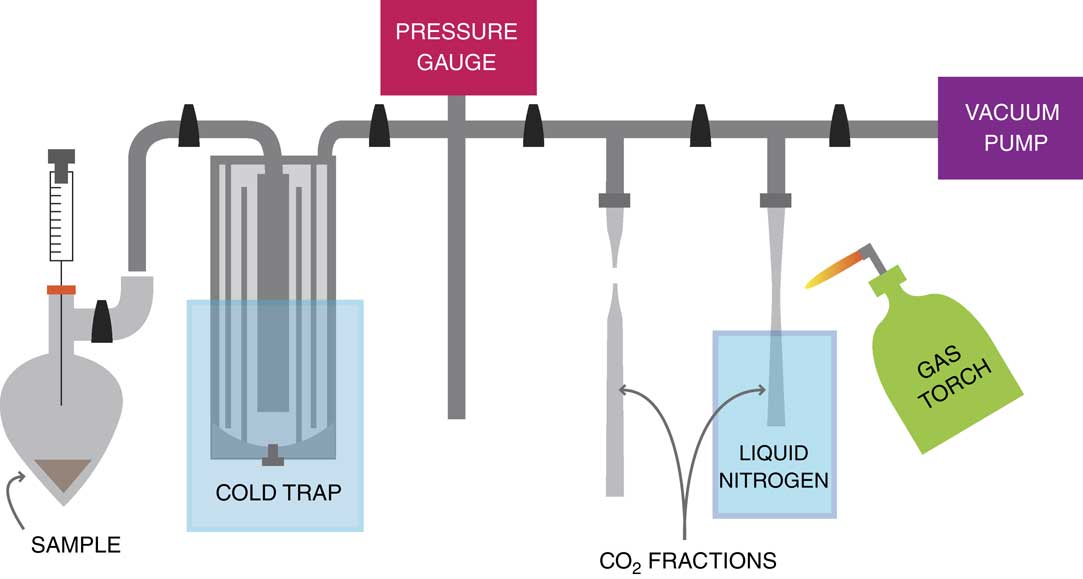
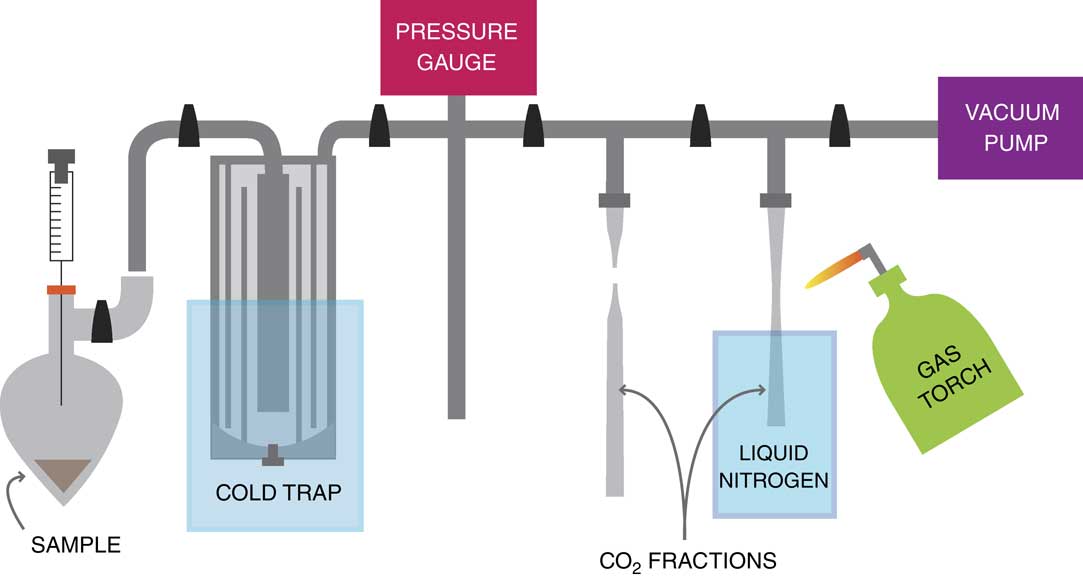
Dating of small selected samples of historical mortars became possible after the introduction of accelerator mass spectrometry (AMS) (Tubbs and Kinder Reference Tubbs and Kinder1990). Several studies have shown that lime lumps may potentially be more suitable for 14C dating than bulk mortars (Van Strydonck et al. Reference Van Strydonck, van der Borg, de Jong and Keppens1992; Ringbom and Remmer Reference Ringbom and Remmer1995; Heinemeier et al. Reference Heinemeier, Jungner, Lindroos, Ringbom, von Konow and Rud1997; Lindroos et al. Reference Lindroos, Heinemeier, Ringbom, Braskén and Sveinbjörnsdóttir2007; Pesce et al. Reference Pesce, Quarta, Calcagnile, Délia, Cavaciocci, Lastrico and Guastella2009, Reference Pesce, Ball, Quarta and Calcagnile2012). Since fewer 14C measurements may be needed, dating lime lumps may also provide more economically viable solutions in the future. If lumps form by clodding of the lime putty before it is mixed with the aggregate, they should be free from contamination of radiocarbon-dead geological carbonates from the filler. However, there are many kinds of lime lumps and not all of them are suitable for identifying the age of the mortared structure (Van Strydonck et al. Reference Van Strydonck, van der Borg, de Jong and Keppens1992; Pesce et al. Reference Pesce, Quarta, Calcagnile, Délia, Cavaciocci, Lastrico and Guastella2009, Reference Pesce, Ball, Quarta and Calcagnile2012; Lindroos et al. Reference Lindroos, Ranta, Heinemeier and Lill2014). The lump may be a weathered aggregate limestone fragment that has been misidentified, or it may be incompletely burned and disintegrated and still contain limestone relicts that have survived the lime burning process. Due to their soft and porous nature it is also common for weathering and re-crystallization to form secondary calcite within the lumps if they have been in contact with groundwater or percolating water in the masonry work at later stages (Lindroos et al. Reference Lindroos, Heinemeier, Ringbom, Braskén and Sveinbjörnsdóttir2007, Reference Lindroos, Heinemeier, Ringbom, Brock, Sonck-Koota, Pehkonen and Suksi2011a). Pesce et al. (Reference Pesce, Quarta, Calcagnile, Délia, Cavaciocci, Lastrico and Guastella2009) describe in some detail the most suitable lime lumps for 14C dating in archaeology: the best lumps are soft, white and have a flour-like surface. Initially, the potential of dating lime lumps was only investigated sporadically on centimeter-scale lumps by the laboratory of Geology and Mineralogy at Åbo Akademi University in Turku (Åbo), Finland and the AMS laboratory in Aarhus, Denmark. Some of the tests were also performed in Tucson, Arizona, in 2008. When a new line (Figure 1) dedicated to mortar dating was built 2008 in Åbo Akademi University, millimeter-scale samples could be processed and lime lumps were dated more frequently.
CO2 preparation line (modified from Ringbom et al. Reference Ringbom, Lindroos, Heinemeier and Sonck-Koota2014). The sample is held in the reactor vessel to the left and the acid is introduced either as excess 85% H3PO4 with a burette or as injected batches of diluted acid (H3PO4 or HCl in different kinds of experiments for methodological comparison) with a syringe through a rubber septum. The cold trap contains isopropanol cooled down to –70ºC. CO2 is collected in glass vials cryogenically with liquid nitrogen (LN). Not shown in the figure is the LN cold trap in front of the vacuum pump.
We present here the results of testing lumps from well-preserved medieval non-hydraulic mortars made from pure marble in southwest Finland and from lime mortars made from Ordovician limestone in the Åland Islands (between Finland and Sweden) and from Silurian or possibly Mesozoic limestone in southern Sweden. We also complement the Nordic material with data from lime lumps embedded in classical Roman pozzolana mortars and some small lumps in plaster made from Upper Cretaceous limestone in Jerash, Jordan. To date, we have analyzed 57 lime lumps, usually in several CO2 fractions. Some of the results will be published elsewhere in their archaeological context. We will not, however, present a detailed mineralogical and chemical study of the lime lumps; instead, we concentrate on the vital question— whether lime lumps embedded in the mortar are a more reliable material for dating than bulk mortar, and if the time has come to abandon the analysis of bulk mortars in favor of lime lumps.
SAMPLE PREPARATION
The preparation procedure of bulk mortars is described by Hajdas et al. (Reference Hajdas, Lindroos, Heinemeier, Ringbom, Marzaioli, Terrasi and Passariello2017). The mortars are carefully crushed and sieved into decreasing grain-size fractions (see e.g. Lindroos et al. Reference Lindroos, Heinemeier, Ringbom, Braskén and Sveinbjörnsdóttir2007 for details). A sample >50 g is usually sufficient to produce several hundred milligrams of material representing a narrow grain-size window, e.g. 46–75 μm (see appendix) for AMS dating. Lime lumps are prepared in a similar way. It is, of course, not necessary to crush a large sample, as the lump can be picked out of the mortar with a sharp tool at the sampling site or later in the laboratory. As lime lumps are often relatively small, it may be necessary to widen the grain size window to get sufficient material for dating. Theoretically, 1 mg of carbon could be recovered from an 8-mg of lump material, but in practice the smallest lump we have dated was 15 mg in weight. In this case the lump powder was not sieved, but the whole lump was crushed and hydrolyzed. Lumps large enough to yield at least two successive CO2 fractions are preferable in order to have some control of the homogeneity of the 14C distribution. It is also possible to collect material from several individual small lumps, but it is important to ensure that they are homogeneous and representative of the original mortar.
The Hydrolysis System
To monitor any possible contamination, the lime lumps were processed using the same dissolution system as the bulk mortars. Figure 1 illustrates the relevant elements of the CO2 preparation line.
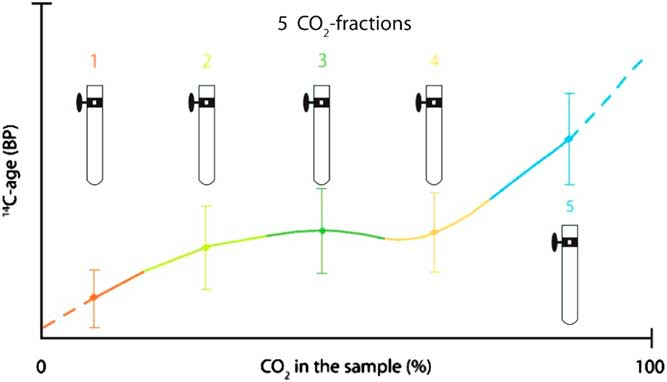
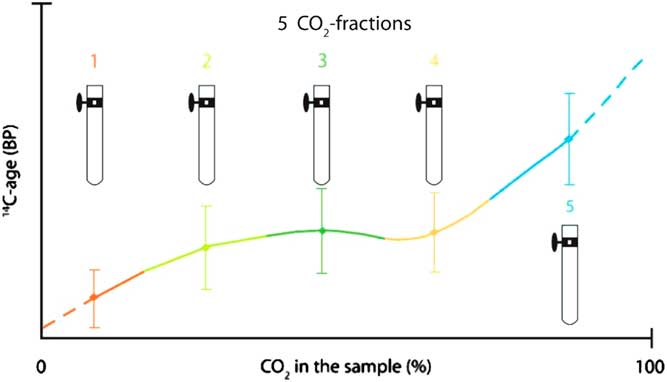
The result of several 14C measurements from successive CO2 fractions can be presented as an age profile of the sample, which is formed by plotting the consecutive 14C ages of the fractions obtained in sequential dissolution (Figure 2). The theoretical modelling of contamination is described by Lindroos et al. (Reference Lindroos, Heinemeier, Ringbom, Braskén and Sveinbjörnsdóttir2007) and a formalized categorization of age profiles produced with H3PO4 hydrolysis is presented by Heinemeier et al. (Reference Heinemeier, Ringbom, Lindroos and Sveinbjörnsdóttir2010). The true archaeological age forms a horizontal baseline from which the contamination deviates. Usually the first CO2 fraction is the least affected by the contamination. In this paper, however, the lines drawn between the points in the plots are not mathematical models of contamination, but are only guidelines connecting the data points from the individual hydrolysis runs to visually separate the different profiles in a plot. The calibration of the 14C ages to calendar years was performed using the IntCal13 calibration curve (Reimer et al. Reference Reimer, Bard, Bayliss, Beck, Blackwell, Bronk Ramsey, Buck, Cheng, Edwards, Friedrich, Grootes, Guilderson, Haflidason, Hajdas, Hatte, Heaton, Hoffmann, Hogg, Hughen, Kaiser, Kromer, Manning, Niu, Reimer, Richards, Scott, Southon, Staff, Turney and van der Plicht2013) and OxCal 4.3 (Bronk Ramsey Reference Bronk Ramsey2017). All calibrated results are reported at the 95.4% confidence level (2 sigma).
14C age profile in five CO2 fractions (from Ringbom Reference Ringbom2011). The relative sizes of the CO2 fractions are presented on the abscissa. They are calculated relative the total CO2 yield collected until no more CO2 bubbles effervesce from the sample powder. In the following plots fraction sizes are presented separately from the 14C ages and on the scale 0→1 instead of 0→100%.
If the age profile is more or less horizontal, with overlapping ages, then it demonstrates absence of contamination and is considered a very reliable result, or a “Criterion I” (CI) result according to the classification in Heinemeier et al. (Reference Heinemeier, Ringbom, Lindroos and Sveinbjörnsdóttir2010). The CI criterion still applies if the first two CO2 fractions of an age profile agree within the given error margins. For “Criterion II” (CII)—another reliable result that independently dates a mortared structure—age profiles for three or more samples per building unit are required. If all these age profiles yield overlapping results in their first CO2 fractions, then the combined calibration is assumed to give the true date of the mortar.
RESULTS AND DISCUSSION
In the appendix we list our previously published lime lump dating results alongside as-yet-unpublished results from more recent studies. Here, we revisit some important lime lump dates and their interpretation, and present data that have not been published before or have only appeared in conference volumes of a regional character. For comparative reasons, we have included age profiles of the surrounding bulk mortars, sometimes generated several times and with both HCl and H3PO4 hydrolysis. In the plots we have used the following abbreviations and marks to denote bulk mortars, lime lumps and different hydrolysis used: sample identification and number=bulk mortar. Extension Li after the number denotes lime lump (in some early publications L was used instead of Li). Bulk mortars are denoted with diamonds and lime lumps with dots. Filled symbols denote H3PO4 and open symbols denote HCl hydrolysis.
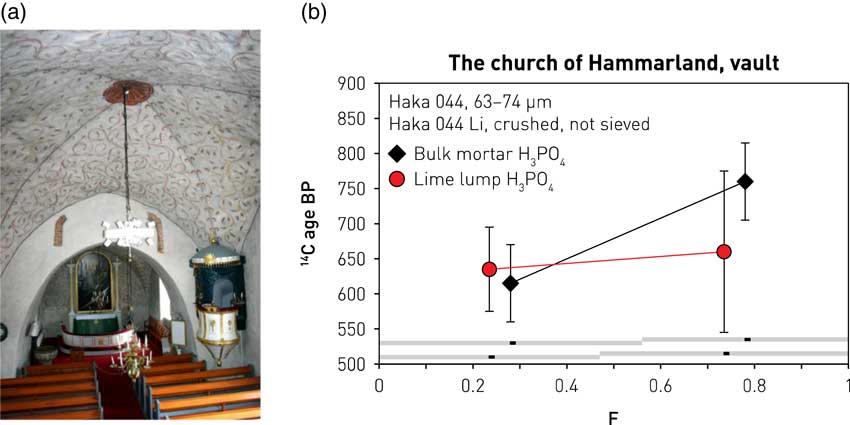
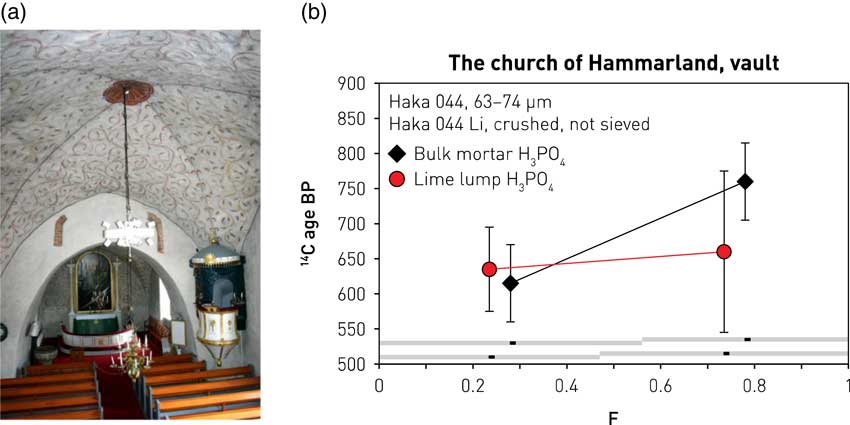
Initially, lime lump dating was undertaken using the Aarhus multipurpose preparation line, which required relatively large samples, preferably >100 mg. There was also another problem: it turned out that the dissolution was difficult to plan in advance, since the carbon yield could vary considerably between a preliminary test and the actual hydrolysis. The first application of lime lump dating was from the church of Hammarland in the Åland Archipelago between Finland and Sweden, which was sampled in 1994 soon after adopting AMS for our mortar dating (Ringbom and Remmer Reference Ringbom and Remmer1995). At that time the samples were usually dated in two CO2 fractions and several different grain size windows were tested (e.g. 21–150 μm or unsieved material). The potential of lime lumps became apparent when dating the vault of the church. Here the age profile of Haka 044Li (Figure 3; Ringbom and Remmer Reference Ringbom and Remmer1995; Heinemeier et al. Reference Heinemeier, Ringbom, Lindroos and Sveinbjörnsdóttir2010), a lime lump embedded in the mortar and dated in two fractions, appears horizontal—thus possibly without contamination, although the errors are large and partially overlap the results of the bulk mortar.
(a) Hammarland church, Åland; (b) age profiles from the vaulting of the nave.
Lime Lumps in Classical Archaeology
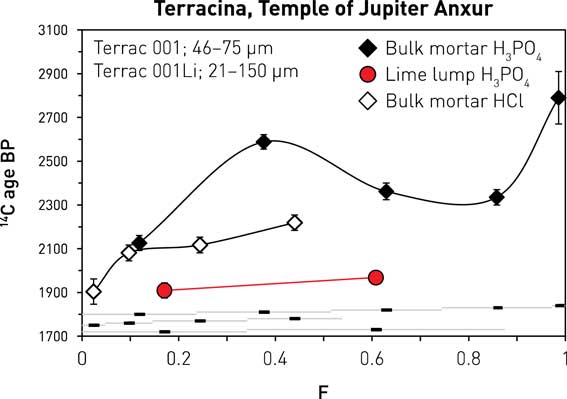
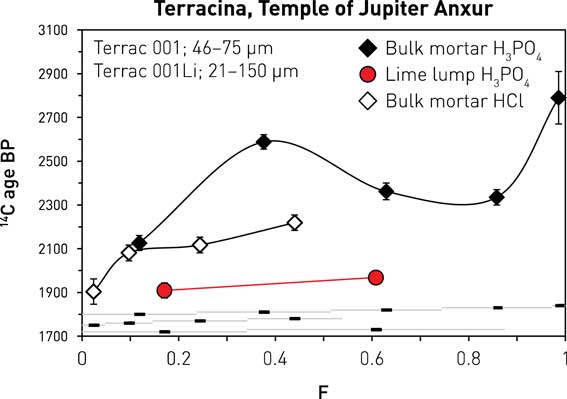
The age of the monumental Temple of Jupiter Anxur in Terracina, Lazio, is considered to be one of the early pozzolana structures in Italy from the first century BC (Coarelli Reference Coarelli1982). The bulk mortar of sample Terracina 001 was analyzed using both H3PO4 (Aarhus) and HCl dissolutions (Tucson), each time in several CO2 fractions (Figure 4). The age profiles coincide at the beginning if the H3PO4 profile is extrapolated further toward the y-axis. The lime lump Terracina 001Li embedded in the mortar was analyzed in two CO2 fractions. The result was an almost horizontal profile and the first CO2 fraction supports the interpretation of the bulk mortars, yielding an age of 1909±35 BP, corresponding to a calibrated age cal AD 20–214 (2σ).
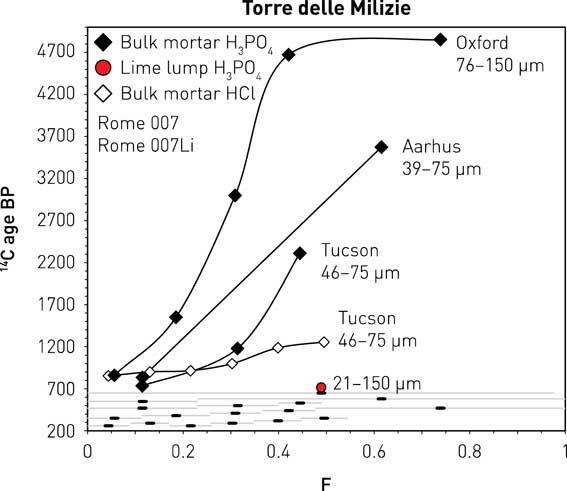
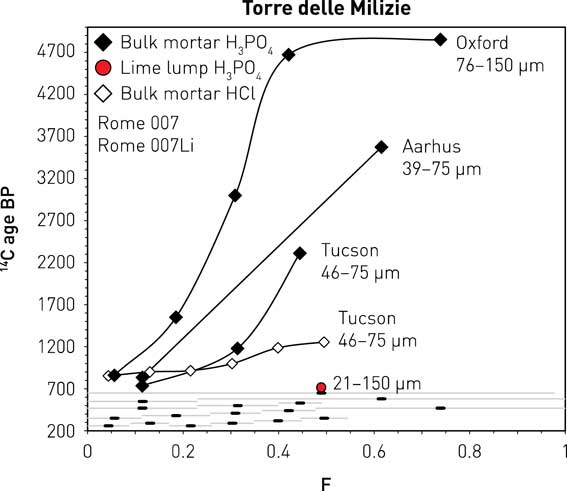
Pozzolana mortar from the very top of Torre delle Milizie, a medieval addition to Trajan’s Market in Rome, erected by Pope Innocence III between 1198 and 1216 (Touring Club Italiano 1999), was sampled in 1998. Different types of dissolution (H3PO4 and HCl) were applied, involving several laboratories: Aarhus, ORAU (Oxford, UK), and Tucson (Hodgins et al. Reference Hodgins, Lindroos, Ringbom, Heinemeier and Brock2011). The earliest dating attempt (Ringbom et al. Reference Ringbom, Hale, Heinemeier, Lindroos and Brock2006), based on hydrolysis with phosphoric acid in Aarhus and Oxford, a 13th century date was proposed, mainly based on the least contaminated sample Rome 009 (see appendix) with the first CO2 fraction dating to 750±35 BP.
Age profiles of a bulk mortar hydrolyzed with H3PO4 and HCl and a lime lump from Terracina, Lazio. Bulk mortar, H3PO4 profile from Lindroos et al. (Reference Lindroos, Heinemeier, Ringbom, Brock, Sonck-Koota, Pehkonen and Suksi2011a), Ringbom et al. (Reference Ringbom, Heinemeier, Lindroos and Brock2011).
Sample Rome 007 (Figure 5), which reveals extreme 14C-dead contamination, was further tested in Tucson with both H3PO4 and HCl. The H3PO4 result for the first CO2 fraction, 735±30 BP, is similar to that of sample Rome 009. The relatively horizontal age profile created by HCl displays somewhat older BP ages in the beginning. The result from the lime lump Rome 007Li is in agreement with our earlier interpretation. Unfortunately, it was only possible to date one CO2 fraction because the lump was very small (15.7 mg).
Torre delle Milizie, Rome. Age profiles of sample Rome 007, from the very top of the tower. Bulk mortar and lime lump within it.
Sant’Agnese
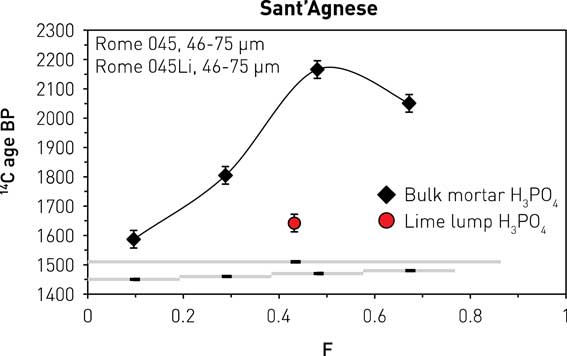
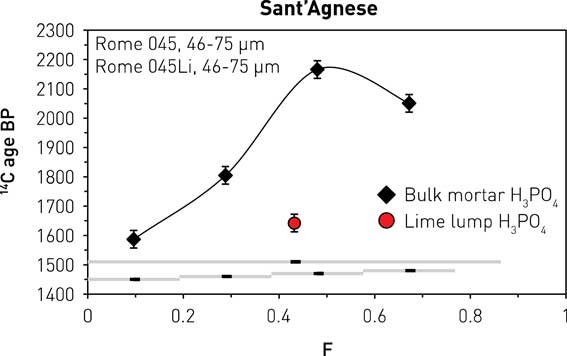
The horseshoe shaped basilica of Sant’Agnese (Figure 6) was erected outside the walls of Rome in connection to early Christian catacombs, in Via Nomentana at the time of emperor Constantine the Great, 312–337 AD (Frutaz Reference Frutaz2001). The rotunda of Santa Costanza is a secondary addition to the basilica (Figure 7).
The Basilica SantÁgnese, Via Nomentana, Rome. Age profiles of bulk mortar and lime lump within it.
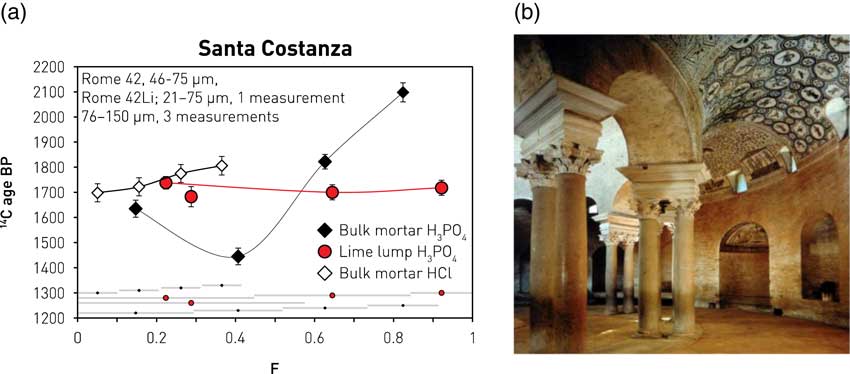
(a) Santa Costanza, Via Nomentana, Rome. Age profiles of bulk pozzolana mortar and a lime lump analyzed twice. (b) Interior of Santa Costanza.
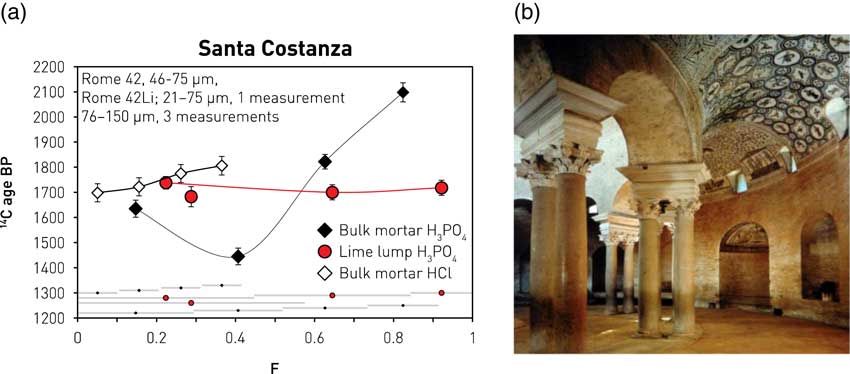
The bulk mortars from this construction (Figure 6 and Santa Costanza, Figure 7a) appear unreliable because they display both dead carbon contamination and variable results for the first CO2 fractions (see sample Rome 044 in appendix). The sample Rome 045/45Li (Figure 6) provides an acceptable date, but the lump was only 23.6 mg, so there is no homogeneity control from a second CO2 fraction.
Santa Costanza
The exact date of this rotunda is unknown, although the building is most certainly Constantinian (Ringbom Reference Ringbom2003; Ringbom et al. Reference Ringbom, Hale, Heinemeier, Lindroos and Brock2006). It was originally a mausoleum for Costantina and Helena, daughters of Constantine the Great, either erected by Constantina around AD 330 or by her brother-in-law Julian the Apostate AD 350–360, who owned the land and who was married to Helena (Mackie Reference Mackie1997; Ringbom Reference Ringbom2003). Several attempts have been made to date the construction, firstly using H3PO4 hydrolysis in Aarhus and Oxford (Ringbom Reference Ringbom2003; Ringbom et al. Reference Ringbom, Hale, Heinemeier, Lindroos and Brock2006) and subsequently with H3PO4 and HCl in Aarhus and Tucson (Hodgins et al. Reference Hodgins, Lindroos, Ringbom, Heinemeier and Brock2011). Here we present the results from sample Rome 042 including a dateable lime lump (Figure 7a).
The first CO2 fractions of Rome 042 (HCl) and the ages of the embedded lime lump are similar. The lime lump from the corner of the niche of Constantina’s sarcophagus was analyzed twice: once in three CO2 fractions and once in a single CO2 fraction. The results form a baseline at 1716±15 BP, or cal AD 256–299 (32.4%), 319–387 (63.0%) in a combined calibration of all four lime lump measurements (χ2-test: df=3 T=1.7; 5% 7.8). The dip in the H3PO4 profile at the second CO2 fraction is irregular. As younger material usually dissolves first, we suggest that the hydraulic mortar contained a large amount of lime lumps, which dominated the reaction at the beginning, but parts of this particular sample may also have been affected by delayed hardening. However, even if analyzing the lime lump proved useful, the resolution of the calibration curve at this period was not sufficient to help confirm the builder of the mausoleum.
The Parma Bridge
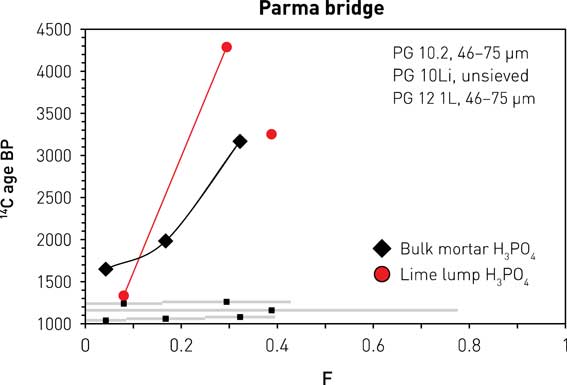
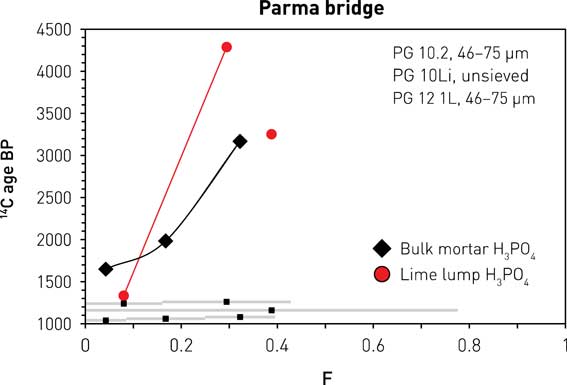
From the Visigothic period, this bridge is located in a very humid environment and in contact with water. Its mortars contained plenty of lime lump inclusions. Two lime lumps were analyzed, one associated with the bulk mortar. The bulk mortar and lime lump profiles (PG10, PG12Li, Figure 8) reveal a high level of contamination by radiocarbon-dead carbon. The small lime lump PG10Li, was analyzed in only one CO2 fraction, and yielded a result which was far too ancient, presumably due to contamination. Lime lump PG12Li displays on one hand a rather young first CO2 fraction and a nearly 3000 yr older second CO2 fraction. The young age for the first fraction may have been caused by new calcite crystals precipitated within the mortar pores due to weathering phenomena, as observed in thin sections. It seems that the weathering/recrystallization has affected at least the other lime lump more than the bulk mortar (the one dated in two CO2 fractions). Only the bulk mortar resulted in an age profile where the first CO2 fraction overlaps the beginning of the Visigothic period (starting in 410 with Alarik sacking Rome), 1649±28 BP, or cal AD 332–433 (87.8%, 2σ).
Visigothic bridge in Parma, Italy. 14C profile from the bulk mortar and a single measurement from a lime lump within it and a profile from another lime lump.
Jerash, Jordan
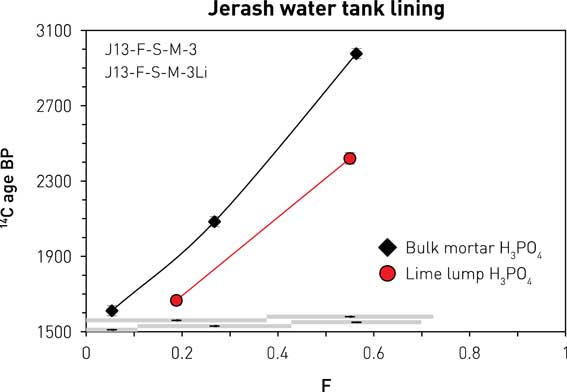
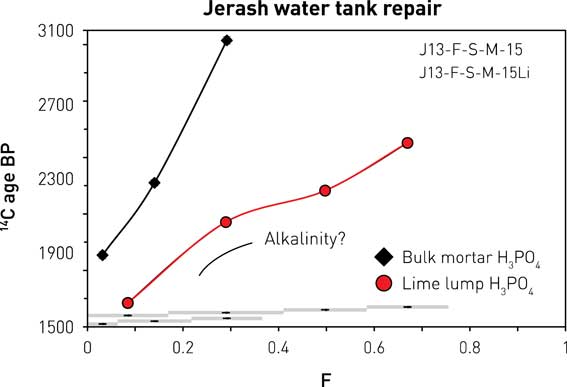
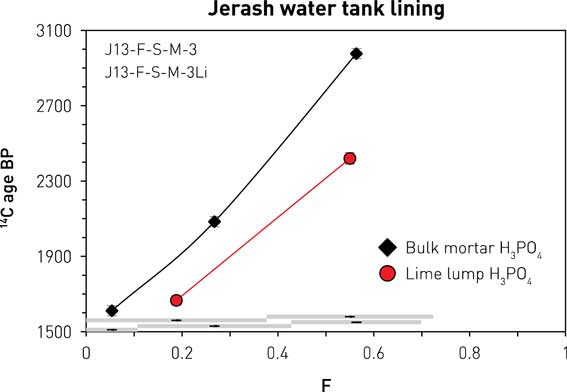
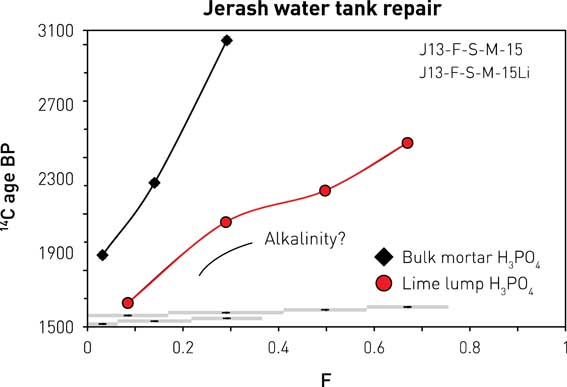
A series of mortar and lime samples from water cistern walls and water pipe joints were taken in 2013 in the ancient city of Jerash in Jordan (Lichtenberger et al. Reference Lichtenberger, Lindroos, Raja and Heinemeier2015). All samples were heavily contaminated with underburnt limestone and had a filler composed of fluvial limestone. The mortars contained abundant charcoal particles and small lime lumps, which were usually too small for 14C dating. They had a dirty gray appearance and on closer inspection revealed charcoal within the lumps as well. The dating of the lime lumps was not successful, but it helped to interpret bulk mortar data to some extent because they showed less dead carbon contamination than the bulk mortars and similar 14C ages at the start of the hydrolysis (Figures 9 and 10). The lime lumps also show absence of the rapidly dissolving dead carbon contaminant seen in Figure 10, bulk mortar, and in many other bulk mortar profiles reported in Lichtenberger et al. (Reference Lichtenberger, Lindroos, Raja and Heinemeier2015).
Bulk mortar and lime lump age profiles from the original water tank lining in Jerash. From Lichtenberger et al. (Reference Lichtenberger, Lindroos, Raja and Heinemeier2015).
Bulk mortar and lime lump age profiles from a repair of the collapsed roof lining of the water tank. From Lichtenberger et al. (Reference Lichtenberger, Lindroos, Raja and Heinemeier2015).
The lime lumps in Jerash were not typical “pure lime lumps” (Pesce et al. Reference Pesce, Ball, Quarta and Calcagnile2012), nor were they well suited for dating.
Lime Lumps from Medieval Sweden and Finland
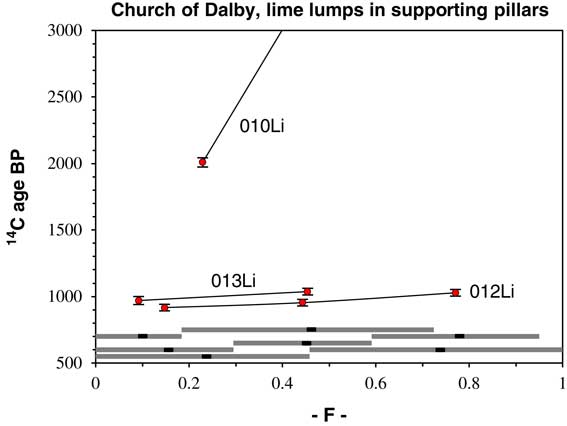
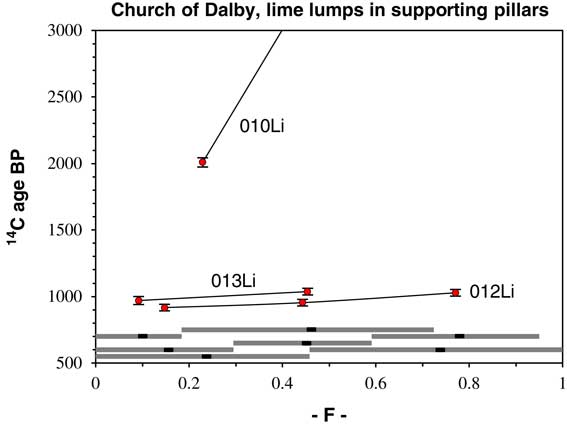
A study focused on lime lumps was made on the church of Dalby in Scania, southern Sweden (Lindroos et al. Reference Lindroos, Ranta, Heinemeier and Lill2014). Three lime lumps were sampled in situ from the supporting pillars within the church. Several hundred milligrams of lump material were peeled out from the pillars with a knife. Lime lump 010Li is iron rich and rusty and contains abundant underburnt limestone contamination (Figure 11). Lumps 012Li and 013Li are soft, bright white and flour-like “pure lime lumps” (Pesce 2009). A combined calibration of CO2 fraction 1 and 2 for sample 012Li and fraction 1 for sample 013Li yields the 14C age 944±16 BP, which corresponds to the calendar ages cal AD 1028–1059 (22.5%) or 1065–1155 (72.9%; χ2-test: df=2 T=2.1; 5% 6.0).
14C age profiles from three lime lumps from supporting pillars in the church of Dalby, southern Sweden (from Lindroos et al. Reference Lindroos, Ranta, Heinemeier and Lill2014).
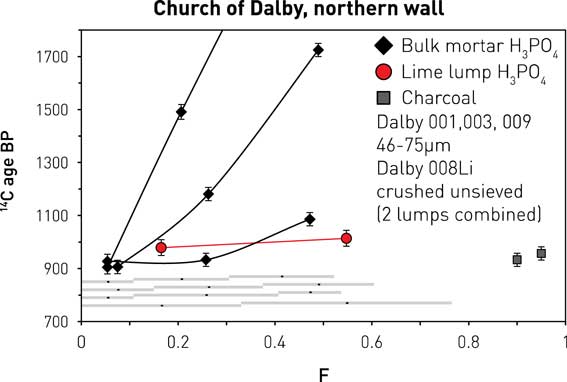
Mortar samples were also taken from the northern wall of the church where younger plaster had fallen off and revealed the original stone masonry. Three bulk mortars and the material from two lime lumps were dated together with two charcoal inclusions (Figure 12).
Church of Dalby, Scania, Sweden. 14C age profiles from three bulk mortars and one lime lump together with two charcoal 14C ages.

Samples 001 and 003 from Dalby church show extreme dead carbon contamination while sample 009 yields a CI profile typical of a reliable date (e.g. Lindroos et al. Reference Lindroos, Heinemeier, Ringbom, Braskén and Sveinbjörnsdóttir2007; Heinemeier et al. Reference Heinemeier, Ringbom, Lindroos and Sveinbjörnsdóttir2010) and is in agreement with the ages of the charcoals (Dalby 002C, 003C in appendix). The lime lump material 008Li appears slightly older, but the whole sequence of profiles suggest a similar age to that of the supporting pillars (Figure 11).
Ruins of the Ås Kloster Monastery
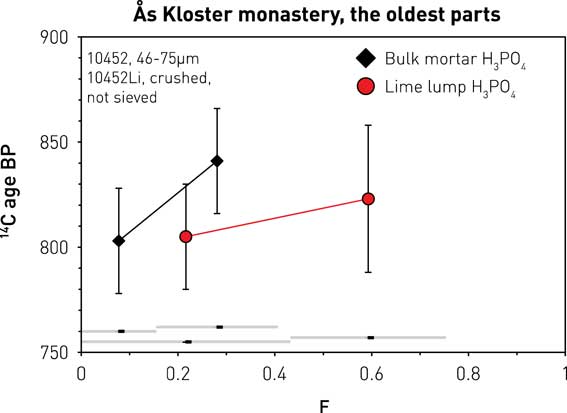
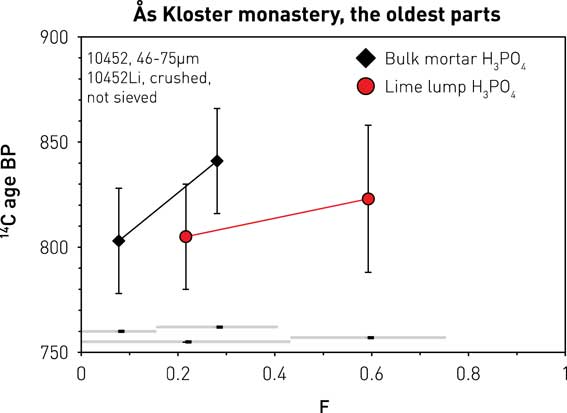
On the southwest coast of Sweden, these ruins were dated in 2013 (Bjuggner and Rosengren Reference Bjuggner and Rosengren2015). The mortar samples were taken during excavations below the present ground level. A bulk mortar/lime lump sample pair from the stratigraphically oldest part of the monastery provided a rather convincing date (Figure 13). Both the lime lump and the bulk mortar date the construction to cal AD 1185–1274, which is within the expected age frame of the 12th–14th centuries.
Age profiles of bulk mortar and its embedded lime lump from Ås Kloster monastery, SW Sweden.
Church of Sund
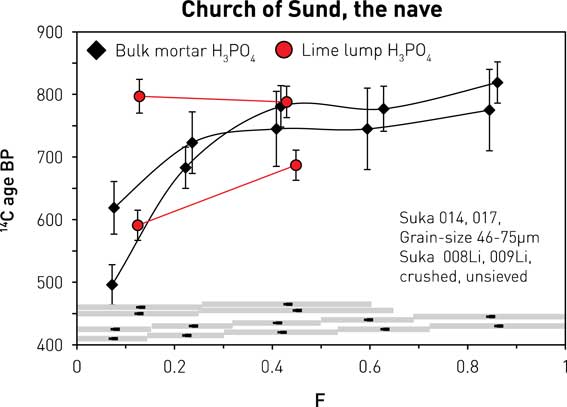
Originally the largest church on the Åland Islands, Sund was dated by analyzing fire-damaged bulk mortars (Figure 14a; Ringbom et al. Reference Ringbom, Bartholin, Klein, Lindroos, Sveinbjörnsdóttir and Heinemeier2005). This was the first time age profiles of fire-damaged mortars were identified and interpreted. In this case the horizontal plateau in the profile is believed to reflect the true age of the structure, whereas the first fractions probably reflect the time of the fire when the mortar was partly re-calcined and re-crystallized. The horizontal parts of the two profiles from the nave agree within the error margins. A combined calibration (omitting the first fractions) yields 778±16 BP or 1225–1285 cal AD (2σ, Ringbom Reference Ringbom2011).
Age profiles from fire damaged mortars in the church of Sund. The original sample series (from 1999) was re-examined for lime lumps. Two undated samples from the same unit contained datable lumps. Both were dated in two CO2 fractions in 2015.
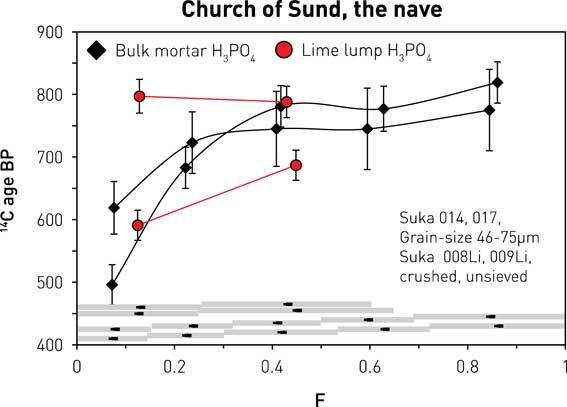
The data were complemented with two lime lump analyses undertaken in 2015. Suka 008Li produced an almost horizontal age profile, with first and second fractions dating to 797±27 BP and 788±25 BP, or combined 1190-1275 cal AD (χ2-test: df=1 T=0.1; 5% 3.8) supporting the earlier dates obtained from the fire-damaged bulk mortars (Ringbom et al. Reference Ringbom, Bartholin, Klein, Lindroos, Sveinbjörnsdóttir and Heinemeier2005). Suka 009Li, however, appears younger, possibly also displaying fire damage effect as indicated by the slope.
Church of Finström
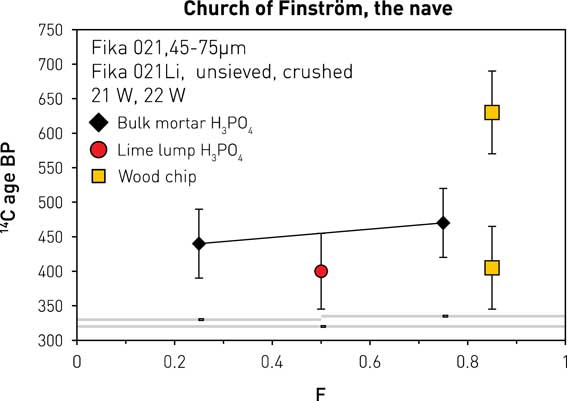
Archaeological excavations in 1969–1970 revealed the foundations of an earlier wooden church under the floor of the present nave in the Finström Church, Åland. In 1994 we sampled the nave of the church for mortar and undertook some of our first lime lump dating (Figure 15; reported in Heinemeier et al. Reference Heinemeier, Ringbom, Lindroos and Sveinbjörnsdóttir2010).
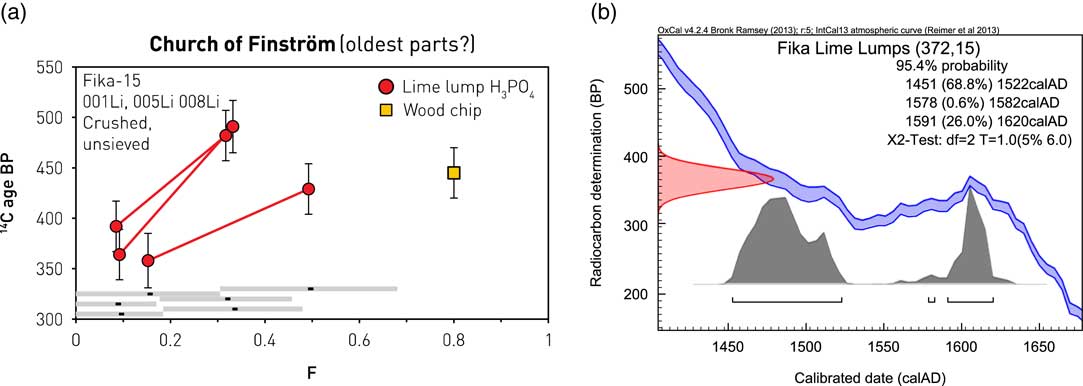
Results from analyzing a bulk mortar and lime lump in the church of Finström in 1994. The mortar also contained an older wood chip. A nearby sample had another wood chip displaying the same age as the lime lump.
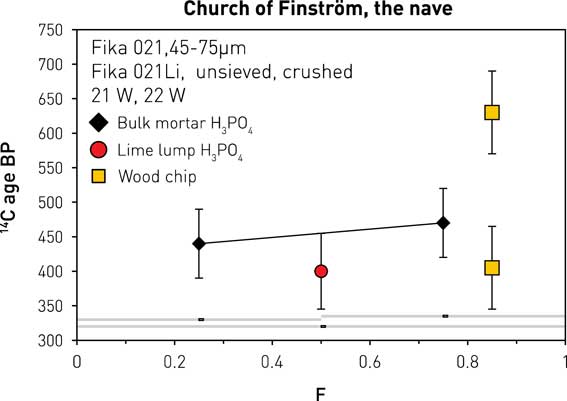
Note that total dissolution and too few CO2 fractions can fail to reveal heterogeneous 14C distribution. Theoretically, all CO2 fractions can be more or less contaminated with dead carbon and the wood may be old. In this case, however, there are sufficient data in Heinemeier et al. (Reference Heinemeier, Ringbom, Lindroos and Sveinbjörnsdóttir2010) to support the interpretation presented in the text to Figure 15.
In 2004 we collected another series of mortar samples, one of which contained lime lumps, representing the secondary vaulting of the nave. Dendrochronological results from the roof trusses yield AD 1450 (reported in Ringbom Reference Ringbom2011). The results from the mortar dating met the demands of both the CI and CII criteria (Heinemeier et al. Reference Heinemeier, Ringbom, Lindroos and Sveinbjörnsdóttir2010), and all age profiles from the same building unit agree in their first CO2 fractions (one of the profiles, Fika 060, is entirely horizontal). A combined calibration of the first CO2 fractions yields 1435–1485 cal AD (Ringbom Reference Ringbom2011).
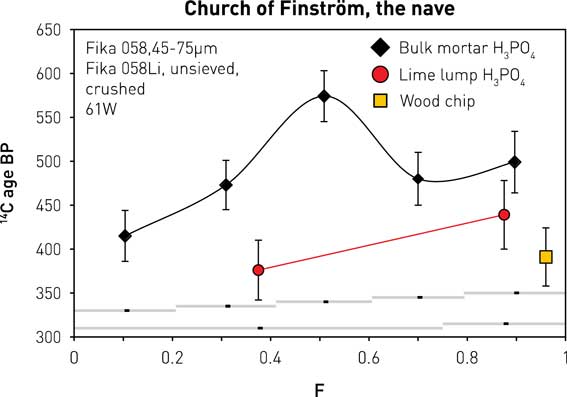
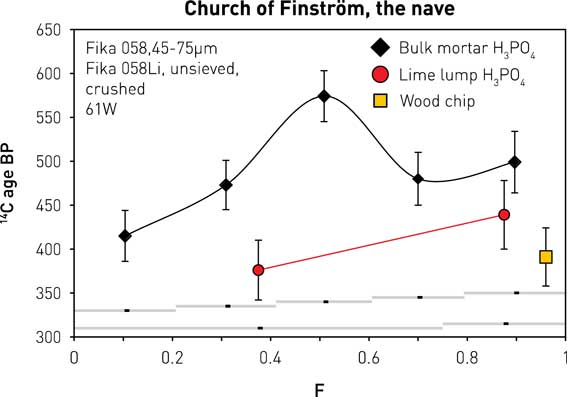
The lime lump Fika 058Li (Figure 16) adds further support to this interpretation. The first CO2 fraction calibrates to 1443–1529 (54.7%) and 1543–1635 (40.7%) cal AD. The corresponding bulk mortar Fika 058 exhibits a typical total dissolution profile in five CO2 fractions: after an initial increasing slope the profile goes through a local maximum reflecting a dead carbon component from aggregate limestone, which then becomes exhausted and is followed by a low, positive slope due to dead carbon from slowly dissolving calcination residues.
Age profiles of bulk mortar Fika 058 and lime lump Fika 058Li, dating the vaulting of the nave in the Finström church. Another mortar sample from the nave contained the wood chip 61W.
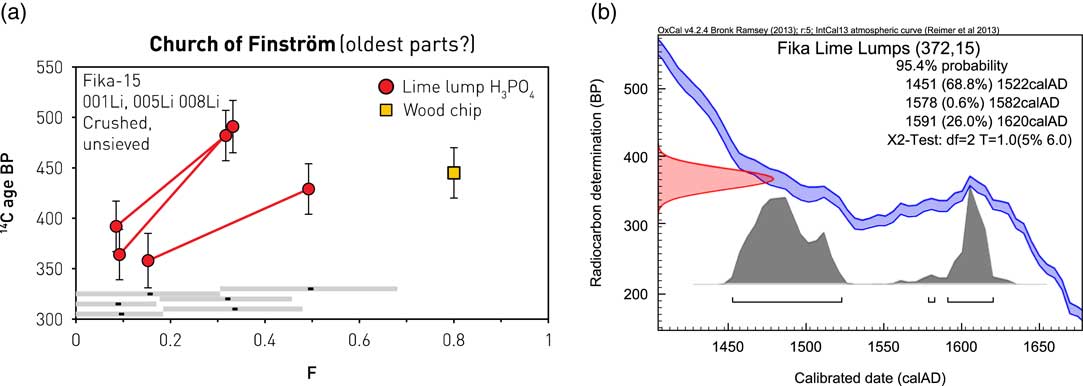
In 1970 a hoard of coins from 1250–1285 was uncovered under the sacristy floor in Finström church, indicating that the sacristy could represent the oldest part of the stone church. To verify this hypothesis, three samples including lime lumps were gathered from the attic of the sacristy in 2015 and analyzed in age profiles with two CO2 fractions (Figure 17a). All of them reveal high levels of contamination and furthermore, contrary to expectations, all of them show that the upper part of the sacristy may even be younger than the nave. The wood sample Fika 04W from the same sample series cannot be younger (i.e. terminus post quem) than the lime lumps and thus the second CO2 fractions are certainly biased. Consequently, in spite of our efforts we have not yet been able to document the oldest parts of the stone church in Finström.
(a) The sacristy of the church in Finström. Three age profiles of lime lumps and a wood inclusion sampled above the vault. They present a CII result, where all first CO2 fractions meet. (b) The combined calibration of the three first fractions yields the highest probability at cal AD 1451–1522 (68.8%, 2σ).
Nave of Jomala Church
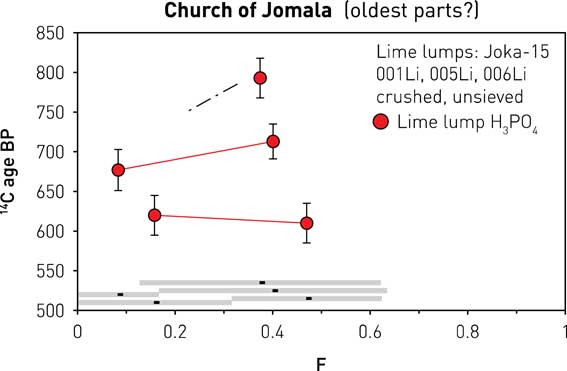
This nave is usually considered to be the oldest known stone construction in the Åland Islands (Ringbom Reference Ringbom2011). Unfortunately, it has been heavily rebuilt and the oldest parts were demolished in the 19th century. However, the bulk mortar of the tower has been successfully dated to the 1280s (Heinemeier et al. Reference Heinemeier, Ringbom, Lindroos and Sveinbjörnsdóttir2010). To determine the age of the nave, lime lumps from the west gable of the nave were dated in 2015 (Figure 18).
Lime lump dating in the church of Jomala. The first CO2 fraction of sample Joka-15-005Li was lost.
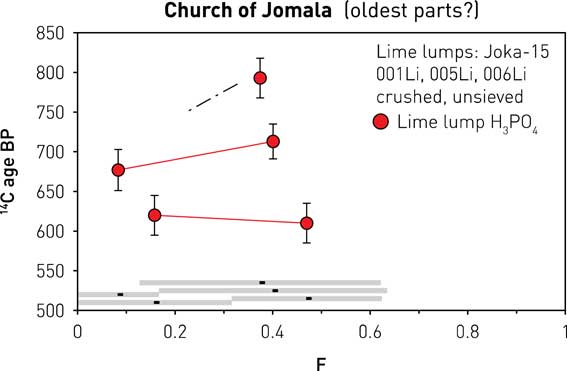
The resulting age profile of Joka 001Li (first fraction BP 660±26, cal AD 1273–1389, 95.4%) is similar to the dates presented by analysis of bulk mortar and dendrochronology of the tower wood elements. It was sampled from the joint between the tower staircase and the west gable and could possibly date the oldest part of the nave. Thus, it is still not clear whether the west gable and the tower belong to the same building phase or whether there are still older parts of the nave in the church.
Church of Nagu
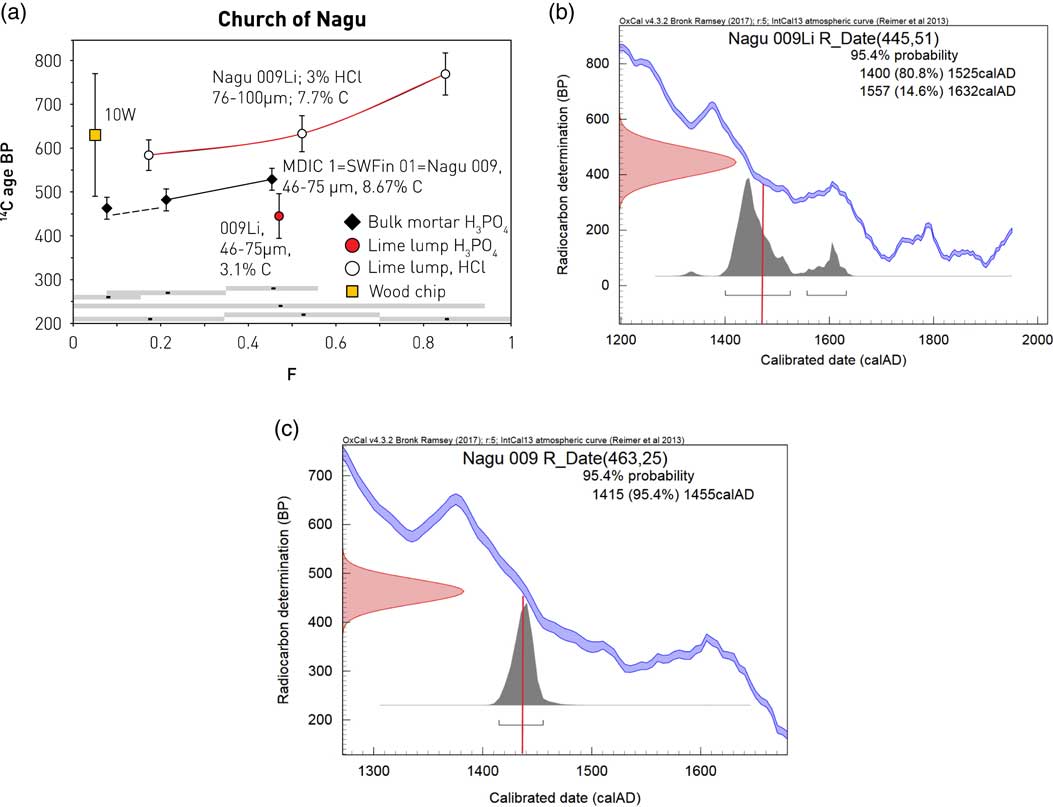
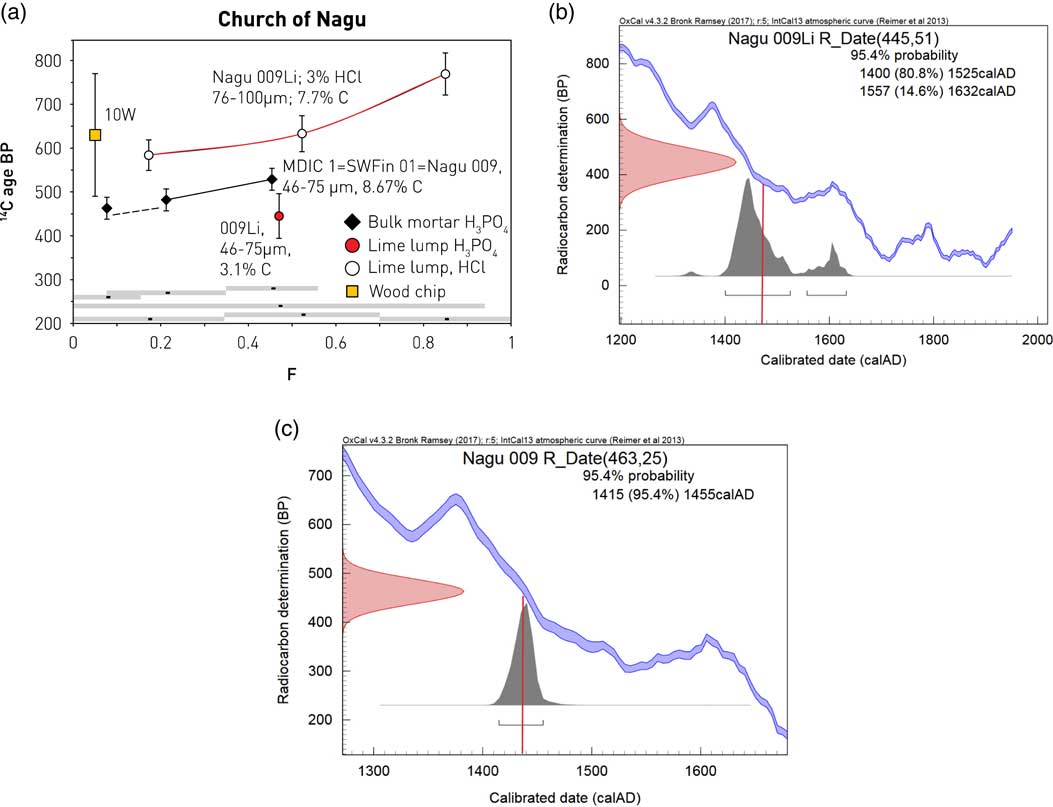
This church is located in the Åboland archipelago, southwest Finland. The bulk mortar sample Nagu 009 is part of the inter-comparison project within the international mortar-dating network (MODIS; Hayen et al. Reference Hayen, Van Strydonck, Fontaine, Boudin, Lindroos, Heinemeier and Ringbom2016a, 2016b). The sample has been labeled MDIC 1, SWFin 01, and Nagu 009 in different reports. The hydrolysis was done twice because CO2 fraction 1 was lost in the first attempt (therefore the overlap of fractions 1 and 2). The mortar contains abundant amounts of lime lumps, one of them had previously been dated using both 5% H3PO4 and 3% HCl (Figure 19). The sample should date the secondary vaulting of the nave, which has a dendrochronological dating at AD 1436 (appendix).
(a) Bulk mortar and lime lump age profiles from the church of Nagu. The MDIC date in the plot was produced by the Åbo-Aarhus team as part of the intercomparison; (b) calibrated results of lime lump Nagu 009Li (5% H3PO4; 445±51 BP) and (c) bulk mortar Nagu 009 (463±25 BP) accordingly. Both values coincide with the dendro-date (1436) of the roof construction of the nave, marked as a red vertical line in the plots. Figure 19a is from Sjöberg et al. (Reference Sjöberg, Lindroos and Ringbom2011).
Cathedral of Turku
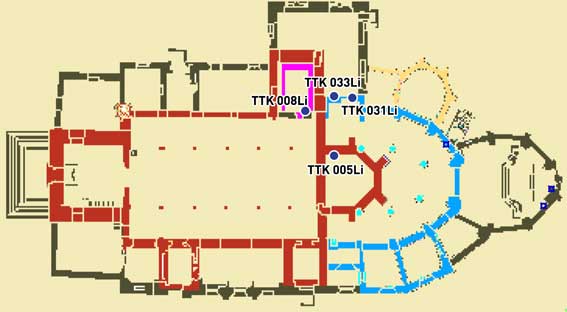
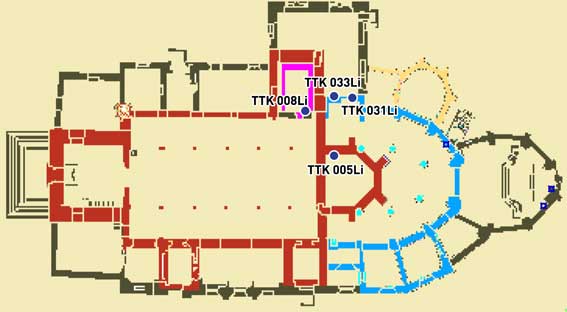
From the 13th century to 1809 AD, Finland was part of Sweden, forming one large diocese, the diocese of Turku. The building history of Turku Cathedral is controversial. According to the traditional chronology, following the evidence of written sources, it has been dated to around 1300 AD (e.g. Gardberg et al. Reference Gardberg, Heininen and Welin2000), when the sacristy and the nave were supposedly inaugurated. According to later theories the cathedral was not built until the 15th century (Hiekkanen Reference Hiekkanen2007). The south gable of the first sacristy is still fully visible as a separate part adjoining the northern wall of the nave, thus predating the nave. The cathedral has been subject to repeated fires and the irregularity of the calibration curve in the 14th century adds further uncertainty to the interpretation. Nevertheless, analyzing bulk mortars (Lindroos et al. Reference Lindroos, Ringbom, Kaisti, Heinemeier, Hodgins and Brock2011b, Reference Lindroos, Regev, Oinonen, Ringbom and Heinemeier2012) and lime lumps (this study) have added clarity to dating the first three building stages: the sacristy (TTK 008Li), the polygonal chancel (sample TTK 005Li), and the tower staircase belonging to the Hemming chancel, an enlargement of the nave (TTK 031Li and TTK 033Li, Figure 20).
Plan of Turku Cathedral and the sampling of the lime lumps.
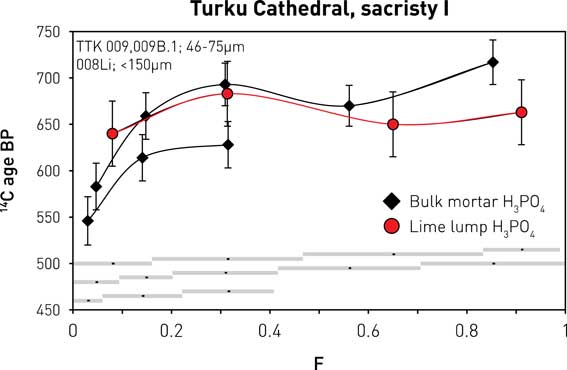
The remnants of the first stone sacristy comprise the structurally oldest part of the building where, according to written sources, Bishop Magnus I was elected in 1291 AD (Diplomatarium Fennicum: 201). In 2012 we analyzed new lime lump samples from the cathedral and from samples taken earlier. Lump TTK 008Li is from a mortar sample taken earlier (Figure 21).
Turku Cathedral. Plot of age profiles of fire damaged bulk mortars (TTK 009 and TTK 009B) from Sacristy I, combined with the age profile from lime lump TTK 008Li.
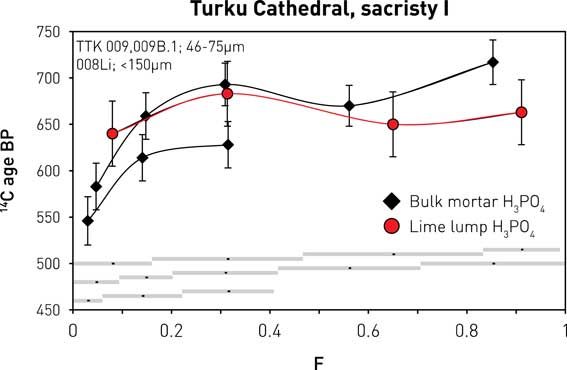
The bulk mortars show the usual effects of fire damage (Lindroos et al. Reference Lindroos, Regev, Oinonen, Ringbom and Heinemeier2012), the earliest fire recorded in 1318 when the cathedral was devastated by the Novgorodians. The first CO2 fractions are irregular and appear too recent, probably indicating the time of later fires, which would have caused re-crystallization. The subsequent plateau in the profiles of the bulk mortars may be interpreted as a baseline formed by the binder carbonate at the time of construction: we used it to date the sacristy to cal AD 1270–1300 (84.8%, Lindroos et al. Reference Lindroos, Ringbom, Kaisti, Heinemeier, Hodgins and Brock2011b, Reference Lindroos, Regev, Oinonen, Ringbom and Heinemeier2012). All four CO2 fractions of the lime lump profile TTK 008Li agree within the error margins and support this interpretation. The combined calibration yields 659±18 BP or cal AD 1282–1313 at 46.3% probability and 1357–1389 at 49.1% respectively (χ2-test: df=3 T=0.8; 5% 7.8), and is thus compatible with the chronology of Gardberg et al. (Reference Gardberg, Heininen and Welin2000).
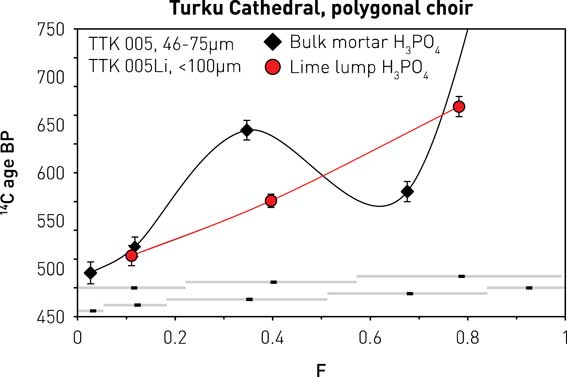
Remains of the foundations of an earlier polygonal choir attached to the east wall of the nave are found under the present floor, where they have been sheltered from fire. The bulk mortar of TTK 005 was analyzed in five CO2 fractions (Figure 22; Lindroos et al Reference Lindroos, Ringbom, Kaisti, Heinemeier, Hodgins and Brock2011b, Reference Lindroos, Regev, Oinonen, Ringbom and Heinemeier2012).
Plot of profiles from the polygonal choir. TTK 005, bulk mortar and the lime lump inclusion TTK 005Li.
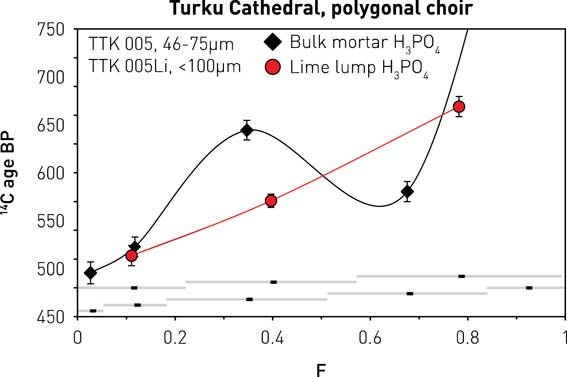
The age profiles of bulk mortar TTK 005 and its embedded lime lump TTK 005Li overlap at the start. The calibration of the first CO2 fractions in the bulk mortar profile and in the lime lump are both affected by the irregularity of the calibration curve in the 14th century but reveal mutually very close dates (TTK 005: cal AD 1300–1370; 45.4% and cal AD 1380–1440; 50.0%; TTK 005Li: cal AD 1293–1405). The final fractions reveal heavy contamination with underburnt marble from lime production, whereas the increase in age at the third fraction of the bulk mortar is interpreted as contamination from marble splinters in the filler material. Note that the observed slope in the lime lump profile means that one single date based on a total or large fraction would have given a misleading date (too ancient).
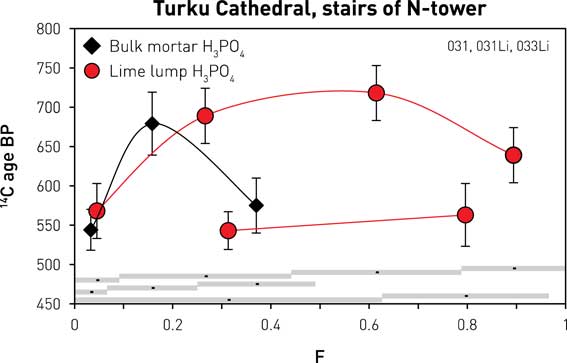
Two bulk mortars (TTK 030, appendix and TTK 031) from the northern staircase belonging to the Hemming choir were each analyzed in three fractions. Sample TTK 031 contained embedded lime lumps, one of which was analyzed in two CO2 fractions. From another sample, TTK 033, we analyzed only the lime lump TTK 033Li, from which we were able to extract four datable fractions (Figure 23).
Turku Cathedral. Plot of bulk mortars and lime lumps from the northern staircase adjoined to the Hemming choir. Samples: TTK 031, 46–75 μm, TTK 031Li, <75 μm, TTK 033Li, 76–150 μm.
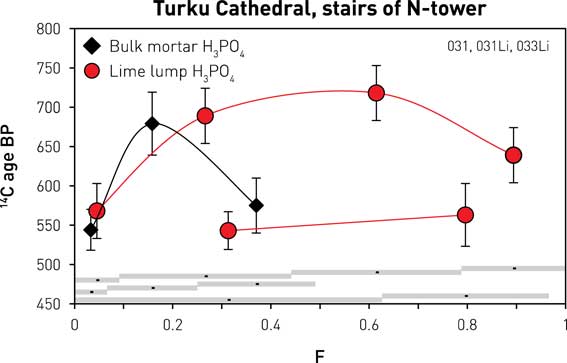
Even if the age profiles (Figure 23) behave very differently from each other, all the first CO2 fractions coincide within the error margins. Furthermore, the profile for TTK 031Li is almost horizontal, which aids the interpretation. The combined calibration of the first fractions yields 543±14 BP, or cal AD 1325–1343 (12.5%), and 1395–1425 (82.9%), which is more recent than the polygonal choir, in accordance with the structural sequence.
Church of Pargas
This church is located in city near the largest marble quarry in Finland, which has been in production since the 14th century (Boström Reference Boström1986).
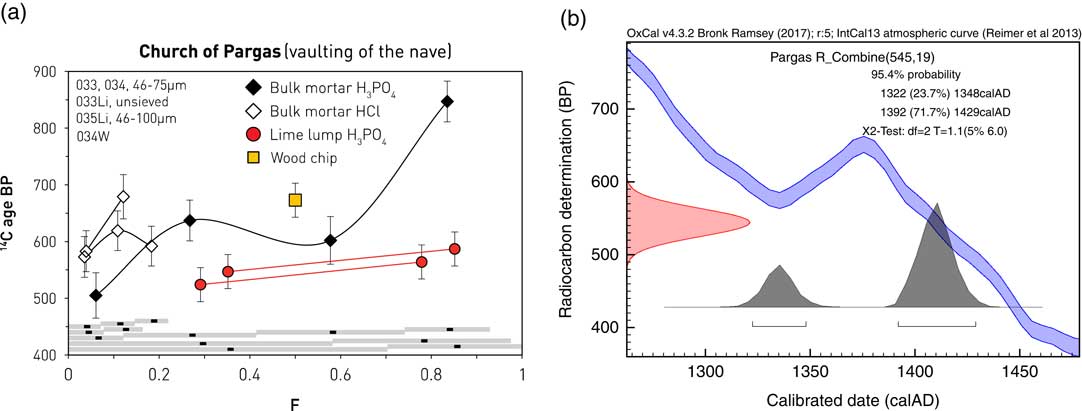
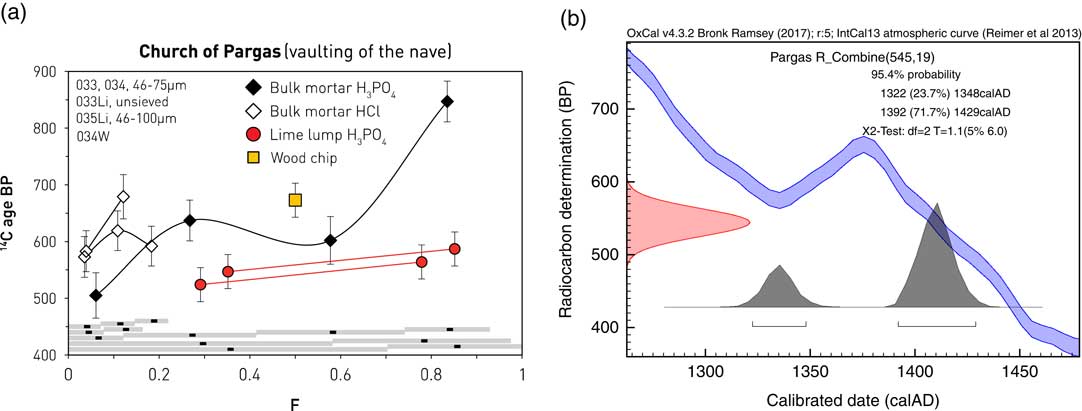
From the secondary vault of the nave in the church of Pargas two bulk mortars were dated, one using only HCl hydrolysis and the other using both H3PO4 and HCl, for comparison. The HCl results were later considered unreliable in general in the marble area since the 14C profiles repeatedly revealed rapidly dissolving marble contamination (see two examples in Lindroos et al. Reference Lindroos, Ringbom, Kaisti, Heinemeier, Hodgins and Brock2011b). Two lime lumps: Pargas 033Li and 035Li were dated using H3PO4 hydrolysis (Figure 24). Both lime lumps present almost horizontal age profiles, meeting the demands of Criterion I and combined with the first fraction from the H3PO4 hydrolysis of the bulk mortar they yield 529±19 BP, dating the vaulting of Pargas church to cal AD 1329–1341 (5.0%) and 1396–1435 (90.4%; χ2-test df=2 T=0.7; 5% 6.0).
(a) The church of Pargas, in the Åboland archipelago; age profiles from the vault of the nave and (b) combined calibration of the first CO2 fractions of 034, 033Li, and 035Li yielding the highest probability at cal AD 1392–1429 (71.7%).
CONCLUSION
In this paper we present results from a selection of buildings from different ages and geological regions, investigating whether lime lumps, possibly even dated in one fraction only, are preferable to bulk mortars for AMS 14C dating of ancient constructions. We have presented the dates from a selection of lime lumps in comparison with other materials relevant for the chronology of the structures, preferably with the very bulk mortars hosting the lumps. For a broader comparison we dated lime lumps embedded in mortars based on different types of limestone from medieval Scandinavia and from classical archaeology from different sites in Europe and the Middle East. We demonstrated that lime lumps, as with bulk mortars, can be subject to contamination of underburnt limestone, and that they therefore need to be analyzed in several successive CO2 fractions to create reliable dates from age profiles, just as bulk mortars do. Our results clearly indicate that lime lumps dated using only one CO2 fraction are not sufficiently reliable without supporting data because contamination from dead carbon or younger calcite growth cannot be a priori assumed to be absent, nor indeed can its possible effect on the dating result be detected. The contamination from underburnt limestone commonly appears, however, to be less severe than in the case of bulk samples, whereas the lumps are essentially free from contamination from the filler, as expected.
The same criterion guidelines apply for the interpretation of results from lime lumps as for bulk mortars. While lime lumps often yield good results, especially in medieval Scandinavia, 14C AMS analysis of lime lumps should not substitute analysis of bulk mortar, but should rather be seen as a valuable complementary method to validate 14C AMS analysis of bulk mortars. If the two form agreeing age profiles, then the result of the first CO2 fractions can be regarded as very reliable.
ACKNOWLEDGMENTS
For generous financial support through the years we wish to thank the following contributors: The Academy of Finland, Helsinki; The Finnish Society of Sciences and Letters, Helsinki; The Foundation for Åbo Akademi University Research Institute, Turku/Åbo; and The Åland Cultural Foundation, Mariehamn. More information about the International Mortar Dating Project is available at www.mortardating.com.
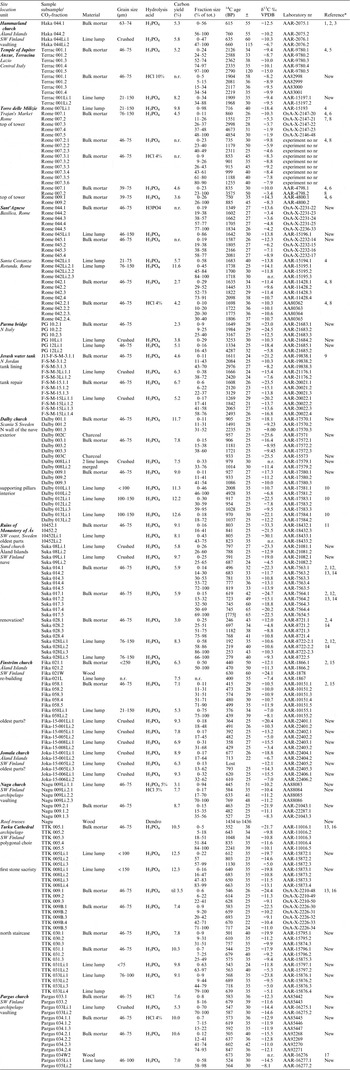
Dated CO2 fractions from lime lumps and bulk mortars including them or in close connection with them. 14C data of charcoal and wooden inclusions from the mortars are also reported as well as a relevant dendrochronological age.