Introduction
Mental health problems are evident in 25% of people attending primary care, with depression the third most common reason for consultation in general practice. Primary care thus has a key role in recognising and treating this disorder as well as being the ‘gatekeepers’ to mental health services (Copty & Whitford, Reference Copty and Whitford2005). A study conducted by the Irish College of General Practitioners (ICGP) found that over 95% of general practitioners (GPs) stated they treated patients with mental health problems, 25% ranked depression as the most prevalent condition and 48% ranked severity as the main reason for referral (Copty, Reference Copty2004). This study highlighted the need for training, protocols and improved communication with mental health services. The increasing awareness of psychological illness at a societal level has resulted in increased demand and referral for specialised input into decision making (Verhaak etal. Reference Verhaak, van der Lisdonk, Bor and Hutschemaekers2000). Consequently, more effective management of the primary–secondary care interface is a priority for both primary care and mental health services. Efficiency in use of specialist mental health services by GPs is crucial to allowing greater specialist input into primary care, while ensuring access and equity (Banks & Gask, Reference Banks and Gask2008; Gask & Lester, Reference Gask and Lester2008).
Enhanced management of depression in primary care is a key element of the World Health Organization's strategy for improved mental health (World Health Organization, 2001). Increasing emphasis on evidence-based practice, along with a growing awareness of inequalities in health care delivery, have encouraged the development of treatment protocols and guidelines. However, evidence suggests that best practice guidelines for the assessment and management of depression are poorly adhered to in primary care (Kessler etal. Reference Kessler, Lloyd, Lewis and Gray1999; Hegarty etal. Reference Hegarty, Gunn, Blashki, Griffiths, Dowell and Kendrick2009).
Consultation conducted as part of the development of Ireland's mental health policy (Vision for Change) identified an overreliance on medication and lack of access to a range of psychological therapies as key challenges in mental health service development (Department of Health and Children, 2006). Ireland's primary care strategy (Primary Care: A New Direction) advocates the formation of primary care networks comprising primary care teams integrated with a wider network of health and social care professionals (Department of Health and Children, 2001). A principal aim is to improve integration between primary care teams and specialist services and especially so in mental health.
In 2006, Guidelines for the Management of Depression and Anxiety Disorders in Primary Care were published in Ireland (Irish College of General Practitioners, 2006). The guidelines advise on identification, diagnosis and treatment, and outline specific indications for referral to specialist services (Box 1). We examined referrals to our CMHT for patients with depressive symptoms identified in primary care, using the 2006 Primary Care Guidelines for the management of depression and anxiety as a comparison point.
ICGP guidelines for the management of depressive illness: indications for referral to mental health services
• Urgent concerns (risk to self /others)
• Severe symptoms/impairment
• Diagnosis unclear
• No response to two antidepressant treatments
– First-line SSRI, at least 4 weeks’ duration
– Second-line different SSRI, or other class
• Therapeutic relationship has broken down/non-compliance with assessment/treatment.
Methods
Setting
The South-East Limerick Mental Health Services provide community care through St Anne's Day Hospital to a population of 50 000 living in both urban and rural areas. A generic multidisciplinary team (MDT) operates from this community-based day hospital providing assessment and a range of psychological and pharmacological treatments.
Participants
We conducted a retrospective review of referral correspondence and casenotes of 100 patients referred for ‘low mood’ or ‘depression’ during the period February 2006 and March 2007. To compare information provided by GPs at referral with that noted after formal psychiatric assessment, we included only cases where the patient actually attended for assessment. Data were initially gathered on a data collection form before transfer to a SPSS database.
Referral letters were evaluated with regard to clarity/legibility, demographic details, clinical symptoms and treatment. Clarity/legibility of this information was assessed objectively by a senior registrar and a senior house officer. Information was deemed ‘not legible’ if neither could identify meaningful information. In addition, we looked for documentation of level of urgency, current social circumstances, past psychiatric history, family psychiatric history and medical history. Using the casenotes we estimated time to assessment and level of engagement. Diagnosis was confirmed, suicide risk assessed and previous and subsequent treatment was clarified, including referral to other members of the MDT.
Statistical analysis
Statistical analyses were conducted using SPSS Version 14. The level of detail in referrals was calculated by assigning a score for each of 18 items in the referral communication (legibility, demographic items, features of depression (severity and duration of illness, mention of any biological features or suicidality, context of episode (past history, family history, etc.) and treatment details). Median scores were compared using Kruskal–Wallis tests. The use of antidepressant agents was compared for those who subsequently were diagnosed with and without syndromal depression by mental health services using χ 2 tests.
Results
Content of referrals
Of the 100 referrals, 45 were typed letters, 44 handwritten letters and structured referral forms in 11 cases. Seventy six were deemed fully legible in terms of name, address, major symptoms and treatment. The majority of GPs provided name and address (100%) and date of birth (95%). However, the telephone contact for the patient was missing in 57 of the letters, including 13 referrals deemed urgent by the GP.
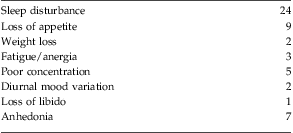
In relation to clinical information, 27% mentioned severity of illness. The duration of low mood was described in 43% and 34% mentioned any biological symptoms. The frequency that biological features of depression were described is shown in Table 1. Sleep disturbance (24%) was the only biological symptom mentioned with any consistency even though these features are key to establishing the severity of depressive illness (World Health Organization, 1992). Suicide risk was commented upon in 26% of the letters.
Biological/somatic features of depression described in referral letters (n = 100)
Treatment was mentioned in 92% of the letters with 71% stating they had commenced an antidepressant. However, in many cases (n = 20) medication was commenced on the same day the referral letter was sent. The first line of choice for antidepressant medication was an SSRI in 53 cases, Venlafaxine in 12 cases, Mirtazapine in three cases and a tricyclic agent in three cases (Table 2).
Antidepressant agents used in first- and second-line treatment (n = 100)
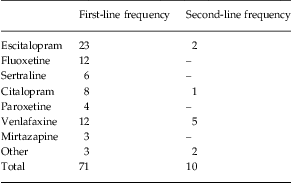
A second antidepressant trial had been conducted in 11% of patients. One-quarter of referrals mentioned initiating benzodiazepine medication.
Information regarding dose and duration of treament was frequently not provided. Judging by the referrals alone, 11% of patients were deemed to have undergone an adequate first trial of antidepressant and 3% were deemed to have undergone two adequate antidepressant trials.
Relevant current social circumstances were described in 78% of letters. Fifty per cent stated past psychiatric history. Past medical history was mentioned in 29%. Fourteen per cent stated any family psychiatric history. One letter mentioned all four of these elements.
Processing of referrals
Most patients (94%) attended the first appointment provided, with a mean waiting time of 24.1 ± 2.8 days for non-urgent cases and 3.1 ± 3.5 for urgent cases. Sixty per cent were assessed within 4 weeks, with 90% assessed within 8 weeks.
Casenote review
Key information relating to treatment (e.g. dose, duration of treatment) was absent in 72% of referral letters. It was confirmed that 71% of patients had been commenced on a first antidepressant. However, just 25% had recieved an adequate trial before referral to specialist services. An adequate second antidepressant trial was observed in 3% of patients. At the time of assessment, 30% of patients were receiving benzodiazepine medication.
Diagnosis at assessment indicated 76% had syndromal depression, of whom 67 had mild to moderate depression and 9% had severe depression (two were actively suicidal). The patients without syndromal depression had a variety of diagnoses including adjustment disorder, post-traumatic stress disorder, obsessive compulsive disorder, substance misuse disorder and no axis one diagnosis. The severity of depressive illness was linked to the degree of overall detail provided in referrals (p = 0.03) when compared according to the presence of 18 key elements of information. Patients that were subsequently diagnosed with depressive illness by mental health services were more likely to have been initiated on antidepressant treatments than those who were not (χ 2 = 13.8; df = 1; p = 0.001). The majority of urgent referrals from primary care (n = 33) were deemed urgent by the mental health services (n = 19; 58%) but seven non-urgent referrals from primary care were subsequently deemed in need of urgent input by mental health services.
Treatment advice provided by the mental health services
At first appointment, 29 patients had no immediate change to their antidepressant medication, a dose increase was advised in 21 cases, in three cases the agent was switched. Antidepressants were initiated in 27 patients while existing antidepressant use was discontinued in two patients. Benzodiazepines were immediately discontinued in 11 patients. Antipsychotic treatments were initiated in seven patients. Forty-five per cent were referred for further supportive input from members of the MDT, with 19% referred to the psychologist.
Discussion
This work highlights considerable variability in referral information and outcomes. A substantial percentage of referrals were provided as handwritten unstructured letters with very few utilising the standardised HSE mental health referral letters. The propensity for handwritten letters to omit important information is evidenced by the finding that only 45% of the letters documented the patient's telephone number. Other work (Campbell etal. Reference Campbell, Parsons and Loane2008) has also highlighted this problem with unstructured referral formats. This represents a simple omission that can pose a significant barrier to timely engagement by mental health services. Moreover, this hinders efforts to optimise use of appointments as the service has a policy of contacting new patients by phone to confirm their attendance at the outpatient clinic.
More recently, failures in communications between primary and secondary care stimulated Ireland's Health Information and Quality Authority to engage in a consultative process aimed at identifying a standardised approach to referral between different agencies engaged in primary and secondary care. Initial work suggests that the use of a standardised patient referral form, or a referral template, would be of great benefit to both GPs and hospital staff and that the use of templates can facilitate more complete information provision by acting as a prompt to the referrer (Health Information and Quality Authority, 2010).
Clinical information provided in referral letters
ICGP Guidelines highlight the severity of depression as the most important feature to assess in depressive illness. However, just 27% mentioned severity in the referral letter. This, along with the absence of other information (e.g. presence of biological features), seriously limit the ability of mental health services to assess the appropriateness and urgency of referrals. The information provided by GPs was focused on the psychosocial aspects of presentations, with 78% documenting current social circumstances compared with 34% mentioning any biological features of depression. Shaw etal. (Reference Shaw, Clegg Smith, Middleton and Woodward2005) also found different emphasis, where GPs letters appeared to prioritise details about the patient as a person and their personal circumstances over more ‘medical’ information, such as symptoms or diagnoses. Undoubtedly, GPs are particularly well positioned to advise regarding the psychosocial context of presentations, but the challenge is to link this information with other elements of patient profile. The detection of depressive illness in primary care can be improved through the use of brief screening instruments [e.g. the Patient Health Questionnaire two-item screener (PHQ-2) and nine-item instrument (PHQ-9)], which emphasise diagnostically important symptoms such as core mood disturbances, loss of enjoyment and disturbed biological features that are particularly useful for mental health services in responding to referrals (Kroenke etal. Reference Kroenke, Spitzer and Williams2001; Arroll etal. Reference Arroll, Khin and Kerse2003).
Urgent referrals
Although suicidal risk assessment is outlined in the ICGP guidelines, most referrals gave no account of this information. Of particular concern was the observation that a number of patients referred for routine assessment were deemed in need of urgent input by the CMHT, highlighting the lack of precision in referral practices. Burbach (Reference Burbach1997) found that only 19% of referrals mentioned the degree of urgency and that 25% underestimated urgency level. Similarly, Hilton etal. (Reference Hilton, Bajal, Hagger, Taha and Warner2008) found a low level of agreement between the psychiatry team and referrers as to what should constitute an urgent referral. Thirty-three per cent of referrals were deemed urgent by the referrer, compared to 17% by the psychiatric consensus panel, with little agreement between the two. Perhaps, more worryingly, seven referrals considered urgent by the psychiatry team had not been indicated as urgent in the original referral. Prioritising early appointments for these cases requires appropriate information regarding issues of urgency and risk. It is possible that these cases may reflect a worsening in illness severity during the delay between referral and assessment. The provision of information (e.g. a patient information leaflet) about the process and expectations of the referral process can incorporate advice as to how worsening of illness can be addressed by further assessment and, where necessary, earlier review by mental health services. Interestingly, the ICGP standardised referral letter has no specific section on risk assessment and warrants consideration in future updates/revisions.
Pharmacological treatment
The emphasis on pharmacological approaches in the primary care management of depression is highlighted by the use of antidepressants in 71 of the 76 patients diagnosed with depression. Given that the majority were diagnosed as mild to moderate severity, if psychological services were available as part of the primary care network, as originally envisaged by Ireland's ‘HSE Transformation Programme’ many of these patients could be more optimally managed using psychological approaches (National Institute for Clinical Excellence, 2004). The availability of such interventions in primary care is a recurring issue for services in Ireland and beyond (Layard etal. Reference Layard, Clark, Knapp and Mayraz2006). Neither ‘Vision For Change’ nor the ‘Primary Care Strategy’ provide any detail as to the resourcing of psychological services in primary care. This lack of clarity is a serious impediment to the development of more active relationships between primary care and mental health services, as the latter lack the capacity to provide psychological services to the less severely ill and the model that has guided resourcing of mental health has been built upon the presumption that the vast majority of mild to moderate mental health problems will be managed in primary care (Burns, Reference Burns2004).
The use of antidepressant medications (71%) is in keeping with studies in the UK (Kendrick etal. Reference Kendrick, Dowrick, McBride, Howe, Clarke, Maisey, Moore and Smith2009) and indicated an association between accurate diagnosis of depression and antidepressant use in primary care. However, in many cases this treatment was for a period that was shorter than the recommended adequate duration or the dose was subtherapeutic. In some cases this related to perceived urgency for specialist assessment but in many cases may relate to a need for ongoing education of GPs around optimal prescribing in the management of depressive illness. The frequency of benzodiazepine use in this report is relatively modest in comparison with previous studies, but it is relevant that in many cases this treatment was immediately discontinued by the mental health services who have an active policy of minimising benzodiazepine use (Raju & Meagher, Reference Raju and Meagher2005).
Factors underpinning referral
Many factors may impact upon referral practices including comorbidity, age, gender, previous psychiatric history, relationship with GP, personal threshold of GP, and style of working relationship between general practices and community mental health teams (Evans, Reference Evans1993; Ross etal. Reference Ross, Moffat, Mcconnachie, Gordon and Wilson1999; Hull etal. Reference Hull, Jones, Tissier, Eldridge and Maclaren2002; Barth etal. Reference Barth, Schumacher and Herrmann-Lingen2004; Williams etal., Reference Williams, Katon, Lin, Nöel, Worchel, Cornell, Harpole, Fultz, Hunkeler, Mika and Unützer2004; Chew-Graham etal. Reference Chew-Graham, Slade, Montana, Stewart and Gask2007; Age Concern, 2008). Increasingly, the demand for individualised care that includes psychological therapies in primary care is a key factor underlying referral of patients with depressive illness (Lester & Howe, Reference Lester and Howe2008). It is interesting that almost half of patients assessed were subsequently referred to other members of the MDT for additional input. This highlights the capacity of mental health services to contribute to the care of these patients but also reflects the lack of similar appropriate supports within primary care. Hull etal. (Reference Hull, Jones, Tissier, Eldridge and Maclaren2002) found that where primary care-based psychologists work with GP practices there are greater numbers of CMHT referrals for consultation purposes but reduced overall use of psychiatric services.
Implementation of practice guidelines
The so-called knowledge gap between best evidence and real world practice is well recognised across healthcare. Where knowledge tools such as clinical guidelines are available, studies indicate that successful implementation generally requires a combination of supportive interventions. In relation to referral practices, Akbari etal. (Reference Akbari, Mayhew, Al Alawi, Grimshaw, Winkens, Glidewell, Pritchard, Thomas and Fraser2008) reviewed studies exploring methods to improve the quality of referrals from primary care to specialist services and concluded that in addition to dissemination of guidelines with supportive materials (e.g. structured referral sheets) the involvement of local clinicians in devising guidelines and/or operational policies for local services, as well as the involvement of consultants in supportive educational activities, are linked to better implementation outcomes.
In the case of depression, a recent review of seven national guidelines highlighted that most (including Ireland's) failed to meet basic criteria on rigour of development, applicability and editorial independence (Hegarty etal. Reference Hegarty, Gunn, Blashki, Griffiths, Dowell and Kendrick2009). This review also highlighted how issues such as diagnostic uncertainty, inadequate attention paid to psychological therapies and individual patient circumstances can pose a challenge in the development of clinical guidelines for the care of patients with depression in primary care.
Slade etal. (Reference Slade, Gask, Leese, McCrone, Montana, Powell, Stewart and Chew-Graham2008) conducted a randomised controlled trial investigating whether the introduction of a standardised assessment for illness severity might impact upon referral quality from primary care to mental health services. The measure was poorly implemented (25%) and where used, did not impact upon perceived appropriateness of referrals or the ability of the receiving service to identify more urgent referrals.
In addition to service arrangements, many patient and clinician factors also contribute to implementation. Education level, accessibility of care and patients’ perceived needs for care are more strongly associated with the delivery of guideline-concordant care for anxiety or depression than clinical need factors (Prins etal. Reference Prins, Verhaal, Smolders, Laurant, van der Meer, Spreeuwenberg, van Marwijk, Penninx and Bensing2010). It has been noted that guidelines for some conditions (e.g. depression) are less readily incorporated into primary care practice possibly reflecting perceptions of the validity and utility of such formalised approaches to assessment and management (in contrast to management of conditions such as asthma and diabetes) (Dowrick etal. Reference Dowrick, Leydon, McBride, Howe, Burgess, Clarke, Maisey and Kendrick2009), but also may relate to the perceived importance of such presentations. For example, Album & Westin (Reference Album and Westin2007) surveyed GPs in Norway to rank 38 conditions on a ‘disease prestige’ list with depression rated 33rd. This low rating may be a marker of other factors that are impediments to actively engaging with more formalised approaches to management of depressive illness.
Developing the interface between primary care and mental health
It is clear that a gap exists between primary care and specialist mental health services in relation to management practices and perceived role within the overall healthcare system. In particular, the relative roles in providing for the mental health of the overall community are unclear as evidenced by communication difficulties at the point of interface. In general, there is disagreement about the perceived ‘appropriateness’ of around 20% of primary care referrals to community mental health teams (Slade etal. Reference Slade, Cahill, Kelsey, Leese and Powell2002).
Greater clarity as to roles and responsibilities of various elements of mental health care (Cohen, Reference Cohen2008) is thus a key element of service reform. This is especially the case during change processes outlined in current national strategy documents for primary care and mental health, which it must be noted are not entirely complementary in content, especially where optimal interaction between primary care services and mental health teams and the respective resource allocation, is concerned. For example, concerns regarding dilution of resources available for the management of patients with severe and enduring mental illness are borne out by studies that indicate that the lack of access to basic psychological interventions and counselling in primary care means that when given the opportunity, GPs refer patients with less severe mental disorders to community mental health nurses effectively using them as counsellors (Crawford etal. Reference Crawford, Carr, Knight, Chambers and Nolan2001). Moreover, Kendrick etal. (Reference Kendrick, Simons, Mynors-Wallis, Gray, Lathlean, Pickering, Harris, Rivero-Arias, Gerard and Thompson2006) conducted a randomised trial comparing usual GP care, generic mental health nurse care and care from nurses trained in problem-solving treatment. This study provides strong evidence that referral of unselected primary care patients with common mental disorders to a specialist mental health nurse confers no additional benefit over usual GP care. The economic results provide good evidence that community mental health nurse care is significantly more expensive (doubled costs) than usual GP care.
The National Institute for Clinical Excellence guidelines provide a model of stepped care based upon primary care teams that include psychological and social supports (National Institute for Clinical Excellence, 2004). However, caution is needed in extrapolating from experiences in the UK where, after sustained transition, mental health services have an almost exclusive focus upon illness at the more severe end of the spectrum that contrasts with arrangements in Ireland where mental health services provide input into a much higher percentage of patients with less severe illness (Meagher etal. Reference Meagher, O'Brien, Pullela, Oshun and Brosnan2009). In keeping with this observation, the severity of depressive illness in this referral sample contrasts with that identified in similar studies from the UK (Kendrick etal. Reference Kendrick, Dowrick, McBride, Howe, Clarke, Maisey, Moore and Smith2009), where the majority of referrals are with moderate or severe depressive illness, in keeping with the focus of CMHTs on severe and enduring mental illness.
‘Vision for Change’ advocates a consultation-liaison model that inevitably is associated with increased referral rates. However, this increased service burden includes patients who can benefit from CMHT involvement, and this is supported by this study where a high percentage of patients with less severe depressive illness were engaged with the wider MDT. Where such consultation-liaison relationships are established, the presence of a psychologist within the primary care team can allow for greater precision in use of CMHT resources (Hull etal. Reference Hull, Jones, Tissier, Eldridge and Maclaren2002).
This study describes referral practices within a particular geographical region which may not generalise to the primary care–mental health interface in Ireland, although evidence does not suggest that contrasting patterns might exist elsewhere. Moreover, the delay between referral and assessment by the mental health services might have impacted upon clinical presentation, although this was generally of short duration, especially for urgent referrals. Equally, some referrals may have been precipitated by uncertainty regarding diagnosis rather than specifically for assessment and treatment advice for depression.
Conclusions
Providing optimal care for patients with depressive illness is challenging in primary care, especially with limited resources. This study highlights aspects of current practice that could be improved upon and compares this with suggested best practice guidelines from Ireland. Guideline implementation requires mutifaceted interventions rather than mere dissemination (Gilbody etal. Reference Gilbody, Whitty, Grimshaw and Thomas2003) and indeed, depression is an example of a complex clinical problem that is difficult to address in simple guidelines. The development of the primary care – mental health interface as outlined in current national policies needs to embrace these difficulties in order to allow for optimal benefit to the overall mental health of the nation.
Acknowledgements
The authors thank the multidisciplinary team at St Anne's Day Hospital, Roxboro Road, Limerick.