High body condition score (BCS) during the first weeks of lactation can result in elevated production of non-esterified fatty acid (NEFA) and oxidative status in high producing dairy cows (Castillo et al. Reference Castillo, Hernandez, Bravo, Lopez-Alonso, Pereira and Benedito2005; Jamali Emam Gheise et al. Reference Jamali Emam Gheise, Riasi, Zareh shahneh, Celi and Ghoreishi2017). Houseknecht et al. (Reference Houseknecht, Cole and Steele2002) demonstrated the nutritional and pharmacological strategies for decreasing insulin resistance in dairy cows. Some synthetic (thiazolidinedione family, TZD) and natural (poly unsaturated fatty acids, PUFA) ligands of proliferator-activated receptor-γ (PPAR-γ) may affect the capacity of adipocytres for fatty acid storage and regulate several adipokines which affect insulin resistance (Guo & Tabrizchi, Reference Guo and Tabrizchi2006).
Pioglitazone (a TZD derivative), is a synthetic and specific ligand for PPAR-γ and is considered for treatment of type 2 diabetes mellitus in human. It has been reported that pioglitazone (PGT) could increase plasma superoxide dismutase (SOD) activity and decrease the level of peroxidation products in diabetic rabbits (Gumieniczek, Reference Gumieniczek2003) and rats (Chaudhry et al. Reference Chaudhry, Ghosh, Roy and Chandra2007). Administration of 2,4-thiazolidinedione in close-up ration of dairy cows reduced plasma NEFA, increased dry matter intake and decreased BCS loss (Smith et al. Reference Smith, Stebulis, Waldron and Overton2007, Reference Smith, Butler and Overton2009). Moreover, Ghoreishi (Reference Ghoreishi2012) reported that PGT supplementation in dairy cow ration had the effect of decreasing prepartum plasma NEFA concentration.
Nuts are high in fat, especially mono and poly unsaturated fatty acids (USDA, 2012). Walnut is uniquely high in PUFAs (47%) comprising both n-6 and n-3 fatty acids (Wu et al. Reference Wu, Pan, Yu, Qi, Lu, Zhang, Yu, Zong, Zhou and Chen2010) and it contains high amounts of dietary fiber and antioxidants (Maguire et al. Reference Maguire, O'sullivan, Galvin, O'connor and O'brien2004). There are some reports that walnut consumption can improve insulin resistance and have positive effects on the cardiovascular system in humans (Banel & Hu, Reference Banel and Hu2009).
Walnut meal is a low cost agricultural by-product which is produced in walnut oil extraction industry. This product contains several nutrients which may have beneficial effect for dairy cow health. To our knowledge, there is no report in scientific papers to compare the effects of PGT and walnut meal on oxidative status and metabolism of transition dairy cows. The hypothesis of the present study was that dietary supplementation with PGT or walnut meal may change the metabolic profile and therefore suppress oxidative stress in high producing fresh dairy cows with high pre-calving BCS.
Material and methods
The animal care advisory committee of the Isfahan University of Technology approved all experimental procedures (Isfahan University of Technology, 1995).
Animals, feeding and housing
The experiment was carried out in a large commercial dairy herd (FKA dairy herd Co. Isfahan, Iran). About 7 d before expected parturition time, 36 multiparous (3·2 ± 0·6 parities) Holstein cows with high pre-calving BCS (≥4 BCS) and high producing potential (>13 000 kg in previous 305 d in milk) were allocated to 3 dietary treatments: 1- Control (basal diet; CTR), 2- Walnut meal (9·45% walnut meal of DMI; WM), and 3- Pioglitazone (6 mg/kg BW; PGT). Allocation took into account BCS and previous milk yield. All diets were iso-nitrogenous and iso-energetic and fed after parturition to 21 d postpartum. Walnut meal was provided from Barij Essence Co., Kashan, Iran and was included in the diet (9·45% of DM) instead of soybean meal. Pioglitazone was obtained as PGT hydrochloride from Hetero Drugs (India; Batch No: PH 0 080 513) and kindly provided by Darou Pakhsh Co. (Tehran, Iran). It was considered that PGT had 60% bioavailability for oral administration (Ghoreishi et al. Reference Ghoreishi, Rajaian, Sheykhzade, Alikhani, Rahmani, Hajipour, Khorvash and Khodaei2012; Yousefi et al. Reference Yousefi, Kohram, Shahneh, Zamiri and Fouladi-Nashta2016). The cows were housed individually in box stalls (4 × 3 m2) with free access to feed and water throughout the study. Cows were fed twice daily at 0830 and 1630 h with about 5–10% refusal/d. Daily milking was done at 0800, 1600 and 2400 h.
Feed and milk sampling
Chemical composition (AOAC, 2002), total phenolic compound and total tannin (Makkar, Reference Makkar2000, Reference Makkar2003), omega-6 and omega-3 fatty acids content (Alasalvar et al. Reference Alasalvar, Shahidi, Ohshima, Wanasundara, Yurttas, Liyanapathirana and Rodrigues2003), and antioxidant potential (radical scavenging activity by the 1,1-diphenyl-2-picrylhydrazyl method, Brand-William et al. Reference Brand-Williams, Cuvelier and Berset1995) of walnut meal was determined. Butylated hyroxy toluene (BHT) was used as a synthetic antioxidant control (online Supplementary Table S2).
All cows had access to the fresh feeds each morning at 0830 h. Each morning before feeding, the leftover was weighed and recorded. Dry matter intake was recorded daily from day 1 after parturition through 21 d postpartum. Feed samples were analysed for DM (AOAC, 2002), CP (Kjeldahl method, Kjeltec 1030 Auto Analyzer Tecator, Höganäs, Sweden), NDF and ADF (Van Soest et al. Reference Van Soest, Robertson and Lewis1991), ether extract and ash (AOAC, 2002). Ingredient and chemical composition of the experimental diets are presented in online Supplementary Table S1.
Milk samples were collected each day from 3 consecutive milkings during the first 21 d of postpartum. The sample of each day was pooled and stored at 4 °C before analysis for fat, protein, lactose and total solid (TS) by an automatic milk composition analyser (MilkoScan134BN; Foss Electric, Hillerød, Denmark).
Body condition scoring and blood sampling
The back fat thickness (BFT) was determined days 1, 7, 14 and 21 postpartum using the ultrasound technique, and then the data were converted to 1–5 score of body condition (Schröder & Staufenbiel, Reference Schröder and Staufenbiel2006).
Blood samples were taken from the coccygeal vein of all cows at 1200 h at 1, 7, 14 and 21 d postpartum. Blood samples were drawn into evacuated tubes containing EDTA (1·95 mg/ml). Plasma was separated by centrifugation at 3000 g for 15 min at 4 °C and 3 aliquots of separated plasma were frozen at −20 °C before blood analysis. The samples were analysed for glucose, albumin and total protein using the commercial kits (Pars Azmoon Co. Tehran, Iran) and an automatic analyser (Alycon300, Dual voltage instrument). Insulin and insulin like growth factor (IGF-1) were assayed using bovine kits (Elisa test kit; EASTBIOPHARM Instruments, Inc., USA; assay sensitivity of 0·27 mIU/l and 0·53 ng/ml for insulin and IGF-1, respectively). Intra and inter assay CV were 3·65 and 5·58% for insulin and 6·98 and 7·84% for IGF-1. Plasma concentrations of NEFA were determined by enzymatic method (Randox Lab. Ltd, UK) and UV-2100 spectrophotometer (S2100 UV; S. Planfild, New Jersy, 07080). Intra and inter assay CV were 6·65 and 7·8% for NEFA. Plasma concentrations of BHBA were determined by enzymatic method (Randox Lab. Ltd, UK) with intra and inter CV values of 6·3 and 7·45% using automatic analyser (Alycon300, Dual voltage instrument). Plasma malondialdehyde (MDA) was determined based on the colour complex formed from the reaction of malondialdehyde with 2-thiobarbituric acid (2-TBA) in acidic environment (Bilici et al. Reference Bilici, Efe, Köroğlu, Uydu, Bekaroğlu and Değer2001). Total antioxidant capacity (TAC) was measured using a commercial kit (Randox Lab Ltd; Cat No.NX2332). The EDTA-whole blood samples were used to determine enzymatic activity of superoxide dismutase (SOD) and glutathione peroxidase (GSH-Px). Erythrocyte lysate was prepared following by kit guidelines (RANSOD, Randox Laboratories, UK) and analysed to determine SOD activity using automatic analyser (Alycon300, Dual voltage instrument) at 505 nm wavelength. Erythrocyte GSH-Px activity was measured by commercial GSH-Px kit (RANSEL, Randox Laboratories; UK) and an automatic analyser (Alycon300, Dual voltage instrument). The revised quantitative insulin sensitivity check index (RQUICKI) was measured:
 $${\rm RQUICKI} = 1/[{\rm log(}G) + {\rm log}(I) + {\rm log}({\rm NEFA})],$$
where G, glucose (mg/dl); I, insulin (μU/ml); NEFA, NEFA (mmol/l) (Holtenius & Holtenius, Reference Holtenius and Holtenius2007).
Statistical analysis
Data were analysed by the MIXED procedure of SAS (2001; Institute Inc., Cary, NC, USA). The model was included the fixed effects of treatment, time, interaction of treatment and time, and the random effect of cows nested within treatments. Analytical model and its components were:
 $$y_{ijk} = {\rm \mu } + A_i + B_j + {\rm \delta }(A)_{ik} + (A \times B)_{ij} + {\rm \beta }(X_i - X) + e_{ijk}$$
where, Y ijk , dependent variable; μ, mean of the population; A i , effect of treatment; B j , j th day of sampling as a repeated factor; δ(A) ik , random effect of cow k nested within treatment i; (A × B) ij = 2 way interaction of treatment × time of sampling, β(X i − X), covariate variable, and e ijk , unexplained residual with normal distribution. The significance level was declared at P ≤ 0·05, and tend toward significance was considered at 0·05 < P ≤ 0·1 by Tukey test (SAS Institute, 2001).
Results
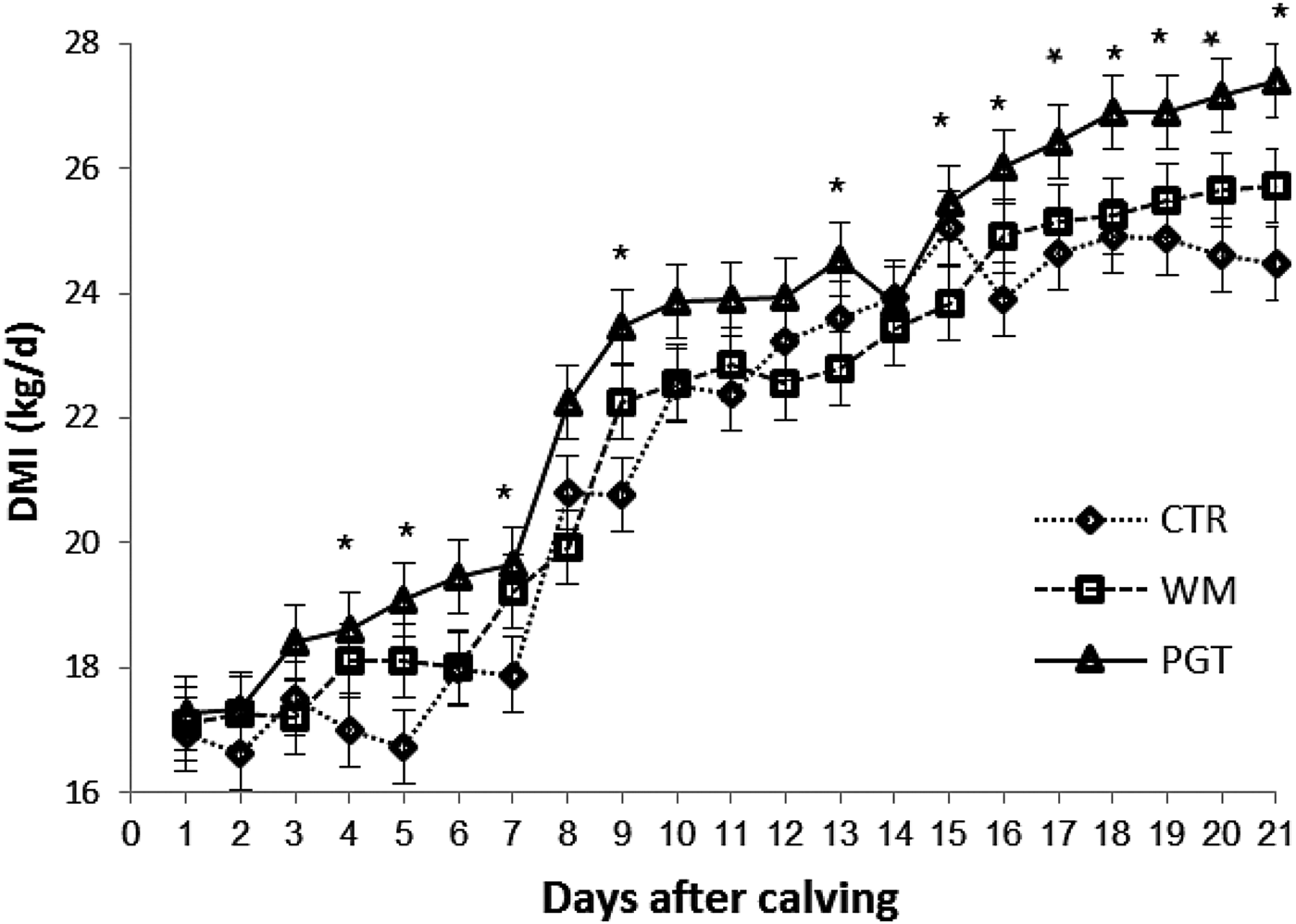
Cows fed PGT had higher (P < 0·05) DMI (22·95 kg/d) than those in the CTR and WM groups (21·45 and 21·78 kg/d, respectively). The cows fed PGT had higher DMI at different times especially during the last week of experiment. Moreover, DMI was lower (P < 0·05) in the CTR cows at days 5, 9, 16, 20 and 21 postpartum, compared to the WN and PGT groups (Fig. 1).
Effect of dietary supplementation of walnut meal and pioglitazone on DMI during the first 21 d of postpartum. CTR, basal diet provided for fresh dairy cows; WM, diet containing 9·4% walnut meal; PGT, basal diet supplemented with 6 mg/kg BW pioglitazone. The significant differences are shown by *.

The results of the present study showed that milk yield and milk composition were not affected by the experimental diets, with the exception of the WM fed cows which presented lower (P < 0·05) milk fat per cent compared with the CTR group at 21 d postpartum. However, the mean of milk fat per cent was not affected by the experimental diets (data are not shown).
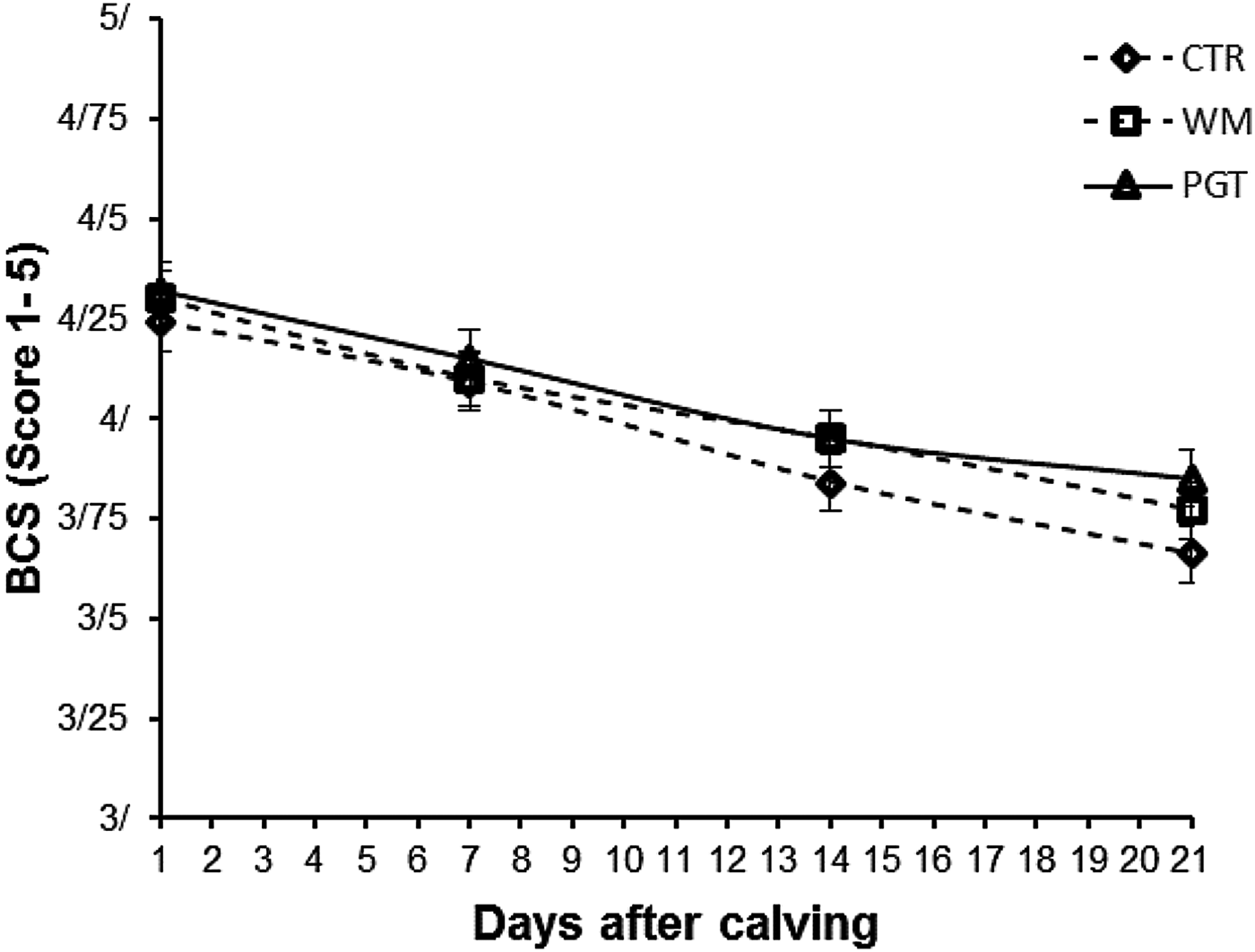
The BCS change of dairy cows during the first 21 d postpartum is shown in Fig. 2. The cows in the present study had high BCS before parturition with no differences between groups (CTR = 4·24 ± 0·21, WM = 4·30 ± 0·28 and PGT = 4·32 ± 0·3, P > 0·05). During the course of the study, BCS decreased in all groups and the CTR group ended the experiment with non-significantly lower BCS (3·66, 14% BCS loss) than those in the WM (3·77, 13% BCS loss) and PGT (3·85, 11% BCS loss) groups.
Effect of dietary supplementation of walnut meal and pioglitazone on BCS changes during the first 21 d of postpartum. CTR, basal diet provided for fresh dairy cows; WM, diet containing 9·4% walnut meal; PGT, basal diet supplemented with 6 mg/kg BW pioglitazone.

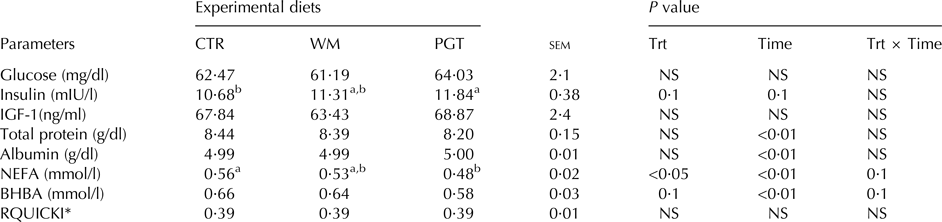
Mean concentration of plasma metabolites (glucose, insulin, IGF-1, total protein, albumin, NEFA, BHBA) and the RQUICKI data are presented in Table 1. Results showed that plasma glucose and IGF-I concentrations were not affected by the experimental diets. However, insulin concentration was higher (P < 0·05) in the PGT fed cows than the CTR group and WM fed cows presenting intermediate plasma insulin values.
Effect of dietary supplementation of walnut meal or pioglitazone on blood metabolism in multiparous Holstein dairy cows during the first 21 d of postpartum

CTR, basal diet provided for fresh dairy cows; WM, diet containing 9·45% walnut meal; PGT, basal diet supplemented with 6 mg/kg BW pioglitazone
* RQUICKI = 1/[log(G) + log (I) + log (N)], where G = glucose (mg/dl), I = insulin (μU/ml), and N = NEFA (mmol/l)
a,bThe means with different indices are differ (P < 0·05)
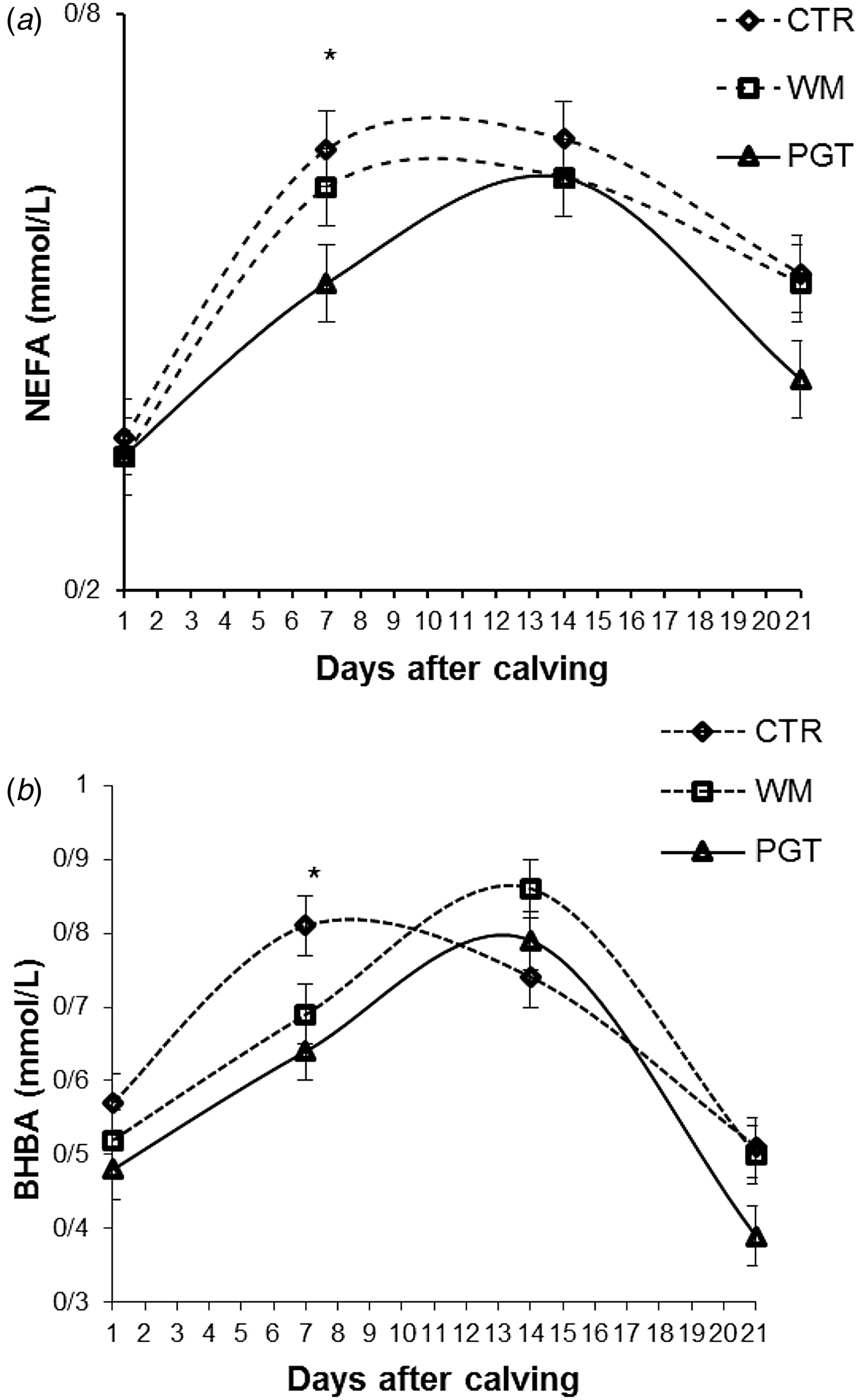
The experimental diets and interaction of time and treatment had no effect on plasma total protein and albumin. However, these data was affected (P < 0·01) by the sampling time, so that the metabolites increased from d 1 to d 21 postpartum in all experimental groups. A tendency for time x treatment interaction (P = 0·1) was noted for NEFA and BHBA (Fig. 3a and b). Cows fed PGT had lower (P < 0·05) plasma NEFA concentrations than the CTR cows (0·48 vs. 0·56 mmol/l), while the WM group had intermediate plasma NEFA (0·53 mmol/l). Plasma concentration of NEFA increased in all experimental groups after parturition and reached to the peak around 10 d postpartum in CTR and WM groups, whereas the increasing rate of NEFA was slower in PGT group (Fig. 3a). Finally, the CTR cows had higher (P < 0·05) plasma NEFA than PGT cows at 7 and 21 d postpartum. The PGT cows tended to have lower (P = 0·1) mean plasma BHBA than the CTR group. Plasma BHBA concentration was affected (P < 0·01) by sampling time. In the CTR group plasma BHBA rapidly increased after parturition and its peak (0·8 mmol/l) was observed about 7 d postpartum which was higher (P < 0·05) than those the PGT and WM cows (0·62 and 0·67 mmol/l, respectively) (Fig. 3b). On the other hand, the PGT and WM groups presented a slower increase in plasma BHBA which is reflected in the attainment of its peak about 14 d after parturition. Cows fed PGT had their lowest (P < 0·05) plasma BHBA at 21 d postpartum. Analysis of the RQUICKI data showed that there was a not significant difference between the 3 experimental groups in this regard.
(a, b) Effect of dietary supplementation of walnut meal and pioglitazone on plasma NEFA and BHBA changes during the first 21 d of postpartum. CTR, basal diet provided for fresh dairy cows; WM, diet containing 9·4% walnut meal; PGT, basal diet supplemented with 6 mg/kg BW pioglitazone. The significant differences are shown by *.

Plasma concentration of MDA, as a lipid peroxidation marker, and the antioxidants indices (TAC, SOD, GSH-Px) during the 21 d postpartum are presented in Table 2. Results showed that cows fed PGT had lower (P < 0·05) plasma MDA and higher (P < 0·05) plasma TAC and SOD than those the two other groups. Plasma concentration of GSH-Px was not affected by the treatments. Results showed that the sampling time had significant effect on plasma MDA (P < 0·01), SOD (P < 0·01) and GSH-Px (P = 0·07), so that MDA increased from d 1 to 7 postpartum then decreased sharply. The SOD activity decreased from d 1 to 14 and then increased in fed PGT and WM cows. The effect of time and treat interaction was not significant for plasma oxidative indices.
Effect of dietary supplementation of walnut meal or pioglitazone on oxidative indices in multiparous Holstein dairy cow during the first 21 d of postpartum

CTR, basal diet provided for fresh dairy cows; WM, diet containing 9·45% walnut meal; PGT, basal diet supplemented with 6 mg/kg BW pioglitazone
a,bThe means with different indices are differ (P < 0·05)
Discussion
Our results showed that feeding PGT (6 mg/kg BW) increased DMI in multiparous cows during the first 21 d postpartum. This was in agreement with the findings of Smith et al. (Reference Smith, Butler and Overton2009) who reported that I.V. injection of 2–4 mg TZD/kg BW linearly increased DMI during the prepartum period. They demonstrated that this effect may be attributed to decreasing plasma NEFA level. Similarly, TZD stimulated DMI in diabetic rat and this was ascribed to the direct activation of PPAR-γ receptors (Larsen et al. Reference Larsen, Jensen, Sørensen, Larsen, Vrang, Wulff and Wassermann2003). Dietary supplementation of WM in fresh cows had no effect on DMI. The studies in goats have shown that WM can be included up to 10% in the diet without adverse effects on DM digestibility (Mir et al. Reference Mir, Sharma, Rastogi and Barman2015). Based the data gathered in this study it seems reasonable to assume that the lack of effect of WM on DMI and the other parameter measured in this study could be ascribed to the short duration of the supplementation period and to the level of supplementation.
In line with Smith et al. (Reference Smith, Stebulis, Waldron and Overton2007) and Yousefi et al. (Reference Yousefi, Kohram, Shahneh, Zamiri and Fouladi-Nashta2016), results of the present study showed that dietary PGT and WM during the first 21 d of postpartum had no effect on milk yield and milk composition. It is well documented that there is a relationship between the BCS at calving and BCS loss postpartum. Roche et al. (Reference Roche, Friggens, Kay, Fisher, Stafford and Berry2009) reported that optimum calving BCS is 3·0 to 3·25 (5-point scale). They noted that BCS ≥ 3·5 (5-point scale) is associated with a reduction in early lactation DMI and milk production and an increased risk of metabolic disorders (Roche et al. Reference Roche, Friggens, Kay, Fisher, Stafford and Berry2009). In the current experiment cows supplemented with PGT or WM tended to loose less BCS compared to the control group. This result was in agreement with Smith et al. (Reference Smith, Butler and Overton2009) who reported that prepartum TZD injection caused lower BCS loss postpartum. As the PGT fed cows had higher DMI throughout the study and especially during the final week of experiment, this could partially explain the higher BCS values observed in these cows at 21 d postpartum.
High producing dairy cows face dramatic metabolic changes around parturition time and monitoring some of their plasma metabolites such as glucose, insulin, NEFA, BHBA and oxidative indices (Celi & Gabai, Reference Celi and Gabai2015) are important for studying their health and energy balance status (Ospina et al. Reference Ospina, Nydam, Stokol and Overton2010). Our results showed that the experimental diets improved the metabolic and oxidative status of dairy cows during the first 3 weeks after calving. In this regards, both PGT and WM groups tended to have higher plasma insulin than the CTR group with no change in plasma glucose. This may be related to lower NEFA and lower BCS losses observed in PGT or WM groups. It is demonstrated that TZD administration of animal models improved pancreatic β-cell function (Houseknecht et al. Reference Houseknecht, Cole and Steele2002). Nevertheless, Smith et al. (Reference Smith, Butler and Overton2009) reported that prepartum TZD administration had no effect on plasma insulin concentration at peripartum, prepartum and postpartum dairy cows. The positive effect of medium and long chain-PUFA on reducing type 2 diabetes and insulin resistance when feeding walnut, sesame and hazelnut has been reported (Risérus et al. Reference Risérus, Willett and Hu2009). In the present study, plasma IGF-1 concentration was not affected by PGT or WM supplementation. This result may be ascribed to the short duration of the dietary supplementation. Yousefi et al. (Reference Yousefi, Kohram, Shahneh, Zamiri and Fouladi-Nashta2016) who fed 6 mg PGT for a 35 d period reported higher plasma IGF-1 in transition dairy cows.
In accordance with Smith et al. (Reference Smith, Butler and Overton2009), our study revealed that PGT supplementation in dairy cow's diet reduced plasma NEFA. Recently, Yousefi et al. (Reference Yousefi, Kohram, Shahneh, Zamiri and Fouladi-Nashta2016) demonstrated that dietary administration of PGT during the prepartum and/or postpartum periods decreased concentrations of NEFA in high producing dairy cows. Plasma NEFA concentration is a well-established biomarkers of lipolysis and it has been shown that TZD directly stimulate the re-esterification of fatty acids in adipocytes (Tordjman et al. Reference Tordjman, Chauvet, Quette, Beale, Forest and Antoine2003). As mentioned earlier, cows fed PGT had higher DMI and lower BCS decreasing during the 21 d postpartum. These observations suggest that dietary PGT supplementation can potentially improve lipid metabolism and therefore energy balance. Cows fed WM had numerically lower NEFA concentration compared to the CTR group. Considering the elevated PUFA content of walnut meal and its agonistic effect on PPARγ and fatty acid metabolism in liver (Clarke, Reference Clarke2000), it is possible that higher inclusion rate of WM in the diet are required to see a more pronounced effect.
In addition to NEFA, BHBA is another metabolites which is related to energy balance and liver function in dairy cows (Ospina et al. Reference Ospina, Nydam, Stokol and Overton2010) and lower plasma BHBA could be attributed the lower NEFA availability in liver (Allen et al. Reference Allen, Bradford and Harvatine2005; Yousefi et al. Reference Yousefi, Kohram, Shahneh, Zamiri and Fouladi-Nashta2016). There are some reports for lower plasma BHBA (Yousefi et al. Reference Yousefi, Kohram, Shahneh, Zamiri and Fouladi-Nashta2016) or even higher plasma BHBA (Smith et al. Reference Smith, Butler and Overton2009) after administration PGT or TZD in transition dairy cows. Our results showed that feeding PGT or WM had no effect on plasma BHBA that was in agreement with Ghoreishi (Reference Ghoreishi2012). However, the results showed that plasma BHBA had outright increase after parturition in CTR cows (Fig. 3b) that was in accordance with NEFA change trend.
In the present study the RQUICKI was calculated as an insulin resistance index. Despite of CTR group having higher NEFA concentration and the PGT group having higher insulin concentration, the RQUICKI was not affected by the dietary treatment. Our observations are in agreement with those of Schoenberg et al. (Reference Schoenberg, Perfield, Farney, Bradford, Boisclair and Overton2011). While it seems that the RQUICKI has a low discrimination power in diagnosing decreased insulin sensitivity in cows especially when affected by metabolic diseases (Kerestes et al. Reference Kerestes, Faigl, Kulcsár, Balogh, Földi, Fébel, Chilliard and Huszenicza2009), we cannot rule out the fact that the observed lack of difference in RQUICKI values might have been due to the high variability in metabolic responses that occur during the early postpartum period. Therefore, future studies investigating the effect of WM and PGT on the glucose-insulin axis should extend the monitoring period beyond early lactation.
The PGT group had the lowest plasma MDA concentration and highest TAC. As mentioned before, this group of cows had lower plasma NEFA and BHBA. It is well defined that plasma MDA is a marker of lipid peroxidation which increases in oxidative stress status (Castillo et al. Reference Castillo, Hernandez, Bravo, Lopez-Alonso, Pereira and Benedito2005, Reference Castillo, Hernandez, Valverde, Pereira, Sotillo, Alonso and Benedito2006). Therefore, our data revealed that cows fed PGT could have lower susceptibility to oxidative stress. Contrary to our assumption supplementation of WM in dairy cows diet had no beneficial effect on plasma MDA and antioxidant indices. Though, the walnut meal had higher radical-scavenging activity compared to BHT (85·16 vs. 57·68%, supplementary file). In accordance with our finding, Yilmaz et al. (Reference Yilmaz, Bukan, Ayvaz, Karakoç, Törüner, Çakir and Arslan2005) reported a significant increase in the serum TAS and decrease in serum MDA level in PCOs women by rosiglitazone (a member of TZD family). In addition, our study showed that cows fed PGT had higher plasma SOD. The markers of anti-oxidative status such as SOD and GSH-Px defined as the first and second defence against pro-oxidants, which convert the superoxide to hydrogen peroxide (H2O2) and then converts H2O2 into less dangerous reduced forms respectively (Halliwell & Chirico, Reference Halliwell and Chirico1993). In agreement with our finding, Gumieniczek (Reference Gumieniczek2003) reported that administration of PGT for 8 weeks decreased the level of lipid peroxidation products and increased the SOD activity in rabbit.
It was concluded that dietary supplementation of PGT for 21 d postpartum decreased plasma NEFA, BHBA, and MDA concentrations and also decreased BCS losses in over conditioned Holstein dairy cows. The increase levels of insulin and TAC, and also the activity of SOD in PGT supplemented cows suggest that PGT has the potential to improve oxidative status and metabolites profile in dairy cows with high pre-calving BCS during early lactation.
This research was funded by Iran National Science Foundation (INSF; Grant # 92021270). We thank Mr. Jalilnezhad (chief manager) for partial funding of this study and Dr M. Safahani (farm veterinary) for ultrasonographic measurements in FKA dairy farm (Isfahan, Iran).
Supplementary material
The supplementary material for this article can be found at https://doi.org/10.1017/S0022029917000784