

Introduction
The COVID-19 pandemic represents a macro event of high novelty, disruption, and criticality (McFarland, Reeves, Porr, & Ployhart, Reference McFarland, Reeves, Porr and Ployhart2020). Humanity has not experienced an epidemic of this scale for more than 100 years. By May 2022, the virus had spread to 222 countries and regions (Elflein, Reference Elflein2022), causing deaths, business shutdowns, and border closures worldwide. Because of the pandemic's great impact on public health and the world economy, it has been placed at the forefront of the global agenda. Management scholars have found that employees experienced uncertainty (Yoon et al., Reference Yoon, McClean, Chawla, Kim, Koopman, Rosen, Trougakos and McCarthy2021), anxiety (Andel, Arvan, & Shen, Reference Andel, Arvan and Shen2021; Fu, Greco, Lennard, & Dimotakis, Reference Fu, Greco, Lennard and Dimotakis2021; McCarthy et al., Reference McCarthy, Truxillo, Bauer, Erdogan, Shao, Wang, Liff and Gardner2021), emotional fluctuations (Min, Peng, Shoss, & Yang, Reference Min, Peng, Shoss and Yang2021), emotional exhaustion (Caldas, Ostermeier, & Cooper, Reference Caldas, Ostermeier and Cooper2021; Jun & Wu, Reference Jun and Wu2021), and depression (Caldas et al., Reference Caldas, Ostermeier and Cooper2021; Wanberg et al., Reference Wanberg, Csillag, Douglass, Zhou, Pollard, Corporation and Monica2020) during the pandemic. As a result of these psychological challenges, employee performance suffered (Andel et al., Reference Andel, Arvan and Shen2021; Fu et al., Reference Fu, Greco, Lennard and Dimotakis2021; Jun & Wu, Reference Jun and Wu2021; McCarthy et al., Reference McCarthy, Truxillo, Bauer, Erdogan, Shao, Wang, Liff and Gardner2021; Yoon et al., Reference Yoon, McClean, Chawla, Kim, Koopman, Rosen, Trougakos and McCarthy2021). While managerial interventions such as leadership behaviors (e.g., Hu, He, & Zhou, Reference Hu, He and Zhou2020; Slaughter, Gabriel, Ganster, Vaziri, & MacGowan, Reference Slaughter, Gabriel, Ganster, Vaziri and MacGowan2021) and organizational adaptive practices (Lin, Shao, Li, Guo, & Zhan, Reference Lin, Shao, Li, Guo and Zhan2021) can alleviate the pandemic's negative impact on employees, employees themselves can cope with the challenges posed by COVID-19 by regulating their psychological states, such as by restoring their sense of power and autonomy (Anicich, Foulk, Osborne, Gale, & Schaerer, Reference Anicich, Foulk, Osborne, Gale and Schaerer2020) and by shifting from a self- to an other-orientation (Li, Chiu, Kong, Cropanzano, & Ho, Reference Li, Chiu, Kong, Cropanzano and Ho2021).
Employees can also cope with the challenges posed by COVID-19 by shaping the design of their work. The literature on employees’ work-related coping strategies has focused on the self-work interface, suggesting that in the face of the COVID-19 crisis, employees strive to connect to their jobs (Koopmann, Liu, Liang, & Liu, Reference Koopmann, Liu, Liang and Liu2021; McFarland et al., Reference McFarland, Reeves, Porr and Ployhart2020; Yuan, Ye, & Zhong, Reference Yuan, Ye and Zhong2021), manage the boundaries between themselves and their work (Rapp, Hughey, & Kreiner, Reference Rapp, Hughey and Kreiner2021), and create opportunities to utilize their personal strength at work (Chen, Crant, et al., Reference Chen, Crant, Wang, Kou, Qin, Yu and Sun2021). We argue that employees can also cope with COVID-19 by adapting their work characteristics. To a large extent, the pandemic interrupted businesses because business goals cannot be achieved through traditional methods during this type of crisis. COVID-19's high levels of novelty, disruption, and criticality demand learning and creativity in addressing its challenges to work (Bundy, Pfarrer, Short, & Coombs, Reference Bundy, Pfarrer, Short and Coombs2017; Chen, Hogan, Liu, & Tang, Reference Chen, Hogan, Liu and Tang2021; Morgeson, Mitchell, & Liu, Reference Morgeson, Mitchell and Liu2015). Therefore, job knowledge characteristics, referring to the demands for knowledge, skill, and ability that a job places on its occupant ‘as a function of what is done on the job’ (Morgeson & Humphrey, Reference Morgeson and Humphrey2006: 1323), may change as employees cope with the COVID-19 crisis at work. The work design literature has highlighted the need to understand macro-level influences on work design and called for a dynamic perspective on work design (Dierdorff & Morgeson, Reference Dierdorff and Morgeson2007; Parker, Morgeson, & Johns, Reference Parker, Morgeson and Johns2017). Accordingly, our primary goal is to investigate how COVID-19 affects job knowledge characteristics over time. Moreover, coping with work challenges during the pandemic is a challenge in itself. Thus, we also examine the implications of the changes in job knowledge characteristics for employees over time.[Footnote 1]
We integrated event system theory (Morgeson et al., Reference Morgeson, Mitchell and Liu2015) with the work design literature (Morgeson & Humphrey, Reference Morgeson and Humphrey2006) to address our research questions. As a novel, disruptive, and critical event, COVID-19 has affected job knowledge characteristics. Because event system theory suggests the importance of studying the immediate effects of an acute event and the reactions to that event (Morgeson et al., Reference Morgeson, Mitchell and Liu2015), we applied the framework of discontinuous growth modeling (DGM; Bliese, Adler, & Flynn, Reference Bliese, Adler and Flynn2017) to distinguish the immediate change in job knowledge characteristics caused by the onset of COVID-19 from the subsequent change in job knowledge characteristics during the post-onset period. We argue that job knowledge characteristics increase only in the post-onset period because of the time that it takes for employees to prepare to cope with the crisis. The increase rate of job knowledge characteristics is expected to be higher for those employees with higher individual task adaptivity, who can better cope with the challenges of the pandemic. Based on the job demands-resources model (Demerouti, Bakker, Nachreiner, & Schaufeli, Reference Demerouti, Bakker, Nachreiner and Schaufeli2001), we further argue that changes in job knowledge characteristics lead to changes in employee stress and that job security is a boundary condition of this relationship. We tested our arguments with a longitudinal design using a sample of 235 employees in Macau, a special administrative region of China, with two waves of data obtained before the onset and four waves of data obtained after the onset of COVID-19 in the region.
This study makes several contributions to the literature. First, it extends the current literature on COVID-19 and employees by emphasizing that employees may cope with the crisis not only by regulating their minds and their interfaces with work but also by adapting their work characteristics. This insight adds to the pool of knowledge on how organizations and employees can combat the challenges at work caused by COVID-19. Second, it responds to the call for research into the antecedents (particularly at the macro level) of work design (Parker et al., Reference Parker, Morgeson and Johns2017). By integrating event system theory (Morgeson et al., Reference Morgeson, Mitchell and Liu2015) and the work design literature (Morgeson & Humphrey, Reference Morgeson and Humphrey2006) within the DGM framework (Bliese et al., Reference Bliese, Adler and Flynn2017), we capture both the immediate and subsequent changes in job knowledge characteristics attributable to the pandemic. This helps us understand how this type of macro-level event shapes various features of work design. The research on work design, although limited, has underlined the need for both organizations and employees to be flexible and adaptive to complex and dynamic situations (Harju & Tims, Reference Harju, Tims, Griep and Hansen2020; Humphrey, Nahrgang, & Morgeson, Reference Humphrey, Nahrgang and Morgeson2007; Parker et al., Reference Parker, Morgeson and Johns2017). We contribute to this research by providing a nuanced perspective on the dynamics of job knowledge characteristics in social crises such as the COVID-19 pandemic. Finally, although there has been a clear shift to knowledge-based jobs in China (Dahlman & Aubert, Reference Dahlman and Aubert2001) and other countries (Grant & Parker, Reference Grant and Parker2009; Parker, Wall, & Cordery, Reference Parker, Wall and Cordery2001), academic research on work design has predominantly focused on task characteristics (Humphrey et al., Reference Humphrey, Nahrgang and Morgeson2007) and paid little attention to the knowledge characteristics of work. We highlight the importance of job knowledge characteristics in crises, illustrating that to cope with crises, employees must learn and be creative.
Theoretical Background and Hypotheses Development
A job is the aggregation of the tasks allocated to a worker (Wong & Campion, Reference Wong and Campion1991). Job knowledge characteristics are the job features that indicate the knowledge, skill, and ability demands placed on workers, including job complexity (the extent to which a job's tasks are complex and difficult to perform), information processing (the amount of information that an employee must attend to and process), problem solving (the degree to which a job requires the creation of unique ideas or solutions), skill variety (the extent to which a job requires employees to have a variety of skills), and specialization (the extent to which a job requires an employee to perform specialized tasks or possess specialized knowledge and skills) (Morgeson & Humphrey, Reference Morgeson and Humphrey2006). Because ‘jobs are in a state of constant change’ (Harju & Tims, Reference Harju, Tims, Griep and Hansen2020: 105), we conceptualize job knowledge characteristics as dynamic. Job knowledge characteristics are likely to change and evolve over time because job situations may change and require different levels of knowledge characteristics.
Event system theory explicates what makes an event impactful and triggers changes to cope with an event (Morgeson et al., Reference Morgeson, Mitchell and Liu2015). We draw on event system theory (Morgeson et al., Reference Morgeson, Mitchell and Liu2015) to explain the pandemic's influence on job knowledge characteristics over time. Based on this theory, macro events, which occur at higher levels (e.g., global or national levels as opposed to the organizational level), and strong events, which are novel (different from prior phenomena), disruptive (causing significant changes), and critical (requiring unusual attention and action), are likely to have a broad and enduring influence on the features of employees’ jobs. The COVID-19 pandemic is such an event: it is novel, disruptive, and critical. The last similar event was the flu pandemic of 1918. Because society has not experienced an epidemic of this scale for a century, the COVID-19 pandemic event has a high level of novelty. It is also extremely disruptive, as it has led to business shutdowns, travel prohibitions, and work-from-home orders worldwide. It has also had critical financial and health-related impacts, giving it a high level of criticality. The combination of these three features determines the strength of an event. Because of its high level of strength, the COVID-19 pandemic has had top-down effects and triggered changes in the workplace (Morgeson et al., Reference Morgeson, Mitchell and Liu2015).
Events are inherently embedded in time (Morgeson et al., Reference Morgeson, Mitchell and Liu2015). A strong macro event has a beginning (i.e., an onset) and can produce both an immediate reaction to the event and subsequent, enduring changes afterward (Bliese et al., Reference Bliese, Adler and Flynn2017; Bliese, Kautz, & Lang, Reference Bliese, Kautz, Lang, Griep and Hansen2020). Therefore, we examined the impact of the COVID-19 pandemic on job knowledge characteristics during the onset and post-onset periods. The onset period occurs between the start of the event and start of the post-onset period (Bliese et al., Reference Bliese, Adler and Flynn2017). In this context, the post-onset period started 14 days after confirmation of the first local COVID-19 case, when the government and companies began to think about business continuation issues.
COVID-19 and Job Knowledge Characteristics
The COVID-19 pandemic broke out unexpectedly. Because of its serious health threats, the immediate global response was to impose social distancing and lockdowns to slow the spread of the virus, which caused business disruptions. Under such circumstances, most of the work tasks traditionally performed in person are impossible to carry out, leaving employees to focus on tasks that do not require face-to-face interaction. Therefore, jobs become less complex, and employees need to process less information, solve fewer problems, and use fewer and less specialized skills than before COVID-19. In other words, jobs become less demanding of employees’ knowledge, skills, and abilities.
Moreover, there are ‘no established scripts or routines to guide action in response to a novel event such as the COVID-19 pandemic (Morgeson et al., Reference Morgeson, Mitchell and Liu2015: 520). This novelty poses immediate learning challenges because of employees’ inability to interpret new events through the lens of old knowledge (Beck & Plowman, Reference Beck and Plowman2009). As a result, employees are ill-prepared to effectively respond to the crisis. Although there is a need for change in this regard, employees have little ability to swiftly implement adjustments during the onset of a pandemic. Both the immediate work disruption and the difficulty of swift adjustment suggest that employees’ job knowledge characteristics decreased shortly after COVID-19 broke out. Therefore, we propose the following hypothesis:
Hypothesis 1 (H1): Job knowledge characteristics decreased during the COVID-19 onset period relative to the pre-onset period.
Following the onset of the pandemic, people were equipped with more information about how to protect themselves from the virus, enabling them to take business-related actions. The virus has since raged around the world, and uncertainties persist about the end date of the pandemic on a global level. Therefore, it is unrealistic to wait for the situation to resolve itself. Employees must cope with the challenges posed by COVID-19 by finding ways to maintain and grow their businesses in the ‘new normal’. This requires employees’ knowledge and skills (Kramer & Kramer, Reference Kramer and Kramer2020) to have both breadth (i.e., skill variety) and depth (i.e., specialization). Coping is likely to make jobs more complex because during a crisis, employees must balance conflicting goals, manage tensions, and make complex decisions with limited resources (Collings, Nyberg, Wright, & McMackin, Reference Collings, Nyberg, Wright and McMackin2021). According to event system theory (Morgeson et al., Reference Morgeson, Mitchell and Liu2015), disruptive events such as COVID-19 block old routines; for people to learn from such events, they need to make substantial information-processing efforts (Bundy et al., Reference Bundy, Pfarrer, Short and Coombs2017) and generate novel solutions to the challenges that arise (Chen, Hogan, et al., Reference Chen, Hogan, Liu and Tang2021).
A post-onset increase in these job knowledge characteristics is unavoidable because coping with critical events such as COVID-19 demands unusual and valuable resources and efforts (Morgeson et al., Reference Morgeson, Mitchell and Liu2015). For example, when bars are subject to temporary lockdown-related closures, bartenders need to devise new ways to sell cocktails, such as sending the ingredients to their customers, who can then participate in Zoom-based cocktail parties where bartenders both socialize with them and teach them to make cocktails (Lowe, Reference Lowe2020). Solving the problem in such an innovative way demands bartenders’ cognitive ability at work. Another example involves teachers. To facilitate safe and effective learning, teachers must teach online and work in a hybrid mode (Dorn, Panier, Probst, & Sarakatsannis, Reference Dorn, Panier, Probst and Sarakatsannis2020). This makes their jobs more complex and requires them to use a variety of skills and process more information to solve work-related problems. Employees with managerial responsibilities may face even more complex situations. Their subordinates’ active coping may present new problems for managers to solve, require more attention and monitoring by managers, and demand more specialized knowledge to handle difficulties. We, therefore, hypothesize the following:
Hypothesis 2 (H2): Job knowledge characteristics increased over time in the post-onset period.
Although the COVID-19 crisis has demanded that employees cope, not all individuals have responded to this demand to the same extent. We argue that the need to learn from the crisis and adapt to its changes is likely to be more effectively addressed by those with a higher level of individual task adaptivity; individuals who operate at that level tend to experience a greater increase in job knowledge characteristics during the post-onset period. Individual task adaptivity, defined as ‘the degree to which individuals cope with, respond to, and/or support changes that affect their roles as individuals’ at work' (Griffin, Neal, & Parker, Reference Griffin, Neal and Parker2007: 331), indicates the extent to which employees act to address challenges and adapt. It is a behavioral tendency to react to changes and accommodate the need for adaptation in one's job. Research has shown that employees with high individual task adaptivity are more likely to cope with new technologies, new work roles, and environmental uncertainties (Griffin et al., Reference Griffin, Neal and Parker2007; Pulakos, Arad, Donovan, & Plamondon, Reference Pulakos, Arad, Donovan and Plamondon2000). Therefore, we propose the following hypothesis:
Hypothesis 3 (H3): Job knowledge characteristics increased more for employees with higher individual task adaptivity than for others during the post-onset period.
Job Knowledge Characteristics and Job Stress
When employees cope with business interruptions, there is a psychological cost that is reflected in the implications of changes in job knowledge characteristics for changes in job stress. A change refers to the extent to which the level of a dynamic concept prompts an intrapersonal shift ‘from one point in time to another’ (e.g., month to month) (Taylor, Bedeian, & Cole, Reference Taylor, Bedeian and Cole2017: 647). We propose that the direction and magnitude of changes in job knowledge characteristics (i.e., the increase or decrease in job knowledge characteristics that an employee experiences over time) affect subsequent changes in job stress or the emotional experience of strain, tension, and nervousness associated with job tasks (Hunter & Thatcher, Reference Hunter and Thatcher2007). In other words, we expect a change-to-change dynamic relationship between job knowledge characteristics and job stress at the within-individual level.
According to the job demands-resources model, job demands refer to work features that require physical or psychological effort and thus have physiological or psychological costs (Bakker & Demerouti, Reference Bakker and Demerouti2007; Bakker, Demerouti, & Euwema, Reference Bakker, Demerouti and Euwema2005; Demerouti et al., Reference Demerouti, Bakker, Nachreiner and Schaufeli2001). Job knowledge characteristics impose demands on employees’ cognitive effort and therefore are likely to tax their cognitive resources and create cognitive overload, increasing their job-related stress (Crawford, LePine, & Rich, Reference Crawford, LePine and Rich2010; Schaufeli & Taris, Reference Schaufeli, Taris, Bauer and Hämmig2014). Therefore, an upward change in the level of job knowledge characteristics is likely to trigger an upward change in the level of job stress. In contrast, when employees experience a downward change in job knowledge characteristics, they have a respite that provides them with the opportunity to regain cognitive resources, thus improving their psychological well-being. Thus, we expect a downward change in job knowledge characteristics to result in a downward change in job stress. Under the circumstances of the COVID-19 pandemic, employees must expend cognitive resources dealing with the troubles caused by the crisis, sensitizing them to additional cognitive demands from work. Therefore, we hypothesize the following:
Hypothesis 4 (H4): Changes in job knowledge characteristics are positively associated with employees’ subsequent changes in job stress.
The core tenet of the job demands-resources model suggests that job resources, as features that can help employees achieve goals and enhance their personal growth and development, buffer the effect of job demands on work stress (Bakker & Demerouti, Reference Bakker and Demerouti2007; Bakker et al., Reference Bakker, Demerouti and Euwema2005; Demerouti et al., Reference Demerouti, Bakker, Nachreiner and Schaufeli2001). This indicates that individual job resources may work as the boundary condition on the above-proposed within-person relationship. Job security, which is the level of certainty that workers feel about the continuity of their jobs (Kraimer, Wayne, Liden, & Sparrowe, Reference Kraimer, Wayne, Liden and Sparrowe2005), is an important job resource (Demerouti et al., Reference Demerouti, Bakker, Nachreiner and Schaufeli2001).
Individuals differ in their perceptions of job security[Footnote 2] because they vary in the attributes that may affect it, such as their levels of education, their professional competence and qualifications, and their relationships with their employers (Kraimer et al., Reference Kraimer, Wayne, Liden and Sparrowe2005; Roskies & Louis-Guerin, Reference Roskies and Louis-Guerin1990). We argue that job security weakens the positive relationship between changes in job knowledge characteristics and subsequent changes in job stress. A high level of job security motivates employees to invest time and energy in their work, increasing their capacity to deal with a change in the knowledge demands of their work. This aligns with research suggesting that employees who worry less than others about job loss have a high level of organizational commitment (Cheng & Chan, Reference Cheng and Chan2008; Debus, Probst, König, & Kleinmann, Reference Debus, Probst, König and Kleinmann2012). Thus, a high level of job security buffers the effect of changes in job knowledge characteristics on changes in job stress. In contrast, a low level of job security drains individuals’ cognitive resources because the possibility of job loss can occupy their minds, leading them to think less clearly (Wu, Wang, Parker, & Griffin, Reference Wu, Wang, Parker and Griffin2020). Thus, they may feel less capable of coping with an upward change in job knowledge demands. As a result, the effect of a change in job knowledge characteristics on a subsequent change in job stress is stronger for individuals who have a relatively low level of job security. Therefore, we propose the following:
Hypothesis 5 (H5): Job security moderates the relationship between changes in job knowledge characteristics and subsequent changes in job stress such that changes in job knowledge characteristics are more positively related to changes in job stress when job security is lower.
Methods
Sample and Procedure
The participants were working adults in Macau who belonged to one of six groups on the social networking platforms WeChat, Facebook, and Telegram. They joined these groups to pursue their common interests, such as discussing current affairs related to Macau (five groups on Facebook and Telegram) and exchanging information related to adult activities of the Scout Association of Macau (one group on WeChat). We recruited participants using the snowball sampling technique, which is widely used in organization studies (e.g., Groth, Hennig-Thurau, & Walsh, Reference Groth, Hennig-Thurau and Walsh2009; Hülsheger, Lang, Depenbrock, Fehrmann, Zijlstra, & Alberts, Reference Hülsheger, Lang, Depenbrock, Fehrmann, Zijlstra and Alberts2014). Our research assistant invited her contacts in these social media groups to participate in our study, who in turn invited their own contacts in the groups to participate. Contacts who worked in Macau and expressed interest in participating in our study received links to our surveys in six waves at one-month intervals starting in mid-December 2019. Figure 1 presents our data collection schedule, the COVID-19 infection trend in Macau, and the pre-onset, onset, and post-onset periods. We finished collecting the first two waves of data before the first case of COVID-19 was confirmed in Macau on January 22, 2020. We defined the onset period as between January 22 and February 4, during which nine additional cases were confirmed and the government announced lockdown measures, including business interruptions, to curb the spread of the virus. We treated the period after February 4, 2020 as the post-onset period, during which businesses in Macau gradually reopened because the virus was well contained.[Footnote 3] However, Macau did not experience a full recovery: the pandemic hit gaming and tourism hard, which are the mainstays of Macau's economy (Ng, Reference Ng2020). The surveys at Time 1 (T1) and Time 2 (T2) represent pre-onset measurements and the surveys from Time 3 (T3) to Time 6 (T6) represent post-onset measurements.
COVID-19 infection trend in Macau: the pre-onset, onset, and post-onset periods and the data-collection schedule in 2020 Notes: The y-axis represents the number of daily confirmed cases. The x-axis represents the time. The time marks on the x-axis are unevenly spaced. No cases were confirmed between June 25, 2020 and the end of 2020. In 2020, 46 cases were confirmed in Macau. The data can be found here: https://www.ssm.gov.mo/apps1/PreventCOVID-19/en.aspx#clg17046 T1: Time 1 data collection, dated December 13–19, 2019. T2: Time 2 data collection, dated January 10–15, 2020. T3: Time 3 data collection, dated February 15–26, 2020. T4: Time 4 data collection, dated March 22–30, 2020. T5: Time 5 data collection, dated April 25–May 3, 2020. T6: Time 6 data collection, dated May 29–June 2, 2020.

We sent anonymous survey links to the participants through private messages on the social networking platforms and promised them confidentiality. To link their responses across the six data waves, we asked the participants to provide the first letter of their first name, the last letter of their last name, and the last three digits of their cell phone number, which combined to form a unique code for each participant. A supermarket gift voucher worth MOP100 (approximately US$12.5) was provided to each participant as a token of our appreciation. We received 1,229 completed surveys from 276 participants, each of whom completed at least one survey. With 1,656 potential observations (i.e., 276 observations per wave multiplied by six waves), the overall response rate was 74%.
During the 6-month survey period, we captured 49 instances of job changes from 41 participants[Footnote 4], including 7 instances with a change of employer, 39 instances with no change of employer, and 3 instances involving self-employed participants. To exclude the effect of job change on changes in job knowledge characteristics, we removed the 41 participants who changed jobs at least once. Thus, we obtained a sample of 235 participants who completed at least one survey. Most of them were citizens of Macau, China (93.1%). Their average age was 32.94 (SD = 7.24). On average, they had worked in their current jobs for 6.14 years (SD = 5.31). Females accounted for 60.3% of the sample; 89.1% held a bachelor's degree or above. Most of the participants were employed as managers (15.4%), teachers (20.3%), secretaries (21.1%), engineers and technicians (11.4%), public servants (7.7%), or service sales people (5.7%). The remainder was drivers, social workers, lawyers, or auditors. The demographic characteristics of those who had changed jobs were not significantly different from those who had not.
Measures
Following the translation and back-translation procedure (Brislin, Reference Brislin, Triandis and Berry1980), we obtained Chinese versions of the measurement tools. The participants rated all of the measured items on a five-point Likert scale (1 = strongly disagree to 5 = strongly agree). The reliability scores for these scales are given in Table 1.
Descriptive statistics and correlations between the study variables

Notes: JKC, job knowledge characteristics; T, time. Numbers in brackets on the diagonal are the reliability scores. ***p < 0.001; **p < 0.01; *p < 0.05; †p < 0.10.
Job knowledge characteristics
We measured job knowledge characteristics using Morgeson and Humphrey's (Reference Morgeson and Humphrey2006) 20-item scale. This scale covers the five sub-dimensions of knowledge characteristics: job complexity, information processing, problem solving, skill variety, and specialization. Sample items are ‘The job requires that I only do one task or activity at a time’ (reverse coded) and ‘The job requires me to solve problems that have no obviously correct answer’. In each of the six monthly surveys, participants rated the knowledge characteristics of their jobs during the previous month. Using confirmatory factor analysis (CFA), we verified that job knowledge characteristics as a second-order construct with five first-order factors fit the data adequately well at each time (χ 2 = 306.13–392.59, df = 165, Comparative Fit Index = 0.91–0.94, Tucker–Lewis Index = 0.91–0.93, Root-Mean-Square Error of Approximation = 0.07–0.09, across the six times). The factor loadings of the five dimensions were as follows: job complexity (0.64–0.75, across six times except for 0.46 at Time 3), information processing (0.73–0.93, across six times), problem-solving (0.76–0.92, across six times), skill variety (0.72–0.84, across six times), and specialization (0.65–0.77, across six times). The CFA results indicated that the 20 items in five dimensions represented an overarching factor. Therefore, we used the composite measure to create an overall measure of the participants’ job knowledge characteristics.
Job stress
We measured job stress six times using Keller's (Reference Keller2001) four-item scale. Sample items are ‘I experienced tension from my job’ and ‘I never felt pressured in my job’ (reverse coded). In each survey, participants rated their job stress during the previous month.
Individual task adaptivity
We measured individual task adaptivity in the T5 survey using a three-item scale developed by Griffin et al. (Reference Griffin, Neal and Parker2007). A sample item is ‘I learn new skills to help myself adapt to changes in my core tasks’.
Job security
We measured job security using a five-item scale (Kraimer et al., Reference Kraimer, Wayne, Liden and Sparrowe2005) in the T5 survey. Sample items include ‘If my current organization were facing economic problems, my job would not be the first to go’ and ‘Regardless of the economic conditions, I will have a job at my current organization’.
We measured both individual task adaptivity and job security as between-person concepts to operationalize our theories about individual differences in response to the COVID-19 crisis. Because these individual differences are enduring and relatively stable over time, we could measure them either early or late during the short period of our data collection (cf. Sliter, Sinclair, Yuan, & Mohr, Reference Sliter, Sinclair, Yuan and Mohr2014). Therefore, measuring them in the T5 survey did not present problems.
Data Analysis Strategies
To test H1 and H2, which concerned the effect of COVID-19 on job knowledge characteristics, we used the DGM and performed the analysis using Mplus 7.4 (Muthén & Muthén, Reference Muthén and Muthén1998–2015). As a variant of the mixed-effects growth model, the DGM was suitable for testing hypotheses related to discrete events (Bliese et al., Reference Bliese, Kautz, Lang, Griep and Hansen2020). The model had two levels, with the six measurement occasions of job knowledge characteristics at T1–T6 (Level 1) nested within individuals (Level 2). We followed the approaches described by Bliese and colleagues (Bliese & Ployhart, Reference Bliese and Ployhart2002; Bliese et al., Reference Bliese, Adler and Flynn2017, Reference Bliese, Kautz, Lang, Griep and Hansen2020; Bliese, Wesensten, & Balkin, Reference Bliese, Wesensten and Balkin2006) to model the effects of discontinuous change, including the patterns prior to an event, in reaction to an event, and following an event. In this study, we had two measurement occasions before and four measurement occasions after the onset of the COVID-19 pandemic. Although Bliese et al. (Reference Bliese, Adler and Flynn2017) advised using at least three measurement occasions before and at least three measurement occasions after the onset of an event, it was sufficient to use two pre-onset measurement occasions because we estimated the shift in the mean level rather than the trajectory change due to the onset of COVID-19 when testing H1 (Halbesleben, Wheeler, & Paustian-Underdahl, Reference Halbesleben, Wheeler and Paustian-Underdahl2013). We estimated the trajectory post-onset when testing H2.
We captured the elements of time and discontinuous change using several growth terms. In Table 2, we outlined the data structure and coding of all of these growth terms. First, we created the pre-onset term, coded from 0 to 5, to indicate each of the six measurement occasions. Second, we included an onset predictor, coded as 0 for the measurement occasions before the onset (i.e., T1 and T2) and 1 for the measurement occasions after the onset (i.e., T3–T6). Third, we created the post-onset term. For this term, we coded the measurement occasions before the onset (i.e., T1–T2) as 0 and the measurement occasions after the onset (i.e., T3–T6) using the numbers 0 through 3 (Bliese & Lang, Reference Bliese and Lang2016). Because the pre-onset term represented time and increases over the six time points, the coefficient of the pre-onset term captured the trend in job knowledge characteristics if the COVID-19 crisis had not occurred. The coefficient of the onset term was estimated relative to the change pattern determined by the parameter estimate for the pre-onset term, capturing the immediate reaction to the COVID-19 outbreak as reflected by changes in job knowledge characteristics relative to the pre-onset trend. The coefficient of the post-onset term in this model was likewise estimated in relative terms, representing the linear trajectory following the COVID-19 outbreak relative to the pre-onset trend. This model allowed us to test H1 with respect to the onset effect of COVID-19 on job knowledge characteristics. H1 was supported if the coefficient of the onset term was significant.
Sample data structure for each participant

Note: JKC, job knowledge characteristics.
In H2, we hypothesized the trajectory of job knowledge characteristics in the post-onset stage, which is an absolute change in job knowledge characteristics rather than a relative change compared to the pre-onset trend. We followed the approach suggested by Bliese and colleagues to test the absolute effect (Bliese & Lang, Reference Bliese and Lang2016; Bliese et al., Reference Bliese, Kautz, Lang, Griep and Hansen2020). To do so, we created another growth term called pre-onset.absolute (see Table 2). Using this term, we coded time sequentially before the onset of COVID-19 (0 and 1 for T1 and T2, respectively) and held time constant over the remaining measurement occasions (1 for T3–T6). We then ran another DGM analysis, regressing the job knowledge characteristics scores on the growth terms, including the newly defined pre-onset.absolute term and previously defined onset and post-onset terms (Bliese et al., Reference Bliese, Kautz, Lang, Griep and Hansen2020). Substituting the pre-onset.absolute term for the previously defined pre-onset term in the DGM analysis, we assessed whether the coefficients of the onset and post-onset terms were significantly different from zero rather than different from the pre-onset trend. Thus, H2 was supported if the coefficient of the post-onset term in this model was significant.
To test H3, which hypothesized about the difference in change in job knowledge characteristics between individuals with different levels of individual task adaptivity, we added individual task adaptivity as a Level 2 predictor for each of the Level 1 components in the DGM model testing H2. To do so, we modeled the random slope of all of the growth terms and predicted those random slopes based on individual task adaptivity (Lang & Bliese, Reference Lang and Bliese2009).
In addition, we also accounted for the possibility of nonlinear change in the post-onset period and thus extended the above linear DGM models by adding the post-onset squared term (see Table 2; Bliese & Lang, Reference Bliese and Lang2016; Lang & Bliese, Reference Lang and Bliese2009; McFarland et al., Reference McFarland, Reeves, Porr and Ployhart2020). For example, we ran the extended curvilinear DGM model by regressing the job knowledge characteristics scores on the growth terms including the pre-onset term, onset term, post-onset term, and post-onset squared term. The equations of all these DGM models are presented in Appendix I.
To test H4 and H5, which were related to the dynamic relationship between change in job knowledge characteristics and subsequent change in job stress, we used latent change score (LCS) modeling[Footnote 5] (Ferrer & McArdle, Reference Ferrer and McArdle2010; Selig & Preacher, Reference Selig and Preacher2009) and performed our analysis in Mplus 7.4 (Muthén & Muthén, Reference Muthén and Muthén1998–2015). The LCS model has the advantage of explicitly modeling change as a latent variable that could be derived from two adjacent measurements of a construct. Following the previous approach (e.g., Taylor et al., Reference Taylor, Bedeian and Cole2017), we used a classic bivariate LCS model to examine the change-to-change relationships, as stated in H4. For example, as shown in Figure 2, the latent changes in job knowledge characteristics from T1 to T2 (i.e., ΔJKC(T1-2)) were modeled as the change in the same construct between T1 and T2 (i.e., JKC at T1 and JKC at T2). Accordingly, we modeled five latent change variables across six measurement occasions for both constructs (i.e., ΔJKC and Δjob stress). These change-to-change effects (e.g., the effect of ΔJKC(T1-2) on Δjob stress(T2-3)) were represented by the ξyx path in Figure 2, which was the key parameter for testing H4.
An extended bivariate latent change score (LCS) model Notes: JKC, job knowledge characteristics. We also estimated the latent intercepts and latent slopes of the change terms for job knowledge characteristics and job stress (i.e., ΔJKC and Δjob stress). ΔJKC (T1-2)/Δjob stress (T1-2) indicates the change in job knowledge characteristics/job stress between T1 and T2. ΔJKC (T2-3)/Δjob stress (T2-3) indicates the change in job knowledge characteristics/job stress between T2 and T3. ΔJKC (T3-4)/Δjob stress (T3-4) indicates the change in job knowledge characteristics/job stress between T3 and T4. ΔJKC (T4-5)/Δjob stress (T4-5) indicates the change in job knowledge characteristics/job stress between T4 and T5. ΔJKC (T5-6)/Δjob stress (T5-6) indicates the change in job knowledge characteristics/job stress between T5 and T6. For clarity, the latent intercept, the latent slopes, and their associated paths and covariances are not shown above. The unlabeled paths were fixed equal to 1.0, and the labeled paths were estimated but constrained to be equal (Taylor et al., Reference Taylor, Bedeian and Cole2017).

Before adding the change-to-change path to the LCS model, we took a building-up approach (Taylor et al., Reference Taylor, Bedeian and Cole2017) to ensure that the best-fitting and most parsimonious cross-lagged structure was included. We achieved this by comparing the model fit for the full model of the basic LCS bivariate model (as shown in Figure 2) with the following reduced models: (1) a model without the γxy parameters (i.e., regressing Δx on the prior level of y), (2) a model without the γyx parameters (i.e., regressing Δy on the prior level of x), and (3) a model without either set of parameters. The results indicated that all three of the reduced models fit the data significantly worse than the full model: Δχ 2 = 34.53 and 31.04 (Δdf = 1, p < 0.001) for reduced models (1) and (2), respectively, and Δχ 2 = 34.77 (Δdf = 2, p < 0.001) for reduced model (3). Therefore, we added the change-to-change path (ξyx path) to the full model, including the γxy and γyx parameters. To test the moderating role of job security proposed in H5, we included the between-person job security scores in the bivariate LCS model. Using the XWITH function in Mplus, we created the interaction term (i.e., the product of ΔJKC and job security) and used it to predict the subsequent change in job stress (i.e., Δjob stress). We implemented the latent moderated structural approach (Klein & Moosbrugger, Reference Klein and Moosbrugger2000), which is a common approach to estimating interactions in an LCS model (Taylor et al., Reference Taylor, Bedeian and Cole2017).
Results
Table 1 presents the descriptive statistics, including the means, standard deviations, correlations, and internal consistency estimates of the variables.
Measurement Invariance Test
To ensure that the same underlying construct was measured across time, we performed a measurement invariance test of the measures of job knowledge characteristics and job stress across six waves. We checked the overall model fit for two models: the model with configural equivalence (i.e., the baseline model that specified that the same items measured the construct across time) and the model with metric equivalence (i.e., the baseline model with an additional constraint that the factor loadings of the same item were equivalent across time) (Vandenberg & Lance, Reference Vandenberg and Lance2000). The metric invariance was assessed by comparing the fit of the metric model with the fit of the configural model using a chi-square difference test. If there was no significant difference in model fit, then there was evidence to suggest that the factor loadings are invariant across measurement occasions. For job knowledge characteristics, given that our dataset could not afford to run the configural or metric equivalence model with 20 items across six waves, we checked the equivalence of each dimension of job knowledge characteristics. The results indicated that setting the factor loadings of the same item to be equal across time (i.e., metric equivalence) did not significantly change the model fit compared to the models with configural equivalence (Δχ 2 = 8.28–14.63, Δdf = 15, ns, across five dimensions). For job stress, the results indicated that the metric equivalence model did not significantly fit the data better than the configural equivalence model (Δχ 2 = 8.93, Δdf = 15, ns). These results supported the measurement equivalence across time (Chen, Reference Chen2007; Cheung & Rensvold, Reference Cheung and Rensvold2002). Table 3 indicates the results of our measurement invariance tests.
Results of the measurement invariance tests
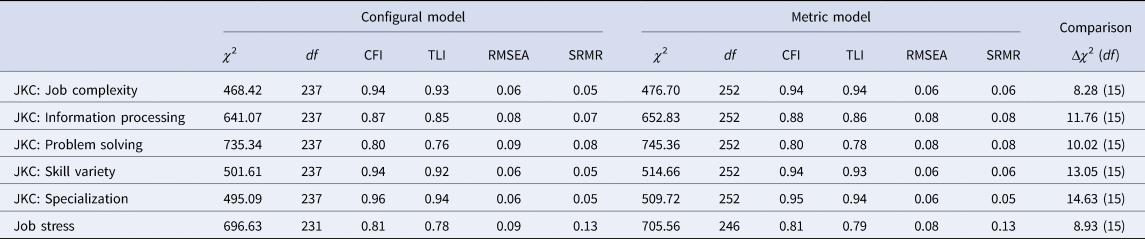
Notes: JKC, job knowledge characteristics; CFI, comparative fit index; TLI, the Tucker–Lewis index; RMSEA, the root mean square error of approximation; SRMR, the standardized root mean square residual. For the configural model, we tested whether the same items measured the construct across administrations (i.e., six measurement occasions). For the metric model, we tested whether the factor loadings of those items were equivalent across six measurement occasions.
Hypothesis Testing
The first step in conducting our discontinuous growth data analysis was to estimate the intra-class coefficient (ICC(1)) from the null model (Bliese et al., Reference Bliese, Kautz, Lang, Griep and Hansen2020). ICC(1) indicated how much of the total variance was caused by personal-level differences or within-person differences. We ran the null model (i.e., the intercept-only model) with job knowledge characteristics as the dependent variable and obtained an ICC(1) score of 0.61. The results suggested that 39% of the variance in job knowledge characteristics was caused by within-person differences.
H1 states that job knowledge characteristics decreased from the pre-onset level immediately after the outbreak of COVID-19. Model 1 in Table 4a presents the results of testing the relative effect with a linear model (Bliese & Lang, Reference Bliese and Lang2016; Bliese et al., Reference Bliese, Kautz, Lang, Griep and Hansen2020) and shows that the coefficient of the onset predictor was negative and significant (b = –0.17, s.e. = 0.06, p < 0.01). Thus, H1 was supported. H2 states that job knowledge characteristics increased in the post-onset period. Model 1 in Table 4b reports the absolute effect with a linear model (Bliese & Lang, Reference Bliese and Lang2016; Bliese et al., Reference Bliese, Kautz, Lang, Griep and Hansen2020), showing that the coefficient of the post-onset predictor was positive and significant (b = 0.04, s.e. = 0.01, p < 0.01). Thus, H2 was supported. Model 2 in Table 4a and Model 2 in Table 4b both illustrate the results of the extended curvilinear models (e.g., Lang & Bliese, Reference Lang and Bliese2009), also providing support for H1 and H2 when accounting for the curvilinear trend. With Figure 3, we also demonstrate the curve of job knowledge characteristics over time based on the curvilinear model in Model 2, Table 4b.
Results of discontinuous growth modeling (relative effect)

Notes: Number of observations = 1,002. ***p < 0.001; **p < 0.01; *p < 0.05; †p < 0.10.
Results of discontinuous growth modeling (absolute effect)

Notes: Number of observations = 1,002 for Models 1 and 2; number of observations = 885 for Models 3 and 4. ***p < 0.001; **p < 0.01; *p < 0.05; †p < 0.10.
Job knowledge characteristics over time

H3 states that the increase rate of job knowledge characteristics post-onset was higher for employees with higher individual task adaptivity. Although the interaction effect between individual task adaptivity and post-onset term on job knowledge characteristics was not significant (b = 0.03, s.e. = 0.02, p = 0.18) in the linear model (see Model 3 in Table 4b), when accounting for the curvilinearity of the trend of job knowledge characteristics in this period (see Model 4 in Table 4b), the model shows that individual task adaptivity moderates both the effect of the post-onset term (b = 0.16, s.e. = 0.06, p = 0.01) and the effect of the post-onset squared term (b = −0.04, s.e. = 0.02, p = 0.048) on job knowledge characteristics. As shown in Figure 4, the growth rate of job knowledge characteristics was higher for those with high (one SD above the mean) than those with low (one SD below the mean) individual task adaptivity. Thus, H3 was supported.
Change in job knowledge characteristics over time for individuals with high versus low task adaptivity

Table 5 displays the results of the LCS model for testing H4 and H5. As shown in Model 1, the effect of changes in job knowledge characteristics on subsequent changes in job stress was positive and significant (ξyx = 0.81, s.e. = 0.41, p = 0.05). Thus, H4 was supported. As shown in Model 2 in Table 5, job security moderated the dynamic relationship between changes in job knowledge characteristics and subsequent changes in job stress (interaction = −1.27, p = 0.03, one-tailed). We used a one-tailed test because we had a relatively small sample size for testing moderation (Aguinis, Reference Aguinis1995) and a directional hypothesis (Ambrose, Schminke, & Mayer, Reference Ambrose, Schminke and Mayer2013; Jones, Reference Jones1952). To clarify the nature of this interaction, we plotted its form and calculated the simple slopes at higher (+1 SD) and lower (−1 SD) levels of job security. As Figure 5 shows, the simple slope of changes in job knowledge characteristics predicting subsequent changes in job stress was significant at lower (slope = 3.23, p < 0.01) but not at higher (slope = 1.29, p = 0.25) levels of job security. Thus, H5 was partially supported.
Moderating effect of job security Notes: JKC, job knowledge characteristics. The effect of changes in job knowledge characteristics on changes in job stress was stronger for individuals with lower levels of job security.

Results of the bivariate latent change score models

Notes: Number of observations for Model 1 = 234. Number of observations for Model 2 = 167.
**p < 0.01; *p < 0.05; †p < 0.10.
Supplementary Analyses
Job knowledge characteristics may have increased over time during the post-onset period of COVID-19 because that was when employees’ workloads recovered. Macau has a small and open economy that is highly dependent on tourism and gaming. Because of the strict border controls and social distancing measures imposed in Macau during this period, it was difficult for business and employee workloads to recover naturally. However, we acknowledge that workloads may have increased as employees learned to cope better. We performed a supplementary test by controlling for the number of days off the participants had because of COVID-19 from T3 to T6 as a proxy for employees’ workloads. We modeled this as a time-varying predictor along with the existing terms in the DGM. The results showed that the number of days off predicted job knowledge characteristics (b = −0.01, p = 0.02), and the effect of the post-onset (b = 0.15, p = 0.01) term was significant. This implies that when we controlled for the effect of workload, the effect of the post-onset period still held.
We conducted an additional analysis to test whether the relationship between changes in job knowledge characteristics and changes in job stress varied across time. People may learn and adapt to the increase of job knowledge characteristics, resulting in a decreasing trend of increasing job stress over time (Matthews, Wayne, & Ford, Reference Matthews, Wayne and Ford2014). However, job stress may also accumulate over time when an increase in job knowledge characteristics persists, leading to a rising trend of increasing job stress over time (Hobfoll, Reference Hobfoll1989). Given the complex ways in which time functions in the change-to-change relationship, we explored whether the relationship between changes in job knowledge characteristics and changes in job stress remained stable over time. When we relaxed the equal constraints associated with the ξyx paths (see Figure 2) at any given time, a chi-square difference test indicated that the model did not improve significantly (Δχ 2 = 0.01–1.41, df = 1, ns). Thus, it appears that the magnitude of the within-person relationship between changes in job knowledge characteristics and changes in job stress remained stable over time.
Discussion
The modern workplace is dynamic. Strong macro events such as the COVID-19 pandemic may affect the design of employees’ work. Adopting a dynamic perspective on work design, we examined how the COVID-19 pandemic changed job knowledge characteristics and the implications of those changes. Our findings indicate that the outbreak of COVID-19 affected the workplace and caused an immediate decrease in job knowledge characteristics. Consistent with our argument that employees learn to cope with such situations and work in new ways to maintain their businesses, in the post-onset period, their job knowledge characteristics increased over time, and the increase rate of job knowledge characteristics was higher for employees with a higher level of individual task adaptivity. For these individuals, job knowledge characteristics had great momentum of increase at early stages and declining rates of increase later after coping began to take effect in the post-onset period. Our findings also indicate that changes in job knowledge characteristics were positively related to subsequent changes in employee job stress. This effect was even stronger for employees who perceived a lower level of job security.
This study makes several important theoretical contributions to the work design literature. First, whereas prior research has focused on the consequences of work characteristics (see Luchman & González-Morales, Reference Luchman and González-Morales2013 for a meta-analysis), our research reveals that macro-level events such as the COVID-19 pandemic may change work characteristics. Our findings concerning the differential effects of the COVID-19 pandemic on job knowledge characteristics in the onset and post-onset periods add to the understanding of work design as shaped by top-down forces (cf. Harju & Tims, Reference Harju, Tims, Griep and Hansen2020). Second, whereas most research has adopted a static perspective that treats work characteristics as enduring features (Parker et al., Reference Parker, Morgeson and Johns2017), we studied changes in job knowledge characteristics during the COVID-19 pandemic. From a dynamic perspective, we highlight that the individual experience of work design is not solely a between-person phenomenon and that it is important to conceptualize the dynamic nature of the intra-individual experiences of job characteristics.
In addition to examining how a macro event changes job knowledge characteristics, we also conceptualized and identified the change-to-change relationship between job knowledge characteristics and job stress. This nuanced perspective also enriches our understanding of the consequences of work design, highlighting the importance of both the level of job knowledge characteristics and their change between adjacent time periods.
Furthermore, we draw attention to the knowledge characteristics of work. Although the number of knowledge workers has surged in the 21st century (Colbert, Yee, & George, Reference Colbert, Yee and George2016), academic research on knowledge job characteristics has been very limited (Parker et al., Reference Parker, Morgeson and Johns2017). Our research shows that we need to pay more attention to this dimension of job characteristics because it provides an important demonstration of how employees can cope with the challenges posed by dynamic environments. Our study echoes research on COVID-19 and employees showing that employees have not only suffered from but also coped with the crisis by managing their self-work interface (Chen, Crant, et al., Reference Chen, Crant, Wang, Kou, Qin, Yu and Sun2021; Koopmann et al., Reference Koopmann, Liu, Liang and Liu2021; McFarland et al., Reference McFarland, Reeves, Porr and Ployhart2020; Rapp et al., Reference Rapp, Hughey and Kreiner2021; Yuan et al., Reference Yuan, Ye and Zhong2021). We extend the focus of those studies from coping by managing the self-work interface to coping by adapting work knowledge characteristics.
Practical Implications
Our study also offers several important practical implications. First, although the COVID-19 pandemic has dramatically affected the global economy, there is a way to mitigate its effects. We suggest that employees be open-minded, seek novel solutions to problems, and stand ready to update their knowledge and abilities in the face of a large-scale crisis such as COVID-19. By doing so, they can better manage the difficulties posed by the pandemic and accomplish their task goals in a time of crisis. Indeed, the pandemic has provided opportunities for employees to not only survive but also thrive through learning and developing.
Second, by understanding the changing patterns of job knowledge characteristics in response to the pandemic, managers can be alert to the need to intervene. Our findings suggest that job knowledge characteristics bounced back quickly during the first month after the onset of the pandemic and became relatively stable two or three months later. This suggests that managers should provide more support during the very early reopening period to help employees cope with the work challenges of the pandemic while reducing their stress during the coping process. Moreover, managers should provide training to improve individual adaptability so that employees can better cope with crises such as the pandemic.
In addition, we suggest that organizations pay special attention to employee well-being as the workplace becomes more dynamic and jobs become more cognitively demanding. Coping with challenges in dynamic environments creates a higher demand for employees’ cognitive resources, which can cause them to experience stress at work. Organizations need to create conditions that help buffer the threats of increasing job knowledge characteristics. Our findings highlight the importance of job security as such a buffer in social crises. Therefore, we advise organizations to foster employees’ perceptions of job security to maintain their strength and health in times of hardship.
Limitations and Future Research Directions
This study has several limitations that suggest future research directions. First, although we argue that the COVID-19 pandemic prompted new approaches to coping with its challenges, we were unable to measure employees’ specific coping behaviors, instead making inferences about the changes in employees’ perceptions of their job knowledge characteristics. However, we did examine the moderating role of task adaptivity in the post-onset period, and we found evidence of the coping process for which we argued. Future studies should capture the processes or behaviors used by organizations and employees to cope with a crisis that result in changes in job knowledge characteristics. For example, future researchers can use qualitative approaches to explore specific coping behaviors and quantitative approaches to examine the mediating effects of those behaviors.
Second, we were unable to identify any industrial or organizational factors that would moderate the effect of the COVID-19 pandemic on job knowledge characteristics because of the limitations of our data. Macau is a small and open economy that is largely dependent on tourism and gaming. The service sector contributes 93.7% of Macau's gross domestic product (The World Factbook, 2017). We can thus assume that our findings are generalizable to the service sector. Future studies should explore more specific industrial or organizational factors to gain a more comprehensive understanding of the effect of COVID-19 on the dynamics of job characteristics across industries and organizations.
Third, our data were collected in Macau, a special administrative region of China, where the COVID-19 infection rate has been quite low compared to many other cities in the world thanks to the Macau government's swift response and its residents’ cooperation. Still, the city's economy was decimated by the COVID-19 pandemic. Macau's economy shrank by 49% in the first quarter of 2020 as its lockdown measures affected revenue from gaming, hotels, and tourism (Bloomberg News, 2020). The motivation to restore business and cope with the challenges of COVID-19 is common worldwide, including in Macau. Therefore, we believe that our findings are not unique to Macau and are generalizable both to other places in China and to other countries. We also believe that the impact of the COVID-19 pandemic on job knowledge characteristics may be more pronounced in societies that have experienced higher infection rates. Future studies should further investigate this possibility.
Fourth, we admit that in addition to knowledge characteristics, other aspects of work characteristics might be affected by the pandemic. For example, social distancing measures might change the social characteristics of work (Morgeson & Humphrey, Reference Morgeson and Humphrey2006). Future studies should examine the dynamics of other work characteristics in response to macro events. Furthermore, we cannot draw causal conclusions from our study, as it would be almost impossible to obtain a control group of employees who did not experience the COVID-19 pandemic. Future studies focused on the effects of similar events should seek a workaround to this shortcoming in our study design.
Conclusion
We found that job knowledge characteristics decreased immediately after the onset of the COVID-19 pandemic. However, these characteristics increased gradually in the post-onset stage, especially for those with higher individual task adaptivity. Changes in job knowledge characteristics were positively related to changes in job stress, especially for employees who perceived a lower level of job security. We shed light on the understanding of a macro-level event (i.e., the COVID-19 pandemic) as a driver of changes in job knowledge characteristics and the psychological implications of occasional changes in job knowledge characteristics. Our findings offer implications for how organizations and employees can cope with COVID-19 and how to maintain employees’ well-being in the process.
Data Availability Statement
Data and code for this article are available via Open Science Framework at https://osf.io/d9hv3/
Appendix I
The DGM is used to examine how a dependent variable changes in response to one or more event. As a form of random coefficient modeling, it models the data with a multilevel structure, i.e., typically persons provide numerous responses over time. To model the effect of a discrete event that creates discontinuity in time (Morgeson et al., Reference Morgeson, Mitchell and Liu2015), it models the time dimension with basically three components: pre-onset, onset, and post-onset. Table 2 displays the coding of these terms for a particular person.
The Linear Models
-
The basic model:
-
Level-1: Ytj = β 0j + β 1j pre-onsettj + β 2j onsettj + β 3j post-onsettj + etj
-
Level-2: β 0j = γ 00 + μ 0j
-
β 1j = γ 10
-
β 2j = γ 20
-
β 3j = γ 30
-
The pre-onset parameter captures the linear trajectory prior to the event; the onset parameter captures the immediate reaction to the event; and the post-onset parameter captures the linear trajectory following the event.
To capture the absolute change in trajectories in the post-onset period, we code the pre-onset.absolute term as shown in Table 2 and run the following model.
-
Level-1: Ytj = β 0j + β 1j pre-onset.absolutetj + β 2j onsettj + β 3j post-onsettj + etj
-
Level-2: β 0j = γ 00 + μ 0j
-
β 1j = γ 10
-
β 2j = γ 20
-
β 3j = γ 30
-
To model individual task adaptivity as a level-2 moderator, we run a model as follows:
-
Level-1: Ytj = β 0j + β 1j pre-onset.absolutetj + β 2j onsettj + β 3j post-onsettj + etj
-
Level-2: β 0j = γ 00 + γ 01 task adaptivity + μ 0j
-
β 1j = γ 10 + γ 11 task adaptivity + μ 1j
-
β 2j = γ 20 + γ 21 task adaptivity + μ 2j
-
β 3j = γ 30 + γ 31 task adaptivity + μ 3j
-
The Curvilinear Models
Taking into account the possibility of nonlinear change in the post-onset period, we add the post-onset squared term (see its coding in Table 2).
The curvilinear model testing the relative effect:
-
Level-1: Ytj = β 0j + β 1j pre-onsettj + β 2j onsettj + β 3j post-onsettj + β 4j post-onset squaredtj + etj
-
Level-2: β 0j = γ 00 + μ 0j
-
β 1j = γ 10
-
β 2j = γ 20
-
β 3j = γ 30
-
β 4j = γ 40
-
The curvilinear model testing the absolute effect:
-
Level-1: Ytj = β 0j + β 1j pre-onset.absolutetj + β 2j onsettj + β 3j post-onsettj + β 4j post-onset squaredtj + etj
-
Level-2: β 0j = γ 00 + μ 0j
-
β 1j = γ 10
-
β 2j = γ 20
-
β 3j = γ 30
-
β 4j = γ 40
-
The curvilinear model testing individual task adaptivity as a level-2 moderator:
-
Level-1: Ytj = β 0j + β 1j pre-onset.absolutetj + β 2j onsettj + β 3j post-onsettj + β 4j post-onset squaredtj + etj
-
Level-2: β 0j = γ 00 + γ 01 task adaptivity + μ 0j
-
β 1j = γ 10 + γ 11 task adaptivity + μ 1j
-
β 2j = γ 20 + γ 21 task adaptivity + μ 2j
-
β 3j = γ 30 + γ 31 task adaptivity + μ 3j
-
β 4j = γ 40 + γ 41 task adaptivity + μ 4j
-
The DGM is used to examine how a dependent variable changes in response to one or more event. As a form of random coefficient modeling, it models the data with a multilevel structure, i.e., typically persons provide numerous responses over time. To model the effect of a discrete event that creates discontinuity in time (Morgeson et al., Reference Morgeson, Mitchell and Liu2015), it models the time dimension with basically three components: pre-onset, onset, and post-onset. Table 2 displays the coding of these terms for a particular person.
The Linear Models
-
The basic model:
-
Level-1: Ytj = β 0j + β 1j pre-onsettj + β 2j onsettj + β 3j post-onsettj + etj
-
Level-2: β 0j = γ 00 + μ 0j
-
β 1j = γ 10
-
β 2j = γ 20
-
β 3j = γ 30
-
The pre-onset parameter captures the linear trajectory prior to the event; the onset parameter captures the immediate reaction to the event; and the post-onset parameter captures the linear trajectory following the event.
To capture the absolute change in trajectories in the post-onset period, we code the pre-onset.absolute term as shown in Table 2 and run the following model.
-
Level-1: Ytj = β 0j + β 1j pre-onset.absolutetj + β 2j onsettj + β 3j post-onsettj + etj
-
Level-2: β 0j = γ 00 + μ 0j
-
β 1j = γ 10
-
β 2j = γ 20
-
β 3j = γ 30
-
To model individual task adaptivity as a level-2 moderator, we run a model as follows:
-
Level-1: Ytj = β 0j + β 1j pre-onset.absolutetj + β 2j onsettj + β 3j post-onsettj + etj
-
Level-2: β 0j = γ 00 + γ 01 task adaptivity + μ 0j
-
β 1j = γ 10 + γ 11 task adaptivity + μ 1j
-
β 2j = γ 20 + γ 21 task adaptivity + μ 2j
-
β 3j = γ 30 + γ 31 task adaptivity + μ 3j
-
The Curvilinear Models
Taking into account the possibility of nonlinear change in the post-onset period, we add the post-onset squared term (see its coding in Table 2).
-
The curvilinear model testing the relative effect:
-
Level-1: Ytj = β 0j + β 1j pre-onsettj + β 2j onsettj + β 3j post-onsettj + β 4j post-onset squaredtj + etj
-
Level-2: β 0j = γ 00 + μ 0j
-
β 1j = γ 10
-
β 2j = γ 20
-
β 3j = γ 30
-
β 4j = γ 40
-
The curvilinear model testing the absolute effect:
-
Level-1: Ytj = β 0j + β 1j pre-onset.absolutetj + β 2j onsettj + β 3j post-onsettj + β 4j post-onset squaredtj + etj
-
Level-2: β 0j = γ 00 + μ 0j
-
β 1j = γ 10
-
β 2j = γ 20
-
β 3j = γ 30
-
β 4j = γ 40
-
The curvilinear model testing individual task adaptivity as a level-2 moderator:
-
Level-1: Ytj = β 0j + β 1j pre-onset.absolutetj + β 2j onsettj + β 3j post-onsettj + β 4j post-onset squaredtj + etj
-
Level-2: β 0j = γ 00 + γ 01 task adaptivity + μ 0j
-
β 1j = γ 10 + γ 11 task adaptivity + μ 1j
-
β 2j = γ 20 + γ 21 task adaptivity + μ 2j
-
β 3j = γ 30 + γ 31 task adaptivity + μ 3j
-
β 4j = γ 40 + γ 41 task adaptivity + μ 4j
-



