Introduction
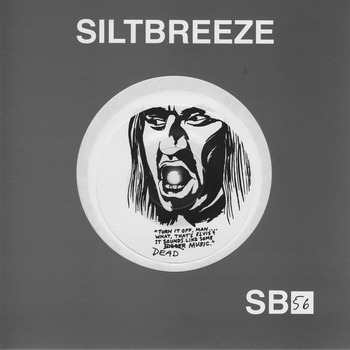
On an obscure one-sided 7” vinyl single released in 1996 on the independent Siltbreeze label (US), a cartoon long-haired dude prepares us for what we're about to hear: ‘Turn it off, man. … What, that's Elvis? It sounds like some nigger dead music’ (Figure 1). That most painful and offensive of epithets, nigger, is written but crossed out on the cartoon. Placing the needle on the record, we hear crashing cymbals throbbing against droning, detuned guitars. A half-step interval emerging as a theme, followed by a prominent feedback hum – soon accompanying a series of blood-curdling female screams. The texture flows in and out, with low howling soon in dialogue with the screams as the feedback, cymbals and droning continues. After three and a half minutes, the sounds end.
Harry Pussy, ‘Black Ghost’, Siltbreeze, 1996.

The etching on the ‘b-side’ of the vinyl announces THE HARRY-PUSSY, ‘BLACK GHOST’ (L. HOPKINS). But if this is indeed a cover of Lightnin' Hopkins' classic ‘Black Ghost Blues’, as Harry Pussy's Bill Orcutt has indicated in recent interviews (Masters Reference Masters2010), what is one to make of it, when the connections between the original and the new version have been so obscured? Is this the sound of erasure? The sound of homage? Is it the sound of conflict and contradiction, or the sound of purity (pure anger, pure joy)? Why drop ‘Blues’ from the song's title? Are the references to Elvis and ‘nigger dead music’ in the artwork ironic, self-reflective, shocking, funny, offensive? All of the above? A whole new set of questions arises when we add another level of parody, imitation, homage and appropriation: the entire design concept is a copy of Thermidor #10, the single-sided 7” of ‘Walking Down the Street’ by Nig-Heist (1983), a group that took punk's ridiculous confrontational aesthetic to an extreme that may still be unmatched.Footnote 1 The cover art is the same as Raymond Pettibon's original drawing, with one major change – ‘Turn it off, man. … What, that's Elvis? It sounds like some nigger’.
Harry Pussy's rendition of ‘Black Ghost’, and the swirling miasma of questions and tangled musical affect it generates, is only one extreme manifestation of a deep tension that is at the very heart of punk: the force, energy and power of blues foundations that provide punk with its musical vocabulary, and the haze of confusion and alienation that comes from musical strategies which have obscured those very same blues roots. For while specific treatments of blues resources with strong associations of raw energy and power are at punk's core, the blues has also disappeared as the music's acknowledged basis – a discursive negation, denial or refutation of punk's genealogy made possible and supported by particular musical choices. The contradictions, paradoxes and friction in punk music and discourse give punk its potency and meaning, a musical translation of the social tensions surrounding authenticity, race, class, gender and sexuality that gave rise to the style in the first place.
In American popular music styles and their international offshoots, the blues occupies a singular place. It is the foundational set of resources for scores of contemporary styles, as well as an explicit source of power connected to ever-shifting ideas of race, class, gender and sexuality.Footnote 2 Musicians of various backgrounds, identities and affiliations have reinforced and shaped ideas of ‘the blues’, adding layers of ambiguity while linking particular blues styles and musicians to constructions of blackness, male sexual prowess and authenticity. Musicians seeking to destabilise socially constructed categories, including punk musicians and those they identify as their precedents, have drawn on the blues for its paradoxical, complex associations with power (usually in the form of a stereotyped black male sexuality) and the downtrodden underclasses – the latent power of the chained or oppressed man ready to spring from his shackles, represented in such iconic figures as Lead Belly (Carby Reference Carby1998; Wald Reference Wald2004, p. 232; see also Bannister Reference Bannister2006, pp. 33–5). Innovative treatments of the blues can also signal revolutionary ideas, (often self-imposed) marginality, challenges to social order, calls for collaboration among youth and, most of all, pure and authentic expression.
An impressive array of musicians in the 1960s and early 1970s thrived on connecting blues resources to reimagined and politicised ideas of blackness. Artists as wide ranging as Howlin' Wolf, Johnny Winter, Miles Davis, Led Zeppelin, Jimi Hendrix, Eric Clapton and James Brown each found different ways to engage and shape ideas of blackness with blues styles. However, for white musicians, who had been unapologetically appropriating and exploiting black music on popular entertainment stages at least since the mainstream emergence of blackface minstrelsy at the end of the 1820s (whether in the form of actual African American musical resources, invented stereotyped notions of black music or some combination of the two), the high sociopolitical stakes of musical blackness in the 1960s was a game-changer.Footnote 3 For white musicians participating in African American musical styles there was no clear path to musical authenticity – such was the price of whiteness itself. Some musicians – including many of the mostly white musicians retrospectively grouped as ‘proto-punks’ – found solutions in ‘whitening’ stylistic choices, including adjustments to vocal performance styles, and changes in tempo and rhythmic approaches. Meanwhile, these same musicians cultivated harmonic and melodic approaches that retained the powerful affect of black musical resources even when obscured, such as blues-based riffs and vamps.Footnote 4
Punk musicians ran with these approaches and introduced innovations of their own. In the process, punk became severed from its roots in the blues, and even characterised as a thoroughly ‘white’ style, opposed to the blues, described as a thoroughly ‘black’ style. Even the slightest familiarity with American popular music history renders absurd Johnny Ramone's often-quoted description of his guitar style as ‘pure, white rock ‘n’ roll with no blues influence' (Sisario Reference Sisario2004). However, such statements dovetailed with musical choices associated with whiteness, and the prevalence in punk culture of shocking racist visual imagery such as the swastika further distanced punk from its roots in the blues. Associations of musical style and race had clear ramifications for punk as a subculture: by the explosion of hardcore in the early 1980s, and despite the contributions of several key African American figures (e.g. Bad Brains), the punk scene was overwhelmingly white. The Clash's prescient lyrics – ‘White Riot, I wanna riot, White Riot, a riot of my own’ – became reality.
Yet, throughout punk's history, the blues has remained an essential resource at the core of punk. It is what constitutes the ‘back to basics’ sound in punk to which so many descriptions refer. With very little scratching of the surface, blues elements jump out from the music of bands as diverse as Black Flag, X-Ray Spex, Bikini Kill, Minor Threat and Hüsker Dü. And, especially since the 1990s, several musicians have attempted to reinsert and foreground the blues in their music, rejecting or problematising the ‘black-and-white’ boundaries ascribed to punk.
‘Punk’, ‘blues’, ‘rock’ and other popular music categories (I avoid the word ‘genre’ since popular music styles are so variously constituted) are best understood as ever-changing assemblages of products created by individuals concerned in multiple ways with the labels, and the musical and societal questions surrounding the labels. In this paper – itself one such ‘product’ – I propose an empirical and musicological understanding of punk, starting from the premise that all ‘rock’ is based on blues resources, and that ‘punk’ describes some particular approaches to those materials. I use ‘punk’ as the most practical and consistent category for describing the musicians who engaged in those transformations to blues resources, but my choice does not negate or preclude the possible usefulness of other terms such as ‘indie rock’ in the discussion.Footnote 5
Hearing punk as blues is more than an exercise – it is a musical starting point for untangling the complex relationship between punk and social categories of race, class, gender and sexuality. While there is a considerable amount of scholarly literature addressing punk and society from a critical point of view,Footnote 6 there is a glaring absence of analysis of the elements of musical style that allowed for and contributed to punk's uncomfortable position at the nexus of so many tensions and paradoxes, and which stir such strong responses in listeners.
Roots and tradition in punk's dustbin
As Jonathan Kane, the original drummer for Swans, stated:
Blues is the unacknowledged resource of alternative rock. There is a heavy anti-blues bias in the indie rock scene. […] a lot of blues has become an archivists' art form, and some of it's corny sounding, […] but that in no way can minimise the contribution of artists like Muddy Waters, and Robert Johnson, Fred McDowell, and Albert King, and I could list a hundred more to the development of rock music and where it is. And people who refute it, just really simply don't know what the fuck they're talking about. Because […] by and large it's the undeniable essence and building block, DNA of rock music. I mean it's something that … this separation of people who can get blues and who don't in the alt-rock community is something that I take very seriously, because I know people who just don't seem to get it – make that connection. And it troubles me. (Kane Reference Kane2010)
Kane's frustrations speak to the large-scale, almost systematic obscuring of the connections between certain rock styles – which he grouped under the umbrella of ‘alternative’ and ‘indie’ rock, both overlapping with ‘punk’ in our conversation – and their blues roots. Fans, musicians, critics and other members of the ‘alt-rock community’ passively fail to acknowledge blues as the source, but some also refute this fact, actively and explicitly rejecting reality. The idea that punk in particular is somehow devoid of the blues rather than rooted in it has become commonplace and even taken for granted.Footnote 7
This is no accident. Obscuring roots and denying one's place in a tradition are paradoxical, yet key, elements of the punk style. Even many of the musicians most associated with punk, such as the Ramones and the Sex Pistols, resisted the label of ‘punk’, speaking to a general unease with categorising, historiography and the idea of a general ‘punk’ community (Taylor Reference Taylor2003, pp. 8, 14). Richard Hell famously belonged to the ‘blank generation’ (Heylin [Reference Heylin1993] 2005, p. 123). The title track of Sonic Youth's EP Kill Yr. Idols (1983) encouraged listeners to find an original voice through musical deicide: ‘kill your idols/sonic death’. By now, irreverence for tradition is a cliché of punk rock (‘kill your idols’ is now the name of a movie, a book, a book series, etc.).
Paradoxically, the strategy of rejecting and obscuring tradition is itself a tradition, and one that contributes to punk being read as ‘white’ (Whitesell Reference Whitesell2001). Punk's ‘blankness’ has parallels in the ‘Eurological’ discursive modes described by George E. Lewis with respect to improvised music after 1950. Eurological approaches tend to ‘deemphas[ise] memory and history’ (Lewis Reference Lewis1996, p. 109) – whereas ‘Afrological’ approaches, ‘coming from a legacy of slavery and oppression, cannot countenance the erasure of history’ and emphasise personal narrative (Lewis Reference Lewis1996, pp. 109–11).Footnote 8 Furthermore, historians and critics have sometimes attempted to place punk solely in a European experimental or avant-garde tradition, placing undue emphasis on the impact of Situationist International, Dada or experimentalists in the European classical music tradition – the complex makeup of these movements is another story – on punk (Marcus Reference Marcus1989).Footnote 9
Yet it is possible to identify strategies of erasure and obscurity and still establish a definite musical genealogy and stylistic tradition; ‘rebellion against my identity is always one possible mode of expressing it’ (MacIntyre Reference MacIntyre1984, p. 221). One of the major challenges and goals of this project is to separate the discourse negating tradition from the musical processes which demonstrate a clear lineage. No music or musician is rootless. Establishing a musical tradition of punk requires first understanding the negation of tradition as a conventional discursive mode rather than truth, and then listening closely to the places where tradition explicitly emerges.
For example, punk musicians do acknowledge inspirations and influences, even if such language is couched in an overall attitude of negation. For example, Black Francis (Charles Thompson, a.k.a. Frank Black) said, ‘I grew up in L.A. when bands like Black Flag were around, but I never listened to them. I was buying used records for 50 cents, and didn't socialise, really; I was lost in headphone-land. … I had those [Hüsker Dü] albums, a couple of Iggy albums, one Captain Beefheart and a tiny studio apartment. … At the start of the Pixies I only had four or five albums and the Hüskers were two or three of them’ (Macnie Reference Macnie1992).
Even as Black Francis denies being situated in a community, he also acknowledges his debt to Hüsker Dü, Iggy Pop and Captain Beefheart, and his mention of Black Flag, even to negate their influence, indicates their importance as a point of reference. Certain names, such as Iggy Pop and Captain Beefheart, repeatedly appear in musicians' statements about their inspirations.Footnote 10 Even more telling is when these verbal statements align with cover versions, such as the many interpretations of Stooges songs; the same year Sonic Youth released Kill Yr. Idols, for instance, they also released a passionate and rather straightforward interpretation of the Stooges' ‘I Wanna Be Your Dog’ (Confusion is Sex, 1983). Punk musicians' overriding antagonism towards the idea of tradition makes cover versions extremely important, as these interpretations are instances of punks explicitly and publicly looking to the past. And perhaps unsurprisingly, given punk's strict elements of style, punk covers are often extremely faithful to their models.Footnote 11 Cover versions and musicians' gestures of self-contextualisation, rather than blind adherence to a pure or abstract notion of ‘punk’, can paint a more meaningful picture of the musical practices in which punks participate.
When tracing a musical genealogy of punk through covers and explicit acknowledgments of inspiration, it does not take long to get to the blues. While punk musicians themselves are usually unclear or silent about their music's roots in the blues, those they refer to as inspirations are often the opposite, quite vocal about their debt to the blues. For the MC5's Wayne Kramer, ‘growing up in Detroit, [the blues] was all kind of in the ether, it was just always there’, especially on the radio (Kramer Reference Kramer2012). Perhaps punk's most cited and most covered musician, Iggy Pop, began his career as an aspiring blues drummer (McNeil and McCain [Reference McNeil and McCain1996] 2006, pp. 35–8). He has also consistently spoken on the central importance of the blues to punk and related rock styles, saying, for example, ‘Stuff like [Bukka White and John Lee Hooker], that's the basis. That's the Rolling Stones, that's every – that's Cream, that's even Sonic Youth. In fact, it's very close to Sonic Youth. It's everything that's happened in … rock, right up from Chuck Berry through alternative. … That's the vocabulary there’ (Pop Reference Pop2009). Captain Beefheart showed himself to be a student of the blues at the very outset of his debut album, with Ry Cooder's slide guitar opening the Delta-drenched ‘Sure ‘Nuff ‘n’ Yes I Do'.
By placing musicians' choices and actions at the centre of the investigation and identifying musical processes, an empirical definition of punk begins to emerge with particular treatments and transformations of blues resources at the core. Punk and the blues are not synonyms, as musicians drew on many resources other than the blues in developing the punk style; however, the specific approaches to blues materials underpinning all of the seminal products discussed in this paper constitute an essential thread and touchstone for punk.Footnote 12 This musical foundation of punk – which I consider to be fundamental for grasping punk's meaning – is avoided or undervalued by most writers, who tend to define punk instead primarily or even exclusively as an ‘attitude’, a subcultural phenomenon, a youth movement or a political intervention. Greil Marcus acknowledged punk's musical genealogy but dismissed it as uninteresting and unworthy of attention, writing, ‘Yes, the Sex Pistols encored with the Stooges’ “No Fun”, as sons they killed their father-Dolls with “New York”, Velvets covers were a punk touchstone, but this is just arithmetic. If what is interesting about punk is something other than its function as a musical genre, there is no point in treating it as one' (Marcus Reference Marcus1989, p. 82). Among the scholarly works that do pay attention to punk in terms of its music – and there are not that many – serious and detailed issues of musical style remain unexplored. For example, in what is still one of the only studies that addresses the musical style of punk (in the UK), One Chord Wonders, Dave Laing writes that ‘“Punk” meant an attitude towards musical performance which emphasised directness and repetition (to use more than three chords was self-indulgence) at the expense of technical virtuosity’ (Laing Reference Laing1985, p. 12). But which three chords, and how and why were they used? What are the differences between songs employing three chords, one chord or two? What of the many songs built on four-chord patterns? How does such a statement account for the many different harmonic and melodic models, and many kinds of musical virtuosity and techniques that one can find even in the most iconic punk bands?
The importance, appeal, meanings and innovations of punk music cannot be understood simply as an ‘attitude’ or just in the ear-of-the-behearer. Punk is an ‘attitude’, but a musical attitude that is represented by particular approaches to the blues and other musical stylistic features. Constructing a musical genealogy of punk, beginning with tracing punk's roots in the blues, helps reveal the many musical innovations and contributions made by punk musicians, and the many paradoxes at the heart of the punk aesthetic, such as the dissonance between musical affect and verbal discourse.
Proto-punk treatments of blues resources (1960s–early 1970s)
Punk musicians (either self-identified or named as such by writers) such as the Sex Pistols, Damned, Electric Eels and Black Flag quickly settled on musical conventions, many of which were direct extensions of particular approaches to the blues taken by earlier ‘proto-punk’ bands such as the Stooges, Velvet Underground and MC5.Footnote 13 The specific choices that punks found inspiring as they developed their own styles included moving from multi-part, three-chord harmonic schemes to riffs and one- and two-chord vamps, and retaining certain blues melodic approaches, such as the use of pentatonic scales and monophonic textures of vocal melodies doubled with instrumental melodies, and improvisations based on blues scales. At the same time, punk musicians extended changes by proto-punks that distanced their styles from the blues, such as alterations in vocal performance styles, significant increases in tempo and volume, and the use of barre (‘power’) chords instead of functional triadic harmony.
Proto-punk musicians' preferences were extreme manifestations of a growing interest during the 1960s in the idea and ‘discovery’ of a particular kind of authentic blues and bluesman, well articulated by Amiri Baraka (LeRoi Jones) in Blues People (Reference Baraka and Jones1963).Footnote 14 Particular kinds of blues, especially Delta and ‘folk’ blues, became inexorably linked to an idea of blackness heavily intertwined with white audiences' and rock musicians' tastes, while the reality of the blues' diverse resources and history – including vaudeville and hokum, sheet music entertainment and the women who dominated ‘classic blues’ – became obscured.
British musicians of the 1960s such as Eric Clapton and the Rolling Stones were especially taken with the music of country and Delta blues artists such as Robert Johnson, as well as the Chicago blues artists that were connected to the Delta, and their interest helped relaunch the careers of Muddy Waters, John Lee Hooker and others (Headlam Reference Headlam, Covach and Boone1997; Schwartz Reference Schwartz2007; Adelt Reference Adelt2010).Footnote 15 Robert Johnson and his peers went from sophisticated professionals to mysterious primitives, a move that bolstered rock musicians' drawing on the blues as a source of authenticity, primal expression and ideas of masculinity (on this trend more generally, see Frith Reference Frith1996, pp. 130–32). In actuality, the blues musicians themselves – like most professional musicians – often had a wide range of approaches at their disposal. Howlin' Wolf, Muddy Waters and Robert Pete Williams had diverse repertoires filled with assorted song forms and harmonic schemes. Personal preferences and external pressures of the marketplace combined to emphasise the quintessential blues style that became associated with these figures.Footnote 16
Proto-punk groups extended this approach shared with other rock groups in the 1960s while toying with a range of approaches to vocal timbre, harmonic schemes, rhythmic treatments and production aesthetics. The moves that set them apart from other groups in the 1960s were strategic, as they saw their peers as too imitative and thus inauthentic. Their transformations to the blues set the stage for a potentially radical and, in hindsight, schismatic scene that would be paradoxically read as an authentic ‘white’ equivalent to the blues.
Shifts in harmonic schemes
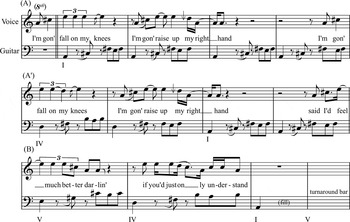
For most rock musicians in the 1960s, the 12-bar, three-line blues was the dominant form out of many possibilities. In some cases, rock musicians even imposed a 12-bar structure on songs that originally didn't have the form, as in the Doors' version of Willie Dixon's ‘Back Door Man’. Example 1 (‘How Many More Years’) shows the three-line blues in its most typical manifestation, a strophic AAB vocal form set to a I-IV-V chord scheme in a 12-bar cycle. The texts are sung to pentatonic-based melodies and delivered in an off-beat style, but they align with the harmonic rhythm as stressed syllables are usually coordinated with the downbeats of each four-bar group.
‘How Many More Years’, Howlin’ Wolf, Chess Records, 1951. Example of three-line, 12-bar blues form. Transposed to A and starting from second stanza. All music examples are transcribed by the author.

By the 1950s, the 12-bar scheme had flourished as a common resource among jazz musicians and had acquired associations of urban sophistication accruing since the 1920s. The 12-bar blues ‘was promoted by those blues musicians and their clients who had come to perceive the use of these chords as status-enhancing’ (Kubik Reference Kubik1999, p. 42; on the 12-bar blues and the development of ‘popular blues’, see Muir Reference Muir2010). Yet the 12-bar structure is only one of many blues schemes, and blues musicians subjected even this scheme to countless variations, often on the spur of the moment: changing lengths of phrases, altering lyric patterns, and adding and subtracting chords.
For rock musicians in the 1960s and early 1970s seeking to tap into associations of ‘raw power’ (to reference one of the Stooges' most famous albums), the rural, the ‘natural’ and the ‘primitive’, the 12-bar blues and its aura of sophistication often fell short. Instead, these musicians typically looked to blues compositions based on riffs and one-chord vamps. These models were seen as avenues for a direct, pure form of expression, and it is these alternative forms that provided much of the foundation for punk. The simpler structures also encouraged social interaction and do-it-yourself aesthetics, later staples of the punk movement. According to Wayne Kramer, such structures – or lack thereof – challenge musicians to ‘pay complete attention to the other people that you're playing with so that you're actually playing together and all working together on a musical idea, a unified thought’ (Kramer Reference Kramer2012).
The move in emphasis from 12-bar forms to riff- and vamp-based compositions was not instantaneous nor absolute. The ‘proto-punk’ groups also used entirely conventional 12-bar forms, such as in the Velvet Underground's ‘Too Much’. The 12-bar form continues to remain an important resource, especially when played in a hyper, manic, sloppy style, and 12-bar-type chordal movement is a strong feature of punk style to the present day. But by and large, for the musicians whom punks particularly found inspiring, the blues compositions based on short-cycle riffs and one-chord vamps found in the music of Big Joe Williams, John Lee Hooker, Howlin' Wolf, Bukka White, Robert Pete Williams and many others presented productive alternatives to the 12-bar scheme. For example, an early cover of the blues standard ‘Baby Please Don't Go’ by the MC5 (1966, released only in 1999) extends Them's version (1964), following no form at all, relying completely on a whole-step alternation in the bass and improvisations from the rest of the band. Big Joe Williams' early version of 1935 is already notable for his sticking to one chord, even when the form would suggest harmonic movement (see also Kubik Reference Kubik1999, pp. 71–3). The Stooges' seminal albums also include entirely riff-based, one-chord songs without any nod to 12-bar-type patterns, such as ‘T.V. Eye’ (Fun House). Iggy Pop's continued interest in blues musicians who play primarily riff-based, one-chord songs, such as Junior Kimbrough and R.L. Burnside, is well documented.
Many proto-punks combined approaches in one song. Following the approach of James Brown, who began seriously exploring vamps and riff-based compositions in 1967 (‘I Can't Stand Myself’, ‘Cold Sweat’, ‘Let Yourself Go’ and ‘There was a Time’ were released that year), proto-punks based compositions on 12-bar or other multi-part schemes and also incorporated one-chord vamps or two-chord oscillations to be used as extended sections.Footnote 17 In these compositions, such as the Stooges' ‘No Fun’ and the Velvet Underground's ‘Foggy Notion’, extended vamp sections provided places for musicians to galvanise the audience to social action, enter or simulate altered states of consciousness, and dance.
So one-chord riffs and two-chord oscillations opened the blues to untrained and amateur performers even more than the straightforward 12-bar patterns. Riffs and I-IV oscillations imply such a strong harmonic foundation that virtually any sound or noise can be made to fit, without the improviser concerning him or herself with adjusting to harmonic movement. The introduction of noise as an improvisational expressive device, inspired by the extended techniques of ‘New Thing’ and ‘free jazz’ musicians, became a crucial technique for proto-punk and punk musicians (Heylin [Reference Heylin1993] 2005, p. 33). Proto-punk and punk interpretations of ‘free jazz’, including performances such as the Stooges' ‘L.A. Blues’ and MC5's ‘Starship’ (interpreting a poem by Sun Ra), although sometimes based on primitivist (mis)understandings, speak to ‘expression’ as a key factor in proto-punk and punk.Footnote 18 As Tom Verlaine remembered, ‘I used to have these jam sessions with a friend. We couldn't play at all; we just used to like to make noise; fantastic noise, this raw expression … I was especially into saxophone players then … guys like John Coltrane and Albert Ayler. I played sax for maybe two years, but I never really played it well, because I was eager for expression before I'd got the technique right’ (Heylin [Reference Heylin1993] 2005, p. 95). Punks may not have been ‘rejecting’ progressive rock and jazz fusion – the party line – so much as looking for ways to immediately express themselves, have fun, and interact with their peers with limited technique. As Billy Idol said, ‘Iggy, Lou Reed, and the Velvet Underground took me away from people like the Mahavishnu Orchestra. That's beautiful music, but, fuck, I can't play the guitar like that!’ (Lydon Reference Lydon and Zimmerman1994, p. 176; see also Albiez Reference Albiez2003, and a fair amount of love for prog rock in Robb Reference Robb2006).
A closer look at some key songs reveals much about the approaches to the blues that punks drew upon. The Stooges perhaps more than any other group laid a blueprint for punk, with their records continually serving as vehicles for social outcasts assembling into bands. In his memoir, John Lydon recalls the Sex Pistols' cover of the Stooges' ‘No Fun’:
‘No Fun’ is a song I love. We made up our version on the spot. I always wanted to do it. I asked Steve [Jones] to learn the riff, which he did very quickly. Paul [Cook] filled in, and it went on from there. I hummed and hawed around the words because I didn't quite know them. That's fairly typical of me. While I love the feel of ‘No Fun’, I don't like the actual lyrics. I think they're flippant in some places while they can be very astute in others. No fun was definitely what we were having at that particular time. (Lydon Reference Lydon and Zimmerman1994, p. 228)
Lydon's account focuses on his approach to the lyrics, as one might expect from a vocalist, but he also makes striking points about the group's overall decision to incorporate the tune into their repertoire. He mentions that ‘No Fun’ was based on a ‘riff’, and it had the right ‘feel’. Perhaps most importantly for a culture oriented around the participation of young people with varying levels of technique, the band could learn and play the tune right away. Such immediacy opened doors to many who otherwise might not have joined bands, dismantling the notion that music was the property of a select group of trained musicians.
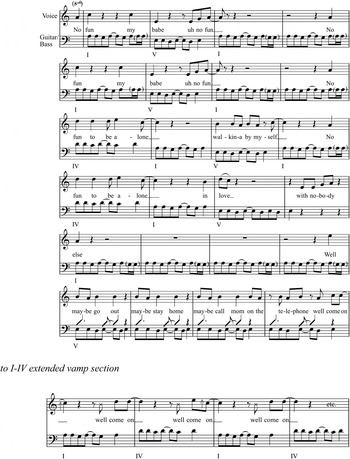
As shown in Example 2, in ‘No Fun’ a basic 16-bar ‘Trouble in Mind’ scheme is treated less like a conventional blues cycle and more like a collection of independent four-bar blocks. ‘No Fun’ also employs a flexible turnaround concept built on the dominant chord rather than a turnaround built into a harmonic cycle of fixed length. This free approach to the blues turnaround is based directly on the approach of Robert Pete Williams and others – ‘I've Grown So Ugly’, for example, is almost entirely built on a one-chord riff, with a V-IV-I turnaround occasionally and loosely thrown in. Finally, and perhaps most importantly, the three-chord harmonic cycle in ‘No Fun’ eventually gives way to an extended freak-out improvisation built on an oscillation between I and IV. The riff anchoring this oscillation is based on a whole step, which became perhaps the most typical melodic convention in punk.
‘No Fun’, The Stooges, The Stooges, Elektra, 1969. From second stanza. Variation of ‘Trouble in Mind’ scheme: I V I IV I V I I.

The approach heard in ‘No Fun’ of combining blues patterns is also found in ‘Sister Ray’, ‘Foggy Notion’ and other songs by the Velvet Underground that later groups interpreted. ‘Foggy Notion’ is constructed mostly on a repeating four-bar riff, but with a 12-bar blues section that is dropped into the overall structure at will. Overall, musicians expanded and extended sections of four-bar and two-bar patterns built on one-chord riffs or two-chord oscillations, while they deemphasised the 12-bar patterns that had become almost synonymous with ‘the blues’. Live versions of ‘Sister Ray’ and ‘Foggy Notion’ extended the vamps and minimised the 12-bar section.
Lester Bangs recognised that the Velvet Underground's approach was not sui generis, but rather an extreme manifestation of the style of other blues-based rock bands: the Velvet Underground ‘seemed to have carried the Yardbirds/Who project to its ultimate extension’ (Bangs [Reference Bangs and Marcus1970] 1988, p. 43). The Modern Lovers' take on the Velvet Underground's harmonic approach encapsulates the trend that would fully take hold in punk. A Modern Lovers performance of ‘Foggy Notion’ from 1972 completely avoids the 12-bar section.Footnote 19 ‘Roadrunner’ is only a hop-skip-and-a-jump from ‘Sister Ray’. Almost entirely based on a two-bar, I-IV oscillation used for verses, organ solos and general jamming, the tune has only one nod to three-part blues form: a brief stop-time section (‘Roadrunner once, roadrunner twice, I'm in love with rock ‘n’ roll, and I'll be out all night') containing a V chord turnaround. The one-chord vamp of ‘Pablo Picasso’ dispenses with such nods altogether.
Maintaining melodic elements of the blues
From proto-punk to punk and subsequent variations of the style, musicians have shown a remarkable adherence to the melodic frameworks of the blues, especially the minor pentatonic scale and neutral ‘blue notes’. The riffs that form the basis of most songs hang on this scaffolding. Improvisations invariably follow the lick-based, pentatonic guitar soloing styles of Albert King, Buddy Guy, Albert Collins and other blues musicians, even if they are buried in added noise.Footnote 20 Remembering Robert Quine, the guitarist for the Voidoids, Lou Reed and many others, Alan Licht wrote, ‘besides the fact that I don't think he much liked punk, he should really be ranked with people like Ike Turner or Otis Rush – that violent take on the blues – or Pete Cosey’ (Licht n.d.).
A less apparent blues feature in proto-punk that remained an essential element of punk is monophony (sometimes heterophony), with one melody sung and played simultaneously by the voice and instruments. Rather than create a homophonic texture like most rock and roll groups, in which functional harmony played on accompanying instruments supports a clear overarching vocal melody, proto-punk musicians followed the approach heard on recordings such as Muddy Waters' ‘Rollin’ and Tumblin'', in which voices and melodic instruments perform the same lines simultaneously with only minor expressive variations. The voices and instruments are also often in call-and-response dialogue with each other.
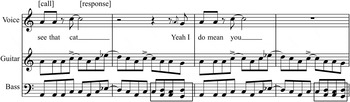
As shown in Example 3, in the Stooges ‘T.V. Eye’ blues scaffolding, monophony and call-and-response are used to great effect. The riff is a classic example of blues pentatonicism, and Iggy Pop's voice also exploits blue notes such as the neutral third between the natural and flatted pitches. The overall texture is mostly of monophony, although Dave Alexander (bass) sometimes substitutes pitches. The vocal and instruments are in call-and-response dialogue with each other.
‘T.V. Eye’, The Stooges, Fun House, Elektra, 1970. Boxed bass pitches indicate substitution options.

Proto-punk groups as well as other groups imitating or performing blues repertoire performed these melodies in ‘urban blues’ configurations, coordinating the homophonic textures, call-and-response patterns and blues riffs in the style heard on many of Howlin' Wolf's and Muddy Waters' recordings made in Chicago during the 1950s. Ensembles progressively amplified and expanded, from the innovations of the southern blues musicians who moved north to Chicago, to the British groups such as the Yardbirds playing blues and blues-based repertoire in the 1960s. Musicians paved the way for punk by making stripped-down blues styles louder, bigger and often faster: Johnny Winter's hopped-up version of Muddy Waters' originally lean and understated ‘Rollin’ and Tumblin'' (1969) and the expanded arrangement of Robert Pete Williams' originally solo ‘Grown So Ugly’ by Ry Cooder on Captain Beefheart's Safe as Milk (1967) serve as emblematic examples. Proto-punk and punk groups through the 1970s also employed certain instruments with strong blues and R&B associations, such as the saxophone (the Stooges, Captain Beefheart, Pere Ubu, X-Ray Spex, Electric Eels), piano or organ (Velvet Underground, Modern Lovers, Patti Smith Band) and slide guitar (Captain Beefheart's Magic Band).
Shifts in vocal performance styles
Both proto-punk and punk musicians made major transformations in the area of the voice and lyrics. As in most rock music, the idea that blues resources were connected to notions of masculinity and sexuality above all else is evident in the shift away from the diverse range of themes in blues poetry, such as migration, work, religion (including African retentions), and personal and social problems, to lyrics primarily dealing with sex and machismo. This shift again dovetailed with the styles of Muddy Waters and Howlin' Wolf, who presented themselves as highly sexualised (Gioia Reference Gioia2008, pp. 219–20 and 292–4). Some proto-punk groups differed from other rock groups to the extent that they pushed these associations, such as the Stooges in ‘Loose’ and ‘Penetration’. The MC5 traded heavily in the merging of blues resources, blackness and masculinity. Steve Waksman's reading of the MC5's style – while extreme and overstated, and which I would modify with ‘ideas of black masculinity’ – provocatively raises the issue: ‘Indeed, one could say that for Sinclair and the MC5 it was only through the appropriation of black masculinity that white men could become any kind of men at all’ (Waksman Reference Waksman, Swiss, Sloop and Herman1998, p. 59). They pushed at the limits of convention, employing profanity (‘Kick out the jams, motherfucker!’) rather than the metaphor and allusion used by blues and R&B singers (the watershed moment of Ronald Isley singing ‘all this bullshit going down’ on ‘Fight the Power’ did not happen until 1975). The Velvet Underground went far afield from blues poetic conventions with their lyrics in famous examples such as ‘Venus in Furs’, and other groups favoured lyrics that were deliberately confrontational or stupid, political, and on themes of teenage rebellion or partying. Punk groups differed from earlier groups, even the proto-punk bands, with their very broad approach to lyrical content, singing about asexuality, nihilism and apathy (Laing Reference Laing1985, pp. 27–32).
However, vocal performance styles – the ways in which these lyrics were sung – are just as important to consider as the lyrical themes. Iggy Pop and Rob Tyner, for example, usually emulated the vocal timbres and styles typical of many blues musicians, in the same vein as other white male rock singers such as Mick Jagger and Van Morrison who were looking to American blues singers as models of sexual potency and societal rebellion. Iggy Pop imitated the voices of Howlin' Wolf and Bukka White, and fellow musicians identified this. Alan Vega of Suicide commented: ‘Iggy has a great voice, a great blues voice’ (Nobakht Reference Nobakht2005, p. 21). Iggy also aligned the syllables of the lyric to the underlying harmonic rhythm in a blues style, as part of an overall rhythmic approach which reflected the elasticity typical of blues and jazz. Patti Smith incorporated growls, howls and blues inflections into a heterogeneous vocal style that could move from one approach to another. Her style on the controversial ‘Rock ‘n’ Roll Nigger' is a masterpiece of discomfort in musical affect; her attempt to associate the word ‘nigger’ with anyone ‘outside of society’ (Jimi Hendrix and Jackson Pollock?) by adopting blues timbres over ferocious riffs is as consummate an example of the tangled web of appropriation, privilege, and stereotypes of race, gender and sexuality as any in this paper.
However, proto-punk musicians also began differentiating their vocal styles from typical male blues voices. Lou Reed emphasised the limitations of his range to cultivate a vocal style that worked in tension with his blues-based music, and which conveyed authenticity rather than imitation. Jonathan Richman, who began performing with the Modern Lovers in 1970, explicitly modelled his vocal style after Reed's. For both Reed and Richman, this meant highlighting talky, nasal, thick white US Northeast accents. In Pere Ubu, David Thomas' unique combination of warbling and screaming was juxtaposed intriguingly with blues-based riffs on ‘Life Stinks’. In the United States, racialised difference is frequently located in vocal timbre, dating back to notable examples of songs that feature ‘white’ vocal styles combined with blues melodic and harmonic resources such as Jimmie Rodgers' blue yodels, Bill Monroe's ‘Rocky Road Blues’, Dock Boggs' ‘Country Blues’ and Hank Williams' ‘Long Gone Lonesome Blues’ (Wald Reference Wald2010, pp. 99–102).
The British punk singers truly exploited the potential of locally marked vocal styles, highlighting working-class, regional or otherwise identifiably English accents in direct opposition to the strict, imitative blues singing styles of Mick Jagger, Eric Burdon and others (Laing Reference Laing1985, pp. 57–8). Their vocal styles would eventually become the standard for male punk singers worldwide. For these British singers, the outsize inspiration is Ray Davies of the Kinks. On ‘You Really Got Me’, although Davies is still somewhat indebted to American and British blues models, he sneers and makes little attempt to mask his English accent. (With respect to their 1965 US tour, Davies reflected, ‘I had abandoned any attempt to Americanise my accent’ [Hinman Reference Hinman2004, p. 61].) Perhaps most of all, he does not take a rhythmic approach to the lyric based on the blues. Instead, at key moments, he ignores the stress patterns of the syllables, evenly distributing them among the subdivision of the beat.Footnote 21
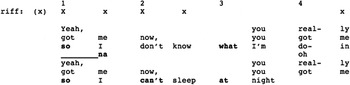
This approach is immediately apparent in the opening verse of their breakout hit, ‘You Really Got Me’ (1964). As shown in Example 4, lines three and four of the verse, Davies holds and sneers the ‘n’ of ‘doin’, finally adding a vowel, ‘-na’, on the upbeat of the next measure. A typical blues singer or a rock singer imitating a blues singer's approach would end the syllable in a more straightforward manner. Davies also shifts the typical rhythmic placement of the syllables in the ending line, ‘so I can't sleep at night’. A blues singer would normally align at least the first stressed syllable, ‘I’, with the strong beat, and approximate the placement of the other strong syllables, ‘sleep’ and ‘night’, on strong beats. Davies, instead, aligns the weak syllables ‘so’, ‘can't’ and ‘at’ with downbeats, evenly performing the syllables in strict conformity to the guitar riff.
‘You Really Got Me’, The Kinks, Kinks, 1964.

Compare ‘You Really Got Me’ with Wire's ‘Three Girl Rhumba’ from Pink Flag (1977). Like ‘You Really Got Me’, ‘Three Girl Rhumba’ is based on a nearly identical whole-step, barre-chord riff. However, unlike ‘You Really Got Me’, ‘Three Girl Rhumba’ stays almost completely on this riff, without moving to other harmonic centres in a multi-part blues-like manner. There is a turnaround, but it appears infrequently, similar to ‘Roadrunner’ or ‘No Fun’. Most importantly, singer Colin Newman extends Ray Davies' approach, eschewing any imitation of blues vocal models in favour of a pronounced English accent, and without aligning strong syllables and strong beats. As shown in Example 5, like Davies, Newman mostly divides the syllables evenly, and he places weak syllables (‘-ber’ instead of ‘num-’, ‘by’ instead of ‘two’) on strong beats.
‘Three Girl Rhumba’, Wire, Pink Flag, Harvest, 1977.

Newman's vocal approach almost completely obscures Wire from being heard as blues, despite the strong blues-based riff. If Newman had sung in a blues style – with a blues timbre and placing strong accents like ‘num-’ on or near strong beats – there would be no question about the song's blues foundation.Footnote 22
From the 1960s to the mid-1970s, proto-punks experimented with various approaches to blues resources. While bands such as the Stooges and the Velvet Underground continued to use 12-bar and other multi-part blues schemes in their compositions, they also moved away from these schemes, emphasising riffs, vamps and two-chord oscillations. They also retained key melodic features and approaches in the blues, and some began to change their vocal styles in schismatic ways. In the process, these groups created the prototype for the style that would become known as punk.
Punk style and hardcore (mid-1970s–early 1980s)
Hardcore was a negation of all traditions. The anger of punk accelerated to fit into where everyone's head was at in the early ’80s. It was a cleansing.
Barry Hennsler (Necros), quoted in American Hardcore (Blush Reference Blush2001, p. 42)From the mid-1970s to the early 1980s the punk style solidified, reaching clear definition with hardcore as represented by groups such as Black Flag, Minor Threat, Circle Jerks and Bad Brains. In creating punk, musicians drew on the blues approaches described above and combined those approaches with other stylistic features and their own innovations. But even as punk musicians created their own music, blues resources remained at the core of the style and served as renewable sources of inspiration. Punk groups searching for ‘raw power’, authenticity, associations of the primitive, and simply a ‘back to basics’ approach have continually drawn on the same approaches to the blues that the Stooges found productive.
Many punk groups have explored the standard 12-bar blues in its conventional manifestation, or with only slight variations. The Clash's straightforward version of ‘Brand New Cadillac’ on London Calling (1979), Slaughter and the Dogs' sloppier and faster takes on Chuck Berry's blues such as ‘Johnny T’ (1977) and ‘Quick Joey Small’ (1978), and X's hand-clapping ‘Year 1’ (Wild Gift, 1981) are just a few examples. But even by the late 1970s, such 12-bar-type forms sounded like overt ‘throwbacks’ to an earlier era of rock and roll – ironically, usually associated with whiteness – rather than blues and blackness.
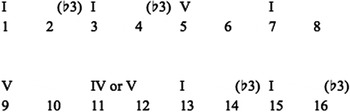
As a more powerful or ‘rawer’ alternative, punk musicians emphasised extensions of riff-based blues structures, one- or two-chord vamps, or the form of I-IV or I-II alternations with a turnaround employed at will. Freer approaches to the three-part form than the 12-bar form are also common, such as structures that use four- or two-bar melodic and harmonic blocks to satisfy movement to the I, IV and V areas without necessarily conforming to an established blues scheme, as in ‘Let's Submerge’ (X-Ray Spex). As shown in Example 6, the 16-bar form contains a stop-time on bar 12, making the IV (1st x) or V (2nd x) work like a turnaround back to the basic 1-♭ 3 (A-C) minor third tonic riff.
Form of ‘Let's Submerge’, X-Ray Spex, Germ Free Adolescents, EMI, 1978.

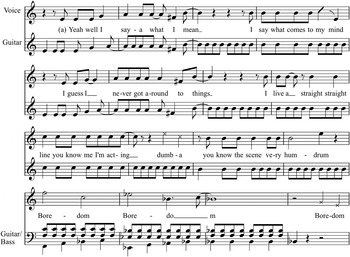
Punk composers often combined blues schemes and melodies with a loose approach to the multi-part song forms with choruses and bridges cultivated by the Ramones. In typical early punk songs such as the Sex Pistols' ‘Submission’ and the Damned's ‘Neat Neat Neat’, blues riffs anchor the verses and solo sections, but they are placed within song forms that also move to non-blues harmonies and melodies. Buzzcocks experimented early with unusual melodic movement; as shown in Example 7, a song with a bluesy riff such as ‘Boredom’ quickly moves to uncharted territory in contrasting sections. By combining a half-step shift and a V-IV-I turnaround in the new area, ‘Boredom’ captured a harmonic freedom even as it demonstrated punk conventions. The jittery gestalt of the song is supported by Devoto's unbluesy Davies-esque use of syllables, and his thick ‘mickey-mouse, fake Cockney’ accent (Savage Reference Savage1992, p. 297).
Buzzcocks, ‘Boredom’, Spiral Scratch, New Hormones, 1977.

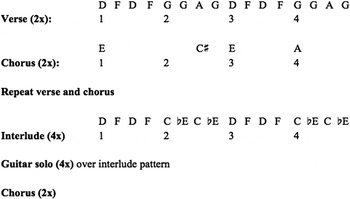
The use of monophonic textures and blues-scale melodic scaffolding, used to great effect by proto-punk groups, continued unabated in punk. Through rejection of homophony and functional harmony, and through the favouring of barre chords, riffs and vamps, punk harmony became dissociated from blues schemes. This dissociation culminated in hardcore, which thrives on the same combination of blues-based patterns and unpredictable melodic movement heard in ‘Boredom’. Paradigmatic songs such as ‘Manimal’ (Germs, 1979) ‘Nervous Breakdown’ (Black Flag, 1978) and ‘Out of Vogue’ (The Middle Class, 1978) each combine verses and main melodies built on whole-step alternations combined with unpredictable movement. Other representative songs, such as Hüsker Dü's ‘Big Sky’ (1982), take a similar approach but with I-IV (or I-V) alternations combined with whole steps. As shown in Example 8, the quintessential hardcore song ‘Out of Step (With the World)’ by Minor Threat contains verses built on minor pentatonic patterns, a whole-step alternation pattern (with a guitar solo), and a chorus with an unpredictable pattern, all in a little over one minute.Footnote 23 The verse uses the minor pentatonic scaffolding D-F-G-A and an I-IV alternation from bar to bar, while the chorus suggests the ‘turnaround concept’, especially with the A (V chord) on the last bar. The interlude/guitar solo combines minor-third patterns with whole-step alternations.
Form of ‘Out of Step (With the World)’, Minor Threat, In My Eyes, Dischord, 1981.

Changes in vocal style constituted overt elements in the creation of punk as a distinct musical style and main factors in the eventual erasure of the blues from punk discourse. As noted above, British punk singers made a clean break with blues vocal styles, following the lead of Lou Reed and Ray Davies. By the late 1970s and early 1980s, the white working-class or marked British accents and nasal sneers exploited by Johnny Rotten, Pete Shelley and Howard Devoto (Buzzcocks), Steve Ignorant (Crass) and Jimmy Pursey (Sham 69) became the standard vocal style for punk singers; many American hardcore singers, in a reversal of the earlier trend, typically modelled their vocal styles on the British singers. The dissociation of syllabic stress and strong beats in favour of a rat-a-tat equal subdivision of syllables regardless of stress became a cornerstone of hardcore punk.
Hardcore's blistering tempos, blaring volumes and generic approach to instrumentation further masked the music's blues DNA. Hardcore groups invariably limited themselves to drums, bass, one to two guitars, and vocals; they stopped using instruments found in earlier and non-hardcore groups that signalled the blues and R&B, such as the saxophone and piano or organ (Derf Scratch's turn on Fear's ‘New York's Alright if You Life Saxophones’, notwithstanding).Footnote 24 Extreme speed, volume and shouted vocals in hardcore can mask even the most straightforward blues adaptations, as with Black Flag's seminal ‘Thirsty and Miserable’ (Damaged, 1981), which underneath it all is a fairly straight-ahead 12-bar blues (with movement to ♭ iii rather than IV), complete with guitar solo and down-and-out lyrics about alcohol.
The slower tempos of the proto-punk groups were designed to enable typical rock or R&B dancing, couples dancing with alternating bodily movements and coordination of limbs and hips with beats. The tempos of hardcore songs could easily be twice as fast as a Stooges or Kinks song, and even much faster than Ramones songs. The dance matched the music: hardcore's dances, moshing and slamdancing (and even the earlier pogo), have little to do with couples dancing or the underlying beat, as dancers usually only emphasise key melodic or rhythmic accents rather than a consistent pulse. Instead, hardcore dances combine individual style and group homogeneity (heavily young, white and male) with intense physical contact (Tsitsos Reference Tsitsos1999).
In the Teen Idles' cover of ‘No Fun’ recorded in 1980 and included on the 1982 hardcore compilation Flex Your Head, the blues features that are so prominent in the Stooges' original are completely obscured. Whereas Iggy Pop sang ‘No Fun’ in a blues style, Ian MacKaye models his singing style after the working-class punk groups of the UK such as Sham 69. The medium tempo and hand-clapping rhythms of the Stooges (about 114 beats per minute) is replaced with a turbo-charged oom-pah pattern that is more than twice as fast as the original (about 256 beats per minute). The I-IV oscillation at the end, which so prominently featured Ron Asheton's blues-based improvisations in the original and Iggy Pop's Jagger-style vocalising, is retained in the Teen Idles' version, but this extremely brief section – lasting only 30 seconds – has no soloing.
The solidification of the hardcore style in the early 1980s arrived in tandem with a growing aura of punk as a mostly white scene with even overtones of racism.Footnote 25 Moves towards musical uniformity accompanied and encouraged social homogeneity. This is despite the contributions of African Americans; Bad Brains, composed of all African Americans, arguably did the most to fashion the hardcore style. Songs that ambiguously addressed whiteness and race in the United States, such as Black Flag's ‘White Minority’ and Minor Threat's ‘Guilty of Being White’ remain flashpoints for punk's thorny relationship to whiteness and race (Blush Reference Blush2001: 30–33; Traber Reference Traber2001; Bondi et al. [Reference Bondi, Dictor, MacKaye, Duncombe and Tremblay1983] 2011; Tonooka [Reference Tonooka, Duncombe and Tremblay1981] 2011). Along with self-consciously white working-class vocal timbres and other ‘whitening’ musical techniques, some punks presented offensive and racist imagery that alienated and shocked the general populace. (Again, we can look to the Stooges as one template: musically they were steeped in the blues, but Ron Asheton's dubious fondness for swastikas and jackboots also found many admirers in the later punk scene.) The swastika was already a cliché of punk fashion, with other Holocaust and WWII imagery and references a close second. Regardless of the intention behind the incorporation of such references, these gestures helped situate punk as a ‘white music’ and prepared the conditions for an eventual amnesia concerning punk's roots in the blues.
The blues became almost completely obscured as punk's backbone in hardcore. But in the same ways that proto-punk groups drew on blues resources to carve out a raw, ‘back to basics’, distinct musical path, groups seeking to stretch out from the generic confines of hardcore repeated the process, drawing on blues vocal styles, slower tempos and explicit blues-based harmonic schemes. The tension between punk's roots in African American traditions and its complex transformations by proto-punk and punk musicians over time has created an ever-deepening power of ambiguity, especially for musicians who wish to tackle thorny social issues. A brief coda describes just a few of the diverse ways that musicians concerned with punk and its offshoots have drawn on the blues since the 1990s, adding to the complex layers of meaning and affect.
Some continue to draw on blues vocal timbres and rhythmic approaches without explicitly acknowledging them as such. In some cases, such as the music of many Riot Grrrl groups in the 1990s, placing familiar punk transformations of the blues in an ostensibly new context was enough to extend the tradition. In Bikini Kill's feminist anthem ‘Rebel Girl’, singer Kathleen Hanna's guttural growls and girlish sing-songy styles juxtaposed with stereotypically testosterone-associated blues guitar ‘cock-rock’ riffs generated contradictory, often controversial responses in the male-dominated culture of punk. Reviews could be condescending even when positive: ‘The inspired amateur caterwaul of a thousand zine dreams, more convincing than the boys’ version even if it isn't as good as it ought to be or as right on as it thinks it is', wrote Robert Christgau (Reference Christgau2000).Footnote 26
Other musicians, such as Jonathan Kane and Dave Soldier, musically explain the relationship between punk and the blues in an almost pedagogical fashion. Like Iggy Pop, Kane is vocal about his music's roots in the blues, including the Swans days of the early 1980s: ‘I always thought of Swans as a kind of blues band. One of the things that helped me forge the band's rhythmic set-up was my fascination with Howlin’ Wolf. His song “Evil” got played out in my head endlessly while bashing away during a Swans song’ (Carden Reference Carden2002). Working primarily in the realm of instrumental music, Kane focuses on the possibilities of blues harmony. His 14-minute version of Mississippi Fred McDowell's ‘I Looked At the Sun’ is a minimalist, slowed-down-again summary of the choices made by punk musicians with respect to blues harmony, as he builds upon the single guitar riff at the root of McDowell's song to create a rhythmically swinging, almost trance-inducing epic, highlighting melodic blues cells.Footnote 27 The Kropotkins, Kane's group with Dave Soldier, the Velvet Underground's Maureen Tucker, Lorette Velvette, Charlie Burnham, Dog and others draw on Southern fife-and-drum repertoire in a similar way, urging listeners to make connections between blues sources and the rock styles that followed. (The use of juxtaposition is obvious from the start, naming a blues-oriented band after Kropotkin.)
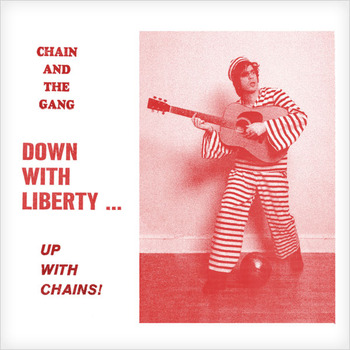
Other artists have overtly tackled punk's complex relationship to its blues roots, which, according to the aesthetic defined in this paper, is at the core of punk and, more generally, at the core of all so-called rock music. Ian Svenonious's group Chain and the Gang demonstrates an approach along these lines, uncomfortably addressing issues such as white privilege and reparations through the blues, raising the spectre of exploitation even as the group interrogates their own racially coded musical choices and decisions. The name of the group and imagery evoke mid-century blues and Folkways records (see Figure 2), but even here the blues remain obscured, operating as an ambiguous set of associations with power and social disenfranchisement (see also Matula Reference Matula2007 on another Svenonious project, The Make-Up). Harry Pussy's noise-drenched cover of Lightnin’ Hopkins’ ‘Black Ghost’ that opened this paper is an extreme example of obscuring blues resources while acknowledging punk's debt to the blues and identifying the processes of exploiting and concealing the blues as a complex part of punk's history.
Chain and the Gang, Down with Liberty … Up with Chains!, K Records, 2009.

‘A legit, pure thing’
The blues is a natural starting point for communication and collaboration between young musicians, regardless of background or training. It is the backbone of American popular music styles and their offshoots, and it is easy to begin playing. The approaches to the blues cultivated by punk musicians are the most open varieties of these already immediate musical resources. Personally, as a musician who played in garage bands, jazz groups and classical ensembles beginning in my teens, competency in the blues was the one skill that allowed me to play music with nearly anyone I met. I also realise that my background in many different styles shaped my listening habits so that I easily heard the blues roots of punk.
The discrepancy between my own hearing of punk as a direct corollary of the blues and the reality of what many listeners hear in punk became immediately apparent while teaching. At The New School in New York, I regularly direct a seminar on ‘Punk and Noise’ and, listening to the proto-punk examples outlined here by the Stooges, MC5 and Velvet Underground, many students resist connecting punk and the blues, even after reading quotes from Iggy Pop and others that assert the centrality of the blues to punk's musical vocabulary. ‘I think punk is more about Igor Stravinsky than the blues’, said one student well versed in most of punk's seminal recordings. While this statement may seem odd at first, it is the product of musical erasure and obfuscation, as well as the critical historiography which attempts to situate punk in a bounded, whitewashed European avant-garde tradition. I blindly start the semester with ‘Politicians in My Eyes’ recorded in 1975 in Detroit by the African American group Death, an obscure group that was heard as proto-punk by its later champions such as Jack White (‘ahead of punk, and ahead of their time’ [Rubin Reference Rubin2009]) – an understandable and completely natural interpretation, based on the whole-step alternations, rat-a-tat vocals and bluesy guitar solos in the recording. I ask the students to keep a journal with their responses to our listening sessions. ‘I absolutely associate punk with white people, so it came as a surprise to find that Death's members are black’, wrote one student, after I asked them to read a feature on the group in The New York Times.
After tracing the close and continuous relationship between punk and the blues, we can revisit the key issue of why punks made stylistic and discursive choices that ultimately obscured the blues’ place at the centre of punk. As noted, these choices are rooted in racialised ideas of authenticity in popular music. Punks pushed the notion of authenticity to one of purity. Black styles, especially the blues, were associated with the kinds of pure, ‘primal’, authentic expression that punk musicians sought, but notions of authenticity also exposed the contradiction of authenticity-through-imitation, and punk musicians made adjustments to find different routes.
For the mostly white musicians who identified with punk, this meant musical gestures that would not be immediately read as ‘black’. They felt compelled to use vocal styles and rhythmic approaches that were not imitations of blues artists of any race, even as they kept the harmonic and melodic elements of the blues that drew them to the music in the first place. Punk transformations of the blues managed to create a complex, powerful affect that emerged from the apparent paradox of combining styles with opposing ‘black’ and ‘white’ associations. Once constructed, punk musicians could take an ironic or tongue-in-cheek stance towards this paradox, countering the obsession with authenticity with an acknowledgment of extreme artifice, down to punk's de rigueur pseudonyms. Perhaps this comes from a realisation that the logical extreme of this vision, a ‘white’ authenticity without irony, is a ‘be careful what you wish for’ place that few punk musicians would want to go to or acknowledge, yet it certainly happens, and the limits of race and authenticity explored in punk have been a consistent flashpoint.
To return to the prototypical example of Lou Reed, he maintains that ‘under the surface’, all of his songs are in the R&B tradition in which he got his start as a songwriter. Yet he also claims that the Velvet Underground did everything they could to avoid recognisable blues licks:
We used to have a thing in the Velvet Underground because, you know we knew all this [R&B], was that, it was like a ten dollar fine if you play a blues lick. It was like not allowed. Because it was not legit. They had all these white guys out there playing blues; we didn't want anything to do with that. We wanted to create our own, own legit, pure thing. (Velvet Underground 2009)
How seriously can one take such words, when blues resources so obviously provide the basis for most of the Velvet Underground's music? Yet his words speak to an overriding concern that he (and those he inspired) had for doing something that would not be a ‘pale imitation’ of the white rock bands such as the Rolling Stones. African American musicians and journalists invested in clearly defining black music as rooted in the blues and ‘soul’, such as Amiri Baraka and James Brown, also exerted pressure to break or at least alter the cycle of white musicians simply stealing black music for profit (Baraka Reference Baraka1967, p. 205).
The dilemma facing Lou Reed in the 1960s has not disappeared. In a sense, it has grown in importance for contemporary musicians, who must struggle with the legacy of punk's paradoxes and a reflexivity born of critical theory and punk historiography. Bill Orcutt's reflections on his days playing in Harry Pussy echoes Lou Reed:
I'm just a guy who is trying to find his own way of playing the blues … I always thought [Harry Pussy] were playing blues music, in some sense. I don't know that I can really play anything other than the blues. […] I just feel like if you're gonna play the blues you have to somehow address the fact that you're not Robert Johnson. […] I can't justify it ultimately. My connection to the blues comes from buying the records. I saw Muddy Waters play once. I have no authenticity in connection to the blues. (Keenan Reference Keenan2011)Footnote 28
Avoiding blues-based timbres and transforming musical styles associated with African Americans and blackness may have seemed a purer, more authentic, or more legitimate approach than imitation for Lou Reed and those in his wake – perhaps even noble, as Bill Orcutt suggested when he titled his recent idiosyncratic yet blues-drenched album New Ways to Pay Old Debts. Orcutt's music thrives on and amplifies the racial tension that helped generate punk. However, the irony is that the very problem of authenticity, especially as it relates to the blues, is largely an invention of white musicians and writers in the first place; the need to ‘address the fact that you're not Robert Johnson’ is dependent on the myth of Robert Johnson and the idea of the pure, authentic Delta in which, on the whole, white people were originally invested.
Punk is an extreme manifestation of the rock project, which is to say that it depends on an association of blackness with particular kinds of blues resources, and then the processes of white appropriation, transformation and obfuscation of those resources. Its aesthetics as a musical style are completely dependent on social categories and hierarchies of race, merged with class, gender and sexuality. The imitation, parody, erasure and even reclamation and interrogation found in punk rely on an underlying logic that maps whiteness and blackness onto specific musical gestures, played out in an unequal society. Punk emerged at a time of extreme social and political upheaval, with major revisions of conceptions of race and class, and it drew its power from translations of categorical uncertainty. Tension between blues resources and stylistic choices that mask those resources, at once reinforcing ideas of ‘white’ and ‘black’ and unsettling these categories, provide the very affect at the core of punk.
Acknowledgements
The author owes special thanks to Jonathan Kane, Wayne Kramer, Bill Orcutt and Dave Soldier for their insights and generosity with their time in interviews. Anthony Jillions was an invaluable research assistant. Tamar Barzel, Scott Currie, Farzaneh Hemmasi, Chris Johnson, Nat Rabb, Ivan Raykoff, Alex Rodriguez, Charles Sharp, Chris Stover and Sarah Vezina offered helpful remarks on the initial presentation of the ideas at the Annual Meeting of the Society for Ethnomusicology in 2010, or on drafts of this paper. Allan Moore, Barbara Lebrun and Popular Music's anonymous reviewers provided useful comments during the preparation of this paper. Thanks also to the author's students in the ‘Punk and Noise’ seminars, Margaret Kramer and Dan Burt.
Copyright permissions
‘How Many More Years’ – words and music by Chester Burnett. Copyright © 1960 (Renewed) by Arc Music Corporation (BMI). Worldwide rights owned by Arc/Conrad Music LLC (Administered by BMG Rights Managements (US) LLC). International Copyright secured. All rights reserved. Reprinted by permission of Hal Leonard Corporation.
‘No Fun’, words and music by Dave Alexander, Scott Asheton, Ronald Asheton and Iggy Pop (James Osterberg). Copyright © 1969 (Renewed) Bug Music, Warner-Tamerlane Publishing Corp. & Stooge Staffel Music. All rights for Bug Music administered by Bug Music, Inc., a BMG Chrysalis Company. All rights for Warner-Tamerlane Publishing Corp. & Stooge Staffel Music administered by Warner-Tamerlane Publishing Corp. (BMI). All rights reserved. Used by permission. Reprinted by permission of Hal Leonard Corporation and Alfred Publishing.
‘T.V. Eye’, words and music by Dave Alexander, Scott Asheton, Ronald Asheton and Iggy Pop (James Osterberg). Copyright © 1970 (Renewed) Bug Music, Warner-Tamerlane Publishing Corp. & Stooge Staffel Music. All rights for Bug Music administered by Bug Music, Inc., a BMG Chrysalis Company. All rights for Warner-Tamerlane Publishing Corp. & Stooge Staffel Music administered by Warner-Tamerlane Publishing Corp. (BMI). All rights reserved. Used by permission. Reprinted by permission of Hal Leonard Corporation and Alfred Publishing.
‘Boredom’, written by Howard Devoto and Peter Shelley. Copyright © 1977 Mute Song Limited/Complete Music. International copyright secured. All rights reserved. Used by permission. Reprinted by permission of Embassy Music Corporation (Music Sales).