The artist
Pavel Nikolayevich Mikhailov was born at St Petersburg in 1786. Demonstrating early talent, in 1795 he was enrolled in the charity school attached to the Academy of Fine Arts and in 1806 he graduated with distinction. In the first phase of his professional career he specialised in portraits and miniatures. In 1812, Mikhailov enlisted in the army and served with honour against the Napoleonic invasion. In 1815 he was appointed an Academician and in 1819 he was recommended for the Bellingshausen expedition by the president of the Academy, Aleksei Nikolayevich Olyenin (Suris Reference Suris1962).
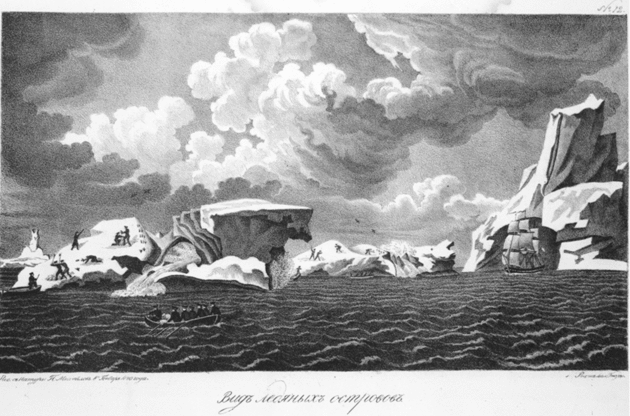
When the expedition returned to Russia in 1821 Mikhailov's portfolio was much admired by visitors to HIMS Vostok, including Tsar Alexander I and Tsarina Elisabeth Alexeyevna (Anon. 1821). He then produced about fifteen large watercolours of the voyage. When Bellingshausen's book, Two seasons of exploration in the Southern Ice Ocean and a voyage around the world, appeared in 1831 the Atlas volume included 45 lithographs prepared from Mikhailov's sketches and watercolours by Ivan Fridrits, Yegor Geitman and Pietro Gonzago (Fig. 1) (Bellingshausen Reference Bellingshausen and Golenishchev-Kutuzov1831; Suris Reference Suris1962).
‘A view of Ice Islands’ by P.N. Mikhailov, 20 January 1820; Plate 12 in the Bellingshausen Atlas, Reference Bellingshausen and Golenishchev-Kutuzov1831. Lithographer P. Gonzago. With typical licence, Mikhailov shows boat parties simultaneously harvesting ice for water, collecting penguins, and shooting birds for dissection or the pot. Meanwhile Mirnyi has too much sail set for a ship with boats in the water, and a bone in her teeth underlines the speed she ought not to be making.

In August 1826 Mikhailov left Kronstadt for a second time as an expedition artist, this time on board HIMS Moller, under captain and expedition commander Lieutenant Mikhail Nikolayevich Stanyukovich. Moller and her sister ship HIMS Senyavin, under the command of Lieutenant Fyodor Petrovich Lütke, called at Copenhagen, Portsmouth, Tenerife and Rio before rounding Cape Horn to enter the Pacific where they spent about two years charting and exploring the northern part of that ocean, from the Hawaiian Islands in the south to Kamchatka, Alaska (Russian America) and the Aleutians in the north. Moller returned to Kronstadt in August 1829 (Anon. undated).
Mikhailov's final years were unhappy ones. He fell into poverty, supported only by a meagre state pension and the generosity of his more successful friend Aleksandr Grigor'evich Varnyek. He died of tuberculosis in September 1840.
The visit
During a research trip to St Petersburg in April 2011 the author was granted the rare privilege of viewing the collection of Mikhailov's expedition pictures held by the Russian Museum (RM). The visit lasted an hour and a quarter, during which about 300 pictures were seen. Subjects not immediately recognised were identified by museum staff from a card index or in some cases from titles pencilled on by the artist. The author was also shown the ‘Attestat’, a formal certificate of Mikhailov's competence and suitability that was signed by Bellingshausen in August 1821 (R 9750). (All catalogue numbers in this note refer to items held at the RM.)
There was no opportunity, in the circumstances, to inspect anything thoroughly or to ask for detailed information. There was barely time to jot down (some of the) catalogue numbers. What follows, therefore, is largely based on memory. Another important caveat is that anything said about an image, for example that the original picture of Macquarie Island contains no sloops on the horizon, may not be true of another version of the same image, if such a one exists in a second, smaller collection, the album of 47 of Mikhailov's expedition pictures held by the State Historical Museum (SHM) in Moscow, which the author has not seen. The relationship between the two collections appears to be that the album at the SHM comprises (most of) the finished work that Mikhailov submitted for Bellingshausen's book in the 1820s, and the larger collection at the RM comprises everything that the artist still had about him when he died, and which his friend Varnyek gathered up and deposited with the Academy of Arts (Suris Reference Suris1962: 70). Lastly neither Mikhailov's methods, nor his media, nor the aesthetic aspects of his work will be discussed in this note.
The collection
The collection of Mikhailov's work held by the RM had been mislaid for many years when it was re-discovered in the 1950s by the art historian Boris Davydovich Suris.
The subjects of the pictures fall into three main groups: coastal views, whether populated or unpopulated (and including ice); natural history, which for the artist and his sponsors included not only animals, birds and flowers but also portraits of local people and depictions of their mores; and thirdly expedition narrative. The author was mainly interested in the third and smallest group, which in some cases overlaps with one of the others. Both expeditions yielded images of all three types, but in a few cases the expedition cannot be identified. A rough estimate is that the collection contains slightly more images from the second, longer expedition than from the first. However there are even fewer narrative images from the second expedition than from the first.
Most of the pictures are small watercolour or pencil sketches done on card, but the Bellingshausen group includes some more highly finished pieces that may have been worked up after the expedition. Some of the coastal views, in particular, were created on long strips of card that have been folded. In some cases the reverse side of the card was also used.
The pictures are lightly fastened with strips of elastic to about seventy newish A1 boards. The boards are stored flat on top of one another, with sheets of protective film between, and separated into groups by title boards created early in the history of the collection, perhaps by Mikhailov or by Varnyek. The stack of mounting boards is kept inside a large nineteenth century binder, which suggests that the current boards are replacements for earlier ones of a similar size. There is no chronological order or separation between the two voyages. A catalogue number, from R 29001 to R 29308, is written on the mounting board alongside each picture.
One or two of the mounting spaces were empty. Some of the seven pieces included in the Museum's 2009 exhibition ‘Around the world with an easel’ (below) appeared to have been returned to the binder, but others may still be in their exhibition frames or mounts.
The Atlas lithographs
The Royal Geographical Society has a copy of the Atlas and some of the lithographs were perhaps first shown outside Russia in Mill's Siege of the South Pole (Reference Mill1905). Others followed in the first edition of the Hydrographic Department's Antarctic Pilot (1930), and the largest and best non-Russian showing was achieved in Debenham's translation of Two seasons (Bellingshausen Reference Bellingshausen and Debenham1945), which has recently been republished (Bellingshausen Reference Bellingshausen and Debenham2010).
The lithographers may not always have done justice to Mikhailov's originals, but to judge only from the RM collection the relationship was complex. At that date the printer could not have reproduced the vivid colours of the portraits and nature studies. On the other hand the lithographers may have been called on to complete unfinished pieces. The lithographer of ‘Breakfast with the king of Otahiti’ (Bellingshausen Reference Bellingshausen and Debenham1945: plate 27), for example, may have enhanced the minor figures and (much admired) background vegetation of the original (Laks Reference Laks2009: 208). The picture of Bellingshausen and Lazarev leading a shore party, and encountering a Maori haka, at Queen Charlotte Sound, New Zealand, exists only as an unfinished pencil sketch at the RM (R 29282), as compared with the memorable lithograph (Bellingshausen Reference Bellingshausen and Debenham1945: plate 20). But it must be emphasised that another, more finished version may exist in the album at the SHM.
The narrative pictures are not simply factual. For example a final view of Sydney at the SHM, which is related to R 29276 and R 29277 at the RM and was rendered as Plate 21 in the Atlas, appears to show a third Russian ship in the harbour with HIMS Vostok and Mirnyi, which was never the case. They are moored further out into the fairway towards Sydney Cove than perhaps they should be, and a ship's boat is towing empty barrels in the wrong direction. Likewise a modest watercolour of Macquarie Island (R 29267) shows a deserted shore instead of the sealing shambles that was actually in progress. The subsequent lithograph accentuated the romantic wilderness by adding more rocks, seals and penguins and placing the distant sloops on the horizon (Bellingshausen Reference Bellingshausen and Debenham1945: plate 33). Mikhailov painted ‘Chief’ Boongaree's portrait (R 29210) without the condescending chest-plate bestowed on him by English colonists, and a separate sketch was taken of the trinket. The two images were then merged in the lithograph, if not earlier (Bellingshausen Reference Bellingshausen and Debenham1945: plate 15). And so on.
Other Bellingshausen pictures
Inevitably many interesting pictures (including one of the aurora australis which may be at the SHM) did not appear in the Atlas. Among them are panoramas of naval shipping at Rio de Janeiro and dramatic views of the coasts of South Georgia (R 29023) and of the South Sandwich Islands, including several of the Traversay group (R 29034/38/42/43/43 verso). Australians would be interested in the views of Mistaken Cape, on Maria Island in Tasmania (R 29032), and of North Head at the entrance to Sydney Harbour. There is also a striking watercolour of a lone koori, possibly Cammeraigal, woman sitting at the water's edge behind a dugout canoe lying on its side.
Some important pictures by Mikhailov, of which the originals were not seen by the author, are held separately by the RM's Drawings Department. One is a striking portrait-sketch of Bellingshausen, dated to the time of the expedition (R 29063 verso). Another is a self-portrait of the artist dated to the 1820s (R 1440). There may be other Bellingshausen pieces, including ice-scapes, in the Department.
Two interesting pictures are not attributed to a specific expedition. One is a small watercolour of two sloops sailing towards what looks like a sundog or similar phenomenon (R 29299). The other is a pencil sketch entitled simply ‘On deck’, in which the eye is drawn along the line of cannon lashed up to the starboard rail (R 29291). The sloops of Mikhailov's two expeditions were so similar that identification is probably impossible. All that can be said in favour of Vostok's claim to this tantalising image is that Mikhailov was far more prone to drawing such narrative pieces on his first voyage than on his second.
The second voyage
The large number of pictures which Mikhailov produced on the Moller expedition include dramatic views of the volcanoes of Kamchatka and the rugged shores of Alaska, and many portraits of indigenous people. Stanyukovich did not produce a book. Lütke did, but he seems to have drawn the charts and coastal profiles for his Atlas section himself (Litke Reference Litke1835). He makes no reference to Mikhailov, who was not on his sloop. Versions of some of the ethnographical pictures, in particular, have occasionally appeared (Korsun Reference Korsun2010), but on the whole Mikhailov's work from this expedition, while no less competent, is less well known than his record of the Bellingshausen voyage.
Publication history
The Atlas volume of Bellingshausen's book (Reference Bellingshausen and Golenishchev-Kutuzov1831) is extremely rare and unlike the text volumes it has never been republished, although it should be possible to do so with modern digital techniques. Next, Mikhailov is said to have published a collection of his Bellingshausen pictures just before he died. Few if any scholars have seen or referred to this work and it is not listed at any major library inside or outside Russia. Pending further enquiries its existence must be deemed at best putative (Mikhailov Reference Mikhailov1840; citation Korsun Reference Korsun2010). One reason to believe that Mikhailov may at least have prepared such a book, however, is the fact that some pieces for the Atlas are not now in the album at the State Historical Museum where they should be (Barratt Reference Barratt1992: plate 7), and some pieces that were with Mikhailov when he died, and which therefore ended up at the RM, such as R 29276 and R 29277, look like studio work prepared for the Atlas or another publication. In other words towards the end of his life Mikhailov appears to have been drawing some of his best pieces together, possibly with a view to separate publication.
As early as 1919 the eminent geographer Yulii Mikhailovich Shokal'skii urged that some of Mikhailov's original pictures, rather than the lithographs, should be published (Suris Reference Suris1962: 70). He was probably referring, at that point, only to the album at the SHM. This began to happen in 1949, when instead of Atlas plates the second edition of Bellingshausen's book included black-and-white reproductions of 40 pictures from the SHM album (Bellingshausen Reference Bellingshausen and Shvedye1949). For the ‘Bellingshausen boom’ of the 1950s and 1960s it is sometimes hard to tell whether images were re-copied from the 1949 photographs or from the Atlas lithographs, by then in most copies deteriorating from age and neglect. Apart from the picture of an aurora mentioned above, Suris (Reference Suris1962) was the first to show pieces that had not been included in the Atlas lithographs, but his article went unnoticed by historians for some time.
In the 1980s several of Mikhailov's pictures were shown in (McCormick and others Reference McCormick, Irving, Imashev, Nelson and Bulland1987). At about the same time the Canadian historian Glynn Barratt was able to study both collections of Mikhailov's work and to publish some of the first black-and-white versions of pieces in the large RM folder. They included two views of Port Jackson, the second showing an interim phase of composition (R 29276/274 and R 29277/275) and two studies of members of the Cammeraigal tribe (R 29206/204 and R 29203/201) (Barratt Reference Barratt1988: plates 14, 15, 22, 23). He also showed the self-portrait and the portrait of Bellingshausen referred to above (Barratt Reference Barratt1988: plates 20, 21). However although he attributed them also to the Russian Museum he uncharacteristically failed to provide the catalogue numbers, which suggests that in those two cases all he actually had access to were the versions provided in (Suris Reference Suris1962). In a later work Barratt reproduced an RM folio showing tattooed heads and other items (R 29070) (Barratt Reference Barratt1992: plate 4). Some illustrations in the same book reverted to the Atlas lithographs, and others, rather confusingly, showed an original work by Mikhailov but cited only its subsequent lithograph in the Atlas, in one case inaccurately (Barratt Reference Barratt1992: plate 8).
In recent years the SHM has allowed at least one of Mikhailov's pictures to be reproduced in full colour and high definition, probably the first to be released in that form. The same book includes other good black-and-white reproductions of Mikhailov's work, without precise attributions (Govor and Massov Reference Govor and Massov2007). Then in 2009 Palace Editions, the publishing arm of the RM, issued a lavish catalogue for their exhibition ‘Around the world with an easel’, in which seven pictures by Mikhailov, five of them from the Bellingshausen expedition, were beautifully reproduced in colour (Laks Reference Laks2009: 8, 206–209).
To complete this survey, the National Library of Australia holds a portfolio of photographs of 27 works by Mikhailov in the RM, from which photocopies can be ordered for reference purposes. Other copies are held at the Scott Polar Research Institute.
The RM is considering publication of a Mikhailov album, a potentially useful outcome although, for the history of exploration, the ideal would be a collaboration between the RM and the SHM. Perhaps Shokal'skii's wish may soon be fully realised in colour and high definition.
Acknowledgements
The author expresses his sincere gratitude to Grigorii Naumovich Goldovskii, head of the department of eighteenth and nineteenth century paintings at the Russian Museum, for his kind invitation to view their collection of Mikhailov's work and for further assistance. He also wishes to thank Yevgeniya Petrova, the museum's deputy director for research, and her curatorial staff for all their help during his visit, Elena Govor for a copy of Govor and Massov (Reference Govor and Massov2007), and his friend Alexander Chekulayev for his unstinting support.