




No CrossRef data available.
Article contents
- Extract
- The Liberal Medium? Dean and the Political Attitudes of Web Users
- The Earliest Primary: “Big Mo'” Meets the Internet
- The Internet and the Infrastructure of Politics
- Internet Fund-Raising
- Networks of Political Recruitment and the 'Net
- Dean without the Internet: Considering the Counterfactual
- Conclusion
- References
The Real Lessons of Howard Dean: Reflections on the First Digital Campaign
Published online by Cambridge University Press: 09 March 2005
Article contents
- Extract
- The Liberal Medium? Dean and the Political Attitudes of Web Users
- The Earliest Primary: “Big Mo'” Meets the Internet
- The Internet and the Infrastructure of Politics
- Internet Fund-Raising
- Networks of Political Recruitment and the 'Net
- Dean without the Internet: Considering the Counterfactual
- Conclusion
- References
Extract
Howard Dean's presidential bid was notable for many things, including the mixed reaction it drew from political scientists. Many scholars found Dean's ultimate failure predictable. Longstanding political science wisdom suggests several explanations for Dean's defeat: the central issue of electability, which seemed to weigh heavily against his campaign; the fact that primary voters are more moderate than party activists; the well-documented difficulty of regaining lost momentum. Less systematic factors—such as numerous verbal gaffes and one infamous scream—surely contributed as well.Matthew Hindman is an assistant professor of political science at Arizona State University (matthew.hindman@asu.edu). This research was supported by the National Center for Digital Government, with funding from the National Science Foundation under grant no. 0131923. The author thanks Jennifer Hochschild, Larry Bartels, Chris Karpowitz, Gabriel Lenz, David Lazer, Alan Abramowitz, James McCann, and the three anonymous reviewers for their contributions.
Information
- Type
- PERSPECTIVES
- Information
- Copyright
- © 2005 American Political Science Association
Howard Dean's presidential bid was notable for many things, including the mixed reaction it drew from political scientists. Many scholars found Dean's ultimate failure predictable. Longstanding political science wisdom suggests several explanations for Dean's defeat: the central issue of electability, which seemed to weigh heavily against his campaign; the fact that primary voters are more moderate than party activists; the well-documented difficulty of regaining lost momentum. Less systematic factors—such as numerous verbal gaffes and one infamous scream—surely contributed as well.
Still, the Dean campaign exposes a curious gap in political science knowledge. If Dean's failure now seems unsurprising, how are scholars to explain his brief but remarkable success? Though he entered the race a relative unknown, he shattered previous fund-raising records, won numerous key endorsements, from Al Gore's to the AFL-CIO's, and had a strong plurality in the polls in the months leading up to the Iowa caucuses.
To understand Dean's early and unexpected rise as the Democratic front-runner, we should begin by considering one obvious difference between 2004 and previous primary campaigns: the role of the Internet. Dean's use of the Web to organize, invigorate, and finance his campaign has been much celebrated, but it remains too little understood.
Here, I attempt to reconcile Dean's experience with standard political science views on primary campaigns. Two themes emerge. First, previous scholarship on presidential primaries, which emphasizes the importance of momentum, needs to be revised in light of the Web's political demographics. Although liberals and conservatives are online in roughly equal numbers, survey data suggest that liberals visit political Web sites much more than do moderates or conservatives. This likely helped Dean by making the online campaign, in essence, an early primary among a very liberal constituency.
Second, the Dean campaign marks an ongoing shift in how candidates use the Web. In the business world, the Internet's real successes have been not in retail, but at the backend: thousands of businesses have quietly used the Internet to streamline organizational logistics. Dean's example suggests that the Web may alter the infrastructure of politics in a similar fashion. Dean used the Internet to revamp backend campaign functions like fund-raising and volunteer recruitment—critical tasks that did not involve mass appeals to voters.
Ultimately, the Dean campaign raises questions that can not be answered with available data. In ways both large and small, Dean's example does not fit with what political scientists think they know about primary dynamics, political recruitment, patterns of political giving, elite strategy, and even the so-called digital divide. Accounting for these anomalies should be an important matter for future research.
The Liberal Medium? Dean and the Political Attitudes of Web Users
In covering the Dean campaign, the popular press consistently emphasized the novelty of its tactics. Howard Dean did something that was smart, brave, and unprecedented—something only a candidate with little to lose would do: he created a genuinely interactive campaign Web site. Previous online campaigns—including those of John McCain and Jesse Ventura, the most celebrated antecedents to Dean's efforts—kept rigid control over their Web presence. Encouraging supporters to generate their own content, join online discussions, create their own Dean sites, and organize their own events necessarily meant that the campaign must give up some control over the messages it wanted to project. In considering what Dean means for the future of digital politics, we should first acknowledge that many campaigns will not follow this lead. Strong candidates have little incentive to take such chances.

Still, Dean's digital innovations are inadequate to explain his successes. To understand what happened during the course of the 2004 primaries, we must look more closely at those who use the Web for political purposes and confront the puzzlingly liberal character of online politics.
From the beginning of the Internet revolution, it was clear that patterns of Web access and usage closely tracked existing social cleavages. The rich and educated used the Internet more than those with less money and education; women lagged behind men; Hispanics and African Americans trailed their white and Asian counterparts. Though most of these usage gaps have narrowed in recent years—particularly gender differences—large inequalities remain. Indeed, as scholars have looked beyond mere “access” to the Internet and focused on essential user skills, these disparities appear to be as profound as ever.
For political scientists, the demographics of Web users are consistent with a familiar and disturbing pattern. In Voice and Equality, for example, Sidney Verba, Kay Lehman Schlozman, and Henry E. Brady argue that differences in political resources result in a systematic distortion in the perceived preferences of the public, which on the whole favors traditionally privileged groups and those with conservative views.1
If the Internet is itself an important political resource—a powerful tool for political organizing, fund-raising, and information gathering—placing the new medium disproportionately in the hands of advantaged groups might be expected to perpetuate or even exacerbate a conservative bias in American politics.Yet survey data seem to tell a different story. To illustrate this, I turn to the 2000 and 2002 General Social Survey (GSS), the first large-scale surveys to combine measures of Web usage with metrics of users' political and social views. The GSS's political orientation questions show no difference between the political leanings of users and nonusers. Yet although the liberal to conservative ratio among Web users mirrors that of the general population, the two groups have starkly different usage patterns.
Liberals dominate the audience for politics online. Across a wide range of politically relevant activities, from gathering news online to visiting government Web sites, liberals outpace conservatives by a wide margin. As seen in tables 1 and 2, the results are particularly dramatic for visits to political Web sites, where more than twice as many liberals as conservatives fall into the highest category of Web use. Among self-identified Democrats, frequent visitors to political Web sites are dramatically more liberal than the party as a whole; they are more highly educated than the general public; and while voters as a group skew older, those who visit political Web sites are disproportionately young.
Table 1: Visits to political Web sites

Table 2: Who visits political Web sites?

There is much that we still do not know about political Web use, and many important details remain to be filled in. In the Dean case, though, the importance of these skewed political demographics is clear. In the early campaign, Dean positioned himself to the left of most competitors, declaring that he represented “the Democratic wing of the Democratic Party” and offering forceful opposition to the Iraq war while other competitors adopted more nuanced positions.2
Nagourney 2003, A11.
These findings force us to consider whether Dean's experience might be part of a larger trend in online activism that benefits liberal views. Should we expect this liberal-conservative gap to be temporary or an enduring feature of the online political landscape? At this point, we do not know. There is some reason to expect that conservatives will catch up. The Internet is a young medium, and effective methods of online organizing are still largely experimental. As user sophistication continues to improve, as conservative candidates invest resources in exploiting the Web, and as conservative partisans themselves see online participation as a key part of political activism, online politics may have less of a liberal cast.
Ideological differentials in usage may not fade quickly, though. 2004 is not 1994; the majority of the American public is online and has been for several years. There is no liberal-conservative gap in access more generally, or in time spent online. Moreover, many other mediums of political outreach have had a persistent partisan character. For example, direct mail solicitation has long been a more effective tool for Republicans than Democrats.
The Dean campaign highlights the importance of the liberal-conservative gap in political Web usage, but it does little to show us how this disparity will evolve as online politics matures. Measuring and understanding the ideological divide in political Web usage will be critical to nearly every aspect of online politics.
The Earliest Primary: “Big Mo'” Meets the Internet
Liberal overrepresentation online dovetails with a larger point about the dynamics of the primary process. The concept of momentum enjoys a central place in the scholarship on presidential primaries. The snowball effects of early success (or failure) are substantial: candidates who win the first primaries receive more favorable press coverage, more public interest in the campaign, more volunteers, and more money. The order of these contests is thus critically important. For example, as Larry Bartels shows, it was “pure, unadulterated luck” that states most favorable to Gary Hart—overwhelmingly white states without major urban populations—were first on the 1984 electoral calendar. The Iowa and New Hampshire results greatly magnified the seriousness of Hart's challenge to Walter Mondale.3
Bartels 1988, especially chapter 10; quotation on p. 260.
Dean's candidacy benefited enormously from a digital version of the Gary Hart effect. In June 2003 the leading liberal activist site MoveOn.org sponsored what it termed an “online primary.” Dean won, receiving a 44 percent plurality.4
The symbolism of the win was appropriate: in a larger sense, the entire online campaign came to serve as a sort of virtual primary. Dean's demonstrable successes on the Web generated the sort of coverage, enthusiasm, and compounded success that candidates usually enjoy only after winning an actual electoral contest.Dean's Internet campaign generated a spiral of positive press coverage. A Lexis-Nexis search finds 1,325 stories in major papers that mentioned Dean's Internet effort during the six months preceding the New Hampshire primary—a priceless publicity boon for a candidate who began as a dark horse. Both the scale of Dean's online organization and his unprecedented success at raising large amounts of money in small donations qualified as newsworthy. Dean's campaign provided other tangible metrics of success: the long list of supportive Weblogs, the number of hits on its home page, the number of Dean house parties, and the number of citizens willing to sign up as supporters on the Dean Web site. Overall, the breadth of Dean's online organization was taken as evidence that Dean had broad grassroots support.
Dean was not the only beneficiary of online momentum. Gen. Wesley Clark, whose late entry shook up the primary contest, witnessed a similar effect. Though Clark's online efforts were dwarfed by Dean's, they nonetheless outpaced the rest of the field. Clark raised $17 million, much of it online—far less than Dean's $52 million, but raised over a shorter time span.5
Though Clark did not have the extensive network of Webloggers that Dean relied on, he did make good use of both the campaign Web site and other online tools. As with Dean, the press counted these online victories as pro-Clark momentum, citing them as evidence of grassroots support and the campaign's financial robustness. The 2004 Internet campaign thus became in an important sense the earliest primary. But if the GSS data are any indication, those who visit political Web sites are a constituency like no other.Dean's example shows that it is possible to translate online interest into tangible political resources—money, positive press coverage, and volunteers. It also shows that the Web can grant a partly intangible asset: early momentum. Even if the press proves more skeptical of the next online “groundswell,” the financial and organizational advantages to be won online may offer future campaigns a critical early boost.
The Internet and the Infrastructure of Politics
Overall, then, the case of Howard Dean suggests that political behavior in the online world follows unexpected fault lines. There is a second lesson to be drawn from the Dean campaign: the Internet may alter key parts of the nation's political infrastructure. Dean's campaign suggests that the Web's evolution in the business world is being repeated in the political realm. As I note above, the real success of the Web for commerce has been at the backend. For every Amazon.com or eBay, hundreds of businesses have used the Internet to restructure their supply chains. Business-to-business, not business-to-consumer, is where the real transformation has taken place.
Now a similar shift may be taking place with online politics. Initially, most candidates tailored their Web sites to reach swing voters, independents, and the undecided—the elusive median voter. This strategy produced dismal results. Survey data show that most who visit political Web sites are not swing voters, but rather people with strong party affiliations and strong preexisting views on politics.6
Bimber and Davis 2003, chapter 4.
Bimber and Davis are right that online campaigning thus far consists of “preaching to the converted.” Yet increasingly, Dean and other candidates have turned this fact to their advantage. Instead of online appeals to the median voter, a new breed of campaign Web site seeks to engage and motivate those most likely to become core supporters. If Web sites are not a way to reach the masses, the Dean campaign and others have shown that they can be a powerful tool for fund-raising and energizing the faithful. In short, Dean demonstrates that the Internet can affect what might be termed the supply chain of politics.
Backend logistics are crucial to candidate strategy—and the locus of many types of political activity. The gap between prevailing theory and Dean's experience is particularly significant for fund-raising and recruitment of volunteers. Focusing our attention on these two areas, we conclude by trying to answer the question: What would have happened to the Dean campaign without the Internet?
Internet Fund-Raising
It is difficult to overstate the importance of Dean's Internet fund-raising. For candidates in presidential primaries, the ability to raise funds is a prerequisite to being taken seriously, and no previous candidate of either party had successfully translated two-digit donations into real money. By the end of January 2004, as the primaries commenced, Dean had raised more than $41 million, much of it online; 318,884 citizens had contributed to the Dean campaign. Overall, 61 percent of Dean's financial resources came from those giving $200 or less. Only 2,851 donors—less than 1 percent of the total—gave $2,000, the maximum under federal law. These large givers provided 11 percent of Dean's total funds.7
The distribution of giving for the Dean campaign was almost exactly the reverse of his rivals. (To keep Dean's relative success in perspective, note that Bush's reelection campaign dwarfed Dean's money-raising efforts, raising a total of $130.8 million over the 2003 calendar year alone.) By the end of January 2004, 42,649 of Bush's donors had given the federal maximum of $2,000. These large gifts accounted for 68 percent of Bush's total. Donations of less than $200 contributed less than 16 percent of Bush's total funding. And though Democratic candidates like John Kerry and John Edwards raised far less than Bush, their campaigns similarly relied on large donors to get them through the early primaries. At the end of January, those who gave the $2,000 maximum were responsible for 58 percent of Kerry's campaign war chest, and 73 percent of Edward's financial resources.8
The Dean campaign departs from academic expectations for campaign finance in several respects. First, because of the influx of small donors, the less-than-affluent contributed a greater share of Dean's funding than that of any major presidential campaign in recent decades. Second, smaller donations send less precise messages to candidates. Verba, Schlozman, and Brady declare that the power of financial contributions is the fact that they are both “loud and clear”—money is key to electoral success and communicates a great deal about the giver's preferred policies.9
But the sheer number of citizens who donated to the Dean campaign means that the messages were rather soft and indistinct. A hand-delivered $2,000 check carries with it a great deal more information than 40 individual $50 credit card contributions submitted via the campaign Web site. Third, most Internet donations to Dean's campaign were spontaneous. Traditionally, donating money to a political campaign is the type of political participation least likely to be self-generated, and personal social contacts play an important role. Most campaign contributions are solicited, and people that the donor already knows are generally the ones who ask for donations.10 By contrast, Dean's funding came mostly from individuals who sought out the campaign on their own.The overall implications are clear. If Dean's success is repeated on a large scale, political scientists will have to reexamine much of what they think they know about the relationship between money and politics: the demographics and political views of contributors, how donations are solicited, the clarity with which money communicates preferred policies, and the extent of the rightward preference distortion that political fund-raising induces in American politics.
Networks of Political Recruitment and the 'Net
Political scientists have often noted that those who participate in politics are those asked to do so. The literature on political participation emphasizes the role that social networks and social pressure play in recruitment. Yet Dean's experience in this regard fails to square with our expectations, for if social networks often serve as gatekeepers in the political process, record numbers of Dean supporters seem to have jumped the fence.
Dean's focus on “meetups”—Web-organized face-to-face meetings of citizens interested in the campaign—seems particularly consequential. Meetups proved to be an elegantly simple organization strategy. At either the official Dean site or at the Meetup.com homepage, citizens could offer their e-mail address and zipcode, and immediately receive e-mail reminders about pro-Dean meetings in their vicinity. The process of signing up for a local Dean meetup could take as little as 30 seconds.
By the time Dean dropped out of the Democratic race, 640,937 people had registered as Dean supporters through the candidate Web site; 188,941 of those had signed up to receive notices about meetings in their area.11
Data on number of total supporters from the Dean Web site (http://www.deanforamerica.com). Data on the number of Dean supporters registered for meetups from Meetup.com.
Personal communication, Jesse Gordon, cofounder of Mass for Dean, February 19, 2003.
Williams, Weinberg, and Gordon 2004; survey data available at http://Meetupsurvey.com/Study/ReportsData.html.
Some popular accounts suggested that Dean's campaign was transforming numerous previously inactive citizens into activists. In their October and January surveys, Williams, Weinberg, and Gordon found that only 39 and 47 percent of their respondents, respectively, had volunteered in previous election cycles, providing some support for that thesis. Most primary volunteers are chronic participators; previous studies have suggested that, for almost every candidate, two-thirds to four-fifths of their primary campaign workers are veterans.14
See, for example, Johnson and Gibson 1974.
Ross Perot's 1992 campaign provides another interesting point of comparison with Dean's. Perot used a 1-800 telephone number to solicit volunteers and was credited in popular accounts with recruiting previously inactive citizens. Nonetheless, data gathered by Ronald Rapoport and Walter Stone show that more than 67 percent of Perot's volunteers had previous campaign experience; moreover, about a third had been working for Bush or Dukakis four years before.16
The most surprising fact to emerge from Williams, Weinberg, and Gordon's data, however, is not that Dean's volunteers were relatively inexperienced, but that only 23 and 31 percent of survey respondents first learned about meetups from someone they knew. Almost all of the rest found out about the first gathering they attended through the national Dean Web site, the local pro-Dean site, or the Meetup.com homepage. These figures are a significant departure from the expectations set by previous scholarship. Verba, Schlozman, and Brady, for example, found that more than 80 percent of contacts for campaign recruitment came through personal relationships.17
Verba, Schlozman, and Brady 1995, chapter 5.
Dean without the Internet: Considering the Counterfactual
I have so far offered a causal explanation for Howard Dean's initial rise as the Democratic party front-runner. In social science, causal questions are ultimately about counterfactuals. Thus, it is worth putting these observations together to ask: but for the Internet, how should we have expected Dean's campaign to unfold? While such analysis is never an exact science, the strong body of established research on political participation, fund-raising, and primary politics makes Dean's counterfactual case study easier than most.
In the 2004 primary field, Dean had several potential advantages over his competitors that would have been important with or without the Internet. Many Dean supporters opposed the war in Iraq, and there was no other staunch antiwar candidate. As both governor and medical doctor, Dean presented a compelling personal narrative. His energetic presence on the stump (and the fervor of his attacks against the president) made him stand out. For the dark horse candidate, being ignored is the biggest danger; Dean was consistently quotable.
A completely offline Dean campaign, then, would still have had important strengths. But one thing it would not have done is raise more than a fraction of the $52 million that Dean ultimately received. Dean's campaign defied the example of every previous primary candidate, the Republicans' longstanding advantage in small donations, and every political science model of how much candidates raise and from whom. It is not just the grand sums of money raised that point to the influence of the Internet—though that was important enough—but also the balance between large and small donations. The only other recent primary campaigns to raise a substantial percentage of their funding from small donors—specifically Clark and Dennis Kucinich—were themselves heavily invested in the Web. Not only that, once Senator John Kerry had the nomination, his sudden success in online fund-raising dramatically increased the proportion of funding he received from smaller donors: whereas at the end of January, 58 percent of his giving had come from those giving $2,000 each, by the end of June those who gave the maximum accounted for only 34 percent of Kerry's total war chest.18
To get a sense of Dean's expected fund-raising without the Internet, let us make two assumptions for the sake of argument: first, that Dean's online success did not scare off more large donors than it attracted; second, that without the Internet, large donors would have provided roughly the same proportion of Dean's funding that they did for previous primary candidates, or for those of Dean's competitors who failed to run strong Web campaigns. Dean attracted 2,851 donors who gave the $2,000 maximum. Let us conjecture that these donors would otherwise have accounted for 50 percent of Dean's funds—still less than the percentage that they accounted for in the early fund-raising for George W. Bush, John Kerry, John Edwards, Dick Gephardt, and Joe Lieberman. In that case, Dean would have raised no more than $11 million in campaign funds, 21 percent of his actual total—placing him behind all of the above candidates in the fund-raising race.
These facts leave us with only two credible conclusions: either the Internet suddenly made it possible for a few candidates to raise more money in smaller chunks than in the past; or some other change in the political landscape—a change that happened to be correlated with extensive campaign Web use—was responsible. Given that so much of this new funding was received online, Occam's razor suggests that we assign the Internet the causal role.
The second area where Dean's campaign would have unfolded differently concerns his network of volunteers. Comparing Williams, Weinberg and Gordon's data with the profile of volunteers in previous campaigns suggests that, without the meetup phenomenon, Dean's volunteer corps would have been significantly smaller. Moreover, it would have grown far more out of existing interpersonal networks, it would not have been as geographically dispersed, and it would have had proportionally more veterans and fewer previously inactive volunteers.
Finally, the early press coverage that Dean received focused largely on his online success in fund-raising and volunteer recruitment. Without the financial and organizational fruits of the online campaign, much of this coverage would simply not have happened, leaving Dean to struggle with name recognition in a crowded field. And of course, without the extensive press coverage that made his campaign credible, Dean would not have won major endorsements, as he did from previous candidates Al Gore and Bill Bradley, from a parade of congressmen and elected officials, and from key unions initially expected to support opponents like Richard Gephardt.
So where would Howard Dean have been with far less money, with a leaner volunteer organization, and without such ubiquitous (and often glowing) early coverage of his campaign? Not out of the race, probably—with luck, and without the curse of high expectations, strong finishes in Iowa and New Hampshire might have given him a solid base to build on in the later primaries. Nonetheless, without the Internet, it seems impossible that Dean would have become so formidable so early.
Conclusion
For months leading up to the Iowa caucuses, the Dean campaign seemed poised to do for the Internet what the Kennedy-Nixon debate did for television: provide an undeniable demonstration of the new medium's political power. The result proved anticlimactic. In the aftermath of the Dean meltdown, it would be easy for observers to dismiss Dean's candidacy as a failed referendum on the importance of digital politics. Many lessons of the Dean campaign are indeed remedial ones: momentum matters; a candidate's perceived viability and electability matter; candidate gaffes and misstatements matter; and it matters that primary voters have different preferences than party activists. Even the best-funded campaigns are not assured of victory.
But this is not the whole story. In trying to squeeze Dean into established patterns, scholars may miss the important ways in which he simply does not fit. The puzzle for political scientists is not why Dean failed, but how he ever become the front-runner in the first place.
My answer to this question is simple: to paraphrase a previous presidential campaign, it's the Internet, stupid. There is strong evidence the Internet was an indispensable component of Dean's fund-raising success. Dean challenges nearly all of the conventional wisdom on political fund-raising: who gives, to whom, how much, and with what sort of underlying message. With the nomination in hand, Kerry suddenly inherited Dean's fund-raising success, collecting a stunning $40 million just in the first quarter of 2004 ($26 million of that online) and keeping pace with the Bush fund-raising machine. Kerry's online cash influx implies that Dean's campaign was not a fluke, but rather part of an important shift in the American political landscape.
Internet fundraising is not the only Dean legacy. Dean used the Web (and specific sites like Meetup.com) to build a minor candidacy into a national movement. The geographic reach of the campaign, the size of its volunteer corps, and its ability to recruit previously inactive citizens were all a result of Dean's Internet strategy.
Dean's candidacy is thus the best evidence to date that the Web matters for politics. His example makes it doubly important to understand how this resource is distributed, and it highlights important ideological gaps in who uses the Web for politics. The digital divide is not just about access, user skills, or even what Pippa Norris labels a “democracy gap” between the engaged and the politically indifferent.19
For practical politics, the most crucial divide concerns the attitudes of those who frequent political Web sites. Disproportionate liberal use laid the groundwork for everything Dean accomplished and ensured that the online political audience would be particularly receptive to his message. Much of the future of online politics depends on how persistent this liberal-conservative gap proves to be.The Dean campaign marks the end of the beginning for the study of the Internet in political science, the moment when the medium dramatically affected traditional concerns like fund-raising and mobilization. There is still a great deal that we do not know about the Internet and its implications for political life. For those who study political campaigns, filling in these gaps is suddenly a lot more important.
References
Abramowitz, Alan I.,
John McGlennon,
Ronald B. Rapoport, and
Walter J. Stone.
2001.
Activists in the United States presidential nomination process,
1980–1996
[computer file].
2nd ICPSR version. Study no. 6143.
Williamsburg, VA:
Alan I. Abramowitz et al. [producers], 1996. Ann Arbor,
MI: Inter-university Consortium for Political and Social Research
[distributor].
http://webapp.icpsr.umich.edu/cocoon/ICPSR-STUDY/06143.xml/
Bartels, Larry M.
1988.
Presidential primaries and the dynamics of public choice.
Princeton:
Princeton University Press.
Bimber, Bruce A., and
Richard Davis.
2003.
Campaigning online: The Internet in U.S. elections.
New York:
Oxford University Press.
Center for Responsive Politics.
2004.
Report on 2004 donor demographics.
http://www.opensecrets.org/presidential/donordems.asp.
Accessed February 2004, July 2004, August 2004, and December 2004.
Davis, James A.,
Tom W. Smith, and
Peter V. Marsden.
General Social Surveys,
1972–2002
[computer file].
2nd ICPSR version. Study no. 3728.
Chicago, IL:
National Opinion Research Center [producer], 2003. Storrs,
CT: Roper Center for Public Opinion Research, University of
Connecticut/Ann Arbor, MI: Inter-university Consortium for Political
and Social Research [distributors], 2003.
http://webapp.icpsr.umich.edu/cocoon/ICPSR-STUDY/03728.xml.
Johnson, Donald Bruce, and
James R. Gibson.
1974.
The divisive primary revisited: Party activists in Iowa.
American Political Science Review
68 (1):
67–77.CrossRefGoogle Scholar
MoveOn.org.
2003.
Report on the 2003 MoveOn.org PAC primary.
http://www.moveon.org/pac/primary/report.html.
Nagourney, Adam.
2003.
For Democrats, an early chance to sample the 2004 line of
presidential candidates.
New York Times, February 22.
Norris, Pippa.
2001.
Digital divide: Civic engagement, information poverty and the
Internet worldwide.
New York:
Cambridge University Press.
Rapoport, Ronald B., and
Walter J. Stone.
1999.
National survey of callers to the Perot 1-800 Numbers, 1992
[computer file].
ICPSR version. Study no. 2809.
Minnetonka, MN:
National Computer Systems [producer], 1993. Ann Arbor, MI:
Inter-university Consortium for Political and Social Research
[distributor].
http://webapp.icpsr.umich.edu/cocoon/ICPSR-STUDY/02809.xml.
Verba, Sidney,
Kay L. Schlozman, and
Henry E. Brady.
1995.
Voice and equality.
Cambridge:
Harvard University Press.
Williams, Christine,
Bruce Weinberg, and
Jesse Gordon.
2004.
When online and offline politics “meetup.”
Paper presented at the 2004 APSA conference.
http://Meetupsurvey.com/Study/Components/Reports/APSApaperfinal.doc.
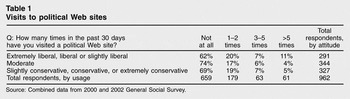
Table 1: Visits to political Web sites
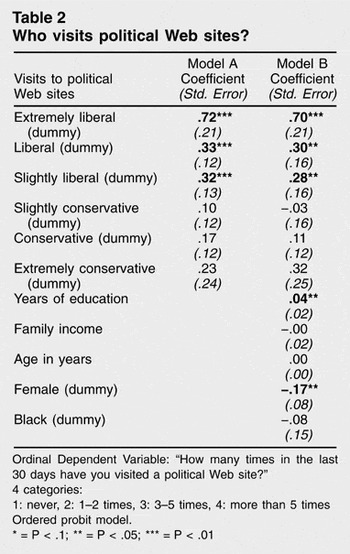
Table 2: Who visits political Web sites?
 You have
Access
- 66
- Cited by