Cronobacter (Enterobacter) sakazakii is a Gram-negative rod belonging to the family Enterobacteriaceae. This mesophilic organism has recently emerged as a foodborne pathogen because sepsis, meningitis and necrotizing enterocolitis have occurred in neonates following the consumption of contaminated and rehydrated powdered infant milk formulae (Gurtler et al. Reference Gurtler, Kornacki and Beuchat2005).
Enterobacteriaceae are common contaminants of raw milk (Martins et al. Reference Martins, Pinto, Rocha, de Araújo and Vanetti2006). However, pasteurisation is effective for inactivating Enterobacteriaceae during dairy processing. In the case of Cron. sakazakii, even though strains may differ in their thermal resistance profiles (Edelson-Mammel & Buchanan, Reference Edelson-Mammel and Buchanan2004), there is no documented evidence to suggest that Cron. sakazakii can survive pasteurization (Gurtler et al. Reference Gurtler, Kornacki and Beuchat2005). Risk models have predicted that pasteurisation temperatures of 68°C for 16 s should reduce Cron. sakazakii populations by 5-log cycles (Nazarowec-White et al. Reference Nazarowec-White, McKellar and Piyasena1999).
There is widespread belief that re-contamination events between the spray drying step and the packaging step are the most likely cause of this pathogen being recovered from the dried product (Gurtler et al. Reference Gurtler, Kornacki and Beuchat2005). Food-contact surfaces and food processing environments are considered to be two of the most significant sources of contamination by potential foodborne pathogens (Reij et al. Reference Reij and Den Aantrekker2004). In addition, evidence from a recent study indicates that Cron. sakazakii strains may persist in processing lines, that Cron. sakazakii strains may enter the process from air supply areas and that inefficient cleaning-in-place regimes may also allow Cron. sakazakii to survive in milk powder processing equipment (Hein et al. Reference Hein, Gadzov, Schoder, Foissy, Malorny and Wagner2009).
As a consequence of the emergence of Cron. sakazakii as an important infant pathogen, and the recognition of the role of environmental sources in the contamination of the dairy process stream, robust and efficient testing protocols for monitoring dairy manufacturing environments for Cron. sakazakii have become a vital part of product safety risk management programmes. The aim of these protocols is to identify areas within the processing environment where Cron. sakazakii is present and from which process contamination could occur.
Environmental monitoring programmes generally involve the sampling of processing and environmental surfaces using a variety of commercially available swabbing materials. The numbers of pathogens within a manufacturing environment are likely to be low, and occur sporadically (Mullane et al. Reference Mullane, Whyte, Wall, Quinn and Fanning2007). Therefore, sensitive test methods are required to increase the probability of detecting environmental contamination. Rapid results turnaround is also important to manufacturers so that environmental clean-up can be actioned as soon as possible after contamination has been identified.
The aim of this study was to reduce the time taken to detect Cron. sakazakii recovered on environmental swabs from the manufacturing environment using a simple procedure for application in a dairy testing laboratory. Cron. sakazakii in pure culture and in the presence of competing coliforms (Citrobacter freundii was used as a competitor) were tested using a modified enrichment procedure, and three types of swabbing materials were also compared.
Materials and Methods
Preparation of bacterial cultures
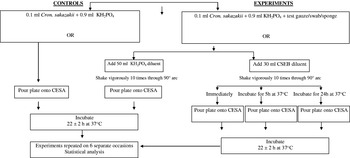
Cron. sakazakii NZRM50, a strain of dairy origin, and Cit. freundii NCTC 9750, were each grown in Tryptone Soya Broth (TSB) (Oxoid, Basingstoke, UK) overnight at 37°C (Fig. 1). Aliquots (1 ml) of the overnight cultures were frozen in the presence of 10% v/v sterile glycerol at −80°C. Prior to each experiment, 1 ml aliquots were thawed and diluted appropriately.
Simplified flow diagram of experimental procedure

This freezing and thawing approach was adopted for two reasons: to standardize the stage of growth of the cultures across all experiments, and to add an ‘injury’ step to simulate the damage that occurs during processing – the resuscitation of injured cells during subsequent enrichment steps is a key aspect of many microbiological methods (Jasson et al. Reference Jasson, Uyttendaele, Rajkovic and Debevere2007; Dupont & Augustin, Reference Dupont and Augustin2009).
Preparation of test suspensions
Cron. sakazakii in pure culture
For each trial, 1 ml frozen aliquots containing Cron. sakazakii NZRM50 were thawed and diluted in reconstituted skim milk (RSM) to achieve three different levels of cells − approximately 10, 100 and 1000 cfu/ml. RSM was used to simulate the presence of the milk solids that are likely to be collected on swabs when sampling dairy manufacturing environments.
To determine the number of bacteria inoculated onto each swab, 0·1 ml RSM from each tube containing 10, 100 or 1000 cfu/ml was diluted in 0·9 ml phosphate solution (KH2PO4) in duplicate Petri plates. Pour plates were then prepared for counts of Cron. sakazakii NZRM50 using Chromocult™ Enterobacter sakazakii agar (Merck) (CESA) (Moore & Griffith, Reference Moore and Griffith2007). The plates were incubated for 22±2 h at 37°C (Fig. 1).
Cron. sakazakii with simulated background flora
Cit. freundii NCTC 9750 was used to evaluate the robustness of the test system for detecting Cron. sakazakii NZRM50 in the presence of other background coliforms. Aliquots (1 ml) of Cit. freundii NCTC 9750 were thawed and diluted in a similar way to Cron. sakazakii NZRM50 to achieve approximately 1000 cfu/ml. To determine the number of Cit. freundii NCTC 9750 inoculated onto each swab, 0·1 ml RSM from the tube containing 1000 cfu/ml was diluted in 0·9 ml KH2PO4 in duplicate Petri plates. In addition, 0·1 ml RSM from each tube containing 10, 100 or 1000 cfu/ml Cron. sakazakii NZRM50 was also added to the duplicate Petri plates. Pour plates were prepared and incubated as described previously (Fig. 1).
Recovery of bacteria from directly inoculated swabs
The following surface swabbing materials were tested: pre-moistened gauze (cotton) swabs (10 contained in a 70 ml sample bottle and pre-moistened with 20 ml diluent) (BHB Biosciences, Fort Richard, Auckland, New Zealand), the Biolab FlexiSwab™ (foam) (Biolab, Auckland, New Zealand) and the Whatman SwabCheck Polywipe™ sponge (Biolab). Each type of test swab was inoculated as described below.
Swabs inoculated with Cron. sakazakii in pure culture
For each trial, twelve sample bottles (70 ml volume) were prepared, four containing a gauze swab, four containing a FlexiSwab™ and four containing a Polywipe™ sponge. Each swab was inoculated with 0·9 ml KH2PO4 and 0·1 ml of the dilution of Cron. sakazakii in RSM containing 1000 cfu/ml, to achieve a final cell concentration of approximately 100 cfu per swab. The latter equated to 1–5 cfu/cm2 if a 20–100 cm2 surface was swabbed, as suggested in ISO Standard 18593 (International Organization for Standardization, 2004). A similar procedure was used to inoculate and prepare 12 sample bottles containing 10 cfu per swab (0·1–0·5 cfu/cm2) and a further 12 sample bottles containing 1 cfu per swab (0·01–0·05 cfu/cm2). In all cases, a total of 1 ml of liquid was added (Fig. 1). All experiments were carried out on six separate occasions.
To each sample bottle and swab, either 30 ml Cronobacter sakazakii enrichment broth (CSEB) (International Organization for Standardization, 2006) (Fort Richard) with vancomycin or 50 ml KH2PO4 (no enrichment, negative control) was added, and the sample bottle was shaken vigorously ten times through an arc of 90°.
For CSEB-containing sample bottles
Pour plates (1 ml) of CESA were prepared immediately (0 h) from one sample bottle for each dilution of cells and each swab type.
A further sample bottle for each dilution of cells and each swab type was incubated for 5 h at 37°C. Following incubation, and after gentle inversion of each sample bottle, 1 ml aliquots were pour plated using CESA (Fig. 1).
A final sample bottle for each dilution of cells and each swab type was incubated overnight (24 h) at 37°C. Pour plates (1 ml) were again prepared using CESA. This served as a final positive control for the growth of Cron. sakazakii.
All plates were incubated for 22±2 h at 37°C and colony counts were determined (Fig. 1). Although the current ISO Cron. sakazakii method (International Organization for Standardization, 2006) stipulates an enrichment incubation temperature of 44°C, for this study, 37°C was adopted as a number of publications have indicated that several strains of Cron. sakazakii may not grow at 44°C (Lehner et al. Reference Lehner, Nitzsche, Breeuwer, Diep, Thelen and Stephan2006).
For KH2PO4-containing sample bottles
Pour plates (1 ml) were prepared immediately from one sample bottle for each dilution of cells and each swab type using CESA as previously described.
Swabs inoculated with Cron. sakazakii with simulated background flora
Twelve sample bottles (70 ml volume) were prepared: four containing a gauze swab, four containing a FlexiSwab™ and four containing a Polywipe™ sponge. Each test swab was inoculated with 0·9 ml KH2PO4 and 0·1 ml of the dilution of Cron. sakazakii in RSM containing 1000 cfu/ml (this gave a final concentration of 100 cfu per swab), plus an additional 0·1 ml of the dilution of Cit. freundii NCTC 9750 in RSM containing 1000 cfu/ml (this gave a final background inoculum of 100 cfu per swab). A similar procedure was used to inoculate and prepare 12 sample bottles containing 10 cfu of Cron. sakazakii/ml and 100 cfu of Cit. freundii NCTC 9750/ml per swab, and a further 12 sample bottles containing 1 cfu of Cron. sakazakii/ml and 100 cfu of Cit. freundii NCTC 9750/ml per swab. The samples were incubated and plated as described previously (Fig. 1).
Calculating the percentage recovery of cells by each enrichment procedure
How effective each pre-enrichment procedure was for the recovery of Cron. sakazakii cells from test swabs was calculated using the following equation:
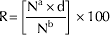
In the equation, R is the percentage recovery of Cron. sakazakii for each enrichment step tested, Na is the mean number of cfu counted on duplicate plates after each enrichment step, d is the dilution factor and Nb is the number of cfu inoculated onto each swab before the enrichment step, and estimated from control plates without swabs (Moore & Griffith, Reference Moore and Griffith2007). As cells were enriched in this study, values for percentage recovery above 100% were also recorded due to bacterial growth.
Statistical analysis
One-way analysis of variance (ANOVA) at 95 and 99% confidence followed by Tukey's test were used to analyse the resulting counts to determine which method recovered more Cron. sakazakii NZRM50 cells from each swab type tested.
Results and Discussion
The results of this study are shown in Table 1 (percentage recovery of Cron. sakazakii from the different swab types after each enrichment step) and Table 2 (percentage of samples that tested positive for Cron. sakazakii after each enrichment step). Swabs were successfully inoculated with approximately 100 cfu (97–98 cfu), 10 cfu (8–12 cfu) and 1 cfu (0·3–0·9 cfu) per swab, as determined by the numbers of colonies obtained when the inocula were plated onto CESA without swabs.
Percentage (%) recovery of Cronobacter sakazakii from inoculated swabs after incubation in Cronobacter sakazakii enrichment broth (CSEB) for 0, 5 and 24 h compared with controls without an enrichment step (KH2PO4). Results are an average of experimental data obtained on six separate occasions

Percentage (%) positive samples obtained after incubation of inoculated swabs in Cronobacter sakazakii enrichment broth (CSEB) for 0, 5 and 24 h compared with controls without an enrichment step (KH2PO4). Results are an average of experimental data obtained on six separate occasions

Procedures in which no enrichment was used (KH2PO4 or 0 h in CSEB) recovered the least Cron. sakazakii cells (Table 1). Furthermore, Cron. sakazakii was detected between 0 and 50% of the time when no enrichment was used (Table 2). In addition, no statistically significant differences (P>0·01) were observed for counts of Cron. sakazakii obtained without enrichment. In contrast, the 5-h enrichment step in CSEB resulted in significantly higher counts (P<0·01) of Cron. sakazakii compared with corresponding counts without enrichment (KH2PO4 or 0 h in CSEB). This was true for swabs inoculated with Cron. sakazakii only, and also for swabs inoculated with Cron. sakazakii and Citrobacter in combination.
Overall, enrichment of the swabs in CSEB for 24 h at 37°C was the most efficient procedure for recovering Cron. sakazakii colonies (Table 1), and positive samples were obtained 100% of the time at all inoculation levels (Table 2). Similarly, the 5-h enrichment procedure resulted in the detection of positive samples 100% of the time for swabs inoculated with 100 cfu per swab (Table 2). This would mean that a surface contaminated with between 1 and 5 cfu of this pathogen per cm2 could be detected using this 5-h enrichment step, if a minimum of 20–100 cm2 were sampled according to the ISO procedure (International Organization for Standardization, 2004), and assuming that all cells are captured from the surface by the swab. This 5-h enrichment step would also detect <1 cfu/cm2 (10 cfu per swab) 83% of the time using either FlexiSwabs™ or gauze swabs, and 67% of the time using the Polywipe™ sponge (Table 2). As speed is essential in method development for pathogen detection (Nugen & Baeumner, Reference Nugen and Baeumner2008), the 5-h enrichment step in this study proved to be more efficient for recovering Cron. sakazakii than no enrichment, and just as efficient as pre-enrichment for 24 h for swabs containing 100 cfu (Tables 1 & 2).
The 5-h enrichment step was also successful in detecting Cron. sakazakii in both single and mixed cultures, as no significant differences (P>0·05) in counts between swabs inoculated with Cron. sakazakii in pure culture and swabs inoculated with Cron. sakazakii together with Citrobacter were recorded.
Previous studies have shown that different swabbing materials may influence the numbers of bacteria recovered from a surface (Moore & Griffith, Reference Moore and Griffith2007). No statistically significant differences (P>0·05) were recorded in this study between counts obtained using the FlexiSwab™ and counts obtained using gauze swabs, or between counts obtained using gauze swabs and counts obtained using Polywipe™ sponges. However, counts obtained using Polywipe™ sponges were significantly lower (P<0·05) than corresponding counts obtained using the FlexiSwab™. These results indicated that the type of swab selected for use in environmental safety programmes is influential on the outcome and consequently there is the need to carefully evaluate and select an appropriate swabbing material for use during environmental monitoring programmes.
In conclusion, a 5-h enrichment step in CSEB at 37°C, prior to plating on CESA, could be used as a more rapid recovery procedure for Cron. sakazakii from environmental swabs in a dairy testing laboratory. However, because the sensitivity of the 5 h enrichment method requires ⩾100 cfu Cronobacter, it may be suggested that the 24 h enrichment procedure be performed simultaneously. The benefit of a dual enrichment procedure would be that a 5 h enrichment method provides results 19 h sooner for rapid notification of highly contaminated samples. In these experiments, the FlexiSwab™ and gauze swabs were the most efficient swabbing materials evaluated for the detection of Cron. sakazakii from dairy environments.
The authors wish to thank Barbara Kuhn-Sherlock for carrying out the statistical analyses in this study.