Writing back in 1888, Adolf Neubauer, the father of modern scholarship on the Lost Tribes, warned that “It would be lost time . . . to trouble ourselves about the identification of this stream.”Footnote 1 Neubauer was referring, of course, to the Sambatyon River, the mythical waterway that, according to common understanding, rests each Sabbath and separates missing Jews—the ten lost tribes or others—from their brethren, and indeed from the known world. Six days each week, according to the legend, the river runs so powerfully that neither these tribes nor their seekers can cross it; on the Sabbath, either natural wonders or halakhic restrictions prevent them from doing so as well.Footnote 2 Thus, whether showcasing the sheer power and solemnity of the seventh day or the piety of the isolated (or general) community, the Sambatyon legend certifies that only in the messianic age will this lost population be restored to the rest of the Jewish people.
A great many versions of this legend have come down to us in rabbinic and other sources, often varying significantly as to the river's nature and behavior, as well as to the identity and precise location of the population trapped and/or protected by its banks.Footnote 3 In some cases, the river flows six days each week with water; in others, with sand and stones (in addition or instead).Footnote 4 In many accounts, the river rests entirely on the Sabbath,Footnote 5 whereas in other cases its banks erupt in fire on this day or are obscured by clouds.Footnote 6 Sometimes all ten of the so-called “lost tribes” are placed across this river;Footnote 7 on other occasions, only some of the tribes are to be found there (e.g. Naphtali, Gad, and Asher; at times Dan as well),Footnote 8 or even a separate group entirely (the Levite Sons of Moses and/or Rechabites).Footnote 9 Finally, while usually marking the border past which the tribes reside, the river sometimes denotes merely the region in which the tribes are to be found, or on occasion even encircles them.Footnote 10 For one widely attested tradition, the Sambatyon demarcates the refuge of only one (or in some cases two) of the three exiles of Israel.Footnote 11
A perhaps equally vast body of scholarly literature has previously explored the various incarnations of this legend, of which Zvi Ben-Dor Benite's comprehensive Ten Lost Tribes: A World History published in 2009 is the latest installment.Footnote 12 Surveying its beginnings, or, pun intended, the “source” of the Sambatyon, much of this research has correctly observed that the Roman author and natural philosopher Pliny the Elder and the Jewish historian Josephus Flavius represent the first known discussions of a Sabbatical river. At the same time, however, this scholarship typically regards these authors as little more than ritual stops on the pilgrimage route to the later, more extensive accounts of the Eldad the Danite and Prester John traditions, of medieval Jewish travelers to the East, and of David Reubeni, not to mention a number of non-Jewish sources.Footnote 13 And this in spite of the critical and oft-noted fact that neither Pliny nor Josephus (nor, probably, the oldest rabbinic traditions concerning the Sambatyon) ever associated the river with either the tribes or another “lost” population.
Clearly, then, there is a distinct early history to the Sambatyon, one deserving of close attention in its own right. A careful analysis of the relevant passages in the works of Pliny, Josephus, and the rabbis—as distinct from later traditions—can greatly assist us in answering the following critical questions: in what context and why did the legend of the Sabbatical river arise? What meaning did it convey, what purpose did it serve? Important as they are, these questions have hardly been posed, let alone carefully addressed. While Neubauer was certainly right to warn against “identifying” the Sambatyon, its source and early course nevertheless remain fully (and critically) to be charted.
The neglect of this initial history of the Sabbatical river stems in large part from the brevity of the earliest sources and also reflects the paucity of research that has been devoted specifically to the Sambatyon in and of itself. Since most scholars have simply approached the river as an element of the larger story of the Ten Lost Tribes or Sons of Moses (even when its independent origin has been recognized—and all the more so when it has not been), there has been little reason to linger upon passages in which these groups were not mentioned. And because the river has been almost exclusively perceived as a Jewish entity, there has been little attempt to interpret the myth in a Roman context. As a result, the historical development of the Sambatyon legend has largely remained hidden from view. Simply put: the quintessential legend about Jewish time has ironically remained for the most part timeless.Footnote 14
However, when its earliest sources are subjected to careful scrutiny—situated in both their immediate textual environments and in the larger context of contemporary Sabbath discourse—it emerges that contrasting Roman and Jewish attitudes towards the seventh day represent the critical backdrop against which the early stages of this legend need to be understood.Footnote 15 In particular, Pliny's description of the Sabbatical river echoes the Roman ridicule of the Sabbath widespread at the time, which Josephus with his wished to counter. It is thus quite likely that this legend first arose among Romans, only later to be appropriated and subverted by Jews. In addition, the early significance of the Sabbatical river legend can be better illuminated by reading it against the symbolic role played by rivers in Roman culture, particularly in celebrations of conquest and triumph. But whatever the precise context and conditions of its origin, it seems clear that in the aftermath of the Great Revolt of 66–72 the Sabbatical river functioned as a new, albeit discursive, Roman-Jewish battleground.
The respective accounts of Pliny and Josephus differ in almost every respect, first and most noticeably in their length and degree of detail. In his encyclopedic Natural History, Pliny merely stated that there was “in Judea a river that runs dry every Sabbath.”Footnote 16 Josephus, by contrast, offered a much more substantial description of his Sabbatical river in The Jewish War, one directly built into his historical narrative. Recounting Titus's departure from Judea in the aftermath of the Great Revolt, Josephus noted:
In the course of his march he saw a river, the nature of which deserves to be recorded in history (ἱστορηθῆναι). It runs between Arcea, located in Agrippa's kingdom and Raphanea, and has an astonishing peculiarity. For, when it flows, it is a copious stream with a current far from sluggish; then all at once its sources fail and for the space of six days it presents the spectacle of a dry bed; again, as though no change had occurred, it pours forth on the seventh day just as before. And it has always been observed to keep strictly to this order; whence they have called it the Sabbatical river, so naming it after the sacred seventh day of the Jews.Footnote 17
Comparing these two sources, it appears that while Pliny was content to place the Sabbatical river in Judea, without offering further details, Josephus took care to indicate its precise location in Syria to the north: Arcea can probably be located in the mountains to the east of Tripoli, in contemporary Lebanon, whereas Raphanea was probably further to the north in today's Syria.Footnote 18 Pliny's river is left unnamed, and is sabbatical only incidentally (because on the Sabbath it runs dry), whereas Josephus explicitly linked his to “the sacred seventh day of the Jews,” declaring that for this reason multiple, but unspecified, others had formally named it the “Sabbatikon.” Explicitly to name the river was to endow it with a special importance; to suggest that it was “others” who had done so was to imply that awareness of this importance was shared and potentially widespread. Likewise, whereas Pliny merely implied that the river's flow was constant, Josephus emphasized this aspect of its behavior deliberately. Finally and most significantly, of course, Pliny and Josephus described this flow in distinctly opposing terms: Pliny's river runs six days a week, whereas Josephus's Sabbatikon does so only on the Sabbath. That is to say, while Pliny's account of the river's flow accords with that of all later Jewish (and non-Jewish, for that matter) sources, Josephus's alone is opposed to them. This is puzzling, and cries out for explanation.
At first glance, one might be inclined to posit that Pliny and Josephus simply draw upon different sources or traditions. But the fact that no other known source in any way echoes Josephus's claims as to the location and behavior of the river strongly suggests (especially in light of the degree of detail contained in his account) that the Jewish historian deliberately reworked common source material in pursuit of a particular agenda. In particular, the possibility should be considered that Josephus wrote here directly in response to Pliny.Footnote 19 This possibility becomes all the more likely when it is realized that both accounts stem from Flavian Rome. Pliny returned to Rome with Vespasian's rise to the principate in 69, becoming a key figure in the emperor's inner circle and household;Footnote 20 he was at least periodically in the city until his death in 79. His Natural History first appeared in 77 and was dedicated to Vespasian's son, the future emperor Titus (whose reign began in the year of the natural scientist's death).Footnote 21 Based in Rome throughout this period, Josephus was of course similarly well-connected to the Flavian dynasty;Footnote 22 books 1–6 of his Jewish War were likely published under Titus (i.e. sometime between 79 and 81), while Book 7, or at least the section that mentions the Sabbatical river, was probably written during the first part of Domitian's reign that lasted from 81–96.Footnote 23 While not furnishing airtight proof, the fact that these sources were written (or at least published) in virtually the same place and time points to a possible interaction between them. But whether or not Josephus was aware of or interested in Pliny's specific text, he was likely reacting to its content, which must have been known in Roman cultural circles at the time.
Why would Josephus have wished to respond to Pliny or his source? What would have bothered him about a river located in Judea that ran dry on the Sabbath? What explains the degree of detail and overall context of the river in his account? Before attempting to address these critical questions, it will be useful first to consider whence the notion of such a river might have arisen, or at least with what attitudes it appears to have been conjoined. This will prove especially helpful in explicating Josephus's revisions.
While the similarity between Pliny's and numerous rabbinic accounts of the river's flow has often been understood to indicate his exposure to, and dependence on, Jewish tradition,Footnote 24 one should not simply assume a Jewish provenance for the legend. No earlier traces of such a waterway appear to be found in the extensive Jewish literature (e.g. Hellenistic, pseudepigraphic) of this period, and the rabbinic sources with which Pliny's Natural History in part overlaps were only redacted (whether in oral or written form) several centuries later.Footnote 25
Pliny was thus the first to refer to a Sabbatical river, and the fact that this river did not yet have a name in his text obliges us to wonder if he might lie at or very near the ultimate source of the myth. Pliny was also the only one ever to place it in Judea, and the manner in which he did so is both vague and puzzling: “. . . in iudaea rivus” he was content to write, and one wonders not only why no further information was provided, but also why the river was never previously mentioned in Book 5,Footnote 26 site of an extensive survey of Judaea and surrounding regions.
These textual difficulties paradoxically point to an explanation as to how and why the idea of such a river might have arisen in the first place. Pliny's river appears in the end as an entity more conceptual than truly geographical, one intended to exemplify Judea as a whole, including perhaps its inhabitants. In short, while there is no other geographic evidence for a Sabbatical river in Judea, the notion of a river that runs dry on this day suited the Roman discourse on the Sabbath that was widespread in Pliny's, and Josephus's, time as, figuratively, a day of drought and deprivation.
The Jewish Sabbath was, in this period, a frequent target of Roman attack. Already “in the age of Augustus, the poets Horace and Ovid indicate that knowledge of the Sabbath as a day that placed restrictions on activity. . . was commonplace.”Footnote 27 And there is no reason to suspect that this awareness declined in the course of the first century, given that the philosopher Seneca (ca. 1 B.C.E.–65 C.E.) is reported to have complained that the Jews wasted away nearly one-seventh of their lives in idleness by observing the Sabbath, a sentiment echoed by both Juvenal (late first to early second century C.E.) and Tacitus (ca. 56–ca. 117 C.E.), the latter adding that “in course of time the seductions of idleness made them devote every seventh year to indolence as well.”Footnote 28 According to a widespread Roman view, the Jews even fasted on the seventh day.Footnote 29
And one must furthermore bear in mind the common allegation that Jerusalem had repeatedly fallen because of the Jewish refusal to fight on the Sabbath.Footnote 30 Already in the second century B.C.E., “the Greek historian Agatharchides of Cnidus berated the practice that had delivered Jerusalem into the hands of Ptolemy I. The refrain was picked up by Strabo, for whom the decision not to take up arms on the Sabbath allowed Pompey to capture the city.” Later, in the first century, Frontinus (c. 40–104) offered the same explanation for the Roman conquest of Jerusalem at the end of the Great Revolt.Footnote 31 And while Frontinus's claim slightly postdates Pliny's Natural History—the Strategmata in which it appears was written during the reign of Domitian—there is no reason to doubt that such sentiment would have been in the air in the Rome of the 70s.
In addition, as Trevor Murphy has stressed, rivers in the Roman geographical imagination “were of great religious and symbolic importance,” reflecting the character of the territories and peoples they traversed,Footnote 32 and playing a particularly prominent role throughout the Natural History.Footnote 33 Placed against this contemporary backdrop, Pliny's river can be seen to encapsulate in its Sabbath drought and Judean location an unusual, negative, and uniquely Jewish practice: a river that runs dry on the Sabbath for a people who, so to speak, do so as well. Consideration of the precise context in the Natural History in which Pliny introduced the Sabbatical river (as one waterway among many) as well as his descriptions of Judean waterways elsewhere in the work confirms this assessment.
In the course of a discussion of unusual waterways, Pliny turned to a group of springs known for their prophetic powers, adding that “it is considered an evil presage when persons who wish to see these springs find them dry: a circumstance which happened very recently, for example, to Lartius Licinius, who held the office of legatus after his prætorship; for at the end of seven days after his visit he died. There is in Judea a river that runs dry every Sabbath.”Footnote 34 It appears that the story of Licinius, who died seven days after encountering these parched springs, brought to mind, or at least provided an appropriate segue for, the sabbatically-dry river of Judea. (The unmentioned fact that he seems to have died around 70Footnote 35 may have itself contributed to the recollection of a province that suffered great destruction in that same year). And if this is the lead-in to the seven-day river in Judea, the sequel is no better: a chapter concerned with deadly waters. In other words, Pliny's Sabbatical river is not in happy company and marks the transition in his discussion from springs to poisonous waters.Footnote 36
Comparison with other passages in the Natural History furthermore reveals that this placement of the Sabbatical river can hardly be coincidental. Trevor Murphy has convincingly shown that Pliny's description of the Jordan river and Dead Sea into which it empties functions as a metaphor for the ruin the Jewish revolt brought to Judea: “A river of delightful quality, obedient and conducive to the fruitful development of the larger whole at its beginning, is lost in sterility in the end, just as Jerusalem, once by far the most famous of the cities of the East, is now only a charred pyre.”Footnote 37 In addition, just as the Dead Sea swallowed up (“ebibitur”) the fertility of the Jordan, so the Essene sect, which lived nearby, thrived on the world-weary who joined their society, bereft of all normal human production and reproduction; Pliny commented on how they lived “without women, rejecting carnal lust, without money.”Footnote 38 And while the Essenes in Josephus are presented (albeit quite positively) as but one of the three philosophical sects among the Jews,Footnote 39 in Pliny's otherwise people-less account of Judea, they seem to stand in and most negatively at that for the Jews as a whole.Footnote 40 Placed in dialogue with this earlier description, Pliny's Sabbatical river can be seen to function as its mythological extension, a further description and explanation for the death and sterility that had come to Judea.
In Roman society, rivers were also used to showcase or encapsulate the conquest or defeat of a region or people. As part of Vespasian's and Titus's celebration of the defeat of Judea, Josephus reported that a series of moving stages had been created, depicting various scenes from the war zone, including “rivers flowing, not over cultivated land, nor supplying drink to man and beast, but across a country still on every side in flames.”Footnote 41 The very sequence of wondrous objects paraded through the streets of Rome is described by him as “flowing…like a river” (τις ῥὲοντα ποταμόν).Footnote 42
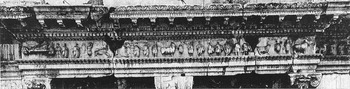
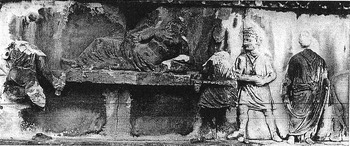
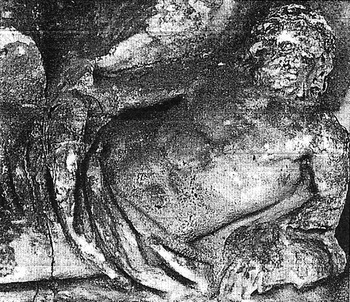
It is well-known that the Arch of Titus in Rome displays in its passageway the celebration of the Roman triumph over Judea, recording for posterity how the various Temple vessels and Jewish prisoners were paraded through the streets of the empire's capital. Much less appreciated is the continuation of the display in a decorative frieze on the east side of the arch, featuring on its far left (and therefore seemingly at its conclusion) an image of the god of the Jordan river conveyed on a ferculum (see figures 1–3).Footnote 43 Gods representing important mountains and rivers of conquered regions were a staple feature of Roman triumphal parades (in the processions themselves, the gods were probably played by actors) and served to demonstrate the Romanization of the territory and its key landmarks;Footnote 44 river gods can also be seen on the triumphal arches of the emperors Septimius Severus and Constantine.Footnote 45 In a figurative sense, then, not only were the wealth and people of Judea brought to Rome as booty, but Judea itself.Footnote 46 Thus, if, for Pliny, the demise of the life-giving Jordan in the Dead Sea symbolized the fate of Judea and its inhabitants, the seizure of the god of the Jordan represented in general its new status as the property of the Roman Empire. These symbolic associations also clarify why Pliny's Sabbatical river flows (somewhere) in Judea—for where else could it?—and render it extremely difficult to conceive of this legend emerging in a Jewish context. In such a cultural environment, what “work” could a legend about a river that runs dry on the Sabbath possibly do for its Jewish creator or audience?
Arch of Titus (Rome), Decorative Frieze (East Side). From Michael Pfanner, Der Titusbogen (Mainz: Verlag Philipp von Zabern, 1983), Table 79.1, reprinted with permission.

Decorative Frieze (Detail), God of Jordan River carried on Ferculum. Pfanner, Der Titusbogen, Table 86.4, reprinted with permission.

Jordan River God (detail); note water on lower right. Pfanner, Der Titusbogen, Table 86.6, reprinted with permission.

Given the significance of rivers for Pliny and the Roman world, we are also now better positioned to appreciate why Josephus, living in Rome in the aftermath of the Great Revolt, might have felt the need to offer an opposing account of the Sabbatical river—just one of several passages in which he attempted to address pagan aspersions regarding the Sabbath. Later on, for example, in his Jewish Antiquities, the Jewish historian addressed the allegation that Jews did not fight on the Sabbath. In particular, the story of the brothers Asineus and Anileus, two Jewish strongmen from the Babylonian city of Nehardea who seized territory in Mesopotamia with the consent of the Parthian king, afforded him a welcome opportunity to challenge such allegations.Footnote 47 On one occasion, Asineus and his forces were threatened with a surprise Parthian and Babylonian attack on the Sabbath. Spies of his who had spotted the attackers reported back that “we are caught by their intrigues like brute beasts . . . because we are restrained from [defending ourselves] by the prohibition of our law, which obliges us to rest on this day.”Footnote 48 “But Asineus,” Josephus wrote, “did not by any means agree . . . but thought it more agreeable to the law to pluck up their spirits in this necessity they were fallen into, and break their law by avenging themselves . . . than by doing nothing to please their enemies in submitting to be slain by them.”Footnote 49 The victory that ensued, along with Josephus's generally positive portrayal of Asineus, conveys to the reader that Asineus's view was probably that of Josephus as well. In this most carefully weighed of accounts, Josephus succeeded both in upholding the sanctity of the seventh day—which does, to his understanding, seem to prohibit military activity—as well emphasizing the Jewish willingness to violate this provision when necessary.Footnote 50
In reworking the notion of the Sabbatical river, Josephus similarly responded to Roman views on the Sabbath, at the same time exploiting and subverting the symbolic meaning of rivers for Romans. Relocating the Sabbatikon in Syria, and indicating its precise location presumably so as to enhance his credibility, he neutralized its status as a potential marker of an exotic and arbitrary Jewish practice, or as a negative marker of the Jews themselves, instead praising it for being “of such a nature (ϕύσιν) as deserves to be recorded in history.”Footnote 51 No longer a mere Judean curiosity, the river became an established and respectable natural phenomenon that certified the Sabbath as a holy day deeply rooted in nature.Footnote 52
A similar point was made in the fictional rabbinic dialogue between Rabbi Akiva and the Roman governor of JudeaFootnote 53 Tineius or—as the rabbis cleverly denote him, punning on the Greek, Tyranus (i.e. tyrant)Footnote 54—Rufus.Footnote 55 For in response to the Roman's query how the Jews could be certain they were celebrating the Sabbath on the correct day, Akiva replied (according to most versions) “let the river Sambatyon prove it” (“נהר סמבטיון יוכיח”). As nature's water clock, so to speak, this river could apparently be relied upon as proof. To what degree might this story be specifically linked to the accounts of Pliny and Josephus? Elena Loewenthal and Zvi Ben-Dor Benite have both drawn attention to how it appears to presume that the Sabbatical river represents a common point of reference for Jews and Romans.Footnote 56 Indeed, despite substantial variations among the numerous sources that report the Akiva/Tyranus Rufus encounter,Footnote 57 this reference to the Sambatyon nearly always comes first or last among a number of other such “proofs.”Footnote 58 Clearly, the Sambatyon represented for the rabbinic tellers and authors of this story a, if not the, critical response to Roman skepticism regarding the Sabbath. But why should this be the case? While these sources furnish no direct proof in this regard, the emphasis on the Sambatyon in this context points again to the likely Roman or Greco-Roman provenance of the legend.Footnote 59 On such a reading, the rabbinic use of the Sambatyon in defense of the Sabbath in fact represents the Jewish borrowing and subversion of a Roman trope, a rhetorical move parallel to that of Josephus.
Further support for this claim can perhaps be derived from the similarly subversive nature of the proofs offered in defense of the Sabbath alongside the Sambatyon. In several of the sources,Footnote 60 it is stated or implied that the soul of Tyranus Rufus's dead father cannot be raised on this day,Footnote 61 leading the living son to fear that his father has in the underworld converted to Judaism. The father instead reveals that all those who do not observe the Sabbath of their own free will when alive are forced to do so when dead: during the week such souls undergo judgment and/or punishment, while only on the Sabbath are they left alone. This is an especially striking form of rabbinic revenge against the Romans, one which appears to address the typical Roman accusations discussed above: far from wasteful or otherwise negative, the Sabbath is revealed to be both pleasurable and of immense long-term benefit; no longer a particular Jewish oddity, it is here recast as, in at least some sense, a universal obligation.Footnote 62 Most importantly, however, this example nicely parallels that of the Sambatyon in implying the Sabbath's accord with the natural (under)world. It is also true that some of the sources further attempt to justify the Sabbath on the basis of the manna's appearance in the desert, that is, on the basis of an argument wholly internal to Judaism. Nevertheless, the dominant strain in these texts appears to be a conscious effort to subvert the Romans and their views.Footnote 63 Finally, it is striking that just as in Pliny, the Sabbatical river is here juxtaposed with the prophetic arts, albeit with one critical difference. Whereas for the former (and presumably, by extension, the Romans in general), the failure of oracular techniques (e.g. the drying out of prophetic waters) was a sign of bad luck, the rabbis emphasize that even the occult rests on the Sabbath.
While there is thus an important similarity in the polemical deployment of the Sabbatical river by both Josephus and the rabbis, the specific concerns of each party were nevertheless somewhat different, and can help us to understand why Josephus's response—the inversion of the behavior of the river's flow—was more radical than that of the rabbis. The rabbinic passages are oriented around justifying the Sabbath as a day different from all others (“what is one day from other days?” a skeptical Tyranus Rufus asks AkivaFootnote 64), a critical aspect of which concerns the very reliability of this differentiation, i.e. how can one be certain that one is marking the Sabbath on the correct day, how can one discern the difference between one day and another? To be sure, this aspect clearly also played a role for Josephus; hence his strong emphasis on the regularity and reliability of the river's flow: “it has always been observed to keep strictly to this order . . . ”
Probably even more important for Josephus in this context, however, was the specific quality and dignity of the Sabbath day itself, a concern that reflects the general, i.e. non-Jewish, audience to which this work was at least in part directed. Josephus certainly had a highly positive view of the Sabbath, and elsewhere stressed its status as a day of gladness.Footnote 65 The notion of a river in or near Judea that dried out every seventh day echoed too closely for him the Roman criticism of the Jewish Sabbath as a day of sloth, idleness, and fasting. Instead, through the depiction of a river that gushed forth every seventh day, Josephus wished to imply a more positive, fulfilling dimension of Shabbat as the start and culmination of each week.Footnote 66 Indeed, Josephus appears to have structured his account of the river precisely in order to emphasize these characteristics: “For, when it flows, it is a copious (πολὺς) stream with a current far from sluggish (οὐ σχολαῖος); then all at once its sources fail and for the space of six days it presents the spectacle of a dry bed; again, as though no change had occurred, it pours forth (ἐκδι´δωσι) on the seventh day just as before.”Footnote 67 In this passage, Josephus addressed the seventh day twice, beginning and ending with it—fully aware of the need to counter an opposing account. At the very least, he went out of his way to draw attention to the exceptional day of its flow.Footnote 68
Ironically, then, if Tacitus later condemned the Jews for instituting the opposite of what everyone else does,Footnote 69 here the desire to respond to similar such attacks in fact brought Josephus to invert his source—and by no means for the only time in his corpus. Castigated in the books of both Kings and ChroniclesFootnote 70 for doing “what was evil in the sight of the Lord,” the late Judean king Jehoiachin (Jeconiah) came in for praise by Josephus for his kindness and justice; the biblically-condemned Zedekiah experienced a similar rehabilitation in the Jewish Antiquities.Footnote 71 If Josephus had no compunction about inverting a biblical account, there is no reason to believe he would have had any such scruples regarding the particular characteristics of the Sabbatical river.Footnote 72 But his inversion here leads of course to the paradoxical situation that in order to defend the Sabbath, Josephus must have felt compelled to present the river seemingly in violation of it, and this coming from an author for whom the prohibition of activity on the Sabbath was of utmost concern.Footnote 73 On one hand, Josephus can be understood here to anticipate his later discussion of Asineus's determination to defend the law by violating it (i.e. fighting on the Sabbath). From this perspective, the challenge posed by the Roman Sabbath rhetoric was sufficiently threatening that it was worth putting the Sabbatikon to work on Shabbat in order to counter it. On the other, it may also be possible to link Josephus's river to what rabbinic sources report concerning the Hasmonean queen Shelamzion Alexandria (76–67 B.C.E.), during whose rule rains fell every Sabbath as opposed to during the week. On this understanding, far from violating the Sabbath by flowing, Josephus's Sabbatikon simply recalls other associations between the Sabbath and fertility-bringing waters.Footnote 74
As was the case in Pliny, the specific context in The Jewish War in which Josephus deployed the Sabbatikon further emphasizes the river's role in responding to contemporary criticism of the Sabbath. According to Josephus, Titus encountered the river as he made his way into Syria following the destruction of the Temple and Jerusalem. In particular, Josephus noted that Titus saw the Sabbatikon immediately after apprising the reader of the “costly spectacles” he put on “in all the cities of Syria through which he passed, making his Jewish captives serve to display their own destruction.”Footnote 75 Thereafter, immediately following his account of the Sabbatical river, Josephus described how upon arrival in Antioch, the people of that city repeatedly beseeched Titus to expel its Jews, and were each time rebuffed by the future emperor (“But their own country to which, as Jews, they ought in that case to be banished, has been destroyed, and no other place would now receive them” Josephus had Titus reply).Footnote 76 Although no causal effect can be directly imputed to the river (Titus is merely described as having seen it), the impression made upon the reader is striking. If prior to the river's appearance in the narrative, Titus actively celebrates the destruction of the Jewish nation, thereafter, he is directly involved in its preservation. Although credited with no specific power or influence, the river's role validating the Sabbath provides a fitting backdrop for Titus's confirmation of Jewish rights. In thus choosing—and there are no grounds for deeming this particular detail as anything but Josephus's own conscious decisionFootnote 77—to place the Sabbatical river herein between these two very different kinds of behavior, Josephus seems to have presented it as an implicit symbol of Jewish continuity and endurance, as a sign that not only the Sabbath, but the Jews and their religion in general were etched much deeper into nature than the destruction of Jerusalem and its temple might have suggested.
But this is only part of the story—and close consideration of both the prior information Josephus conveyed regarding the situation of the Jews in Antioch as well as the precise manner in which he presented Titus's visit to the city only reinforces further the interpretation just advanced.
Already well prior to Titus's encounter with the Sabbatikon, Josephus addressed the origins of the Greek-Jewish tensions in Antioch in an account that appears closely modelled after the second-century B.C.E. persecutions of Antiochus IV.Footnote 78 The Jewish nation, Josephus first reminded his readers, was especially numerous in Antioch, where those who succeeded Antiochus IV Epiphanes “granted them citizen rights on an equality with the Greeks.” This enabled the Jewish population to increase continually in both size and prestige, such that they “[constantly attracted] to their religious ceremonies multitudes of Greeks, [whom] they had in some measure incorporated with themselves.”Footnote 79 Around the time of the outbreak of the Great Revolt, however, Jewish affairs in Antioch took a dramatic turn for the worse. The son of the head of the Jewish community in the city, coincidentally also named Antiochus, accused his father and others of conspiring to set the city on fire. This accusation sparked riots that threatened the Jewish population with destruction. Antiochus, Josephus continued, converted over to the Greeks and continued to stoke anger against his former co-religionists. After reporting how the Jews were compelled to offer sacrifice in accordance with Greek custom (the majority who refused were massacred), Josephus reported that Antiochus
having next procured the aid of troops from the Roman general, domineered with severity over his Jewish fellow-citizens, not permitting them to rest on the seventh day, but compelling them to do everything exactly as on the other days; and so strictly did he enforce obedience that not only at Antioch was the weekly day of rest abolished, but the example having been started there spread for a time to the other cities as well.Footnote 80
The status of the Sabbath thus played a central role in the turmoil and violence in Antioch in the period leading up to Titus's post-revolt visit there—the role of Roman soldiers in restricting Sabbath observance especially noteworthy—and in the pages leading up to the introduction of the Sabbatikon.Footnote 81 This section is in fact carefully arranged so as to maximize the reader's suspense. Concluding his initial account of the events at Antioch with the statement that “The Jews, with these charges hanging over them and still anxiously awaiting the issue, were thus in troubled waters and in grave alarm,”Footnote 82 Josephus then turned to Vespasian's arrival in Rome and to rebellion on the German frontier and elsewhere. Only several pages later does he return to the situation in Antioch and to the reprieve granted by Titus to the city's Jews. Josephus's description of Titus's encounter with the Sabbatikon marks the resumption of this stage of the narrative.
In light of the clear significance of the events at Antioch, and especially the central role played there by the question of the Sabbath, Josephus's introduction of the Sabbatical river at this stage of his narrative has to be read as both intentional and significant. It has been written that Josephus believed the observance of the Sabbath to be “of the utmost significance for the preservation of the nation.”Footnote 83 Titus's rendezvous with the Sabbatical river represents one of the most significant instances of this view.
There is, finally, one further piece to the puzzle of Josephus's deployment of the Sabbatikon: its appropriation of the symbolic meaning of rivers in the Roman world of the sort already encountered in Pliny. Thanks to the placement of the river immediately after the description of Titus's triumphal celebrations with his Jewish captives across Syria, Josephus's narrative nicely parallels the official triumph celebrated in Rome, itself described at length a bit further along in Book 7. In that later scene, Josephus forbore mentioning the likely presence of the “god of the Jordan river” in the triumphal parade as apparently recorded on the Arch of Titus. Might then the Sabbatikon river function in the former episode as a symbolic parallel—and indeed response and replacement—for the exiled Jordan? Presumably it is not by chance that the river appears alongside Titus, the great hero of “Judea capta.” Here, though, instead of putting a foreign river on display for others at home, Titus is compelled while abroad himself to observe a river which (by virtue of its singular behavior) eludes his control.
To be sure, Josephus seems to have written his account of the Roman victory procession in Book 7 of The Jewish War more than a decade after the events therein described, and thus after the death of Titus in 79.Footnote 84 This naturally raises the question of the extent to which Josephus would still have been concerned about such matters. In fact, there is very good reason to think that he would have been: the construction of the Arch of Titus in the early 80s would not only have spurred his memory of that earlier celebration, but would also have provided him especially good political reasons for writing about it. For while commemorating the divine Titus (“Divo Tito”), the arch appears to have been constructed during the early reign of Titus's younger brother Domitian, as part of the new emperor's attempts to legitimize his rule by linking himself to the Judea campaign of his brother and father (in which he himself had played no role whatsoever).Footnote 85 This explains the otherwise inexplicable prominence of Domitian on the arch itself—positioned alongside Vespasian and Titus atop the bas relief depiction of the arch through which the temple relics are being led, he alone is depicted riding a horseFootnote 86—and can therefore account for the similar and equally bizarre prominence of Domitian in Josephus's depiction of the triumphal procession: “Behind them drove Vespasian, followed by Titus; while Domitian rode beside them, in magnificent apparel and mounted on a steed that was itself a sight.”Footnote 87 It is almost certain that Josephus modeled his account of the victory parade after that presented on the Arch of Titus; this scenario certainly seems far more likely than the alternative, namely that Josephus in some way anticipated or modeled the depiction on the arch.Footnote 88 And it is further not unreasonable to suppose that if the arch itself was completed in the early years of Domitian's reign, Josephus's very similar description is probably a product of this period as well. Josephus, ever aware of his dependence upon imperial patronage, seems to have been eager to display his loyalty to the new Domitian order.Footnote 89 This helps better pinpoint the likely date of composition of this section while at the same time rendering it all the more likely that the Roman “conquest” of the Jordan was on Josephus's mind as he sat down to write about its fellow waterway, the Sabbatikon.
Thus, whereas the frieze of the Roman arch depicts the conquest and Romanization of the Jordan, Josephus summoned forth a very Jewish river that carefully negotiated that conquest. Indeed, on the assumption that the case for the Sabbatical river's Roman origin is persuasive, it can be said here that Josephus “de-Romanized” this river, insofar as it had suited Roman stereotypes about Jews. Far from ending up in Roman hands, Josephus's Sabbatikon guides, as it were, Titus toward one of the great Jewish diaspora communities of the age, namely Antioch. The river can thus be seen symbolically to represent an alternative kind of Jewish identity. With the Jordan captive in “Rome,” a national-political identity was no longer possible, but Josephus here seems to have held out a degree of hope for the Jewish diaspora, acknowledging the Roman conquest of Judea while simultaneously revealing its limits.Footnote 90 At the same time, the sabbatical rhythm of Josephus's river looks forward to a day when Jewish fortunes will experience a thorough revival, demonstrating that however bleak the position of the Jews may at any one time seem, the future promises something better.Footnote 91
Indeed, there is a pronounced sense in which Josephus's recounting of the episode at Antioch itself underscores the cyclical quality of Jewish fortunes. At the very outset of his account of this episode, Josephus noted that although Antiochus IV Epiphanes had over two-hundred years earlier “sacked Jerusalem and plundered the temple, his successors . . . restored to the Jews of Antioch” their ritual tools, and granted them the status of equal citizenship.Footnote 92 Likewise, in the present-day, Titus had destroyed Jerusalem and the Temple but then re-affirmed the rights of the Antiochene Jews when they were subjected to persecutions recalling those of Antiochus IV.
The Sabbatical river's symbolic role having been better illuminated, the meaning of the specific geography Josephus crafted for it can now be addressed. Josephus's statement that the river “runs between Arcea, located in Agrippa's kingdom and Raphanea . . . ” lends a certain verisimilitude to what otherwise appears to be his blatant invention. All well and good, but why did Josephus opt to place its start in Arcea, stressing in particular that this place is “located in Agrippa's kingdom”? Josephus here referred to Agrippa II (28–92 C.E.),Footnote 93 who as the last king of the Herodian line ruled over portions of the Galilee, including Tiberias. A close ally of the Flavians and determined foe of the Great Revolt (Josephus elsewhere described the king's efforts to prevent itFootnote 94), Agrippa II can at the same time be seen as the last representative (at least at this time) of quasi-Jewish independence under the Romans. It is thus appropriate that the river, which appears to symbolize the move from Judean independence to diaspora dependence, should first flow forth from his territory, and in the direction of a region specifically known for its mixed Syrian and Jewish population.Footnote 95 Pliny's Jordan flows in to Judea, toward the Dead Sea and the deathly EssenesFootnote 96 who live nearby, whereas Josephus's Sabbatical river leads outwards towards the confirmed status of a large, prosperous, diaspora Jewish community. One is reminded here of Trevor Murphy's claim that, for Pliny, “the movement of a river from spring to sea is a story: it permits the insertion of narrative into geography.” Josephus, too, seems interested in using this river to tell, and indeed evoke, a very particular story.Footnote 97
In this respect, it is also fitting that Josephus juxtaposed the final conclusion of the Antioch episode, in which Titus left “the status of the Jews of Antioch exactly as it was before . . ., ”Footnote 98 with a report of the future Roman emperor's return visit to Jerusalem. While there, according to Josephus, Titus contrasted “the sorry scene of desolation . . . with the former splendour of the city,”Footnote 99 an invitation for Josephus himself to editorialize upon “the criminal authors of the revolt, who had brought this chastisement upon [Jerusalem].”Footnote 100 The reader is thus brought to reflect upon the contrast between Antioch and Jerusalem, between a city whose substantial Jewish presence is validated and reconfirmed by Titus and one in which he destroyed it utterly.Footnote 101 This comparison of the result of Jewish dependence upon Rome with that of outright rebellion against her appears structured to counsel the need for moderation in dealing with the empire in the here and now, while at the same time holding out hope for a redeemed future.
The origins of the myth of the Sambatyon river need to be understood against the backdrop of first-century Roman Sabbath discourse and in light of the symbolic meaning of rivers in Roman culture. In all likelihood a Roman innovation, the Sabbatical river was subsequently appropriated by Jewish authors in order to defend the Sabbath, and Judaism in general, against Roman attack. The polemical significance of the Sambatyon thus comes to light especially starkly in the pairing of the Flavian-era authors Pliny and Josephus, but is readily apparent as well in the later rabbinic tale of the encounter between Tyranus Rufus and Rabbi Akiva.
The foregoing discussion and previous scholarship, however, by no means exhaust the myriad questions posed by the early course of the Sambatyon legend. Indeed, it remains for the most part to be shown how the river acquired the predominant characteristics for which it later came to be known. As we have seen, the earliest sources discussing the Sambatyon make no reference to the lost tribes or any other “missing” population as located in its vicinity. When and why, then, did the lost tribes first, so to speak, cross the Sambatyon—or better, why did the Sambatyon cross them? When and why did the Sambatyon lose its earlier geographical specificity (Judea, Syria), migrating—albeit vaguely—to the edge of the known world? When and why did it take on miraculous features, especially the fires and fogs that prevented its Sabbath crossing, and when and why were these wonders replaced by emphasis on the halakhic prohibition of crossing the river on the seventh day? And finally, to what degree did the polemic that gave rise to and so strongly characterized the Samabatyon's initial stages retain its presence along its subsequent course? Indeed, the uncovering here of the previously overlooked polemical significance of the Sambatyon in Flavian Rome raises the possibility of similar new readings of other known sources.
Only when these and related questions have been answered in detail will we have a thorough understanding of the development and significance of one of Jewish culture's great legends. And only when these questions have been addressed will we be in a position to analyze with greater care and sophistication than hitherto a critical theme that accompanies it along its historical journey: the tension between the Sambatyon's natural and wondrous character. For the very stream which is at times celebrated as a “natural law”Footnote 102 is elsewhere, as noted, endowed with “miraculous” properties.
Why does this oscillation in the rhetoric concerning the river's character occur and what does it reveal as to its changing role in Jewish culture? And what might it teach us about Jewish culture in general, including its position and justification in a mostly non-Jewish world? Can the case of the Sambatyon be compared with that of other Jewish symbols or entities?Footnote 103
In addition, to what degree is the turn to nature conditioned by the values of the surrounding culture or prompted by the insecurities of exile and diaspora? And what does it mean, in any case, to naturalize a highly particular phenomenon, be it the Sambatyon, the Sabbath, or Judaism itself? In short, the origins and development of the Sambatyon legend raise fundamental questions as to what is at stake in the grounding of Judaism in nature as opposed to miracles.