Introduction
Drug abuse (DA) is a public health problem of major importance (World Health Organization, 2010). Because DA strongly aggregates within families (Bierut et al. Reference Bierut, Dinwiddie, Begleiter, Crowe, Hesselbrock, Nurnberger, Porjesz, Schuckit and Reich1998; Merikangas et al. Reference Merikangas, Stolar, Stevens, Goulet, Preisig, Fenton, Zhang, O'Malley and Rounsaville1998; Rounsaville et al. Reference Rounsaville, Kosten, Weissman, Prusoff, Pauls, Anton and Merikangas1991), substantial effort has gone into understanding these familial influences. Twin studies show that both genetic and environmental factors contribute to within-generational resemblance for DA, with genetic factors playing a stronger role (Tsuang et al. Reference Tsuang, Lyons, Eisen, Goldberg, True, Lin, Meyer, Toomey, Faraone and Eaves1996; Kendler & Prescott, Reference Kendler and Prescott1998; van den Bree et al. Reference van den Bree, Johnson, Neale and Pickens1998; Kendler et al. Reference Kendler, Karkowski, Neale and Prescott2000a , Reference Kendler, Maes, Sundquist, Ohlsson and Sundquist2014a ; Lynskey et al. Reference Lynskey, Heath, Nelson, Bucholz, Madden, Slutske, Statham and Martin2002). We know much less about the causes of the cross-generational transmission of DA. Genetic and environmental factors are both likely to contribute. Environmental effects could be direct. That is, offspring could ‘learn’ DA from their parents (Bandura, Reference Bandura1986). Alternatively, DA could be transmitted across generations indirectly. Parental DA often interferes with effective parenting and/or increases the risk for parental divorce, premature death or lowered socio-economic status, all of which can predispose offspring to substance use and/or DA (Hawkins et al. Reference Hawkins, Catalano and Miller1992; Stein et al. Reference Stein, Newcomb and Bentler1993; Black et al. Reference Black, Nair, Kight, Wachtel, Roby and Schuler1994; Steinberg et al. Reference Steinberg, Fletcher and Darling1994; Kendler et al. Reference Kendler, Myers and Prescott2000b ; Wills & Dishion, Reference Wills and Dishion2004; van den Bree & Pickworth, Reference van den Bree and Pickworth2005; Newman et al. Reference Newman, Harrison, Dashiff and Davies2008; Otowa et al. Reference Otowa, Gardner, Kendler and Hettema2013).
The most commonly used method to disentangle genetic and environmental sources of parent–offspring resemblance is the adoption design. While elegant, it has several potential limitations including non-random placement of adoptees and the fact that both biological and adoptive parents are rarely representative of the general population (Cadoret, Reference Cadoret1986). Consistent with prior earlier studies (Cadoret et al. Reference Cadoret, Yates, Troughton, Woodworth and Stewart1995, Reference Cadoret, Yates, Troughton, Woodworth and Stewart1996), the single available large-scale adoption study of DA found a significant association for DA in biological parents and adoptees (Kendler et al. Reference Kendler, Sundquist, Ohlsson, Palmer, Maes, Winkleby and Sundquist2012). DA in the adoptee was also predicted by DA, divorce and death in the adoptive parents (Kendler et al. Reference Kendler, Sundquist, Ohlsson, Palmer, Maes, Winkleby and Sundquist2012), suggesting that DA could be environmentally transmitted across generations.
Outside of formal adoptions, other family constellations can help disentangle the nature of parent–offspring transmission. Parents beget offspring with whom they never cohabit. Adults raise children with whom they are not genetically related. Individuals can have multiple relationships with different offspring – e.g. raise one as a biological parent and another as a step-parent. In this report, we utilize registry information available in Sweden to examine, in these informative families, the parent–offspring transmission of DA. In our main analyses, we examine parent–offspring resemblance for registration for DA in: (i) parent–offspring pairs from intact families; (ii) parent–offspring pairs where the parent never resided with or near the offspring; and (iii) step-parent–stepchild pairs. Then we examine the rarer situations where a parent has more than one type of parenting relationship with different offspring. Our goal is to gain insight into the relative contribution of genetic and environmental factors in the parent–offspring transmission of DA.
Method
We used linked data from multiple Swedish nationwide registries and healthcare data with linking achieved via the unique individual Swedish 10-digit personal identification (ID) number assigned at birth or immigration to all Swedish residents. This ID number was replaced by a serial number to preserve confidentiality.
The following sources were used to create our database: the Total Population Register, containing annual data on family, education and geographical status; the Multi-Generation Register, providing information on family relations; the Swedish Hospital Discharge Register, containing all hospitalizations for all Swedish inhabitants from 1964 to 2010; the Swedish Prescribed Drug Register, containing all prescriptions in Sweden picked up by patients from 2005 to 2010; the Outpatient Care Register, containing information from all out-patient clinics from 2001 to 2010; the Primary Health Care Register, containing out-patient primary care data on diagnoses and time for diagnoses in 2001–2007 for 1 million patients from Stockholm and middle Sweden; the Swedish Crime Register that included complete national data on all convictions from 1973 to 2011; the Swedish Suspicion Register that included complete national data on all individuals strongly suspected of crime from 1998 to 2011; the Swedish Mortality Register, containing causes of death; and the Population and Housing Censuses that provided information on household, education and geographical status in 1960, 1965, 1970, 1975, 1980 and 1985. Geographical status was defined using Small Areas for Market Statistics (SAMS) that are small geographical units defined by Statistics Sweden, the Swedish government-owned statistics bureau. There are approximately 9200 SAMS throughout Sweden, their average population being around 1000. We secured ethical approval for this study from the Regional Ethical Review Board of Lund University (no. 2008/409).
DA was identified in the Swedish medical registries by International Classification of Diseases (ICD) codes [ICD-8: drug dependence (304); ICD-9: drug psychoses (292) and drug dependence (304); ICD-10: mental and behavioral disorders due to psychoactive substance use (F10–F19), except those due to alcohol (F10) or tobacco (F17)]; in the Suspicion Register by codes 3070, 5010, 5011 and 5012, that reflect crimes related to DA; and in the Crime Register by references to laws covering narcotics (law 1968:64, paragraph 1, point 6) and drug-related driving offences (law 1951:649, paragraph 4, subsection 2 and paragraph 4A, subsection 2). DA was identified in individuals (excluding those suffering from cancer) in the Prescribed Drug Register who had retrieved (in average) more than four defined daily doses per day for 12 months from either of hypnotics and sedatives [Anatomical Therapeutic Chemical (ATC) classification system N05C and N05BA] or opioids (ATC: N02A).
Sample
The database was created by entering all individuals in the Swedish population born in Sweden between 1960 and 1990 (n = 3 257 987). The database included the number of years, during ages 0–15 years, that individuals resided in the same household and the same SAMS as their mother, father, possible stepmother and possible stepfather. From 1960 to 1985 (every fifth year), we used household ID and geographical status from the Population and Housing Census in order to define our different family types. The household ID includes all individuals living in the same dwelling. From 1986 and onwards (every year) we used the family ID and geographical status from the Total Population Register in order to define our different family types. The family ID is defined by individuals that are related or married and who are registered at the same property (a person can only be part of one family). Furthermore, adults who are registered at the same property and have common children, but are not married, are registered in the same family. We created our different family types by investigating who the proband shared the same household ID/family ID with during the ages of 0–15 years. For the step-parent analysis, this ascertainment means that, during the period 1986 and onwards, for a proband living with his/her mother, we only capture the stepfather if he is married to the mother of the proband and/or has had a common child together with the proband's mother. This means that the number of probands born after 1970 decreases [mean number of probands included in the stepfather analysis decreases from on average 4077 for years of birth 1960–1970 to 3529 for years of birth 1971–1985 and for the years (1986–1990) where we only have household information from the family ID to 1872]. For the years we did not have information, we approximated the household and geographical status with the information from the year closest in time. We also examined information on parental DA, highest achieved education among parents and peer deviance, as defined previously (Kendler et al. Reference Kendler, Ohlsson, Sundquist and Sundquist2014b ). The rates of DA in peers were calculated at age 15 years and were based on the proportion of future DA in the SAMS area of individuals in an 11-year interval around the age of the individual. In these calculations, the individual and close biological relatives (twins, full- and half-siblings, and first cousins) were excluded.
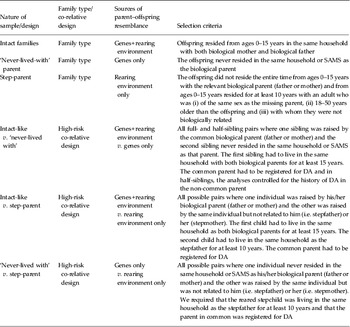
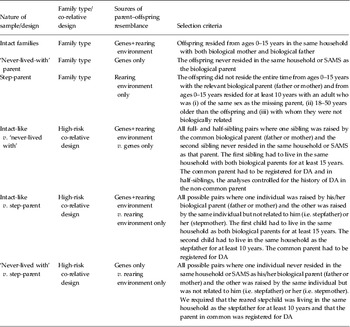
From this database, we first defined three kinds of families using criteria outlined in Table 1: (i) intact families; (ii) ‘not-lived-with’ parent families; and (iii) step-parent families. The ‘not-lived-with’ and step-parents were defined so that their relationship with their offspring maximally resembled that seen between an adoptee and, respectively, his or her biological and adoptive parents. The ‘not-lived-with’ status arose in only a small minority of cases (1.5% of fathers and 4.7% of mothers) through death of the parent in the year of the child's birth. We identified separate groups of families where the father and mother were ‘not-lived-with’ and which contained stepfathers and stepmothers. In our stepfather and stepmother families, the offspring spent on average 1.35 (s.d. = 2.0) and 2.45 (s.d. = 2.6) years with their biological father and mother, respectively.
Description of the three key family types and three high-risk co-relative designs utilized in this report
SAMS, Small Areas for Market Statistics; DA, drug abuse.
We used Cox proportional hazards models to investigate the future risk for DA in offspring as a function of a DA diagnosis in the relevant parent. In these analyses, we always controlled for the DA status of all other relevant biological and step-parents. Robust standard errors were used to adjust the 95% confidence intervals (CIs) as we had several sibling pairs from the same parent. Follow-up time in number of years was measured from age 15 years of the child until the year of first registration for DA, death, emigration or end of follow-up (year 2011), whichever came first. In all models we investigated the proportionality assumption. In order to combine the results from the different samples, we used the Mantel–Haenszel meta-analysis method (Mantel & Haenszel, Reference Mantel and Haenszel1959). We calculated the combined hazard ratios (HRs) and the p values for the heterogeneity tests.
We then compared results from these family types using the same analytic methods with a subset of the sample previously analysed in our Swedish nationwide adoption sample (born 1960–1990 rather than 1950–1993 in the original report; Kendler et al. Reference Kendler, Sundquist, Ohlsson, Palmer, Maes, Winkleby and Sundquist2012). Next, we compared our prior results with findings from three high-risk co-relative designs as outlined in Table 1. We used the same methods in our co-relative designs as in our main analyses except that we included a separate stratum for each pair in the models.
All statistical analyses were performed using SAS 9.3 (SAS Institute, Inc., USA). For our main analyses, we utilized a ‘two-sided’ test, presenting 95% CIs. In our follow-up high-risk co-relative designs, where we had predicted directions of effect and modest sample sizes, to improve power, we utilized a ‘one-sided’ test presenting 90% CIs.
Results
Main analyses: five novel samples
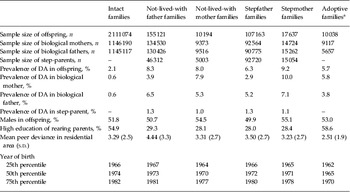
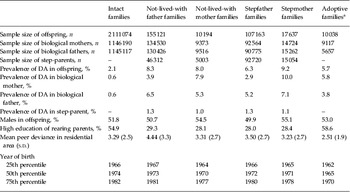
The sample size, rate of DA, age, educational status and community peer deviance for each of our five samples can be seen in Table 2. Sample size was largest for intact families, next for not-lived-with father and stepfather families, and smallest for not-lived-with mother and stepmother families. The intact families stand out in having low rates of DA in biological parents and offspring, and high levels of parental education. Community peer deviance was highest for fathers not lived with and stepfamilies, and broadly comparable in the other three samples.
Features of the five main family types examined as well as adoptive families
DA, Drug abuse; s.d., standard deviation.
a Number of adoptive fathers = 8512, adoptive mothers = 8507. Prevalence of DA was 0.5% in adoptive fathers and 0.9% in adoptive mothers.
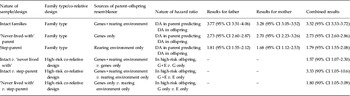
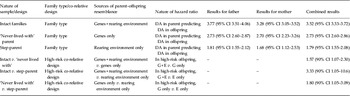
In the intact families – where the same parents contribute genetic risk and rearing – the association between diagnoses of DA in father–offspring and mother–offspring pairs was strong: HR 3.77 (95% CI 3.51–4.06) and 3.28 (95% CI 3.05–3.52), respectively (Table 3). The parent–offspring associations for DA were more modest in the fathers not-lived-with and mothers not-lived-with families where the parents contribute only genetic effects [HR 2.73 (95% CI 2.60–2.87) and 2.70 (95% CI 2.23–3.26), respectively]. The parent–offspring associations for DA were weakest in the stepfather and stepmother samples where the parents provide only the rearing environment [HR 1.81 (95% CI 1.55–2.12) and 1.68 (95% CI 1.12–2.53), respectively]. The HRs between mothers and fathers differed significantly in the intact families (p = 0.01) but not in the not-lived-with families (p = 0.91) or stepfamilies (p = 0.74). Examining the combined effects across both parents, these samples suggests that the parent–offspring transmission of risk for DA – as estimated by the HR – from parents who provide genetics plus rearing, genetics only and rearing only were 3.5, 2.7 and 1.8, respectively.
Results as hazard ratios for risk for DA in three key family types and three high-risk co-relative designs
DA, Drug abuse; CI, confidence interval.
Main analyses – comparison with the adoptive sample
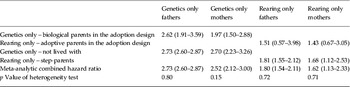
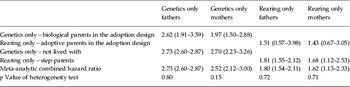
The parent–child relationships in our not-lived-with and stepfamilies were selected to resemble those seen in, respectively, biological and adoptive parents in an adoption design. To examine the similarity of estimates from these methods for DA, we re-analysed, in a comparable manner, results from our prior Swedish national adoption sample of DA (Kendler et al. Reference Kendler, Sundquist, Ohlsson, Palmer, Maes, Winkleby and Sundquist2012). The results are seen in Table 4. None of the heterogeneity tests for the four HRs (biological fathers and mothers from the adoption sample v. not-lived-with parents and adoptive mothers and fathers v. stepmothers and stepfathers) were statistically significant.
Hazard ratios (and 95% confidence intervals) for drug abuse in offspring as predicted by drug abuse in parents from intact families, not-lived-with parents, step parents and biological and adoptive parents from an adoption sample
Follow-up analyses in special populations
We were able to identify three relatively small high-risk co-relative samples in which the parents had distinct parental roles with different offspring (for design details, see Table 1). While limited in power, these samples permit us to replicate our better-powered findings from our five family types with greater control obtained by comparing different offspring of the same parent. First, we identified 492 parents with a DA registration who had 968 full- or half-sibling pairs of biological offspring, one of whom they raised and the second of whom they were a ‘not-lived-with’ parent. Of these pairs, 177 were discordant in the DA outcome and the HR for DA was significantly greater in their reared-biological than their not-lived-with biological child (HR 1.57, 90% CI 1.07–2.30). Second, we located 45 parents with DA who had 64 pairs of offspring, one of whom they raised as their own biological child and the second of whom they were not biologically related but raised as a step-parent. Of these pairs, 16 were discordant for DA, and the HR for resemblance for DA was significantly greater in their reared-biological v. reared non-biological child (HR 3.33, 90% CI 1.05–10.6). Third, we identified 209 parents who had 321 pairs of offspring, one of whom was a biological child to whom they had a ‘not-lived-with’ status and the second was a non-biological child whom they step-parented. Of these pairs, 61 were discordant for DA and the HR was significantly greater in their not-lived-with biological v. stepchild (HR 1.80, 90% CI 1.05–3.09).
Discussion
We sought to determine the degree to which parent–offspring resemblance for DA results from genetic v. rearing effects. Using the complete genealogical and residential data available in Sweden, we expanded beyond the legally sanctioned adoption study, utilizing more naturalistic and representative designs with which we could discriminate genetic and environmental effects.
Our study had three parts. First, we defined and identified three types of parent–offspring relationships in intact families, not-lived-with families and stepfamilies. Combining results from mothers and fathers, the HR for DA in offspring of these relationship types given DA in the parent was 3.52, 2.73 and 1.79, respectively. These results suggest that both genetic and rearing–environmental factors contribute substantially to parent–offspring resemblance for DA. Using the epidemiological framework of the HR, these findings further suggest that genetic effects for DA are moderately stronger than rearing effects. These results are broadly consistent with recent results from a national twin-sibling study of DA in Sweden that found evidence for both genetic and shared environmental influences on DA, with genetic influences being more important (Kendler et al. Reference Kendler, Maes, Sundquist, Ohlsson and Sundquist2014a ).
Second, we re-analysed our adoption sample to be directly comparable with results from our not-lived-with families and stepfamilies. The results did not differ significantly, suggesting that our naturalistic designs were, with respect to DA, comparable with the formal adoption design.
Third, we identified three small high-risk co-relative samples where parents with DA had distinct parenting roles for different offspring. Although known imprecisely, these results validated our main findings with a stronger design that compared relatives matched on high-risk parents. As predicted from our main analyses, the largest difference in DA risk was seen in stepsiblings when a parent with DA raised both a biological child and a stepchild, that is the contrast between genetic risk + rearing v. rearing alone. The next largest difference was seen when a parent had a child with whom he or she did not live v. an unrelated child they step-parented – the contrast between genetics alone v. rearing alone. The smallest difference was seen between biological offspring of the same parent, one of whom was raised in an intact family and the other who never lived with the biological parent – that is, genes + rearing environment v. genes alone.
Noteworthy are six other features of our results. First, an important methodological concern about the validity of adoption studies is the atypicality of adoptive parents (Cadoret, Reference Cadoret1986). They are highly selected and normally have low rates of psychopathology, and high levels of income and education. The reduced level and variation of environmental adversity in adoptive homes might result in an underestimation of rearing effects. Our stepfamilies differ from the adoptive families in having higher rates of psychopathology and lower educational status (Table 2). The variation in peer deviance – a broad index of community social deprivation – is 50% greater in stepfamilies than in adoptive families. The greater HRs seen in the step- v. adoptive parents might reflect the greater variation of adversity seen in the stepfamilies.
Second, our results clarified potential differences in the cross-generational transmission of DA from fathers v. mothers. In our intact and not-lived-with families, the HR for parent–offspring transmission of DA was greater in fathers than in mothers. Some biological mothers may have abused substances while pregnant which could increase the risk for offspring DA through intra-uterine effects (Frank et al. Reference Frank, Rose-Jacobs, Crooks, Cabral, Gerteis, Hacker, Martin, Weinstein and Heeren2011). Our results make it unlikely that such effects play a major role in the mother–offspring transmission of DA as this should result in stronger resemblance for DA in mother–offspring than father–offspring pairs. These results also suggest that misidentification of paternity in Swedish registries – which would produce the same pattern of findings – is insufficiently common to substantially bias our results.
Third, could further examination of our stepfamilies provide insight into the impact of the rearing environment on DA risk? In particular, does the cross-generational transmission of DA result entirely from direct offspring ‘learning’ DA from observing parental figures (Bandura, Reference Bandura1986) or do more indirect disruptions in the rearing environment due to the parental DA also contribute? In both our stepfather and stepmother families, the HR for DA was elevated when the step-parent was registered for criminal behavior but not DA [HRs of 1.57 (90% CI 1.48–1.67) and 1.30 (90% CI 1.03–1.64), respectively]. If the first registration for DA in a step-parent occurred after the stepchild left home, the HR for DA was still substantially elevated in the offspring of both affected stepfathers (HR 1.59, 90% CI 1.31–1.92) and stepmothers (HR 1.63, 90% CI 1.05–2.52). Consistent with our findings that DA in adoptees was predicted by adoptive parental criminal behavior, divorce, death and medical hospitalization (Kendler et al. Reference Kendler, Sundquist, Ohlsson, Palmer, Maes, Winkleby and Sundquist2012), these results in stepfamilies suggest that direct observational learning of DA in children does not account for all of the cross-generational transmission of DA.
Fourth, our results of important environmental contributions to the cross-generational transmission of DA are consistent with prior evidence in Sweden that the risk for DA in high-risk siblings is substantially higher when reared by their own parents than when reared in an adoptive family (Kendler et al. unpublished work).
Fifth, our findings suggest that with sufficient registry information, family constellations can be identified in current populations that contain substantial information about the genetic and environmental sources of parent–offspring resemblance. Furthermore, such family constellations are much more common than adoptive families.
Finally, our results have implications for prevention. Our clear evidence that risk for DA can be environmentally transmitted from parents to offspring provides strong justification for therapeutic efforts to reduce the prevalence of DA in the offspring of high-risk families (Black et al. Reference Black, Nair, Kight, Wachtel, Roby and Schuler1994; Sanders, Reference Sanders2000; Liddle et al. Reference Liddle, Dakof, Parker, Diamond, Barrett and Tejeda2001).
Limitations
These results should be interpreted in the context of five potentially important methodological limitations. First, our results were obtained in the country of Sweden and may or may not extrapolate to other populations. Second, subjects with DA were detected from medical, legal and pharmacy records. This method does not require respondent cooperation or accurate recall and reporting. However, it surely produces both false-negative (individuals with DA who never had medical or legal attention) and false-positive diagnoses (individuals arrested or treated for a drug problem without having DA). We cannot precisely estimate these biases as no large epidemiological study has reported rates of DA in Sweden. However, such a survey, done in neighboring Norway, with similar rates of drug use and DA (Kraus et al. Reference Kraus, Augustin, Frischer, Kummler, Uhl and Wiessing2003; Hibell et al. Reference Hibell, Guttormsson, Ahlstrom, Balakireva, Bjarnason, Kokkevi and Kraus2007), found lifetime prevalence rates of Diagnostic and Statistical Manual of Mental Disorders, revised third edition (DSM-III-R; APA, 1987) DA and dependence of 3.4% (Kringlen et al. Reference Kringlen, Torgersen and Cramer2001), very close to the 3.6% we detected in all of Sweden. The validity of this method is further supported by the very high odds ratios (mean of 52.2; Kendler et al. Reference Kendler, Sundquist, Ohlsson, Palmer, Maes, Winkleby and Sundquist2012) for registration for DA across our different sources.
Third, our various family constellations differed in measures (family socio-economic status and levels of community deprivation) that are related to the risk for DA (Faris & Dunham, Reference Faris and Dunham1939; Warner et al. Reference Warner, Kessler, Hughes, Anthony and Nelson1995; Muntaner et al. Reference Muntaner, Eaton, Diala, Kessler and Sorlie1998; Compton et al. Reference Compton, Thomas, Stinson and Grant2007). We therefore repeated all the key analyses here reported, adding as control variables educational status of the rearing families and community peer deviance (online Supplementary Tables S1 and S2). As expected, the HRs declined for all the observed parent–offspring associations, with the reduction proportionally greatest among the stepfamilies: intact families (HR 3.33, 95% CI 3.15–3.51), not-lived with families (HR 2.52, 95% CI 2.38–2.68) and stepfamilies: (HR 1.49, 95% CI 1.27–1.75). These results suggest that a modest proportion of parent–offspring transmission of DA results from broad social class and community factors.
Fourth, we set 10 years as a minimum duration of cohabitation for step-parents and stepchildren because the sample sized declined substantially with longer periods. Therefore, we were not able to match for duration of rearing between intact families and stepfamilies. Could we have underestimated the impact of parental rearing on transmission of DA? To explore this, we focused on the larger group of stepfather families and found no difference in the HR for DA in stepchildren who lived 5–9 v. 10–14 years with their stepfather [HR 1.68 (95% CI 1.53–1.85) v. HR 1.66 (95% CI 1.40–1.97), respectively]. However, in families where the stepchild lived his/her first 15 years with the stepfather, the HR for DA was increased (HR 2.45, 95% CI 2.08–3.65). Our main analyses may have modestly underestimated the impact of rearing effects on the cross-generational transmission of DA.
Finally, our design permitted us to control genetic relationships and cohabitation but not other aspects of the parent–offspring relationship. For example, we know neither the frequency with which the biological parents visited their ‘not-lived-with’ offspring nor the nature of the step-parent–stepchild relationship. Our hope is that our analyses have accurately depicted aggregate effects of genetic factors and rearing environment in Sweden on parent–offspring transmission of DA. Other research designs would be needed to clarify more fine-grained family processes.
Conclusions
We examined parent–offspring transmission of DA in three family types identified from the general Swedish population: intact, ‘not-lived-with’ and step-parent. The aggregate HR for DA in the offspring given DA in the parent for these three family types was estimated at 3.52, 2.73 and 1.79, respectively. This pattern of results was confirmed by smaller high-risk co-relative control analyses. Our findings suggest that: (i) DA is strongly transmitted from parents to offspring; (ii) genetic and environmental factors both contribute substantially to this cross-generational transmission; and (iii) genetic factors are moderately stronger than rearing effects.
Supplementary material
For supplementary material accompanying this paper visit http://dx.doi.org/10.1017/S0033291714001093.
Acknowledgements
This study was funded by grant no. RO1 DA030005 from the National Institute of Drug Abuse, the Swedish Research Council (no. 2008-3110, 2008-2638), the Swedish Research Council for Health, Working Life and Welfare (no. 2013-1836), the ALF project grant, Lund, Sweden and the Swedish Council for Information on Alcohol and Other Drugs (CAN).
Declaration of Interest
None.