Implications
Supplementation of young pigs’ diets with pharmacological Zn resulted in an improvement in average daily gain and feed conversion ratio, especially in the presence of phytase with 1750 mg/kg Zn from ZnO or additional digestible P with 3500 mg/kg Zn from ZnO. Increasing pharmacological Zn from 0 to 3500 mg/kg reduced apparent P, Na, K and Cu digestibility, indicating interactions between pharmacological Zn and dietary minerals, which may influence growth performance. When supplementing pharmacological Zn, the concentrations of Ca, P and other minerals supplied in the diet need to be considered. In addition, the Na and K digestibility data may indicate a possible role of pharmacological Zn in water secretion and subsequent effects on faecal dry matter or diarrhoea post-weaning.
Introduction
Zinc (Zn) in the form of zinc oxide (ZnO) is commonly fed at pharmacological doses (1500 to 3500 mg/kg) to piglets in order to mitigate diarrhoea post-weaning (Carlson et al., Reference Carlson, Hill and Link1999). However, Hill et al. (Reference Hill, Mahan, Carter, Cromwell, Ewan, Harrold, Lewis, Miller, Shurson and Veum2001) reported a quadratic effect of pharmacological Zn from ZnO supplementation on average daily gain (ADG) and feed efficiency (feed conversion ratio (FCR)) using nursery pigs. The authors reported an increase in ADG and improvements in FCR, as levels of Zn were increased to 2000 mg/kg, but the pigs fed 3000 mg/kg supplemental Zn were 8% lighter and 5% less efficient compared with the nursery pigs fed 2000 mg/kg supplemental Zn. In a different trial, pigs fed 1750 mg/kg Zn from ZnO were heavier and more efficient than pigs fed 0 or 3500 mg/kg Zn, especially in the presence of 2500 FTU/kg phytase added over the top of the diet (Walk et al., Reference Walk, Srinongkote and Wilcock2013). Phytase hydrolyses phytate, a known chelator of Zn, and supplementation with high levels of dietary phytase increases serum Zn to a similar level as that of 1750 mg/kg supplemental Zn from ZnO (Walk et al., Reference Walk, Srinongkote and Wilcock2013). Standard levels of phytase increased plasma Zn and retained Zn (mg/day) in 9-kg piglets (Revy et al., Reference Revy, Jondreville, Dourmad and Nys2004), further indicating that phytase has an influence on Zn availability in weaned pigs.
In addition to influencing Zn concentrations in the blood, Walk et al. (Reference Walk, Srinongkote and Wilcock2013) reported a negative influence of pharmacological Zn from ZnO supplementation on plasma phosphorus (P), regardless of phytase supplementation. The authors hypothesised that Zn from ZnO precipitates with P, resulting in a reduction of P digestion and absorption. The antagonistic relationship between P and Zn is well-defined in rats (Cabell and Earle, Reference Cabell and Earle1965; Zemel and Bidari, Reference Zemel and Bidari1983). For example, Cabell and Earle (Reference Cabell and Earle1965) reported that rats fed low dietary Zn (18 mg/kg) gained 43% less weight when fed diets with 1.2% dietary calcium (Ca) and P compared with rats fed low dietary Zn with 0.30% Ca and P. However, Martinez et al. (Reference Martinez, Link and Hill2005) reported no effect of supplemental Zn from ZnO on plasma P, and there are no known reports evaluating the influence of pharmacological Zn on P digestibility. Therefore, the objectives of this experiment were to evaluate growth performance, faecal scores, plasma minerals and apparent total tract mineral digestibility of piglets fed graded levels of pharmacological Zn from ZnO and different sources of P (4.5 g/kg digestible P, 4.5 g/kg digestible P plus 2500 FTU/kg of phytase or 5.5 g/kg digestible P) from day 0 to 20 post-weaning.
Material and methods
The trial was conducted according to the Animals (Scientific Procedures) Act 1986, implemented by the Department for Health, Social Security and Public Safety in Northern Ireland.
Animals and husbandry
A total of 720 crossbred (PIC337) weaned pigs (28±3 days post-farrowing) were sorted by BW and randomly allotted to nine dietary treatments in a 20-day experiment. Dietary treatments were replicated using eight pens (blocked over time with four replicates/block) of 10 pigs of mixed sex in each pen (five intact males and five females). The average initial BW of each pen was 9.5±0.3 kg. Dietary treatments were arranged as a 3×3 factorial, which included three sources of supplemental P (4.5 g/kg digestible P, 4.5 g/kg digestible P plus 2500 phytase units (FTU)/kg or 5.5 g/kg digestible P) and three levels of supplemental Zn from ZnO (0, 1750 or 3500 mg/kg). The phytase used was derived from an Escherichia coli six-phytase expressed in Trichoderma reesei and contained a declared activity of 5000 FTU/g (Quantum Blue; AB Vista Feed Ingredients, Marlborough, UK). Phytase activity in the feed was analysed according to modified methods of Engelen et al. (Reference Engelen, van der Heeft, Randsdorp and Somers2001), where one phytase unit is defined as the amount of enzyme required to release 1 mole of inorganic P/min from rice bran phytate at pH 4.5 and 60°C. Titanium dioxide was added (3.0 g/kg) to the diets as an indigestible marker.
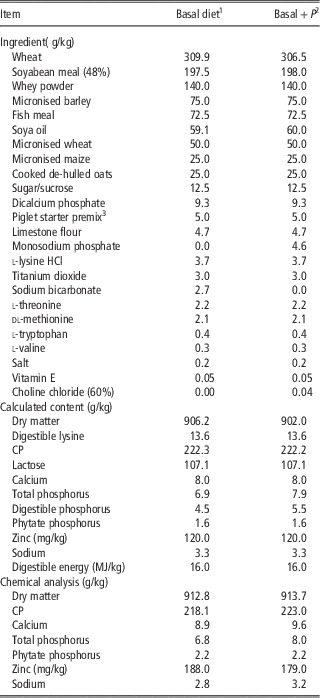
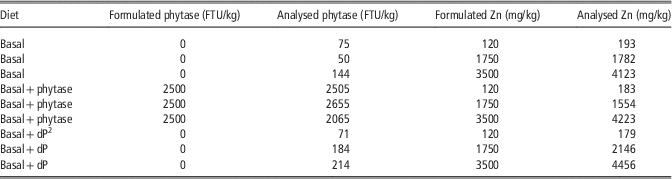
Diets were fed in a pelleted form from day 0 to 20 post-weaning. The ingredient compositions, in addition to the calculated and analysed nutrient inclusion levels of the experimental diets, are presented in Tables 1 and 2. The phytase, additional P from monosodium phosphate and Zn were added over the top of the basal diet in place of corn and soyabean meal. All diets were formulated to meet or exceed National Research Council (1998) requirements for 5- to 20-kg pigs, including Ca, P and Zn. All pigs were housed in a closed-sided barn with natural lighting and at least 2 h of artificial lighting per day at a stocking density of 0.38 m2/pig. The pens were composed of concrete walls, plastic slats and plastic pen dividers and contained a stainless steel bowl drinker and multi-space plastic dry feeder to facilitate ad libitum access to water and feed.
Composition and chemical composition of experimental diets (as-fed basis)

1 Five additional diets, identical to the basal diet were formulated to contain zinc from ZnO (82% Zn; PigZin; DSM Nutritional Products Ltd, Derbyshire, UK) at 1750 or 3500 mg/kg and 0 or 2500 FTU/kg of phytase at the expense of corn. The phytase used was Quantum Blue (AB Vista Feed Ingredients, Marlborough, UK) and had an expected activity of 5000 FTU/g.
2 Two additional diets, identical to the basal+P diet were formulated to contain zinc from ZnO (82% Zn; PigZin) at 1750 or 3500 mg/kg at the expense of corn.
3 Supplied per kilogram of diet: vitamin A (retinyl acetate), 13 180 IU; vitamin D (cholecalciferol), 3000 IU; vitamin E (α-tocopheryl acetate), 180 IU; vitamin K (menadione dimethylpyrimidinol bisulphate), 3.0 mg; folic acid, 1.0 mg; niacin, 25.0 mg; calcium pantothenate, 12.3 mg; riboflavin, 8.0 mg; vitamin B12, 0.02 mg; thiamine, 3.0 mg; pyridoxine, 4.0 mg; biotin, 0.1 mg; selenium (sodium selenite, 4.4%), 0.2 mg; iodine (calcium iodate anhydrous), 2.0 mg; iron (iron sulphate monohydrate), 150 mg; manganese (manganese oxide), 45 mg; copper (copper sulphate pentahydrate), 160 mg; and zinc (zinc sulphate monohydrate), 110 mg.
Recovered phytase activity and analysed zinc composition of the experimental diets (as-fed basis)Footnote 1

1 Diets were analysed in duplicate for Zn using ICP-OES (Perkin Elmer Optima 5300DV; Perkin Elmer, Llantrisant, UK) and phytase recoveries according to methods of Engelen et al. (Reference Engelen, van der Heeft, Randsdorp and Somers2001).
2 Digestible phosphorus.
Response variables
Pig BW and feed disappearance were measured at the beginning of the experiment (day 0) and again on day 20 to calculate average daily gain (ADG), average daily feed intake (ADFI) and feed conversion ratio (FCR). Faecal consistency scores were recorded daily on a pen basis from day 1 to 10 inclusive. Scoring was based on a 4-point scale (1: firm; 2: soft, spreads slightly; 3: very soft; and 4: watery), according to methods of Wellock et al. (Reference Wellock, Fortomaris, Houdijk and Kyriazakis2006). Scores were assessed by the same stockperson who was unaware of the treatment allocation of pigs. Two scores were taken per pen and pooled to obtain an average faecal consistency score per day. Blood samples were collected from two pigs per pen via jugular venipuncture on day 20. Samples (~6 ml/tube) were collected into plastic tubes containing no anticoagulant. Blood was allowed to clot at room temperature, centrifuged at 1155×g for 5 min and plasma was separated and stored at −20°C until further mineral analyses. Grab faecal samples were collected from the entire pen once daily and pooled per pen from day 18 to 20. The pooled faecal samples were dried for 48 h at 80°C and milled before mineral analyses. Diet dry matter (DM), CP, Ca, P, Zn and sodium (Na) and plasma and faecal Ca, magnesium (Mg), P, potassium (K), Na, copper (Cu) and Zn were determined at the Sciantec Analytical Services Ltd (Cawood, North Yorkshire, UK). For determination of Ca, Mg, P, K, Na, Cu or Zn, diet and faecal samples were ashed at 510°C, and subsequently diets, faecal samples and plasma samples were digested with a mixture of nitric and hydrochloric acid. The diluted and filtered samples were then aspirated into an ICP-OES (Perkin Elmer Optima 5300DV; Perkin Elmer, Llantrisant, UK), and the optical emission was measured at the wavelength selected for that mineral using standards of known concentration. Titanium in the diets and faecal samples was analysed according to methods of Short et al. (Reference Short, Gorton, Wiseman and Boorman1996). CP concentration in the diets was determined using the DUMAS method and a Leco FP-528 N analyser (LECO Corporation, St. Joseph, MI, USA), and the DM content was determined by gravimetry. Plasma alkaline phosphatase activity was determined by Central Analytical Services (Midlothian, Scotland, UK) using a United Kingdom Accreditation Service-approved method and spectrophotometry (RX Imola Analyser; Randox Laboratories; Dungloe, Ireland). Apparent mineral digestibility was calculated using the following equation: apparent digestibility=100−[(markerdiet/markerfaeces)×(mineralfaeces / mineraldiet)]×100.
Statistical analysis
All data were analysed as a completely random design using the fit model platform (JMP 10.0; SAS Institute Inc., Cary, NC, USA). The statistical model included a 3×3 factorial arrangement of treatments to determine the influence of pharmacological Zn, P source and the interaction. When differences were significant, interactive or main effect means were separated using orthogonal contrast statements. Significant interactions were separated using linear and quadratic contrasts between Zn dose (0, 1750 or 3500 mg/kg Zn from ZnO) within each P source (4.5 g/kg digestible P, 4.5 g/kg digestible P plus 2500 FTU/kg of phytase or 5.5 g/kg of digestible P). Significant main effects of Zn from ZnO were separated using equally spaced linear and quadratic contrast statements. Significant main effects of P source were separated using orthogonal contrast statements to determine differences between 4.5 and 5.5 g/kg of digestible P or the effect of phytase supplementation (2500 FTU/kg) compared with diets containing 4.5 and 5.5 g/kg of digestible P. Pen served as the experimental unit and significance was accepted at P<0.05. Initial BW appeared to be different for pigs fed the different pharmacological Zn levels (P=0.04). Therefore, initial BW was used as a covariate when evaluating treatment differences in ADG, ADFI and FCR. Replicate pen was also included in the model to account for differences between replicating the treatments over time.
Results
The analysed chemical composition and phytase recoveries of the diets were similar to formulated values and within acceptable ranges when sampling and assay variations were considered (Tables 1 and 2). Mortality was >1% and was not influenced by pharmacological Zn or P source or the interaction (data not shown). Initial BW appeared to be influenced by pharmacological Zn supplementation. However, this effect was likely the result of replication over time, and therefore initial BW was used as a covariate in the model to determine treatment differences for ADG, ADFI and FCR.
Growth performance
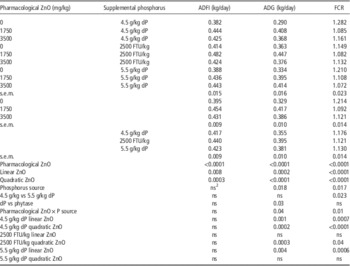
From weaning to 20 days post-weaning, ADFI increased (quadratic P<0.05), irrespective of P source, from 0.395, 0.454 and 0.431 kg/day for pigs fed 0, 1750 and 3500 mg/kg of Zn from ZnO, respectively (Table 3). There was no main effect of P source or Zn level×P source interaction on ADFI. There was a significant Zn level×P source interaction on ADG and FCR from weaning to 20 days post-weaning (Table 3). Pigs fed 4.5 g/kg digestible P or 4.5 g/kg digestible P plus 2500 FTU/kg phytase gained more per day (quadratic P<0.05) and had better FCR (quadratic P<0.05) when they were fed 1750 mg/kg supplemental Zn. However, pigs fed 5.5 g/kg digestible P gained more per day (linear P<0.05) and were more efficient (linear P<0.05) when they were fed 3500 mg/kg supplemental Zn.
Influence of pharmacological zinc oxide and phosphorus source (phytase or additional phosphorus from monosodium phosphate) on piglet performance from weaning to 20 days post-weaningFootnote 1

ADFI=average daily feed intake; ADG=average daily gain; FCR=feed conversion ratio; dP=digestible phosphorus.
1 Data are means of eight replicates of 10 pigs per replicate pen.
2 Not significant (P>0.05).
Faecal consistency scores
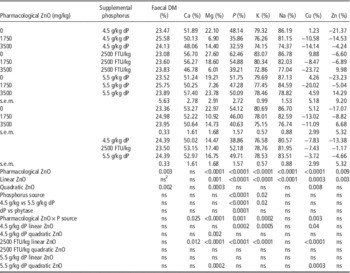
Faecal consistency scores were <2.0 for all the days measured and not significantly influenced by Zn level, P source or the interaction (data not shown). Faecal DM was influenced (quadratic P<0.05) by supplemental Zn level, whereas DM was 23.36, 24.98 or 23.95% in pigs fed 0, 1750 or 3500 mg/kg supplemental Zn from ZnO, respectively (Table 4). There was no main effect of P source or Zn level×P source on faecal DM.
Influence of pharmacological zinc oxide and phosphorus source (phytase or additional phosphorus from monosodium phosphate) on faecal dry matter and apparent faecal mineral digestibility of 17-kg pigsFootnote 1

DM=dry matter; dP=digestible phosphorus.
1 Data are means of eight replicates of 10 pigs per replicate pen.
2 Not significant (P>0.05).
Apparent mineral digestibility
Apparent faecal digestibility of Ca, Mg, P, K and Cu were influenced by a significant Zn level×P source interaction (Table 4). Supplemental Zn had no influence on apparent faecal Ca digestibility, except in the presence of 4.5 g/kg digestible P plus 2500 FTU/kg of phytase, which resulted in a linear (P<0.05) reduction in Ca digestibility as supplemental Zn in the diet increased from 0 to 3500 mg/kg. When pigs were fed diets supplemented with 4.5 g/kg digestible P without phytase, apparent faecal Cu (linear P<0.05), Mg (quadratic P<0.05), P (linear P<0.05) and K (linear P<0.05) digestibilities were reduced as supplemental Zn from ZnO increased from 0 to 3500 mg/kg. Similarly, supplementation of pig diets with 4.5 g/kg digestible P plus 2500 FTU/kg of phytase reduced (linear P<0.05) apparent faecal Mg, P, K and Cu digestibilities as supplemental Zn from ZnO increased from 0 to 3500 mg/kg. However, when pigs were fed 5.5 g/kg digestible P, there was no influence of supplemental Zn on apparent faecal digestibility of P or K and a quadratic (P<0.05) influence of supplemental Zn on the apparent faecal digestibility of Mg and Cu. Apparent faecal digestibility of Na was reduced (linear P<0.05) as Zn supplementation in the diet increased from 0 to 3500 mg/kg, irrespective of P source. In addition, irrespective of P source, apparent faecal digestibility of Zn increased (linear P<0.05) from −17.1 to −8.82 or 6.68% as supplemental Zn in the diets increased from 0 to 1750 or 3500 mg/kg, respectively.
Plasma minerals
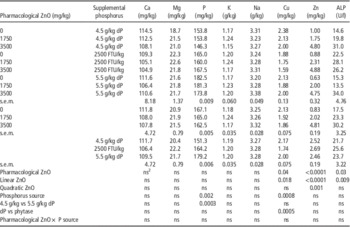
There was no effect of supplemental Zn×P source on any mineral evaluated in the plasma (Table 5). Supplemental Zn or P source had no effect on the concentrations of Ca, Mg, K or Na in the plasma. However, there was a significant main effect of supplemental Zn on plasma Cu, Zn and alkaline phosphatase concentrations (Table 5). Cu concentrations in the plasma decreased linearly (P<0.05) from 2.13 to 1.92 and 1.86 mg/kg as supplemental Zn increased in the diet from 0 to 1750 and 3500 mg/kg, respectively. Plasma Zn concentrations increased (quadratic P<0.05) from 0.83 to 2.02 or 4.81 mg/kg as dietary Zn supplementation increased from 0 to 1750 or 3500 mg/kg, respectively. Plasma alkaline phosphatase increased (linear P<0.05) from 17.5 to 23.3 or 30.2 U/l as supplemental Zn increased from 0 to 1750 or 3500 mg/kg, respectively. In addition, there was a significant main effect of P source on plasma P and Cu (Table 5). Pigs fed 5.5 g/kg digestible P had a higher (P<0.05) concentration of P in their plasma than pigs fed diets containing 4.5 g/kg digestible P without phytase, but this was not different from the plasma P concentration in pigs fed diets with 4.5 g/kg digestible P plus phytase. Pigs fed 4.5 g/kg digestible P plus phytase had reduced (P<0.05) plasma Cu concentrations compared with pigs fed diets supplemented with 4.5 or 5.5 g/kg digestible P without phytase.
Influence of pharmacological zinc oxide and phosphorus source (phytase or additional phosphorus from monosodium phosphate) on plasma minerals of 17-kg pigsFootnote 1

ALP=alkaline phosphatase; dP=digestible phosphorus.
1 Data are means of eight replicates of 10 pigs per replicate pen.
2 Not significant (P>0.05).
Discussion
Pigs were healthy throughout the trial, with a cull or mortality rate <1% and faecal scores <2. The basal diets were formulated to contain adequate or excess nutrients, including Ca, P and Zn, although some of the diets were supplemented with phytase. Regardless of the nutrient adequacy of the diets, the high health status of the animals, as well as the occurrence of minimal diarrhoea, ADG and FCR were influenced by supplemental Zn and P source. More specifically, ADG and FCR linearly improved in pigs fed 5.5 g/kg digestible P as supplemental Zn increased from 0 to 3500 mg/kg. However, when pigs were fed 4.5 g/kg digestible P without or with phytase, there was a quadratic effect of supplemental Zn on ADG and FCR, with pigs fed 1750 mg/kg supplemental Zn having the highest ADG and the best FCR. Improvements in growth performance associated with pharmacological Zn from ZnO have been previously reported (Carlson et al., Reference Carlson, Hill and Link1999; Hill et al., Reference Hill, Mahan, Carter, Cromwell, Ewan, Harrold, Lewis, Miller, Shurson and Veum2001). Similar to the results of the present study, Hill et al. (Reference Hill, Mahan, Carter, Cromwell, Ewan, Harrold, Lewis, Miller, Shurson and Veum2001) reported a quadratic effect of pharmacological Zn supplementation on ADG and feed efficiency; and nursery pigs fed 3000 mg/kg supplemental Zn from ZnO were 8% lighter and 5% less efficient compared with nursery pigs fed 2000 mg/kg supplemental Zn from ZnO. Walk et al. (Reference Walk, Srinongkote and Wilcock2013) fed 1750 or 3500 mg/kg of supplemental Zn from ZnO and reported no effect on ADG of 7- to 11-kg pigs and a linear reduction in ADG of 11- to 21-kg pigs. Martinez et al. (Reference Martinez, Link and Hill2005) fed 1000 or 4000 mg/kg Zn from ZnO to 7-kg pigs for 21 days and reported no effect of dietary Zn on growth performance. The inconsistencies in the performance benefits of pharmacological Zn from ZnO may be associated with numerous factors such as the age and health status of the pigs, the level of Zn from ZnO supplemented in the diet, the length of time the pigs are fed pharmacological Zn, the environment in which the pigs are housed, the presence of dietary phytase and the level of dietary P.
In the present trial, phytase supplementation in diets containing 4.5 g/kg digestible P improved ADG and FCR, but the magnitude of the performance response was associated with the level of supplemental Zn in the diet. Previous authors have also reported improvements in ADG or ADFI of pigs fed Ca- and P-adequate diets supplemented with phytase (Adeola et al., Reference Adeola, Lawrence, Sutton and Cline1995) or phytase and pharmacological Zn from ZnO (Walk et al., Reference Walk, Srinongkote and Wilcock2013). However, Martinez et al. (Reference Martinez, Link and Hill2005) reported no effect of 500 FTU/kg of phytase on growth performance of 7-kg pigs when supplemented in diets containing various levels of pharmacological Zn from ZnO. Augspurger et al. (Reference Augspurger, Spencer, Webel and Baker2004) reported a 30% reduction in microbial phytase efficacy when supplemental ZnO or ZnCl was included at 1500 mg/kg in diets fed to 7-kg pigs. Zn has an affinity to phytate; however, the binding of Zn to phytate appears to be dependent on the molar concentrations of Zn and Ca relative to the molar concentration of phytate and the pH of the solution (Champagne and Phillippy, Reference Champagne and Phillippy1989; Champagne et al., Reference Champagne, Fisher and Hinojosa1990; Gifford and Clydesdale, Reference Gifford and Clydesdale1990; Simpson and Wise, Reference Simpson and Wise1990). In the present trial, the Zn-to-phytate molar ratio was calculated to be 2 : 1 or 4 : 1 in the diets of pigs fed 1750 or 3500 mg/kg supplemental Zn, respectively. Therefore, similar to previously published in vitro trials (Champagne et al., Reference Champagne, Fisher and Hinojosa1990; Simpson and Wise, Reference Simpson and Wise1990), Zn and phytate precipitation may have occurred more readily in pigs fed 3500 mg/kg supplemental Zn than those fed 1750 mg/kg supplemental Zn. This precipitation would result in reduced phytate hydrolysis and decreased mineral digestibility, specifically of Ca and P.
Apparent faecal Ca digestibility was not influenced by dietary Zn or by 4.5 or 5.5 g/kg digestible P in the absence of phytase. However, supplementing phytase resulted in a linear decrease in apparent faecal Ca digestibility, as dietary Zn increased from 0 to 3500 mg/kg. Similarly, the dietary inclusion of supplemental Zn from 0 to 3500 mg/kg resulted in a linear reduction in apparent faecal P digestibility, especially in pigs fed 4.5 g/kg digestible P without phytase, whereas there was no effect of supplemental Zn on apparent faecal P digestibility in pigs fed 5.5 g/kg digestible P. Meyer et al. (Reference Meyer, Lindemann, Cromwell, Monegue and Inocencio2002) reported pharmacological Zn from ZnO reduced Ca and P absorption in piglets fed diets containing 0.78% total P and 0.95% Ca. The authors concluded that, when considering pharmacological Zn supplementation in pig diets, the lowest possible level should be evaluated from an environmental and nutritional perspective.
These previous authors reported a 20-fold increase in Zn excretion and a reduction in Zn absorption as ZnO increased from 0 to 3000 mg/kg Zn (Meyer et al., Reference Meyer, Lindemann, Cromwell, Monegue and Inocencio2002). This is in contrast with the apparent faecal Zn digestibility of the present trial, which was negative and increased as ZnO supplementation increased to 3500 mg/kg. However, Buff et al. (2005) reported a 53% increase in Zn absorption and a 60% increase in Zn retention when pigs were fed 2000 mg/kg Zn from ZnO compared with a basal diet containing 162 mg/kg Zn. The discrepancies in the data may be due to collection methods, the time and age of the pigs at sampling, ADFI – and thus average daily Zn intake – and the bioavailability of the source of Zn used.
Although increasing supplemental Zn from ZnO increased Zn digestibility, it actually reduced Cu, Mg, K and Na digestibility, and this is in agreement with Meyers et al. (Reference Meyer, Lindemann, Cromwell, Monegue and Inocencio2002). The extent of the effect of pharmacological ZnO on Cu, Mg, K and Na digestibility varied with dietary ZnO concentration or P source, and in some cases (Mg and Cu) no real trends or explanations can be determined. However, in the case of Na and K, it is interesting to note that pharmacological ZnO may have an impact on the osmotic gradient and the flux of water through the intestinal tract. For example, Zn from ZnCl has been reported to block the K-channels that regulate enterocyte Na and Cl flux (Hoque et al., Reference Hoque, Rajendran and Binder2005), and Cl secretion is the principle determinant of luminal hydration (Berkes et al., Reference Berkes, Viswanathan, Savkovic and Hecht2003). Under normal conditions of Cl secretion, Na follows, resulting in an accumulation of NaCl and an osmotic gradient for water diffusion into the intestinal lumen (Berkes et al., Reference Berkes, Viswanathan, Savkovic and Hecht2003). Therefore, in the present trial, Zn from ZnO may have blocked both Na and K absorption from the intestinal lumen, which resulted in a linear reduction in Na and K digestibility. This decrease in luminal uptake of Na and K may have reduced water secretion into the intestinal lumen, which resulted in an increase in faecal DM with pharmacological ZnO supplementation.
The concentration of Zn or alkaline phosphatase activity in the plasma increased as supplemental Zn from ZnO increased in the diet, and this is in agreement with previous authors (Hill et al., Reference Hill, Mahan, Carter, Cromwell, Ewan, Harrold, Lewis, Miller, Shurson and Veum2001; Martinez et al., Reference Martinez, Link and Hill2005; Shelton et al., Reference Shelton, Tokach, Nelssen, Goodband, Dritz, DeRouchey and Hill2011). Hahn and Baker (Reference Hahn and Baker1993) plotted a quadratic effect of plasma Zn on ADG, whereas ADG increased by 18% as plasma Zn concentration increased from 0.85 to 1.99 mg/l and then decreased by 10% as plasma Zn concentration increased to 3.27 mg/l. This is in agreement with the plasma Zn concentrations in the present trial, except when supplemental P was included in the diets. For example, pigs fed 3500 mg/kg Zn from ZnO were 7% lighter and 3% less efficient than pigs fed 1750 mg/kg supplemental Zn, and this corresponds to an increase in plasma Zn from 2.02 to 4.81 mg/kg.
There was no effect of supplemental Zn on plasma P and this is in agreement with Martinez et al. (Reference Martinez, Link and Hill2005) but contradictory to Walk et al. (Reference Walk, Srinongkote and Wilcock2013) who reported pharmacological ZnO reduced serum P concentration. Shelton et al. (Reference Shelton, Tokach, Nelssen, Goodband, Dritz, DeRouchey and Hill2011) reported pharmacological ZnO reduced plasma P, but only in the presence of 150 mg/kg Cu from tri-basic CuCl. In the present trial, Cu concentration in the plasma was reduced as supplemental Zn increased, and this has been previously reported by Hill et al. (Reference Hill, Mahan, Carter, Cromwell, Ewan, Harrold, Lewis, Miller, Shurson and Veum2001). However, in other studies, pharmacological Zn from ZnO had no effect on plasma Cu concentration (Buff et al., Reference Buff, Bollinger, Ellersieck, Brommelsiek and Veum2005; Shelton et al., Reference Shelton, Tokach, Nelssen, Goodband, Dritz, DeRouchey and Hill2011) or actually increased plasma Cu concentration, except when both Zn and Cu were combined in the diet (Shelton et al., Reference Shelton, Tokach, Nelssen, Goodband, Dritz, DeRouchey and Hill2011). Differences in the results between the present trial and the previously reported trials may be associated with the level of Cu or Zn fed or the source of Cu supplied in the diets.
In conclusion, the performance, plasma and digestibility data from the present trial indicate a complex interaction between supplemental Zn and minerals, particularly Ca, P, Cu, Na and K. Supplemental Zn from ZnO improved growth performance, especially at 1750 mg/kg Zn with phytase. Increasing the concentration of supplemental Zn in the diet from 0, 1750 to 3500 mg/kg reduced Ca, P, Na, K, Mg and Cu digestibility, which in some cases was mitigated or exacerbated by additional P from monosodium phosphate or phytase. Understanding the factors that influence the binding of these minerals to phytate or precipitation with each other will facilitate more accurate use of these minerals in feed formulations and an improvement in animal performance.
Acknowledgements
The authors acknowledge Dr Ian Wellock at Primary Diets for his help with feed formulation and provision of the diets. The authors also acknowledge AFBI pig research farm staff.