Mama says that Indians, too, would suffer ‘Jim Crow’ laws if we hadn't wiped most of them out with bullets and diseases. In south Florida, there are few left, but Papa says they have started to come in to trade at Everglade with dugouts full of deer hides, plumes, and pelts …Footnote 1
So writes a female character in Peter Matthiessen's epic Florida novel Shadow Country, set in Everglades country in the late nineteenth century. Although a fictional musing, it points to a real historical issue: the presence of Native Americans – those “few left” after wars, diseases, and federal policies of removal – in the racially segregated South. This article argues that the racial symbolism of the Seminoles presented a particular problem to white promoters of Florida. Predominantly focussed on whites and blacks, constructions of race in the segregated South of “Jim Crow” often fixated upon ideas of purity and order; the notion that the two races were fundamentally different and therefore miscegenation was both a crime and an abomination.Footnote 2 While the Everglades-based Seminoles existed outside this binary racial coding, they had long been associated with runaway slaves, racial mixture, and defiance of government authority, and therefore did not “fit” into the racial ideology espoused by proponents of the New South.Footnote 3 Nevertheless, promoters invested in the selling of Florida to the American public began to see commercial potential in the Seminoles towards the turn of the century, when, as “Papa” notes in Shadow Country, the Seminoles were coming into greater contact with whites with the southward push of development into the peninsula. Consequently, state boosters, including railroad agents and magazine writers, cultivated new, romantic depictions of the Seminoles which often involved interlinked processes of historical erasure and racial “realignment.” At times aided by the work of ethnologists, promoters effectively cut away the historical ties between the Seminoles and runaway black slaves. From being seen as craven mixed-race killers central to earlier notions of Florida as a “forbidden land,” the Seminoles were recast as benign specimens of moral and racial purity and saleable symbols of the state's unique appeal.Footnote 4 Superficially uplifting in its appraisal of the Seminoles, the new representations enabled whites to incorporate the Seminoles within the promotional and racial ideals of Jim Crow Florida.
None of which should diminish the efforts of the Seminole and Miccosukee Indians – or i:laponathli:’ as the Mikasuki-speaking Seminoles call themselves – as they sought to protect their communities in the face of white encroachments and ultimately developed extensive commercial interests in south Florida, through tourist camps created in the early twentieth century to bingo gaming and casinos from the 1970s (since this article's focus is on booster representations of the Seminoles, it will refer to the tribes as Seminoles rather than as i:laponathli:’).Footnote 5 In The Enduring Seminoles, Patsy West has shown how the Seminoles evolved from turn-of-the-century “alligator wrestling” in white-owned tourist camps to formal tribal status in 1957 to the tribal-owned “casino gambling” institutions that have helped to make them arguably the richest tribe on earth, exemplified by the Seminole Tribe of Florida's purchase in 2006 of Hard Rock International (including casinos, restaurants, and retail stores in forty-five countries as well as the world's largest music memorabilia collection) for nearly a billion dollars.Footnote 6 Using interviews with employees of the tourist attractions, both Indian and non-Indian, West argues that the Seminoles were not exploited by white developers in Progressive Era Florida, given that the Seminoles were increasingly keen to be part of the growing tourism industry due to their desperate economic situation: indeed, the “success of the endeavour was fired by the i:laponathli:’ desire to retain their freedom, economic and otherwise, from the federal government.” Hence tourism “set the stage for the i:laponathli:’ to mold their identity and, with it, the popular conception of the Florida Seminoles.”Footnote 7 Jay Mechling has taken an alternative approach, examining the ways in which whites envisaged and sought to make profitable use of the Seminoles. As Mechling notes, “The Seminoles played a key symbolic role in the social construction of the meanings of Florida through tourism.” In particular, the “white audience loved the ‘wildness’ of the Seminoles” which was inextricably tied up with their Everglades home, at a time when developers began the first systematic attempts to drain the wetlands for white settlers.”Footnote 8
Vital as these contrasting accounts are, they overlook the mixed-race element of the Seminole story and how it was reconfigured in white promotion of Florida and the Seminoles. Its significance goes beyond the Jim Crow era: even today, the “black Seminole” issue has cultural, legal, and financial ramifications, evident in the controversy over the Seminoles' exercising of tribal sovereignty by excluding the descendants of freedmen from their tribe in the 1990s and 2000s.Footnote 9 The Seminole Nation came under a great deal of criticism in the US news media following the freedmen decision, a critique which Susan A. Miller has argued amounts to “the counterhistorical narrative of a ‘multiracial’ history of Seminole–African/African American relations.”Footnote 10 Such events and debates go far beyond the remits of this article, but point to the sustaining complexity of issues of tribal sovereignty and racial politics in the case of the Seminoles.
The focus of this article is inevitably much narrower: on white representations of the Seminoles in the formative Jim Crow period (1880s to 1920s), when they began to feature more and more in the selling of south Florida. Given the promotional context, the veracity of these depictions is thoroughly questionable, although it is worth noting that physical anthropologists who studied the Seminoles in 1970 found that their “serologic and morphologic” factors were “similar to Cherokee ‘full-bloods’ ” with a “small amount of admixture” with African Americans.Footnote 11 In dealing with white constructions of Native Americans, this paper offers scarce insight into the actions of the Seminole and Miccosukee peoples of Florida. Yet, as advertisement-like creations, the constructions are telling in themselves, indicating how ideas of and anxieties over race shaped white approaches to Florida and its nonwhite peoples. While historians have taken different approaches to studying advertisements and their significance in US culture, this paper benefits, in particular, from Roland Marchand's work on product advertising – a source material which shares key similarities with state promotion – as “a basis for plausible inference about popular attitudes and values.” For Marchand, what advertisers strove for was “not a true mirror [of reality],” but “a Zerrsspiegel, a distorting mirror that would enhance certain images” – and remove others altogether.Footnote 12 With the selling of the Florida Seminoles, the removal centred on the nineteenth-century notion of a “multiracial history of Seminole–African” relations which disturbed many white southerners. Instead, white ideals of Native American wildness and racial purity were hoisted onto the tribe, supporting the “incorporation” of the Seminoles into the promotion of Florida.
On one level, that incorporation reflected national changes in white attitudes towards Native Americans in the late nineteenth century, when Indians and their cultures became common advertising material.Footnote 13 Particularly after the Battle of Wounded Knee in 1890 – the final military engagement between Native Americans and the United States Army – Indians were seen less and less as a threat to white expansion and were appropriated into the mainstream culture of novels, theatre, and, later, motion pictures, albeit often as foes.Footnote 14 Fascination with Indians helped to make Buffalo Bill's Wild West Show, which ran from 1883 to 1916, “one of the largest, most popular, and most successful businesses in the field of commercial entertainment.”Footnote 15 In the Southwest, the Santa Fe Railroad advertised its lines with Native American-themed posters and exhibitions of Pueblo and Zuni Indians for tourists en route: a policy reproduced at countless state fairs and expositions.Footnote 16 Yet the case of the Seminoles contained a distinctive sectional element which sets it apart. As the Wild West terminology suggests, region infused white ideas about Native Americans, both in this period and later: it was the West – of wilderness, frontiersmen, and “savage” Indians – that enchanted the American imagination. With the West largely conquered by the 1890s, the section still served as a mythic wellspring for American exceptionalism, especially for Americans inhabiting an increasingly urban and industrial North. Excepting Texas, meanwhile, the states of the Confederate South were largely exempt from this frontier and Indian mythology. Popular romances set in the South tended to focus on the plantation, with rarely an Indian in sight.Footnote 17 For understandable reasons: the Indian Removal policies of the 1830s had overseen the displacement of the vast majority of the South's indigenous population. Northern political interest in the post-Civil War South, moreover, was dominated by volatile issues such as sectional reconciliation and emancipated African Americans. Indeed, the sectional contrast between West and South was arguably most stark when national commentators discussed America's so-called racial “questions.” Debates on the “Indian Question” focussed on the western plains, as federal policy shifted clumsily away from the concentration of Native Americans onto reservations and towards Americanization, which, through land reform, formal education, and emphasis on “individual identity,” aimed to assimilate Indians into American society.Footnote 18 Commentators on the “Negro Question,” meanwhile, wrote almost exclusively about the Redeemed South. As Joel Martin writes, “Viewed from a distance, it seems there was a great national division of labour taking place in the production of discourses on race” in Gilded Age America.Footnote 19 The South was biracial (black and white) and Indians – those left – belonged to a vanishing West.
The Seminoles problematized these traditional matrices. In the southern state of Florida, Native Americans became a significant theme in state promotion, indicating that this was not strictly a western phenomenon. At the same time, the Seminoles fell outside the black–white paradigm which dominated New South racial politics – and which, as Grace Hale has argued, underpinned white identity during Jim Crow.Footnote 20 Florida, to be sure, was a distinctive southern state – geographically but also in terms of its economy, heritage, and reputation. “Florida,” Stephen Whitfield has written, “seems much more than or quite different from the rest of the South.”Footnote 21 Underpopulated prior to the Civil War, the state showed a pace of development afterwards which, as two historians of the South wrote, by 1900 “made Florida southern only in geography.”Footnote 22 State promoters often proclaimed Florida's exceptionalism from the staple-crop South, highlighting its tropical nature, unsettled frontiers, and luxuriant coastal resorts built by and for northern wealth. Florida's southern-ness was quite deliberately obscured in booster pamphlets that hailed the peninsula as a “Northern colony” or America's “only Eastern frontier.”Footnote 23
Yet, of course, for all its exoticism, Florida was a southern state, where developed a rigid system of racial segregation. By the 1890s most African Americans in Florida had ceased voting and lived in a state as brutal in fact as it was restrictive in law.Footnote 24 Between 1882 and 1930, African Americans in Florida suffered the highest per capita lynching rate in the United States.Footnote 25 During those years, at least 266 blacks in Florida were lynched, while whites destroyed black communities and perpetrated countless lesser acts of violence in order to maintain white supremacy.Footnote 26 Florida boosters made no mention of the ugliest realities of Jim Crow. Instead they fashioned a benign vision of New South race relations which emphasized distinct spheres and social harmony. The 1904 State Immigration guide thus explained,
Social equality between the races is not tolerated, and is impossible; miscegenation is prohibited by law, and the gulf that marks the social boundary between the white race and the black, is as broad as the universe, and as fathomless as the infinitudes of space. Yet, the relationship between the races is of the most kindly and friendly order.Footnote 27
For southern whites, miscegenation was a terrifying and constant fear, in their minds threatening the integrity of their society as well as their wives and daughters. Northerners who went south sometimes shared in this terror. A prominent businessman who migrated to Florida from Chicago expressed the widespread conviction that “the mulatto is a hybrid, being a cross which degenerates and devitalizes,” as “the mixture of the races has the effect to lessen the capacities of the Caucasian and does not advance the negro race.”Footnote 28
To understand the realignment of the Seminoles which evolved amid these white racial assertions and anxieties, it is necessary first to consider the origins of the tribe. Contrary to the claims of later promoters, the Seminole Indians were not native to the modern state of Florida. At the time of the Spanish discovery of the New World, the aboriginal peoples of what became the state of Florida included the Calusa, Timucua, and Apalachee: peoples who died off from disease and warfare over two centuries of Spanish rule.Footnote 29 Into this vacuum came Native Americans who broke away from the Creek tribes in the lower piedmont of present-day Georgia and Alabama, and came to be known as cimmarones – a Spanish word for “wild ones” or “runaways,” which, in the Muskogean tongue, became seminoles (a term in formal use in British Florida in 1765).Footnote 30 The Seminoles settled across Florida, in panhandle and peninsula, trading in skins and foodstuffs with British and Spanish colonialists.Footnote 31 By 1815, there were estimated to be five thousand Seminoles in Florida.
Meanwhile, small numbers of slaves from the southern states fled their masters and crossed into Spanish Florida. Many of these runaways set up villages adjacent to Seminole towns and “entered into a peculiar type of vassalage with the Seminoles, supplying them with agricultural produce and expecting some degree of protection in return.”Footnote 32 If not entirely free, the escaped slaves nonetheless experienced a far greater degree of autonomy than they had in Georgia and became a major source of antagonism for American planters, who were angered not only at losing their property but at a borderland where blacks had some degree of freedom and were often armed. By the 1820s there were some four hundred blacks living with the Seminoles, of whom approximately eighty could be identified as fugitive slaves.Footnote 33 White Americans increasingly loathed the Seminoles as perpetrators of heinous attacks which threatened something even more terrific: black revolt. As one US government report declared,
The Seminole Indians are not a “legitimate” tribe of native Americans. They are an association of desperadoes, who have been banished from other tribes, and who have drawn into their confederacy, many runaway negroes, whose African sullenness has been aroused to indiscriminate vengeance, by the more frantic fury of the American natives.Footnote 34
Sharing these sentiments and claiming frontier defense against Indian attacks, General Andrew Jackson led raids into Spanish Florida in 1818.Footnote 35 President James Monroe declared Jackson's invasion necessary to punish the Seminoles while denying it was an aggressive war of conquest against Spain. Nevertheless, the US government convinced Spain to sell the territory and purchased Florida with Jackson installed as governor. Under Jackson's gubernatorial and then presidential policies of Indian Removal, the US military attempted to transfer the Seminoles out of Florida – as they did the four other major tribes of the southeast. Spread over thirty years, the ensuing wars between US soldiers and the Seminoles became synonymous with the territory of Florida itself.
An amorphous group of tribes, the Seminoles made a determined physical resistance to removal in part because they objected to living under the authority of hostile Creeks in the Indian Territory.Footnote 36 In the early 1830s some Seminoles agreed to relocation while others were “reconciled to removal if they could retain tribal independence in the west,” only for the demand to be refused by the Jackson administration.Footnote 37 Crucial to this issue were the blacks who lived with the Seminoles and had every reason to fear removal, since white slaveholders prepared to seize them once they gathered for departure. A number of Seminole chiefs, including Osceola, refused transplantation and in 1835 killed Major Francis Dade and two companies of US soldiers – an event termed by whites the Dade Massacre. Beginning in 1835, the Second Seminole War would become the longest and most expensive Indian war in US history. Importantly, it also had complex racial significance for those whites fighting it. On assuming command of his troops, General Thomas Jesup wrote to the secretary of war, “This, you may be assured, is a negro, not an Indian war; and if it be not speedily put down, the south will feel the effects of it on their slave population.”Footnote 38 Whether a “negro” or an “Indian” conflict (it was, of course, both), the war was not “speedily put down”: it lasted until 1842 and eventually 3,824 Seminoles, including blacks, were captured and shipped out, while unknown numbers died. No peace treaty was ever signed and the remaining Seminoles were allowed to retreat to unwanted south Florida.Footnote 39 But in the 1850s, incursions by white cattle raisers sparked a third war which further decimated the Indians. On the eve of the Civil War, perhaps two hundred Seminoles still lived in Florida, the majority eking out a survival in island dwellings in the Everglades.
It would have been these Seminoles and their children who Clay MacCauley of the Bureau of American Ethnology encountered when undertaking a census of the tribes in the winter of 1880–81. MacCauley struggled greatly with the logistics of the task, finding transportation in south Florida as limited as was knowledge of the Seminoles' locations and languages; he claimed to meet only one Seminole with whom he could have “the semblance of an English conversation.”Footnote 40 Intermittently, the Seminoles traveled to settlements such as Miami to trade, exchanging skins and pelts for cloth, corn, beads, pots and pans, rifles and ammunition; but, unsurprisingly given their past experiences, they generally avoided contact with whites, shunning the advances of Indian agents or missionaries who went into the Everglades to convince them to remove to reservations or convert to Christianity.Footnote 41 Nonetheless, after three months in south Florida, MacCauley had mapped five major Seminole camps with a total population of 208 as part of a detailed, if typically stylized, report on the Indians. For MacCauley, the Seminoles were “uncivilized” and lacked “the persistent and rapid labor of the white man of a northern community,” yet “easily enter the first class” when compared with “other American aborigines.” Racial mixture with blacks remained a feature of the tribes: “The white half-breed does not exist among the Florida Seminole,” the ethnologist reported. “The only persons of mixed breed among them are children of Indian fathers by negresses who have been adopted into the tribe.”Footnote 42 Yet – contrary to the earlier condemnations of the Seminoles as “desperadoes” – MacCauley wrote of the high “morality” of the tribes and their “physical excellence,” and saw no reason why the Seminoles should not increase rapidly in numbers. Indeed, if both whites and Indians could only move beyond the historical conflicts, “at a time not far distant, all these Indians may become our friends, forgetting their tragic past in a peaceful and prosperous future.”Footnote 43
In a sense, MacCauley's appraisal of the Seminoles was both revisionist and prescient. In the following decades a process of “forgetting” the past supported a “prosperous future” in which whites and Seminoles would interact on a daily basis, most commonly in the growing tourism industry of south Florida. But that process would take time as old racial animosities died hard. “For many years,” as a Chicago newspaper reported in 1901, “the name Seminole stood in our language as a symbol for unrelenting hatred and desire for vengeance.”Footnote 44 Through the 1880s, several leading Florida promoters sustained the older view of the Native Americans living within their state, echoing the 1878 “guide to the Land of Flowers” which referred to the “bloodthirsty Seminole.”Footnote 45 In accounts that reeked of the inherited racial enmity of the Seminole Wars, promoters like James Wood Davidson depicted the Seminoles as mixed-race outcasts to be loathed and feared. Although Davidson had probably read MacCauley's Smithsonian report, his popular guidebook The Florida of To-day (1889) – for years, publishers Appleton & Company's standard guidebook to the state – exemplified how many Florida boosters and developers saw little to admire and much to oppose in the south Florida tribe.Footnote 46 “The Seminoles of the present generation are better than those of the last were, albeit the progress is passing slow,” wrote Davidson,
Those old fellows that tomahawked children and cut women's throats while Jackson was Governor in 1821 are in no mood to forgive anybody to-day. It is not the Indian's revelation to have merely an eye for an eye and a tooth for a tooth; but his ethics demands everything for anything, and his worship is carnage and his sacramental wine is blood.Footnote 47
Lest this description be dismissed as the ravings of an inveterate Indian-hater (which undoubtedly he was), it is worth noting that Davidson was also a fairly influential figure in post-Reconstruction Florida. A South Carolinian by birth who studied Greek at the state's Mount Zion College and published in 1869 a book entitled Living Writers of the South, Davidson had lived for over a decade in New York, working as an editor for the New York Evening Post and a correspondent for the London Standard. In the 1880s he migrated to remote south Florida, where, as a subtropical fruit grower, he was held in such esteem by his neighbours that he was elected to represent Dade County at the state's 1885 Constitutional Convention.Footnote 48 One product of the new Constitution was a poll tax requirement which, over the next decade, was crucial to the disenfranchisement of African Americans across Florida.Footnote 49 Keenly involved in the promotion of the state to white “health, pleasure, and profit seekers [who] rapidly become immigrants and home-seekers,” Davidson was a proponent of a new and prosperous, but still racially hierarchical, Florida in which whites were the “controlling race” and blacks filled a non-voting role ideally akin to their prewar status as slaves.Footnote 50 The Seminoles, meanwhile, would have no part to play in Davidson's future Florida – which was for the best since they were a malevolent tribe who had for too long held back the civilizing march of progress. “There have been several causes assigned for the Indian's hostility to the white man; encroachments of the whites, individual wrongs to property, especially cattle, etc.,” Davidson wrote, “but the great underlying and essential causa causans has been the innate blood-thirst of the savages. The killing is sweet to them.”Footnote 51 While MacCauley's report pointed to the high morality of the Seminoles, Davidson's best-selling guidebook stated plainly that the Seminole “will lie without stint, with no motive higher than to circumvent the white man.”Footnote 52
Tellingly, Davidson made much of the tribe's racial heterogeneity. Indeed the guidebook indicates how the Seminoles were still associated with a form of cross-racial existence (and resistance) that sat very queasily with the segregationist ideals of the Redeemer South. To begin with, Davidson included a lengthy description of the Dade Massacre which concluded, “Soon after the Indians had left, about fifty negroes galloped up on horseback and alighted, and at once commenced a horrible butchery … One man, by something like a miracle, escaped to tell the story.” As this version of the “massacre” showed, racial mixture was built into the history of the Seminoles, whose tribal name meant “refugees, runaways, vagabonds.” It was a fitting title for a group of mixed-race outcasts: “The prowlers, numbering nearly three hundred, now living in Subtropical Florida and gadding about the country, look the name perfectly,” Davidson informed his readers. “In addition to the general mixture of Indian bloods, hundreds of runaway negroes have been absorbed; and the half-breeds on the white side have a pretty low grade of pale-face blood to boast of.” They were, as such, a “mongrel race … all blood-hungry and revengeful.”Footnote 53
By placing this lengthy description in a Florida guidebook, Davidson indicated how commonplace such views were – or, at least, had been. Indeed, it is fair to say that Davidson echoed dominant white attitudes towards the Seminoles from the previous half-century. According to a travel writer in 1869, the Indians around Lake Okeechobee lived “in the same state of incorrigible savagery that they ever were,” while a contributor to the Florida Dispatch, in 1882, described “the hostile and blood-thirsty Seminoles, disputing every inch of territory, armed with the tomahawk, scalping-knife and unerring rifle, making hideous the wilderness with the war-whoop, accompanied with all the attendant evils.”Footnote 54 The Dade Massacre, the archetype of Seminole and black savagery, lingered on the state's historical horizon: reporting on south Florida in 1882, the Atlanta Constitution confirmed “a remnant of the Seminole Indians, numbering between three and five hundred,” including “some who participated in the war of '36 and who took part in the memorable Dade's massacre.”Footnote 55 Davidson, then, was far from a lone voice in disdaining the Seminoles as mixed-race killers and his guidebook only further publicized that reputation. Of the book, the Chicago Tribune reported, “Prof. Davidson, the author, has resided several years in Florida, and is thoroughly well acquainted with his theme.”Footnote 56
Yet even historical accounts of Indians and blacks together killing whites made for a decidedly uncomfortable fit in a southern state's promotional literature, only compounding northern anxieties about Florida. For many Americans, Florida's racial history combined with its swampy nature to suggest a deadly wilderness. The narrator of an 1882 novel set in the antebellum period, for example, responded to medical advice to relocate to Florida with the lament, “Don't send me down among the Indians and negroes to be scalped and massacred.”Footnote 57 Such notions displayed impressive stamina.Footnote 58 As George Canning Hill observed in 1888, “Of Florida the people of … the North really knew nothing until long after the close of the war of the sections. To the most of us it was as a forbidden land,” associated “in the common imagination” with the Everglades, alligators, malaria, and the “gallant Major Dade's bloody fight with the Seminoles.”Footnote 59
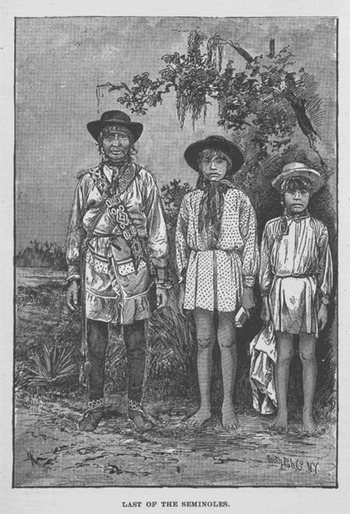
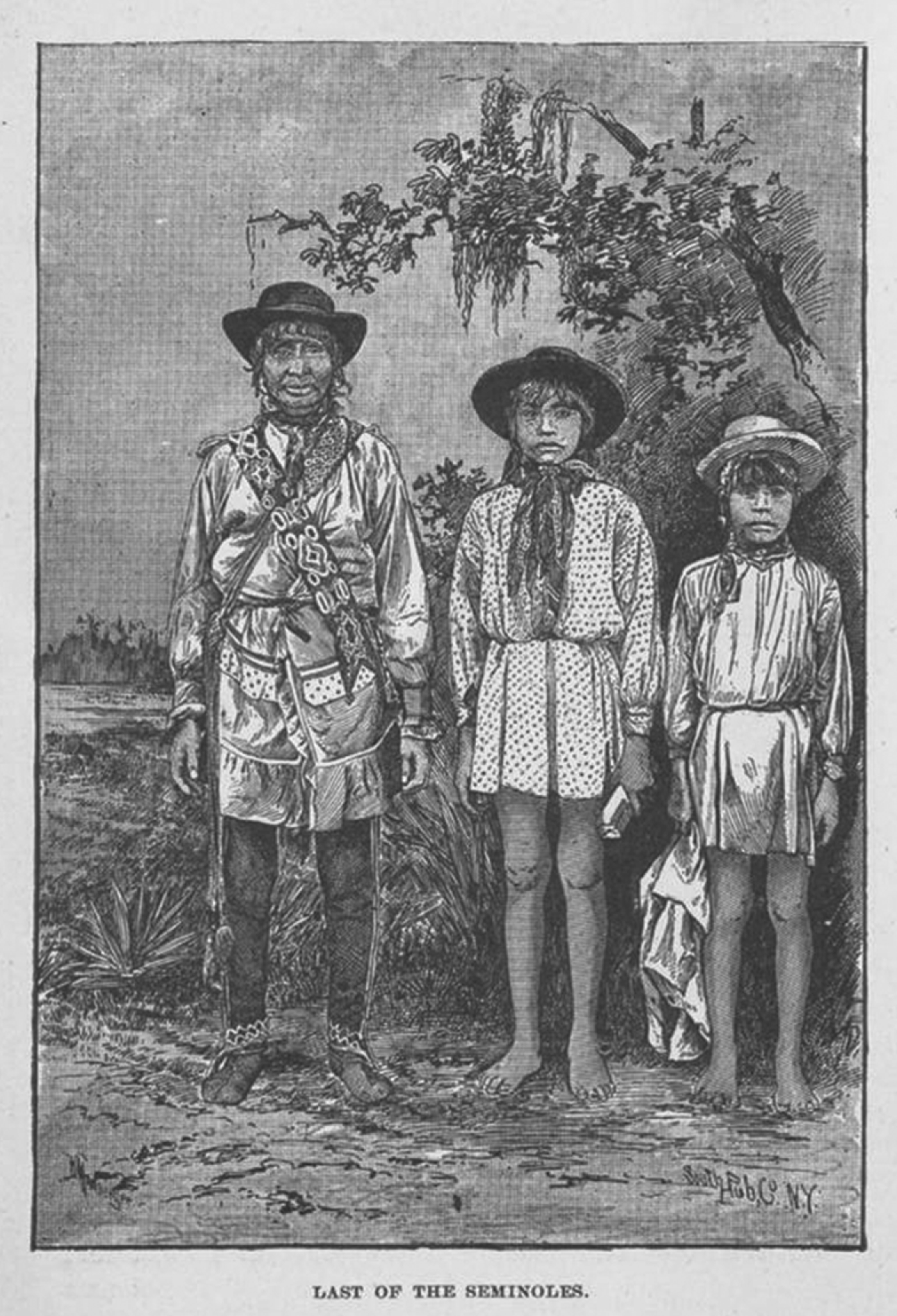
Florida boosters thus faced a dilemma: how to recast and sell their state when the Seminoles – and the legacies of racial mixture and defiance – remained alive. Davidson's answer was to add the Seminoles to the national discourse on the so-called “Vanishing Indian”: Florida's Native Americans were a savage, mixed-race tribe, but they were also a disappearing one and hence a non-factor in the state's brighter future. “Today,” Davidson wrote, “the race is not self-sustaining.”Footnote 60 This view found support in other booster texts of the period. In a nod to James Fennimore Cooper, Oliver Crosby's 1887 guidebook featured a drawing of the “Last of the Seminoles (see Figure 1).”Footnote 61 A 1908 guidebook, meanwhile, which also referred to “half-negro” Seminoles and Seminole children as “pickaninnies” – a term usually applied to African American children – titled its chapter on the Indians “A Vanishing Race.” “Anglo Saxon aggressiveness is bumping the native American off the map,” the writer declared with colonialist bluster.Footnote 62 A 1911 Miami guidebook juxtaposed a photograph of a “Seminole Indian's Grave” with that of an “Everglades Drainage Canal,” implying that the one gave way inevitably to the other: that the only places for the Seminoles in the newly reclaimed south Florida would be in the past or in the ground.Footnote 63
Oliver Crosby's Florida Facts guidebook (1887) was one of many in the late nineteenth century to depict the Seminoles as a vanishing race, a dying remnant from the mixed-race bands that had fought the US military in earlier decades.
Yet, increasingly, promoters of south Florida recognized that the Seminoles would not simply “vanish.” After all, as Clay MacCauley had pointed out, they were successful agriculturists and skilful hunters who lived in a fertile environment.Footnote 64 Therefore the Seminoles had to be made in some way more palatable for incoming Americans. As such, Davidson's scathing depiction was one of the last of its kind. In the following decades, a gradual and imperfect shift took place in how Florida boosters represented the Seminoles. To an extent, this shift had already begun by the time Davidson was writing. Decades since the last Seminole War and after the turmoil of the Civil War and Reconstruction, Florida promoters in the 1880s were desperate to look forward rather than back. Expediting this desire were the railroad and hotel construction, agricultural growth (in particular citrus), and a southward-moving line of settlement that were opening up the peninsula for white Americans. By the year 1900 Florida's population had doubled from its 1880 level, while winter tourism had become a social phenomenon for the Yankee elite. Railroads traversed both the Atlantic and Gulf coastlines; Henry Flagler's East Coast Railway reached Biscayne Bay in 1896 to incorporate the city of Miami; and, in 1906, drainage of the Everglades by the state and private companies began in earnest.Footnote 65 With the Seminoles numbering only a few hundred and improved transportation links conveying more Americans to Florida, it was both viable and self-serving for boosters to accommodate the Seminoles within their advertising.
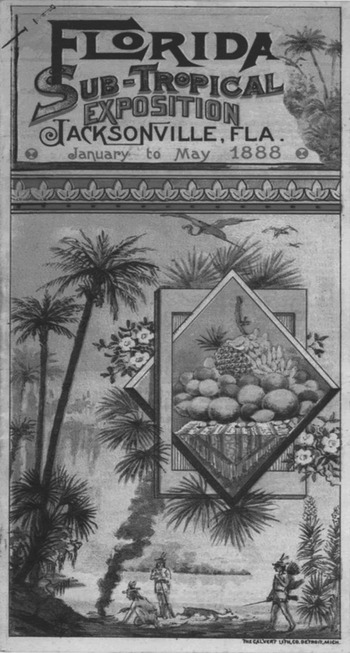
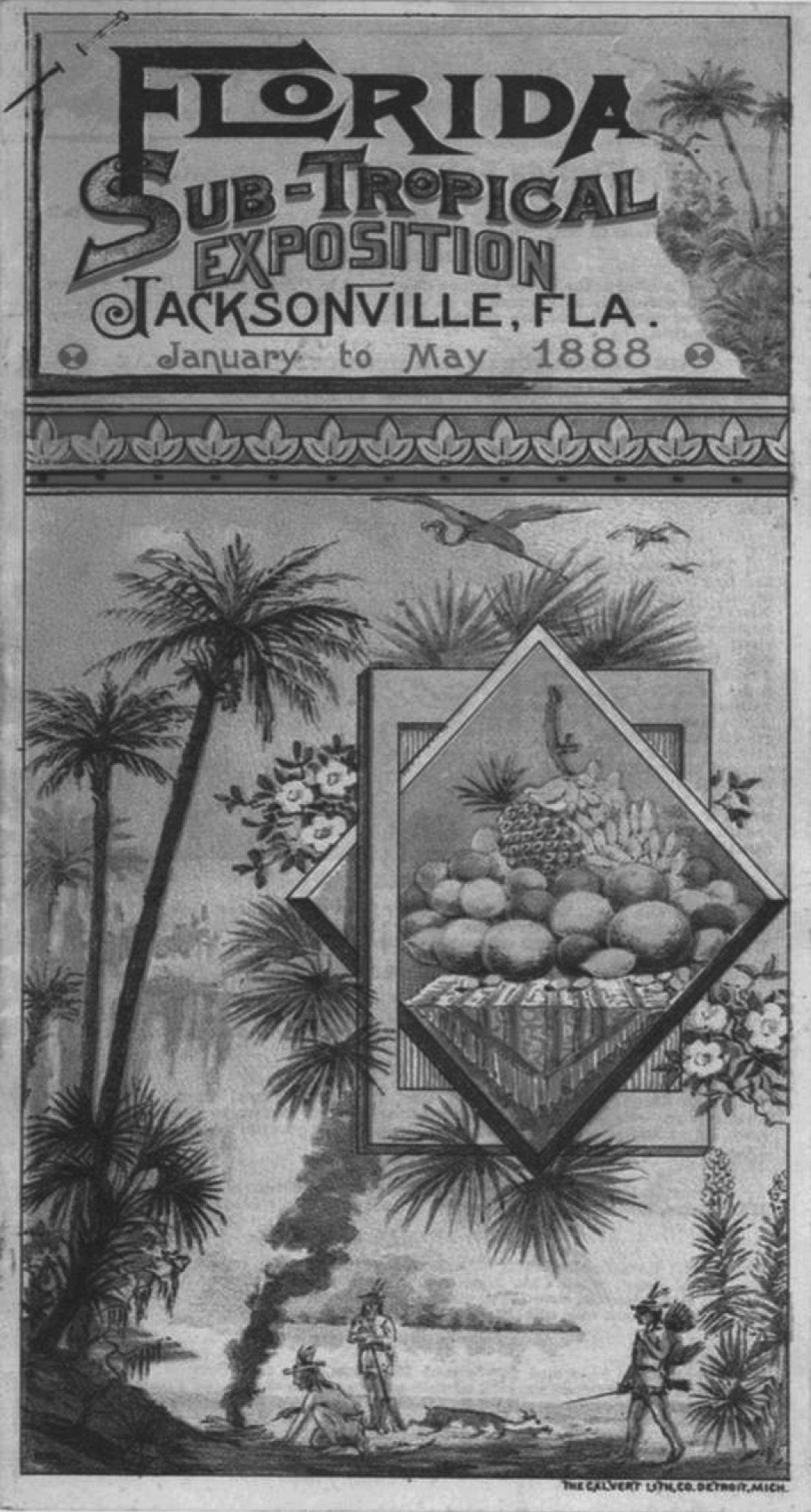
Several prominent tropes emerged. Hotel, railroad, and tourism boosters featured the Seminoles in exotic visions of Florida as a tropical destination reachable by rail: somewhere affluent winter visitors could encounter “primitive” yet benign nature and peoples. A precedent had been set in 1876 when captured Plains Indian warriors had been transferred to Fort Marion in St. Augustine, Florida, and became a local tourist attraction, paraded through the streets and on show in the fort for curious visitors.Footnote 66 First held in 1888, the Florida Sub-tropical Exposition, a promotional fair in Jacksonville attended by thousands of northern and southern tourists as well as Floridians, featured among its many exhibits a “rare treat in the shape of a genuine Seminole Indian Camp upon the grounds” (see Figure 2). Visitors were presented with “a band of Seminole Bucks, Squaws and Pappooses, in their native costume” and “in the same palmetto thatch huts as in their native home, the Everglades of Florida.” Organizers stressed that the tribe, while “primitive,” were “peaceful and industrious.” Thus between resplendent displays of Florida's fruits and vegetables – educative of the state's emergent agricultural civilization – white tourists could witness Indians who “live to themselves, far removed from, and shunning all intimacy with the white man.”Footnote 67 Meanwhile, land and immigration promoters who worked to overturn stubborn Yankee conceptions of Florida as a malarial swamp unfit for permanent settlement began to find, ironically, in the Seminoles, exemplars of successful Florida habitation, whose resistance to leave the land suggested that it must be worth something after all.Footnote 68 Responding to northern notions that California possessed a more “stimulating” climate than did Florida, one booster reasoned that, while “what the ultimate effect of each may be on the Anglo-Saxon race remains yet to be proven,” “as between the aborigines of the two States, the Diggers and the Seminoles, certainly the former will bear no comparison with the latter in respect of material prowess, daring and skill in the chase, dignity of bearing, and freedom from degrading vices.”Footnote 69 From being dreaded figures, the Seminoles were becoming a curious but valuable element within the promotional reconstruction of Florida from a forbidding to a desirable land.
The Florida Sub-tropical Exposition was one of the first state promotional events to feature the Seminoles as human exhibits, with no mention made in the pamphlet to the historic links to runaway slaves.
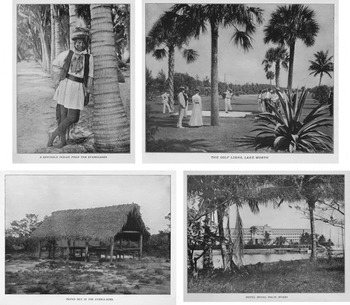
But the growing booster interest in the Seminoles involved first avoidance and then a cleansing of the tribe's historical ties to African Americans. To be sure, some boosters, intentionally or not, continued to link the Seminoles with blacks. A group of images from 1911 captioned “Some Florida Natives” featured an African American man, an ostrich, and a group of Seminole Indians – implying a similar commodification of the state's nonwhite peoples (and wildlife).Footnote 70 Promoters like Davidson who saw the modern Seminoles as mixed breeds denigrated them, observing a virulent merging of Native American and African American which had resisted not only the US army but white racial codes. Florida boosters, however, were in the business of matching hopes rather than fears. Hence the Seminoles were distanced from the threats to racial order they had once evoked. Often this meant silence on the issue: when writing about the Seminoles past and present, boosters simply avoided the history of racial mixture with blacks and focussed instead on the idea of the Seminoles as the Deep South's only remaining Native American peoples. A typical piece on the Seminoles in a Miami promotional book – which posited that “the Seminoles are thought to have sprung from the old Aztecs of Mexico” – thus elided any mention whatsoever of runaway slaves.Footnote 71 Instead, promoters painted the Seminoles as human symbols of Florida's tropical nature. For the thousands of winter tourists heading to the state's resorts, the Jacksonville, Tampa, and Key West Railway advertised the Indian River as a veritable Eden “teem[ing] with finest fish” and trees bearing “the banana, pineapple, cocoanut, and other tropical fruits,” where the Seminoles “like the timid deer” may be “often seen on the banks and wave.”Footnote 72 With expanding hotel and urban development along Florida's coasts, photographic pamphlets served to assure tourists that an exotic wilderness remained only a short journey inland: a typical collection of souvenir “scenes” from 1901 contrasted images of the peninsula's new hotels, golf courses, and citrus groves with those of Seminoles and their Everglade home (see Figure 3).Footnote 73
Guides to Florida's east coast resorts, such as this J. Murray Jordan guide from 1901, often featured photographs of Seminoles and Seminole homes alongside new hotels and leisure pursuits, juxtaposing, for white visitors, the attractions of both “primitive” and “modern” Florida.

At the heart of such imagery was the romantic and marketable idea of the persisting wildness of the Seminoles, who, like the Everglades, existed outside the “civilized” corridors of coastal Florida. By the 1900s, Flagler hotels could accommodate forty thousand guests annually and excursion companies began taking tourists into the Everglades, promoting the trips as safe encounters with tropic wetlands.Footnote 74 The Seminoles recognized the threat these incursions posed to their way of life. As one investment guide to Florida noted in 1898, the Seminoles “will rarely ever act as guides, and try to discourage parties in exploring the Everglades.”Footnote 75 Yet the tours proved popular, particularly as drainage of the Everglades appeared more feasible. The Florida East Coast Hotel Company advertised the trips as journeys through time as much as space:
From Miami a small boat will carry the curious visitor up into the wildest stretches of the Everglades, the last of the waste lands east of the Mississippi which remain unreclaimed, and which have held for years all the mystery and romance and tradition which [the] mind can conjure up. Here he may catch a glimpse in their native haunts of the Seminoles, the sole remaining remnant of the Indian tribes that once roamed over Dixie.Footnote 76
In the Florida wilds, white male tourists took part in hunts, shooting birds and alligators, as part of masculine fantasies which were only reinforced by descriptions of the Seminoles as “the most perfect type of physical man.”Footnote 77 For those less adventurous tourists unsure about travelling through “the wildest stretches of the Everglades,” promoters set up commercial Seminole tourist camps near Miami, where Seminole inhabitants “displayed craft techniques … sold the crafts as souvenirs, and wrestled alligators to the … delight of white tourists.”Footnote 78 By the 1920s, approximately half a million tourists visited the Seminole camps, which were hailed by local boosters as “educational exhibits.”Footnote 79
The changing historic and racial symbolism of the Seminoles was part of the education. Rather audaciously, Florida promoters increasingly contrasted the “independent” Seminoles with “ugly western Indians.”Footnote 80 In doing so, they plugged into nationwide resentment of reservation Indians at a time when the federal policy of Americanization was in vogue. Largely unsuccessful in its goals, the Americanization policies had the effect of further stigmatizing Indians who lived on reservations; they were denigrated as idle, immoral, and unproductive – charges which were occasionally leveled at the Seminoles, usually by boosters with designs on the Everglades.Footnote 81 Far more often, however, Florida promoters played upon the growing resentment of “cut-throat, unkempt, and squalid [western] Indians … whom the Government provided with reservations” to depict the Seminoles as “the finest specimens of Indian manhood in this country, clean in body, [and] pure in morals.”Footnote 82 Federal government Indian agents sometimes reinforced this new approach. In 1899, Department of the Interior Indian inspector A. J. Duncan, calling on both the federal and state governments to take a more active role in protecting the Seminoles, stressed the moral and pure-race qualities of the tribe. For Duncan, the Seminole was “the finest specimen of the aborigine on this continent … No foreign blood or hereditary disease contaminates his blood.”Footnote 83 Whites in Florida could enjoy these Native Americans as spectacles of pure “noble” primitivism. Indeed the Seminoles' earlier defiance of the US government became a selling point in itself. As Flagler's East Coast Railway Company declared, the Seminoles were “the only Indian tribe in the United States which has successfully defied all efforts of the government to remove them from their native hunting grounds.”Footnote 84 Whereas Western Indians had been “ruined” by government handouts, the Seminoles still lived off the land.Footnote 85 The Florida East Coast Homeseeker thus stated that the “morally pure” Seminoles stood “in broad contrast to the Indians of the West and Northwest, the western Indian being notoriously immoral and with a disposition to steal only equaled by the coyote of the plains.”Footnote 86 The appeal of this vision was put bluntly by a 1926 state guide that, beneath a photograph of a Seminole family, declared, “We still have Wild Indians.”Footnote 87
The modern-day “wild” Seminoles celebrated by boosters were, however, not of mixed race, as promotional silence on this controversial point was alloyed with explicit assertions to the contrary. For white visitors, the Seminoles were stripped of their ties to the mixed-race bands which had fought for decades against whites and transformed into physically and morally “pure” natives who were a boon to Florida. As early as 1887, a travel writer on the Everglades proclaimed that “no tribe – or remnant of a nation … has preserved its blood so free from contamination as this.”Footnote 88 If this was an unusual claim in the 1880s, it was being heard more and more by the early decades of the twentieth century. Seminoles of previous generations, one tourist guide explained, had held out against the US government with runaway slaves, but ultimately “had no power to establish their rights” over the African Americans, “some of whom they had purchased from the whites and others who had been born among them,” and the latter had been moved west along with many Indians. Those Seminoles left in Florida, however, were “splendid types of manhood,” whose unmixed qualities were confirmed by the fact that “with a very few innovations we find these dark-skinned aborigines little changed from the time the Spaniards first intruded on their isolation.”Footnote 89 Promoters exhibited a keenness to fix the Seminoles as figures of racial and cultural purity. The Seminoles were the “undefiled descendants of those Native Americans who greeted Ponce de Leon” in the sixteenth century. The “American Indians of Florida,” one booster wrote, “stand unique and apart in that they have kept to their old ways and own manner of living … their blood being practically pure and undefiled from mixture with any other race.”Footnote 90 Even individuals involved in trying to provide the Seminoles with land and protection, such as Minnie Moore-Willson, joined in the racial-purity vision. Moore-Willson wrote about both the historic Seminole–black marriages and the existence of a few black slaves even among contemporary Seminoles. But the racial divisions were clearly delineated: “To the haughty Seminole a negro is the lowest of human creatures.”Footnote 91 By contrast, to the white author the Seminole was worthy of praise and protection. As Moore-Willson wrote in one of her tracts, “Here and there in the mysterious depths of the great Florida jungle live the 600 descendants of the bravest, purest blood American Indian.”Footnote 92
The racial realignment of the Seminoles coincided with white developmental efforts to claim their Everglades homeland – a process which Moore-Willson campaigned against for decades. Paradoxically, in the 1900s and 1910s, leading state boosters praised the Seminoles as pure-blooded “true son[s] of the forest” whilst simultaneously promoting vast drainage schemes designed to “tame” the Everglades and effectively displace the Seminoles.Footnote 93 An increased demand for Everglades land in the Progressive Era impelled efforts by campaigners such as Moore-Wilson to provide the Seminoles with lands protected by the US government. In 1913 approximately a hundred thousand acres in Monroe County were set as reservation lands; however, few Seminoles chose to relocate there, having little desire to leave a domain where they continued to hunt and sell bird plumes and pelts to white traders.Footnote 94 The drainage of stretches of south Florida, however, lowered the water table and changed the ecology of the landscape, ruining the natural subsistence base for the Seminoles. Into the 1920s, with south Florida undergoing a real-estate boom and drainage canals penetrating further into the Everglades, increasing numbers of Seminoles worked on truck farms near Miami and Fort Lauderdale or in the tourist attractions sprouting up across the region; others established their own camps along the new Tamiami Trail highway.Footnote 95 Some younger Seminoles worked as caddies at the Hialeah golf course, where, a journalist wrote, golfers and spectators enjoyed “curious contests … in which two of the Indians using bows and arrows compete[d] against a pair of expert golfers” to complete the course. “Usually, the savage archers are victorious.”Footnote 96 The Seminoles had become such a fixture in Florida's promotional imagery that they adorned the cover of a 1930s State Department of Agriculture guide as colourful, canoe-paddling natives in a modern landscape of citrus, sugar cane, and truck farming.Footnote 97 Guidebooks reported that some “Seminoles still live in … isolated regions [of the Everglades], but now they paddle their canoes along the drainage canals, between great fields of the richest agricultural soil in America, if not in the world.”Footnote 98
The changing status of the Seminoles formed the basis of a 1930 survey by Roy Nash for the US Office of Indian Affairs, which also provides a useful bookend to a half-century of racial realignment of the tribe. Indeed, according to Nash, “The starting point in time of this 1930 survey is the year 1880 [when MacCauley undertook his survey of the Seminoles] … Two points 50 years apart may indicate the trend of a slowly moving body with some accuracy.” Nash found much to lament in that “trend”: “driven into the most inhospitable swamps in Florida” and “robbed of all security of possessions,” the “children of warriors have become drunkards and beggars.” Yet while Nash highlighted a variety of altered (and, in his view, “decaying”) aspects of Seminole social, economic, and cultural life, it was his comments on the “race question” that are relevant here. Nash noted the mixture with blacks that was part of the Seminole heritage, but saw a very different future: “Under present conditions the negro blood [in the Seminole population] will shortly be eliminated as a recognizable quantity. Not so with the white blood that is creeping in.” With Miami now a pleasure capital of America and some Seminole women working as prostitutes along the Tamiami Trail, Nash observed a growing number of “white half-breeds” among the Native American population. This development “could have been predicted with mathematical certainty by one possessing the slightest knowledge of history. Men of a dominant economic group always have been able to possess the women of the decidedly inferior economic group” – although, Nash clarified, the only “painful part” of this trend was “that the process should start with bastardy [sic] and prostitution.” Modern racial mixing between white men and Seminole women, it seemed, was less disturbing than the historic links between Seminoles and blacks. But Nash went further, reflecting the complex racial symbolism of the Seminoles in Jim Crow Florida. “In a society which draws the color line, it is highly interesting to note the position of the Indian, who, so far as epidermal pigmentation goes, is frequently darker than many classified as negroes. [Yet] the Seminole is a ‘white man’” – in terms of being able to travel on white-reserved railroad coaches and stay in white hospital wards. No longer associated with blacks, Nash concluded, the Seminoles would continue to be “amalgamated” into white Florida: “Five hundred Seminoles surrounded by the rapidly increasing white population of Florida are destined to be absorbed as inevitably as a lump of salt thrown into Lake Okeechobee is destined to be dissolved.”Footnote 99 In making this claim, of course, Nash was thoroughly mistaken: the Seminoles would in later decades protect their tribal sovereignty and achieve extensive commercial success.Footnote 100 And yet Nash's perspective tells us a great deal about the earlier booster representations of the Seminoles: figuratively, at least, they were seen as being absorbed by white culture, transformed from feared outsiders to accepted citizens. Through this absorption, “The original American, now a social outcast, will again be an American.”Footnote 101
During the formative years of Jim Crow, promoters of Florida strived to fit the Seminoles within the ideological and material designs of state development. The Seminoles of pre-Civil War Florida – widely described as unscrupulous, mixed-race killers – had personified racial disorder, which, as Grace Hale writes, “endangered the very meaning of white racial identity.”Footnote 102 Hence boosters attempted a kind of historical surgery: avoiding and then cutting away aspects of the tribe – namely racial mixture – which flared southern fears. The success of this approach was indicated by a 1925 article in south Florida's Suniland magazine. Entitled “Savages of Southern Sunshine,” the article showed continuity in terms of white racist conceptions of the Seminoles as “savages” – here meaning a lack of civilized customs rather than a lust for violence. Whether noble or ignoble, the Seminoles were still fixed as an “other” within white, civilized Florida: “their belief and traditions … as fanciful and fantastic as those of most other American tribes.”Footnote 103 Yet a significant shift had taken place. While Davidson – like countless whites before him – had castigated the Seminoles as blood-thirsty killers, the journalist now stated that “these aborigines of stern-faced countenance, exemplary behaviour, erect and powerful stature … are honest and honorable.”Footnote 104 Their racial makeup was central to the new positive appraisal. Whereas Davidson had denigrated the Seminoles as mixed-race “mongrels,” the Suniland writer praised the racial purity of the tribe:
History states that the Seminoles are a mixed race due to inter-marriage with fugitive slaves which escaped from Southern plantations and ultimately settled in the Everglades. Uncle Sam's scientists, however, report that the remnant redskins now living in southern Florida are “of pure blood, fine physique, and dignified mien.”Footnote 105
While still a “savage” race, the Seminoles had become a purified and unthreatening one: unlikely symbols of the New South racial vision. Celebrating the commercial value of the Seminoles, the writer concluded, “These picturesque Indians are worth a million dollars to Florida in advertising value.”Footnote 106