1. INTRODUCTION
The functions of a technical system allow users to draw value from the system by using it for a certain purpose (Tan et al., Reference Tan, McAloone and Gall2007). Design strives to generate descriptions of technical systems, which are capable of fulfilling required functions related to ever-growing customer expectations, in sufficient detail for their implementation (Blessing, Reference Blessing1994; Chakrabarti & Bligh, Reference Chakrabarti and Bligh2001; Eder, Reference Eder2008). Technical system development increasingly requires the integration of different technologies, necessitating a closer collaboration of experts from different disciplines. The term technical system used in this article encompasses both technical products and product/service systems (PSS). Particularly, the conceptual design stage (i.e., the transition from a design problem to an early solution concept) is considered to be among the most demanding design tasks (Blessing, Reference Blessing1997). It requires a joint effort and the establishment of a shared understanding of the technical system under development, including the design problem and expected functional capacities, among the involved designers (Valkenburg, Reference Valkenburg2000; Kleinsmann, Reference Kleinsmann2008).
Across disciplines, systematic design approaches propose functional modeling in order to support and guide designers during conceptual design (Blessing, Reference Blessing1997; Eisenbart et al., Reference Eisenbart, Gericke and Blessing2011). Integrated functional modeling may thus considerably support the establishment of the required shared understanding and facilitate cross-disciplinary collaboration during conceptual design. However, such a generally accepted approach for integrated functional modeling has not been established. Consequently, the exchange of expertise is hindered, because different understandings and different ways of representing function are competing when designers (of different disciplines) collaborate (Buur, Reference Buur1990; Müller et al., Reference Müller, Schmidt-Kretschmer, Blessing, Vanek and Hosnedl2007). The specific way functions are represented is bound to the particular understanding of function applied, as Eckert (Reference Eckert2013) and Goel (Reference Goel2013) highlight. Diverse understandings of function (Crilly, Reference Crilly2010; Carrara et al., Reference Carrara, Garbacz and Vermaas2011; Vermaas, Reference Vermaas2013) and a large variety of functional models (Erden et al., Reference Erden, Komoto, van Beek, D'Amelio, Echavarria and Tomiyama2008; Eisenbart et al., Reference Eisenbart, Blessing and Gericke2012) can be found across, but also within, different disciplines.
This article presents the results of an extensive literature study on proposed functional modeling approaches from a variety of disciplines and discusses needs and opportunities for an integrated functional modeling approach. The presented research aims at contributing to a better understanding of functional modeling approaches proposed in different disciplines.
The following section discusses the ambiguity related to the understanding of function and the way functions are represented in research and related to its practical application. Section 3 presents a review of functional modeling approaches proposed in literature from a variety of disciplines. Focus is put on the addressed content (functional modeling perspectives) and the proposed sequence for functional modeling, if multiple functional models are proposed. The results of the analysis are discussed in Section 4. Finally, the implications of the derived needs and opportunities are discussed in Section 5.
2. AMBIGUITY RELATED TO FUNCTION
Despite the centrality of function to technical system development “function lacks a single precise meaning. It is a term that has a number of coexisting meanings, which are used side-by-side in engineering” (Vermaas, Reference Vermaas2011). Various definitions of function exist (see, e.g., Crilly, Reference Crilly2010; Carrara et al., Reference Carrara, Garbacz and Vermaas2011), and a shared understanding of function has not been established among researchers (see, e.g., Ullman et al., Reference Ullman, Blessing and Wallace1992; Umeda & Tomiyama, Reference Umeda and Tomiyama1997; Chandrasekaran & Josephson, Reference Chandrasekaran and Josephson2000; Far & Elamy, Reference Far and Elamy2005) or even among practitioners from the same discipline (Alink, Reference Alink2010; Eckert, Reference Eckert2013). The different authors agree that this ambiguity is problematic in the collaboration of different designers because it may considerably hinder communication about individual functions and expected system functionality.
2.1. Coexistence of different perspectives on function
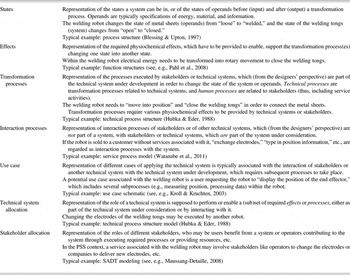
The divergent understanding of function in research has resulted in a large variety of functional models proposed in literature across disciplines (Eisenbart et al., Reference Eisenbart, Blessing and Gericke2012). In an exhaustive literature study Eisenbart et al. (Reference Eisenbart, Blessing and Gericke2012) analyzed a total of 70 functional models (54 original models plus variants proposed by different authors). The considered models originate from mechanical engineering (24 models), electrical engineering (8 models), software development (12 models), mechatronic system development (10 models), as well as service and PSS design (16 models). The analysis led to the identification of different functional modeling perspectives, which are described in Table 1, taking the example of a welding robot using welding tongs. Functional modeling perspectives relate to the particular content addressed by individual functional models (i.e., they relate to what is explicitly modeled in a specific functional model), in order to represent individual functions and overall system functionality.
Functional modeling perspectives

Note: PSS, product/service systems; SADT, structured analysis and design technique.
Individual functional models frequently address multiple functional modeling perspectives, and Eisenbart et al. (Reference Eisenbart, Blessing and Gericke2012) suggest that several functional modeling perspectives are more prominent than others within the different disciplines. For instance, the proposed functional models in mechanical engineering seem particularly concerned with technical processes and effects. These are typically structured hierarchically and/or related to flows of operands (typically specifications of material, energy, or information), which are to be changed in their state. In contrast, software and PSS development seem to focus on transformation and interaction processes performed by different stakeholders in relation to different use cases. As part of the presented research in this article, it will be analyzed more thoroughly, which specific functional modeling perspectives are particularly prominent within individual disciplines.
2.2. Studies on functional modeling in practice
Ambiguity in the use of function seems to persist not only in research but particularly in how designers approach functional modeling in practice. Eckert (Reference Eckert2013) presents the results of an interview study and experiments, which suggest that practical designers do not employ a clearly defined understanding of function. As a consequence, different understandings of function get mixed and are employed inconsistently during functional modeling (see also Alink, Reference Alink2010; Alink et al., Reference Alink, Eckert, Ruckpaul and Albers2010). In the presented experiments, designers essentially switched between understandings of function as related to the purpose of technical systems, flows of operands, or transformation of states. They typically did not differentiate between function and intended behavior. In addition, the inclusion of unintended behavior seems dependent on the individual designer.
Designers tend to make assumptions about the potential solution to a design problem and model the functions of the system accordingly (see, e.g., Blessing, Reference Blessing1997; Eckert et al., Reference Eckert, Alink and Albers2010). Thus, within the developed functional models, rather than strictly applying suggested functional taxonomies,Footnote 1 individual functions have been formulated on an inconsistent level of abstraction and related to different understandings of function (Alink, Reference Alink2010). Difficulties with the application of functional taxonomies in practice are also discussed by Ahmed and Wallace (Reference Ahmed and Wallace2003) and van Eck (Reference van Eck2010). Alink (Reference Alink2010) emphasizes that although they are moving toward a potential solution concept, designers need to be able to describe functions on different levels of abstraction or concreteness. The functions of a potential solution concept need to be modeled as concretely as possible in order to determine required auxiliary functions (Albers et al., Reference Albers, Sadowski and Braun2010).
Essentially, designers often seem to feel restricted in modeling and reasoning about functions when strictly applying functional modeling as proposed in systematic design approaches (Alink, Reference Alink2010; Blessing, Reference Blessing1997). Rather, they preferred modeling functions in a way fitting to their particular needs (with a particular potential solution in mind).
2.3. Implications
Although many researchers have strived to determine one generally accepted understanding of function (Vermaas, Reference Vermaas2013), designers in practice seem to switch flexibly between alternative understandings and ways of representing functions. Allowing ambiguity is thus seen as a desirable advantage for individual designers to perform functional modeling fitting to their specific needs (Alink, Reference Alink2010; Carrara et al., 2010; Eckert, Reference Eckert2013; Vermaas, Reference Vermaas2013), that is, fitting to their current strain of reasoning: “We see different meanings of function not as an obstacle to functional modeling but as a critical source of the power of functional reasoning” (Goel, Reference Goel2013).Footnote 2
This suggests that an integrated functional modeling approach needs to link what individual designers represent in their models (i.e., the addressed functional modeling perspectives) regardless of the ambiguous understandings of function these are based on. Such an integrated approach could facilitate joint functional modeling and support the establishment of a shared understanding in interdisciplinary design projects, while at the same time provide designers with the flexibility they require.
3. ANALYZING FUNCTIONAL MODELING APPROACHES
“Functional models of complex systems and functional reasoning about the systems are closely intertwined,” and functional modeling is proposed to support functional reasoning of designers (Goel, Reference Goel2013). Eisenbart et al. (Reference Eisenbart, Blessing and Gericke2012) found many of the functional models proposed within systematic design approaches to be building up on each other. A proposed sequence of functional models is intended to guide designers in their reasoning toward a potential solution concept (Chakrabarti, Reference Chakrabarti, Ullman, Blessing and Wallace1992; Eder, Reference Eder2008), whereas individual synthesis and analysis steps related to individual modeling activities are typically highly iterative. Such a sequence of functional models further implies moving between the respectively addressed functional modeling perspectives. The term functional modeling approach is used henceforth, in order to encompass the proposed functional models (with the inherent modeling perspectives these address) and the proposed sequence for modeling (i.e., the sequence in which the respective models are proposed).
The research presented here aims at contributing to a deeper insight into functional modeling approaches proposed across disciplines. Functional modeling perspectives or proposed modeling sequences, which are common across disciplines, may provide a suitable starting point for the development of an integrated modeling approach. The presented research strives to determine the typical (or most prominent) modeling perspectives and proposed modeling sequences in the different disciplines. The research is guided by the following questions:
• Which functional modeling perspectives are addressed within the different disciplines, and which are most prominent?
• What kind of sequence (if any) is suggested for considering the different functional modeling perspectives in the different disciplines, and is there a shared one across?
3.1. Research approach: Coding scheme
The analysis focuses on systematic design approaches that explicitly propose functional modeling. In total, 41 functional modeling approaches are analyzed, each proposing between 1 and 5 different functional models. The approaches originate from mechanical engineering, electrical engineering, software development, service development, mechatronic system development, and PSS design.
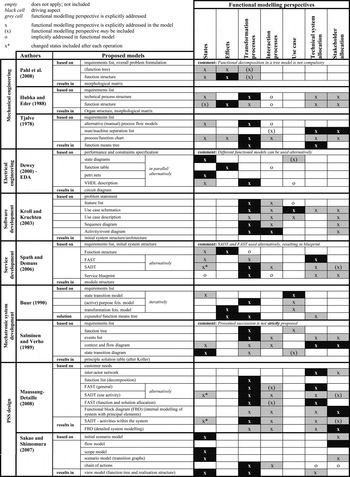
The individual functional models proposed in the different modeling approaches are coded based on the modeling perspectives identified by Eisenbart et al. (Reference Eisenbart, Blessing and Gericke2012; see their table 1). In other words, it is analyzed which functional modeling perspective is represented in the respective models. If multiple perspectives are addressed in a model, the perspective(s) are highlighted (black filling in cell), which drive the associated modeling activities (if applicable). Further, implicitly addressed perspectives are marked with an “o,” as described in Figure 1.
Examples of functional modeling approaches.

3.2. Functional modeling approaches in different disciplines
Figure 1 shows the functional models, their succession, and the modeling perspectives they address for a few examples of the reviewed systematic design approaches. Their succession of the models in the respective rows corresponds to the proposed sequence in the individual modeling approaches. The column labeled “proposed models” includes the particular models the individual functional modeling approaches are based on and result in, respectively. Not all of these are functional models themselves. For instance, the functional modeling proposed by Pahl et al. (Reference Pahl, Beitz, Feldhusen and Grote2008) is based on a requirements list and results in a working structure, which is represented in a morphological matrix (see Figure 1). The inclusion of these models indicates the individual context for which functional modeling is related to the different approaches. In the following, the findings are presented based on examples from each reviewed discipline.
3.2.1. Mechanical engineering
In mechanical engineering, functional modeling proposed by Pahl et al. (Reference Pahl, Beitz, Feldhusen and Grote2008; and related approaches) has been adapted and taken up by various authors from mechanical engineering (see, e.g., Roozenburg & Eekels, Reference Roozenburg and Eekels1995; Stone & Wood, Reference Stone and Wood2000; Ulrich & Eppinger, Reference Ulrich and Eppinger2008) and interdisciplinary system development (e.g., Verein Deutscher Ingenieure, 1993, 2004; Spath & Demuss, Reference Spath, Demuss, Bullinger and Scheer2006; Cross, Reference Cross2008). Pahl et al. (Reference Pahl, Beitz, Feldhusen and Grote2008) focus on the effects that are necessary to transform an initial state into a desired state within a technical system. Frequently, a set of individual effects is encompassed as a transformation process.
Approaches that are considerably different from Pahl et al. (Reference Pahl, Beitz, Feldhusen and Grote2008) are proposed by Hubka and Eder (Reference Hubka and Eder1988) and Tjalve (Reference Tjalve1978). These approaches (and related ones) propose modeling the required transformation processes (totally external to the technical product under development) to change operands from an initial into a final state. Subsequently, the required technical processes and effects within the technical product are derived, which enable the external transformation processes. Therein, human operators are also modeled, who either substitute transformation processes or deal with the system as a whole. Furthermore, additional technical systems, either performing or supporting individual transformation processes, are allocated within functional modeling. The proposed sequence for modeling differs slightly between the two authors.
3.2.2. Electrical engineering
In electrical engineering, functional modeling is prominently process oriented, addressing the particular switching sequences (e.g., in relation to the signal flows) within different use cases and different system states. Although all reviewed systematic electrical engineering approaches propose a stepwise overall design process, functional modeling involves alternative functional models addressing different sets of functional modeling perspectives. A specific succession is not clearly proposed (see, e.g., Bleck et al., Reference Bleck, Goedecke, Huss and Waldschmidt1996; Dewey, Reference Dewey and Dorf2000; Scheffer et al., Reference Scheffer, Lavagno and Martin2006). The designers may choose which functional models to use and in which particular succession.
3.2.3. Software development
In software development, functional modeling strongly focuses on interaction processes with the system as well as transformation processes executed by the system. Kroll and Kruchten (Reference Kroll and Kruchten2003), for instance, start by listing the processes the system is supposed to enable and to offer the user (see also Schwaber, Reference Schwaber2007), whereas successive functional models focus on the particular use cases and transformation processes, gradually giving more detail (see also V-Model XT in IABG, 2006). They include a representation of the interaction processes of a user with the system as well as the triggered transformation processes executed by the system.
3.2.4. Service development
Functional modeling in service development prominently seems to focus on modeling transformation processes executed by humans (often in conjunction with the use of technical products), as well as the allocation of technical systems and stakeholders. Spath and Demuss (Reference Spath, Demuss, Bullinger and Scheer2006) propose service blueprinting in order to support functional modeling, whereas other authors frequently propose it for later design stages, in particular concept development, thus addressing the solution rather than the functions the solution has to fulfill (see, e.g., Bullinger et al., Reference Bullinger, Fähnrich and Meiren2003; Fähnrich & Meiren, Reference Fähnrich and Meiren2007).
3.2.5 Mechatronic system development
In mechatronic system development, Verein Deutscher Ingenieure guideline 2206 (Verein Deutscher Ingenieure, 2004) proposes a function structure similar to Pahl et al. (Reference Pahl, Beitz, Feldhusen and Grote2008). Buur (Reference Buur1990) proposes iterative modeling of the different system states, effects, and transformation processes, associated to different use cases, using multiple functional models. Finally, the required effects and processes are allocated to different technologies and solution concepts within a function means tree.
Salminen and Verho (Reference Salminen and Verho1989) propose sequential functional models. In particular, system states, transformation processes, interaction processes with the system, as well as stakeholder and technical system allocation are addressed. Several functional modeling perspectives are distributed among two or more functional models, which, irrespective of their sequential proposition, implies that the designer will have to move between different functional models iteratively. Changes made to one functional model may affect another model.
3.2.6. PSS design
Except for Sakao and Shimomura (Reference Sakao and Shimomura2007), none of the reviewed PSS design approaches was found to propose a sequential functional modeling approach, and the different approaches differ greatly. The proposed functional models prominently address transformation processes, interaction processes with the system, as well as the different states of the user and the system.
Within PSS design (e.g., service blueprinting) structured analysis and design technique modeling and function analysis system technique modeling are often are proposed for different design stages of the system development process. In some approaches, these models are used to independently model the function in one design stage and the concept in another; in other approaches, they support the transition from function to concept. Within this transition, the models are refined, and gradually stakeholders and technical systems are allocated. Iterative refinement of functional models, leading to a spiral design approach, is explicitly proposed by, for example, Brezet et al. (Reference Brezet, Diehl and Silvester2001) and, to a lesser degree, Watanabe et al. (Reference Watanabe, Mikoshiba, Tateyama, Shimomura and Kimita2011) and Maussang-Detaille (Reference Maussang-Detaille2008).
3.3. Comparing functional modeling approaches across disciplines
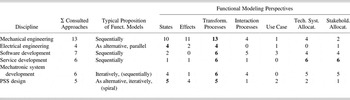
The findings suggest that the functional modeling approaches proposed in design literature form different disciplines differ greatly. That includes the considered functional modeling perspectives (addressed in the respective functional models) and how designers are supposed to move between individual functional models (i.e., between the inherent functional modeling perspectives). The results are summarized in Table 2.
Comparison of functional modeling approaches from the different disciplines

Note: The number entries are the amount of functional modellng approaches that were found to explicitly address the respective functional modeling perspective. The bold values are the most prominent functional modeling perspective(s) in the individual disciplines.
There seems to be no shared sequence for moving between individual functional modeling perspectives across disciplines, and the individual modeling approaches use alternative starting points. Even within the different disciplines a great diversity can be found. The reviewed systematic design approaches from mechanical engineering, software, and service development, which propose multiple functional models, typically propose a sequential modeling approach. In PSS design and mechatronic system development, mostly iterative functional modeling approaches were found or alternative paths are proposed. In PSS design, in addition, spiral approaches can be found.
The findings suggest that the transformation processes perspective is always one of the most prominent, or even the single most prominent, modeling perspective within all reviewed disciplines. Thus, it is prominent across all the disciplines.
Although mechatronic system development and the subdisciplines mechanical engineering, electrical engineering, and software development focus on technical processes, service development focuses on human processes. In PSS design, both types are prominent. Nevertheless, even in mechanical engineering, some authors particularly stress the inclusion of humans as operators into the system (e.g., as “man–machine systems”; see Andreasen; Reference Andreasen, Ullman, Blessing and Wallace1992) and thus into functional modeling.
4. DISCUSSION
The presented analysis aims to answer the question, what kind of functional modeling approaches are proposed across disciplines, with regard to the proposed sequence of functional models and the addressed functional modeling perspectives.
4.1. Hindered communication
The identified diversity in functional modeling approaches proposed across disciplines supports the general picture of diversity and ambiguity associated with the concept of function. The presented literature study further suggests that, depending on the respective author, the same model may serve entirely different purposes in technical product development; for instance, as is the case with service blueprinting. Designers, who have been introduced to discipline-specific functional modeling approaches, may not be aware of the modeling perspectives relevant to designers from other disciplines or how the respective functional models are used.
All these different issues support the assumption that communication between individual designers is hindered, particularly across disciplines. It seems the particular points in time at which specific information is shared have to be managed to reduce the risk of miscommunication and ensure information can be adequately shared. In order to support the integration of functional modeling in interdisciplinary system development, an integrated modeling approach needs to cope with the existing diversity.
4.2. Needs and opportunities for integrated functional modeling
The largest diversity in the proposed functional modeling approaches was found in those cases when many functional modeling perspectives are to be integrated, such as in mechatronic system development and PSS design. Looking across different proposed functional modeling approaches, no shared sequence for moving between the different modeling perspectives seems to exist. Furthermore, individual designers in practice tend to change between specific perspectives taken, as highlighted in Section 2. An integrated functional modeling approach thus needs to enable switching between taken modeling perspectives flexibly, allowing different entry points and moving between individual modeling perspectives in alternative successions.
The conducted literature study further suggests different sets of functional modeling perspectives, which are particularly prominent within the different disciplines (see Table 2). The transformation process perspective has been identified to be prominently addressed across all reviewed disciplines. Modeling the required transformation processes (both human and technical) may, hence, serve as a common basis in an integrated functional modeling approach. Linking the remaining modeling perspectives through the shared transformation process perspective may enable interlinking and translating between the different modeling perspectives taken by designers at a specific point in the development process.
The analyzed functional modeling approaches, from the point of view of the representation, did not differentiate between intended or unintended functionality of a technical system, which resembles design practice (see Alink, Reference Alink2010).
Finally, embedding different ways of formulating functions needs to be enabled in an integrated functional modeling approach, in order to make it adaptable to a variety of applications, as discussed above (see, e.g., Alink, Reference Alink2010). A modeling approach that intends to implement the presented insights is the integrated functional modeling framework proposed in Eisenbart et al. (Reference Eisenbart, Qureshi, Gericke and Blessing2013).
4.3. Limitations
The presented research is based on the assumption that the approaches proposed in design literature are taught to designers or incorporated in design guidelines and, at least subconsciously, influence design practice. The comparison has been based solely on the analysis and interpretation of the functional models proposed in systematic design approaches, as described and illustrated in literature. In some cases, however, few or no examples and limited descriptions of the proposed models were available.
5. CONCLUSIONS
As the main design decisions are taken when conceptualizing a technical system, a shared understanding among the involved designers of the system under development is essential. Integrated functional modeling may serve as a basis for the establishment of such a shared understanding across disciplines. It is shown that such an integrated modeling approach needs to link the different functional modeling perspectives relevant to the different disciplines, while at the same time provide designers with the flexibility they require. The article presents the results of an extensive literature study on functional modeling approaches proposed across disciplines. The conducted study led to the identification of specific needs and opportunities for the development of an integrated modeling approach.
The derived insights suggest that individual modeling approaches are specific in relation to the addressed functional modeling perspectives and related to how to move between them. The diversity is particularly large in interdisciplinary system development approaches. However, the transformation process perspective is most prominently addressed in functional modeling approaches across all reviewed disciplines. Modeling the transformation processes may, hence, serve as a common basis for the development of an integrated functional modeling approach. Depending on which additional modeling perspectives are needed in a specific design project, these need to be included and linked to the transformation process perspective. Thus, such an approach could potentially enable addition or omission of modeling perspectives depending on whether these are needed in a specific system development project.
Providing the designer with a functional modeling approach that is capable of linking the different functional modeling perspectives through a shared perspective may improve the designers' understanding of functional modeling and reasoning outside their own expertise. An expansion of the available vocabulary to describe the content of functional modeling and the particular approaches (sequence) associated with it, hence, may positively influence the comprehension of cross-disciplinary functional modeling. However, with respect to the diverse approaches related to moving between different functional modeling perspectives, such an approach explicitly needs to be able to support functional modeling irrespective of the particular direction from which it is approached.
Future research needs to address the specifics of such an integrated functional modeling approach. Research is also needed to address which functional models and, hence, which functional modeling perspectives are de facto relevant to designers from different disciplines in practice.
ACKNOWLEDGEMENTS
The authors thank the Fonds Nationale de la Recherche Luxembourg for funding this research as well as Prof. Mogens Myrup Andreasen for valuable discussions preceding the creation of this article. Furthermore, the authors thank the editors and the reviewers for useful comments on the earlier version of this article.
Boris Eisenbart is a Research Assistant in the Research Unit in Engineering Sciences at the University of Luxembourg. He obtained his diploma in mechatronics at Saarbrücken University. His research interests include function modeling, modeling approaches, and design methodology for transdisciplinary conceptual design.
Kilian Gericke is a Research Associate at the University of Luxembourg. He attained his PhD in design management in 2011 at Technische Universität Berlin. Dr. Gericke's research interests are in product development processes, design methodology, design thinking and design management.
Luciënne Blessing is a Professor of engineering design and methodology at the University of Luxembourg. She obtained her PhD at the University of Twente in the area of knowledge management in design. Dr. Blessing's research interests include the product development process, diversity (culture, age, and gender), user–technology interaction, design methodology, and design research methodology.