


The ability of a political system to attract and retain high-quality graduates to serve the country is critical for state governance and policy implementation.Footnote 1 Previous research on political selection has focused mostly on the candidate pool and how the preferences of elite university graduates affect their political careers.Footnote 2 However, of equal importance to elite graduates’ choices (i.e. supply-side response) but far less researched are government recruitment preferences (i.e. demand-side policy), which establish eligibility criteria and determine the source of elite legitimacy. These preferences reinforce homophily and factional ties among political elites.Footnote 3 While the candidate pool may influence the overall quality of the graduates who aspire to become political leaders, government recruitment preference is more important in determining which candidates are hired and, hence, in shaping elite upward mobility.
This article examines the Chinese government's elite recruitment preferences by studying the relationship between university education and elite selection. In China, meritocratic criteria, particularly academic credentials, have been taken as a source of elite legitimacy since the cadre personnel reform in the 1990s. To attract high-quality cadre personnel, the Chinese government has made tremendous efforts to recruit graduates from elite universities, which both narrows down the pool of potential future political leaders on the one hand and naturally leads to the blossoming of elite-university alumni networks within government on the other. Homophily arising from a common school experience leads to a significant advantage for elite university graduates in the political recruitment, selection and promotion processes.Footnote 4 These advantages in turn motivate graduates from top elite universities to choose a political career.Footnote 5 But because elite universities only recruit a small proportion of their students from poor, lower-class families, these advantages are open only to a few. Merit-based political recruitment has resulted in a closed loop of homophily that excludes broad segments of the population from the highest echelons of the political bureaucracy. Merit-based political recruitment as a channel of upward mobility for non-elite classes is largely an illusion.
We use a dataset from China's special civil service recruitment system – the specially selected graduates (xuandiaosheng 选调生, hereafter SSG) scheme – to examine the selection advantages that graduates from elite universities have and to illuminate how elite education shapes the political elite selection process. The SSG scheme, which was first developed in the 1980s, is designed chiefly to cultivate Party reserve cadres and select high-quality personnel for grassroots-level governments. By design, it enables the party-state to recruit high-quality university graduates into the cadre workforce directly from universities. These selected graduates are provided with a fast track to fill higher-level governmental positions that is not accessible to civil servants recruited through the regular civil service examination.Footnote 6
To further differentiate university graduates, in 2009 the Chinese government stratified the SSG scheme into two types of recruitment plans. The first, the non-target-based plan (feidingxiang xuandiao 非定向选调), recruits fresh graduates from ordinary universities across the country. The second, the target-based plan (dingxiang xuandiao 定向选调), recruits graduates only from specified elite universities. In recent years, the target-based SSG scheme has gained ascendancy in SSG recruitment across the country, which has made the government's preference for elite university graduates more pronounced in political selection.
We thus advance our key argument that access to elite university education denotes an easy pathway to a political career, with the significant downside of enlarging social inequality due to increasing educational stratification. To support our argument, we show that as the elite university education system has become more stratified, commensurate changes in elite recruitment processes have been put in place. In this study, we consider the internal stratification among elite universities and explore the advantages and incentives that have benefited top elite university graduates in elite political selection.
We collect and code data on recruitment quotas, scope, requirements and incentive strategies from provincial target-based SSG recruitment plans from 2017 to 2021 to create a province-level panel dataset on SSG selection. We match these data with provincial socioeconomic characteristics to further identify the regional effects of target-based SSG recruitment on governments’ recruitment preference for university graduates, particularly graduates from elite universities.
This article contributes to several strands of research. By exploring the relationship between university education and political selection, it speaks directly to the literature on the role of elite university education in shaping and nurturing political elites. Many previous studies have argued that merit-based elite recruitment, taking elite university education as a hard eligibility criterion, can produce high-quality politicians, and provide a visible channel of upward mobility for non-elites and ultimately enhance regime resilience.Footnote 7 One drawback in these studies is their lack of understanding of the internal stratification in elite university education and its effect on political selection. Our study provides nuanced evidence that shows how internal stratification, measured in terms of competition intensity and incentives within the target-based SSG scheme, affects elite selection.
Moreover, this paper builds on the work of many scholars who have focused on the role of alumni networks in political elite recruitment.Footnote 8 By examining the selection advantages accruing to elite university graduates in SSG selection, this paper shows how elite university education has reinforced the homophily of political elites and hence strengthened the political influence of China's top elite universities. We also point out the potential role of the SSG scheme as a significant social stratifier and discuss the unintended but unsurprising outcome of elite closure and increasing social inequality.
This article also contributes to the work on the determinants of political elite selection. Extant research findings mainly focus on how regional socioeconomic characteristics such as economic development level, fiscal capacity, supply of public services and the like have affected the scale of civil service recruitment.Footnote 9 We complement this strand of research by examining the effects of government recruitment preference. Furthermore, as this is the first empirical study on elite preference in SSG recruitment, our findings shed some light on the developments, challenges and prospects of China's special civil service recruitment system.
Political Meritocracy in China
China's political meritocracy is considered a variant of Weberian bureaucracy.Footnote 10 Merit-based elite recruitment, a typical feature of Weberian bureaucracy, can be a double-edged sword: it improves the competence of officials on the one hand, but concentrates power in a ruling minority on the other.Footnote 11 While the stated purpose of merit-based recruitment is to select the most qualified and competent personnel and to give ordinary citizens an opportunity to move into the ruling class,Footnote 12 if recruitment targets elite university graduates, and if elite universities take very few students from the ranks of the rural poor, then the latent function of merit-based recruitment is to reinforce social inequality.Footnote 13
Another important characteristic of Weberian bureaucracy is a predictable career ladder, which provides long-term tangible and intangible, power-based privileges, and benefits to selected elites.Footnote 14 In China, elite university graduates are drawn into a mutually advantageous state–scholar nexus where the elites accede to political compliance in return for the privileges and benefits provided by the state. The system thus reinforces the state's legitimacy by producing “educated acquiescence.”Footnote 15 Simultaneously, the rural poor who are disadvantaged in access to elite universities may not embrace the ideology of meritocracy and will not see it as a source of legitimacy.
In general, most jobs in the Chinese bureaucracy are tied to the political needs of the Chinese Communist Party (CCP). Under the one-party rule of the CCP, China's cadre personnel management has always been politically driven and characterized as a closed and top-down management system. Political elites at all levels are selected, appointed and promoted by the upper levels of government.Footnote 16 In other words, incumbent Party and government leaders serve as the selectorate, and their preference has direct consequences for the composition of political leadership groups. Moreover, the political careers of all cadres are hierarchically structured within a closed system. Those who want to pursue high-level posts must enter the party-state bureaucracy, usually at the entry level, and subsequently climb up the career ladder.Footnote 17
As the Chinese government at all levels recruits new elites only at the entry level, it is very important that they can attract and recruit the best university graduates. Before the personnel reform in the 1980s, China's elite recruitment, selection, deployment and promotion operated as a centralized job placement system, where personal, university or work unit recommendation was the main reference for decisions. This led to a closed job market filled with nepotism and patronage, which inevitably impeded the upward mobility of the non-elite classes. This started to change with the personnel reform in the 1980s. After several pilot schemes in various localities (e.g. Shenzhen), the National Civil Service Examination (NCSE) was introduced in the 1990s and reinforced again in the 2006 Civil Service Law.Footnote 18 Since then, the NCSE has provided an open platform for all eligible individuals to apply to join the civil service.
The Specially Selected Graduate Scheme: A “Talent Source Project”
The main goal behind the CCP's introduction of merit-based elite recruitment systems like the NCSE or the SSG is to be able to cultivate Party cadres who are both competent and politically loyal.Footnote 19 The SSG scheme is designed as a “talent source project” (yuantou gongcheng 源头工程); that is, a project sourcing outstanding graduates for mainly grassroots government posts directly from specified universities. In 2000, the Central Organization Department issued a notice on “further improving the selection of outstanding fresh university graduates to work at the grassroots level.” The 2000 notice clarified that the policy goals of the SSG scheme are to cultivate reserve cadres for the Party and to select high-quality personnel chiefly for Party and government institutions at or above the county level.Footnote 20
A graduate selected under the scheme becomes both a civil servant and reserve cadre. The SSG recruitment process for reserve cadres is very different from the recruitment process for ordinary civil servants in terms of recruitment requirements, selection methods and incentive measures (see Table A1 in the Appendix). The recruitment requirements for SSGs are higher than those for ordinary civil servants: an SSG candidate must not only have a degree from a good university but must also have relevant experience as a student cadre and as a Party member or reserve member. As in the ordinary civil service recruitment process, in many provinces, fresh graduates participating in the SSG process are required to pass the standardized written examination. However, successful SSG recruits will be given better treatment than ordinary civil servants (e.g. they will be on a fast track for promotion, and they will receive attractive material incentives).
To further differentiate young university graduates, beginning in 2009 the Chinese government stratified the SSG scheme into the non-target-based SSG scheme and the target-based SSG scheme.Footnote 21 Within the target-based scheme, SSG selection is only open to graduates from target universities, which are generally elite universities recognized by the central government (e.g. double first-class [shuangyiliu 双一流] universitiesFootnote 22) or local universities recognized by provincial governments. In terms of position assignment, the majority of the non-target-based SSGs will fill positions in grassroots agencies, such as section-level township units, while target-based SSGs will fill higher-level positions, mostly at the county or municipal level, or even, in some special cases, in provincial-level units.
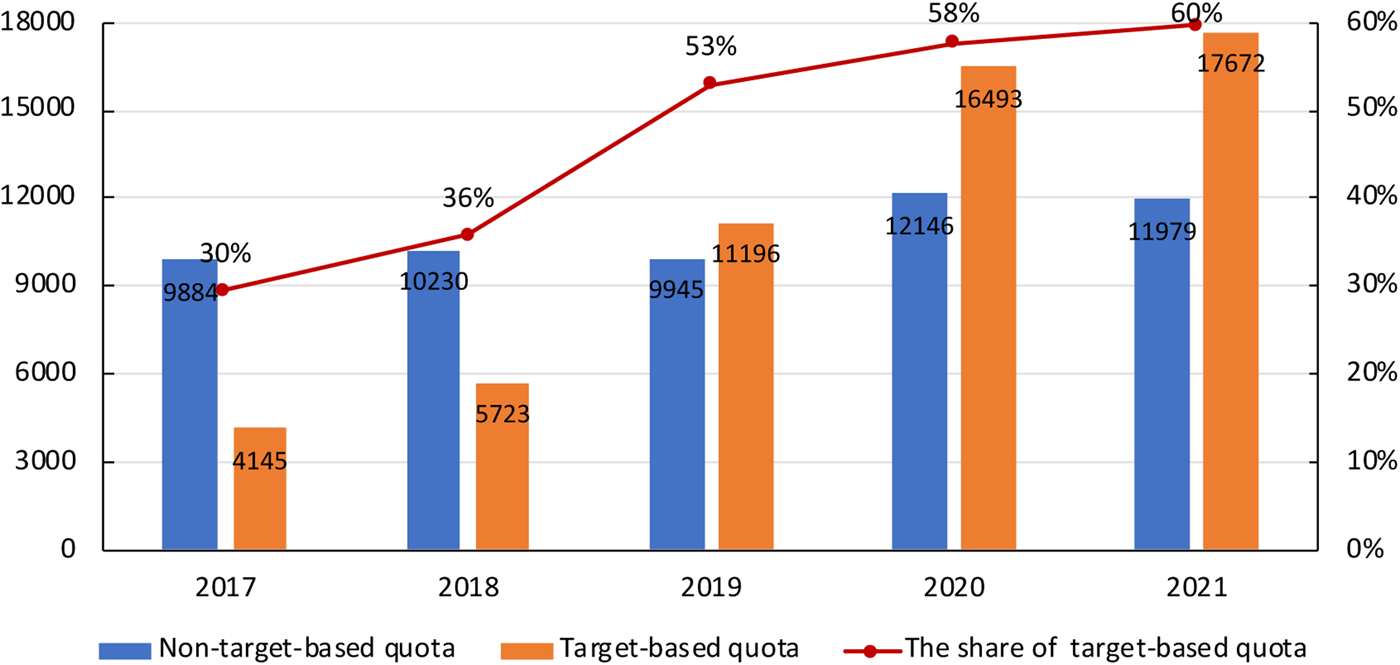
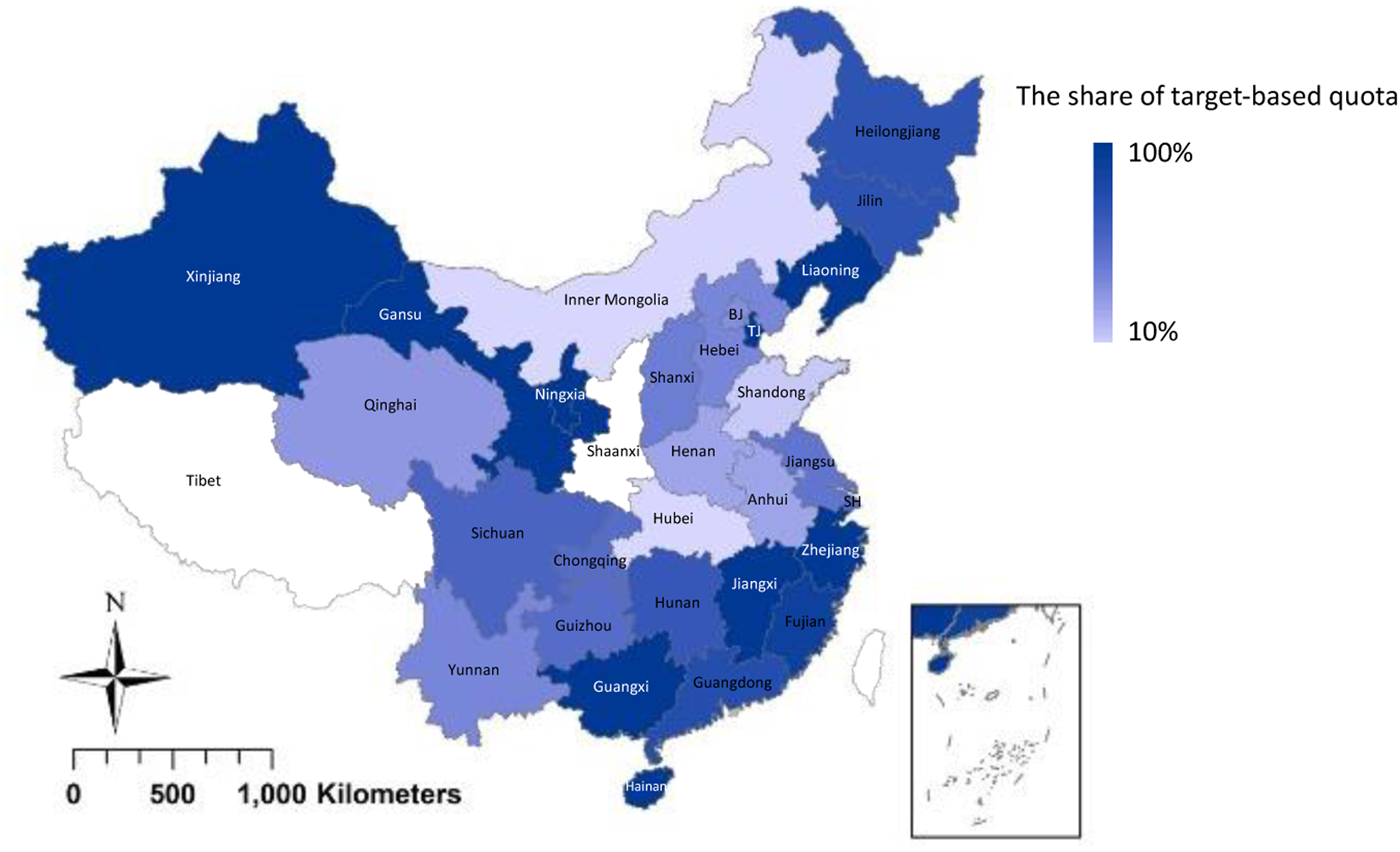
Figure 1 illustrates the recruitment goals for non-target-based and target-based SSGs from 2017 to 2021. The recruitment quota for target-based SSGs has exceeded that for non-target-based SSGs since 2019, and it grew to 60 per cent of the total in 2021 in accordance with the government's increasing preference for elite graduates in SSG selection in recent years. Figure 2 shows the share of target-based SSG recruitment quotas of 29 provinces in 2020 (Tibet and Shaanxi are excluded due to missing data). Among them, the western, north-eastern and south-eastern coastal provinces have shown a pattern of significant preference for elite graduates in SSG selection. Moreover, there are nine provinces that recruit only target-based SSGs.
Shares of National Target-based SSG Recruitment Quotas, 2017–2021
Shares of Target-based SSG Recruitment Quotas of 29 Provinces in 2020
Notes: Tibet and Shaanxi are excluded due to missing data.
Elite Education in China
Since the late 1990s, higher education in China has experienced unprecedented expansion and increased stratification.Footnote 23 In 2021, China had 2,756 registered universities, but these institutions varied considerably in quality. All Chinese universities recruit students based on their scores in the National College Entrance Examination. Each university sets a cut-off score and a fixed admission quota for each province. This practice has gradually stratified universities into three tiers: elite universities, ordinary universities, and vocational colleges and institutions.Footnote 24 Due to regional protectionism, a university generally has a higher admission quota for its own province.Footnote 25 As most elite universities are located in economically advanced cities such as Beijing or Shanghai, students in these cities have a greater chance of attending a top university than those in provinces like Anhui or Qinghai.Footnote 26 Even greater inequalities in access to universities exist between urban and rural areas. Although elite universities recruit the best and brightest across the whole country, they lower their standards for students living in cities by providing preferential admission quotas. The consequence is that rural students have less access to elite universities than urban students.Footnote 27 In addition, rural students start at a disadvantage educationally due to China's urban–rural divide, which favours those in urban regions legally, economically and socially.Footnote 28 Students must take the college entrance examination where their hukou (household registration) is located, which reduces rural students’ academic opportunities from a young age.Footnote 29 Other disadvantages, such as low family income and low levels of parental education, contribute to ex ante disadvantages in educational opportunities.Footnote 30 Therefore, even though the college admission examination is theoretically merit based and open to all social classes, its quota system has increased inequality in access to elite universities. Regional disparities and China's urban–rural divide have further reinforced the role of elite education as a significant social stratifier.
In this study, we use “elite universities” to refer to those in the first tier. In 2015, the State Council proposed a tertiary education development initiative, the Double First-class University Plan (hereafter the Double First-class Plan).Footnote 31 The Double First-class Plan further demarcated two types of top elite universities: “world first-class universities” (roughly equivalent to the earlier Project 985 universities) and “universities with first-class academic discipline construction” (roughly equivalent to the earlier Project 211 universities).Footnote 32 This plan replaced all earlier plans and projects.Footnote 33 The plan strives to establish world-class Chinese universities and to transform and upgrade their faculty members into world-class scientists and scholars by the end of 2050. There are 137 universities in the Double First-class Plan. Forty-two of these are categorized as the world first-class universities, and 95 are categorized as first-class academic discipline construction universities. Despite a massive expansion of higher education, Chinese students still face fierce competition for places at elite universities. The 2020 data show that only 1.8 per cent of national college entrance examination takers were able to get into world first-class universities.Footnote 34
Research Hypotheses
Three main research questions and corresponding hypotheses guide this study. First, we ask if and how elite education shapes political selection. Our previous discussion has alluded to the fact that local government has shown a strong and explicit preference for target-based SSGs in both SSG selection and to fill jobs. In terms of eligibility criteria, all target-based SSG candidates must be fresh graduates from elite universities, which means each candidate must have a bachelor's degree from a double first-class university. The admission score required for acceptance by elite universities is significantly higher than that required by ordinary universities, thus effectively separating target-based SSG candidates from non-target-based SSG candidates. SSG eligibility criteria have been raised in recent years, and target-based SSG candidates are further separated into graduates from any double first-class university, graduates from a world first-class university and graduates from a select subset of world first-class universities. To select elite graduates, some provincial governments have a list of target universities in the SSG recruitment plan. For example, Anhui province's 2021 SSG recruitment plan targeted only 19 world first-class universities.Footnote 35 The stiffer eligibility criteria narrow down the candidate pool and lower the competition intensity. As noted earlier, graduates from top elite universities have significant selection advantages due to extensive alumni networks. Therefore, we believe that within the target-based SSG scheme, graduates from top elite universities face less competition for selection and benefit from greater opportunities in job placement and promotion. Extending this line of reasoning, we derive our first hypothesis as follows:
Hypothesis 1: Access to elite education increases a candidate's probability of being selected in SSG recruitment.
Second, recognizing the relationship between regional characteristics and the number of elite graduates recruited, we argue that the educational background requirements for SSG selection differ depending on the characteristics of the region of the country (for example, levels of higher education, economic development and fiscal capacity). When applying for jobs, potential applicants determine a position's attractiveness based on factors such as salary, working conditions and job security.Footnote 36 Employment opportunities in economically advanced regions are often associated with higher pay and better working conditions and are therefore more attractive to talents. Based on this understanding, we expect that governments of less developed provinces are more likely to lower their requirements for SSG applicants’ educational background due to talent shortage, leading to the following hypothesis:
Hypothesis 2: Governments in less developed provinces will have lower requirements for the universities that target-based SSG applicants attended.
Third, because elite graduates generally have more lucrative career alternatives, it can be assumed that civil service employment may not always be their first choice.Footnote 37 This has propelled local governments to compete for elite graduates by offering incentives. For example, although in 2021 Ningxia province limited its target-based SSG applicant pool to candidates from only 19 of the best universities – candidates who might well have had more appealing opportunities outside of government – the provincial organization department stipulated that the SSGs recruited from the target universities would receive between 30,000 and 70,000 yuan as a relocation payment. In addition, recruits with master's degrees who serve two years in grassroots units are promised a follow-up deployment in a section chief leading position, and recruits with doctoral degrees are promised a deputy division-level leading position.Footnote 38 In other words, compared with the career path of an ordinary civil servant, an SSG graduate from an elite university is fast-tracked in selection, deployment and promotion. Therefore, our third hypothesis states:
Hypothesis 3: Graduates from higher-ranked elite universities will receive more incentives in target-based SSG recruitment.
As discussed earlier, elite graduates generally have more options in the job market and tend to prefer positions with higher pay and better working conditions. Therefore, to compete for elite graduates, local governments, particularly those in less developed regions, may need to make extra efforts to enhance the attractiveness of their SSG schemes to elites by offering incentives. This leads to the following hypothesis:
Hypothesis 4: Governments in less developed provinces will provide more incentives to attract elite graduates in target-based SSG recruitment.
Research Design
In order to test our hypotheses on how university education affects political selection, it would be ideal to use a national sample of SSG candidates. However, obtaining such a sample is difficult because (1) it is arduous to identify potential SSG candidates at the national level, and (2) there are huge costs to tracking individual career choices over time. Given these difficulties, we elected an alternative design focusing on government decisions on elite recruitment. We start by exploring possible determinants of province-level target-based SSG recruitment quotas. Since the overall recruitment quotas cannot well explain the competition intensity of political selection, we then use an alternative measurement based on recruitment quota per university, paying attention to variations in recruitment quotas across both university cohorts and regions.
Data
Our empirical design draws mainly on provincial panel datasets on recruitment under the target-based SSG scheme. We use provincial, annually issued recruitment announcements to count recruitment quotas and to code various recruitment factors from 2017 to 2021 for 29 provinces (excluding Tibet and Shaanxi because of missing information). Definitions of all key variables used in the analysis are reported in Table A2 in the Appendix.
Eligibility criteria and supporting factors for SSG selection
We collect information on eligibility criteria from provincial SSG recruitment plans, focusing on the target universities specified in each province's annual SSG recruitment plan. We find that there exists internal stratification even among elite universities. For example, some provinces restrict eligibility for target-based SSG selection to graduates from just a few top universities. We thus create a three-category ordinal variable to measure the category level of target universities in SSG selection (1=available to graduates of all double first-class universities or Project 985/211 universities; 2=available only to graduates of world first-class universities or Project 985 universities; 3=available only to graduates of a subset of world first-class universities).
We consider four other factors in a candidate's likelihood of being selected: Party membership, student cadre experience, having received on-campus awards, and military experience. We create four three-category ordinal variables to measure the importance of each factor (1=it is necessary; 2=preference is given to graduates meeting this condition; 3=it is optional).
There are also some additional common factors considered in SSG recruitment, including applicants’ field of study, gender and whether they are ethnic minorities. For example, a 1:1 ratio of men to women has been specified in some provinces’ SSG recruitment plans (e.g. Jiangsu's 2018 target-based SSG recruitment plan). Some recruitment plans give preference to applicants with majors in specific fields, such as economics or information technology (e.g. Jiangsu's 2021 target-based SSG recruitment plan states a preference for graduates who specialize in economics and finance, information technology, urban–rural construction and the like). Some provinces have stipulated that excellent ethnic-minority graduates will be given priority in the SSG recruitment, all things being equal (e.g. Guangxi's 2021 target-based SSG recruitment plan). Measuring the effects of these three additional factors, we create dichotomous variables where the existence of the factor is denoted as 1 and otherwise 0.
Incentives
We obtained data on the incentives the provinces offered in their SSG recruitment plans. Incentives generally fall into one of the two categories: material or promotion related. Material incentives include one-off subsidies, settling-in allowances, rental allowances, and the like. Promotion incentives generally refer to the promise of accelerated promotion in administrative rank or promotion to a unit at a higher administrative level. The incentive intensity directly reflects the efforts of a province to make its SSG scheme more competitive in recruiting elite graduates. To capture incentive intensity, we create a three-category ordinal variable with values of 0 (no incentive), 1 (either a promotion incentive or a material incentive) and 2 (both promotion incentive and material incentive).
Recruitment quotas and competition intensity
Each province publishes its SSG recruitment quota annually. The provincial recruitment goal relates directly to the number of posts and scope of recruitment in the party-state bureaucracy. A simple way to estimate the relationship between elite education and political selection may begin by constructing and measuring the regression effects of university ranking on recruitment quotas. However, this approach may lead to some endogeneity problems, as unobserved supply-side factors (career choice of graduates) may simultaneously shape both provincial recruitment preferences and recruitment quotas. For instance, if provinces target a few prestigious universities for their recruitment, potential SSG applicants from those institutions may be relatively fewer, possibly leading to a spurious negative relationship between elite education and recruitment quota. The actual effect of elite education is thus difficult to detect since it is offset by a narrow recruitment scope and the resulting small base of applicants.
To avoid this problem, we construct an alternative indicator, that is, the ratio of recruitment quota to recruitment scope, to measure the competition intensity of SSG recruitment. Here, “recruitment scope” refers to the number of target universities from which each provincial SSG recruitment plan will accept applicants. This variable represents the average quota assigned to each target university, reflecting the biases caused by recruitment scope and applicant base. The higher the ratio, the more available places, or the fewer competitors, if the universities comprising the recruitment scope pool are approximately the same size. Thus, exposure to a larger quota per university indeed means a higher probability of success in the SSG recruitment process.
Socioeconomic controls
Each province's recruitment plan, including its recruitment quota, recruitment preference and incentive strategy, is determined ex ante by its government size, fiscal capacity, economic development level and human capital stock. Therefore, when exploring the relationship between university education and political selection, we avoid omitted-variable bias and control for several ex ante variables: economic level (as measured by per capita GDP), fiscal pressure (as measured by the ratio of fiscal gap to fiscal revenue), population size, higher education level (as measured by the number of local colleges) and human capital stock (as measured by the number of local fresh graduates).
Model specification
We specify our model in three stages: (1) ordinary least squares (OLS) estimates of recruitment quotas, (2) ordered logit estimates of preference for elite graduates and (3) ordered logit estimates of incentives given to SSGs.
Stage 1: OLS estimates of recruitment quotas. We employ an OLS model to estimate the determinants of SSG recruitment quotas. As mentioned, we use the ratio of recruitment quota to recruitment scope as an alternative measure of the intensity of SSG recruitment competition to address potential endogeneity issues. In the robustness checks, we also employ Poisson regression and negative binomial (NB) regression to examine the robustness of our results. Our baseline regression model is:
 $$Y_{it} = \alpha _{it} + \beta Univeristy_{it} + \gamma Requirement_{it} + \theta X_{it} + {\rm \delta }_i + {\rm \tau }_t + \varepsilon _{it}$$
where i and t indicate province and year, respectively. Yit denotes the provincial SSG recruitment quota or the intensity of SSG recruitment competition. Univeristy indexes the level of target universities in SSG recruitment. β is the key coefficient of elite education, which indicates how much the recruitment quota and competition intensity will change if the quality of target universities increases by one level. Requirement is a series of variables measuring various factors in SSG recruitment. X it is a vector of control variables, including GDP per capita, population size, fiscal pressure, the number of local colleges and the number of local fresh graduates. δ i and τ t are the provincial and year fixed effects, and  $\varepsilon _{i, t}$ is the error term.
Stage 2: ordered logit estimates of preference for elite graduates. In the second stage, we use an ordered logit model to estimate the provincial preference for elite graduates in SSG recruitment. In SSG recruitment, the cumulative probability of observing province i targeting a level of elite universities higher than the threshold j is shown as follows:
 $$P_{ijt} = {\rm Pr}( Y_{it} > j\vert {X_{it}) \;} $$
where i and t indicate province and year, respectively, P ij indicates the probability that province i′s recruitment is targeting universities at level j, and J is the highest level of target universities (in our case, J=3).
Each P ijt refers to a binary variable (in our case, 3 or higher and 2 or higher). The ordered logit model is then divided into the J–1 set of binary logit models as follows:
 $$ \eqalign{ \log ( \displaystyle{{P_{ijt}} \over {1-P_{ijt}}}) & = \alpha _j + \beta _1GDP_{it} + \beta _2Fiscal_{it} + \beta _3Pop_{it} + \beta _4College_{it} + \beta _5Graduate_{it}, \;\;\; \cr j & = 1, \;\ldots , \;J-1$$
where GDP indicates GDP per capita, fiscal indicates fiscal pressure, pop is population size, and college and graduate are the number of local colleges and local fresh graduates, respectively. α j is the overall intercept of the cumulative logits.
Stage 3: ordered logit estimates of incentives given to SSGs. In the final stage, we employ an ordered logit model to estimate the intensity of incentives offered by each province to SSGs. In SSG recruitment, the cumulative probability of observing province i offering incentives with an intensity level higher than the threshold j is shown as follows:
 $$F_{ijt} = {\rm Pr}( Y_{it} > j\vert {X_{it}) \;} $$
where i and t indicate province and year, respectively. F ij indicates the probability of province i providing incentives at level j, and J is the highest level of incentive intensity (in our case, J=2).
Each F ijt refers to a binary variable (in our case, 0 or higher and 1 or higher). The ordered logit model is then divided into the J–1 set of binary logit models as follows:
 $$ \eqalign{\log ( \displaystyle{{F_{ijt}} \over {1-F_{ijt}}}) & = \alpha _j + \beta _1University_{it} + \beta _2GDP_{it} + \beta _3Fiscal_{it} + \beta _4Pop_{it} + \beta _5College_{it} \cr & \,\,\,\,\,\, + \beta _6Graduate_{it}, \;\;\; j = 1, \;..J-1$$
where University indicates the level of target university, GDP indicates GDP per capita, fiscal indicates fiscal pressure, pop is population size, and college and graduate are the number of local colleges and local fresh graduates, respectively. α j is the overall intercept of the cumulative logits.
Results and Discussion
Table 1 presents evidence of the determinants of recruitment quotas and competition intensity in target-based SSG recruitment. Columns 1–3 use recruitment quotas as the dependent variable. We begin with an OLS model in column 1 and report the results of Poisson and NB models in columns 2 and 3, respectively. Since the recruitment quota is a count variable, we believe using the Poisson and NB regression model to do the analysis is an appropriate estimation strategy.
Regression Results
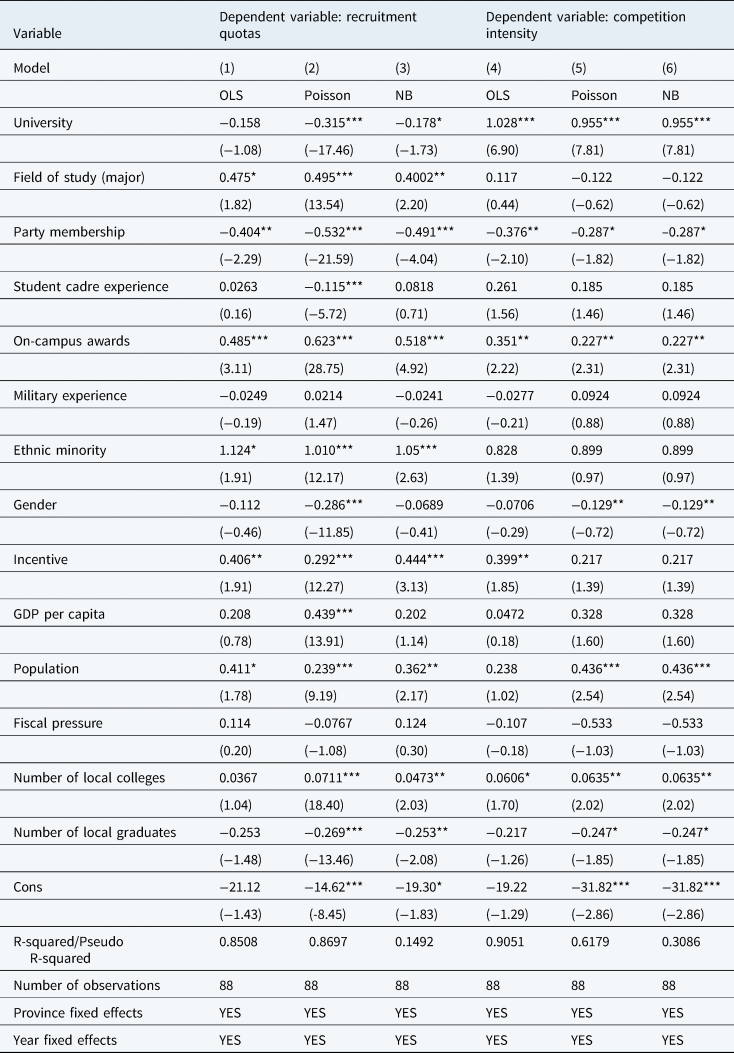
Notes: T-statistics are given in parentheses; * p < 0.1, ** p < 0.05, *** p < 0.01.
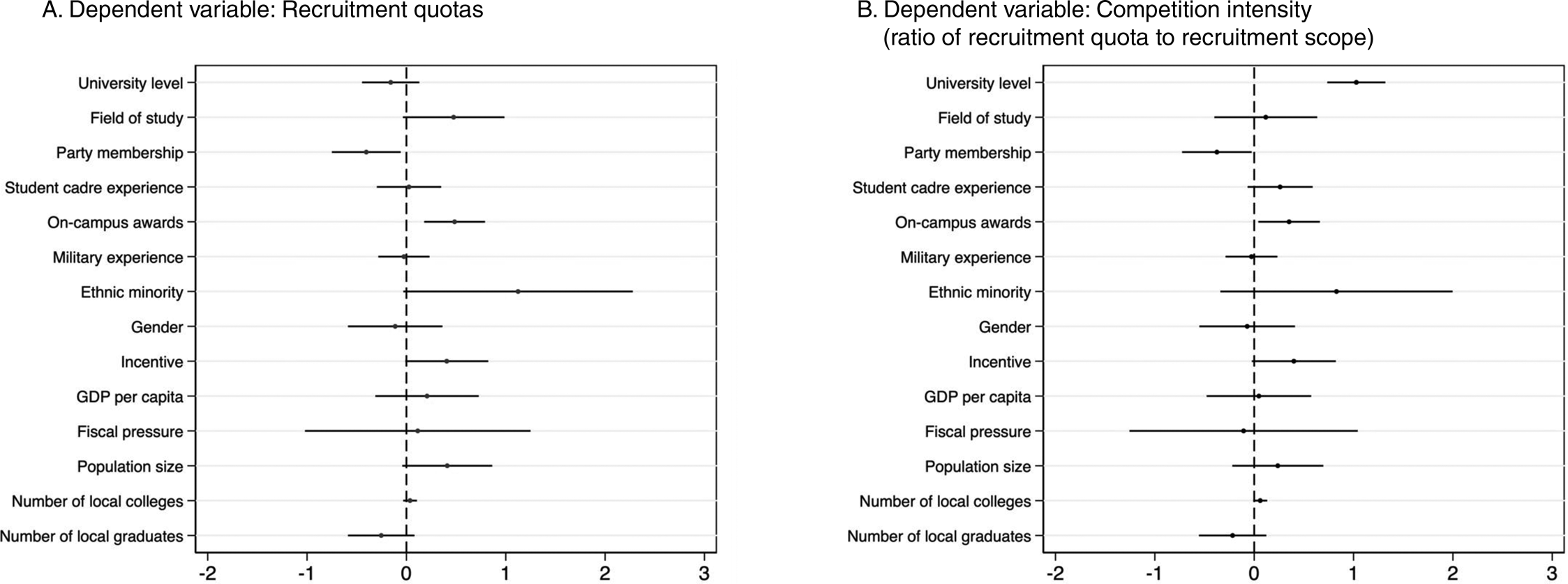
The OLS, Poisson and NB results consistently demonstrate that the level of the target universities is negatively associated with the overall recruitment quota. This result is not surprising because if provinces narrow the SSG recruitment scope down to several top universities, the overall recruitment quotas will decline in parallel with the reduction in potential applicants. The results in columns 1–3 on the effects of other recruitment factors show that on-campus awards have a significantly positive effect on the recruitment quota, while the two other factors, Party membership and student cadre experience, have a significantly negative effect. In line with the coding definition of the three dummies, the results indicate that SSG recruitment quotas will increase when taking on-campus awards as a necessary condition, while more stringent requirements on Party membership and student cadre experience lead to a reduced recruitment quota. The findings suggest that the requirements for political loyalty and student cadre experience are a marker for the competition intensity of the SSG recruitment, while the requirements for on-campus awards cannot explain such competition intensity. The possible reason is that graduates holding on-campus awards are not scarce resources, while graduates who have Party membership and student cadre experience are somewhat rarer and more valuable. As Figure A1 in the Appendix shows, Party membership and student cadre experience are the two more common and stringent requirements for SSG selection in most cases, comparing to the other two factors. The results for incentive intensity (columns 1–3) show that stronger incentives lead to an expansion in recruitment quotas.
In columns 4–6, we change our dependent variable to the ratio of recruitment quota to recruitment scope to gauge the intensity of competition for target-based SSG selection. The results show that the relationship between elite education and SSG competition is reversed, that is, the more demanding requirements for the quality of the target university lead to a lower competition intensity for SSG positions. Like the examples of Anhui and Hubei SSG recruitment plans discussed earlier, with a similar total recruitment quota at the province level, targeting higher-level universities narrows the recruitment scope and lowers competition intensity. The results are robust in Poisson and NB regressions.
Figure 3 presents the OLS estimates of recruitment quotas and intensity of target-based SSG recruitment competition, showing a comparison of the estimated effects on the two dependent variables. Apart from the opposite results for the effects of elite education, we obtain substantively similar findings for the effects of other determinants.
Determinants of Recruitment Quotas and Competition Intensity in Target-based SSG Selection (2017–2020)
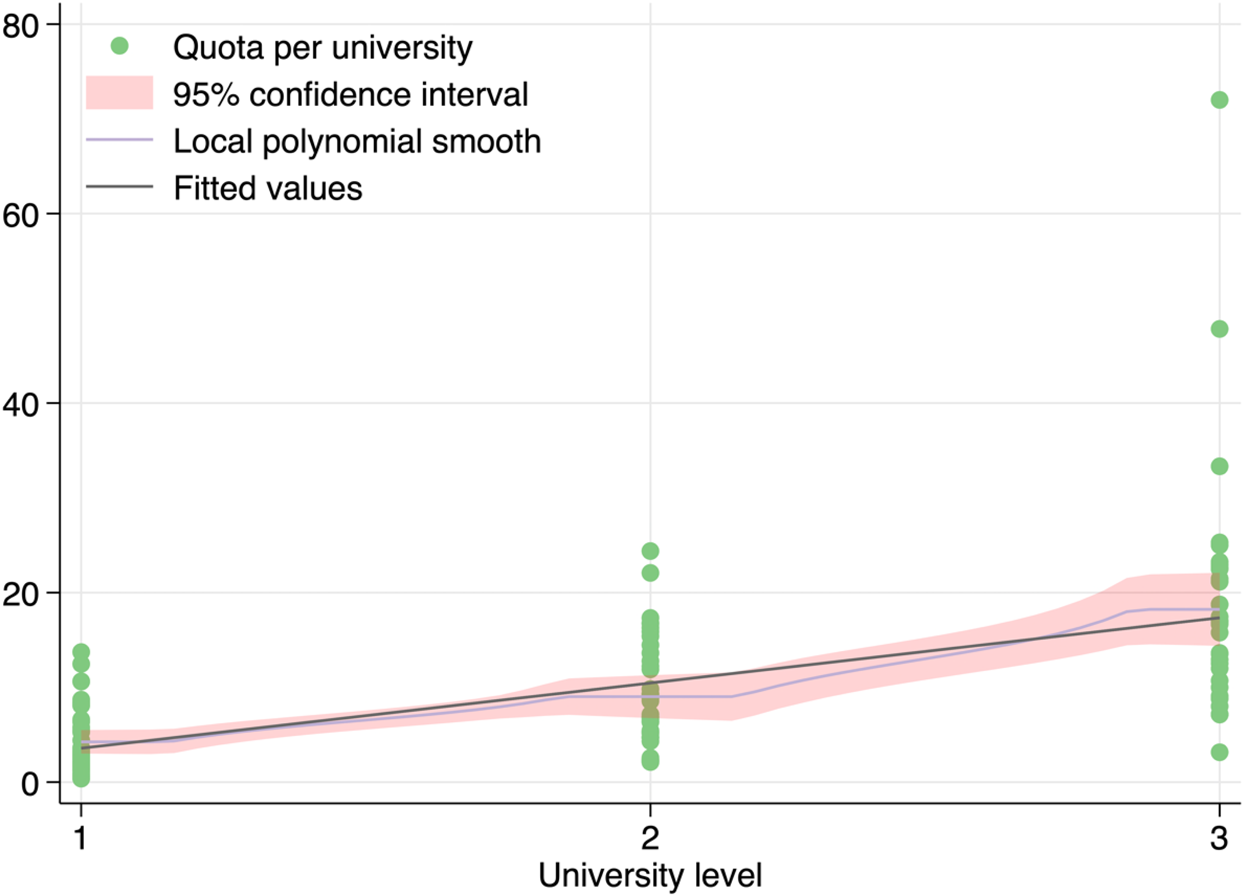
To examine this relationship, in Figure 4 we plot the average quota for each target university against the target university level. The fitted line in Figure 4 indicates that the graduates from top elite universities have more opportunities and much less competition when applying to be SSGs than do graduates from less prestigious universities. Thus, Hypothesis 1 is confirmed. This finding reveals two simple but profoundly important messages: first, elite education is increasingly stratified; second, access to elite education means an easier pathway into the establishment and, in our study, to become a civil servant and a reserve cadre in China. This is particularly true for graduates from top elite universities. Figure A2 in the Appendix shows that more than 75 per cent of Peking University graduates who applied as target-based SSGs in 2017 were employed in Party and government institutions, and this percentage increased to 89 per cent in 2019. As for Tsinghua University, about 90 per cent of its graduates who became civil servants were target-based SSGs in 2020. Target-based SSG recruitment has become the primary route for graduates from the top elite universities to enter and advance in the party-state bureaucracy, bypassing the slower NCSE route followed by ordinary graduates. Existing data show that the top two elite universities in China for cultivating target-based SSGs are Peking University and Renmin University of China, followed by Tsinghua University.Footnote 39 The popularity of target-based SSG application in these and similar universities can be explained by the special selection advantages afforded to elite university graduates. Although it is too early to estimate the long-run outcomes of the target-based SSG scheme, it is likely that this increasingly stratified elite recruitment pattern will mean that graduates from top universities fill substantial numbers of positions in grassroots-level units, further reinforcing the role of homophily in political selection and promotion. Such homophily, arising from the shared school experience, builds identity loyalty in political relationships and thus provides an ex ante prediction for selection of political candidates.Footnote 40
The Relationship between Elite Education and Political Selection
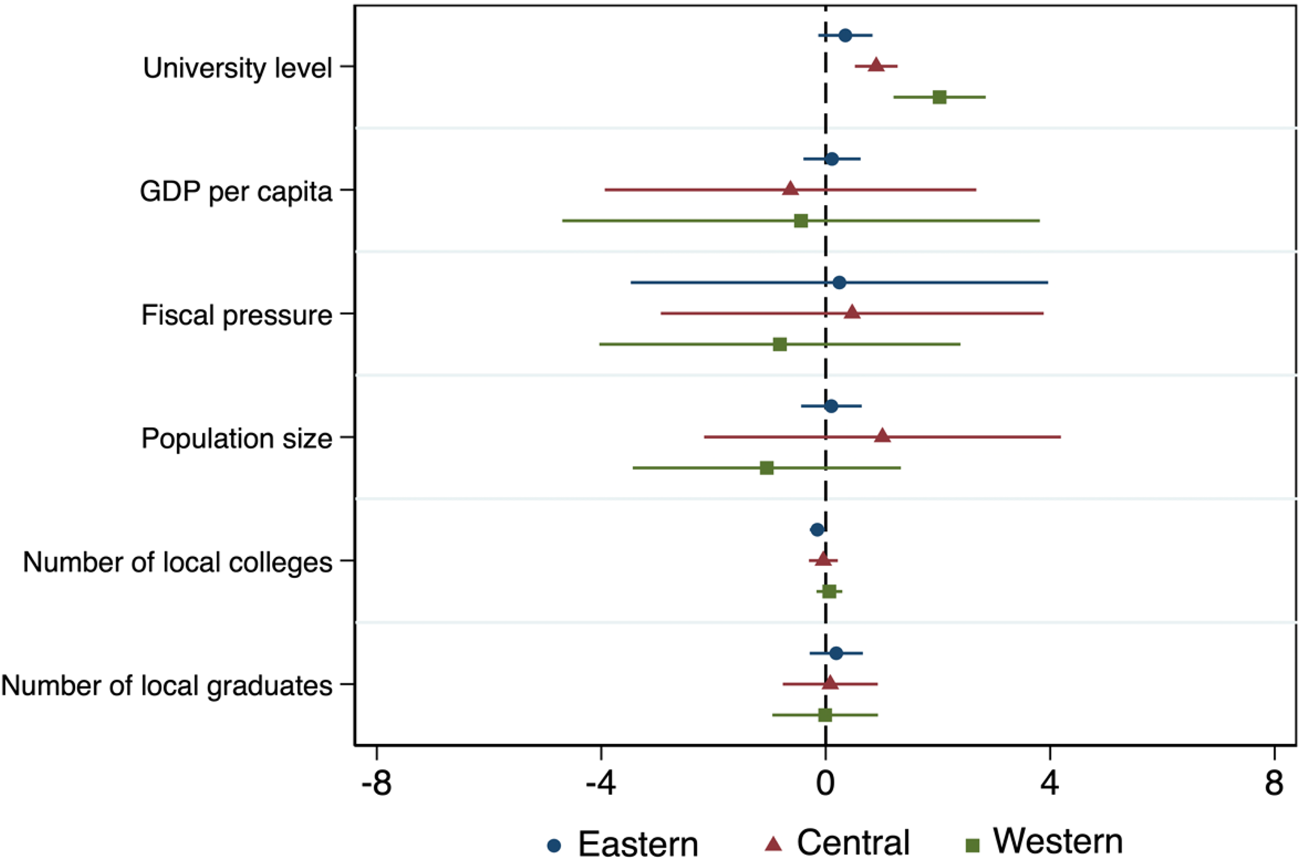
Based on the baseline regression results, we conduct further regional heterogeneity analysis on the relationship between elite education and SSG selection. In terms of economic development level and geographical location, we classify provinces into three main regions: eastern, western and central.Footnote 41 Table A3 in the Appendix reports that a significant positive relationship between target university level and the average quota for each target university can be identified in all three regions. Figure 5 shows that controlling for the socioeconomic factors, the estimated effect of elite education is highest in the western region, followed by the central region, and is lowest in the eastern region (Table A3 in the Appendix presents the full results). We see this as indicative of the influence that regional economic level has on the desire for graduates from elite universities: in less developed regions with a shortage of highly educated talents, governments are more likely to compete for elite graduates through providing more places.
Regional Heterogeneity and Intensity of SSG Competition
Next, we turn to our second hypothesis, about the regional effects on preference for elite graduates. Table 2 presents the ordered logit regressions on the effect of provincial socioeconomic characteristics on the preference for elite graduates in SSG selection. Column 1 reports the regression results, and columns 2–4 report the average marginal effects. The results indicate a negative and statistically significant relationship between GDP per capita and target university level in SSG selection. The marginal effects show that a one-unit increase in GDP per capita reduces the likelihood of targeting top elite universities by about 31 per cent. A similar significant and negative relationship is also found between population size and target university level. Contrary to Hypothesis 2, we find that when choosing which universities to target for SSG selection, economically advanced and populated provinces have adopted more inclusive eligibility criteria, while less developed provinces are more likely to seek graduates from top universities.
Results of Ordered Logit Estimates on Target University Level in SSG Selection
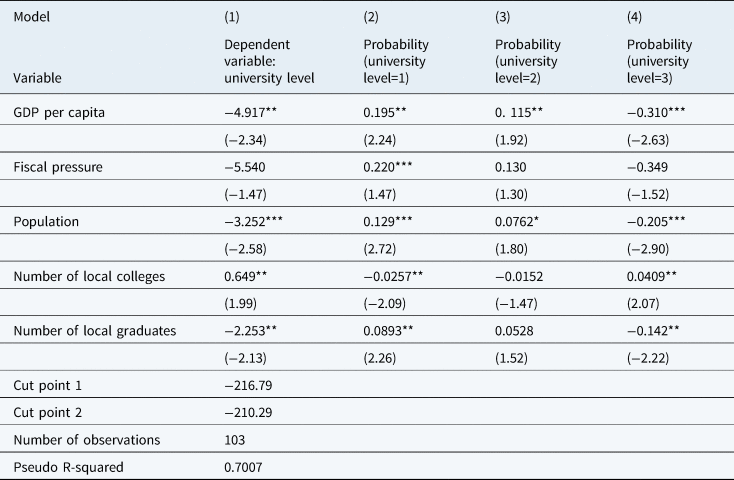
Notes: Z-statistics are given in parentheses; * p < 0.1, ** p < 0.05, *** p < 0.01.
On the surface, the fact that less developed regions require a higher level of university education for SSG recruitment may appear puzzling. Because elite university graduates generally have many attractive and lucrative career choices, less developed regions, which generally have lower pay and poorer working conditions, are thus less attractive to them.
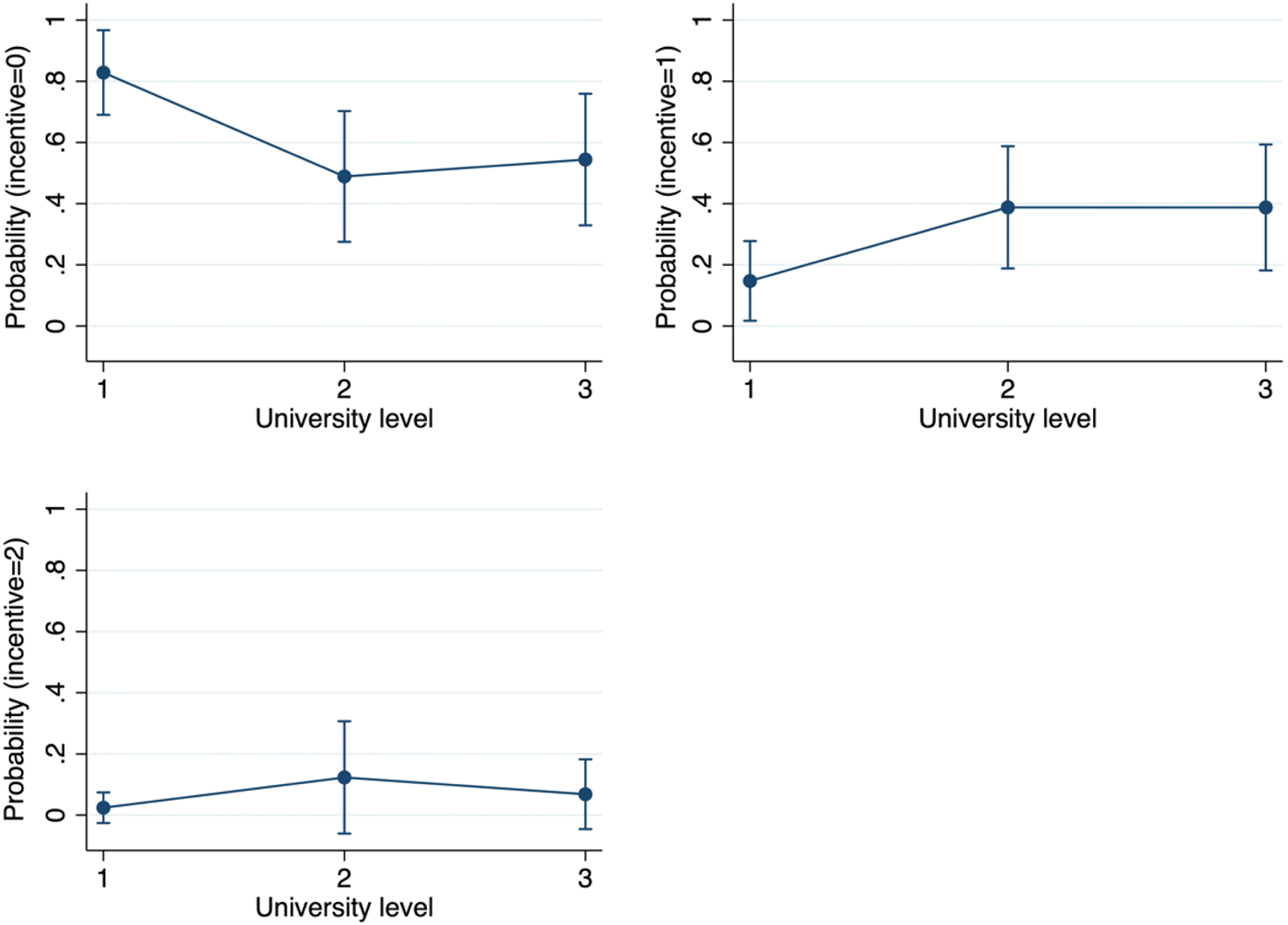
To further understand the strong preference for graduates from elite universities, we must look at the role of incentives in SSG selection. To that end we present ordered logit estimates in Table 3. Column 1 suggests that each year, graduates from higher-level universities are offered stronger incentives. The results of our estimation of marginal effects show that given a one-level rise in target university quality, the probability of providing a single incentive (either a material incentive or a promotion incentive) will increase by 3.04 per cent, and the probability of providing double incentives (both a material and promotion incentive) will increase by 9.79 per cent. Thus, Hypothesis 3 is confirmed. Figure 6 illustrates the predicted marginal effects of target university level holding other variables at mean and shows that if target-based SSG selection is open only to elite university graduates such as those from world first-class universities, incentive intensity increases significantly. However, when recruitment scope is further narrowed to only the very top universities, the marginal variation in incentive intensity is lesser in effect. This finding demonstrates that when making decisions on incentive strategy, the world first-class university may be a threshold for providing incentives. But within world first-class universities, there is no significant distinction in terms of incentive intensity between those at the very top and others.
Adjusted Prediction of the Effect of Target University Level on Incentive Intensity (95% Confidence Interval)
Results of Ordered Logit Estimates on Incentive Intensity in SSG Selection
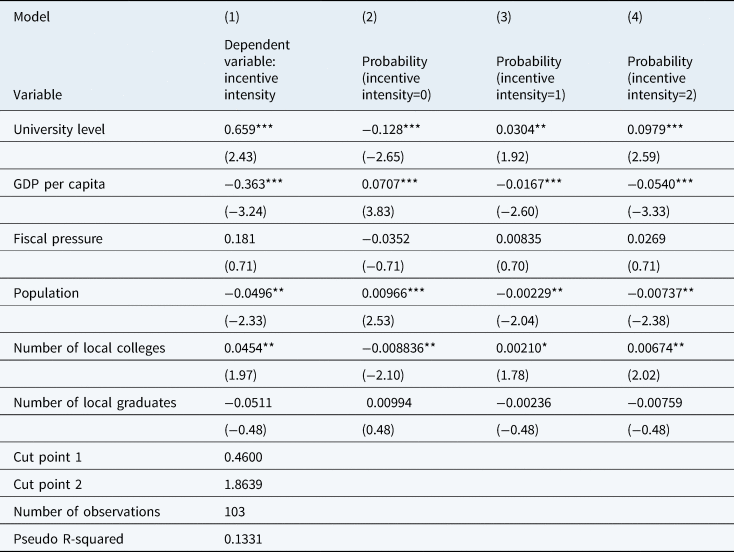
Notes: Z-statistics are given in parentheses; * p < 0.1, ** p < 0.05, *** p < 0.01.
Table 3 also shows the effects of provincial socioeconomic characteristics on incentive strategy in SSG selection. Column 1 shows that both GDP per capita and population size are negatively associated with the incentive intensity. Thus, Hypothesis 4 is confirmed. The last four columns suggest that a one-unit increase in GDP per capita reduces the likelihood of providing a single incentive by about 1.67 per cent and reduces the likelihood of providing double incentives by about 5.4 per cent. Consistent with our hypothesis, governments in less developed provinces tend to provide more incentives to attract elite graduates.
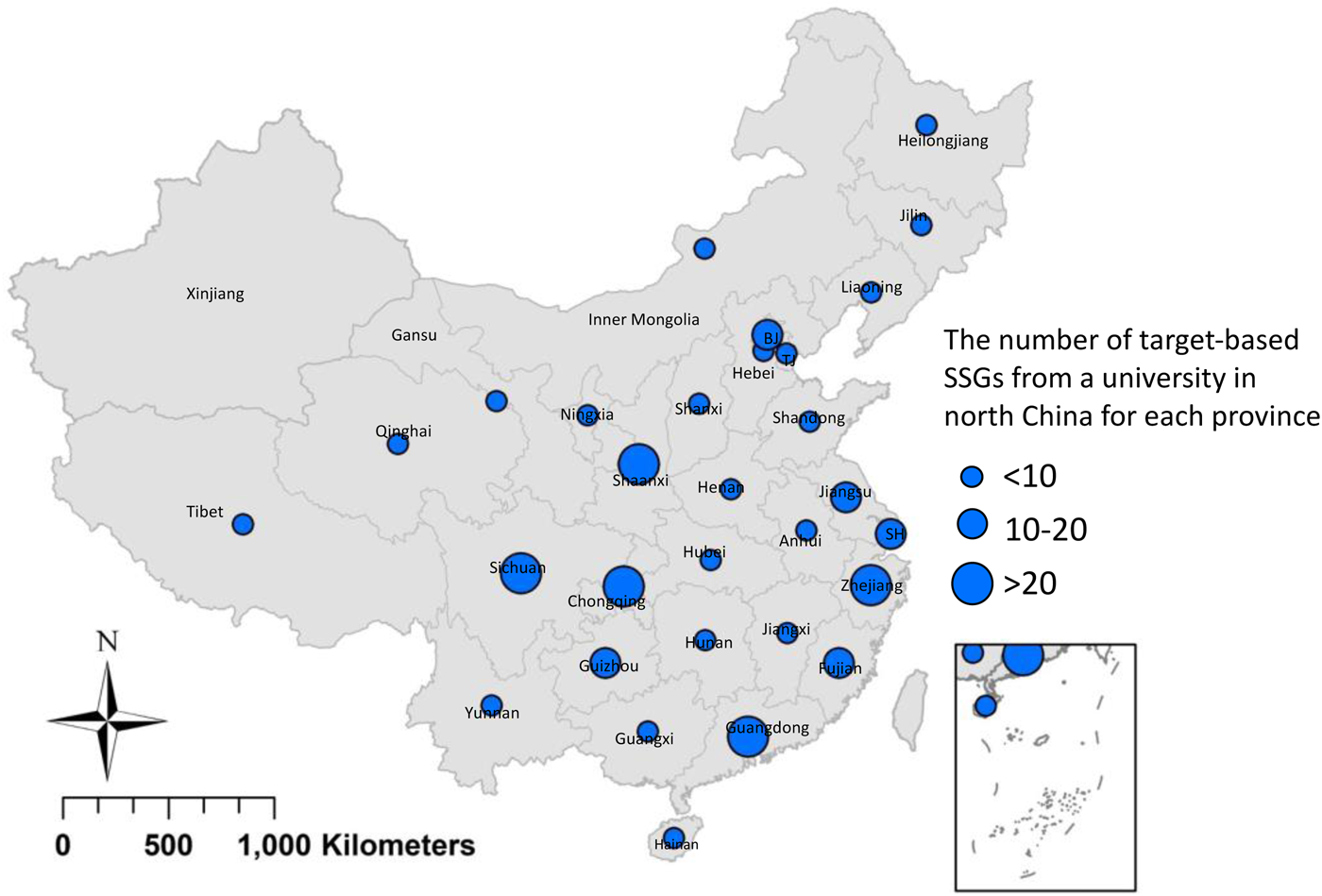
The question is whether, despite incentives, graduates from elite universities will choose to join the party-state bureaucracy in a less developed region. Figure 7 shows the regional distribution of target-based SSGs from a university in North China. In 2020, over 300 fresh graduates from this university became SSGs, and they served in grassroots units across 30 provinces. The eastern regions attracted the majority of these SSGs. Meanwhile, the western provinces, which are seen as underdeveloped and backward, recruited over 30 per cent of the total number of target-based SSGs from this university. Even provinces with particularly poor working conditions, such as Ningxia and Qinghai, were able to attract a few elite graduates (although not many) to serve in grassroots units in these regions. This finding supports the notion that offering incentives is useful in attracting elite graduates to serve in less developed regions.
Regional Distribution of Target-based SSGs from One University in North China, 2020
Source: Internal statistics from that university.
In addition, the extensive spread of target-based SSGs across the country has accelerated the formation of alumni networks of elite university graduates in grassroots units across China. In the long run, graduates from elite universities will benefit from homophilous affinity arising from shared education experience. They will be able to join forces to help one another in advancing their careers.
Concluding Remarks
The key finding of this study is that elite education provides outstanding graduates with an easy pathway to become reserve cadres in China, and increases educational and social stratification. Using information in provincial recruitment plans for target-based SSGs, we estimate how the preference for elite graduates affects both the intensity of competition for SSG selection and the amount of incentives offered to potential candidates. We find that elite education is increasingly stratified, such that graduates from top elite universities have significant selection advantages in the SSG competition and are likely to be offered more incentives. We also investigate and identify other factors that provincial governments look for in candidates for SSG selection. Our findings suggest that less developed regions have a stronger preference for elite graduates. The empirical results are robust to various additional checks, including alternative measurements of dependent variables and different empirical specifications. Our findings provide empirical evidence of the relationship between elite education and political selection and offer suggestive evidence that the stratification of elite universities may have long-term political as well as policy ramifications.
Our study has important implications for understanding “merit-based” elite recruitment in China. As a typical product of political meritocracy in communist China, the goal of the SSG scheme is to cultivate reserve cadres and recruit competent and politically loyal personnel for grassroots-level governments. However, the SSG scheme has been stratified into the target-based and non-target-based schemes, which are quite different in terms of selection criteria and position allocation. Moreover, local governments’ preference for top elite university graduates further deepens the internal stratification of target-based SSG selection. This trend is emblematic of China's political meritocracy and indicates that elite universities in China are now being used as a means of supporting and sustaining state legitimacy.
In addition, by selecting political elites fresh from university, the target-based SSG scheme may come to rely on homophily in the long run. Each year, graduates from elite universities account for most reserve cadres in grassroots-level governments. Such extensive alumni networks amass strength over time, and in the long run further intensify the homophily effects on elite selection and promotion.Footnote 42 In fact, the preferences and needs of both the demand side and the supply side have converged to form a closed loop of homophily. The government prefers graduates from top elite universities to improve the quality of cadre personnel whilst top elite universities strive to cultivate cadres to enhance their representation and influence in politics. As for the graduates of elite universities, they can relatively easily achieve their political ambitions given the selection advantages they enjoy in the political recruitment process. This closed loop of homophily has created elite closure, an unintended but unsurprising outcome of the merit-based elite selection system. Considering the ex-ante inequality in access to elite education between the rural poor and urban rich, it appears the target-based SSG scheme increases social inequality and social stratification by keeping socioeconomically disadvantaged young people out of political leadership.
Finally, the increasingly stratified elite recruitment system has resulted in a tournament for academic qualification credentials. Because the SSG scheme provides fresh graduates with a convenient route into the establishment and a political career, the SSG position has been among the most highly sought-after jobs in China. Under the current target-based SSG scheme, a formal degree from a top elite university greatly increases a university graduate's chance of being chosen as an SSG. Therefore, despite the expansion of higher education, competition for access to elite universities will become increasingly fierce.
The findings highlight that although admission to elite universities is based on merit (i.e., educational credentials), the proportion of students in today's China from poorer, lower-class families who have gained access to elite education has been quite small.Footnote 43 Our major finding is that merit-based political recruitment as a channel of upward mobility for non-elite classes is largely illusory. The increasing internal stratification within elite education and political selection may further exacerbate social immobility.
Supplementary material
The supplementary material for this article can be found at https://doi.org/10.1017/S0305741023000802.
Acknowledgements
This work was supported by the Ministry of Education of the Republic of Korea and the National Research Foundation of Korea (NRF-2017S1A3A2067636), Beijing Social Science Fund (No. 21DTR058), and National Natural Science Foundation of China (No. 72274203). We are grateful to the excellent research assistance of Yongkang Jiang.
Competing interests
On behalf of all of the authors, the corresponding author states that there are no competing interests.
Mengxue ZHAO is a PhD student at the Department of Public and International Affairs, City University of Hong Kong. Her research interests cover cadre personnel management and urban governance.
Liang MA is a professor at the School of Public Administration and Policy, Renmin University of China. His research interests cover public organizational innovation and public service performance management.
Hon S. CHAN is president of the HKU SPACE Po Leung Kuk Stanley Ho Community College, Hong Kong. His major research interests cover public sector personnel management, performance measurement, civil service reforms, comparative institutional and policy capacity studies, and environmental policies.



