Introduction
The European corn borer, Ostrinia nubilalis (Hübner) (Insecta: Lepidoptera: Crambidae), is naturally distributed in Europe, western Asia and north-west Africa and infests a wide array of host plants Mutuura & Munroe (Reference Mutuura and Munroe1970). North American populations of this species are thought to have originated from accidental introductions in the early 20th century (Thompson & Parker, Reference Thompson and Parker1928). In Poland and other European countries, O. nubilalis is found mainly on mugwort (Artemisia vulgaris L.; Wocke, Reference Wocke1874), hop (Humulus lupulus L.; Büttner, Reference Büttner1880; Romaniszyn & Schille, Reference Romaniszyn and Schille1930), hemp (Cannabis sativa L.; Romaniszyn & Schille, Reference Romaniszyn and Schille1930) and maize (Zea mays L.; Wocke, Reference Wocke1874). The European corn borer is one of the most serious pests of maize in Europe. Extensive damage to crops by O. nubilalis has been reported for Hungary, Italy, Spain, France, Germany and Poland. Meissle et al. (Reference Meissle, Mouron, Musa, Bigler, Pons, Vasileiadis, Otto, Antichi, Kiss, Pálinkás, Dorner, Van Der Weide, Groten, Czembor, Adamczyk, Thibord, Melander, Nielsen, Poulsen, Zimmermann, Verschwele and Oldenburg2010) found that in infested areas O. nubilalis occurs in a large proportion of maize fields, ranging from 20% (in Hungary) to 60% (in Spain), and estimated yield losses at between 5 and 30%. In Poland O. nubilalis has caused serious damage to maize since the 1950s (Kania, Reference Kania1966). Currently, this pest is found throughout the country (Bereś & Konefał, Reference Bereś and Konefał2010). In regions with intense maize cultivation (southern Poland) this species damages 50–80% and locally up to 100% of plants, causing a direct loss in grain yield of 20–30%, and sometimes up to 40% (Lisowicz & Tekiela, Reference Lisowicz, Tekiela and Dubas2004).
Taxonomic revision of the genus Ostrinia by Mutuura & Munroe (Reference Mutuura and Munroe1970) placed the European corn borer within the group of trilobed uncus species and the subgroup characterized by males lacking a row of enlarged scales or a tuft of hair-like scales on mid-tibia, i.e. the so-called ‘small mid-tibia’ phenotype. However, a number of studies have put into question many traditional relationships within the genus since the publication of Mutuura and Munroe's monograph. Although the division based on the shape of the uncus seems valid (Kim et al., Reference Kim, Hoshizaki, Huang, Tatsuki and Ishikawa1999), the relationships within the trilobed group have been strongly contested. For example, the mid-tibia morphology exhibits a simple Mendelian pattern of inheritance and extensive hybridization between species differing in this trait has been shown (Frolov, Reference Frolov1981, Reference Frolov1984). Frolov et al. (Reference Frolov, Bourguet and Ponsard2007) concluded that this group should be divided according to host type instead of mid-tibia morphology. They proposed that individuals feeding on maize in Europe should be referred to as O. nubilalis (sensu nov.) while those infesting dicotyledonous species such as mugwort, hemp and hop across Eurasia as Ostrinia scapulalis (sensu nov.) (Walker). Interestingly, significant divergence between O. nubilalis populations inhabiting maize and dicots, including prezygotic reproductive isolation, was suggested much earlier (Judenko, Reference Judenko1938; Karpova, Reference Karpova1959; Frolov, Reference Frolov1984). Additionally, Frolov et al. (Reference Frolov, Bourguet and Ponsard2007) synonymized two Asian species, Ostrinia narynensis Mutuura & Munroe and Ostrinia orientalis Mutuura & Munroe, with O. scapulalis (sensu nov.). According to the new division, O. scapulalis included all three mid-tibia morphotypes (small, medium and large), whereas O. nubilalis only encompassed individuals with the small phenotype. Further studies based on microsatellite variation corroborated this taxonomic treatment showing two genetic clusters corresponding to maize-derived individuals and those infesting dicotyledons in Europe and Asia (Frolov et al., Reference Frolov, Audiot, Bourguet, Kononchuk, Malysh, Ponsard, Streiff and Tokarev2012; Bourguet et al., Reference Bourguet, Ponsard, Streiff, Meusnier, Audiot, Li and Wang2014).
Mitochondrial genes, especially cytochrome oxidase subunits I and II (COI and COII thereafter) are commonly used in phylogenetic, population and biogeographical studies of Lepidoptera (e.g. Dopman et al., Reference Dopman, Pérez, Bogdanowicz and Harrison2005; Hoshizaki et al., Reference Hoshizaki, Washimori, Kubota, Frolov, Kageyama, Gomboc, Ohno, Tatsuki and Ishikawa2008; Wiemers et al., Reference Wiemers, Stradomsky and Vodolazhsky2010; Zhou et al., Reference Zhou, Chen and He2012). The COI fragment is a universal barcode for insects (Ratnasingham & Hebert, Reference Ratnasingham and Hebert2007), and is the most abundantly available marker in GenBank for the majority of taxonomic groups (e.g. Piwczyński et al., Reference Piwczyński, Szpila, Grzywacz and Pape2014). Both markers have been used for population and phylogenetic studies of trilobed Ostrinia species (Kim et al., Reference Kim, Hoshizaki, Huang, Tatsuki and Ishikawa1999; Coates et al., Reference Coates, Sumerford and Hellmich2004; Hoshizaki et al., Reference Hoshizaki, Washimori, Kubota, Frolov, Kageyama, Gomboc, Ohno, Tatsuki and Ishikawa2008; Bourguet et al., Reference Bourguet, Ponsard, Streiff, Meusnier, Audiot, Li and Wang2014). A COII-based phylogeny showed that O. furnacalis (Guenée) (Asiatic corn borer) formed a sister clade to the O. nubilalis group which included O. orientalis, O. scapulalis, O. narynensis and O. kurentzovi Mutuura & Munroe (Hoshizaki et al., Reference Hoshizaki, Washimori, Kubota, Frolov, Kageyama, Gomboc, Ohno, Tatsuki and Ishikawa2008). Most of these phylogenetic and population studies sampled individuals from Asia and to a lesser extent from Europe. For example, the majority of COII sequences available in GenBank for Ostrinia come from samples collected in Japan and China. There are only a few sequences from Europe (e.g. Slovenia and France; Hoshizaki et al., Reference Hoshizaki, Washimori, Kubota, Frolov, Kageyama, Gomboc, Ohno, Tatsuki and Ishikawa2008). In the case of COI, only sequences from Asian and North American specimens are available. Moreover, the majority of studies used restriction enzymes to investigate haplotype variation of the COI gene (e.g., Martel et al., Reference Martel, Réjasse, Rousset, Bethenod and Bourguet2003; Bourguet et al., Reference Bourguet, Ponsard, Streiff, Meusnier, Audiot, Li and Wang2014) and in consequence fewer sequences are available in GenBank than for COII.
In this paper, we explore variation in mitochondrial DNA (mtDNA) using fragments of COI and COII genes of individuals traditionally recognized as O. nubilalis collected on three of the most common host plants: maize, mugwort and hop. These study centers on East-Central Europe (different parts of Poland), a region in which various host plants of O. nubilalis occur, but for which no information is available to date. We test if the clear genetic distinctiveness among individuals of O. nubilalis living on maize vs. dicots found at nuclear microsatellite loci is also tracked by mtDNA. We subsequently compare the mtDNA variation with results of other studies and contribute to unraveling the biogeographic history and genetic variability of this serious pest in Europe.
Material and methods
Sampling
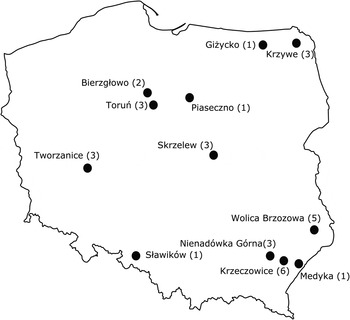
Thirty-two larvae of O. nubilalis were sampled from maize (19), mugwort (eight) and hop (five) from 12 localities in Poland in 2012, 2013 and 2015 (fig. 1, Table S1). Plant material was transported from the field to the laboratory where larvae were removed from stems, documented and immediately preserved in 70 or 96% ethanol. Photographs of larvae and preserved material are available from the first author on request.
Map displaying 12 sampling localities in Poland. The number of sampled individuals from each site is given in parentheses (for more information and GenBank accession numbers see Table S1).

DNA extraction, amplification and sequencing
Total genomic DNA was isolated from approximately half of each larvae using the DNeasy Blood & Tissue Kit (Qiagen, Valencia, CA, USA). A ca. 1.2 kb fragment of the COI gene was PCR-amplified using primers Ron and Pat (Dopman et al., Reference Dopman, Pérez, Bogdanowicz and Harrison2005), whereas the entire COII region was PCR-amplified using primers O-tLEU and B-tLYS (Liu & Beckenbach, Reference Liu and Beckenbach1992; Kim et al., Reference Kim, Hoshizaki, Huang, Tatsuki and Ishikawa1999). Each 25 µl PCR was prepared using 1 × PCR buffer, 0.2 mM dNTPs, 0.2 µM of each primer, 3–4 mM MgCl2, 1–2 U of Taq DNA polymerase (Qiagen) and 1 µl of DNA template. PCR cycles for the COI gene included initial denaturation at 94°C for 5 min, followed by 30 cycles comprising 45 s. denaturation at 94°C, 45 s. annealing at 50°C, and 1:30 min. extension at 72°C. PCR cycles for the COII gene included initial denaturation at 94°C for 5 min., followed by 32 cycles comprising 30 s. denaturation at 94°C, 1 min. annealing at 48°C and 2 min. extension at 70°C. Both PCR cycling schemes included final extension at 72°C for 10 min.
Each PCR product was electrophoresed in a 1% agarose gel and stained with ethidium bromide. No obvious polymorphism (multiple bands from a single PCR product) was observed. The PCR products were precipitated by addition of 0.1 volume of 3 M NaAc and 2.5 volume of 95% EtOH and then resuspended in water. Subsequently, cycle sequencing reactions were carried out using the PCR product and fluorescent Big Dye terminators (Applied Biosystems, Foster City, CA, USA). The final products were resolved using an automated DNA sequencer at the Laboratory of Molecular Biology Techniques, UAM (Poznań, Poland). The sequences were assembled and edited using SeqMan II ver. 4.0 (DNASTAR, Madison, WI, USA); both DNA strands were considered. All newly obtained COI and COII sequences have been deposited in GenBank (see Table S1 for accession numbers).
Phylogenetic analyses
We used COI and COII sequences available for the genus Ostrinia in GenBank to study the phylogenetic position of individuals from Poland. Analyses for COI and COII were done separately because sequences from both genes were not available for the majority of the specimens from GenBank. Additionally, five confamilial species (Lepidoptera: Crambidae) for which both COI and COII sequences of appropriate length were available, were used as outgroups (Cnaphalocrocis medinalis (Guenée) JQ647917, Tyspanodes hypsalis (Warren) KM453724, Elophila interruptalis (Pryer) KC894961, Scirpophaga incertulas (Walker) KF751706 and Chilo suppressalis (Walker) HQ860290). All DNA sequences were aligned using MUSCLE (Edgar, Reference Edgar2004) through the graphical interface in Seaview 4.4.0 (Gouy et al., Reference Gouy, Guindon and Gascuel2010), with default parameters for gap penalty and extension. The alignment was then edited manually and sequences much shorter than those obtained in this study were removed, whereas longer ones were trimmed. Phylogenetic analyses included Bayesian inference (BI) using MrBayes v. 3.2.1 (Ronquist et al., Reference Ronquist, Teslenko, Van Der Mark, Ayres, Darling, Höhna, Larget, Liu, Suchard and Huelsenbeck2012) and maximum likelihood (ML) using Phyml version 20120412 (Guindon & Gascuel, Reference Guindon and Gascuel2003). Substitution models were selected using the program jModelTest 2.1.4 and the Bayesian information criterion (Darriba et al., Reference Darriba, Taboada, Doallo and Posada2012). Two simultaneous BI analyses were carried out using a random starting tree, one cold and three heated chains (at default temperature of 0.1) for 20 million generations sampling every 4000th generation, and default priors for estimated parameters. The initial 25% (1250) of saved trees were discarded as burn-in and the consensus and posterior probabilities (PP) of clades were calculated based on the remaining trees. Node support values for best ML tree were assessed using bootstrap analysis with 1000 replicates.
Genetic divergence between O. nubilalis infesting different host plants in Poland
We grouped the obtained sequences into larvae originating from maize (N = 19) and dicots (N = 13) and used a set of summary statistics in DnaSP v5 (Librado & Rozas, Reference Librado and Rozas2009) to quantify genetic differentiation between them. We also constructed a median-joining network in Network v. 4.6 (Bandelt et al., Reference Bandelt, Forster and Röhl1999) to visualize haplotype differentiation in sequences from Poland.
Next, we used the genealogical sorting index (gsi; Cummings et al., Reference Cummings, Neel and Shaw2008) to quantify the degree of exclusive ancestry of individuals infesting maize and dicots. This index takes values between 0 and 1 where the maximum indicates reciprocal monophyly, while gsi < 1 implies different degrees of paraphyly of the examined group. In the first step, we reconstructed phylogenies from concatenated sequences of COI and COII applying the ML method implemented in Phyml with substitution models selected using the jModelTest. Each tip was then labeled as ‘dicot’ or ‘maize’ and the gsi value was calculated. Permutations were used to test the hypothesis that the obtained pattern is statistically different from that which might be observed at random. We used the R package genealogicalSorting available at http://www.genealogicalsorting.org/resources/.
mtDNA variability of O. nubilalis among different geographical regions
Our phylogenetic results (figs 2 and 3) failed to confidently delimit species within the O. nubilalis group. In fact, each taxon within this group seems paraphyletic in respect to mtDNA, and most nodes are left unresolved. In addition, we were not able to separate sequences according to host plant because this information was unavailable in many cases. In the following, we therefore consider O. nubilalis, O. orientalis and O. scapulalis as non-independent genetic units, and calculate summary statistics by grouping according to geographic area instead of taxonomic provenance.
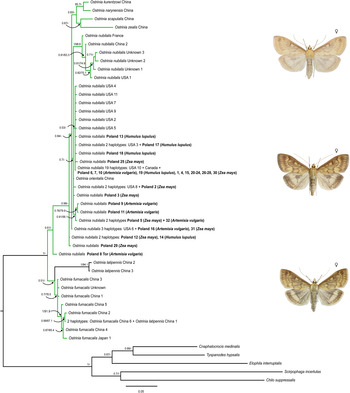
50% majority-rule consensus tree obtained from Bayesian analysis of 43 COI sequences representing the genus Ostrinia and outgroups using the GTR + I + Γ nucleotide substitution model. The clade formed by trilobed Ostrinia species is marked in green. The name of species, number of haplotypes and their origin are given for each tip. For example, ‘2 haplotypes: Ostrinia furnacalis China 6 + Ostrinia latipennis China 1’ means that two identical haplotypes represent this tip: one under the name O. furnacalis and the second O. latipennis and both are from China. The numbers following the country correspond to Table S2 in which details for each haplotype are given. The haplotypes from Poland are boldfaced and numbers correspond to Table S1. Posterior probabilities (PP > 0.5) and bootstrap values (BS > 50%) are given before and after the slash, respectively. Exemplary phenotypic variation of a female imago from Poland is also shown.

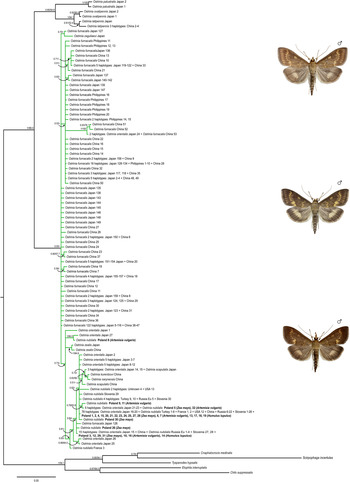
50% majority-rule consensus tree obtained from Bayesian analysis of 95 COII sequences representing the genus Ostrinia and outgroups using the GTR + I + Γ nucleotide substitution model. The clade formed by trilobed Ostrinia species is marked in green. The name of the species, number of haplotypes and their origin are given for each tip. For example, ‘Ostrinia furnacalis 5 haplotypes: Japan 2–4 + China 48–49’ means that five identical haplotypes represent this tip: three from Japan and two from China. The numbers following the country correspond to Table S2 in which details for each haplotype are given. The haplotypes from Poland are boldfaced and numbers correspond to Table S1. Posterior probabilities (PP > 0.5) and bootstrap values (BS > 50%) are given before and after the slash, respectively. Exemplary phenotypic variation of a male imago from Poland is also shown.

We also retrieved COI and COII sequences from GenBank for the O. nubilalis group and separated them into groups according to country of origin. The political borders reflect local populations from various geographical regions differing in climate, biogeographical history and land use (Japan – Far East, Russia – Eastern Europe, Slovenia – Balkan Peninsula, Turkey – Anatolia, USA and Canada – North America). In subsequent analyses, we only considered sequences with similar length as sequences obtained for individuals from Poland. The nucleotide diversity (π) for all sets was compared as follows: (1) pooled individuals from Poland vs. other regions for COI and COII, (2) individuals collected on maize from Poland vs. other regions for COI and COII, and (3) individuals collected on dicots from Poland vs. other regions for COI and COII. All these comparisons were done twice. In the first set of analyses, we used the maximum number of sequences retrieved from GenBank for a given region. In consequence, the numbers of sequences were unequal between compared datasets. Because estimation of allelic richness may be complicated by the effects of sample size as large samples are expected to have more alleles (Kalinowski, Reference Kalinowski2004), the second set of analyses was done with equal numbers of sequences in comparisons. The statistical significance for the first set of comparisons (unequal sample sizes) was estimated by obtaining a distribution of differences of π values between the two sets of sequences from 1000 bootstrap samples. The statistical support was calculated as follows: P-value = number of times {diffsam > diffobs}/number of repetitions. In the second set of analyses, we adopted the following approach: (1) to equalize the sequence number for a given comparison, 100 reduced datasets were generated for region with the higher number of sequences by random sampling of sequences without replacement from the alignment; (2) for each dataset, a comparison of π values was made by bootstrapping as described above; and finally (3) the number of significant results (P < 0.5) from the bootstrap analyses was compared with the binomial distribution, i.e. the probability of having x successful outcomes, in our case significant results at P < 0.05, in n-independent trials (bootstrap analyses) with probability of success equal to P = 0.5. If this value was above the 97.5th percentile of the distribution, then we treated it as statistically significant.
Results
For each of the 32 studied individuals we obtained part of the COI (1185 bp) and the entire COII region (682 bp). Nineteen individuals were sampled from maize (Zea mays), eight from mugwort (A. vulgaris) and five from hop (H. lupulus) (Table S1). In the case of COI, there were 14 haplotypes, whereas only seven were found for COII (see figs 2 and 3). A concatenated alignment contained 43 variable positions and 13 parsimony-informative sites. Translation of the mtDNA (395 and 227 amino acids for COI and COII, respectively) yielded peptide sequences lacking frame shifts or stop codons.
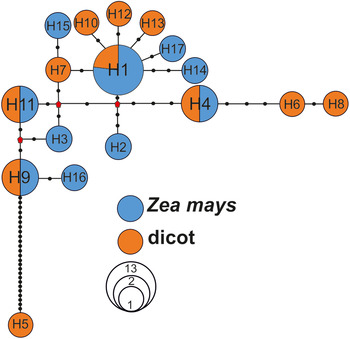
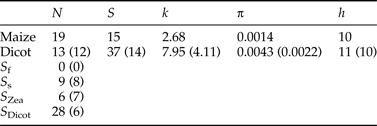
Summary statistics calculated for concatenated COI and COII genes were higher for dicots than for maize (table 1). However, this difference was much reduced if divergent haplotype no. 5 (table 1) was excluded from analyses. The average number of nucleotide substitutions per site between the two groups amounted to 0.0028 (0.0018 after exclusion of haplotype no. 5), but the net number of nucleotide substitutions per site was zero, due to a lack of fixed differences between groups (table 1). This lack of differentiation was driven by the sharing of the two most frequent haplotypes (fig. 4).
Median-joining network for concatenated COI and COII from O. nubilalis specimens from Poland color-coded according to host plant. Circles proportional to sample size; small filled dots represent mutational steps. Red polygons are median vectors. Haplotype numbers correspond to specimens in Table S1 as follows: H1 (1, 4, 6, 7, 15, 19–24, 27, 28), H2 (2), H3 (3), H4 (5, 32), H5 (8), H6 (9), H7 (10), H8 (11), H9 (12, 14), H10 (13), H11 (16, 31), H12 (17), H13 (18), H14 (25), H15 (26), H16 (29) and H17 (30).

Summary statistics calculated for concatenated COI and COII mtDNA gene fragments in O. nubilalis (Hübner) collected from host plants maize and dicots (hop and mugwort) in Poland. Values in parentheses for dicots were calculated after exclusion of divergent haplotype no. 5 (see Fig. 4).

N– number of sequences; S – number of segregating sites; k –average number of nucleotide differences; π – nucleotide diversity per site; h – number of haplotypes; S f – number of fixed differences between groups; S s – number of shared polymorphisms between groups; S Zea – number of polymorphic sites in O. nubilalis found on Z. mays, but monomorphic in individuals found on dicots; S Dicot – number of polymorphic sites in O. nubilalis found on dicots, but monomorphic in individuals found on maize.
We retrieved 337 sequences of COII and 33 sequences of COI for Ostrinia species from GenBank (Table S2). We added 32 sequences obtained in this study and five outgroups to each alignment (see above). After removing identical sequences, the final alignments, together with the outgroups, comprised 97 and 46 sequences of COII and COI, respectively.
The COI and COII alignments used for estimation of the mtDNA phylogeny contained 348 and 222 variable positions and 239 and 141 parsimony-informative sites, respectively. JModeltest with the Bayesian Information Criterion selected the TIM1 + I + Γ model with four substitution patterns (012230) and TIM2 + I + Γ also with four substitution patterns (010232) for COI and COII dataset, respectively. However, in MrBayes, it is possible to apply only models with 1, 2 and 6 substitution types. Therefore, for BI analyses we selected the parameter-rich GTR + I + Γ model. Simulation studies have shown that overparameterization is much less dangerous for BI than underparameterization (Huelsenbeck & Rannala, Reference Huelsenbeck and Rannala2004). The Bayesian 50% majority-rule consensus trees for COI and COII datasets with PP and with corresponding bootstrap values (BS) from ML analysis are presented in figs 2 and 3. Alignments, ML and consensus BI trees were deposited in TreeBASE, study number S18843.
Both COI and COII trees were unresolved at many nodes. In particular, the Bayesian consensus tree for COII showed a large polytomy comprising mainly O. furnacalis specimens (fig. 3), although the O. furnacalis and O. nubilalis group formed a monophyletic clade (PP = 0.83, BS < 50%). In the case of COI, O. furnacalis formed a sister clade to O. nubilalis in ML analysis with low bootstrap support (BS = 51.5%), while in BI to O. latipennis with low PP = 0.51 (fig. 2). One COI sequence (FJ435437) from China was apparently erroneously determined as O. latippenis (Warren) since it was identical to O. furnacalis from China (FJ435436; fig. 2). COI and COII haplotypes from Poland did not form monophyletic clades with other haplotypes from Europe. Moreover, they were not grouped according to host plant. Instead, five haplotypes (four from mugwort and one from maize) had identical sequences or clustered together with O. orientalis specimens from Japan in the COII analysis (fig. 3). In the COI tree, individual number 8 from Poland (Table S1) formed the first branch to the O. nubilalis group, although with low support in both ML and BI analyses (PP = 0.61, BS < 50%). The remaining individuals from Poland were part of a large polytomy in both COI and COII trees. Their sequences were identical to sequences from North America in the case of specimens 1, 2, 4, 6, 7, 10, 16, 17, 20, 21, 22, 23 ,24, 26, 28, 30 and 31 (Table S1) in the COI analysis, and to sequences from Japan, China, Russia and Slovenia (numbers 3, 10 12, 14, 16, 29 and 31) and to Japan, Turkey, France, USA, China, Russia and Slovenia (numbers 1, 2, 4, 6, 7, 6, 7, 13, 15, 17, 18, 19, 20, 21, 22, 23, 24, 25, 27 and 28) in the case of COII.
The gsi indices for two groups representing individuals sampled on dicotyledonous plants and maize had values of 0.258 and 0.046, respectively. Both values were not statistically significant for either labeled group (P > 0.05). This indicates that assignment of individuals according to host type did not result in monophyletic mtDNA clades and was indistinguishable from random expectations. The phylogenetic tree on which gsi estimates were based is provided in Table S2.
We were able to collect data for the O. nubilalis group for one region (North America) in the case of COI and four (Far East, eastern Europe, Balkans and Anatolia) in the case of COII (table 2). Comparisons of π values among pooled individuals from Poland and other regions showed that individuals from Far East had higher nucleotide diversity in the case of COII, while individuals from the remaining regions had lower π values, although significantly only in the case of eastern Europe and Balkans (table 2). These results were consistent after correcting for unequal number of sequences (table 2). When we split data from Poland into ‘dicot’ and ‘maize’ sets, the significant differences disappeared in comparisons for the ‘maize’ group in the case of eastern Europe, whereas in the case of the Balkans only after correction for sample size. ‘Dicot’ group comparisons were significant for eastern Europe, Balkans and Turkey, but not for the Far East after correction. The nucleotide diversity in the COI dataset from North America was not significantly different, except for the corrected comparison with the ‘dicot’ group (table 2).
COI and COII nucleotide diversity (π) (±SD) for the selected countries based on sequences from GenBank. Two types of comparisons with individuals from Poland (without individuals no. 8, table 1) were made independently for maize (π = 0.00165, 0.00106 for COI and COII, respectively), dicot-derived individual (π = 0.00253, 0.00164) and with a combined dataset (π = 0.00199, 0.00129). In the first comparison, the number of sequences for a given country equaled the maximum number retrieved from GenBank (N) and in consequence datasets were uneven. P values were estimated using 1000 bootstrap samples and values <0.5 were boldfaced. In the second comparison, equal numbers of sequences were used in comparisons. See the ‘Material and Methods’ for a description of the assessment of significance.

cdf (x, n, p) – cumulative distribution function of the Bernoulli distribution for the probability of having x successful outcomes, in our case significant results (P < 0.05), in n-independent trials (bootstrap analyses) with probability of success equal to P = 0.5.
Discussion
Lack of phylogenetic resolution and extensive haplotype sharing among O. nubilalis taxa
When we compared sequences from Poland with other sequences available in GenBank, there was no geographical pattern placing Polish individuals with specimens from other European localities (figs 2 and 3). Instead, there is an apparent lack of differentiation among species belonging to the O. nubilalis group as identical haplotypes are shared by Asian and European individuals. The only pattern was the distinction between O. furnacalis from the O. nubilalis species group, although with low support. The null and simplest explanation for this result is the incomplete sorting of a pool of ancestrally polymorphic mtDNA lineages, especially in the case of taxa that have large effective population sizes and/or have split relatively recently (Clark, Reference Clark1997). The mitochondrial genome is haploid and maternally inherited, thus the effective population size (N e) for mtDNA loci is theoretically one-quarter of that of nuclear loci. In consequence, stochastic sorting of ancestral polymorphism should proceed much faster than in the case of nuclear loci (Funk & Omland, Reference Funk and Omland2003). This theoretical expectation contrasts, however, with empirical results (Frolov et al., Reference Frolov, Audiot, Bourguet, Kononchuk, Malysh, Ponsard, Streiff and Tokarev2012; Bourguet et al., Reference Bourguet, Ponsard, Streiff, Meusnier, Audiot, Li and Wang2014), which revealed four clear genetic clusters in the O. nubilalis group based on microsatellite variation: (1) O. nubilalis collected on maize in Europe (O. nubilalis sensu Frolov et al., Reference Frolov, Bourguet and Ponsard2007); (2) O. furnacalis collected on maize in Asia; (3) trilobed Ostrinia species collected on dicotyledonous plants in Asia, including O. nubilalis, O. scapulalis, O. narynensis and O. orientalis (O. scapulalis sensu Frolov et al., Reference Frolov, Bourguet and Ponsard2007); and (4) O. nubilalis collected on dicotyledonous plants in Europe (O. scapulalis sensu Frolov et al., Reference Frolov, Bourguet and Ponsard2007). This apparent incongruence can be caused by several factors. The use of microsatellite markers with high mutation rates might be responsible for the stronger genetic structure in these loci than in mtDNA regions (e.g., Pabijan & Babik, Reference Pabijan and Babik2006). In our case, the COII tree was dominated by a large polytomy where the two species O. nubilalis and O. furnacalis did not form two separate clades. Even the more variable COI region did not provide enough informative sites to resolve relationships among the O. nubilalis group (fig. 2). Our results also exclude substantial divergence between Eurasian and North American populations of O. nubilalis suggested by some authors (Hoshizaki et al., Reference Hoshizaki, Washimori, Kubota, Frolov, Kageyama, Gomboc, Ohno, Tatsuki and Ishikawa2008). Some of the North American haplotypes were identical to COI sequences from Poland, whereas distinct ones did not form definite clades (fig. 2). A similar pattern was found in the case of COII (fig. 3). In spite of our limited sampling, the sharing of identical haplotypes by geographically distant populations cannot be explained solely by low information content of mtDNA regions. Toews & Brelsford (Reference Toews and Brelsford2012), in their review on mitochondrial and nuclear discordance in animals, found that in the majority of studied cases (89%) mtDNA was an outlier, showing no affinity to boundaries identified by nuDNA. They consider six scenarios responsible for these cyto-nuclear discrepancies: (1) adaptive introgression of mtDNA, (2) demographic disparities, (3) sex-biased asymmetries, (4) hybrid zones, (5) Wolbachia infection and (6) anthropogenic introduction. At least two of these scenarios, hybridization and anthropogenic introduction, have been found to operate in the O. nubilalis group. Maize was introduced into Europe and eastern Asia approximately 500 years ago with both introductions occurring at nearly the same time (Bourguet et al., Reference Bourguet, Ponsard, Streiff, Meusnier, Audiot, Li and Wang2014). Subsequently, its cultivation spread rapidly and now maize is one of the most commonly cultivated crops worldwide (Vigouroux et al., Reference Vigouroux, Barnaud, Scarcelli and Thuillet2011). Ostrinia species have migrated together with the proliferation of maize cultivation, likely within and beyond their natural distributions. For example, populations of O. nubilalis infesting maize were observed within the native range of O. furnacalis in China (Bourguet et al., Reference Bourguet, Ponsard, Streiff, Meusnier, Audiot, Li and Wang2014). In Poland, O. nubilalis was detected sporadically on maize before WWII. This species started causing serious damage to maize since the 1950s, coincident with more intensive farming introduced after World War II (Kania, Reference Kania1966). Currently, this pest is found almost all over the country (Bereś & Konefał, Reference Bereś and Konefał2010). In our study, haplotype no. 5 collected on mugwort may represent long-distance dispersal because of its close affinity to Asian haplotypes (figs 2 and 3). Several studies have shown that reproductive isolation between species infesting maize and dicotyledonous plants in Eurasia is imperfect (Bethenod et al., Reference Bethenod, Thomas, Rousset, Frérot, Pélozuelo, Genestier and Bourguet2005; Calcagno et al., Reference Calcagno, Thomas and Bourguet2007; Pélozuelo et al., Reference Pélozuelo, Meusnier, Audiot, Bourguet and Ponsard2007; Bourguet et al., Reference Bourguet, Ponsard, Streiff, Meusnier, Audiot, Li and Wang2014). In laboratory conditions, O. nubilalis individuals from different hosts can reproduce with no visible hybrid breakdown (Calcagno et al., Reference Calcagno, Thomas and Bourguet2007). Assortative mating and oviposition preference, however, decrease the number of hybrids and unexpected host use in natural habitats, albeit incompletely (Bethenod et al., Reference Bethenod, Thomas, Rousset, Frérot, Pélozuelo, Genestier and Bourguet2005). For example, Bourguet et al. (Reference Bourguet, Ponsard, Streiff, Meusnier, Audiot, Li and Wang2014) found hybrid individuals at microsatellite loci (likely F1) and individuals with introgressed mtDNA.
In summary, haplotypes from distant geographic areas can be introduced to local populations, likely via human-mediated dispersal, whereas hybridization and sporadic host jumps can further complicate the geographic pattern of mtDNA variation. We do not rule out other factors causing mtDNA and nuDNA discordance in this system; however, preliminary studies have not detected Wolbachia infection (Hoshizaki et al., Reference Hoshizaki, Washimori, Kubota, Frolov, Kageyama, Gomboc, Ohno, Tatsuki and Ishikawa2008) in Ostrinia species collected in Europe and Turkey or detected Wolbachia at low frequency in four species from Japan (O. furnacalis, O. scapulalis, O. orientalis and O. zaguliaevi Mutuura & Munroe; Kageyama et al., Reference Kageyama, Nishimura, Ohno, Takanashi, Hoshizaki and Ishikawa2004).
High regional mtDNA diversity of individuals from east-central Europe
The genetic diversity of specimens from east-central Europe was higher than in most studied areas (table 2). Interestingly, we found one outlier, which significantly increased the genetic diversity of this sample (fig. 4, table 2). This haplotype, represented by individual no. 8 collected on mugwort (Table S1, fig. 4), did not have the restriction site of the ClaI enzyme found in all individuals on maize and present in 85% of specimens from dicotyledonous plants in Europe, but has never been found in Asian specimens (Bourguet et al., Reference Bourguet, Ponsard, Streiff, Meusnier, Audiot, Li and Wang2014). Conversely, this haplotype has a restriction site of the VspI enzyme which is almost exclusively found in Asian individuals collected on maize (Bourguet et al., Reference Bourguet, Ponsard, Streiff, Meusnier, Audiot, Li and Wang2014). This is also in agreement with the findings that some individuals collected on dicots have the mtDNA type of maize-derived individuals but a distinct nuclear DNA pattern (Bourguet et al., Reference Bourguet, Ponsard, Streiff, Meusnier, Audiot, Li and Wang2014). After removing this outlier from further analyses, we still found significantly higher nucleotide diversity in Poland than in other regions, excluding the Far East (table 2). This is mainly caused by high nucleotide diversity in mugwort individuals (tables 1 and 2), which can possess mtDNA from maize-derived individuals (Bourguet et al., Reference Bourguet, Ponsard, Streiff, Meusnier, Audiot, Li and Wang2014). Additionally, some fraction of females from maize may oviposit on mugwort increasing overall diversity (Bethenod et al., Reference Bethenod, Thomas, Rousset, Frérot, Pélozuelo, Genestier and Bourguet2005). Only sequences from the Far East had a higher diversity than sequences from Poland (table 2). However, the Japanese sample included individuals derived from two species of the O. nubilalis group – O. orientalis and O. scapulalis, both infesting various dicotyledonous plants (Mutuura & Munroe, Reference Mutuura and Munroe1970). Individuals from other regions were mainly derived from maize (e.g., Hoshizaki et al., Reference Hoshizaki, Washimori, Kubota, Frolov, Kageyama, Gomboc, Ohno, Tatsuki and Ishikawa2008) and in spite of lower π values, in the majority of cases we did not find significant differences between them and maize-derived individuals from east-central Europe (table 2). The higher diversity of specimens infesting mugwort is in agreement with data showing asymmetric gene flow from ‘maize’ to ‘dicot’ individuals (Bourguet et al., Reference Bourguet, Ponsard, Streiff, Meusnier, Audiot, Li and Wang2014). Our findings suggest that hybridization between individuals from different host plants can lead to introgression of mtDNA and in consequence to a lack of reciprocal monophyly in mtDNA haplotypes from individuals representing different hosts.
Conclusions
Our study showed high mtDNA diversity of O. nubilalis in east-central Europe and a lack of clear genetic distinction between larvae feeding on maize and dicotyledonous plants based on COI and COII markers. Rare haplotypes likely of Asian origin indicate that more comprehensive sampling is needed from central and eastern European countries to elucidate the biogeographic pattern of mtDNA variation in these pest species. The strong discordance between patterns revealed by mtDNA and nuclear DNA makes the O. nubilalis group an interesting system to study factors contributing to cyto-nuclear incongruence in genetic markers.
Supplementary Material
The supplementary material for this article can be found at http://dx.doi.org/10.1017/S0007485316000195.
Acknowledgements
The present work was supported financially by the National Science Center, Poland (grant no. 2012/07/B/NZ8/00158) to the first author and by the Ministry of Science and Higher Education, Poland, IUVENTUS PLUS (grant no. 0146/IP1/2015/73) to the third author.
Disclosure
The authors declare no conflict of interest relevant to the subject of their manuscript.