

A rich literature in cognitive, social, and political psychology has analyzed the effect of emotions on preferences, beliefs, and ultimately decision-making in situations involving risk and social interactions (Albertson and Gadarian Reference Albertson and Gadarian2015; Brader Reference Brader2005; Damasio Reference Damasio1994; LeDoux Reference LeDoux1996; Lerner and Keltner Reference Lerner and Keltner2000, Reference Lerner and Keltner2001; Valentino et al. Reference Valentino, Brader, Groenendyk, Gregorowicz and Hutchings2011). In particular, recent research analyzes the role of emotions in contentious politics in general and in social movements in particular (Aldama, Vásquez-Cortés and Young Reference Aldama, Vásquez-Cortés and Young2019; De Dreu and Gross Reference De Dreu and Gross2018; Pearlman Reference Pearlman2016; Aytac, Shiumerini and Stokes Reference Aytac, Shiumerini and Stokes2017; Young Reference Young2019, Reference Young2021). However, we still have limited evidence on the mechanisms by which emotions affect risky collective action, whether emotions affect behaviors, and how emotions’ effects vary across contexts.
This article adds to this literature by formalizing and testing predictions about the effects of fear in a situation of risky collective action. We use a global game to formalize the trade-off between taking and abstaining from a risky action. The payoff of the risky action depends on both the actions of other players and chance, while if players abstain, they receive a specific payoff with certainty. Footnote 1 We then probe two well-established mechanisms through which fear may be affecting this decision: increases in pessimism and risk aversion (Lerner and Keltner Reference Lerner and Keltner2001; Lerner et al. Reference Lerner, Gonzalez, Small and Fischhoff2003; Callen et al. Reference Callen, Isaqzadeh, Long and Sprenger2014; Young Reference Young2019). We further disaggregate the increase in pessimism into two distinct mechanisms: (a) that fear may increase pessimism about the state of the world, which we call fundamental uncertainty, and (b) that fear might increase pessimism about other players’ actions or strategic uncertainty. The second channel we explore is an increase in risk aversion, which may make people less likely to participate when the stakes are higher by making the utility function more concave.
We design a lab experiment to test the effects of fear through these three mechanisms. Footnote 2 We induce fear in a random subset of participants using a video clip from a horror film and a short, loud unexpected noise played randomly during the game. Footnote 3 After the emotion induction, participants play 15 rounds of a two-player global game. In this game, players receive a signal of the cost of failed cooperation and decide whether to participate or not. Footnote 4 We then test whether fear increases pessimism about a signal of the payoffs they will receive, increases pessimism about the participation of others in the risky collective action, or increases risk aversion.
We do not find that the fear inductions cause changes in the level of participation in risky collective action in the global game. Participants assigned to the fear treatments were no more or less likely to participate in risky collective action. There is some evidence that participants were slightly more likely to participate when the stakes were higher, but only in full information rounds, which may be consistent with a “nothing-to-lose” effect discussed in Aldama, Vásquez-Cortés and Young (Reference Aldama, Vásquez-Cortés and Young2019).
This project makes three contributions to the literature on emotions and collective action. First, we contribute additional evidence about the causal effects of emotions on a number of economic and political behavioral outcomes, including, among others, participation in collective action (Young Reference Young2019), social sanctioning (Reuben and Van Winden Reference Reuben and Van Winden2008; Hopfensitz and Reuben Reference Hopfensitz and Reuben2009), generosity (Kirchsteiger, Rigotti and Rustichini Reference Kirchsteiger, Rigotti and Rustichini2006), and trust (Albertson and Gadarian Reference Albertson and Gadarian2015; Dunn and Schweitzer Reference Dunn and Schweitzer2005; Myers and Tingley Reference Myers and Tingley2016). Our results suggest that the effects of emotions discussed in this literature may be more context-dependent than is typically assumed. While past research has found that fear affects risk perceptions and preferences in real-world settings or scenarios (Lerner et al. Reference Lerner, Gonzalez, Small and Fischhoff2003; Albertson and Gadarian Reference Albertson and Gadarian2015; Young Reference Young2019), we do not find such effects on a behavioral outcome in a more abstracted risky decision.
Second, we contribute to a literature on the psychological drivers of cooperation. While the literature on fear has tended to focus on individual perceptions and behaviors, the literature on trust and cooperation has focused on mobilizing emotions like anger and happiness, and has generally found mixed results (Dunn and Schweitzer Reference Dunn and Schweitzer2005; Capra Reference Capra2004). Myers and Tingley (Reference Myers and Tingley2016) find using a mediation analysis that anxiety reduces trust. Mobilizing emotions have also been found to affect contributions to public goods and prosocial sanctioning (Kirchsteiger, Rigotti and Rustichini Reference Kirchsteiger, Rigotti and Rustichini2006; Hopfensitz and Reuben Reference Hopfensitz and Reuben2009; Joffily et al. Reference Joffily, Masclet, Noussair and Villeval2014; Drouvelis and Grosskopf Reference Drouvelis and Grosskopf2016). We extend this literature to the negative and generally demobilizing emotion of fear.
Finally, we make two more methodological contributions. We contribute to an economics literature that uses lab experiments in which participants play global games with varying precision in the information that players receive (Cornand Reference Cornand2006; Cabrales, Nagel and Armenter Reference Cabrales, Nagel and Armenter2007; Treviño and Szkup Reference Treviño and Szkup2015). We build on this literature by including an emotion induction and analyzing its impact on participants’ decision-making. In addition, we analyze salivary α-amylase as an indicator of the sympathetic-adreno-medullary axis (SAM) response (Buchanan, Bibas and Adolphs Reference Buchanan, Bibas and Adolphs2010). By doing so, our study contributes to evidence on biological and psychophysiological measures in political decision-making (Ksiazkiewicz and Jung 2020), which has mostly focused on skin conductance (Hibbing, Baker and Herzog Reference Hibbing, Baker, Herzog and Redlawsk2021; Settle et al. Reference Settle, Hibbing, Anspach, Carlson, Coe, Hernandez, Peterson, Stuart and Arceneaux2020).
The rest of the article is organized as follows. We first provide an overview of the theoretical underpinnings for the mechanisms we posit through which the emotion might affect decision-making. Next, we present the game that subjects play in the lab. Then, we discuss the experimental design for our project, followed by the results of the experiment. We conclude by discussing the implications and generalizability of our findings and avenues for further research.
Emotions and decision-making
Emotions are patterned chemical and neural responses to stimuli that elicit physiological and subjective changes to motivate a behavioral responses in order to deal with the relevant event (Frijda Reference Frijda, Ekman and Davidson1994; Damasio Reference Damasio1994). Threatening stimuli often evoke a SAM response. The SAM response is characterized by changes in heart rate, skin conductance, and pupil dilation and can be measured with free salivary α-amylase (Buchanan, Bibas and Adolphs Reference Buchanan, Bibas and Adolphs2010).
The existing literature suggests multiple channels through which fear may impact decisions to participate in risky collective action. Experimental studies in both psychology and economics show that emotions, in particular fear, influence risk perceptions (Johnson and Tversky Reference Johnson and Tversky1983; Lerner and Keltner Reference Lerner and Keltner2000, Reference Lerner and Keltner2001; Lerner et al. Reference Lerner, Gonzalez, Small and Fischhoff2003) and risk aversion (Guiso, Sapienza and Zingales Reference Guiso, Sapienza and Zingales2018; Cohn et al. Reference Cohn, Engelmann, Fehr and Maréchal2015; Young Reference Young2019). First, if fear affects risk perceptions it should influence (a) beliefs about a payoff-relevant state of the world or, in an independent manner, it should affect (b) beliefs about how likely it is that other players will take a risky action (Johnson and Tversky Reference Johnson and Tversky1983; Lerner and Keltner Reference Lerner and Keltner2000, Reference Lerner and Keltner2001; Lerner et al. Reference Lerner, Gonzalez, Small and Fischhoff2003). In the case of (a), an increase in pessimism may make people believe that participating in the risky action is more costly than warranted by the available information. In the case of (b), independently of how costly people believe taking the risky action will be, they might believe that others are less likely to participate. Though related, these are distinct channels. In game theoretic terms, the first channel is through perceptions of fundamental uncertainty, while the latter is through perceptions of strategic uncertainty.
Finally, if fear affects risk aversion, then it changes the concavity of the citizens’ utility functions, making it more likely that players choose the safer choice by lowering the value of their certainty equivalent. Aldama, Vásquez-Cortés and Young (Reference Aldama, Vásquez-Cortés and Young2019) develop a theoretical model of how these effects of fear would influence the decision to join a protest or revolution.
Model
Consider a game in which there are two players deciding whether they want to participate in risky collective action, such as citizens deciding whether to mobilize to bring down an incumbent regime or investors seeking to increase the value of a security. As a running example, we will use the language of mobilization against an incumbent regime. The citizens’ goal, replacing the regime, will only be achieved if both of them participate or mobilize. If the regime remains in place, that is, the status quo remains, the citizens will obtain a payoff of
 $ - c$
, with
 $c \in \mathbb{R}$
. This is a measure of how costly it is for the citizens to have the regime in place. The greater c is, the worse it is for them to have the regime prevail. Failure of the regime will result in a positive payoff of R for both citizens. The greater R is, the more citizens would benefit from regime change. Mobilizing has a cost of
 $\theta $
, which is unknown to both citizens. This captures the idea that even if the regime fails they do not know whether they will suffer physical injury (or worse) if they join the mobilization against the regime. Payoffs are summarized below in Table 1. Although the citizens do not know the true value of
 $\theta $
, they know that it is drawn from a normal distribution with mean y and variance
 $1/\alpha $
(precision
 $\alpha $
), that is,
 $$\theta \sim N(y,1/\alpha ).$$
Payoff Summary of the Game

Moreover, note that it is possible that
 $\theta \lt 0$
, which allows the payment structure to also capture the fact that the regime might co-opt the opposition. This means that there might be cases in which the opposition is better off by mobilizing even if they fail to replace the incumbent regime.
Once
 $\theta $
is realized, independent signals are privately drawn for each citizen. The signals provide additional information to the citizens. These may come, for instance, from their knowledge of previous mobilizations, public pronouncements by the regime, or whether they observe the regime using intimidation tactics, which might be observed by citizens on the news or social media. The signal each citizen receives is a noisy signal of
 $\theta $
. In particular, each citizen receives a signal
 $${x_i} = \theta + {\varepsilon _i}$$
where
 ${\varepsilon _i}$
is normally distributed with mean 0 and variance
 $1/\beta $
(precision
 $\beta $
). Citizens’ posterior beliefs about the
 $\theta $
are derived by Bayes’ rule. In particular, given a signal
 ${x_i}$
, a citizen’s posterior expectation of θ is normally distributed with mean
 $\gamma $
and precision
 $\alpha + \beta ,$
where
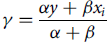 $\gamma = \displaystyle{{\alpha y + \beta {x_i}} \over {\alpha + \beta }}$
.
Footnote 5
The equilibrium consists of a cutoff signal for citizens
 ${x_i} = k$
.
Footnote 6
Citizens using a cutoff strategy will choose to mobilize if upon receipt of their private signal they believe that
 $\theta $
is sufficiently low and will abstain from doing so if they believe it is sufficiently high.
Note that if citizen i mobilizes, she will always receive
 $\theta $
and will receive R if the other citizen also mobilizes. Hence, citizen i will mobilize if she believes that the other citizen will mobilize with high enough probability. In particular, she will mobilize if
 $${\mathbb{E}}[Mobilize|{x_i},k] = R\times Pr({x_{ - i}} \lt k|{x_i}) - {\mathbb{E}}[\theta |{x_i}] \gt - c$$
where k is the cutoff of the other citizen (which in equilibrium will be equal to her own cutoff), and
 $Pr({x_{ - i}} \lt k|{x_i})$
is the probability with which citizen i believes that that citizen
 $ - i$
will receive a signal smaller than k conditional on the signal she received. We must note that:
 $${x_{ - i}}|{x_i}\sim N\left(\gamma ,{1 \over {\alpha + \beta }} + {1 \over \beta }\right).$$
Thus, with some algebra, equation 1 becomes
 $$R\Phi \left[{1 \over \displaystyle{{{2\beta + \alpha } \over {\alpha \beta + {\beta ^2}}}}}\left(k - {{\alpha y + \beta {x_i}} \over {\alpha + \beta }}\right)\right] - {{\alpha y + \beta {x_i}} \over {\alpha + \beta }} \gt - c,$$
where
 $\Phi $
represents the standard normal distribution function. From equation 2, note that since both α and
 $\beta \gt 0$
, the left-hand side is strictly increasing in k and strictly decreasing in
 ${x_i}$
. Thus, as noted by Morris and Shin (Reference Morris, Shin, Hansen, Dewatripont and Turnovsky2003) the game has a unique equilibrium in cutoff strategies in which
 $k = x_i^*$
.
Experimental parameters and predictions
We implement this game in the lab, with participants playing the game under different parametrizations for a number of rounds. In each round of the experiment, the values of the parameters of the model are independently randomly drawn from the five options presented in Table 2.
Experimental Parameters

Note that while
 $y = \alpha = \beta = 1$
for all cases, the pair
 $\{ R,c\} $
changes from round to round to have different stakes for the game. Given
 $\alpha = \beta = y = 1$
, we can substitute these values and the equilibrium condition that
 $k = {x_i}$
into equation 2, which then becomes
 $$R\Phi \left[{2 \over 3}\left(k - {{1 + k} \over 2}\right)\right] - {{1 + k} \over 2} \gt - c$$
Which upon further analysis becomes
 $$R\Phi \left[{{k - 1} \over 3}\right] - {{1 + k} \over 2} \gt - c$$
Figure 1 graphs the left-hand side, the expected benefit of mobilizing, and the right-hand side of this equation, the expected benefit of not mobilizing, for various values of k for
 $R = 1$
and
 $c = 0.5$
. It shows that for these values, the unique cutoff is
 ${x_i} = k = 1$
. The results remain unchanged for the rest of the set of parameters. Hence, a citizen that is fully rational (and has common knowledge of rationality) should choose to mobilize if she receives a signal smaller than 1 and should abstain if it is larger than 1. However, given our theoretical discussion, we expect that subjects that are in a state of fear would abstain at lower values of the signal. Moreover, given fear’s tendency to make people amplify risks, we expect that this effect would be amplified if they believe that other players will also abstain at lower values of the signal, whether this is caused by an increase in fundamental or strategic uncertainty. Aldama, Vásquez-Cortés and Young (Reference Aldama, Vásquez-Cortés and Young2019) model these effects as people believing the signal is higher than it actually is (an increase in fundamental uncertainty) and as people believing that other players are more likely to make mistakes when deciding to mobilize (an increase in strategic uncertainty). Clearly, both effects would demobilize people.
Equilibrium Cutoff.

Finally, to the extent that fear increases risk aversion, we would expect that at higher stakes the effects of fear would be stronger. To see why this is the case, consider the following simple example. Let the utility over the material payoffs be
 $u(\pi ) = 3 + \pi $
, where
 $\pi $
represents the corresponding material payoffs depicted in Table 1 when people are not afraid. Suppose that as a result of an increase in risk aversion when people are afraid, their utility is given by
 $u(\pi ) = (3 + \pi {)^{0.6}}$
. A generalized form of equation (1) reveals that in both option 1 and option 5 in Table 2, without fear the cutoff would be given by
 $k = 1$
. However, in the case with fear, the cutoff in option 1 is
 $k = .98$
and
 $k = .72$
for option 5, revealing that is more likely for subjects in the fear condition not to mobilize in option 5 than in option 1. Though generally increases in risk aversion also lead to less mobilization, particularly under higher stakes, Aldama, Vásquez-Cortés and Young (Reference Aldama, Vásquez-Cortés and Young2019) also note that increases in risk aversion can lead to greater mobilization if they lead to a “nothing-to-lose” effect. This effect prevails if a player’s utility is so affected by fear that the expected payoffs for the status quo become very similar to those of mobilizing and failing to replace the regime.
Although we describe this model in terms of citizens mobilizing against an authoritarian regime, it can be generalized to a wide range of situations in which more than one decision-maker is considering engaging in potentially action against a singular opponent who can selectively punish. This also describes situations in which civilians consider taking collective action against criminal organizations or workers considering reporting an abusive employer. One key assumption is that the actions of players are at least partially visible to the regime, which enables it to impose costs conditional on individual mobilization decisions.
Experimental design
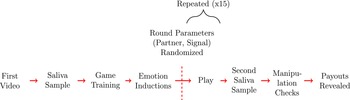
To test the predictions of this model, we use an experimental design that allows us to compare the decisions of participants who are experiencing the emotion of fear to those of otherwise similar participants in a neutral emotional state. We carried out the experiment in the labs of a large private university in the northeast and a large public university on the west coast. We recruited participants from their preexisting pools, primarily composed of undergraduate students. The experiment was implemented using z-Tree (Fischbacher Reference Fischbacher2007). Sessions lasted about 60 min, and participants were paid on average 16 dollars. After providing consent, participants first watched a relaxing seven-minute video clip, after which we took a saliva sample in order to measure their levels of α-amylase, a salivary enzyme that serves as an index of noradrenergic activity (Nater and Rohleder Reference Nater and Rohleder2009; Raio et al. Reference Raio, Orederu, Palazzolo, Shurick and Phelps2013; van Stegeren et al. Reference van Stegeren, Rohleder, Everaerd and Wolf2006). Second, to build familiarity with the game, a member of the research team read the instructions out loud, and participants played five practice rounds. Footnote 7 Third, participants were randomly assigned at the session level to watch a video intended to either induce a state of fear or keep them in a neutral emotional state. Finally, participants played 15 rounds of the game in which we vary key parameters in order to shut down some of the channels by which fear might influence behavior. In random order, participants played three sets of 5 rounds of the game: a standard global game with a human, a standard global game with a computer, and a full information game with a human. Finally, participants answered a few questions about their current emotional state and how they played the game. After all measurement, the sum of three randomly selected rounds (one from each condition) is paid out, and the participants’ payouts revealed. Footnote 8 Figure 2 shows the timing of the game for participants.
Timing of Play During the Experiment.

To induce a mild state of fear in a random sample of our sessions, we used a video clip from a horror film. We pre-tested the video on both Amazon Mechanical Turk and with a sample of subjects from one of the experimental pools and found in both pilots that the video significantly increased self-reported levels of fear. Participants in the treatment condition also heard loud unexpected noises during three randomly selected rounds. In the control treatment, subjects watched a typical placebo video about the solar system. Both videos were of the same length, about seven minutes. The fear treatment is similar to those used in previous studies to create specific emotions (Westermann et al. Reference Westermann, Spies, Stahl and Hesse1996; Lench, Flores and Bench Reference Lench, Flores and Bench2011). After receiving the corresponding treatment, participants were paired with another player and, based on the given parameters, the participants received a signal of the strength of the regime x i and were then asked whether they wished to mobilize or abstain. Footnote 9 After each round, participants were randomly rematched. Participants do not receive feedback until the end of the game to eliminate the possibility that learning the outcomes of each round would affect participants’ moods in subsequent rounds.
Randomization occurs at the session level, and participants know that they are all watching the same video. This implies that participants have common knowledge that others are also experiencing the same treatment that they receive.
We use three different versions of the game to disentangle the possible mechanisms by which fear could affect mobilization: standard, computer, and full information. In each session, participants play a set of five rounds of each version of the game, the order of which is randomly assigned. In standard rounds, participants know that they are playing with another human who has viewed the same treatment video. Thus, their behavior could be affected by pessimism about the signal, pessimism about others’ behavior, or risk aversion. However, in the computer rounds, participants play against a computer that always plays optimal strategies, that is, it will play mobilize for sufficiently low signals. This eliminates the possibility that the effect of fear might work through pessimism about other players’ actions. In the third type of round, full information participants receive the true value for θ, which eliminates the potential mechanism of pessimism about its true value. Footnote 10 Finally, in order to analyze whether fear reduces mobilization by increasing risk aversion, the values of R and c are varied together to vary the stakes of the game while maintaining the same equilibrium prediction. If fear increases risk aversion, we should see that people are less likely to mobilize when the stakes of the game are higher.
Analysis
This experimental design enables us to estimate several parameters of interest. Specifically, we test first for the overall effect of fear on mobilization decisions and then use the variations in the game to test for the relative importance of several potential mechanisms by which fear could reduce cooperation. For each quantity of interest, we estimate the average treatment effect (ATE) with and without demographic and round controls.
The main outcome of interest is whether the participant chooses to mobilize. We hypothesized that participants assigned to the fear treatment should be less likely to mobilize than those in the control group. For each participant, we observe 15 different mobilization decisions in 15 slightly different scenarios. To test for the main effect of fear, we use the results of the rounds in which we do not shut down any of the potential channels (i.e., the five rounds in which players are paired with a human and there is noise on the signal).
 ${Y_{i,t,standard}}(T)$
therefore represents the decision of individual i in round t of the five standard rounds in condition
 $T \in \{ 0,1\} $
, where 1 is the fear treatment and 0 the control. It takes a value of 1 if i plays
 $Mobilize$
and 0 is she does not.
 $AT{E_T}$
represents the ATE of fear across individuals and rounds.
 $$AT{E_T} = E[{Y_{standard}}(1) ]- E[{Y_{standard}}(0)]$$
We estimate the ATE using a linear probability model in which the individual decision to mobilize is the dependent variable and includes round fixed effects. We carry out analysis at the level of the participant-round. Because randomization occurs at the session level, we cluster standard errors by session.
Second, we test for potential channels by which fear could reduce mobilization by examining variations of the game. The first potential mechanism, M1, is pessimism about how partners will behave. To test whether fear makes people pessimistic about what their human partner will do, we test (1) the effect of fear in the rounds in which someone is paired with a computers, and (2) whether the effect of fear is larger in the standard rounds in which the participant is paired with a human than in those in which she is paired with a computer. The first effect is obtained analogously to that in equation (4), estimated using the rounds in which players are paired with a computer. The second,
 $AT{E_{M1}}$
, represents the portion of the ATE attributable to M1, expectations about others’ actions.
 $$AT{E_{M1}} = (E[{Y_{standard}}(1)] - E[{Y_{standard}}(0)] )- (E[{Y_{computer}}(1)] - E[{Y_{computer}}(0)])$$
The portion of the total effect that we will attribute to expectations about how other humans will behave is captured in the difference in mobilization between the 5 standard rounds and the 5 rounds in which the participant plays against a computer. This effect is recovered by
 ${\beta _2}$
in the following linear probability model:
 $${Y_{i,t}} = \alpha + {\beta _0}Compute{r_t} + {\beta _1}Fea{r_i} + {\beta _2}Fea{r_i} \times Compute{r_t} + {\varepsilon _{i,t}}$$
where
 $Compute{r_t}$
is an indicator of whether someone was facing a computer in that round and Feari and indicator that the subject was in the treatment condition,
 ${\varepsilon _{i,t}}$
is the error term. The second potential channel is pessimism about the signal that participants receive. Similar to the above case, we estimate both whether this channel is at play and the effect that fear has when we shut down the channel. The first is done by comparing participants’ decisions in the treatment condition to those in the control condition when there is no noise in the signal. For the latter, we compare the effect in the standard rounds in which the participant receives a noisy signal (a signal drawn from a normal distribution around the true strength of the regime) to those in which they receive a true signal.
 $$AT{E_{M2}} = (E[{Y_{standard}}(1)] - E[{Y_{standard}}(0)]) - (E[{Y_{fullinfo}}(1)] - E[{Y_{fullinfo}}(0)])$$
This quantity of interest is obtained by estimating
 ${\beta _2}$
in the following regression:
 $${Y_{i,t}} = \alpha + {\beta _0}FullInfot + + {\beta _1}Fea{r_i} + {\beta _2}Fea{r_i} \times FullInf{o_t} + {\epsilon _{i,t}}$$
Third, fear could reduce mobilization by increasing risk aversion. We test for changes in risk aversion by testing whether fear has a larger effect on rounds with higher spreads between the payoffs for winning and losing. We randomize the payoffs such that each participant gets a randomly selected payoff scheme in each round. ATE spread=1.5 ATE spread=5.5 Because we predict that the ATE will reduce linearly with the increase in the spread if fear increases risk aversion, our main test of whether the effect of fear is larger for higher payoff spreads will be based on regression analysis that allows us to use the full variation in the payoffs across rounds:
 $${Y_{i,t}} = \alpha + {\beta _0}Sprea{d_{i,t}} + {\beta _1}Fea{r_i} + {\beta _2}Fea{r_i} \times Sprea{d_t} + {\epsilon _{i,t}}$$
where Fear i is a dummy variable that takes a value of 1 if the subject is assigned to the fear emotion induction and Spread i is a measure of the spread of the payoffs for the round that vary from 1.5 to 3.5 experimental currency units. The coefficient β 2 estimates the extent to which the effect of the fear treatment varies based on the spread of the payoffs.
In addition to these substantive analyses, we carry out several manipulation checks. Our main manipulation check tests whether the treatment successfully induced fear without inducing substantively large levels of other emotions using self-reported levels of six emotions after all rounds were played. In addition to these self-reports, we also analyze salivary α-amylase as an indicator of the SAM response (Buchanan, Bibas and Adolphs Reference Buchanan, Bibas and Adolphs2010).
Results
In this section, we present results for 32 sessions and a total of 432 subjects. The estimated ATE on the decision to mobilize is presented in Figure 3. The results are presented by type of round, including the normal global game, the game played with a computer, and the rounds with complete information played with a human. We present the estimate with 95% confidence intervals. In all of the three cases, there is no detectable impact of fear on mobilization. This holds even if we include demographic covariates and controls for other parameters in the round in the regression as controls as we show in Appendix 2.
There is No Effect of the Fear Treatment on Mobilization.

We estimate similar null effects in the full information rounds and computer rounds and find no differential effect of fear across the three types of rounds. These analyses are presented in Table 3. Fear does not differentially impact participants’ decisions when they know the other player’s strategy with certainty and when they know the regime’s strength with certainty. This suggests that blocking the channels of strategic and fundamental uncertainty does not change the effect of the fear treatment.
There is No Differential Effect of the Fear Treatment in Computer and Noiseless Rounds

Note: *p < 0.1; **p < 0.05; ***p < 0.01
Standard errors clustered at the session level in parentheses.
The dependent variable is the mobilization rate by participant during standard and computer (columns 1–3) or noiseless (columns 4–6) rounds. Signal is the value of the signal of the regime’s strength, randomly assigned at the individual level. Average pre-treatment mobilization is the average mobilization rate by participant during the five pre-treatment rounds. Female is a dummy indicating gender and age is the participant’s age. The unit of analysis is the participant-round.
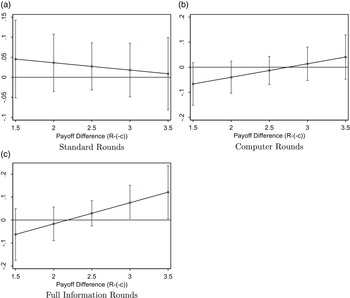
We also analyze participants’ decisions at varying spreads of the payoffs. Contra the expectations that there would be differential effects at different payoff spreads, as observed in Figure 4, we find that the effect of fear is generally null as the stakes of the game increase. The exception to this is that in the full information rounds, changing the stakes does change people’s response to the treatment. At higher differences between R and -c, people become mobilized.
The Effect of the Fear Treatment on Mobilization Depends on the Payoff Spreads In Full Information Rounds.

The mobilizing effect of fear in full information rounds at higher stakes may be driven by the elimination of fundamental uncertainty. When players know the regime’s strength with certainty, other mechanisms, in particular a nothing-to-lose effect, play a large role in determining people’s actions. To see this, it is important to note that in the complete information game, as the payoff differences increase, so does the probability of having two equilibria in pure strategies. Thus, while there is no fundamental uncertainty in this case, there is more strategic uncertainty as the differences in the bayodds for Mobilizing and Abstaining increases. (Mobilize, Mobilize) will be an equilibrium if
 $R + c \ge \theta $
. Hence, the probability that (Mobilize, Mobilize) is an equilibrium is given by
 $Prob(\theta ) \le R+ c = \Phi (R + c - 1)$
, where
 $\Phi $
is the cumulative distribution function of the standard normal. A similar logic aplies to calculating the probability that (Abstain, Abstain is an equilibrium, which is given by
 $1 - \Phi (c - 1)$
. This is summarized in Table 4, which shows the probability of (Mobilize, Mobilize) and (Abstain, Abstain) being equilibria in our game.
Experimental Parameters and Equilibrium Probabilities

As it can be appreciated in the table, as we go from Option 1 to Option 5, the probability that both action profiles are equilibria increases. As noted previously, one of the mechanisms through which fear may operate is an increase in risk aversion. In this case, we would expect that when the probability of multiple equilibria increases, which occurs as we increase the difference between R and −c, subjects in the fear condition would be more likely to choose the action corresponding to the risk dominant equilibrium, (Abstain, Abstain), than those in the control condition. However, as we see in Figure 4, we obtain the opposite result, which suggests that as the spread increases, a “nothing-to-lose” effect may kick in when the pessimism channels are shut down. This result may be in line with the prediction of Aldama, Vásquez-Cortés and Young (Reference Aldama, Vásquez-Cortés and Young2019), who present a model in which if fear only acts by changing the concavity a people’s utility functions, under some conditions, it will mobilize people against the regime. Previous accounts in the literature suggest that in some cases, fear may indeed have mobilizing effects and take riskier actions (Salman Reference Salman1994; Lohmann Reference Lohmann1993), particularly when there is strategic uncertainty (Kugler, Connolly and Ordóñez Reference Kugler, Connolly and Ordóñez2012). Our results dovetail with those of Szkup and Treviño (Reference Szkup and Treviño2020), who find that at low levels of fundamental uncertainty sentiments may cause people to become over-optimistic. Our results show that this is only the case when payoff differences are large enough.
Discussion
Overall, in this lab experiment, fear does not have a strong effect on the decision to take a risky action in a coordination game. Why might this be the case given the strong theoretical expectations that fear should affect mobilization through pessimism and risk aversion?
First, it is possible that the treatments did not induce sufficient or precise levels of fear. We think this is unlikely to explain the null results for several reasons. First, we used an emotion induction based on film and audio clips that has been found in many past experiments to effectively induce emotions (Westermann et al. Reference Westermann, Spies, Stahl and Hesse1996; Lench, Flores and Bench Reference Lench, Flores and Bench2011; Pattwell et al. Reference Pattwell, Duhoux, Hartley, Johnson, Jing, Elliott, Ruberry, Powers, Mehta, Yang, Soliman, Glatt, Casey, Ninan and Lee2012). Second, using self-reported measures of emotions on a four-point scale in our experimental sample, we show in Figure 5 that the fear treatments significantly increased self-reported fear. We find that, on average, participants’ report being half a point more afraid in the treatment condition. Other negative emotions are also induced by the treatments, sometimes at statistically significant levels, but fear and surprise are induced in much larger magnitudes than other emotions like anger and sadness that might have different effects on mobilization decisions.
Effect of Treatment on Emotions.

However, the treatment did not significantly increase salivary α-amylase (Nater et al. Reference Nater, Rohleder, Gaab, Berger, Jud, Kirschbaum and Ehlert2005; Nater and Rohleder Reference Nater and Rohleder2009). Results in Appendix 4 show that participants in the treatment group had slightly higher levels of the enzyme at the end of the experiment, on average, but the result is not statistically distinguishable from zero. Footnote 11 This combination of findings on our manipulation check could be driven by a few patterns. First, participants could be providing the response that they think the experimenter wants to receive on the self-reported measures. However, we do observe increases across several negative emotions that are less obviously targeted by the treatments and thus less likely to be affected by demand effects. Second, our α-amylase analysis could be under-powered: a short film and audio clips are not expected to induce an extremely strong SAM response, salivary α-amylase is noisy, and we are only able to run this test on about 70% of our sample (298 participants). Calculating the minimum detectable effect ex-post based on the realized sample size and variance in our data, we could only detect an effect of 15 U/ml or greater on α-amylase, about twice as large as our observed estimate. Taken together, these results suggest that the fear treatments likely did induce a mild state of fear and that this fear dominated other emotions.
Second, is it possible that we do not find an overall effect of fear because participants did not understand the games or were not playing strategically. Again, we think that this explanation is unlikely. In Appendix 3, we show that participants do seem to be responding in a utility-maximizing way to the randomly assigned parameters in the game, particularly the signal of the strength of the regime. The probability of mobilization in both the treatment and control groups in all three types of rounds is lower at higher signals of regime strength. In addition, majorities of people in all conditions (treatment vs. control, and the three types of rounds) make rational decisions, as defined by whether they decide to mobilize or not in a way consistent with the equilibrium strategy profile, at similar rates, and use similar thresholds for deciding whether to mobilize or not (Heinemann, Nagel and Ockenfels Reference Heinemann, Nagel and Ockenfels2004; Szkup and Treviño Reference Szkup and Treviño2020).
Third, it would be possible that even if the treatment itself is not having an effect on people’s choice, it could be having an effect that is mediated through how much self-reported fear participants experienced (or surprise for that matter, since it is also increased by the treatment). We address this issue in Appendix, where we show that not only is there no treatment effect of our intervention but also that there is no effect that is mediated by fear, surprise, or an additive index of both.
Fourth, it could be that fear’s effect washes away during the 15 rounds that people play. We address this in Appendix 7, where we consider only results in the first set of five rounds. Results show that though the point estimate of the effect is negative, it is not statistically significantly different from zero.
Ultimately, it seems most likely that in this experiment fear had little effect on the decision to participate in risky collective action because the effect of fear is conditioned by context. This experiment focuses on what affective scientists describe as incidental emotions, or emotions that are independent of the choice at hand and thus have seemingly no reason to influence the decision (Phelps, Lempert and Sokol-Hessner Reference Phelps, Lempert and Sokol-Hessner2014). This type of emotion is contrasted from integral emotions in which the affective response is derived from the choice options themselves. An example of integral emotions would be fear or anger induced by thinking about the decision to overthrow an authoritarian government that cannot be disentangled from the overall decision. While some studies have found that even incidental emotions can change political behavior and decision-making (although at lower levels than emotions more related to the choice at hand) (e.g., Young Reference Young2019), recent work has emphasized the importance of more context-specific emotions in politics (Greene and Robertson Reference Greene and Robertson2020; Mattingly and Yao Reference Mattingly and Yao2022). Future work along these lines should investigate whether integral affect alters these types of choices.
Similarly, it is possible that the context of the choice to mobilize or abstain in an abstracted lab experiment modified the effect of fear. While we are ultimately interested in understanding the effect of fear on people’s decisions to participate in risky collective action, including mobilization decisions of citizens confronted by a coercive regime, the external validity of the findings depends on the treatment, context, participant population, and measurement strategy (Egami and Hartman Reference Egami and Hartman2022). In our context, participants may, for example, not react pessimistically about the fundamental state of the world, whereas in a more naturalistic setting they would. In this experiment, participants in university labs were given an abstracted choice between “Action A” and “Action B.” It is quite possible that “WEIRD” participants making decisions in a lab with relatively small financial rather than political stakes may be less affected by fear than participants in authoritarian regimes making explicitly political decisions (Henrich, Heine and Norenzayan Reference Henrich, Heine and Norenzayan2010). Both the type of participant and the type of context may shape the extent to which participants to try to shut down versus learn from the effects of emotions like fear in order to make decisions.
Supplementary material
To view supplementary material for this article, please visit https://doi.org/10.1017/XPS.2023.10
Data Availability
Support for this research was provided by the International Federation for Research on Experimental Economics. The data, code, and any additional materials required to replicate all analyses in this article are available at the Journal of Experimental Political Science Dataverse within the Harvard Dataverse Network, at: doi: https://doi.org/10.7910/DVN/BZ6IFP
Acknowledgements
We thank the International Federation for Research in Experimental Economics (IFREE) for funding. For comments and suggestions, we thank Bethany Albertson, Eric Dickson, Erno Hermans, Aleksander Ksiazkiewicz, Brad LeVeck, Gwyneth McClendon, Rebecca Morton, Nikos Nikiforakis, Pietro Ortoleva, Liz Phelps, Ernesto Reuben, audiences at APSA, MPSA, SPSA, WESSI, the Behavioral Models of Politics conference, and three anonymous reviewers. For excellent research assistance, we thank María Curiel, Spencer Kiesel, Giacomo Lemoli, Taylor Mattia, Aliesha Overton, Daniel Simmons, and Nicolas Warren. This paper is dedicated to the memory of Becky Morton, a dedicated mentor without whose guidance our research would have never been possible. Replication data for this article can be found in Aldama et al. (Reference Aldama, Sambrano, Vasquez-Cortes and Young2022).
Conflicts of Interest
The authors declare no conflict of interest.
Ethics Statement
This study was approved by the Institutional Review Boards at New York University (10-8117), Columbia University (IRB-AAAQ8608), and UC Davis (1198017). In addition, the authors affirm that the research described in this article adheres to APSA’s Principles and Guidance for Human Subjects Research. In particular, we did not use deception in this research. We induced a negative emotion in our treatment group, which can be considered a very minimal harm in this context. Participants were given the following information during the consent process to enable them to make an informed decision about whether they wanted to participate in the research given that minimal harm:
“As part of this research project you will be asked to watch a video which may or may not contain material that some people consider frightening and you may experience negative emotions. Even though you may experience these emotions in your everyday life, please be aware of your own sensitivity to frightening videos when deciding whether to participate. If you have anxiety issues or are concerned that a frightening scene might cause you difficulty you may not want to participate in this study. Although you will receive no direct benefits, this project may help the researchers better understand the decision-making process of individuals in many common situations.”
Participants signed a physical consent form with this information before beginning the experiment. Participants were compensated for three randomly drawn rounds of play, with winnings that averaged $16. This amount was above the minimum wage for one hour of work in New York and California at the time of the experiments and is similar to the hourly wage for undergraduate RAs. At UC Davis, they were also given an extra credit point in a political science class (not taught by the UC Davis investigator) for participating.