

Stable isotope analyses of ancient human and animal tissues hold substantial, yet under-recognized potential to provide archaeological insights into historical processes. This potential is particularly significant in the context of the worldwide expansion of European activities and industrialization between A.D. 1500 and 1900 that fostered profound global environmental, economic, and social changes that shape our contemporary world. While many historical and post-medieval archaeological studies have used stable isotope analyses of human remains to document changing diet, mobility, and residency patterns during this period (e.g., Beaumont et al. Reference Beaumont, Geber, Powers, Wilson, Lee-Thorp and Montgomery2013; Katzenberg et al. Reference Katzenberg, Saunders, Abonyi, Ambrose and Katzenberg2002; Sparks Reference Sparks2012; Ubelaker and Owsley Reference Ubelaker and Owsley2003), materials from the animals that were directly involved with, and in some cases the focus of, socioeconomic and technological innovations have received comparatively little attention (Guiry et al. Reference Guiry, Harpley, Jones and Smith2014, Reference Guiry, Staniforth, Nehlich, Grimes, Smith, Harpley, Noël and Richards2015, Reference Guiry, Hepburn and Richards2016; Klippel Reference Klippel2001; Reitsema et al. Reference Reitsema, Kozłowski and Makowiecki2013; Tourigny et al. Reference Tourigny, Thomas, Guiry, Earp, Allen, Rothenburger, Lawler and Nussbaumer2016). Isotopic patterns associated with a wide range of past events are recorded in different ways by animal species with divergent behavioral and ecological niches, and this potential breadth of isotopic perspectives can be used to explore past subsistence, mobility, and environmental changes that may not be recorded in human tissues (Guiry Reference Guiry2013; Guiry and Gaulton Reference Guiry and Gaulton2016; Szpak et al. Reference Szpak, Orchard, McKechnie and Gröcke2012, Reference Szpak, Orchard, Salomon and Gröcke2013). The archaeological record is a particularly rich source of faunal remains and is well positioned to provide novel contexts in which to approach both long-standing and emerging questions about shifting historical economic practices, social processes, and human impacts on the environment (Guiry et al. Reference Guiry, Noël and Tourigny2012). In this paper, we explore the utility of faunal stable isotope values as a record of large-scale patterns in agriculture and socioeconomic change in recent centuries in eastern North America.
Agricultural adaptability was often key to the success of colonial endeavors, and, therefore, subsistence innovation and flexibility were necessarily a vital interface between Europeans and their New World environments (e.g., Dugmore et al. Reference Dugmore, Keller and McGovern2007, Reference Dugmore, McGovern, Vésteinsson, Arneborg, Streeter and Keller2012). Many of the earliest experiments with European New World colonization occurred along the western margins of the North Atlantic, and these have become the focal point for archaeological and historical research seeking to understand the dynamic interplay between European attempts to transplant their culturally familiar agricultural systems, on the one hand, and adoption of New World resources, on the other (e.g., Anderson Reference Anderson2002; Reitz and Waselkov Reference Reitz and Waselkov2015). In North America, a change in emphasis from traditional European crops, such as wheat, to New World crops, such as maize, is thought to be one of the most economically and environmentally important European agricultural adaptations (Staller et al. Reference Staller, Tykot and Benz2006), one that underpins significant differences in isotopic composition between European and North American populations to this day (Nardoto et al. Reference Nardoto, Silva, Kendall, Ehleringer, Chesson, Ferraz, Moreira, Ometto and Martinelli2006; Wagenmakers et al. Reference Wagenmakers, Rehrer, Brouns, Saris and Halliday1993). However, historical documentation suggests that the earliest European settlers in some areas did not embrace maize agriculture (e.g., McInnis Reference McInnis1984). In particular, settlers of what became York (established 1793, later changed to Toronto in 1834; hereafter Toronto) and its surrounding environs in Upper Canada (established 1791, later changed to Canada West, 1841–1867, and now Ontario, 1867–present) between the 1790s and 1890s developed a wheat-based agriculture regime (e.g., Lewis Reference Lewis1975; McCalla Reference McCalla1978), following a history of at least 1,500 years of maize-dominated cultivation by indigenous peoples in the area (e.g., Crawford Reference Crawford, Smith and Bowyer1997; Katzenberg Reference Katzenberg, Staller and Benz2006; Katzenberg et al. Reference Katzenberg, Schwarcz, Knyf and Melbye1995; Schwarcz et al. Reference Schwarcz, Melbye, Katzenberg and Knyf1985).
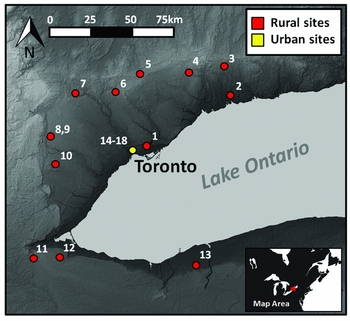
Here, we undertake the first large-scale isotopic study of historical archaeological domestic animals in North America to explore economic and especially social practices associated with major agricultural shifts between culturally (Indigenous, Canadian, and American) and geographically (Upper Canada and the United States) distinct groups in the eastern Great Lakes basin (Figure 1). We compare bone collagen stable carbon (δ 13C) and nitrogen (δ 15N) isotope values from 310 late eighteenth-century and nineteenth-century (1790s to 1890s) pigs and cattle from urban sites associated with different social classes in Toronto as well as sites in its rural environs to test hypotheses about the potential for animal-based dietary and mobility information to verify historical accounts and address new socio-economic questions. We argue that (1) different agricultural systems founded on wheat, particularly in Upper Canada, and maize would leave a geographically patterned isotopic record in the remains of livestock; and (2) this distinction could be used to explore (a) the extent to which maize agriculture was utilized or discarded by settling Europeans in Upper Canada, and (b) the economic (trade) and social (i.e., values assigned to fresh vs. salt meat) roles of animals and their products during the evolution of North American trading networks.
Map showing locations of Upper Canada historical sites considered in this study. Sites are labeled as follows: (1) Ashbridge (AjGt-1), (2) Trull (AlGq-67), (3) CH36 (AlGr-315), (4) Graham (AjGs-370), (5) Lewis (AlGu-365), (6) Edgar (AlGu-196), (7) Hall (AlGw-68), (8) Dolson (AkGx-80), (9) Landmart (AkGw-474), (10) Edwards (AjGw-470), (11) Henry (AhGw-123), (12) Yeager, (13) Loretto (AgGs-326), (14) Bell (AjGu-68), (15) Bishop's Block (AjGu-49), (16) Dollery (AjGu-81), (17) 327–333 Queen St. (AjGu-63), (18) Toronto General Hospital (AjGu-51). (Color online)

Isotope Background
Stable isotope analyses are based on the premise that the carbon (C) and nitrogen (N) atoms incorporated to form biological tissues are taken directly from foods eaten by consumers. Some foods have distinctive isotopic compositions, and it is therefore possible to distinguish between certain dietary regimes based on the stable carbon (δ 13C) and nitrogen (δ 15N) isotope values of animal tissues, in this case, archaeological bone collagen (for review, see Lee-Thorp Reference Lee-Thorp2008). Relatively little change occurs in δ 13C values as C atoms are passed up successive trophic levels in a food chain; for this reason, broad differences between plants using C3 (lower δ 13C values) and C4 (higher δ 13C values) photosynthesis can be recorded in the tissues of humans and animals that consume C that is predominantly taken from one or the other (DeNiro and Epstein Reference DeNiro and Epstein1978; O'Leary Reference O'Leary1988). In this study, we are interested in exploring the importance of maize, a New World C4 cultigen, relative to traditional European crops, such as wheat, oats, and barley, as well as locally available natural resources that are predominantly C3 plants. Other factors, such as consumption of some kinds of aquatic foods, can also produce higher δ 13C values (Chisholm et al. Reference Chisholm, Nelson and Schwarcz1982), but these are less relevant in our study context, which is focused on a terrestrial temperate region.
The δ 15N values of consumer tissues become significantly higher, increasing by 3–4‰, as N is passed between trophic levels (DeNiro and Epstein Reference DeNiro and Epstein1981). This stepwise enrichment of 15N in consumer tissues can be a useful indicator of relative carnivory and of consumption of upper trophic level marine foods (Post Reference Post2002). A variety of environmental factors, however, can also create variability in δ 15N values (for review, see Szpak Reference Szpak2014) in terrestrial and aquatic ecosystems, and for this reason, baseline information from herbivore δ 15N values is necessary for interpreting trophic level.
Research Design
Research Questions
Historical analyses suggest that maize agriculture, though long established in the region by indigenous communities at the time of European settlement (Katzenberg Reference Katzenberg, Staller and Benz2006), was not embraced by settlers, who preferred C3 plants, such as wheat, oats, and peas (McInnis Reference McInnis1982, Reference McInnis1984, Reference McInnis and McCalla1987). In the same period in the United States, however, maize continued to be widely cultivated and maintained an important role as a source of animal feed, especially for fattening livestock, such as swine and cattle (e.g., Pate Reference Pate2005; Walsh Reference Walsh1977). While farms in Upper Canada usually raised some livestock, particularly pigs, for market sale to generate income (e.g., Lewis Reference Lewis2001; Lewis and Urquhart Reference Lewis and Urquhart1999; McCalla Reference McCalla1985a, b), their southern counterparts in the United States produced larger quantities for commercial sale, and, with coinciding advances in canal and rail transport systems, much of this surplus was traded north to urban centers like Toronto, in the form of barreled salt pork and beef (Clemen Reference Clemen1923; McCalla Reference McCalla1979; McInnis Reference McInnis1982; Pate Reference Pate2005; Skaggs Reference Skaggs1986; Walsh Reference Walsh1977, Reference Walsh1982). In the temperate terrestrial environment of Upper Canada, δ 13C values from domestic herbivores and omnivores should provide a means of identifying animals raised locally (i.e., lower δ 13C values from C3 plant consumption) and animals imported from the United States (i.e., higher δ 13C values reflecting some C4 plant intake). In this context, we compare δ 13C and δ 15N values from cattle (n = 144) and pigs (n = 124) collected from urban sites (n = 5) in Toronto and rural sites (n = 13) in the region (Figure 1) to assess the extent to which European settlers had either integrated or disused maize as a crop staple. In this context, we also tested two related hypotheses:
-
(1) If historical analyses (e.g., McInnis Reference McInnis1984) indicating that settlers preferred to cultivate wheat over maize as their agricultural staple are correct, then there will be a lower proportion of C4-fed animals identified in Upper Canada rural contexts, where animals were locally produced, relative to their urban counterparts in Toronto, where there was more access to imported animal products from the United States.
-
(2) If there was a historical preference for fresh, as opposed to preserved, meats, then, within urban contexts, C4-fed animals that were likely imported as salted meat from the United States would be found in lower frequency at higher-status sites relative to lower-status sites due to greater access to market goods for wealthier households.
Sampling Strategy
We focus on cattle and pigs because these species were the most important domesticates for settlers from economic and dietary perspectives (McInnis Reference McInnis and McCalla1987; Reitz and Waselkov Reference Reitz and Waselkov2015) and were also highly visible and symbolically valued animals within a European social framework (Anderson Reference Anderson2002; Landon Reference Landon, Gaimster and Majewski2009). Both species were preferentially fattened on maize (when available) and used to produce barreled salt meat for long-distance trade (Pate Reference Pate2005; Walsh Reference Walsh1977). Samples were selected based on minimum number of individual estimates per species for archaeologically distinct contexts. For higher-status sites (urban middle and upper class), samples were collected from domestic refuse associated with a series of seven homes at two sites in relatively wealthy neighborhoods (ASI 2012a, b). Lower-status (working- and lower-class) sites are represented by samples from two houses in poorer areas as well as a hospital (ASI 2014a, b; HHI 2011). As a baseline for locally raised livestock, we collected samples from 13 roughly contemporaneous rural agricultural homestead sites distributed mostly within 25 km around the outskirts of Toronto, but including sites over a 200 km section of Lake Ontario's north shore (ASI 2006, 2007a, b, 2012a, b, 2014a, b, 2017 a, b; GAL 2014a, b, c; Latta Reference Latta2000; TRCA 2005, 2012, 2013). For a comparison with contemporary livestock from the United States, we sourced baseline values from the literature (Reitsema et al. Reference Reitsema, Brown, Hadden, Cutts, Little and Ritchison2015), which come from six urban eighteenth- to nineteenth-century sites in Charleston, South Carolina (n = 27), and we also analyzed bones recovered from salt meat barrels on the steamboat Heroine (n = 11), which was wrecked on the Red River in 1838 while transporting cargo from Cincinnati, Ohio, to Fort Towson, Oklahoma (Crisman et al. Reference Crisman, Lees and Davis2013). These bones are mainly from intact salt-pork barrels packed by Alfred S. Reeder Packers of Cincinnati in 1837 (Brophy and Crisman Reference Brophy and Crisman2013) and are representative of a key United States livestock region that produced salt meats that could have been traded north to Upper and Lower Canada via the Miami–Erie canal during the nineteenth century (Clemen Reference Clemen1923; Pate Reference Pate2005; Skaggs Reference Skaggs1986; Walsh Reference Walsh1977, Reference Walsh1982).
Methods
Following a modified Longin protocol (Beaumont et al. Reference Beaumont, Beverly, Southon and Taylor2010; Longin Reference Longin1971), cleaned animal bone samples (100–400 mg) were soaked in 0.5 M hydrochloric acid (HCl), with periodic solution changes until the sample was demineralized (usually 1–3 weeks). Samples were then rinsed to neutrality in pure water and treated several times with 0.1 M sodium hydroxide (NaOH) in an ultrasonic bath (15-minute intervals) until visible reactions ceased (i.e., the solution remained clear; usually within one hour). Samples were again rinsed to neutrality with pure water and then refluxed in a 10−3 M HCl (pH ~3) solution at 75°C for 48 hours. The soluble collagen solution was then further purified using 45−90 μm mesh filtersFootnote 1 and 30 kDa molecular weight cut-off (MWCO) filtersFootnote 2 to remove larger particulates and low molecular weight contaminants, respectively (Brown et al. Reference Brown, Nelson, Vogel and Southon1988). The solutions containing the > 30 kDa fraction were then frozen for 24 hours and lyophilized for 48 hours.
Stable isotope analyses were performed in duplicate on 0.5 mg samples of collagen using an Elementar vario MICRO cube elemental analyzer coupled to an Isoprime isotope ratio mass spectrometer in continuous flow mode. Carbon and nitrogen isotopic compositions were calibrated relative to VPDB and AIR using a two-point calibration curve anchored by USGS40 and USGS41 (Qi et al. Reference Qi, Coplen, Geilmann, Brand and Böhlke2003). Measurement accuracy was monitored using a suite of internal check standards with the following long-term δ-values: methionine (MET, δ 13C −28.62 ± 0.11 and δ 15N −5.03 ± 0.15), bovine liver (NIST 1577c, δ 13C −17.52 ± 0.09 and δ 15N +8.21 ± 0.33), seal bone collagen (SUBC−1, δ 13C −13.74 ± 0.18, δ 15N +17.40 ± 0.35), caribou bone collagen (SRM−1, δ 13C −19.33 ± 0.13 and δ 15N +1.81 ± 0.12), and walrus bone collagen (SRM−2, δ 13C −14.72 ± 0.14 and δ 15N +15.59 ± 0.10). The average absolute difference between the observed and known δ-values for all of the check standards (reproducibility or accuracy) was 0.04‰ for δ 13C and 0.06‰ for δ 15N. The repeatability (precision) of the measurements on all of the check and calibration standards was ± 0.13‰ for δ 13C and ± 0.14‰ for δ 15N. Most samples (292/310) were analyzed in duplicate. Any samples that were not analyzed in duplicate did not produce sufficient collagen for a second analysis. The average difference between duplicate sample pairs was 0.09‰ for δ 13C and 0.13‰ for δ 15N. The overall analytical error for all analyzed samples was calculated to be ± 0.14‰ for δ 13C and ± 0.16‰ for δ 15N. Collagen integrity was assessed using elemental C and N concentrations as well as C to N ratios (Ambrose Reference Ambrose1990). For statistical analyses, we used a K-means cluster analysis (Hartigan and Wong Reference Hartigan and Wong1979) of δ 13C values for pigs from Upper Canada to aggregate C3- and C4-fed group members. The cluster analysis was performed using IBM SPSS Statistics for Mac OS X (IBM_Corp 2014). Cattle and pig dietary contributions from C3 and C4 plants were estimated using a single-isotope mixing model in the SIAR (Stable Isotope Analyses in R) package (Parnell et al. Reference Parnell, Inger, Bearhop and Jackson2010) in R 3.0.3 for Mac OS X (R Core Development Team 2007). Parameters for C3 and C4 input were set at −26.0 ± 2.0‰ and −12.0 ± 1.0‰, respectively. The trophic enrichment factor for collagen was set at +3.7 ± 1.6‰ (Szpak et al. Reference Szpak, Orchard, McKechnie and Gröcke2012). Carbon concentrations in C3 and C4 plants were assumed to be the same.
Results
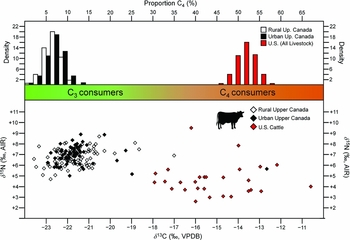
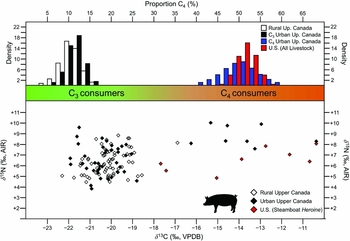
Stable isotope and elemental concentration data are presented in full (Supplemental Tables 1 and 2) and in summary (Figures 2 and 3). Collagen integrity indicators vary, with most samples (90 percent) producing values in the acceptable range for C/N (2.9–3.6) and elemental C (> 18 percent) and N (> 6 percent) concentrations (Ambrose Reference Ambrose1990). Figure 2 shows that cattle at rural sites (n = 81) produced no evidence for C4 dietary inputs (C4 contribution: 3−10 percent, 95 percent credibility interval) and had uniformly low δ 13C values, averaging −21.6 ± 1.1‰, and δ 15N values averaging +6.7 ± 0.8‰. Pigs from rural sites (n = 65) had similarly low δ 13C values, averaging −21.2 ± 0.9‰, and δ 15N values averaging +6.9 ± 1.6‰, indicating that they also had no significant maize-based dietary inputs (C4 contribution: 7−15 percent, 95 percent credibility interval). All pigs from the steamboat Heroine (n = 8), on the other hand, show clear evidence for significant C4 (probably maize) dietary inputs (C4 contribution: 39−62 percent, 95 percent credibility interval) with higher δ 13C values, averaging −14.7 ± 2.9‰, and with δ 15N values averaging +6.5 ± 1.1‰. Only two cattle and one horse were analyzed from this site, but, combined with published values of cattle from several historic contexts in Charleston, South Carolina (Reitsema et al. Reference Reitsema, Brown, Hadden, Cutts, Little and Ritchison2015), these also produced δ 13C (n = 30; average = −15.1 ± 1.7‰) and δ 15N (n = 30; average = +4.5 ± 1.4‰) values, indicating a high reliance on C4 plants (C4 contribution: 48−57 percent, 95 percent credibility interval; Figure 2). This difference between livestock from rural Upper Canada and Cincinnati (the largest pork producer in North America at this time; Pate Reference Pate2005), with lower and higher δ 13C values, respectively, supports the premise that C4 maize dietary input can be a useful marker for livestock origin in C3 wheat-dominated Upper Canada.
Bottom panel: bivariate plot of δ13C and δ15N values for cattle with comparative eastern U.S. data from published literature (Reitsema et al. Reference Reitsema, Brown, Hadden, Cutts, Little and Ritchison2015). Top panel: SIAR (Parnell et al. Reference Parnell, Inger, Bearhop and Jackson2010) density histograms showing percent dietary contributions from C4 plants for different urban and rural cattle groups from Upper Canada alongside contemporary livestock (combined pigs and cattle) from United States sites, including animals from the steamboat Heroine and from literature (Reitsema et al. Reference Reitsema, Brown, Hadden, Cutts, Little and Ritchison2015). (Color online)

Bottom panel: bivariate plot of δ13C and δ15N values for pigs (bottom) analyzed in this study. Top: SIAR (Parnell et al. Reference Parnell, Inger, Bearhop and Jackson2010) density histogram showing percent dietary contributions from C4 plants for different urban and rural pig groups from Upper Canada alongside contemporary livestock (combined pigs and cattle) from U.S. sites, including animals from the steamboat Heroine and from published literature (Reitsema et al. Reference Reitsema, Brown, Hadden, Cutts, Little and Ritchison2015). (Color online)

Relative to rural sites, pigs (n = 59) at urban sites produced a much wider range of δ 13C values, averaging −20.2 ± 2.5‰ (range = −22.9 to –11.4‰) but had similar δ 15N values, averaging +6.9 ± 1.6‰. This variability reflects the presence of a significantly different group of pigs (n = 11; K-means cluster analysis) with higher δ 13C values (average = −15.5 ± 2.0‰; range = −18.4 to –11.4‰) that consumed between 46 and 64 percent C4 foods (95 percent credibility interval; Figure 3), which are primarily localized to a series of higher-status homes (AjGu-49) in a relatively affluent area. Urban cattle (n = 63), however, do not follow this trend and, like their rural counterparts, have uniformly low δ 13C values, averaging −21.6 ± 0.9‰, and δ 15N values that are also similar, averaging +7.0 ± 0.8‰.
Discussion
Livestock δ 13C values at rural sites around Toronto (n = 146) show an overwhelming dominance of C3 dietary input and support historical interpretations (McCalla Reference McCalla1978; McInnis Reference McInnis1984) suggesting that European settlers in Upper Canada focused on wheat rather than maize agriculture. In this context, it is worth pointing out that butchery marks as well as element types for samples that did produce δ 13C values indicative of C4-feeding at rural sites (SUBC 9189 cattle rib and SUBC 9279 pig vertebra) were consistent with common salt meat cuts, suggesting that they most likely represent the occasional purchase of imported commercial meat products from off-site sources, rather than locally raised animals. The near-complete absence of C4-fed livestock is particularly interesting because it was still possible and perhaps even profitable to cultivate maize on a limited basis as a valuable source of feed for fattening livestock (McInnis Reference McInnis1982).
Given our large sample size (146 rural cattle and pigs) and broad geographical coverage of approximately 200 km around the western margin of Lake Ontario, we believe that this pattern is representative of agricultural practices across these rural and urban regions of Upper Canada. It appears that the lack of emphasis on maize cultivation for fodder was pervasive throughout a large geographical area. This finding provides a unique isotopic context, both temporally and spatially, in eastern North America. An important implication for the absence of C4 feeding in locally raised animals is that it can allow for clearer interpretations of the presence and archaeological distribution of imported maize-fed animal products in different urban socioeconomic contexts.
Analyses of remains from beef and pork consumed in different social contexts in the urban center of Toronto provide contrasting evidence for the trajectories and origins of meat products from cattle and pigs in nineteenth-century Upper Canada. Nearly all cattle from urban contexts, regardless of the social statuses associated with their respective sites, produced δ 13C values indicative of C3-based diets and fall comfortably within the range observed for rural animal production sites in the local region. A single individual (SUBC 5048) from a lower-status site produced a higher δ 13C value indicative of C4-fed animal and indicates that beef from maize-fed cattle did occasionally find its way to the markets of Toronto.
From a social perspective, the isotopic similarity between cattle remains from rural and upper- and lower-status urban households suggests that locally produced beef was accessible and preferable to members of diverse social classes and that the origin of beef products, insofar as is detectable through our isotopic analyses, may not have carried significant social value for people living in nineteenth century Upper Canada. Given the adverse effects that salt-based preservatives can have on beef flavor and texture, we anticipate a historical preference among all social groups for fresh beef when possible. In this context, our results may simply reflect the fact that nineteenth-century cattle production in Upper Canada was sufficient to satisfy both rural and urban needs and, therefore, there was no need to rely on imported meat products as might occur early on during the establishment of colonial centers. From an economic perspective, this finding is significant in that it provides negative archaeological evidence for the mobility of cattle, one of the most important colonial domesticates, between two key regions of European New World activity.
In contrast to cattle, maize-fed pigs made up an appreciable portion of the urban pork assemblage and differed markedly between sites of different social statuses. At lower-status sites, nearly all pork remains had δ 13C values indicative of a C3-fed diet, suggesting that less wealthy urban people probably consumed pork from locally raised pigs. At higher-status sites, a significant proportion (> 20 percent) of pig remains show high δ 13C values and clearly had diets incorporating a significant amount of C4 foods, most likely maize. It therefore appears that, while imported pork products did not make up a significant portion of the pigs consumed in all urban areas, they were more frequently consumed by wealthier members of society.
The association of C4 fed pigs with wealthier sites contradicts our hypothesis and could suggest that they were perceived as a higher-status food item, perhaps because they were likely imported and therefore exotic, or due to a preference for the qualities of pork from pigs finished on maize, which can impart differing flavor profiles and fat content (Calkins and Hodgen Reference Calkins and Hodgen2007). Consumption of salt pork may also, in part, reflect access to pork on a more regular basis. While pigs can be slaughtered year round, it is possible that those who could afford it purchased salted pork for the convenience and ease of regular access.
With respect to the potential for using well-contextualized historical archaeological contexts as a venue for testing isotopic interpretive methods, these results are interesting because they present an example that may be useful for interpreting meat trade and consumption patterns in the deeper past, where historical records are unavailable. For example, bearing in mind issues with the use of analogy in archaeological interpretation (Wylie Reference Wylie2002), the finding that isotopically detectable differences in animal origins may be connected with social status of different communities within a single settlement could provide a useful basis for approaching social status in relation to foods origins, and food trade more generally, in more ancient contexts. This would be particularly useful in contexts where the use of C3 and C4 plants varied between different agricultural centers in the ancient world, such as maize-based regions in North America or millet-based regions in Asia.
Conclusion
From a wider angle, the evidence for an overwhelming dominance of C3-fed domesticates at all historical Euro-Canadian rural sites represents a fundamental shift, both temporally and geographically, in the way incoming settlers engaged with their new agricultural landscape in the eastern Great Lakes Basin. In contrast to indigenous maize-based agricultural regimes of the Iroquoian-speaking peoples on the north shore (Katzenberg Reference Katzenberg, Staller and Benz2006), European settlers chose a different path—wheat agriculture. Our isotopic evidence is in line with historical analyses suggesting that wheat came to monopolize agricultural land under European cultivation (McCalla Reference McCalla1978); however, the complete absence of maize in livestock diets at all rural sites provides surprisingly clear insight into the pervasive nature of this shift in agricultural regimes.
The sharp distinction between agricultural practices in Upper Canada, where new, introduced C3 crops monopolized farm fields, and more southerly regions of eastern North America, where maize agriculture continued to play an important role, provides a new opportunity to explore historical processes linked with animal husbandry and meat consumption. Here we used this relationship to consider broad trends in local as well as international meat trade among groups of differing economic and social statuses in nineteenth-century Toronto and were surprised to find that wealthier individuals consumed more imported salt-meat products, as opposed to fresh meats, than their less wealthy counterparts. This unexpected finding inverted our expectations about how animals and their products were valued socially in the past and serves to highlight the immense potential for testing hypotheses about relationships between humans and animals during the profound socio-economic developments associated with the rise of the industrial era. In this context, the roles of livestock, which were ubiquitous in urban spaces until the early twentieth century, underwent continued economic, social, and legal evolution, particularly in response to changing transportation infrastructure, globalizing economic markets, and new norms for how people should and could relate to animals (Kheraj Reference Kheraj, Brocking, Sandberg, Coates and Cruikshank2013; Pate Reference Pate2005; Ritvo Reference Ritvo, Manning and Serpell1994). Given the considerable importance of historical human–animal relations as precursors to present-day ontologies about how humans mediate their relations to animals (Armstrong Oma Reference Armstrong Oma2010; Ingold Reference Ingold, Manning and Speller1994; Knight Reference Knight2005; Puputti Reference Puputti2008), increased work in this area could be highly productive.
Acknowledgments
Funding for this research was provided by the Social Sciences and Humanities Research Council (Canada), Wenner-Gren Foundation, and the Society for Archaeological Science. Reba MacDonald and Michelle Hepburn (University of British Columbia) provided technical support, and Ron Williamson, Caitlin Colman, Alexis Dunlop (Archaeological Services Inc., Toronto), Scott Martin (Golder Associates Ltd.), Dena Doroszenko (Ontario Heritage Trust), Dan Provo, Jeff Briley (Oklahoma Historical Center), Kevin Crisman (Texas A&M), Janet Bachelor, and Eliza Brandy (Toronto and Region Conservation Authority) provided samples. Eric Tourigny (University of Leicester), Suzanne Needs-Howarth (Perca Zooarchaeological Research, Toronto), Heather Henderson (Historic Horizon Inc., Toronto), Lindsay Foreman and Peter Popkin (Golder Associates Ltd), and Juliet Brophy (Louisiana State University; for the steamboat Heroine) provided zooarchaeological assistance. We thank Stéphane Noël for his translation of the abstract.
Supplemental Materials
Supplemental materials are linked to the online version of the paper, accessible via the SAA member login at https://doi.org/10.1017/aaq.2016.34:
Supplemental Table 1. Stable carbon and nitrogen isotope and elemental composition data.
Supplemental Table 2. List of average stable carbon and nitrogen isotope values for animal groups.