Introduction
Insects play a major role in pollination (Bawa Reference Bawa1990), a key mechanism in the sexual reproduction of flowering plants. Animal-mediated pollination appears especially advantageous in species-rich tropical ecosystems where wind transfer of pollen to conspecific plants is less effective (Bawa Reference Bawa1990; Cox and Grubb Reference Cox and Grubb1991). Consequently, approximately 94% of tropical plant species rely on animal pollination, predominantly by insects (Ollerton et al. Reference Ollerton, Winfree and Tarrant2011). Tropical ecosystems harbour the highest diversity of plants and their pollinators (Basset et al. Reference Basset, Cizek, Cuénoud, Didham, Guilhaumon, Missa, Novotny, Ødegaard, Roslin, Schmidl, Tishechkin, Winchester, Roubik, Aberlenc, Bail, Barrios, Bridle, Castaño-Meneses, Corbara, Curletti, Duarte Da Rocha, De Bakker, Delabie, Dejean, Fagan, Floren, Kitching, Medianero, Miller, Gama De Oliveira, Orivel, Pollet, Rapp, Ribeiro, Roisin, Schmidt, Sørensen and Leponce2012; Novotny et al. Reference Novotny, Drozd, Miller, Kulfan, Janda, Basset and Weiblen2006; Liang et al. Reference Liang, Gamarra, Picard, Zhou, Pijanowski, Jacobs, Reich, Crowther, Nabuurs, de-Miguel, Fang, Woodall, Svenning, Jucker, Bastin, Wiser, Slik, Hérault, Alberti, Keppel, Hengeveld, Ibisch, Silva, ter Steege, Peri, Coomes, Searle, von Gadow, Jaroszewicz, Abbasi, Abegg, Adou-Yao, Aguirre-Gutiérrez, Almeyda-Zambrano, Altman, Alvarez-Dávila, Álvarez-González, Alves, Amani, Amani, Ammer, Angoboy-Ilondea, Antón-Fernández, Avitabile, Aymard, Azihou, Baard, Baker, Balazy, Bastian, Batumike, Bauters, Beeckman, Benu, Bitariho, Boeckx, Bogaert, Bongers, Bouriaud, Brancalion, Brandl, Brearley, Briseno-Reyes, Broadbent, Bruelheide, Bulte, Catlin, Cazzolla-Gatti, César, Chen, Chisholm, Cienciala, Colletta, Corral-Rivas, Cuchietti, Cuni-Sanchez, Dar, Dayanandan, de Haulleville, Decuyper, Delabye, Derroire, DeVries, Diisi, Do, Dolezal, Dourdain, Durrheim, Engone-Obiang, Ewango, Eyre, Fayle, Feunang, Finér, Fischer, Fridman, Frizzera, de Gasper, Gianelle, Glick, Gonzalez-Elizondo, Gorenstein, Habonayo, Hardy, Harris, Hector, Hemp, Herold, Hillers, Hubau, Ibanez, Imai, Imani, Jagodzinski, Janecek, Johannsen, Joly, Jumbam, Kabelong, Kahsay, Karminov, Kartawinata, Kassi, Kearsley, Kennard, Kepfer-Rojas, Khan, Kigomo, Kim, Klauberg, Klomberg, Korjus, Kothandaraman, Kraxner, Kumar, Kuswandi, Lang, Lawes, Leite, Lentner, Lewis, Libalah, Lisingo, López-Serrano, Lu, Lukina, Lykke, Maicher, Maitner, Marcon, Marshall, Martin, Martynenko, Mbayu, Mbuvi, Meave, Merow, Miscicki, Moreno, Morera, Mukul, Müller, Murdjoko, Nava-Miranda, Ndive, Neldner, Nevenic, Nforbelie, Ngoh, N’Guessan, Ngugi, Ngute, Njila, Nyako, Ochuodho, Oleksyn, Paquette, Parfenova, Park, Parren, Parthasarathy, Pfautsch, Phillips, Piedade, Pijanowski, Piotto, Pollastrini, Poorter, Poulsen, Poulsen, Pretzsch, Rodeghiero, Rolim, Rovero, Rutishauser, Sagheb-Talebi, Saikia, Sainge, Salas-Eljatib, Salis, Schall, Schepaschenko, Scherer-Lorenzen, Schmid, Schöngart, Šebeň, Sellan, Selvi, Serra-Diaz, Sheil, Shvidenko, Sist, Souza, Stereńczak, Sullivan, Sundarapandian, Svoboda, Swaine, Targhetta, Tchebakova, Trethowan, Tropek, Tshibamba-Mukendi, Umunay, Usoltsev, Vaglio-Laurin, Valentini, Valladares, van der Plas, Vega-Nieva, Verbeeck, Viana, Vibrans, Vieira, Vleminckx, Waite, Wang, Wasingya, Wekesa, Westerlund, Wittmann, Wortel, Zawiła-Niedźwiecki, Zhang, Zhao, Zhu, Zhu, Zhu, Zo-Bi and Hui2022), often featuring highly specialised interactions facilitated by unique adaptations of plants and pollinators. This specialisation may both drive and result from the more pronounced role of individual pollinators compared to other ecosystems (e.g., Martín González et al. Reference Martín González, Dalsgaard, Nogués-Bravo, Graham, Schleuning, Maruyama, Abrahamczyk, Alarcón, Araujo, Araújo, de Azevedo, Baquero, Cotton, Ingversen, Kohler, Lara, Las-Casas, Machado, Machado, Maglianesi, McGuire, Moura, Oliveira, Oliveira, Ornelas, Rodrigues, Rosero-Lasprilla, Rui, Sazima, Timmermann, Varassin, Vizentin-Bugoni, Wang, Watts, Rahbek and Martinez2015; Ollerton et al. Reference Ollerton, Johnson and Hingston2006; Pauw and Stanway Reference Pauw and Stanway2014). Therefore, the detailed research of these diverse interspecific interactions and strategies in the tropics is crucial for understanding the evolution and ecology of pollination interactions (Vizentin-Bugoni et al. Reference Vizentin-Bugoni, Maruyama, De Souza, Ollerton, Rech, Sazima, Dáttilo and Rico-Gray2018; Wardhaugh Reference Wardhaugh2015). Yet, conducting such comprehensive research is challenging, and our understanding of the role of insects as the dominant pollinators of tropical angiosperms remains limited (Vizentin-Bugoni et al. Reference Vizentin-Bugoni, Maruyama, De Souza, Ollerton, Rech, Sazima, Dáttilo and Rico-Gray2018). This is especially true for nocturnal moths representing two functional pollinator groups with specific morphological and behavioural adaptations: hawkmoths and settling moths.
Moths belong among the most diverse insect groups (Stork Reference Stork2018), with numerous species proven to be effective pollinators of wildflowers and crops (Rader et al. Reference Rader, Bartomeus, Garibaldi, Garratt, Howlett, Winfree, Cunningham, Mayfield, Arthur, Andersson, Bommarco, Brittain, Carvalheiro, Chacoff, Entling, Foully, Freitas, Gemmill-Herren, Ghazoul, Griffin, Gross, Herbertsson, Herzog, Hipólito, Jaggar, Jauker, Klein, Kleijn, Krishnan, Lemos, Lindström, Mandelik, Monteiro, Nelson, Nilsson, Pattemore, Pereira, Pisanty, Potts, Reemer, Rundlöf, Sheffield, Scheper, Schüepp, Smith, Stanley, Stout, Szentgyörgyi, Taki, Vergara, Viana and Woyciechowski2016; Wardhaugh Reference Wardhaugh2015); however, some may be nectar thieves, exploiting nectar without pollinating the flowers (Sakhalkar et al. Reference Sakhalkar, Janeček, Klomberg, Mertens, Hodeček and Tropek2023). Approximately 160,000 described species (van Nieukerken et al. Reference van Nieukerken, Kaila, Kitching, Kristensen, Lees, Minet, Mitter, Mutanen, Regier, Simonsen, Wahlberg, Yen, Zahiri, Adamski, Baixeras, Bartsch, Bengtsson, Brown, Bucheli, Davis, Prins, Prins, Epstein, Gentili-Poole, Gielis, Hättenschwiler, Hausmann, Holloway, Kallies, Karsholt, Kawahara, Koster, Kozlov, Lafontaine, Lamas, Landry, Lee, Nuss, Park, Penz, Rota, Schintlmeister, Schmidt, Sohn, Solis, Tarmann, Warren, Weller, Yakovlev, Zolotuhin and Zwick2011) make Lepidoptera one of the most diverse insect orders (Grimaldi and Engel Reference Grimaldi and Engel2005). Most lepidopteran species are moths (∼88%) representing a paraphyletic group, with butterflies (Papilionoidea) as an internal monophyletic clade (Kawahara et al. Reference Kawahara, Plotkin, Espeland, Meusemann, Toussaint, Donath, Gimnich, Frandsen, Zwick, dos Reis, Barber, Peters, Liu, Zhou, Mayer, Podsiadlowski, Storer, Yack, Misof and Breinholt2019; van Nieukerken et al. Reference van Nieukerken, Kaila, Kitching, Kristensen, Lees, Minet, Mitter, Mutanen, Regier, Simonsen, Wahlberg, Yen, Zahiri, Adamski, Baixeras, Bartsch, Bengtsson, Brown, Bucheli, Davis, Prins, Prins, Epstein, Gentili-Poole, Gielis, Hättenschwiler, Hausmann, Holloway, Kallies, Karsholt, Kawahara, Koster, Kozlov, Lafontaine, Lamas, Landry, Lee, Nuss, Park, Penz, Rota, Schintlmeister, Schmidt, Sohn, Solis, Tarmann, Warren, Weller, Yakovlev, Zolotuhin and Zwick2011). Adapted for liquid food consumption through their tubular proboscis, foraging moths visit flowers only for nectar, as they cannot feed on pollen and other floral rewards (Krenn Reference Krenn2010; Willmer Reference Willmer2011). Nocturnal and crepuscular moths are often equipped with highly adapted vision and olfactory systems to locate floral resources in the dark (Wardhaugh Reference Wardhaugh2015). Their compound eyes, with receptors sensitive to UV, blue and green wavelengths (approximately 350 to 550 nm), enable some moths to see in colour even in low light conditions, as evidenced in four hawkmoth species (Kelber Reference Kelber2003). Additionally, their highly sensitive olfactory organs, located in their antennae and labial palps (Chen et al. Reference Chen, Liu, Cao, Ma, Guo, Shen and Wang2021; Szyszka et al. Reference Szyszka, Gerkin, Galizia and Smith2014), are essential for locating flowers at night (Balkenius et al. Reference Balkenius, Rosén and Kelber2006; Klahre et al. Reference Klahre, Gurba, Hermann, Saxenhofer, Bossolini, Guerin and Kuhlemeier2011).
Based on their specific adaptations to nectarivory and foraging, moth pollinators are classified into two main functional pollinator groups: hawkmoths (Sphingidae) and settling moths (including mainly Noctuidae, Geometridae, Erebidae, Pyralidae; Johnson et al. Reference Johnson, Moré, Amorim, Haber, Frankie, Stanley, Cocucci and Raguso2017; Willmer Reference Willmer2011). Hawkmoths, typically large-bodied and large-eyed moths, often have a long proboscis for extracting nectar (Johnson et al. Reference Johnson, Moré, Amorim, Haber, Frankie, Stanley, Cocucci and Raguso2017; Krenn Reference Krenn2010) and are able to hover while feeding on nectar (Stöckl and Kelber Reference Stöckl and Kelber2019; Willmer Reference Willmer2011). In contrast, settling moths, a functional pollinator group represented by most of the remaining moth diversity, typically settle on flowers for extended periods during feeding instead of hovering (Faegri and Pijl Reference Faegri and Pijl1979; Ghazoul Reference Ghazoul1997).
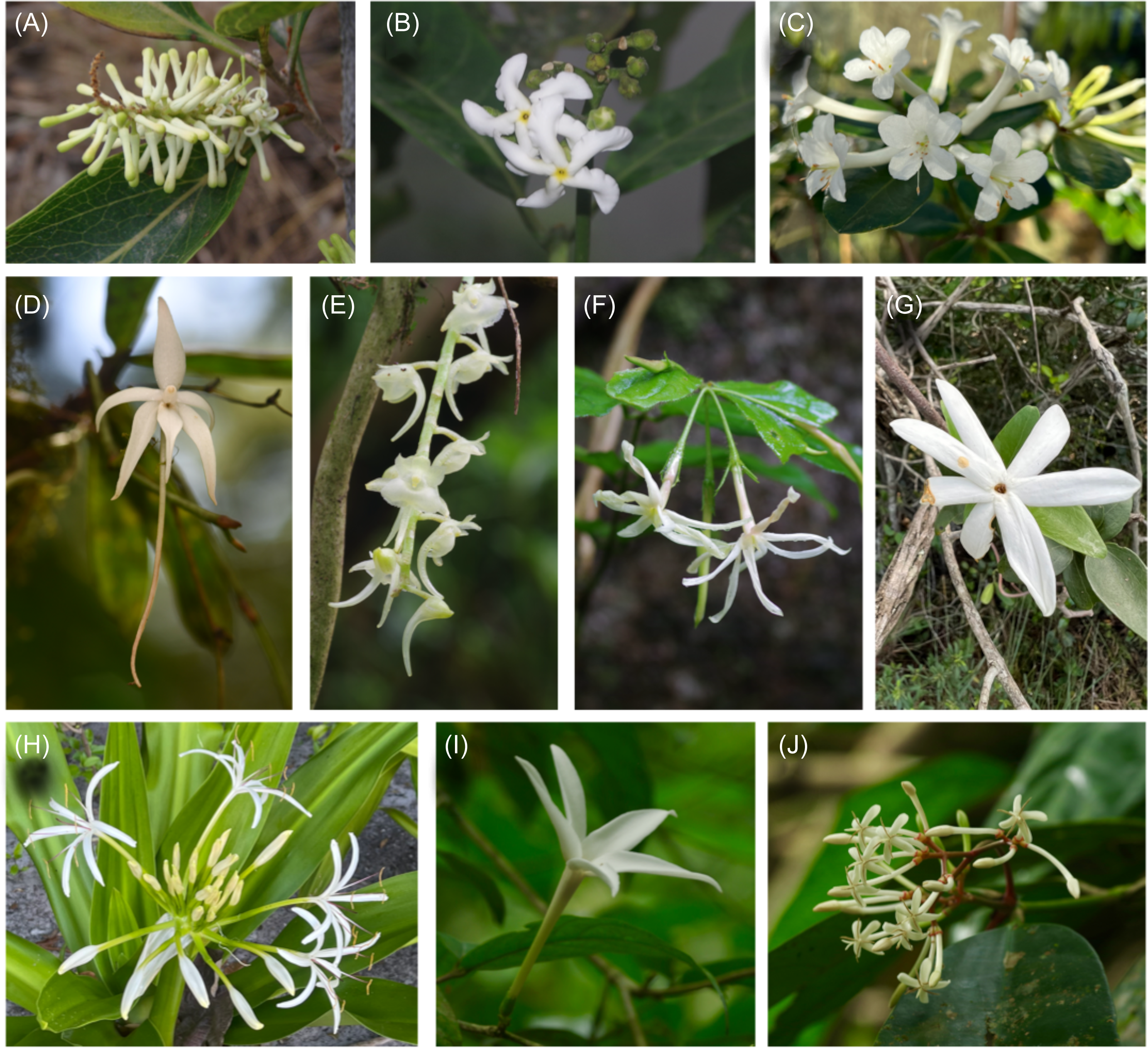
Many plant species are well adapted to pollination by moths whose traits, such as variable proboscis length, were proposed as evolutionary drivers of floral diversity, prompting the development of specialised flowers to accommodate specific moth pollinators (Johnson et al. Reference Johnson, Moré, Amorim, Haber, Frankie, Stanley, Cocucci and Raguso2017; Whittall and Hodges Reference Whittall and Hodges2007). To attract moth pollinators, plants have evolved an array of floral traits, including sensory cues (colour, scent), specialised morphology, and nectar provision (e.g., Johnson et al. Reference Johnson, Balducci and Shuttleworth2020; van der Kooi Reference van der Kooi2021; Xu et al. Reference Xu, Luo, Gao and Zhang2018). Particular combinations of these floral traits have converged across plant families into pollination syndromes: phalaenophily for settling moths and sphingophily for hawkmoths (Figure 1; Faegri and Pijl Reference Faegri and Pijl1979; Willmer Reference Willmer2011). As some pollinator properties (such as activity period, vision, and olfaction) are shared between settling moths and hawkmoths, moth pollination syndromes include nocturnal blooming, contrasting, pale or dull-coloured flowers emitting odour (Willmer Reference Willmer2011). Phalaenophilous flowers tend to be smaller, with shorter floral tubes, and form compact inflorescences, in contrast to the larger, often clearly separated sphingophilous flowers with longer floral tubes (Bawa et al. Reference Bawa, Bullock, Perry, Coville and Grayum1985). Floral scents also differ (Raguso Reference Raguso, Cardé and Millar2004), with oxygenated sesquiterpenes found only in sphingophilous flowers (Knudsen and Tollsten Reference Knudsen and Tollsten1993). Nevertheless, it is important to acknowledge that pollination syndromes do not always perfectly predict the primary pollinators (Ollerton et al. Reference Ollerton, Alarcón, Waser, Price, Watts, Cranmer, Hingston, Peter and Rotenberry2009), which may be influenced by spatiotemporal variability in plant-pollinator communities (Santos-Gómez et al. Reference Santos-Gómez, Figueroa-Castro and Castañeda-Posadas2021), differences in floral traits among different pollinator groups under varying environmental conditions (Klomberg et al. Reference Klomberg, Tropek, Mertens, Kobe, Hodeček, Raška, Fominka, Souto-Vilarós, Janečková and Janeček2022), and the asymmetric nature of pollination syndromes where floral traits may adapt plants to a specific pollinator group while the pollinators exploit a broader range of accessible floral rewards (Chmel et al. Reference Chmel, Ewome, Gómez, Klomberg, Mertens, Tropek and Janeček2021). Furthermore, some hawkmoths can learn to associate nectar with various floral traits, not only those typical for the moth-related pollination syndromes (Balkenius and Dacke Reference Balkenius and Dacke2013). Therefore, caution is required when using pollination syndromes to assess general patterns in pollination.
Examples of flowers from different plant families with floral traits adapted to attract moths. A: Roupala montana Aubl. (Proteaceae), B: Tabernaemontana ventricosa Hochst. ex A. DC. (Apocynaceae), C: Rhododendron sp. L. (Ericaceae), D: Angraecum sp. Bory (Orchidaceae), E: Rhipidoglossum sp. Schltr. (Orchidaceae), F: Jasminum preussii Engl. & Knobl. (Oleaceae), G: Jasminum sp. L. (Oleaceae), H: Crinum asiaticum L. (Amarylidaceae), I: Aulacocalyx caudata (Hiern) Keay (Rubiaceae), J: Ixora guineensis Benth. (Rubiaceae). Photo credits: A ©João Medeiros CC BY 2.0; B, D, E, F, I, J ©Štěpán Janeček & Petra Janečková; C, G, H ©Michal Barták.

In this review, we synthesised the available knowledge on the importance of nocturnal moths in pollination in tropical ecosystems and identified gaps in current research to guide future studies. Despite the rich moth diversity in the tropics, these insect pollinators were frequently overlooked due to the inherent methodological challenges of nocturnal pollination studies, compounded by the general difficulties of conducting biodiversity research in tropical environments. Two recent global reviews focused on hawkmoth pollination niches (Johnson et al. Reference Johnson, Moré, Amorim, Haber, Frankie, Stanley, Cocucci and Raguso2017) and moths as significant pollinators of tropical crops (Buxton et al. Reference Buxton, Gaskett, Lord and Pattemore2022). Considering that Johnson et al. (Reference Johnson, Moré, Amorim, Haber, Frankie, Stanley, Cocucci and Raguso2017) did not include many studies from tropical ecosystems, the scattered studies of nocturnal wildflower pollination by tropical moths have never been reviewed, leaving their general role as pollinators in tropical ecosystems largely questionable. Additionally, we are unaware of any review synthesising the community-level approach and quantifying the importance of moth pollination in tropical communities. Finally, no review focusing on the role of settling moths in the pollination of tropical plants exists to our knowledge. To address these knowledge gaps, we covered 1) the importance of moths in the pollination systems of tropical plants, 2) the proportion of moth-pollinated plants and the relative abundance of moths among pollinators in communities in tropical ecosystems, and 3) the relative abundance of plants adapted to moth pollination in these ecosystems. We collated detailed studies on the pollination systems of tropical plants, providing detailed insights into the behaviour and/or pollination effectiveness of moths among other pollinators. Our focus extended beyond plants primarily pollinated by moths, and we included their pollination roles in plants with bimodal and mixed pollination systems. Additionally, we gathered quantitative studies on nocturnal pollinators in tropical communities to assess how commonly plants are pollinated by moths. Finally, we searched for studies quantifying the proportion of sphingophilous and phalaenophilous plants and plants effectively pollinated by moths in tropical communities. Based on this synthesis, we critically assessed methodological challenges and biases and identified gaps limiting our understanding of the moths’ role in tropical pollination.
For this review, we searched the key literature using combinations of the following keywords: (moth* or hawkmoth* or Lepidoptera or phalaenophil* or sphingophil* or crepuscular or nocturnal) and pollinat* and tropic* in the Web of Science databases. To ensure a comprehensive literature review, we carefully screened studies that cited or were referenced in the articles found, supplemented by additional studies from our personal databases of references. From the retrieved articles, we included only those that explicitly met the following criteria: (1) the study was conducted in the tropics, defined as the area between the Tropics of Cancer (23.43612°N) and Capricorn (23.43612°S), considering all terrestrial ecosystems; (2) sampling effort aimed at studying nocturnal and/or crepuscular flower visitors, even if unsuccessfully; (3) if at least one flower-visiting nocturnal moth was considered a legitimate pollinator of the studied plants, or at least one plant in the community was evaluated as moth-pollinated (based on pollination evidence or its well-reasoned proxy), or classified as sphingophilous or phalaenophilous species based on its floral traits. We excluded articles on specialised micromoth pollinators of Phyllanthaceae plants, senita cacti, and yuccas because these specialised pollinator/seed predator mutualistic interactions have already been reviewed (Fleming and Holland Reference Fleming and Holland1998; Kawakita Reference Kawakita2010; Pellmyr Reference Pellmyr2003). We also excluded studies where only diurnal moths (e.g., Sesiidae, Zygaenidae) or butterflies (Papilionoidea) were observed because of their different adaptations to diurnal pollination. We intended to differentiate crepuscular moths in our review, but virtually all the reviewed studies categorised pollinators simply as diurnal and nocturnal, either grouping crepuscular pollinators with nocturnal ones or not mentioning them at all. Consequently, we were unable to distinguish between crepuscular and nocturnal moth pollinators in this review and used the term ‘nocturnal’ to refer to both groups hereinafter. We accepted the identifications of moths and plants in the reviewed papers as accurate, only updating the nomenclature for moths and plants when necessary, according to the Global Lepidoptera Index (Beccaloni et al. Reference Beccaloni, Scoble, Kitching, Simonsen, Robinson, Pitkin, Hine, Lyal, Ollerenshaw, Wing and Hobern2024), and The World Checklist of Vascular Plants (Govaerts Reference Govaerts2024), respectively.
Tropical moths in plant pollination systems
Assessing the role of nectaring moths in plant pollination systems is often challenging, as only a fraction of floral visitors effectively contributes to the reproduction of the plants they visit (King et al. Reference King, Ballantyne and Willmer2013). Here, in line with most reviewed studies, we consider moths as potentially effective pollinators (sensu Keys et al. Reference Keys, Buchmann and Smith1995) when the study authors identified them as primary and secondary pollinators (i.e., animals whose visits to flowers result in the first and second highest positive impacts on seed production, respectively; Stebbins Reference Stebbins1970) or when there was convincing evidence of their effectiveness in pollination. Due to the inherent difficulties in directly measuring the specific contribution of each visitor species to seed production (thus rarely utilised in pollination studies), we depend on various proxies for assessing pollination effectiveness, including contact with floral reproductive organs (studies of plants with moth-related pollination syndrome floral traits without any proxy for effective moth pollination were not included in this chapter). In this part, consistent with the methodologies employed in most studies of tropical plant pollination systems, we exclude moths classified as incidental pollinators (i.e., animals not considered as effective pollinators, usually because of their low visitation frequencies or abundances) by the study authors. Nevertheless, we also reviewed the existing knowledge on tropical moth nectar thieves who evidently exploited floral rewards without contributing to pollination (e.g., Sakhalkar et al. Reference Sakhalkar, Janeček, Klomberg, Mertens, Hodeček and Tropek2023).
Moths as primary pollinators
Hawkmoths are known to play a crucial role in pollinating numerous tropical plants, many of which exhibit floral traits associated with sphingophily (Albuquerque-Lima et al. Reference Albuquerque-Lima, Domingos-Melo, Nadia, Bezerra, Navarro, Milet-Pinheiro and Machado2020; Potascheff et al. Reference Potascheff, de Brito, Galetto, Sebbenn and Oliveira2020). Substantial evidence originates from Afrotropical ecosystems. In their extensive observational research in South Africa, Johnson and Raguso (Reference Johnson and Raguso2016) confirmed 11 plant species to be pollinated by two widespread hawkmoths, namely the migratory Agrius convolvuli Linnaeus, 1758 and the non-migratory Coelonia fulvinotata Butler, 1875. They also suggested that A. convolvuli might be the primary pollinator for over 70 savanna plant species with long-tubed flowers across Africa, based on similar floral traits with the plants where hawkmoth pollination was confirmed (Johnson and Raguso Reference Johnson and Raguso2016). In Kenyan savannas, similar findings on hawkmoth pollination were reported in an observational study by Martins and Johnson (Reference Martins and Johnson2013), in which the long-proboscid A. convolvuli, along with the short-proboscid Nephele comma Hopffer, 1857 and Hippotion celerio Linnaeus, 1758 were frequently recorded visiting 25 sphingophilous plant species from diverse families (Martins and Johnson Reference Martins and Johnson2013). In Madagascar, hawkmoths are known as primary pollinators for three out of eight described species of Afrotropical baobabs (Malvaceae): Adansonia rubrostipa Jum. & Perrier, Adansonia perrieri Capuron, and Adansonia za Baill. in Madagascar (Baum Reference Baum1995). Among the visitors of their large, bright-yellow, and strongly scented flowers, only the hawkmoths Coelonia solani Boisduval, 1833 and Xanthopan morganii Walker, 1856 were repeatedly observed touching the floral reproductive organs while feeding on nectar (Baum Reference Baum1995). Adansonia digitata L. (Malvaceae) with chiropterophilous flowers was later reported as a hawkmoth-pollinated species (Karimi et al. Reference Karimi, Saghafi, Keefover-Ring, Venter, Ané and Baum2021). Moreover, numerous sphingophilous orchid species in East Africa and Madagascar rely entirely on hawkmoths for pollination, particularly on those with an elongated proboscis, such as C. fulvinotata, A. convolvuli, X. morganii, and Xanthopan praedicta Rothschild & Jordan, 1903 (Martins and Johnson Reference Martins and Johnson2007, Reference Martins and Johnson2013; Nilsson et al. Reference Nilsson, Jonsson, Rason and Randrianjohany1985, Reference Nilsson, Johnsson, Ralison and Randrianjohany1987). As hawkmoths hover while nectaring, the specialised orchid pollinaria attach to their long proboscis (Nilsson et al. Reference Nilsson, Johnsson, Ralison and Randrianjohany1987) or even their eyes (Balducci et al. Reference Balducci, Martins and Johnson2019; Nilsson et al. Reference Nilsson, Rabakonandrianina, Razananaivo and Randriamanindry1992). In East Africa, the strongly scented white flowers of Delphinium leroyi Franch. ex Huth (Ranunculaceae) were found to match their floral tube length (40mm) to the proboscis length (37mm) of its primary pollinator, H. celerio (Johnson Reference Johnson2001).
While comprehensive studies or syntheses on hawkmoth pollination in other tropical areas are lacking, evidence supports hawkmoths as primary or exclusive pollinators in several studied plant pollination systems in other tropical regions. Hawkmoths were documented to pollinate a few sphingophilous plants with large white tubular flowers, such as Chonemorpha fragrans (Moon) Alston (Apocynaceae) and Jasminum rottlerianum Wall. ex DC. (Oleaceae) in monsoon forests in Laos in the Indomalayan realm (Kato et al. Reference Kato, Kosaka, Kawakita, Okuyama, Kobayashi, Phimminith and Thongphan2008), and Cerbera manghas L. (Apocynaceae), Morinda citrifolia L. (Rubiaceae), and Oxera inodora de Kok (Lamiaceae) from various vegetation types in New Caledonia in the Australian realm (Kato and Kawakita Reference Kato and Kawakita2004). In the Neotropics, several sphingophilous plants were identified as visited and potentially pollinated by hawkmoths, including Bauhinia forficata Link. (Fabaceae) in the Brazilian Atlantic rainforests (Neto Reference Neto2013) and the mass-flowering Griffinia gardneriana (Herb.) Ravenna (Amaryllidaceae) in the Brazilian Caatinga forests (Albuquerque-Lima et al. Reference Albuquerque-Lima, Domingos-Melo, Nadia, Bezerra, Navarro, Milet-Pinheiro and Machado2020). In Brazil, hawkmoth-pollinated Habenaria johannensis Barb. Rodr. (Orchidaceae), Habenaria paulistana J.A.N.Bat. & Bianch. (Orchidaceae), Hillia parasitica Jacq. (Rubiaceae), and Posoqueria latifolia (Rudge) Schult. (Rubiaceae) were not only observed being pollinated by hawkmoths but also studied for pollen attachment mechanics on hawkmoths (Amorim et al. Reference Amorim, Wyatt and Sazima2014). Additionally, hawkmoths were documented to pollinate several tree species in the Brazilian Cerrado woodland savanna, including sphingophilous Qualea grandiflora Mart. (Vochysiaceae) with long-tubed, bright-yellow flowers (Oliveira et al. Reference Oliveira, Gibbs and Barbosa2004; Potascheff et al. Reference Potascheff, de Brito, Galetto, Sebbenn and Oliveira2020). Moreover, an extensive 17-year-long study confirmed Macroscepis (form. Schubertia) grandiflora (Mart.) H. A. Keller & Liede (Apocynaceae) as being pollinated by hawkmoths Cocytius lucifer Rothschild & Jordan, 1903 and Manduca florestan Stoll, 1782 (Amorim et al. Reference Amorim, Marino, Sanz-Veiga, Ollerton and Oliveira2022).
The understanding of pollination by settling moths, particularly in tropical ecosystems, remains even more limited. Yet, several available case studies highlight their potential importance. For instance, noctuid moths were identified as the only pollinators of the Asian dioecious vine Gnetum luofuense C.Y.Cheng (Yang et al. Reference Yang, Wan, Dai, Zou, Liu and Gong2021). Despite attracting various insects to its exposed pollen (Corlett Reference Corlett2001; Yang et al. Reference Yang, Wan, Dai, Zou, Liu and Gong2021), only noctuid moths visit both male and female flowers and effectively pollinate the plant (Yang et al. Reference Yang, Wan, Dai, Zou, Liu and Gong2021). A comprehensive study by Kato and Kawakita (Reference Kato and Kawakita2004) determined several New Caledonian phalaenophilous plants to be pollinated by noctuid, pyralid, or geometrid moths, including Dracophyllum ramosum Pancher ex Brongn. & Gris (Ericaceae), Wikstroemia indica (L.) C. A. Mey. (Thymelaeaceae), Nepenthes vieillardii Hook. fil. (Nepenthaceae), Exocarpos neocaledonicus Schltr. & Pilg. (Santalaceae), Exocarpos phyllanthoides Endl., and Alstonia costata (G. Forst.) R. Br. (Apocynaceae). In the Neotropics, diverse noctuid and geometrid moths were identified as exclusive pollinators for certain specialised trees, including Aspidosperma macrocarpon Mart. (Apocynaceae) and Roupala montana Aubl. (Proteaceae) in the Brazilian Cerrado woodland savanna (Oliveira et al. Reference Oliveira, Gibbs and Barbosa2004). In Hawaii, several species of Schiedea Cham. & Schltdl. plants (Caryophyllaceae) are pollinated by the erebid moth Pseudoschrankia brevipalpis Medeiros, 2015 (Powers et al. Reference Powers, Seco, Faiola, Sakai, Weller, Campbell and Guenther2020; Weller et al. Reference Weller, Sakai, Campbell, Powers, Peña, Keir, Loomis, Heintzman and Weisenberger2017). Analogous to hawkmoths, settling moths are primary pollinators for numerous tropical phalaenophilous orchids, such as Sauroglossum elatum Lindl. (Orchidaceae), with small whitish-green, short-spurred flowers in Brazilian Atlantic forests (Singer Reference Singer2002).
We have reviewed 23 studies that represent all available information on tropical moth pollination, meeting this review criteria. Of these, 65% focused on hawkmoths, 22% on settling moths, and only 13% covered both moth groups. Research on pollination by hawkmoths was predominantly conducted in the Afrotropics and Brazil, with notable research efforts led by S. D. Johnson and F. W. Amorim, respectively. In contrast, there are no studies on settling moth pollination in Africa, which is a substantial gap in our understanding of tropical moth pollination. All reviewed studies applied direct or camera observations, sometimes supplemented by moth capturing to assess pollen loads (Johnson Reference Johnson2001; Johnson and Raguso Reference Johnson and Raguso2016; Kato et al. Reference Kato, Kosaka, Kawakita, Okuyama, Kobayashi, Phimminith and Thongphan2008; Kato and Kawakita Reference Kato and Kawakita2004; Nilsson et al. Reference Nilsson, Jonsson, Rason and Randrianjohany1985, Reference Nilsson, Johnsson, Ralison and Randrianjohany1987; Yang et al. Reference Yang, Wan, Dai, Zou, Liu and Gong2021), behaviour analyses to determine contacts with floral reproductive organs (Neto Reference Neto2013; Potascheff et al. Reference Potascheff, de Brito, Galetto, Sebbenn and Oliveira2020; Singer Reference Singer2002; Yang et al. Reference Yang, Wan, Dai, Zou, Liu and Gong2021), or pollination experiments (Karimi et al. Reference Karimi, Saghafi, Keefover-Ring, Venter, Ané and Baum2021). These are helpful proxies for effective pollination, particularly under challenging research conditions (e.g., Oliveira et al. Reference Oliveira, Gibbs and Barbosa2004). Despite the scarcity of such data, it is evident that moths play a crucial role as primary pollinators for certain tropical plants.
Moths in bimodal and mixed pollination systems
Tropical moths also serve as important, though not primary or exclusive, pollinators in numerous plants with bimodal or mixed pollination systems. Bimodal systems involve pollination by two distinct functional pollinator groups (Manning and Goldblatt Reference Manning and Goldblatt2005). The interplay between moths and bats appears most plausible due to their shared attraction to certain floral traits, such as larger, dull or whitish flowers with nocturnal anthesis and nocturnal production of substantial nectar volumes (Willmer Reference Willmer2011). This interdependency can be illustrated in the Mexican Agave macroacantha Zucc. (Asparagaceae), effectively pollinated by both moths and bats (Arizaga et al. Reference Arizaga, Ezcurra, Peters, De Arellano and Vega2000). Particular bat- and moth-pollinated bimodal flowers are characterised by some traits typical for sphingophily, such as the Neotropical Pachira aquatica Aubl. (Malvaceae) with long tubular corollas and fragrant odours, effectively pollinated by bats, hawkmoths, and honey bees (Hernández-Montero and Sosa Reference Hernández-Montero and Sosa2016). Others display morphological traits leaning more towards chiropterophily, such as the Neotropical Pilosocereus Byles & G. D. Rowley plants (Cactaceae) with large compact flowers rich in nectar (Miranda-Jácome et al. Reference Miranda-Jácome, Rodríguez-García and Munguía-Rosas2020; Rocha et al. Reference Rocha, Domingos-Melo, Zappi and Machado2019) and the Australian Adansonia gregorii F. Muell. (Malvaceae) with large white flowers and relatively small petals (Groffen et al. Reference Groffen, Rethus and Pettigrew2016). In Brazilian Caatinga, seven out of 142 species were pollinated by bats and hawkmoths (Machado and Lopes Reference Machado and Lopes2004), and a comprehensive study of 155 Venezuelan plant species unveiled only two moth and bat co-pollination instances within bimodal systems (Ramírez Reference Ramírez2004).
Some tropical bimodal pollination systems combine adaptations for nocturnal moths and diurnal pollinators, typically observed in flowers that remain open day and night. In Venezuela, six out of 155 studied plant species exhibited bimodal pollination involving nocturnal moths and diurnal pollinators, including two combinations with butterflies, one with bees, and one with beetles (Ramírez Reference Ramírez2004). Additionally, Dipterocarpus obtusifolius Teijsm. ex Miq. (Dipterocarpaceae), a Thai tree with large pink flowers that open at dusk and last into the following day, is pollinated by moths and butterflies (Ghazoul Reference Ghazoul1997). In Hong Kong, Mussaenda pubescens Dryand. (Rubiaceae), Pavetta hongkongensis Bremek. (Rubiaceae), and Pittosporum glabratum Lindl. (Pittosporaceae), with long floral tubes, were commonly visited by swallowtail butterflies and less commonly visited by hawkmoths, with no data on their effective pollination (Corlett Reference Corlett2001). In Brazil, Copaifera coriacea Mart. (Fabaceae), a tree with small whitish flowers clustered in large inflorescences, and Faramea cyanea Müll. Arg. (Rubiaceae), a tree with white tubular flowers and a sweet scent, are both effectively pollinated by moths and bees (Maruyama et al. Reference Maruyama, Amorim and Oliveira2010; Souza et al. Reference Souza, Hughes, Funch and Queiroz2021). Inga sessilis Mart. (Fabaceae), a Neotropical tree with white, brush-type flowers that are mass-flowering during the wet season, is visited by hummingbirds, bats, and hawkmoths (Amorim et al. Reference Amorim, Galetto and Sazima2013). Nevertheless, only the latter two were proven effective pollinators contributing to the plant’s reproductive success (Amorim et al. Reference Amorim, Galetto and Sazima2013).
In mixed pollination systems, where multiple functional groups pollinate non-specialised flowers, moths usually play a marginal role. Nonetheless, certain tropical plants with some moth pollination adaptations (i.e., not the typical generalised flowers) are known to be indeed pollinated by moths alongside other pollinator groups. For instance, small dull flowers of the Asian mangrove trees Xylocarpus granatum J. Koenig (Meliaceae) and Xylocarpus moluccensis (Lam.) M. Roem. (Meliaceae) and white tubular flowers of the Brazilian Cerrado tree Hancornia speciosa Gomes (Apocynaceae) are effectively pollinated by a combination of hawkmoths, butterflies, and bees (Oliveira et al. Reference Oliveira, Gibbs and Barbosa2004; Solomon Raju Reference Solomon Raju2019).
In general, 14 studies that included moth pollination within bimodal and mixed pollination systems were collated, mostly from Neotropics. These studies often did not differentiate between hawkmoths and settling moths. All these studies employed direct observation, video recording, or camera trapping to assess foraging behaviour and contact with floral reproductive organs. Interestingly, half of these studies included comprehensive pollination experiments to determine pollinator effectiveness, while a third also investigated pollen loads on captured visitors. Although Ramírez (Reference Ramírez2004) stated that bimodal pollination systems involving moths appear rare, there is currently no evidence from any other tropical region confirming such conclusions on the role of moths in bimodal or mixed systems.
Moths as nectar thieves
Generally, only a small proportion of flower visitors function as effective pollinators (King et al. Reference King, Ballantyne and Willmer2013; Padyšáková et al. Reference Padyšáková, Bartoš, Tropek and Janeček2013). Among cheaters that consume nectar or other floral rewards without contributing to pollination, we distinguish robbers accessing nectar through perforations in floral structures and nectar thieves extracting nectar through the natural openings of flowers but mismatching the flower morphology (Inouye Reference Inouye1980; Irwin et al. Reference Irwin, Bronstein, Manson and Richardson2010). With their usually coilable proboscis, moths are predisposed to nectar thieving since they cannot penetrate flowers (Irwin et al. Reference Irwin, Brody and Waser2001).
Despite the common perception of moths as prevalent nectar thieves due to their lack of specialised pollen-transport structures, such behaviour in tropical ecosystems is reported as rare. In the Cameroonian tropical rainforests, moths were among the least frequent nectar thieves in the pollinator community (Sakhalkar et al. Reference Sakhalkar, Janeček, Klomberg, Mertens, Hodeček and Tropek2023), with only 1% of hawkmoth visits documented as having no contact with floral reproductive organs (Mertens et al. Reference Mertens, Brisson, Janeček, Klomberg, Maicher, Sáfián, Delabye, Potocký, Kobe, Pyrcz and Tropek2021). Nevertheless, the long-tongued hawkmoths, in particular, can exploit nectar from a variety of flowers with short or medium floral tubes or spurs without pollination (Johnson et al. Reference Johnson, Moré, Amorim, Haber, Frankie, Stanley, Cocucci and Raguso2017; Martins and Johnson Reference Martins and Johnson2013). Such nectar thieving has been observed in several pollination systems, including the baobab trees Adansonia suarezensis H. Perrier (Malvaceae) and A. digitata in the Afrotropics (Baum Reference Baum1995; Karimi et al. Reference Karimi, Saghafi, Keefover-Ring, Venter, Ané and Baum2021), D. leroyi in Malawi (Johnson Reference Johnson2001), S. grandiflora in the Neotropics (Amorim et al. Reference Amorim, Marino, Sanz-Veiga, Ollerton and Oliveira2022), and multiple African orchid species (Nilsson et al. Reference Nilsson, Rabakonandrianina, Razananaivo and Randriamanindry1992). Settling moths occasionally access nectar from large open flowers, such as Clematis simensis Fresen. (Ranunculaceae) and A. digitata, or flowers with specialised morphology, such as Aristolochia zenkeri Engl. (Aristolochiaceae), without touching their reproductive organs (Karimi et al. Reference Karimi, Saghafi, Keefover-Ring, Venter, Ané and Baum2021; Sakhalkar et al. Reference Sakhalkar, Janeček, Klomberg, Mertens, Hodeček and Tropek2023). Despite the scant evidence, moths’ potential for nectar thieving might be underestimated due to the lack of comprehensive studies, especially on generalised flowers.
The understudied role of moths in tropical pollination systems
In the reviewed studies, moths showed variable roles as effective pollinators, key actors in bimodal systems, participants in mixed systems, and nectar thieves across tropical plant pollination systems. Moths, especially hawkmoths, were considered crucial in pollinating certain plants, often characterised by deep, tubular flowers adapted to their long proboscis. The available case studies originated mainly in tropical ecosystems across Africa, the Neotropics, and various island environments where specialised interactions emphasised evolutionary adaptations between moths and specific floral traits. However, moths’ contributions in bimodal and mixed systems are notably underexplored or even misunderstood due to the general shortage of nocturnal studies in less specialised plant species. This focus bias hinders our understanding of the pollination role of moths in a broader context, exacerbated by an almost complete absence of quantitative studies across tropical flora. The rarity of comprehensive studies capturing the full range of nocturnal pollinators, including moths in pollination systems, suggests that current knowledge might overlook the ecological roles of moths in tropical ecosystems. Therefore, while it is evident that moths play a variety of significant roles in tropical plant pollination, the extent of their contributions remains unclear.
Moth pollination in tropical plant-pollinator communities
The confirmed role of moths in pollinating certain tropical plant species represents only a fraction of the flowering plant diversity in tropical ecosystems. The significance of moth pollination in tropical plant communities remains largely understudied. Thus, in this chapter, we reviewed studies quantifying the representation of plants with moth-related pollination syndromes, the proportions of plants effectively pollinated by moths, and the relative abundance of moths among all flower visitors in tropical communities.
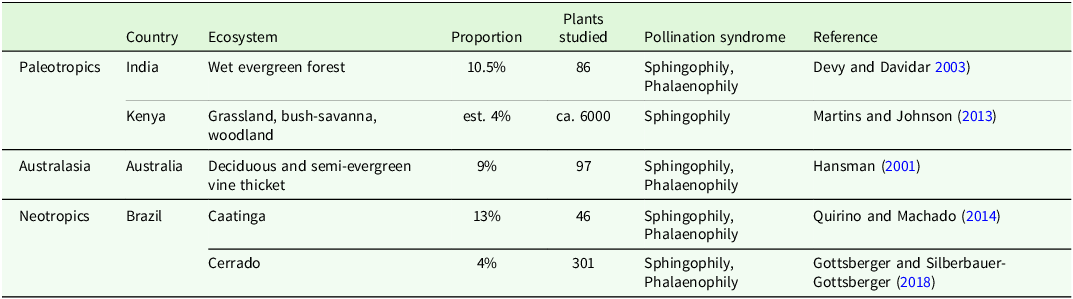
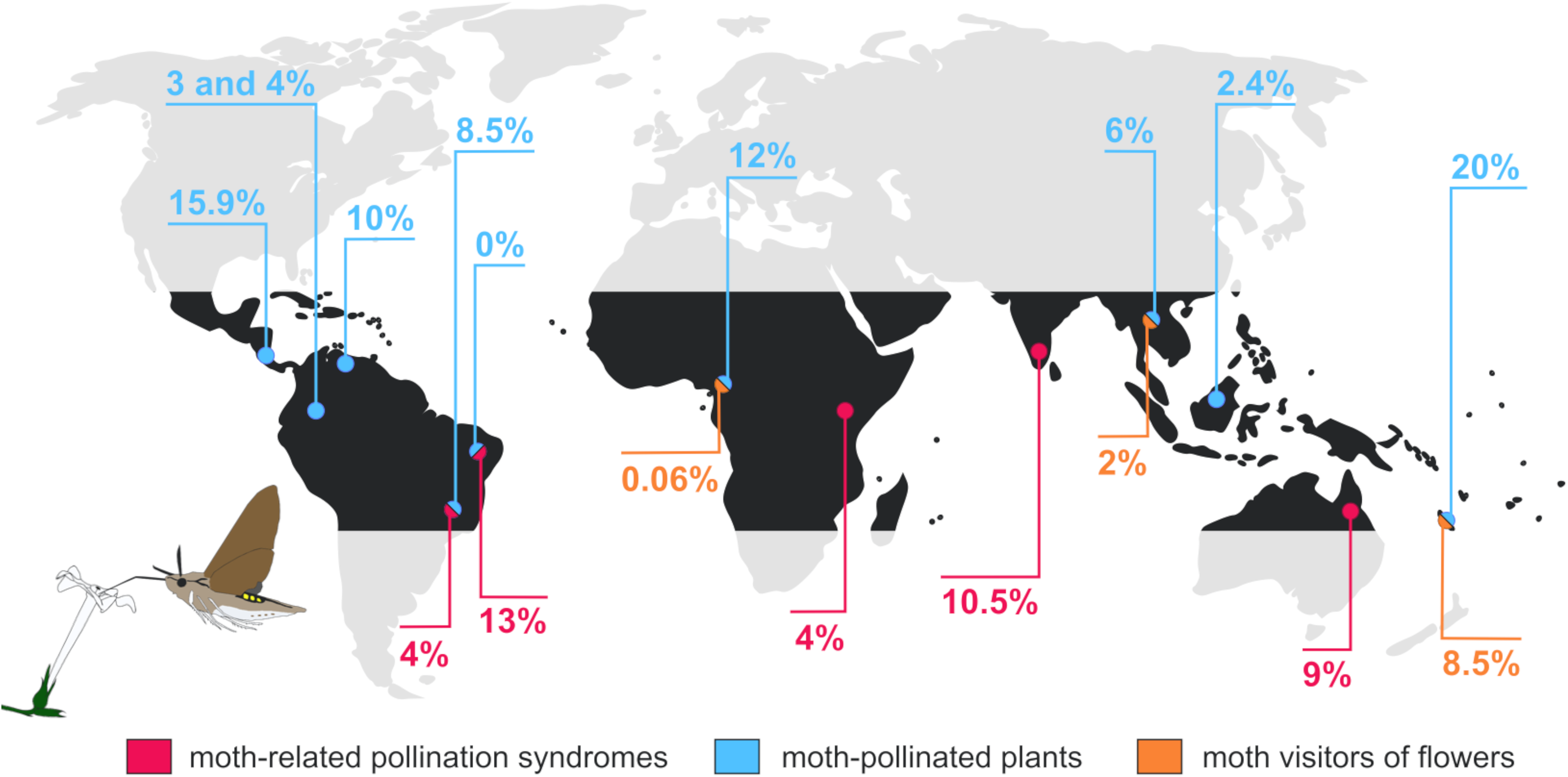
Only five published studies provided quantitative estimates of the proportion of plant species with the two moth-related pollination syndromes in tropical communities (Table 1, Figure 2). Although moths can often pollinate plants with moth-related pollination syndromes, they do not always prefer visiting moth-attracting flowers, and pollination syndromes are, therefore, not always reliable predictors of primary pollinators (e.g., Klomberg et al. Reference Klomberg, Tropek, Mertens, Kobe, Hodeček, Raška, Fominka, Souto-Vilarós, Janečková and Janeček2022; Santos-Gómez et al. Reference Santos-Gómez, Figueroa-Castro and Castañeda-Posadas2021).
Proportions of plant species with moth-related pollination syndrome in tropical plant communities. ‘Sphingophily’ refers to the pollination syndrome related to hawkmoths, while ‘Phalaenophily’ refers to the pollination syndrome related to settling moths. When both syndromes were distinguished in a reviewed study, the listed proportion represents their combined prevalence

Geographical distribution of the reviewed pollination studies focusing on proportions of moth pollination in tropical communities. Each dot indicates a study site, with accompanying percentages showing the relative proportions of (red) plant species exhibiting the moth-related pollination syndromes, phalaenophily and sphingophily (classified by study authors based on floral traits); (blue) all moth-pollinated plant species found in the studied community (based on pollination evidence or its proxy); and (orange) relative abundance of moths among all flower visitors. Distinctively dark areas visualise the tropics. This map highlights the need for more comprehensive studies of nocturnal moth pollination from tropical ecosystems.

On the other hand, the concept offers valuable hypotheses on potential pollinators or co-evolutionary relationships, especially in the diverse and vastly understudied tropical ecosystems. The reviewed studies indicated that sphingophilous and/or phalaenophilous plants account for between 4% and 13% of the flowering plant diversity in the examined tropical plant communities (Table 1, Figure 2). These assessments were based on measured and/or evaluated floral traits to assign pollination syndromes, with only two studies partially complementing these assignments with visitor observations (Devy and Davidar Reference Devy and Davidar2003; Martins and Johnson Reference Martins and Johnson2013). Interestingly, the proportion of moth-related syndromes differed across vegetation strata, ranging from 0% in herbaceous layers to 11% in canopies in the Brazilian Cerrado (Gottsberger and Silberbauer-Gottsberger Reference Gottsberger and Silberbauer-Gottsberger2018). This variation may reflect the higher activity of moth pollinators within tropical forest canopies (e.g., Schulze et al. Reference Schulze, Linsenmair and Fiedler2001). Besides plants classified into pollination syndromes by the study authors, a significant diversity of tropical plants bears generalised flowers (e.g., Devy and Davidar Reference Devy and Davidar2003; Gottsberger and Silberbauer-Gottsberger Reference Gottsberger and Silberbauer-Gottsberger2018). Considering the number of defined pollination syndromes (bees, bats, butterflies, etc.) and plants with generalised flowers, even the seemingly low proportion of moth-attracting flowers in plant communities can imply that plant species with moth pollination syndromes might be relatively common in tropical ecosystems.
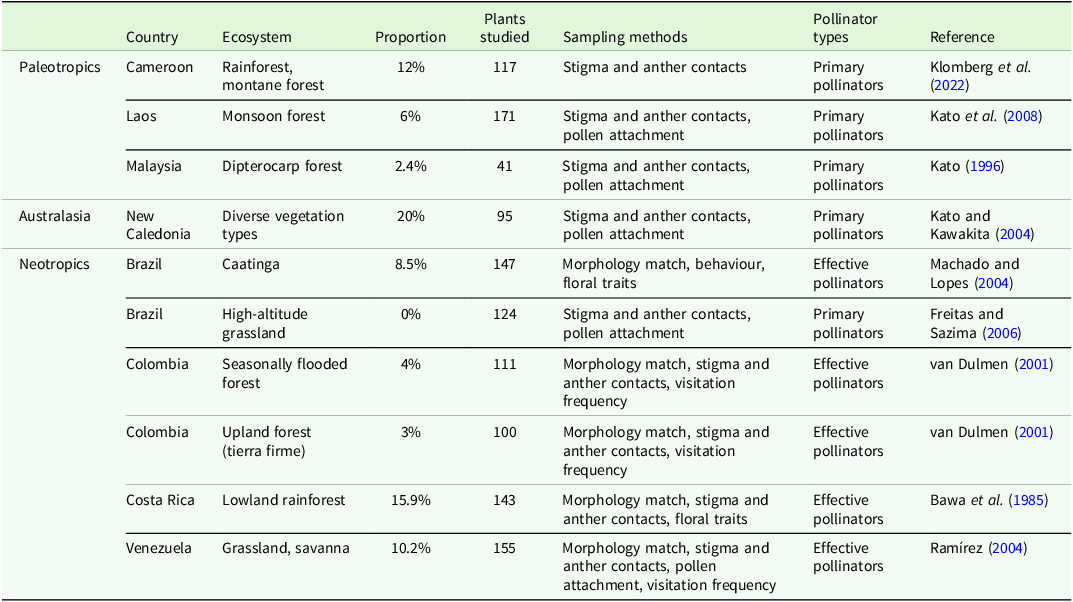
Nine retrieved studies have empirically evidenced effective pollination and reported moth-pollinated plant species proportions in tropical plant communities (Table 2, Figure 2). All these studies were based on direct observations of plant visitors and pollinator behaviour assessments, and eight of them were enhanced by additional proxies for pollination (Table 2). Four of these studies showed that the proportion of tropical plants effectively pollinated by at least a single moth species ranges from 3% in Colombian upland forests (van Dulmen Reference van Dulmen2001) to 15.9% in Costa Rican lowland rainforests (Bawa et al. Reference Bawa, Bullock, Perry, Coville and Grayum1985). The other five studies quantified the proportions of plants with moths as primary pollinators, ranging from 2.4% moth-pollinated plant species in Malaysian dipterocarp forests (Kato Reference Kato1996) to 20% in diverse ecosystems of New Caledonia (Kato and Kawakita Reference Kato and Kawakita2004). Interestingly, despite studying nocturnal pollination, moths were not even visiting any of the 124 studied plant species in Brazilian high-altitude grasslands (Freitas and Sazima Reference Freitas and Sazima2006). The reviewed studies implied that moths are more frequently found pollinating shrub or tree species compared to herbaceous grassland species. However, these conclusions are limited by the low number of studies and the predominant focus on forest ecosystems in reviewed studies.
Proportions of plant species pollinated by moths in tropical ecosystems. ‘Primary pollinators’ refers to the studies focusing on the main pollinators of the focal plants, while ‘effective pollinators’ refers to the studies quantifying proportions of all effective pollinators for each plant species in the community

From the perspective of the pollinator community, only three studies have quantified the proportion of moth flower visits compared to other visitors of flowers in tropical ecosystems (Table 3; Figure 2). In these studies, the proportion of moth visits varied between regions substantially, ranging from only 0.06% of hawkmoth visits in the Afrotropical forests of Mount Cameroon (Mertens et al. Reference Mertens, Brisson, Janeček, Klomberg, Maicher, Sáfián, Delabye, Potocký, Kobe, Pyrcz and Tropek2021) to 8.5% in plant communities of New Caledonia (Kato and Kawakita Reference Kato and Kawakita2004). All three studies counted floral visitors directly through observation (Kato et al. Reference Kato, Kosaka, Kawakita, Okuyama, Kobayashi, Phimminith and Thongphan2008; Kato and Kawakita Reference Kato and Kawakita2004) or video recording (Mertens et al. Reference Mertens, Brisson, Janeček, Klomberg, Maicher, Sáfián, Delabye, Potocký, Kobe, Pyrcz and Tropek2021). Considering the limited number of studies, any generalisations from these results are strongly constrained by geographical and other limitations. Additionally, a few community-wide studies provided non-quantitative evaluations of moth visits, which are difficult to interpret precisely, such as moth flower visits described as ‘occasional’ in Hong Kong (Corlett Reference Corlett2001) and ‘rare’ in the Brazilian Cerrado (Oliveira et al. Reference Oliveira, Gibbs and Barbosa2004). These non-quantitative estimates were not systematically collated in this review.
Relative abundance of moths among flower visitors in tropical plant communities. Proportion refers to the number of moth visits related to all recorded visits

Despite the general scarcity of studies on moth pollination at the community level, the available datasets suggest that moth pollinators can play a significant role in tropical ecosystems. The quantifications from a few studies revealed substantial contributions by moths in pollination, with some ecosystems showing interestingly high proportions of up to 20% moth-pollinated plants (Tables 1, 2, 3), challenging the conventional view of moths as a rather minor pollinator group. Such proportion is surprisingly high, considering the number and diversity of other pollinator groups in tropical ecosystems (Vizentin-Bugoni et al. Reference Vizentin-Bugoni, Maruyama, De Souza, Ollerton, Rech, Sazima, Dáttilo and Rico-Gray2018; Wardhaugh Reference Wardhaugh2015); however, such proportions were not uniformly observed across all studies. In some ecosystems, moths appeared as relatively minor pollinators, implying their significance in tropical communities may vary among biogeographical areas, ecosystem types, or according to specific environmental conditions. Unfortunately, the drivers of these patterns remain unidentified due to the constraints highlighted in this review. There is a strong biogeographic bias in the available datasets; a significant portion of studies originates from the Neotropics, and other tropical realms are less represented (Figure 2). Moreover, most studies focused on forests and woodlands and montane ecosystems, leaving other diverse tropical habitats largely overlooked in community-level nocturnal pollination research (Tables 1, 2, 3).
Challenges, perspectives, and future directions
We synthesised knowledge from 47 available studies on tropical nocturnal moth pollination, which met our selection criteria from particular pollination systems to plant or pollinator communities. We revealed significant knowledge gaps, attributable primarily to the limited number of available comprehensive datasets. The lack of studies stems from the methodological challenges of nocturnal pollination research. Furthermore, moths exhibit complex behaviour, particularly in timing their foraging activities at night (e.g., Balkenius and Dacke Reference Balkenius and Dacke2013; de Camargo et al. Reference de Camargo, de Camargo, Corrêa, De Camargo, Vieira, Marini-Filho and Amorim2016), which makes them challenging to study. The consequent necessity for nocturnal monitoring and the difficulties associated with observations and identifying moth species and their interactions with plants under suboptimal lighting conditions remain problematic and hinder comprehensive studies in many tropical regions. The need for specialised equipment, such as cameras with nocturnal vision (Balducci et al. Reference Balducci, Van Der Niet and Johnson2020), compounds these challenges, considering the high price and limited availability, especially in the Global South.
Variability in the roles of moths across different biogeographical areas further complicates drawing clear conclusions. While some ecosystems showed high proportions of moth pollination, others did not, suggesting that environmental factors and plant species composition significantly influence moth pollination roles. The inequality in the studied geographical areas and tropical ecosystem types, reflecting the lack of funding and other resources in many tropical areas, are the most important biases in understanding biogeographical patterns in the role of moth pollination. Our review showed that the existing research was predominantly concentrated in East Africa and certain parts of Brazil. In contrast, vast areas such as Central and West Africa, Southeast Asia, the Amazon basin, the tropical Andean regions, and the Pacific Islands remain markedly underexplored. Additionally, this review has pointed out the general underrepresentation of nocturnal pollination studies in tropical ecosystems, particularly those involving settling moths and mixed pollination systems. Furthermore, pollination studies should account for the temporal dynamics of moth communities that exhibit considerable seasonal variability even in tropical ecosystems with less pronounced seasonality (e.g., de Camargo et al. Reference de Camargo, de Camargo, Corrêa, De Camargo, Vieira, Marini-Filho and Amorim2016; Maicher et al. Reference Maicher, Sáfián, Murkwe, Przybyłowicz, Janeček, Fokam, Pyrcz and Tropek2018).
The available studies strongly varied in the applied methodology of assessing pollination effectiveness, which further complicates our understanding of the role of moths in pollinating tropical plants. While detailed field experiments are necessary to prove the effectiveness of individual flower-visiting species, they are impossible to do for the vast diversity of tropical plants (Draper et al. Reference Draper, Baker, Baraloto, Chave, Costa, Martin, Pennington, Vicentini and Asner2020). Such experiments with exposing previously covered virgin flowers to particular visitors and quantifying their effect on seed production are necessary to understand many co-evolutionary processes and ecological interactions better (Dafni Reference Dafni1992; Padyšáková et al. Reference Padyšáková, Bartoš, Tropek and Janeček2013). To save highly limited resources, such detailed research should be applied for selected pollination systems with already presumed effective pollination by nocturnal moths, based either on the moth-related pollination syndromes or on extensive studies using observation of floral visitors, analysis of pollen grains carried by animals, or other proxies for effective pollination (Dafni Reference Dafni1992). For such selection of plants for further studies, but also for a better understanding of foraging moth preferences and other processes at the community level, we see the need for modern equipment, such as cameras with nocturnal vision (Balducci et al. Reference Balducci, Van Der Niet and Johnson2020), as they allow researchers to capture a large picture within the same timeframe, despite the lack of objective evidence on pollination effectiveness. However, implementing this approach may not always be possible considering the high price and limited availability of such equipment, especially for the Global South researchers. On the other hand, not much is known about the influence of such technology on pollinators’ behaviour (Balducci et al. Reference Balducci, Van Der Niet and Johnson2020; Boyes et al. Reference Boyes, Evans, Fox, Parsons and Pocock2021). Additionally, the recent advancement of pollen metabarcoding offers a helpful tool for the detailed analyses of pollen loads carried by flower-visiting animals (Bell et al. Reference Bell, De Vere, Keller, Richardson, Gous, Burgess and Brosi2016). Despite pollen metabarcoding bringing various biases and providing only partial information about plants visited by an analysed animal, they allow quantitative community-level analyses, overcoming numerous of the abovementioned methodological challenges of nocturnal pollination research. Especially with the expected decrease in costs, we expect its broader use in pollination research in the near future. Last but not least, the non-selective community-level approaches are necessary to hinder the probable current knowledge bias towards selecting specialised pollination systems to study moth pollination in a large part of the reviewed studies.
Altogether, significant gaps prevent detailed analyses of the complex role of moths as tropical pollinators and the drivers responsible for the reported variability. To address these knowledge gaps, future research should aim to: 1) Expand geographical and ecological scope by initiating moth pollination studies in underrepresented regions and a broader array of tropical ecosystems and generally generate more comprehensive datasets on nocturnal pollination. 2) Utilise and further develop advanced nocturnal research methodologies, such as enhanced camera traps and video camera systems, automated processing of images and videos, and modern AI models (Pichler et al. Reference Pichler, Boreux, Klein, Schleuning and Hartig2020) to overcome the limitations of night-time studies and improve data accuracy. 3) Intensify detailed studies of tropical pollination systems selected based on the community-level observational studies, applying field experiments necessary to disclose pollinator effectiveness of individual floral visitors. 4) Begin long-term studies to capture seasonal variations and temporal dynamics of moth pollination activities, providing a more nuanced understanding of their ecological roles throughout the year. To overcome all these challenges, functional collaboration between Global North researchers with better access to costly specialised equipment and Global South researchers with rich knowledge of the local biodiversity and better access to the neglected ecosystems is crucial (Gewin Reference Gewin2023; Ocampo-Ariza et al. Reference Ocampo-Ariza, Toledo-Hernández, Librán-Embid, Armenteras, Vansynghel, Raveloaritiana, Arimond, Angulo-Rubiano, Tscharntke, Ramírez-Castañeda, Wurz, Marcacci, Anders, Urbina-Cardona, De Vos, Devy, Westphal, Toomey, Sheherazade and Maas2023). By addressing these goals, future research should significantly enhance our understanding of tropical moth-plant interactions and contribute to more informed conservation strategies and ecological management practices, acknowledging the critical roles of nocturnal pollinators.
Conclusions
This review synthesised the current knowledge on the importance of moth pollination in tropical ecosystems, uncovering the substantial roles these pollinators can play and the significant gaps in our understanding, shaped mainly by inherent methodological challenges and biases in nocturnal pollination research. Moths (hawkmoths and settling moths) were confirmed to play crucial roles in pollinating tropical plants. These roles range from primary pollinators in specialised plant species to effective or occasional pollinators in bimodal and mixed pollination systems to occasional nectar thieves, highlighting their variable importance in pollination. Their potential as pollinators has often been underestimated despite some studies showing moths contributed to the pollination of up to 20% of plants in specific tropical communities. Such a proportion is surprisingly high, considering the number of competing pollinator groups. Although the available literature on nocturnal moth pollination is scarce and biased to a certain level, our findings challenge the conventional presumption of moths being minor pollinators.
Data availability statement
Data sharing does not apply to this article as no datasets were generated or analysed during the current study.
Acknowledgements
We are thankful to the members of the Insect Community Ecology Group for various discussions on topics related to our study and to Petra Janečková and Štěpán Janeček for providing plant photos. In some parts of the manuscript, we used the GPT-4 language model (OpenAI) for English proofreading.
Author contributions
Both authors conceived the idea and reviewed the literature; MB wrote the first draft, which was finalised by both authors.
Financial support
Our research was funded by the Czech Science Foundation (21-24186M).
Competing interests
The authors declare none.
Ethical statement
None.