


Introduction
One of the core aspects of the therapeutic relationship is the therapeutic alliance. According to Horvath and Bedi (Reference Horvath, Bedi and Norcross2002, p. 44), the therapeutic alliance can be expressed as “. . . the quality and strength of the collaborative relationship between patient and therapist”. Despite the growing number of studies on the therapeutic alliance in the traditional face-to-face therapeutic context, only few authors have presented pioneer studies on technology and the therapeutic alliance. For instance, Meyerbröker and Emmelkamp (Reference Meyerbröker and Emmelkamp2008) study the role of therapeutic alliance in Virtual Reality Exposure Therapy. The authors demonstrate that the quality of therapeutic alliance was positively related to the clinical outcome (i.e. reduction in anxiety) in the Virtual Reality Exposure Therapy for the fear of flying. Germain, Marchand, Bouchard, Guay and Drouin (Reference Germain, Marchand, Bouchard, Guay and Drouin2010) compare the therapeutic alliance in face-to-face vs video-conference treatment of post traumatic stress disorder. The results show that the therapeutic alliance is developed and maintained without significant difference between the two groups. Similarly, Sucala et al. (Reference Sucala, Schnur, Constantino, Miller, Brackmam and Montgomery2012) propose a review of therapeutic relationship in e-therapy. The results show that e-therapy seems to be at least equivalent to face-to-face therapy in terms of therapeutic alliance.
Although numerous empirical studies have demonstrated the clinical effectiveness of the new technologies, many mental health workers still have some concerns regarding the use of technology in clinical practice. Some criticisms concern the space taken up by the hardware in the therapeutic office; the difficulty of creating a therapeutic alliance in the absence of non-verbal communication; and the difficulty of transferring therapeutic interactions to an electronic medium. In a specific case of Augmented Reality (AR) mediated face-to-face therapy, the concerns regarding this particular technology may include the viability and responsiveness of technology, the effect of visual display on the patient-therapist relationship, and the difficulty of anxiety activation with the virtual elements. The aim of this paper is to compare the influence of AR exposure therapy to the traditional face-to-face exposure therapy on the therapeutic alliance.
Method: the case study
The study compared two types of therapeutic sessions related to the cockroach and spider phobia treatment: the traditional, non-mediated-by-technology In Vivo Exposure Therapy (IVET), and the technology-mediated Augmented Reality Exposure Therapy (ARET, see Juan et al., Reference Juan, Alcañiz, Monserrat, Botella, Baños and Guerrero2005 for detailed description of the system). The experimental design corresponded to between-subject factorial design, in which the two therapeutic sessions included identical clinical protocol (i.e. same one-session treatment protocol); same objectives; and were located in the same place. The study was approved by the ethical committee from Jaume I University of Castellon, Spain. In total, 22 patients participated in this study (M = 28.18 years old; SD = 9.42). The patients participated in the diagnostic interview (based on ADIS IV; Di Nardo, Brown and Barlow, Reference Di Nardo, Brown and Barlow1994), and were randomly assigned to one of two groups. The patients also performed the Behavioural Avoidance Test (BAT; adapted from Öst, Reference Öst and Davey2000) and completed the short version of Working Alliance Inventory (WAI; Tracey and Kokotovic, Reference Tracey and Kokotovic1989), after which they received the intensive therapeutic session using one of two treatments. At the end of the session, the evaluation protocol was applied and the patients performed the BAT and completed the WAI scale.
Results
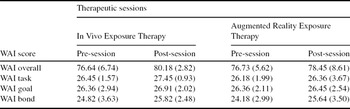
All the analyses were performed using one-way variance analysis (ANOVA). The analysis of the pretest BAT scores showed no statistically significant differences [F(1,20) = 0.061, p = .807] between the traditional group (M = 4.64, SD = 1.29) and the technology-mediated group (M = 4.45, SD = 2.07) with a statistical power of 0.056. The analysis of the posttest BAT scores showed no statistically significant differences [F(1,20) = 2.30, p = .145] between the traditional group (M = 10.91, SD = 1.30) and the technology-mediated group (M = 9.91, SD = 1.76) with a statistical power of 0.303. The results of the BAT pretest vs posttest scores within the group comparison showed a statistically significant decline in the severity of avoidance under both conditions [F(1,19) = 68.59, p <.001] with a statistical power of 1.00. No significant difference was observed between the two conditions in this regard [F(1,19) = 1.591, p = .22], with a statistical power of 0.22. The analysis of the WAI overall score (see Table 1) demonstrated that the therapeutic alliance is created and maintained as a high quality therapeutic relationship. The statistical analysis did not reveal a significant interaction effect, suggesting that there is no significant difference in therapeutic alliance between the technology-mediated therapeutic session and the traditional therapeutic session [F(1,19) = 0.085, p = .77] with power of 0.059. The analysis of specific WAI dimensions also suggest that there is no significant difference in therapeutic alliance between the two conditions with regard to the goal [F(1,19) = 0.076, p = .79], the task [F(1,19) = 1.12, p = .30], and the bond [F(1,19) = 0.26, p = .62], with a power of 0.058; 0.172; and 0.077, respectively.
Range, means and standard deviations for WAI overall scores (out of 84), and means and standard deviations for WAI subscales (out of 28) for the two measurement times

The results also show a significant increase in quality of therapeutic relationship over time for the WAI overall score ([F(1,19) = 5.49, p = .030] with a statistical power of 0.604); the WAI task subscale ([F(1,19) = 16.68, p <.001] with a statistical power of 0.972); and the WAI bond subscale ([F(1,19) = 4.60, p = .045] with a statistical power of 0.530). The comparison of the specific task, goal, and bond indicators did not show any significant difference between the two groups. The only significant difference was found for item 11 (understanding of the changes that would be good for the patient). The score of this item increased in IVET over time and decreased in ARET over time [F(1,19) = 5.787, p = .026] with a statistical power of 0.627.
Discussion and conclusion
The objective of this paper was to determine whether technologies such as Augmented Reality can have a negative influence on the therapeutic alliance and, in turn, have an impact on the clinical outcome. The results demonstrated that the therapeutic alliance between the patient and the therapist were the same in both the technology-mediated therapeutic sessions (ARET) and the non-mediated-by-technology therapeutic sessions (IVET). Therefore the results seem to show that technologies such as Augmented Reality do not represent a danger as they do not negatively influence the patient-therapist relationship. The clinical outcome seems to confirm this conclusion.
This study can be improved in several ways. First, although the sample used in this study is relatively high for a study with clinical population, the power to detect the potential differences is low; thus all the conclusions must be confirmed with a larger clinical sample. Second, introduction of a controlled group of therapists with different levels of therapeutic experience might provide a deeper understanding of how technology affects the therapeutic activity according to the therapists' professional experience. Third, there is also a need for additional therapeutic alliance observational methods that complement the understanding of the patient-therapist relationship. This might also diminish the bias due to the use of self-report measures. Moreover, the introduction of the therapeutic alliance scale from the therapists' perspective might bring some interesting additional information. Finally, the therapeutic alliance measures were initially developed in relation to the traditional psychotherapeutic interactions; however, with the introduction of new forms of therapies the therapeutic alliance measures are challenged (Elvins and Green, Reference Elvins and Green2008). Therefore, adapting the WAI scale to Augmented Reality Exposure Therapy should be proposed.
The therapeutic sessions mediated by technologies are slowly moving from the researchers' laboratories to the therapists' offices. We believe that this study is a first step in understanding therapeutic relationship issues in the Augmented Reality-mediated context.




Comments
No Comments have been published for this article.