Introduction
People who are diagnosed with schizophrenia are typically more likely to use dependence-forming drugs, including tobacco, than the general population (de Leon & Diaz, Reference de Leon and Diaz2005). Smoking is a major cause of cardiovascular disease in schizophrenia (Kelly et al. Reference Kelly, McMahon, Wehring, Liu, Mackowick, Boggs, Warren, Feldman, Shim, Love and Dixon2011), which causes two-thirds of premature deaths in these individuals (Hennekens et al. Reference Hennekens, Hennekens, Hollar and Casey2005). An improved understanding of the factors underpinning tobacco use is therefore crucial to improve the roughly 15-year reduction in life expectancy associated with this illness (Hennekens et al. Reference Hennekens, Hennekens, Hollar and Casey2005).
Cues associated with drug use, such as the sight of a cigarette packet or someone smoking, are thought be important in the development and maintenance of addictive behaviour. For example, substance users typically attribute these cues with incentive salience, reflecting a ‘want’ rather than a ‘liking’ of the drug (Robinson & Berridge, Reference Robinson and Berridge1993). This process is driven by associative learning between cues and sensitized dopamine release but can be amplified by physiological changes such as abstinence (Robinson & Berridge, Reference Robinson and Berridge1993). The ability of drug cues to grab attention or ‘attentional bias’ is commonly used as an index of incentive salience (Field & Cox, Reference Field and Cox2008) and is thought to play a causal role in drug use (Franken, Reference Franken2003). Attentional bias may be an important neurocognitive index of addictive behaviour because it can prospectively identify whether an individual who smokes is likely to succeed during an attempt to quit (Waters et al. Reference Waters, Shiffman, Sayette, Paty, Gwaltney and Balabanis2003; Janes et al. Reference Janes, Pizzagalli and Richardt2010; Powell et al. Reference Powell, Dawkins, West, Powell and Pickering2010). However, the relationship between attentional bias and smoking in schizophrenia has not yet been investigated.
The concept of salience attribution outlined by Robinson & Berridge (Reference Robinson and Berridge1993) has also been applied to schizophrenia research (Heinz & Schlagenhauf, Reference Heinz and Schlagenhauf2010). It has been hypothesized that psychosis may arise from context-independent dopamine release, allowing irrelevant stimuli and internal representations to take on motivational significance (Kapur, Reference Kapur2003). Delusions arise as a way of explaining the subjective experience of increased salience, whereas hallucinations come from the aberrant assignment of salience to normal internal experiences (Kapur, Reference Kapur2003). When compared to control subjects, attribution of motivational salience to irrelevant stimulus characteristics is elevated in first-episode psychosis (Murray et al. Reference Murray, Corlett, Clark, Pessiglione, Blackwell, Honey, Jones, Bullmore, Robbins and Fletcher2007), in schizophrenia (Jensen et al. Reference Jensen, Willeit, Zipursky, Savina, Smith, Menon, Crawley and Kapur2007) and in people at ultra-high risk of developing psychosis (Roiser et al. Reference Roiser, Howes, Chaddock, Joyce and McGuire2012). These at-risk individuals also showed an abnormal relationship between dopamine synthesis capacity in the striatum and hippocampal activation to irrelevant stimulus features during the task (Roiser et al. Reference Roiser, Howes, Chaddock, Joyce and McGuire2012). Furthermore, in a sample of patients diagnosed with schizophrenia, Roiser et al. (Reference Roiser, Stephan, den Ouden, Barnes, Friston and Joyce2009) found evidence of aberrant salience attribution in people currently suffering from delusions when compared to those who were not. Taken together, these findings suggest that aberrant salience attribution to irrelevant stimuli is associated with the development of psychotic symptoms (perhaps delusions in particular) and that it may be associated with changes in dopamine function (Kapur, Reference Kapur2003).
Similarities between the neural correlates of repeated drug use and schizophrenic illness have been suggested as an explanation for their substantial co-morbidity (Tsapakis et al. Reference Tsapakis, Guillin and Murray2003), and erroneous salience attribution processes in addiction and psychosis are built on a common psychological framework (Robinson & Berridge, Reference Robinson and Berridge1993; Heinz & Schlagenhauf, Reference Heinz and Schlagenhauf2010). According to the primary addiction hypothesis (Chambers et al. Reference Chambers, Krystal and Self2001), a single neural abnormality might cause psychotic symptoms to emerge due the attribution of salience to irrelevant stimuli (Gray et al. Reference Gray, Feldon, Rawlins, Hemsley and Smith1991), but could also independently enhance the incentive motivational properties of drugs and their associated cues. This abnormality, proposed to arise in the hippocampal formation and prefrontal cortex, would thus mimic pathological changes that would only normally be achieved through chronic drug abuse (Robinson & Berridge, Reference Robinson and Berridge1993; Jentsch & Taylor, Reference Jentsch and Taylor1999).
Induction of this abnormality in rats using neonatal ventral hippocampus lesions can model aspects of schizophrenia (Tseng et al. Reference Tseng, Chambers and Lipska2009) and increase self-administration of and sensitization to drugs, including nicotine (Berg & Chambers, Reference Berg and Chambers2008; Berg et al. Reference Berg, Sentir, Cooley, Engleman and Chambers2013). Additionally, findings from a human chronic ketamine model of psychosis support the idea that the attribution of salience to drug-related cues and irrelevant stimulus features coincide with each other (Freeman et al. Reference Freeman, Morgan, Pepper, Howes, Stone and Curran2012). This suggests that individuals with schizophrenia or severe psychotic symptoms may be more prone to attribute drug-related cues with incentive salience and develop problematic drug use. Previous studies have found that control and schizophrenia smoking groups show equal levels of ‘cue reactivity’, or the increase in tobacco craving following exposure to smoking cues (Fonder et al. Reference Fonder, Sacco, Termine, Boland, Seyal, Dudas, Vessicchio and George2005; Tidey et al. Reference Tidey, Rohsenow, Kaplan, Swift and Adolfo2008). However, it is not yet known whether these groups exhibit differences in salience attribution, as indexed by attentional bias, and whether this effect is linked to psychotic symptoms.
The aim of the present study was to investigate the relationship between incentive motivational processes in both nicotine dependence and schizophrenia. Based on the primary addiction hypothesis (Chambers et al. Reference Chambers, Krystal and Self2001) and a putative link between salience attribution in addiction and psychosis (Robinson & Berridge, Reference Robinson and Berridge1993; Heinz & Schlagenhauf, Reference Heinz and Schlagenhauf2010), we predicted, first, that smokers with a diagnosis of schizophrenia would show a stronger attentional bias towards smoking cues than a control group of smokers with a similar history of and current exposure to nicotine. Second, we predicted that attentional bias would be positively associated with the severity of delusions and hallucinations because of their hypothesized association with aberrant salience (Kapur, Reference Kapur2003).
Method
Design and participants
A between-subjects design compared 22 smokers with a diagnosis of schizophrenia (SS) with 23 control smokers (CS). Inclusion criteria were age 18–75 years, smoking ⩾5 cigarettes/day, agreement to abstain from alcohol and any other recreational drugs on the day of testing, normal or corrected to normal vision, and fluent spoken English. Exclusion criteria were current use of nicotine replacement therapy or other smoking cessation medication. SS were required to have a current diagnosis of schizophrenia, and CS were excluded if they reported any current or history of a major Axis 1 disorder, or a current or history of psychotic disorder in any immediate family member. All participants provided written, informed consent. This study was approved by the local National Health Service (NHS) and University College London (UCL) Research Ethics Committees and was conducted in accordance with the Declaration of Helsinki.
Assessments
Craving scales
The following questions were administered to measure tobacco craving: ‘How much do you want to smoke a cigarette right now?’ and ‘How much would you enjoy a cigarette if you smoked right now?’ Answers were given on 100-mm visual analogue scales (VAS) scales from ‘Not at all’ to ‘Very much so’. These scales were administered at the beginning and the end of the testing session.
Modified Stroop task (Powell et al. Reference Powell, Dawkins, West, Powell and Pickering2010)
This task required participants to name the colour of 88 words that were either neutral or smoking related. Stimuli were presented in blocked format on test cards that were administered separately in a counterbalanced order. This format was chosen because it is brief, easy to administer and predictive of cessation success in smokers from the general population (Powell et al. Reference Powell, Dawkins, West, Powell and Pickering2010). Slower response times and more errors when naming smoking-related words compared to neutral words are indicative of attentional bias.
Fagerström Test for Nicotine Dependence (FTND; Heatherton et al. Reference Heatherton, Kozlowski, Frecker and Fagerström1991)
This test consists of six items rated between 0 and 3, with scores ranging from 0 (low dependence) to 10 (high dependence). Internal reliability scores (Cronbach's α) were 0.711 in SS and 0.525 in CS.
Motivation To Stop Scale (MTSS; Kotz et al. Reference Kotz, Brown and West2012)
A single-item scale, this measures an individual's motivation to quit smoking, combining aspects of desire and intention to quit. Scores range from 1 (I don't want to stop smoking) to 7 (I really want to stop smoking and intend to in the next month).
National Adult Reading Test (NART; Nelson, Reference Nelson1991)
This task requires participants to read 50 irregular words. Full-scale IQ was estimated based on the number of errors (Nelson, Reference Nelson1991).
Clinical assessment
The Scale for the Assessment of Positive Symptoms (SAPS; Andreasen, Reference Andreasen1984b ) and the Scale for the Assessment of Negative Symptoms (SANS; Andreasen, Reference Andreasen1984a ) were administered to SS. Sums of global SAPS and SANS scores are calculated by summing the global scores for each symptom dimension (SAPS: hallucinations, delusions, bizarre behaviour, positive formal thought disorder; SANS: avolition-apathy, anhedonia-asociality, attention). Current diagnosis of schizophrenia was confirmed using ICD-10 criteria (WHO, 1993). Assessments were conducted by members of the study team (T.P.F., B.O., L.A.N. and S.L.M.) who were aware of the study aims and were trained by the lead author (T.P.F.) using the guidelines provided by Andreasen (Reference Andreasen1984a , Reference Andreasen b ) and the World Health Organization (WHO, 1993). CS completed the Oxford–Liverpool Inventory of Feelings and Experiences (O-LIFE; Mason et al. Reference Mason, Linney and Claridge2005), which is designed to measure psychosis-proneness in the general population.
Procedure
SS were recruited and assessed during their regular clozapine clinic visits, and were all medicated with clozapine at the time of testing. Following initial identification and screening, a suitable test day was arranged based on a future clinic appointment. After their clinic appointment, which typically lasted 15 min, participants gave informed consent, and testing commenced in a quiet room. To control for the effect of this delay on tobacco satiation, CS were asked to refrain from smoking for at least 15 min before they provided consent and testing began. Following assessment of breath carbon monoxide (CO; Bedfont Micro Smokerlyzer, UK), both groups completed the tasks in the following order: craving scales, MTSS, modified Stroop task, NART, FTND, craving scales. Afterwards, SS were assessed on the SAPS and the SANS, and control smokers completed the O-LIFE.
Statistical analysis
All analyses were carried out using SPSS version 19 (SPSS Inc., USA). Independent-sample t tests (Mann–Whitney U tests where data violated assumptions of homogeneous variance) and χ 2 tests were used to compare groups on demographic and questionnaire-based variables. Repeated-measures ANOVA models with a between-subject factor of group (SS, CS) were used for the remaining analyses and included within-subject factors of time (pre, post) for Craving scales and stimulus type (smoking, neutral) for the Stroop task. Two-tailed Pearson correlational analyses were used to test our hypothesis that these scores would be associated specifically with delusions and hallucinations in SS. Attentional bias was also subjected to correlational analysis with expired CO, an objective measure of tobacco exposure, because it has been found to be the best predictor of attentional bias in ‘healthy’ tobacco smokers (Vollstädt-Klein et al. Reference Vollstädt-Klein, Loeber, Winter, Leménager, von der Goltz, Dinter, Koopmann, Wied, Winterer and Kiefer2011). Dose of clozapine in SS and variables revealing group differences were subjected to exploratory correlational analyses to assess their inclusion as covariates. For all tests, a p value ⩽0.05 was considered statistically significant.
Results
Participants and demographics (Table 1)
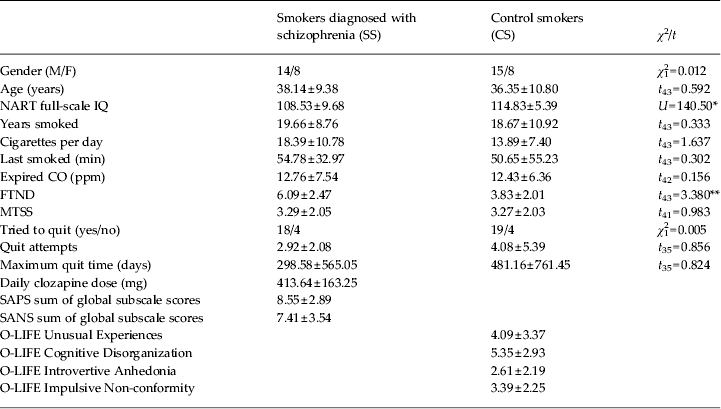
The groups did not differ in gender or age but SS had lower estimated verbal IQ scores than CS on the NART and scored higher in nicotine dependence on the FTND. However, the groups were similar on all other smoking-related variables: years smoked, cigarettes/day, time since last cigarette, expired CO, MTSS scores, number of people who had previously tried to quit, and number and duration of quit attempts. MTSS scores were missing for one SS and CS because they responded with ‘I don't know’; one SS was unable to provide an expired CO reading because of an inability to hold their breath, due to lung disease; Craving scale scores were missing for one CS; and Stroop response time data were missing for one SS. As neither FTND nor NART scores correlated with change in craving scales or Stroop interference (all p's > 0.05), they were not used as covariates in further analyses.
Demographics, smoking behaviour and symptoms

M, Male; F, female; NART, National Adult Reading Test; CO, carbon monoxide; FTND, Fagerström Test for Nicotine Dependence; MTSS, Motivation to Stop Scale; SAPS, Scale for the Assessment of Positive Symptoms; SANS, Scale for the Assessment of Negative Symptoms; O-LIFE, Oxford–Liverpool Inventory of Feelings and Experiences.
Data shown are number or mean ± standard deviation.
* p = 0.01, ** p = 0.002.
Craving scales
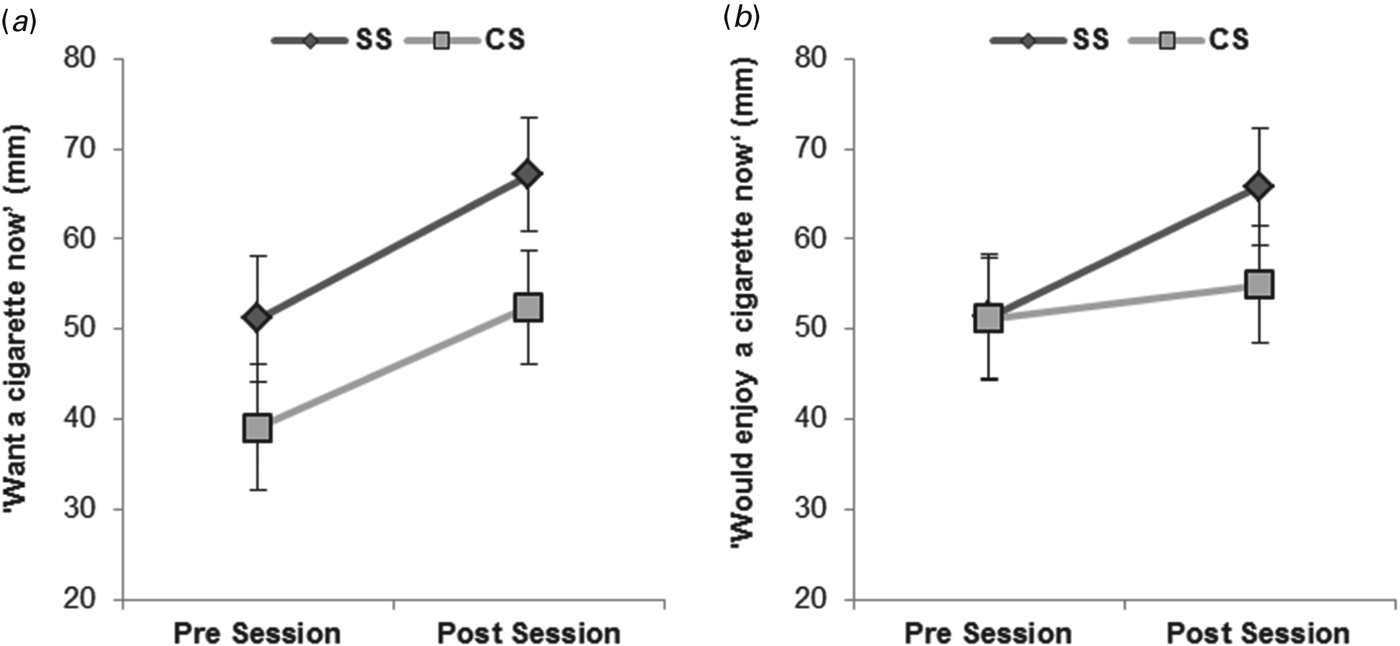
For the question ‘How much do you want to smoke a cigarette right now?’, a significant effect of time was found (F 1,42 = 11.003, p = 0.002, η p 2 = 0.208; Fig. 1 a), reflecting an increase in scores across the testing session, but there were no other significant effects or interactions. A significant effect of time was also found for ‘How much would you enjoy a cigarette if you smoked right now’, with no interaction by group (F 1,42 = 4.523, p = 0.039, η p 2 = 0.97; Fig. 1 b). No other significant effects or interactions emerged.
Craving scales. Scores for (a) ‘want a cigarette now’ and (b) ‘would enjoy a cigarette now’ increased across the testing session for both control smokers (CS) and smokers diagnosed with schizophrenia (SS).

Modified Stroop task (Fig. 2)
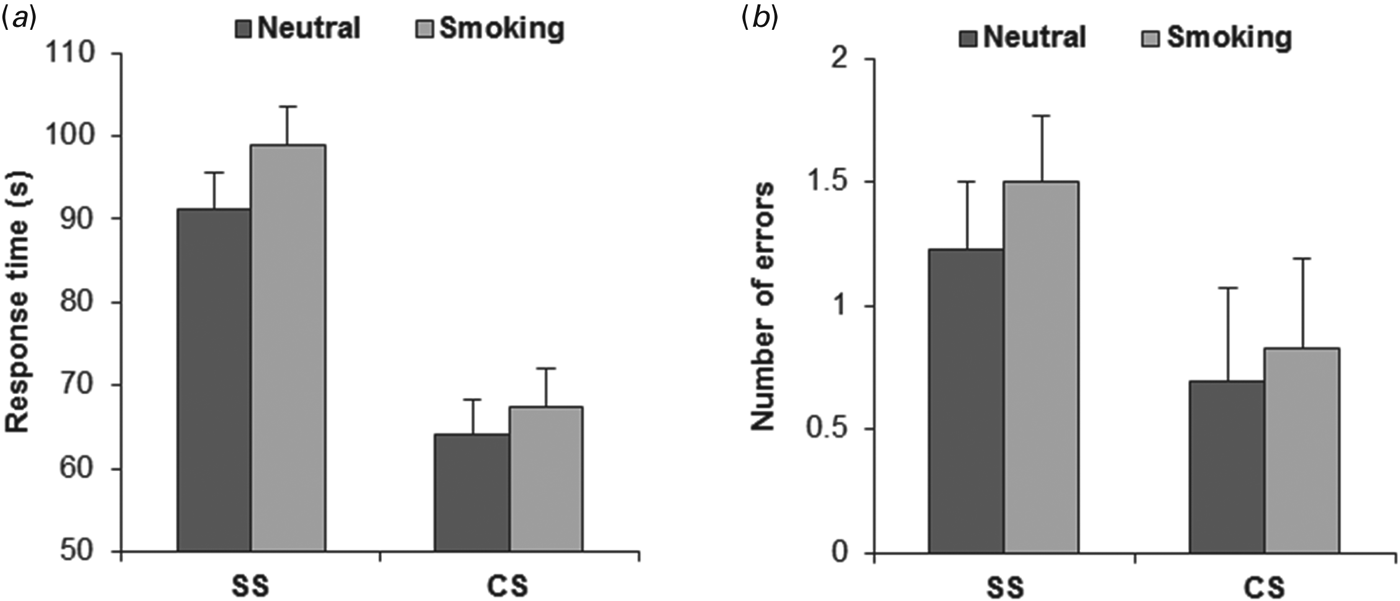
Main effects of stimulus type (F 1,42 = 14.582, p < 0.001, η p 2 = 0.258) and group (F 1,43 = 22.786, p < 0.001, η p 2 = 0.343) were found for response times (Fig. 2 a), reflecting slower responses to smoking-related words compared to neutral words, and in SS compared to CS. No significant type × group interaction was found. Error scores were at floor level and did not reveal any significant effects or interactions (Fig. 2 b).
(a) Response times on the modified Stroop task were slower in smokers diagnosed with schizophrenia (SS) than control smokers (CS) and in both groups to smoking-related compared to neutral words, indicating attentional bias towards smoking cues. (b) Errors on this task were low, and were equivalent across groups and conditions.

Correlations with attentional bias
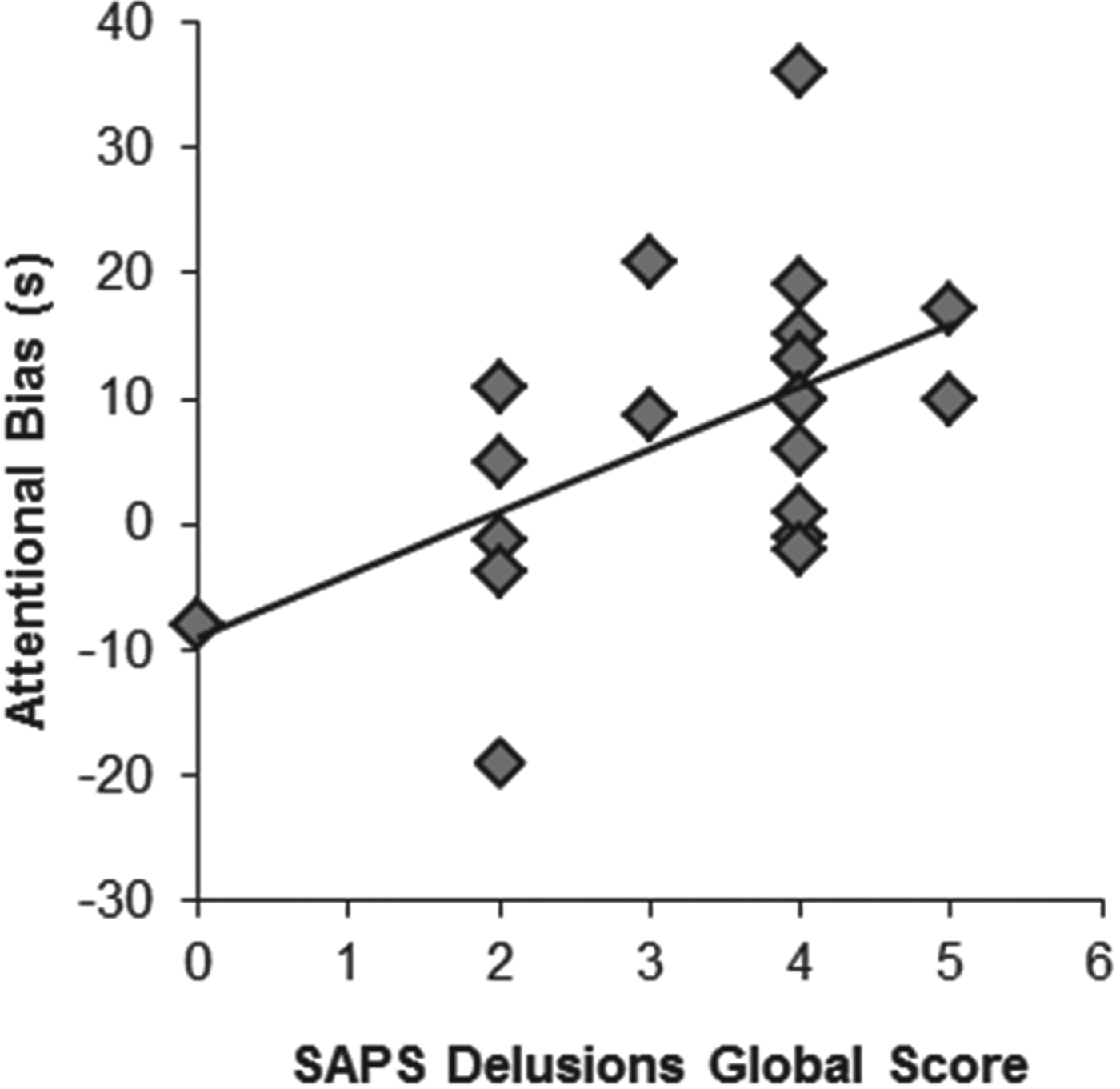
In SS, response time interference scores correlated with the severity of delusions (mean = 3.00, s.d. = 1.66; r = 0.530, p = 0.013; Fig. 3) but not hallucinations (mean = 3.32, s.d. = 1.21; r = 0.349, p = 0.121) or any other SAPS or SANS global scores, clozapine dose in SS, or with schizotypy subscales in CS. However, across both groups these interference scores showed a positive but modest relationship with expired CO, an objective index of recent tobacco exposure (r = 0.343, p = 0.024; Fig. 4).
Attentional bias, as measured by response time interference on the modified Stroop task, correlated with the Scale for the Assessment of Positive Symptoms (SAPS) severity of delusions score in smokers diagnosed with schizophrenia (r = 0.530).

Attentional bias correlated positively with expired carbon monoxide (CO) across all participants. Top line: smokers diagnosed with schizophrenia (SS: r = 0.368); bottom line: control smokers (CS: r = 0.435).

Discussion
This study aimed to test the hypothesis that smokers diagnosed with schizophrenia attribute smoking cues with greater salience than control smokers, and that this effect is associated with the severity of delusions and hallucinations. Both groups showed equivalent levels of interference from smoking cues on a modified Stroop task. Within the schizophrenia group, the degree of this attentional bias was associated with the severity of delusions but not hallucinations.
A disruption of incentive motivational processing is evident in drug addiction and also in psychosis, with both disorders being characterized by changes in salience attribution (Robinson & Berridge, Reference Robinson and Berridge1993; Kapur, Reference Kapur2003; Heinz & Schlagenhauf, Reference Heinz and Schlagenhauf2010). The existence of a common abnormality giving rise to both conditions could explain why use of dependence-forming drugs, including tobacco (de Leon & Diaz, Reference de Leon and Diaz2005), is typically elevated in people diagnosed with schizophrenia (Chambers et al. Reference Chambers, Krystal and Self2001). The findings of this study did not support this hypothesis, as similar levels of attentional bias were found in CS and SS. Those in the patient group were slower on both parts of the task but the relative difference between naming times was similar in both groups. These findings differ from those of a previous study (Copersino et al. Reference Copersino, Serper, Vadhan, Goldberg, Richarme, Chou, Stitzer and Cancro2004) reporting an absence of cocaine-related attentional bias in a schizophrenic population. However, this might be explained by the lower levels of cocaine craving in the schizophrenia group at baseline, which would be expected to coincide with reductions in attentional bias (Franken, Reference Franken2003; Field et al. Reference Field, Munafò and Franken2009). In our study, tobacco craving scores were similar in both groups and showed an equivalent increase across the testing session. Although we did not index craving before and after exposure to neutral and smoking words separately, our findings are consistent with a previous study using this approach in a cue reactivity design (Tidey et al. Reference Tidey, Rohsenow, Kaplan, Swift and Adolfo2008).
Evidence for a common mechanism underpinning psychosis and the incentive motivational effects of abused drugs was, however, supported by our findings that the severity of delusions correlated with attentional bias, with 28% of the variance shared between these two measures. By contrast, the severity of hallucinations was not associated with performance on the task. These findings echo previous findings by Roiser et al. (Reference Roiser, Stephan, den Ouden, Barnes, Friston and Joyce2009, Reference Roiser, Howes, Chaddock, Joyce and McGuire2012) that aberrant salience attribution was associated with the severity of delusions but not hallucinations in medicated patients diagnosed with schizophrenia (Roiser et al. Reference Roiser, Stephan, den Ouden, Barnes, Friston and Joyce2009) and with abnormal thought content in people at risk of developing psychosis (Roiser et al. Reference Roiser, Howes, Chaddock, Joyce and McGuire2012). Increased midbrain activation towards neutral versus aversive conditioned stimuli was also positively related to severity of delusions but not hallucinations in people with psychotic illness (Romaniuk et al. Reference Romaniuk, Honey, King, Whalley, McIntosh, Levita, Hughes, Johnstone, Day, Lawrie and Hall2010). Taken together, these findings suggest that the attribution of salience to external cues may be linked to delusions whereas hallucinations may arise through a different mechanism (Kapur, Reference Kapur2003).
Of course, the association we found between attentional bias and delusions does not imply that they will always coincide with each other. Clearly, attentional bias can occur in the absence of psychosis, as found in the control group here and in many other studies (Field & Cox, Reference Field and Cox2008). In addition, the two groups did not differ in attentional bias overall. This latter finding is also consistent with Roiser et al. (Reference Roiser, Stephan, den Ouden, Barnes, Friston and Joyce2009), who found no differences in aberrant salience attribution when comparing medicated patients with controls at a group level. Our findings indicate that any overlap between addiction and psychosis may be particularly evident in terms of delusions. The concept of ‘salience’ can be applied across diagnostic categories (van Os, Reference van Os2009) and our results may offer some explanation for why smoking prevalence is elevated across psychotic disorders in general, rather than exclusively in schizophrenia (Kotov et al. Reference Kotov, Guey, Bromet and Schwartz2010).
The existence of a common abnormality that can give rise to psychosis and addictive behaviour is in agreement with evidence from a study using a chronic ketamine model of psychosis (Freeman et al. Reference Freeman, Morgan, Pepper, Howes, Stone and Curran2012). Ketamine users with symptoms of both drug dependence and subclinical delusional ideation showed a loss of associative blocking (a process related to psychosis) (Jones et al. Reference Jones, Gray and Hemsley1992), and susceptibility to drug-related cues (a process related to drug dependence) (Freeman et al. Reference Freeman, Morgan, Pepper, Howes, Stone and Curran2012). Chambers et al. (Reference Chambers, Krystal and Self2001) hypothesized that a common basis for both processes might arise from the hippocampal formation and prefrontal cortex, resulting in a change in the impact of dopamine release within the nucleus accumbens. A relationship between prefrontal or hippocampal brain activation and the dopamine system has been reported for both smoking-related attentional bias (Luijten et al. Reference Luijten, Veltman, Hester, Smits, Pepplinkhuizen and Franken2012) and aberrant salience attribution in people at ultra-high risk of developing psychosis (Roiser et al. Reference Roiser, Howes, Chaddock, Joyce and McGuire2012). If these processes do share a common underlying basis and are not causally related to each other (i.e. psychosis enhancing drug use, or vice versa; Tsapakis et al. Reference Tsapakis, Guillin and Murray2003), then in cases of dual diagnosis, drug addiction should be seen as a primary disease symptom and amenable to treatment in its own right (Hahn et al. Reference Hahn, Harvey, Concheiro-Guisan, Huestis, Holcomb and Gold2013), contrary to ideas of self-medication (Kumari & Postma, Reference Kumari and Postma2005). Nicotine dependence seems to have multifactorial causes in schizophrenia (Krishnadas et al. Reference Krishnadas, Jauhar, Telfer, Shivashankar and McCreadie2012; Wing et al. Reference Wing, Wass, Soh and George2012) and the attribution of salience to smoking cues may be an additional factor, particularly in those actively suffering from delusions.
Given that smoking is highly prevalent and a major cause of premature death in schizophrenia (de Leon & Diaz, Reference de Leon and Diaz2005; Kelly et al. Reference Kelly, McMahon, Wehring, Liu, Mackowick, Boggs, Warren, Feldman, Shim, Love and Dixon2011), the extent to which certain antipsychotics influence smoking should be of key importance when choosing an appropriate drug. Although the dopamine D2 receptor antagonist haloperidol is an effective antipsychotic (Irving et al. Reference Irving, Adams and Lawrie2006), it can also increase levels of smoking in tobacco users (Dawe et al. Reference Dawe, Gerda, Russell and Gray1995), including those with schizophrenia (McEvoy et al. Reference McEvoy, Freudenreich, Levin and Rose1995a ). However, because it can attenuate attentional bias and associated brain activation in drug users (Franken et al. Reference Franken, Hendriks, Stam and Van den Brink2004; Luijten et al. Reference Luijten, Veltman, Hester, Smits, Pepplinkhuizen and Franken2012), use of this drug may be preferable in certain individuals who excessively attribute incentive salience to smoking-related cues.
Atypical antipsychotics, with lower affinity for dopamine receptors than haloperidol and other typical agents, are thought to be particularly useful for reducing smoking and other drug use in schizophrenia (Green et al. Reference Green, Drake, Brunette and Noordsy2007). All patients in this study were medicated with clozapine and although dose was not correlated with attentional bias, clozapine has been associated with reductions in tobacco smoking (George et al. Reference George, Sernyak, Ziedonis and Woods1995; McEvoy et al. Reference McEvoy, Freudenreich, McGee, VanderZwaag, Levin and Rose1995b ; Chatterton et al. Reference Chatterton, Sanderson, Van Leent and Plant1998, but see de Leon et al. Reference de Leon, Diaz, Josiassen, Cooper and Simpson2005). Recently, cannabidiol has emerged as a potential treatment for schizophrenia (Leweke et al. Reference Leweke, Piomelli, Pahlisch, Muhl, Gerth, Hoyer, Klosterkötter, Hellmich and Koethe2012) and it may have additional benefits in terms of substance use because of its relationship with attentional bias (Morgan et al. Reference Morgan, Freeman, Schafer and Curran2010) and tobacco smoking (Morgan et al. Reference Morgan, Das, Joye, Curran and Kamboj2013). Further research into the mechanisms responsible for antipsychotic and anti-addictive effects of current and future drugs should be a key priority, given that the majority of people diagnosed with schizophrenia use tobacco and other drugs of abuse (Awad, Reference Awad2012).
This study had three main limitations. First, the patients were all medicated with clozapine and so future studies should aim to replicate these findings in different treatment groups. Second, attentional bias was measured using a modified Stroop task with neutral and smoking-related items. Future studies should extend these initial findings using other tasks and additional conditions (e.g. affective words, to demonstrate the specificity of interference to smoking cues) and functional magnetic resonance imaging (fMRI) techniques (Luijten et al. Reference Luijten, Veltman, den Brink, Hester, Field, Smits and Franken2011) to determine their neural correlates. Nevertheless, the correlation between objective exposure to tobacco (CO) and task performance is consistent with previous findings (Vollstädt-Klein et al. Reference Vollstädt-Klein, Loeber, Winter, Leménager, von der Goltz, Dinter, Koopmann, Wied, Winterer and Kiefer2011), and although the causal direction of this effect is not clear, it does provide some validation of the task. Third, the patient group had lower estimated verbal IQ and higher nicotine dependence scores than controls, and we did not record drug use other than nicotine and clozapine. However, NART and FTND scores did not correlate with the other outcome measures, and the groups were remarkably similar on all other demographic and smoking-related variables.
Conclusions
The results of this study indicate that smoking-related attentional bias is positively associated with the severity of delusions in people diagnosed with schizophrenia. These findings offer preliminary evidence that incentive motivational processes underpinning tobacco smoking are associated with aspects of psychotic illness, which may enhance vulnerability to nicotine use in this population.
Acknowledgements
We are grateful to all volunteers for taking part, and staff at Ealing and Charing Cross hospital clozapine clinics, particularly J. Campling, A. Stenning and O. Thompson. This study was funded by an interdisciplinary Medical Research Council/Economic and Social Research Council (MRC/ESRC) studentship to T.P.F.
Declaration of Interest
None.