Function in a group,
Function in a pack,
Function in a herd.
Run with the she-wolves.
Do not imagine
For a minute you
Can take on this system alone.
(Strom & Mills, Reference Strom and Mills2021)
Coming to this Article
In March of 2021, as two teachersFootnote 1 of physical education (PE) interested in social and ecological justice in (physical) education, we were tasked by the Saskatchewan Ministry of Education and the Saskatchewan Physical Education Association, now amalgamated with the Saskatchewan Health Education Association and (re)named PHE Sask, to develop ‘emotional safety guidelines for physical education’ in the province. The purpose was to provide a manual of sorts exploring how teachers of PE might facilitate engaging and empowering PE spaces for all learners to experience affirmative relationships with physical activity. On the surface, this seemed like a straight-forward project, and one that we were eager to get to work on. Afterall, we were strong advocates for the importance of bolstering affirmative physical activity in our teaching practices to promote lifelong advocacy for physical activity, health and wellbeingFootnote 2 (Pica, Reference Pica2014). We were also cognisant of the salience of PE to attend to Goal 3 of the United Nations Sustainable Development goals, ‘Ensure healthy lives and promote well-being for all at all ages’ (United Nations, n.d).
However, as we delved deeper into our conversations recounting firsthand teaching encounters and wider narratives in PE discourse, we acknowledged that learners in PE were often marginalised and subjugated due to their (dis)ability, body shape and size, class, race, gender and sexual orientations, and ethno-cultural ancestry, linguistic and religious backgrounds. As learners come under erasure through sociocultural parametres that do not fit dominant categories in PE, there is a need to challenge historically situated, culturally located and socially mediated discourses, and expand upon constraining and restrictive theories/practicesFootnote 3 to generate a sense of belonging for lifelong advocacy for physical activity, health and wellbeing. From this standpoint, it was starkly evident that achieving outcomes relating to equitable movement opportunities in PE were part of a burgeoning wicked problem.
In 1973, Horst Rittel and Melvin Webber made important distinctions between ‘tame problems’ and ‘wicked problems’ (Rittel & Webber, Reference Rittel and Webber1973). While tame problems are highly complicated and technical, the problems themselves can be clearly delineated through disciplinary analytics producing workable solutions. In contrast, wicked problems, are difficult or impossible to solve, given it is often difficult to locate the source of the problem, they hinge on dynamic and complex social and political forces, and they often involve multiple stakeholders with contrasting and competing perspectives and biases as to the nature of the problem and approaches to solving the problem (Shannon, Oncescu & Hutchinson, Reference Shannon, Oncescu and Hutchinson2016). Some examples of wicked problems include climate change, obesity, healthcare and poverty.
Recognising the expansive and pervasive nature of these wicked problems, we became overwhelmed by the daunting task to disrupt the status-quo in PE. Although we did agree that, as just two teachers, we could not work from isolated, separated and detached modes of being within dualistic structures of colonial thinking (e.g. us vs. them), but that a collective and political praxis of hope and transformation was necessary through a ‘radical relationality’ (Braidotti, Reference Braidotti2019). Following this, we opened ourselves to philosophical wonderings and wanderings, gathering and collecting new stories, taking new lines of flight to understand how we might grapple with wicked problems from the grounded, lived, embodied and embedded (micro) politics of location in relationship with broader ecologies of the world. For us, a philosophical, theoretical and practical (re)visioning of curriculum policy (within its independent and abstract subject matters), was made possible through transdisciplinary approaches to curriculum that generated knowledge and understanding between, and across, borders, boundaries, categories, fields and practices.
In this article, therefore, we offer a cartographicFootnote 4 mapping of how we, as two teachers of PE, troubled the idea of ‘emotional safety guidelines’ for a siloed and discrete PE, to take up broader ontological (re)configurations that propose entangled, yet differentiated, ‘categories’ of existence. In this way, we simultaneously attend to a (re)configuring of human/Earth relationships (Hart & Hart, Reference Hart and Hart2019), and thus, situate our writing within a PE/environmental education nexus. Taking up postqualitative research, and specifically, Barad’s (Reference Barad2007) agential realism within ‘new’Footnote 5 materialist accounts, we note the expansive postqualitative work already taking place in (environmental) educational scholarship, namely, by Somerville (Reference Somerville2020), Cutter-Mackenzie-Knowles, Malone and Barratt Hacking (Reference Cutter-Mackenzie-Knowles, Malone and Barratt Hacking2020), Malone, Tesar, and Arndt (Reference Malone, Tesar and Arndt2020), Clarke and Mcphie (Reference Clarke and Mcphie2020b), and Jukes, Stewart, and Morse (Reference Jukes, Stewart and Morse2021).
The Postqualitative Turn in Education: ‘New’ Materialisms and Barad’s Agential Realism
Lather (Reference Lather2013) wrote that postqualitative research cannot be defined, summarised, or tidily described, through its refusal of structure, framing and capturing through language. According to Lather, it ‘explores a new culture of method of breaking methodological routine by savouring our critical edges, aporias and discontents’. It troubles visibility and holds up blind spots as productive sites toward ‘the risk of a new relationality’ (p. 642). Leaving conventional research methods behind, postqualitative research departs from essentialist humanist foundations set it dualisms, to focus on the posthuman conditions of entanglement. That is, rejecting the static and hierarchical logic of representation (e.g. interpretation and analysis as conventionally understood), postqualitative research enacts an experimental knowing/being/thinking/doing-with philosophical concepts, as an approach of relationality rather than opposition. Or as Rautio (Reference Rautio2020) suggested, a ‘co-existing-with’. As such, we depart from ideas of ‘meaning-making’ and ‘knowledge acquisition’, because these suggest a cognitive emphasis in obtaining new knowledge ‘out there’ through understandings of the world. Rather, we take up sense-making with the world, given that sensing happens to bodies in allowing them to resonate and relate (MacLure, Reference MacLure2013). That is, we pay attention to affective materiality and incorporeality of thought through an embodied form of knowing/being/thinking/doing, accounting for a nondualistic understanding of the world. Focusing on material (matter) and discursive (social) forces in sense-making, we turn to Barad’s (Reference Barad2007) agential realism.
For Barad (Reference Barad2007), agential realism emerged from the idea that ‘distinct’ agencies do not exist as individual elements in an absolute sense, but that agencies are relational through their mutual entanglements with other ‘distinct’ agencies. Giving rise to intraaction, as different from the usual interaction, which assumes two separate individual agencies, Barad’s agential realism opposed classical Newtonian physics, in which divisions separate everything and ideas of continuity suggest that effects follow their causes within determinist parametres. Barad (Reference Barad2007) draws on Niels Bohr’s critiques of binaries of difference in the early-mid 20th Century and his associated complementary theories to explore the principle of position-momentum indeterminacy. Suggesting that it’s impossible to know position and momentum (of matter) simultaneously given there are no determinate values of position and momentum simultaneously, Barad claimed there are no inherent, stable and fixed attributes of objects, but rather objects are co-constituted through relational properties.
As empiricism (about knowledge) changes to include the agency of matter, ontological assumptions also change to make a point about the nature of reality, not just our knowledge of it (Coole & Frost, Reference Coole and Frost2010). Following this, ontologies conceiving object and subject as mutually constituted, relationally distinct and not existing as separate individual elements, deeply rooted structures of dualistic thinking become problematised. This is because if the idea of ‘other’ is already within, then we can only ever affirm our identities by opening ourselves to the difference from ourselves or of a difference with ourself (Barad, Reference Barad2017). Taking leave of categories and classifications viewing the ‘knower’ as separate and detached from ‘knowledge’ (through Cartesian representational knowing), the classical division between ontology and epistemology breaks down (St. Pierre, Reference St. Pierre2014; St. Pierre, Jackson & Mazzei, Reference St. Pierre, Jackson and Mazzei2016). Barad (Reference Barad2007) conceptualised this an ethico-onto-epistemology.
This ontological shift acted as a crucial catalyst for us to develop ‘emotional safety guidelines in physical education’, because it helped us to understand that knowledge is not obtained by standing outside the world, but we know because we are of the world, co-creating and co-constituting our lived realities with the world. In other words, as deeply rooted dualistic structures of categories (e.g. human/nonhuman, subject/object, mind/body, matter/discourse ability/disability, athletic/nonathletic, Settler/Indigenous, male/female, reason/emotion, etc.) fall away, we open to continuums and multiplicities, as a zigzagging network of difference constellated in a nonhierarchical way (Lather, Reference Lather2013). Guided by this relational understanding, we mapped ‘emotional safety guidelines for physical education’ through a rhizomic assemblage of relations. Further, as realism (in agential realism) is not about representations of an independent reality out there, ‘but about the real consequences, interventions, creative possibilities and responsibilities of intraacting within and as part of the world’ (Barad, Reference Barad2007, p. 37), it was important for us to change the constraining and restrictive (and deficit) language of ‘emotional safety guidelines’ to ‘pedagogies for a sense of belonging in physical education’, given that ‘pedagogies for a sense of belonging’ generates a more affirmative and dynamic articulation of how individuals (intra)relate with broader ecologies of the world.
‘Pedagogies for a Sense of Belonging in Physical Education’ in a Rhizomic Assemblage of Relations
As a complex configuration of an underground system of roots, our conception of a rhizome was inspired by French philosophers, Deleuze and Guattari’s (Reference Deleuze and Guattari1987) rhizomic principles resembling:
-
Asignifying rupture: ‘asignifying’ means that something does not signify language/semiotics, in that there is no central point of reference to what the language/semiotics means (i.e. language within social processes loses power). As a rhizome cannot be broken or shattered, language/semiotics can also not be eradicated and replaced. Rather, language/semiotics, and the rhizome, start up again on a new line, or return to an old line, affirming interconnection and growth. We cannot discard or eradicate old stories (e.g. constraining narratives suggesting what is ‘normal’ practice), but we can expand on these stories in taking up new and different stories for what counts as meaningful education for all.
-
Cartography: a rhizome is a map that is oriented through experimentation with the grounded reality in its portrayal of a visual relationship of connections between, and across, borders, boundaries, categories, fields and practices.
-
Connection: any point of a rhizome could connect to another with multiple entryways. This means that sense-making is not linear, but messy, dynamic, contextual and complex.
-
Decalcomania: a rhizome (re)forms through continuous negotiation with its situated context in that it actively resists rigid organisation and restriction. Similar to connection, we (re)form through continuous and messy negotiation with our situated contexts.
-
Heterogeneity: as a rhizome is diverse in character, it does not close in on itself through static, stable, fixed and rigid representations, but it changes form through dynamic, ongoing, continual and reiterative unfolding with the world. This destabilises binary logics, and hierarchies within dualistic thinking, because as categories are equally implicated by each other, they are no longer influenced by the power differentials of other categories.
-
Multiplicity: a rhizome is not a unit to be measured but produces varieties of measurement through its dynamic directions in motion. This helps us to challenge a static, stable, fixed and rigid identity.
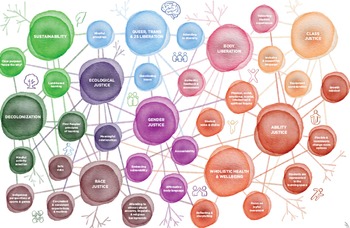
As shown in Figure 1 below, for us, a rhizomic assemblage of relations is a decentralised pedagogical mapping of various nonhierarchical (relational) factors that contribute to a sense of belonging in PE. The larger nodes (circles) in Figure 1 show broader sites of interest for social and ecological justice and the smaller nodes show the diverse (teaching and learning) practices as relationally co-implicated within these broader sites. All these nodes materially/discursively intraact through what Deleuze and Guattari (Reference Deleuze and Guattari1987) called ‘lines of flight’. That is, how relational networks affect and are affected (Fox & Alldred, Reference Fox and Alldred2015), bringing attention to the generative significance of relations (Hughes & Lury, Reference Hughes and Lury2013, p. 790) and the connections/divisions and the sameness/differences between relationships (Haraway, Reference Haraway1988).
Pedagogies for a sense of belonging in physical education (graphic design by M. Dagh).

We offer this rhizomic mapping as a contribution to disrupt the status-quo in PE, yet, enacting a knowing/being/thinking/doing between, and across, borders, boundaries, categories, fields and practices, our broader goals are towards a (re)visioning of curriculum policy. To provide an example of this (re)visioning, we home in on the ecological justice and decolonisation nodes in Figure 1, opening us to an exploration of the PE/environmental education nexus that, for us, is conceptualised as a transdisciplinary approach to curriculum.
Transdisciplinary Approaches to Curriculum
Discipline divisions, in which subjects of inquiry are siloed and discrete, are rooted in Aristotelian philosophy and motivated by the idea that separating knowledge is a more efficient way of learning in its systematic attention to progressive mastery of skills. In contrast, interdisciplinary approaches to curriculum stem from Platonian ideals of unity as the highest good in all logic (Jacobs, Reference Jacobs1989). In our own teaching practices, we were well-accustomed to language and approaches such as ‘crossdisciplinary’ (viewing one discipline from the perspective of another, e.g., the physics/biomechanics of movement in PE), ‘interdisciplinary’ (linking knowledges across fields in applying methodology and language from more than one discipline to examine a central theme, issue, problem, topic or experience) and ‘multidisciplinary’ (several disciplines focused on one problem without integration) (Jacobs, Reference Jacobs1989). Yet, transdisciplinary was not something as common within broader discourses of our teaching practices.
Transdisciplinary approaches start with a problem and seek to make sense of the problem with/through knowledges from different disciplines. Yet, they do not merely draw from an array of disciplines and institutions of knowledge (as taken up through interdisciplinary approaches) (Barad, Reference Barad2007). Rather, transdisciplinary seeks to link disciplines through the grounded, lived, embodied and embedded account of the individual in making connections between and across practices. As such, transdisciplinary approaches emphasise individual subjectivities in relation to the composite material/discursivities of human/Earth relationships. Moving away from acquiring knowledge ‘out there’ through purely discursive (social and cultural) ways of knowing, transdisciplinary approaches enact a rhizomic embrace of contextual diversity in that they account for high degrees of hybridisation. This hybridisation does not blur, or dilute boundaries between curriculum areas but connects and overlaps each field within a horizontal relationship.
In this way, transdisciplinary approaches deterritorialise habits of thought within ‘normalising’ sociocultural protocols of education (i.e. grand narratives housed within discursive structures of what counts as important knowledge). De-territorialisation, according to Deleuze and Guattari (Reference Deleuze and Guattari1987), ‘is the movement by which “one” leaves the territory…carried off by other types of assemblages to form new assemblages’ (pp. 508–509). An example of deterritorialising is to enact certain types of teaching practices that break away from imposed order and create new worlds comprising different types and forms of teaching practices. It is also important to keep in mind that these new ideals might be later rejected/challenged/disrupted through a dynamic, ongoing, continual and reiterative unfolding of new lines of flight (affects) working to further territorialise/de-territorialise/reterritorialise new worlds. Through the immanence of deterritorialising in transdisciplinary approaches, therefore, we open to an ensemble of heterogeneous learners through processes of interconnectivity, in which we can all collaborate on the same project and problem (Tinnell, Reference Tinnell2012). In the following discussions, we provide two vignettes, demonstrating how theoretical underpinnings of transdisciplinary approaches to curriculum underpinned our teaching and learning practices.
Vignette One: An Experimental Teaching Journey
We live in times of the obesity epidemic, technology addiction, food addiction, excessive screen time, increased rates of heart disease, mental health issues, racial vilification, gender norms, social and emotional vulnerability, social unrest, polarised political views, urbanisation, helicopter parenting, ecological destruction, ecological degradation, ecological fragmentation, extreme weather patterns, intensifying wild/bush fires, rising sea levels, increased plastic production and waste, excessive soil erosion, invasive species colonising Indigenous flora and fauna, hyper volatile markets, pandemics – and more. These are the wicked problems that implicate global social and ecological disarray.
While I was timetabled to teach a PE this past year, I sought ways to transcend disciplinary boundaries through actualising a PE/environmental education nexus. Moving beyond disciplinary and discursively oriented content, I was not interested in taking up some aspects of environmental education in a PE curriculum context; nor was I interested in taking up some aspects of PE (e.g. movement pedagogies) in an environmental education curriculum context (e.g. outdoor learning, Place-based education [PBE], Land education). This situates teaching methods within an interdisciplinary approach, in which the unit of inquiry turns to content disseminated by the teacher and acquired by the learner. Rather, exploring burgeoning issues of urbanisation implicating a sense of ‘Nature-relatedness’ in our class, I experimented with the lively, vibrant materiality of affect in sense-making from my grounded, lived, embodied and embedded (micro) politics of location as a White Settler to Saskatchewan. Commenting on how learners in our class related with the topic at hand is outside of the scope of this article, but below, I offer an account of how I transformed with/through intraactions with ‘Other’.
Grade 7 students and I headed out on cross-country skis, exploring the urban park opposite our school. This presented a relevant and meaningful opportunity to explain social and ecological issues associated with increasing urbanisation of our city, and how this worked to encroach on ‘wild spaces’. To begin, we discussed the term urbanisation and what this meant for the destruction, degradation and fragmentation of habitats displacing many animals within the city. We then discussed some alarming statistics of urbanisation that demonstrated how global urban populations overtook rural populations in 2008 (United Nations, 2018). This prompted discussions exploring population increases, preferences for suburban living to get a more ‘country vibe’, and corporate development exploits as set within capitalist agendas. Finally, we discussed why access to wild spaces was important for health and wellbeing, with many students stating that it improved people’s mental health (I couldn’t have agreed more).
Once on the skis, we slowly traversed the park to the small forest boundary on the opposite side. Distributing disposable cameras to groups of students, they were to take photographs that depicted human/Earth relationships from their entangled body/camera and ‘posthuman lens’. The intentions of this was to facilitate a material/affective sense-making with the world, in which students could engage an embodied understanding of the wicked problem relating to urbanisation. That is, through theorising and living with/through the problem (in that we were situated within the midst of encroaching urbanisation in this park), we were provided with opportunities to notice how our bodies might be pulled to action within ethics of obligation to live in more response-able ways.
Sitting amongst bright white snow drifts, to the East and noticed a soft lemon glow in the late January horizon. Trails of wispy cirrus clouds swirled the high sky. To the South, a bright red truck (ute) was parked next to a row of newly constructed townhomes with advertisements for roofing and flooring companies lining the neatly arranged plots of land. To the West, was a grove of green and blue spruce trees, reminding me of Christmas stories. And to the North, Grade 7s were throwing snowballs at each other (against school policy), while trying to capture a moving flight of snow with their cameras. As only a few examples, this multisensory embodied encounter offered a glimpse of the contrasting, contradicting and conflicting material/discursivities in which I dwelled. Moving between the hyphen of wild/domestic, fleshy, vibrant and lively bodies were materially/discursively entangled with camera technologies, −30° temperatures, snowdrifts and spruce trees, cross-country skis and poles, lemon-tinged skies, a red truck, manicured houses and capitalist advertisements set in colonial dis/euphoria. And, of course, I shouldn't forget discursive forces within dominant discourses of PE that inevitably prompted one disgruntled student to state, ‘But all this learning about urbanisation is not phys. ed…’.
Vignette Two: Response-able Practices within a PE/EE Nexus
In this vignette, I explore how I learned-with, and through, a Covid-19 pandemic/PE/PBE/Land education assemblage, taking new lines of flight in teaching and learning practices to implement the ‘Circle of Courage’Footnote 6 (Brendtro, Brokenleg & Van Bockern, Reference Brendtro, Brokenleg and Van Bockern2005) for Grade 4 children.
During the COVID-19 pandemic, as outdoor learning was championed through diverse global arguments suggesting it was safer for classes to learn outside (Green Schoolyards America, 2021), I saw this as an entry point for positioning PE within social and ecological justice education. Learning from how physical activity had helped me foster affirmative relationships with myself, others and the environment, I sought to develop the same for our Grade 4 class as initiated through the ‘Circle of Courage’. Through this time, I have garnered anecdotal evidence suggesting that the ‘Circle of Courage’ strengthened Grade 4 learner’s community connectedness, resilience within mental, physical and spiritual wellness, and shared sense of belonging and inclusion within our class. By taking learning outside, students and adults alike benefited from being more physically active during the school day, resulting in an eager anticipation for increased outdoor learning. Moreover, given several students with various learning challenges, manifesting in more disruptive behaviours in a traditional classroom environment, outdoor learning provided a platform for these students to take on leadership roles within the learning project. While these factors are crucial within (physical) educational equity, liberation and justice, what is relevant in the context of this article, however, is how the ‘Circle of Courage’ provided ontological and philosophical shifts within a PE/environmental education nexus. Expanding on pragmatic discourses of outdoor learning to take up an anti-colonialFootnote 7 project of teaching on, and with, Land, my hope is that we can contribute to advancing Truth and Reconciliation in Saskatchewan and Canada.
Rooted in Indigenous Knowing/Being, the interconnected aspects of the ‘Circle of Courage’ include, ‘belonging’ (always imminent through pregiven understandings of animist Land and inherent and intrinsic human/Land reciprocal relationships), ‘mastery’ (the dynamic, messy and nonlinear nature of learning, in remaining open to vulnerability, change, growth and adaptation), ‘independence’ (the paradox of building relational trust and connection to cultivate a sense of individual empowerment) and ‘generosity’ (accountability, responsibility and context specific obligations to enact good relations). While aspects of the ‘Circle of Courage’ work in conjunction to maintain the integrity of wholism, I applied a more robust focus on the ‘belonging’ piece with our Grade 4 class. This was for two interrelated reasons. First, given that Indigenous Knowing/Being attunes with animist Land and is set within inherent and intrinsic human/Land reciprocal relationships, I was focused on deconstructing the colonial worldview that sets humans as separate and detached from Land (while also assuming access to Land and simultaneously eclipsing Indigenous Knowing/Being). Second, moving PBE forward through an emphasis upon IndigeneityFootnote 8 that troubles educational forms of settler colonialism (Calderon, Reference Calderon2014; Tuck, McCoy & McKenzie, Reference Tuck, McCoy and McKenzie2014), I sought to recentre Indigenous Knowing/Being in bringing attention to the Indigenous position that knowledge is an emergent property of life systems and environments, and not just something centred wholly within human construction (Wildcat, Reference Wildcat2005). Yet, crucially as a White Settler to Saskatchewan, it was important I understood ethical positions in avoiding the appropriation of Indigenous Knowing/Being and/or tokenistic gestures of inclusion in my teaching practicesFootnote 9 . In doing so, a human/Earth (re)configuring was grounded in a postqualitative/‘new’ materialist knowing/being/thinking/doing between, and across, borders, boundaries, categories, fields and practices; enacting a radical relationality that brings relationships between categories into sharp focus, while also serving as an anti-colonial practice against the colonial erasure and dispossession of Land and culture.
Enacting a PE/PBE/Land education assemblage through the ‘Circle of Courage’, afforded me important opportunities to deconstruct the colonial project and deconstruct dominant narratives in PE through fostering inclusive movement opportunities for children with Land. Yet through this assemblage, I also changed and transformed as a teacher of PE. Embodying the idea that learning occurs through moment-to-moment intraactions with the world, as something dynamic, wild and primordial, challenges the dominant model of learning within siloed and discrete disciplines of inquiry. For example, learning with/through the differentiated/entangled relationships of our Grade 4 class, I was reflexively able to explore how my sense of self as a proficient mover, with a strong sense of belonging in physical activity contexts, might be positioned against students who identified as less proficient. This brings to light pervasive athletic/nonathletic binaries in PE discourses. This privileged position has afforded many rich sensory encounters in relationship to myself, others and the broader environment, in that it has provided me with confidence and competence to be physically active across a range of contexts (including land, water, snow). Understanding that children and youth are not always afforded inclusive movement opportunities during the school day, I’m called to action in generating affirmative spaces for physical activity, so that children and youth have opportunities to cultivate a sense of belonging in, and through, physical activity.
Towards a (Re)Visioning of Curriculum Policy
As sense-making in transdisciplinary approaches to curriculum is derived from the grounded, lived, embodied and embedded (micro) politics of location of teachers and learners, as materially and discursively entangled within broader ecologies of the world, we depart from the idea that curriculum policy is an abstract, absent and distant force for teachers to adhere to. Rather, it acts as one of the vital threads entangled in worldmaking. In this way, teaching practices are not only about the ubiquitous role of curriculum policy done to teachers, but are a multimodal and polyvocal enactment, in that curriculum policy is taken up as another material/discursive force in worldly intraactions.
Approaching curriculum policy through its material/discursivities does not disassociate from, or transcend assumptions, practices and outcomes taken for granted in PE or environmental education (e.g. wicked problems associated with obesity and climate change). Nor does it act against the disciplinary and oppressive elements of these fields, examining how, or what might be silenced, hidden and/or constrained in the fields (e.g. the salience of sport/fitness discourse in PE and mechanistic/technicist scientific discourse in environmental education). That is, curriculum is not held as superior in suggesting that it transcends the grounded issues in these fields relating to social and ecological equity, justice and liberation. In the same way, curriculum is not critiqued as deficit in identifying how it fails to account for polyvocal stories in physical and environmental education. These examples are set within discursive narratives of what curriculum should and should not look like. Rather, in bringing commensurate attention to curriculum policy’s materiality taken up through teacher and learner (micro) politics of location, means to consider how individuals at their subjective level might be relationally (re)configured with/through practices.
Crucially, attention to these (micro) politics of location means that different obligations exist within this relational milieu. Here we are following the cue from Liboiron (Reference Liboiron2021), in that obligations do not mean that because relationships exist that we are accountable to them through specific actions, but ‘that things [worlds] are constituted by these relations’ (p. 121). For us, as two teachers of PE, therefore, establishing a sense of belonging for all learners is not something we can ‘inject’ into our teaching practices. Rather, it is attuning to how we are pulled into action through affective obligations moment-to-moment; not through choice to respond, but given the innate and inherent interconnection with the world, a sense of belonging is always immanent, invented and created in any time/space/mattering. This means remaining attentive, vigilant and open to how we might explore wicked problems through collaborating with problems, through a radical relationality that exists between, and across, borders, boundaries, categories, fields and practices. For us, this is not only a focus on ‘what to learn’ (i.e. this assumes a representational and identifiable existence of something to know about), but ‘why’ we need to learn something, as set within our situated obligations to enact good relations with ourselves, each other and wider planetary systems.
Acknowledgements
Writing from Treaty 6 Territory, the traditional Indigenous territory of the Cree, Dakota, Dené, Lakota, Métis and Saulteaux, we pay our deepest respects to the many First Nations, Métis and Inuit peoples whose footsteps have marked these lands for generations. We give thanks to the Elders and Knowledge Keepers, those with us today, and those who are no longer with us, for their stewardship and teachings. And may we all continue to walk together towards Truth and Reconciliation.
Financial Support
This research received no specific grant from any funding agency, commercial, or not-for-profit sectors.
Conflicts of Interest
None.
Kathryn (pronouns: she/her/hers) is a Postdoctoral Fellow in the School of Public Health at the University of Saskatchewan, exploring physical literacy as taken up through Indigenous games, activities, cultural connections, and traditional teachings. Kathryn completed a B.A. in Education and a B.A. in Sport and Outdoor Recreation at Monash University in 2007. She then completed her Masters research through Deakin University in 2014. In 2019, Kathryn obtained a Ph.D. through Deakin University, conducting her research within the Saskatchewan-based education system, exploring new and different ways to (re)story human/nonhuman relationships for/in these Anthropocene times. Kathryn’s research is focused on anti-colonial theories/practice in education and posthumanist/new materialist scholarship that examines material (matter) and discursive (social) entanglements.
Lynden Proctor (pronouns: he/him/his) is an educator with Saskatoon Public Schools where he’s worked as both a French immersion classroom teacher and Physical Education specialist. He currently teaches K-8 Physical Education at W.P. Bate Community School in Saskatoon, Saskatchewan. Lynden completed his B.Ed. in 2015 and his M.Ed. in 2021 from the University of Saskatchewan. During his Master’s in Educational Administration Program, Lynden explored and further developed his passion for better understanding and designing educational structures that support the wholistic well-being of students and teachers in Saskatchewan. Lynden currently sits on the Board of Directors for PHE Saskatchewan, where he continues to work towards promoting and supporting responsive practices in Physical Education, so that young people across Saskatchewan can develop their confidence and competence to becoming life-long movers.