In August 1921, Chief Inspector De Vogel of the Burgerlijke Geneeskundige Dienst (Civil Health Department) of the Netherlands Indies, visited the prison island of Nusakambangan, just off the southern coast of Central Java. This island contained five prisons with approximately 3,200 convicts who were put to work in rubber plantations and stone quarries. De Vogel was alarmed by what he saw. In a scathing report to the Governor-General of the Netherlands Indies, De Vogel lamented the terrible hygiene and the poor state of the facilities. He complained that, despite earlier warnings, the Department of Burgerlijke Openbare Werken (Civil Public Works), which was responsible for the renovation of buildings, had failed to improve the facilities and to better the living conditions of the prisoners. This resulted in an extraordinarily high death rate of 12.3 per cent per year, with a monthly maximum of 35.4 per cent per year in March 1920. Inmates suffered from ulcers, skin diseases, tuberculosis and malaria, and a quarter of the population had tried to escape in 1921.Footnote 1 For doctor De Vogel it was clear that the high death rate was not a reflection of the poor health of prisoners when they arrived on the island—as the Justice Department argued—but was caused by a deadly combination of hard labour in the rubber plantations and the deplorable state of housing and sanitation.Footnote 2
Nusakambangan is historically one of Indonesia's three most notorious prison sites.Footnote 3 Yet, De Vogel's description of its harsh living conditions makes us acutely aware of how little we know about life and labour in this penal institution in late colonial Netherlands Indies. While the other two infamous prisons in Indonesian history—Upper Digul in New Guinea between 1927 and 1942, and the island of Buru in the Moluccas between 1969 and 1979—have been the subject of political contention and historical research, Nusakambangan still awaits thorough investigation. This article not only aims to fill this lacuna but also to contextualise the island in three respects.Footnote 4 In the first place it situates the prison island within the larger penal system of the Netherlands Indies. As we will see, Nusakambangan was at the apex of the colonial penal pyramid, more so than, for instance, Upper Digul. Secondly, this article takes a labour perspective and relates working conditions and labour relations in Nusakambangan to those in privately-owned non-prison plantations in the Netherlands Indies. In this way, the article attempts not only to revive a decades-long scholarly debate about the role of the Dutch colonial state in managing labour conditions in the Netherlands Indies after the abolition of the Cultivation System and the advent of a privately owned plantation industry. It also links up to international scholarly literature about the interrelation between convict labour and other coercive labour systems. Finally, Nusakambangan will be contextualised by focusing on the prisoners’ social behaviour and survival strategies. We will see that accommodating, negotiating, resisting and escaping prisoners made Nusakambangan a regional social contact zone, rather than an island of isolation.
Historiography
Although there is some literature about early nineteenth-century penal transportation in the Indonesian archipelago,Footnote 5 research into the penal system of the Netherlands Indies in the late colonial period is limited to a handful of articles about Upper Digul.Footnote 6 This infamous Dutch ‘concentration camp’ in New Guinea, where communists (and later, nationalists) underwent administrative detention following the failed communist revolts of 1926–27, was not representative of the Indies penal system as a whole. The regime in this camp for intellectuals and political prisoners was much milder than the regime for regular convicts. The Digulists were not forced to work, received monthly food rations, and were allowed to walk around undisturbed. The ‘only’ restraint was the complete isolation of the camp in the immense rainforests of New Guinea, the numbing boredom of everyday life, and the debilitating malaria-ridden climate. Consequently, scholars have regarded Upper Digul mainly as a model camp, a propagandistic project, and a prism through which the perverted ‘normalcy’ of repression in the late colonial state could be interpreted.Footnote 7 The only monograph about the late colonial penitentiary system is by Christien Bruinink-Darlang, which looks at penal developments from a legal and administrative perspective, with one chapter devoted to Nusakambangan.Footnote 8 While rich in detail, this study does not go beyond a positivist discussion of policy debates, leaving out the prisoner experiences. Apart from this work, there are no recent studies about prisons in the Indies in general or colonial Nusakambangan in particular.Footnote 9
This article is inspired instead by the international literature repositioning single-prison histories and individual prisoner's experiences within wider interpretative frames. First, in 2001, Peter Zinoman published an integrated history of the penal system of French Indochina between 1862 and 1940.Footnote 10 In an attempt to explain the decisive influence of the penal experience for the first generations of Indochinese anticolonial activists he emphasised the large variation in prisons and penal sites, depending on their location, position in the penal hierarchy and institutional origin. His notion of the ‘ill-disciplined prison’ is important. According to Zinoman, Indochinese prisons were not ‘laboratories of modernity’ in the Foucauldian sense, but rather old-fashioned, organically developed and chaotic institutions, dominated by brutality and disorganisation. The Indochinese penal system was built on the remnants of pre-existing Sino-Vietnamese carceral traditions and French POW camps, was always short of money and lacked political priority. This resulted in the creation of a ‘hybrid prison system’ in which ‘disciplinary practices were overshadowed by a host of ill-disciplined and exclusively repressive methods of coercion and control’.Footnote 11 Zinoman's observations not only lead us to step away from an exclusively modernist analysis of Nusakambangan's position and function in the larger Indies penal system, but also to focus on the actual lives of prisoners and guards on the island.
Secondly, several ‘New Imperial History’ scholars have tried to break away from the traditional focus on single colonies or from the dual relationship between one colony and its coloniser.Footnote 12 This trend also influenced convict studies.Footnote 13 In 2012 for instance, Clare Anderson published Subaltern lives in which she interprets the British colonial empire around the Indian Ocean as one geographic space through which at least 300,000 convicts were moved around. As such, she regards penal transportation as a ‘geographically networked social process’, and as ‘a part of a larger colonial repertoire of discipline, punishment and work’.Footnote 14 Anderson applies a biographical approach describing (fragments of) the lives and capricious penal careers of individual convicts. Although Nusakambangan does not offer enough archival material for a similar life-writing approach, many of Anderson's conclusions about the trans-imperial traffic of convicts are also insightful for the Indies penal system and Nusakambangan in particular. Obviously, the Dutch Empire of the twentieth century was much less widespread than the British Empire, but because of its size and uneven history of colonisation the Netherlands Indies archipelago may be regarded as an empire in itself, through which convicts and guards were moved around. Moreover, with Anderson's descriptions of individual convict experiences in mind, we learn from a focused analysis of Nusakambangan that the penal experience was as much about transportation, the forging of group identities and corruption as it was about incarceration, isolation and discipline.
Finally, several scholars have emphasised the entwined histories of convict labour, indentured labour, slave labour and other coercive labour systems. These systems not only followed each other diachronically, but also supplemented and inspired each other synchronically. In ‘Convicts and coolies: Rethinking indentured labour in the nineteenth century’ Clare Anderson demonstrates how the development of Indian indentured migration and incarceration was informed by innovations in the transportation of convicts to penal settlements.Footnote 15 In the same year, Taylor C. Sherman introduced the notion of a ‘coercive network’ of the colonial state, in which the criminal justice system, indentured labour system and other forms of colonial punishment and discipline were interconnected and made use of the same mechanisms of transportation, control and exploitation.Footnote 16 More recently. this interconnection was also observed in the context of British India and British East Africa.Footnote 17
With regards to the Netherlands Indies, this idea that penal labour was part of a larger set of interrelated coercive labour relations is not entirely new, and was part of a heated scholarly discussion in the second half of the 1980s. In this period Jan Breman and Ann Laura Stoler began to write about the harsh labour conditions, the mechanisms of control and the survival strategies of workers on plantations in Deli, northern Sumatra. The composition of the Deli labour force changed considerably over time—from local recruitment of wage labour in the initial stage, to imported indentured labourers from 1870 to the emergence of a local reservoir of ‘free labour’ in the 1930s—but Breman and Stoler emphasised the continued reality of coercion and violence that the labourers had to endure.Footnote 18 As Breman argued in 1987 in his monumental book Koelies, planters en koloniale politiek, the circumstances under which convict labourers lived and worked did not differ much from the situation of indentured labourers on the Deli plantations.Footnote 19
A central issue in this debate was the role of the colonial state. While Breman and Stoler showed scepticism towards colonial state interventions, other scholars, such as A. Kamphues, Vincent Houben and Thomas Lindblad, used Labour Inspectorate (Arbeidsinspectie) reports and government statistics to show that health conditions, mortality rates, numbers of desertions and other indicators of well-being did improve in the course of the twentieth century. They stressed the idea that ‘the colonial state’ was not only geared towards promoting the interests of planters, but also played a mediating role between planters, contract labourers and the state itself, and effectively intervened in the maltreatment of labourers in Deli.Footnote 20 The island of Nusakambangan is an interesting case in point. On the one hand, the similarities between this island and plantations in Deli were striking. Both labour regimes were grounded in the same colonial tradition of labour mobilisation and coercion, and made use of similar mechanisms of categorisation and control, routes of transportation and methods of economic exploitation. But there were also important differences. While the colonial state, in the form of the Labour Inspectorate, struggled to gain a mediating position between planters and indentured labourers in Deli, and operated from a vulnerable financial, personal and institutional position, the state itself was in charge of the prisons on Nusakambangan and had a direct influence on its labour conditions. Secondly, while economic fluctuations, with crises in 1920–22 and 1930–32, determined to a large extent the living conditions in Deli, colonial prisons were less directly affected by economic fluctuations. Finally, while the planters were under growing political pressure to improve living conditions for indentured labourers in Deli, the prison authorities had to cope with continuing criticism from the conservative right to apply a harsh regime of punishment on Nusakambangan. In other words, while Kamphues and Houben assign a benevolent role to the state and the Labour Inspectorate in particular in improving labour conditions in Deli, prison administration and intervening authorities such as Chief Inspector De Vogel of the Burgerlijke Geneeskundige Dienst hardly influenced life and labour conditions in the ‘ill-disciplined’ prison island of Nusakambangan.
Nusakambangan in the Indies penal system
The island of Nusakambangan, roughly 120 square kilometres in size, forms a natural coastal barrier for its low-lying Javanese hinterland. Its high cliffs provided a good vantage point for military fortifications and a lighthouse, and the estuary between the island and Java was the only natural seaport on Java's southern coast. The harbour town of Cilacap with around 13,000 inhabitants was located across the water. In 1905, the Resident of Banyumas, the highest-ranking European official of the district, suggested the island as a solution for the severely overcrowded prisons in his residency. The island was densely forested and only inhabited by a few dozen Javanese families. Moreover, strong currents in the estuary would prevent escape. Together with officials from the Department of Justice, the resident initiated a large-scale cultivation project in which prisoners would be instructed to clear and develop parts of the largely inaccessible island.Footnote 21
The establishment of prison camps on Nusakambangan was related to two partly interconnected phenomena, namely the penal reforms between 1903 and 1908 and the large number of Acehnese prisoners of war in Javanese prisons. With regard to the former development, the turn of the century saw a shift from local extramural labour to intramural production in regional prison workshops.Footnote 22 From the early modern period onwards, most Asian offenders were sentenced to perform labour in local ‘public works’, which included the construction and maintenance of infrastructure and government buildings, and garbage collection. People convicted to longer sentences were sent to the Ombilin Coal Mines in Sumatra or used as carriers in military expeditions. The labour performed by these prisoners was unpaid in a double sense. The convicts did not receive payment for their labour, and the Department of Justice received no compensation for the labour force they provided to other governmental departments. For the Department of Justice, this led to two undesirable outcomes. Not only was the supervision of the local convicts insufficiently organised with many convicts ‘mooching about’, but the other departments also wasted invaluable labour as there was no incentive to organise the work more efficiently.Footnote 23
Therefore, in August 1905, the Director of Justice proposed to charge the other departments a small sum per convict labourer per day, the so-called regularisatiegelden (regularisation fees), to make them aware of the value of labour. This budgetary tool would imply that the Department of Civil Public Works would have to pay between 40 and 50 cents per convict per day for the maintenance of a building or road to the Department of Justice, for which the former would receive a budget from the Department of Finance.Footnote 24 This made convict labourers more expensive than indentured labourers in Deli, but the sum included the provision of housing and food by the penal authorities.Footnote 25 A second measure to make the labour of convicts more profitable was the establishment of large central prisons in regional centres, for convicts sentenced to forced labour for longer than one year, but who were unfit to work in coalmines and military expeditions. These prisoners were to be deployed in new workshops where shoes, uniforms, sails, books and other items were produced.Footnote 26 By shifting locally employed open-air convict labour into workshops in regional prisons, the authorities expected to increase productivity and revenues, to improve the resocialisation of convicts, and to counter the endemic overpopulation in local prisons.Footnote 27
There was, however, a large group of convicts for whom a separate solution had to be found: a few thousand Acehnese prisoners of war (POWs) who were detained in Javanese prisons. These fighters were captured during the lengthy war of the colonial state against the Sultanate of Aceh in Sumatra, between 1873 and 1914. They could neither be detained in facilities on Sumatra itself, because the authorities feared escape and liberation attempts by outsiders, nor in prisons on other peripheral islands in the archipelago, because the local authorities in these regions were unwilling and ill-equipped to supervise and control large groups of experienced fighters. Consequently, the Acehnese POWs, who often had received terms of twenty years or more, ended up in the city jails of Java, which were in a state of decay and often severely overcrowded. These Acehnese groups, who spoke their own language, soon gained the reputation of being extremely rebellious and unwilling to work.Footnote 28
As a solution to this ‘problem’, Nusakambangan was found to be a suitable location. In 1906, a first group of 200 Acehnese prisoners arrived on the island from Glodok, the central prison in Batavia, followed by 300 more from the Surabaya city jail. Although the Resident of Banyumas soon began to complain about the defiant behaviour of the Acehnese and their unwillingness to work, his objections were overruled by higher officials in the Department of Justice and the office of the Governor-General.Footnote 29 In 1908, 600 Acehnese prisoners were detained on the island, and their number would rise to a 1,000 in 1913. Although official figures are incomplete, it seems that the Acehnese presence on Nusakambangan lasted at least until the end of the 1920s.
As such, the Acehnese were the first category of prisoners who were detained en masse on Nusakambangan, followed by other groups that because of their size or rebellious reputation were difficult to detain in the regional prisons.Footnote 30 After 1905, more than two thousand Buginese and Toraja prisoners were transported to Nusakambangan following a military expedition in South Sulawesi.Footnote 31 The 1908 anti-tax rebellion of Minangkabau peasants on the west coast of Sumatra was probably the reason for the sizeable group of more than five hundred ‘West-Sumatrans’ in the statistics of 1913.Footnote 32 A final example are the eight hundred communists who were transported to the island in the aftermath of the failed communist uprising of November 1926. They would stay on the island at least until 1932.Footnote 33
This mass detention of rebels from various parts of the archipelago is similar to what the Indian historian Anand Yang described with regards to the Indian rebellion of 1857–58 when the colonial government in British India suddenly had to deal with huge numbers of mutineers and rebels, for whom they found no other solution than to send them to the Andaman Islands.Footnote 34 Furthermore, it illustrates—from the perspective of one location rather than through the lives of individual convicts as in Anderson's Subaltern lives—that Nusakambangan was also part of an intricate web of penality within the Asian half of the Dutch Empire. The fact that the Netherlands did not use large-scale penal exile as a device to settle its colonies in the same way as the British, French or Russians should not lead to the conclusion that mass penal transportation did not take place.Footnote 35
The prisoners of Nusakambangan were supposed to clear the forest for rubber plantations. Due to spectacular developments in the automobile industry, rubber prices increased steadily at the end of the nineteenth century, with prices doubling between 1902 and 1905.Footnote 36 Rubber production was highly successful in neighbouring British Malaya, and with the Acehnese War drawing to a close, the Dutch colonial authorities aspired to make North Sumatra, with a similar climate as the Malay Peninsula, a rubber-producing region as well. The training of former Acehnese rebels and others in the cultivation of rubber on Nusakambangan would enable them to earn a living as independent rubber cultivators or as contract labourers once they returned to their home regions.Footnote 37
Initially, the Department of Agriculture, Industry and Trades, which would provide foresters and other agricultural experts and was responsible for the production on the island, was not willing to pay the normal regularisation fee for rebellious Acehnese. This department considered the Acehnese prisoners of war too dangerous and uncooperative to make rubber production on the island profitable. In reaction, the Department of Justice offered the Department of Agriculture a discount for Acehnese prisoners, from the regular fl.0.40 to fl.0.10 per prisoner per day. For a group of Acehnese who had been deployed as carriers in a military expedition on Bali in 1906 the Department even offered a special price of fl.0.075 per man per day.Footnote 38 This turned the cultivation of rubber on Nusakambangan into a lucrative business for both departments. Between 1904 and 1927, the area under rubber cultivation increased from 30 to 929 hectares, and although global rubber prices fluctuated sharply as a consequence of the First World War and increasing production, the average yearly net revenue between 1914, the year that the first trees started producing, and 1927 was fl.28,726.Footnote 39
Over time, Nusakambangan grew to become the largest prison complex in the Indies with more than two thousand inmates in 1912, more than four thousand in 1929, and more than six thousand in 1938. Even though the island was designed as a special facility for rebellious prisoners and those who were incapable of skilled work, it was an intrinsic part of a much larger penal system, designed to better control and manage colonial prisoners and to make them profitable from an economic and social point of view. As such, the objective of Nusakambangan was different from the idea behind the establishment of Upper Digul, which was not intended to be profitable at all, but was an extreme form of social and political isolation from Indies society. In addition, the colonial state occupied a fundamentally different position in Nusakambangan as compared to the Deli plantations. While abuses of indentured labourers by the planters emerged in a situation in which the colonial state was—perhaps purposefully—absent, the same state designed Nusakambangan to make the penal system of the Netherlands Indies more effective and economically productive.
Classification and everyday negotiation
The arrival of large groups of prisoners from 1905 onwards made the rapid expansion of prison facilities on Nusakambangan necessary. Instead of building one large prison, the authorities decided to establish several camps on the island from where different areas of land could be cultivated. From the prison camps of Gladagan in the centre of the island and Karang Anjar in the west prisoners were deployed to clear forests, drain swamps, and to plant rubber trees. On the south coast, Permisan was established from where, especially after 1914, the penal colony was administered. Apart from large wooden barracks for prisoners and guards, this camp contained the residences of the director and the doctor, a makeshift hospital, isolation cells for offenders and a whipping post. Djumbleng, which was located north of Gladagan and close to the landing stage for the ferry to Cilacap, was the centre for the rubber processing on the island. It contained a factory, and several barns and sheds in which the latex collected was congealed into sheets, then smoked and dried. This camp also housed the factory's supervisors. In Gligir, a small camp just opposite Cilacap, prisoners were employed in the production of limestone, tiles and bricks. These settlements were separated by kilometres of dense forests, steep hills and deep ravines, and were connected by gravel roads only after 1926.
Several rounds of selection and classification determined where a newly arrived convict in Cilacap would end up, and what kind of labour he had to perform. We have to keep in mind that Nusakambangan itself was the result of colonial segregation along lines of race, class and gender. Women and Europeans were detained in two prisons in Semarang and would never be deported to Nusakambangan. The Indonesian nobility and priyayi elite was excluded from humiliating convict labour as well, under a privilegium fori. Consequently, the prison population on Nusakambangan was overwhelmingly male, with no female prisoners or guards, and predominantly pribumi Indonesian, with only a few Chinese Indonesian inmates.
Secondly, the prisoners were distributed over the camps according to their cultural background. Acehnese, for example, were sent to Karang Anjar and Gladagan, while Buginese were assigned to Permisan and Gladagan. The communist prisoners were detained in a special accommodation in Djumbleng for fear of their experience in organising resistance. The rationale behind this cultural and political subdivision were race theories concerning the national characters of the different peoples in the archipelago. According to this logic, Acehnese and Buginese did not get along well, while the right ratio of Javanese and Acehnese prisoners produced the best results. These racial notions, which we recognise from the labour situation in Deli, also determined the number of guards that supervised each group. According to the prison authorities, the Acehnese prisoners required twice as many armed guards as Javanese prisoners. From a supervisor's perspective it made sense to separate the prisoners according to their cultural background.Footnote 40
In this culturally segregated prison society, the guards formed a group of their own. The officials and chief wardens were Dutchmen who had often been in the colonial army or worked elsewhere in the Indies penal system. But the rank and file prison guards, who accompanied the prisoners in the plantations and performed most of the direct tasks of supervision and punishment, were mainly Ambonese and Menadonese veterans from the Dutch colonial army. In the colonial psyche, Ambon and Menado were regarded as loyal regions that supported the Dutch colonial state, and the colonial army recruited many soldiers from these regions. Ironically, Indonesian soldiers serving in the Dutch colonial army and rebels fighting colonial rule would meet again as guards and prisoners in the colonial micro-society of Nusakambangan.
Finally, the prisoners were subdivided into four categories after a physical examination. The majority of convicts were assigned to category D and had to perform hard labour in the rubber plantations, limestone quarries and gardens. Category C prisoners, a much smaller group, were assigned to more specialised, trusted and often less physically demanding tasks such as carpentry. Category B was designed for sick or weakened prisoners who were temporarily unable to perform heavy duties and who were given light tasks in and around the camps. A few category A prisoners were deemed unfit for work due to age or physical conditions. In 1922, 66 per cent of the prisoners belonged to category D and 26 per cent to category C. Only 8 and 0.5 per cent of the prisoners were categorised in groups B and A, respectively.Footnote 41
This multi-stage selection process determined to a large extent the prison experience of individuals and groups and their chances of survival in Nusakambangan. The last round of categorisation in particular allowed for a considerable variety of personal experiences and an everyday negotiation of duties, privileges, autonomy and control between prisoners and guards. This negotiation did not only take place during working hours, when the prisoners were struggling to avoid exhaustion and danger, but also in the evenings when the labourers were allowed to rest. This personal dimension under generally coercive circumstances is an aspect that is recognised in recent studies of oppressive labour regimes, but is taken insufficiently seriously by scholars of the Deli plantations.Footnote 42 Based largely on plantation level or official regional records and information, these studies are unable to provide insights into the social aspects of the labourers’ lives on the plantations.
Working and dying on Nusakambangan
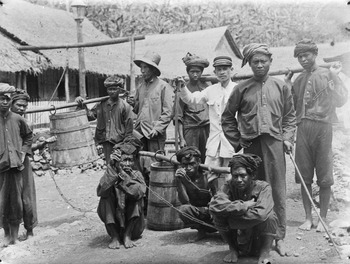
A regular working day on Nusakambangan was not very different from a day on a rubber plantation in Deli. Starting at 5.45 am with a roll call, the working day lasted roughly nine hours, including walking to and from the work site.Footnote 43 The prisoners were divided into groups of 25 persons, with one foreman (kepala or voorman) selected from their midst. This foreman was allowed to carry a stick and was recognisable by an armband with the letter ‘V’. The group was guarded by two mandoers (overseers) who were armed with a revolver and a sabre. The prisoners had to wear brown uniforms, with the letter of their category painted on their chests, and they often wore no shoes. They were often chained when they walked to and from the camp and usually carried axes, billhooks and other equipment needed for the job (see fig. 1).Footnote 44
Convicts and guards, carrying buckets of latex. Collectie Stichting Nationaal Museum van Wereldculturen. Coll.nr. TM-10016323.

Apart from clearing the terrain and preparing the ground for new planting, the work included the maintenance of rubber trees and the collection of buckets of latex tapped from the trees. In general, the convict labourers had to meet a daily target. One squad of 25 loggers clearing the forest had to fell forty trees per day, and on the plantation workers had to harvest latex from at least fourteen rubber trees.Footnote 45 In a factory in the Djumbleng prison camp, category C prisoners congealed the latex, and smoked and dried the rubber sheets, after which they were shipped to Cilacap. Other tasks performed with prison labour included work within the prison camps themselves, the construction and the maintenance of buildings and roads, cultivating food crops, and digging up stones in a small quarry near Gligir.
Working in the hot and humid climate of Nusakambangan was physically exhausting, which resulted in many different illnesses and a high death rate. In the first months of its existence—a precarious period for plantations in Deli as well—between 10 and 20 per cent of the prisoners was temporarily unable to work because they suffered from ulcers, skin diseases or parasites.Footnote 46 Other common diseases were amoebic dysentery and malaria, which became endemic after the forest had been removed.Footnote 47 It is likely that the situation improved after the first years, but despite ethical intentions to resocialise prisoners through labour and to teach Acehnese how to cultivate rubber trees, the reality remained less ideal. Several commentators who visited the island, among whom was the Dutch socialist member of parliament Henri van Kol in 1911, who complained that the prison authorities were ill-equipped to socialise and educate the prisoners, and that the lack of qualified personnel encouraged the guards’ cruel behaviour. Van Kol argued that the prisoners had to work too hard, and that their clothing, personal hygiene and accommodation were far below standards.Footnote 48 Eleven years later, ‘Hs.’ in De Indische Courant argued along the same lines. According to him, the rehabilitation of prisoners could not be achieved as long as hundreds of men were locked up together—boys with older men, and petty criminals with dangerous murderers—and subjected to a harsh prison regime.Footnote 49
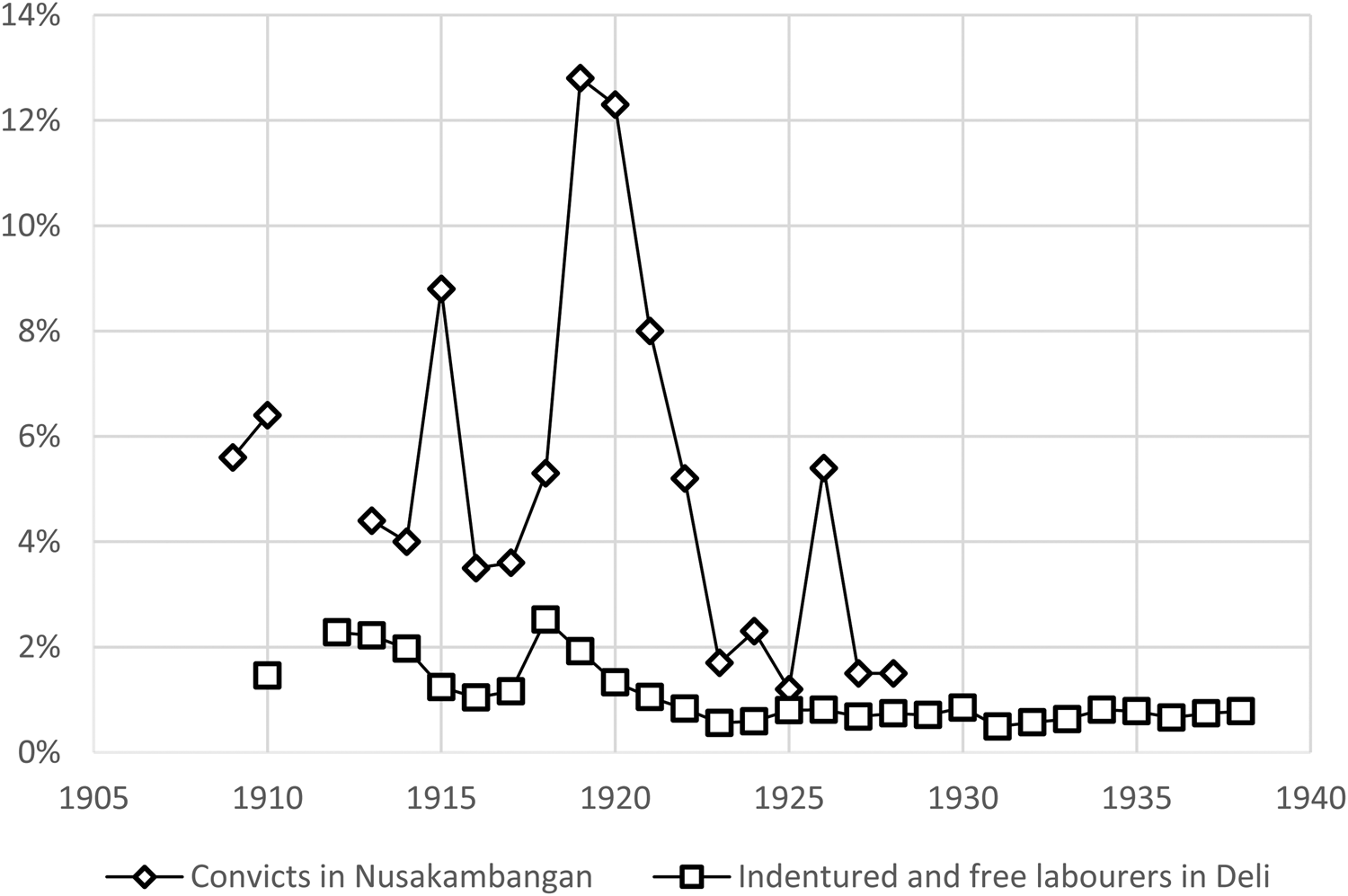
The mortality rate of prisoners in Nusakambangan ranged between 3.5 per cent and 6.4 per cent between 1909 and 1922, excluding the bad years of 1915 (8.8 per cent) and 1919–21 (8–13 per cent). After 1922, the death rate steadily declined to around 2 per cent, with rates of up to 5.4 per cent (1926) in bad years. Especially in the first decades, this rate was higher than the mortality rate among free and indentured labourers in Deli, which was between 0.5 per cent and 2.5 per cent throughout the first half of the twentieth century, and comparable to the mortality rate on rubber plantations in the Malay Peninsula (see fig. 2).Footnote 50
Mortality rate per year, Nusakambangan and Deli
Sources: Verslag van het gevangeniswezen over het jaar 1928: deel I (Pekalongan, 1929), p. 8; NL-HaNA, Koloniën / Openbaar Verbaal, 2.10.36.04, no. 2456, letter of Directeur van Justitie to the Gouverneur-Generaal, 30 Mar. 1906, p. 3; Lindblad, ‘Coolies in Deli’, in Houben and Lindblad, Coolie labour in colonial Indonesia, p. 75.

In relation to Deli, Kamphues argued that the mortality rate among free and indentured labourers was not significantly higher than the average rate among civilians on Java (2.3 per cent between 1910 and 1920) and even the Netherlands (1 per cent in 1920), to which Stoler replied that the population pyramid of Deli was incomparable to that of Java or the Netherlands.Footnote 51 For Nusakambangan it should be remembered that there were no instances of death during childbirth or child mortality, that prisoners were on average young, and that the mortality rate would have been higher when extrapolated to the average Javanese population. Moreover, the prisoners were involuntarily reliant on the care of the state and died from avoidable physical exhaustion. Chief Inspector De Vogel's negative report in August 1921 mentioned in the introduction is a strong indication that the living conditions on Nusakambangan were not considered as normal by contemporaries. The year 1920 was exceptionally bad, with a regional malaria epidemic that became worse on the island because of its swamps, but what angered De Vogel most was the fact that improvements promised years ago by the Bureau for Civil Public Works were never delivered. He added: ‘If similar circumstances had occurred on a private enterprise, this plantation would have been closed by the authorities immediately.’Footnote 52 Apparently, the colonial state, which had intervened to improve working conditions for indentured workers in Deli, was much less successful in keeping workers alive and healthy on its own plantations.
A prisoners’ point of view
How to survive under these difficult circumstances? From a prisoners’ point of view, it was important to arrange a marginally better position, without necessarily undertaking the radical act of challenging the authorities. Their ‘situational agency’ comprised, for instance, the competition for easier tasks and privileges among prisoners, which also increased the power of guards who could assign a prisoner to category C-jobs.Footnote 53 The latter jobs included working in the kitchens, pikoelen (transporting goods with a pole slung over a shoulder), rowing boats or driving cars, woodworking and working in crop fields. These jobs were not only less exhausting, but also allowed the prisoners to escape the guards’ surveillance and determine their work pace independently without daily targets. Privileged prisoners were, for example, allowed to leave the camp or the worksite without supervision to transport goods or deliver messages between the camps. Occasionally, category D and C prisoners worked alongside each other on different tasks, for example, as foremen in the rubber plantations, but also at the limestone quarry in Gligir. A Indische Courant journalist mentioned that category D prisoners had to dig up, cut and transport the limestone to a primitive lime kiln, while category C and B prisoners had to keep the fires going. ‘[This demonstrates that] the doctor [administering the physical examination] played a crucial role in the life of a prisoner.’Footnote 54 On the other hand, most of the category C jobs did not require very high skills, which increased the number of candidates for the tasks and weakened the category C-prisoners’ negotiating position.Footnote 55
The daily negotiation of privileges and duties, dignity and control between the prisoners and guards continued into the evenings and on Sunday, when prisoners were officially allowed to rest. Even though nights fall early in the tropics, and leave only a few hours of sunlight after a working day, they were crucial for the prisoners to improve their life. Prisoners not only used these hours to bathe and cook, but also managed to establish a marginal parallel economy. Prisoners were allowed to cultivate a small private garden to supplement the food rations and exchange food, such as cassava, bananas and sugarcane amongst themselves. Other prisoners herded goats and kept chickens, or sold handmade items. There was a trade in tailored brown uniforms and sarongs, made to Acehnese and other regional tastes. Also important was the trade of goods with smugglers, who came from the Javanese mainland by boat and hid in the forest. Prisoners provided clandestinely harvested latex balls in exchange for money, goods and even weapons. Part of the money was used to visit prostitutes who hid in the forest as well.Footnote 56
The guards were well aware of this parallel economy and clandestine trade. From 1911 onwards, prisoners were allowed to have only one set of clothes, which they had to wash and repair themselves, in an attempt to counter the illegal trade. The authorities also hunted smugglers and prostitutes in the forest and raided the barracks every now and then to search for illegal wares. On the other hand, it is likely that many guards were corrupt and turned a blind eye to prisoners leaving the camps at night in exchange for money and tranquillity. The ubiquity of corruption in the Indies’ penal system is not self-evident in governmental sources, but becomes visible in many articles in the Malay-language press about other prisons.Footnote 57 For the guards, corruption was not only an abuse of their power vis-à-vis prisoners, but also opened a new space for negotiation with prisoners, allowing or denying them to undertake illegal practices. Just as it was considered dangerous for the guards to be too rude and cruel, a certain degree of leniency with the rules was necessary to keep the prisoners under control.
This is, for example, visible in the attitude of outsiders with regards to prostitution on Nusakambangan. The presence of Javanese women on the island was mentioned by many commentators. Although most of the journalists considered it an undesirable fact and a sign of moral decay, it was often also seen as an inevitable side-effect of the long-term imprisonment of men without women. According to them, forced or voluntary sex between men, or between men and boys was much worse than small-scale prostitution. Despite ethical dreams about the resocialisation and moral rehabilitation of prisoners, the guards at Nusakambangan were not in a position to demand anything more than peace and tranquility.Footnote 58
Peace and tranquility were clearly not self-evident on Nusakambangan. Many contemporary journalists visiting the island mentioned a hostile atmosphere among groups of prisoners, and between the prisoners and the guards. The situation was highly explosive due to stress related to work, the climate and physical exhaustion. Moreover, many guards misused their power with rude behaviour, physical maltreatment and verbal abuse. Only the fear of prisoner retaliation and revolt kept them in check. Although the guards were armed, they always had to reckon with the fact that they were severely outnumbered in the field and that prisoners carried axes and billhooks. Between 1907 and 1927, no less than ten guards were killed in confrontation with angered prisoners.
The journalists often blamed the behaviour of the guards themselves when they were lynched. In 1923, an Indische Courant journalist quoted a forester who had years of experience on Nusakambangan that ‘in most of the cases it was the victim's own fault’.Footnote 59 In 1907, a Menadonese mandoer called a Acehnese foreman a monyet (monkey) and a binatang (animal) and forced him to follow orders at gunpoint. Twelve Acehnese workers did not accept this, seized the gun and killed the mandoer.Footnote 60 In 1929, a journalist recounted another incident when ‘an Acehnese on Nusakambangan had killed an Ambonese guard who had called the former a binatang and other names. The Acehnese swallowed the insults, probably because he figured that these words were endurable. But when the guard said: “nènnèk moe” [your grandmother] the prisoner was fed up and killed the man.’Footnote 61 These and other stories gained Nusakambangan's prisoners a notoriety, which helped them to defend a minimum of respect and dignity. On the other hand, as Breman remarked in relation to Deli, these stories about rude individual guards and short-tempered prisoners also helped to evade more fundamental questions concerning the labour and prison regime on Nusakambangan.Footnote 62
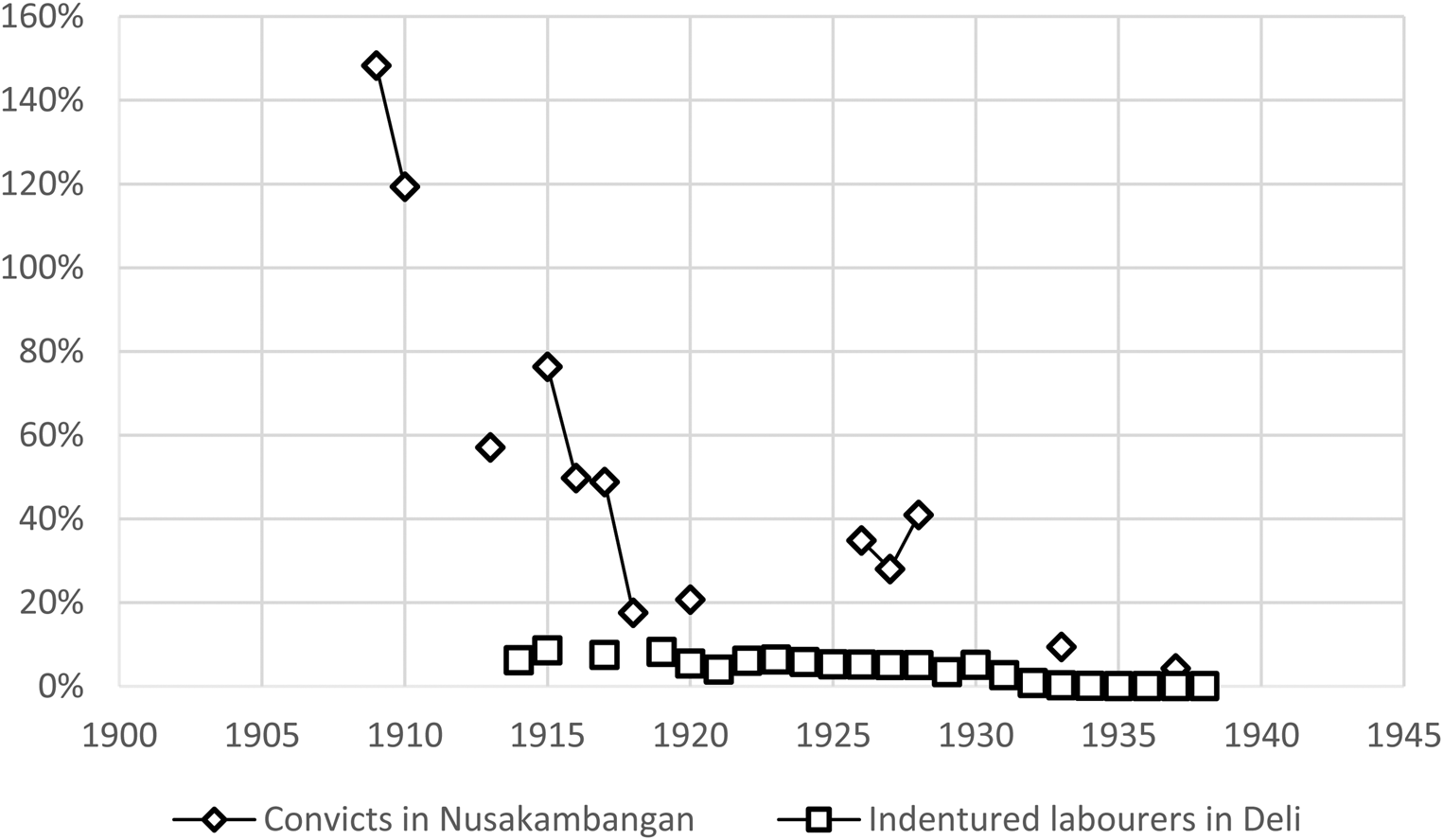
The revolts were not without consequences. On a collective level, the prison authorities relied on the assistance of the military garrison in Cilacap. Often, peace was only restored after military patrols marched through the camps. On an individual level, prisoners were punished for minor offences with the withdrawal of privileges such as smoking, the consumption of coffee or tea, or the right to have breaks. More serious offenders could be locked up in isolation for a maximum of three months in a cell of two by three metres, or were subject to flogging with an official maximum of 25 lashes. The latter punishment was used for prisoners who were found guilty of escaping or starting a riot. Flogging was common especially in the first years of Nusakambangan's existence as a prison island, with 314 cases in 1910 with a prison population of around 3,200, and 545 cases in 1916 with a population of around 5,400 (fig. 3). In the first two years of its existence, the number of punishments in Nusakambangan even exceeded the number of prisoners. In the 1930s, the number of recorded floggings diminished steadily, but remained in practice until the end of Dutch rule, with 17 cases in 1937.Footnote 63 These figures support the impression of Sherman and others that there was a disconnect between the rhetoric of imperial reform and the reality of continued coercion.Footnote 64
Number of punishments per year related to the total subjected population of the site.
Source: ‘Een Nederlandsch eiland voor dwangarbeiders’, De Hollandsche Revue 17, 1, 25 Jan. 1912), pp. 6–8; Statistiek van het gevangeniswezen in Nederlandsch-Indië over het jaar 1913, 1915–1918; 1926; 1927; 1928; 1937, samengesteld bij het hoofdkantoor van het gevangeniswezen (Weltevreden, 1919–1929); ‘Indische Causerieen’, Nieuwsblad van het Noorden (21 Mar. 1933); Lindblad, ‘Coolies in Deli’, p. 76.

Despite the severe punishments, brawls, riots and revolts took place regularly. An affair in October 1906 illustrates the tense relations among prisoners and between prisoners and guards. In the afternoon of 22 October, when the prisoners had to hand in their working tools, there was a brawl between Acehnese and Ambonese prisoners at the Gladagan camp. The Acehnese Nja Rah and Si Dagang attacked the Ambonese David Pangimannan with their rubber tapping knives. They had discovered that the latter had informed a prison warden of the fact that Nja Rah and Si Dagang often escaped from the barracks at night to visit prostitutes near Djumbleng. A guard and a European planter prevented Nja Rah and Si Dagang from attacking, after which ten other Acehnese jumped in and started beating Pangimannan with wooden clubs. Two days later, chief forester Van Rossum went to Gladagan to take Nja Rah, Si Dagang and three other assailants, as well as Pangimannan and another accused informant to Cilacap for interrogation. When Si Dagang returned from the fields with his squad, his fellow prisoners refused to let him be arrested alone. They demanded to be taken into custody as well. After lengthy negotiations and under threat of disciplinary measures, the prisoners had to let Si Dagang go. The same happened with the other suspects, and when Van Rossum finally arrived at the ferry with the arrested men, a group of forty armed Acehnese showed up and demanded the release of the accused prisoners under threat of revolt. Overwhelmed, Van Rossum succumbed and returned to Cilacap with the two alleged informants alone. In Cilacap he immediately went to the assistant resident and the commander of the military garrison, asking for military support. The next morning, twenty soldiers accompanied Van Rossum to Gladagan, where they finally arrested the Acehnese suspects.Footnote 65
This example shows the fragile power balance between prisoners and guards, in which prisoners had an initial advantage that could only be countered with an inevitable delay. As the chief forester mentioned, the Ambonese and European guards were armed with revolvers and sabres, but were spread out over a mountainous terrain. As individuals, they stood no chance against a group of twenty-five prisoners with axes, knives and billhooks.Footnote 66 The abovementioned example also demonstrates the power of group solidarity. At various instances, prisoners confessed their guilt collectively to protect an individual from punishment.Footnote 67 Part of this group solidarity was a strong code of silence. One morning in November 1916, a group of a hundred and fifty prisoners, a European forester and a guard were preparing to leave the plantation when the forester was suddenly stabbed from behind. Seeing his colleague fall, the guard fired one warning shot in the air, but he could not see where the attack had come from. By the time reinforcements arrived, the forester was dead. The assailant had disappeared into the group and was never found.Footnote 68
Strong group identity and collective resistance probably also led to strong inter-ethnic distrust. In newspaper articles the hatred between different ethnicities and groups in Nusakambangan was almost proverbial. Acehnese did not get along with Ambonese and Buginese, Buginese were sworn enemies of Acehnese and Palembangs, and Palembangs disliked Menadonese prisoners. Several articles mention sudden attacks by a prisoner against another of a different cultural background. These stories can partly be explained as examples of genuine ethnic prejudice and competition on the work site. We also have to keep in mind, however, that conflicts between prisoners who happened to be from different ethnic and cultural backgrounds were essentialised to common racial antagonisms by disinterested European guards and puzzled journalists.
Riots erupted mostly because of work-related incidents. However, a violation of dignity or autonomy within the camps—such as insufficient food or water—could also cause unrest.Footnote 69 One such incident was a riot in 1923 in the Karang Anjar camp. During the fasting month of Ramadan, Ambonese guards—who were mostly Christian—had brought food into the barracks. Apparently it was a known fact that this was not accepted by the prisoners, and it was explicitly forbidden by the prison director. The Acehnese prisoners started a riot which led to the death of a few guards.Footnote 70 These examples of conflicts in Nusakambangan show that the prisoners were not wholly powerless against the guards, and had acquired certain privileges which they were ready to defend.
Apart from collective forms of resistance, there were various other strategies of resistance and survival for individuals. Some colonial officials suspected prisoners of neglecting their wounds to the point that they had to stay in the sick bay or even had to be transported to the hospital in Cilacap. They also complained about the long-term convicts’ laziness. But the most troublesome survival strategy—from the authorities’ point of view—were the many escapes on Nusakambangan.
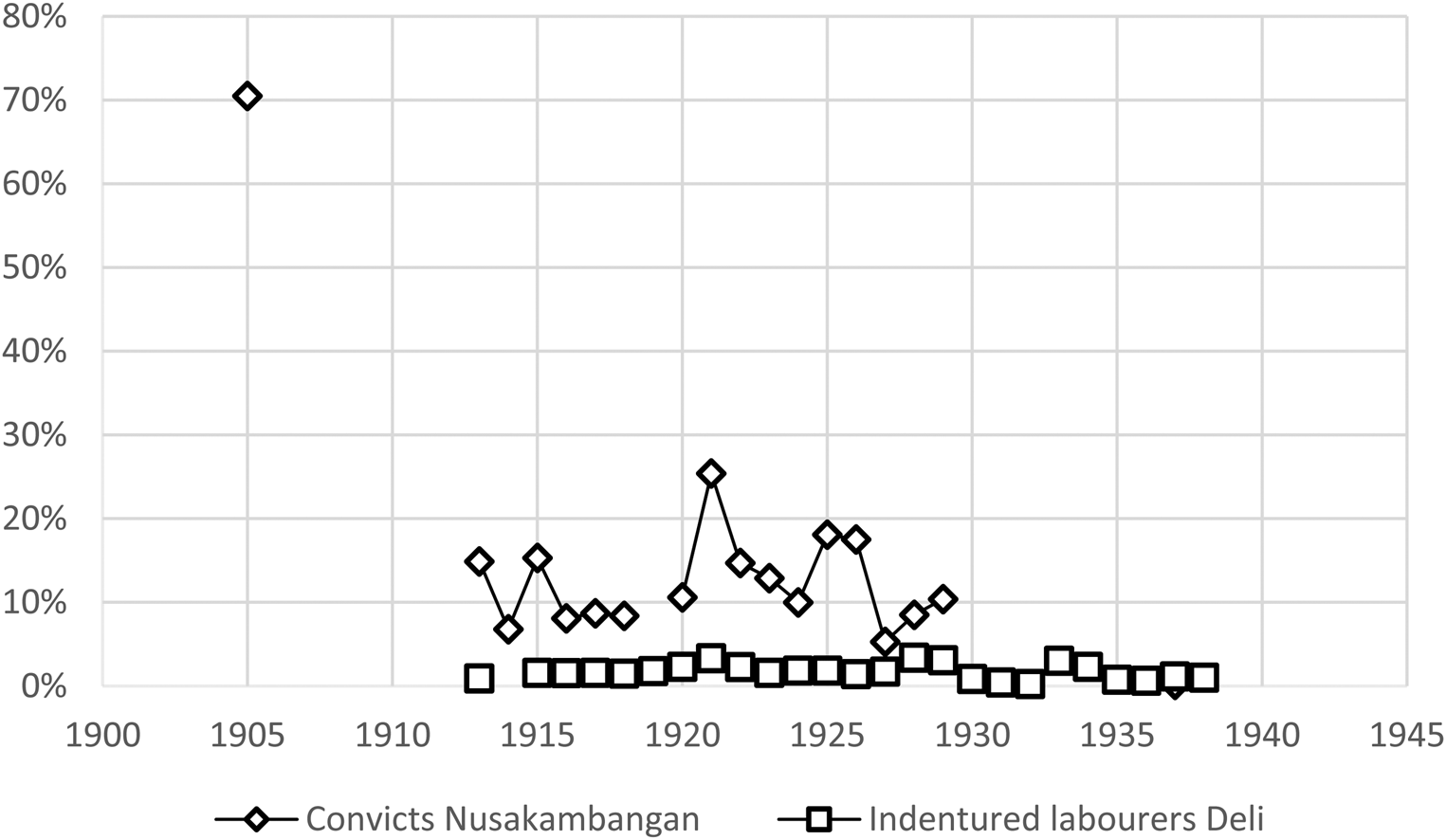
Soon after opening, it became clear that the isolation of Nusakambangan was less effective than expected. The sea currents were, especially around the turning of the tides, not strong enough to prevent crossing the water floating on a tree trunk, and the mangrove swamp on the mainland was an effective hiding place. Until 1931 when a new surveillance system was introduced, the number of escape attempts was extraordinarily high as compared to other prisons in the Indies and plantations in Deli (fig. 4). Within the first four months of opening, the proportion of runaways in relation to the total population quickly climbed to above 10 per cent, and for most subsequent years with reliable data this figure would remain between 10 and 25 per cent per year (fig. 4).Footnote 71
Rate of escapes/ desertion per year, Nusakambangan and Deli
Source: Statistiek van het gevangeniswezen in Nederlandsch-Indië over het jaar 1913, 1914, 1920, 1928, samengesteld bij het hoofdkantoor van het gevangeniswezen (Weltevreden, 1919–1929); ‘Indische Causerieen’, Nieuwsblad van het Noorden, 21 Mar. 1933; Lindblad, ‘Coolies in Deli’, p. 76.

A list of names of escapees from Nusakambangan between November 1905 and March 1906, indicating the original place of residence, the date of escape and—if applicable—the date and location of arrest sheds light on the strategies of fugitive prisoners and their chances of success.Footnote 72 Out of a total number of 123 deserters, 16 people (13 per cent) tried to escape twice over a period of 133 days, and one person even escaped thrice; of these, 37 people escaped alone and 99 in a group. These were most often in pairs (14 times) or groups of three (13 times), but groups of four (5 times), six and nine also occurred.Footnote 73 There were cases in which the same pairs tried to escape twice together, which indicates a strong bond. Often, several groups escaped on the same day, with a maximum of 25 fugitives in eight groups escaping on 19 March 1906. Although the escapees in eight of the groups shared a place of residence, suggesting that they knew each other before they arrived on Nusakambangan, the majority of the groups (27) consisted of people from various places.
Overall, and this corroborates figures from later years, escape attempts were not very successful. Between November 1905 and March 1906, 13 per cent of the fugitives (six individuals and three groups) succeeded in staying out of the hands of authorities. Some 72 per cent of the prisoners were caught within a week of their escape, while 74 per cent of the prisoners did not get further than Cilacap and surrounding areas, many of them caught before they could even leave Nusakambangan. Some of the fugitives returned to the authorities on their own initiative, probably because they were exhausted, hungry or disillusioned. In one case this happened after 15 days, and in two cases after 11 days. Yet, there was a small chance of success. On the 1905–06 list, only five prisoners managed to reach their place of residence, where they were caught by the local authorities. Later newspaper articles mention prisoners who got as far as Aceh, Padang, Makassar and Madura.Footnote 74 Obviously, it is unknown if the fugitives who were never seen again had found a new life in hiding or died along the way, but they probably kept the dream alive for the prisoners left behind.
It is also unclear whether the fugitives had a clear conception of why and where they were going. Some prisoners left in panic after a work-related incident. An article in De Indische Gids indicated that many prisoners attempted to reach the railway track near the town of Maos, just north of Cilacap, which they would follow in a western direction to the Priangan region and ultimately to Bandung and further.Footnote 75 Most of the escape attempts ended at an earlier stage, however. Contemporary newspapers are full of stories about fugitives raiding nearby Javanese villages, plundering the houses of farmers and raping women and girls. In some instances, groups of armed prisoners marched to the town of Cilacap, probably to complain or take revenge. With the presence of a military garrison, it is unlikely that the prisoners believed in the success of an armed insurrection, but the assessment of contemporary journalists that they were only longing for a few days off is also improbable.Footnote 76
Fugitives who were caught were punished with 25 strokes of the rattan cane and solitary confinement. Angry reactions in Dutch-language newspapers, especially in the conservative Nieuws van den Dag van Nederlandsch-Indië, put pressure on the authorities to take additional measures. Already in 1906, the prison authorities decided that Nusakambangan would only take in prisoners from the region of Banyumas or from the peripheral Outer Islands. People from far away did not speak the local Javanese or Sundanese languages and were usually quickly caught. Convicts from Banyumas typically returned to their villages, where they could be easily arrested as well. People from other Javanese regions were more difficult to catch.Footnote 77 Other measures suggest an increasing level of repression, and at the same time an inability to effectively stop the prisoners from escaping. These measures included the removal of the local Javanese population from the island, the prohibition for locals to approach the island, rewards for every captured fugitive, and the purchase of two motorised boats to search for and catch runaway prisoners. Finally, in 1915, the governor-general gave permission to the guards on Nusakambangan to shoot anyone who facilitated or tried to escape, even when the fugitive prisoner posed no threat.Footnote 78 It seems that these measures were only marginally successful. Only in the second half of the 1920s, when the camps were connected by roads and telephone, was the reaction time of the authorities on Nusakambangan shortened to such an extent that the number of escapes decreased.
Overall, we may see the establishment of Nusakambangan as the result of a modernist colonial intervention to rationalise the penal system, to increase its production, and to isolate its most dangerous elements. Yet, the immediate influx of unmanageable groups of fighters from Aceh and elsewhere, the disconnect between the rhetoric of resocialisation and the reality of punishment and mortality rates, and the daily negotiations between guards and prisoners over autonomy and control, show that Nusakambangan was an ill-disciplined colonial prison, in which the colonial state was even less able to better living conditions than in Deli. This observation not only helps to create a more veracious image of life and labour in Nusakambangan, but also adds a new complexity to the relation between the island and its local and regional environment. In fact, Nusakambangan was not as isolated as intended by the colonial authorities. In moments of ill-discipline, prisoners traded latex balls with Javanese smugglers, visited Javanese prostitutes, fought with racial and cultural others, were suppressed by (Christian) soldiers from the Javanese mainland, and made use of their knowledge of the local terrain to flee to home regions. In other words, only when we take negotiation, corruption and resistance into account, does the ill-disciplined prison island of Nusakambangan become part of southern Java again.
Conclusion
Nusakambangan is still a prison island, and as such it remains largely inaccessible to the outside world. Yet, paradoxically, not many sites in the Netherlands Indies are as well documented as this island. Because of the many government reports, statistical data, and newspaper articles, the island can be a starting point to analyse the penal system of the Indies at large, as one of the central colonial instruments of repression and control.
In more ways than one, Nusakambangan has a story to tell about larger histories. First, in a way reminiscent of Benedict Anderson's educational pyramid,Footnote 79 Nusakambangan was at the apex of the colonial penal system bringing anticolonial fighters from all corners of the archipelago together with criminals serving long sentences who were deemed unfit to work in prison workshops. Its creation was the result of several colonial departments working together to maximise the economic productivity of the prisoners and rationalise the costs of running the entire facility. Its population was the residue of several rounds of classification, segregation and selection.
Secondly, to understand life and labour in a prison facility such as Nusakambangan, we should not compare the island with the better known Upper Digul, which stood apart as a place for political detainees. Instead it is striking how similar the situation in Nusakambangan was to plantations on Sumatra's East Coast. The circumstances under which prisoners had to work remind us of what Stoler, Breman, Kamphues and Houben described thirty years ago, if only a little worse. This last remark is significant, because Nusakambangan was managed by a state institution, the Department of Justice, which was not only responsible for the supervision and management of prisons, but also for the punishment and control of dissenting contract labourers under the so-called ‘coolie ordinance’ in Deli.Footnote 80 While the Labour Inspectorate had to struggle with unwilling European plantation owners in Deli to keep labour conditions within the boundaries of what was acceptable—a task in which it was largely successful according to Kamphues, Houben and Lindblad—the Civil Health Department had a less official obligation to monitor the conditions in state prisons such as Nusakambangan. As can be deduced from statistical evidence concerning mortality rates, punishments and desertions, ‘the state’ was as bad an ‘employer’ as the planters in Deli, despite its ethical ambitions and enlightened beliefs about rehabilitation and resocialisation of the prisoner, and despite its dedication to the well-being of indentured labourers. De Vogel himself was acutely aware of this double standard. If the Labour Inspectorate was so strict in Deli, he quoted a colleague approvingly, the government had a moral obligation to make sure that living standards were sufficiently being safeguarded for those convict workers, ‘who had not entered into a contract voluntarily but were forced to work by the rule of law’.Footnote 81
Finally, by focusing on the daily reality of negotiation, corruption and resistance of the prisoners with and against the authorities and among themselves, we see that the ‘ill-disciplined prison’ was in many ways connected to its immediate local and regional surroundings.Footnote 82 The interaction of prisoners with smugglers, prostitutes, journalists, and military and other sojourners from the mainland determined to a large extent their chances of survival. In order to get a comprehensive picture of life and labour on Nusakambangan—or in Deli for that matter—we must take individual and informal strategies of survival into account. Previous studies on living conditions in Deli plantations focused on regional statistics or government reports. Just as Zinoman has warned in relation to French Indochinese prisons, such positivist data and reports obscure the daily reality of the prisoners’ improvisations and negotiations to immediately improve their conditions.Footnote 83 Moreover, evidence from the Nusakambangan penal complex shows that corruption was an important field of negotiation, both for the guards and for the prisoners.