





Introduction
Reducing weed density to levels that do not reduce a crop’s yield is the goal of weed management. The best ways to manage weeds are through a variety of weed control practices; however, these management practices require careful planning and evaluation of weed competitiveness in response to various management strategies. Control strategies that entail preventive, mechanical, biological, and chemical techniques constitute an integrated approach to weed management (Burnside Reference Burnside1992). Herbicide-resistant crops (HRCs) are an important advancement for controlling weeds in cropping systems. With the creation of HRCs, higher levels of weed control efficacy were initially achieved in crops that previously were susceptible to the herbicides enabled by the HRC (Radosevich et al. Reference Radosevich, Ghersa and Comstock1992; Yu and Powles Reference Yu and Powles2014). HRCs could also benefit growers by increasing herbicide rotation programs without relying on a single-ingredient application. The use of tank mixtures could slow the evolution of herbicide-resistant biotypes (Radosevich et al. Reference Radosevich, Ghersa and Comstock1992). In row cropping systems, herbicides are the most efficient and cost-effective method for controlling weeds. However, an overdependence on a few limited sites of action (SOAs) and/or a single effective SOA has led to the rapid emergence of herbicide-resistant weeds (Young Reference Young2006). Palmer amaranth exemplifies this challenge, having evolved resistance to nine different sites of action and ranking among the most problematic weed species in global row crop production (Heap Reference Heap2025; Korres and Norsworthy Reference Korres and Norsworthy2017).
The use of two or more herbicides with different SOAs can be more effective than a single herbicide for controlling weeds and preventing resistance evolution. Mixing two or more active ingredients in spray solution is commonly referred to as tank mixing. Herbicides applied in a tank mixture can exhibit physicochemical and physiological interactions, resulting in additive, synergistic, or antagonistic effects on weed management (Barbieri et al. Reference Barbieri, Young, Dayan, Streibig, Takano, Merotto and Avila2022; Sørensen et al. Reference Sørensen, Cedergreen, Skovgaard and Streibig2007). Additive effects occur in mixes of two or more herbicides when the phytotoxicity observed in the biological target after tank-mixing herbicides is comparable with the anticipated phytotoxicity of the herbicides applied separately (Gandini et al. Reference Gandini, Costa, dos Santos, Soares, Barroso, Corrêa, Carvalho and Zanuncio2020; Zhang et al. Reference Zhang, Hamill and Weaver1995). Antagonism is an undesirable interaction because the observed control is lower than the expected control of the herbicides applied alone, and higher doses of herbicides are typically required for satisfactory levels of control (Barbieri et al. Reference Barbieri, Young, Dayan, Streibig, Takano, Merotto and Avila2022; Meyer et al. Reference Meyer, Norsworthy and Kruger2021; Zhang et al. Reference Zhang, Hamill and Weaver1995). A synergistic effect occurs when the herbicide mixture outperforms the expected result of its individual components, leading to increased weed control compared with the use of single-ingredient herbicides (Barbieri et al. Reference Barbieri, Young, Dayan, Streibig, Takano, Merotto and Avila2022; Gandini et al. Reference Gandini, Costa, dos Santos, Soares, Barroso, Corrêa, Carvalho and Zanuncio2020).
The grass herbicide clethodim has been documented to exhibit antagonistic effects when mixed with auxinic herbicides, specifically 2,4-D and dicamba (Perkins et al. Reference Perkins, Mueller and Steckel2021). When the Colby equation was used to characterize dicamba and glyphosate interactions, an antagonistic response was observed in a glyphosate-susceptible population of horseweed (Erigeron canadensis L.) (Polli et al. Reference Polli, Guimaraes, de Sanctis and Kruger2022). That study reported that adding glyphosate (316 g ae ha−1) to dicamba (560 g ae ha−1) resulted in a 13% reduction in weed biomass compared with dicamba applied alone. This finding indicates that the presence of glyphosate reduced the efficacy of dicamba, demonstrating an antagonistic interaction between the two herbicides (Polli et al. Reference Polli, Guimaraes, de Sanctis and Kruger2022). Given the prevalence of antagonist interactions, Merritt et al. (Reference Merritt, Ferguson, Brown-Johnson, Reynolds, Tseng and Lowe2020) reported that split applications of glyphosate and either dicamba or 2,4-D resulted in higher levels of weed control compared with in-line or tank-mixed treatments. Dicamba or 2,4-D applied alone provided no grass control, whereas tank mixes of those two herbicides with glyphosate achieved 48% control of Italian ryegrass (Lolium multiflorum L.) at one location. The split-applied treatment increased control to 62%, and similar trends were observed across additional sites, where tank-mix treatments averaged 75% control and split applications achieved 89% control (Merritt et al. Reference Merritt, Ferguson, Brown-Johnson, Reynolds, Tseng and Lowe2020). This finding supports the concept that separate-boom applications can reduce antagonism and improve overall efficacy compared with conventional tank mixtures.
Previous research conducted at two locations in Nebraska evaluated synergistic herbicide mixtures for Palmer amaranth control using mesotrione in combination with herbicides that inhibit photosystem II (Abendroth et al. Reference Abendroth, Martin and Roeth2006). At both locations, the combination of mesotrione and bromoxynil produced a synergistic response 6 d after application (DAA). At one site, mesotrione mixed with atrazine and mesotrione mixed with metribuzin also exhibited synergistic effects. Those results demonstrate that certain herbicide combinations can enhance Palmer amaranth control through synergistic interactions. Similarly, glufosinate has been shown to enhance the activity of protoporphyrinogen oxidase inhibitors, resulting in a synergistic response driven by increased accumulation of reactive oxygen species and lipid peroxidation (Takano et al. Reference Takano, Beffa, Preston, Westra and Dayan2020). In contrast, interactions between glufosinate and auxin herbicides such as 2,4-D or dicamba have been reported to be additive rather than synergistic for control of glyphosate-resistant giant ragweed (Ambrosia trifida L.) (Ganie and Jhala Reference Ganie and Jhala2017). These findings highlight that herbicide interactions can vary depending on the combination of mechanisms of action.
The objectives of this study were to compare Palmer amaranth control and plant density following single-ingredient, tank-mixed, and split-boom (simultaneous) applications of 2,4-D and glufosinate applied as initial and sequential postemergence treatments, and to determine whether increasing carrier volume from 140 to 280 L ha−1 influences herbicide efficacy. These results are intended to inform postemergence herbicide application strategies for improving Palmer amaranth management.
Materials and Methods
In 2024 and 2025, research was conducted at four locations in western Tennessee to evaluate the control of herbicide-resistant Palmer amaranth. Each population was numbered and given a corresponding site name. Latitude and longitude coordinates are shown in Table 1. The split-boom vs. tank-mixture study was an arrangement of treatments within a randomized complete block design with four replications at the Madison location and three replications at the Lauderdale 1, Lauderdale 2, and Gibson locations. The six treatments consisted of 1) 2,4-D, 2) glufosinate, 3) 2,4-D + glufosinate applied via tank mix (TM), and 4) 2,4-D and glufosinate applied via the split-boom (SB) method. Treatment 5 consisted of 2,4-D + glufosinate TM, followed by a second application of the same treatment 21 d later. A nontreated check was also used but not included in the models. Likewise, Treatment 6 consisted of 2,4-D and glufosinate SB, followed by a second application of the same treatment 21 d later. Treatments, herbicides, rates, and product names are listed in Table 2. Treated plots were 2 m wide by 9 m long. Split-applied applications were conducted by two applicators, each using a 1.5-m boom. The first applicator began spraying from a single SOA bottle, and the second applicator also had a single SOA bottle. As the first applicator was 0.5 m ahead, the second applicator began spraying, following the first applicator. Each herbicide was used at the 1× rate according to the product label (2,4-D at 1.07 kg ae ha−1; glufosinate at 0.66 kg ai ha−1) (Table 2). All herbicides were applied using a CO2-pressurized backpack sprayer equipped with AIXR 11002 nozzles (TeeJet Technologies, Glendale Heights, IL) calibrated to deliver 140 L ha−1 at 4.8 kph using 220 kPa.
Palmer amaranth control in 2023, relative resistance factor in 2022, and application rates of 2,4-D and dicamba at trial site locations. a

Table 1. Long description
This image displays a data table containing geographic coordinates, control percentages for two herbicides (2,4-D and Dicamba), relative resistance factors, and herbicide resistance levels for Palmer amaranth across different locations.
a Abbreviation: HR, Herbicide-resistant.
b Relative resistance factor levels of Palmer amaranth populations (Foster and Steckel Reference Foster and Steckel2022).
c Palmer amaranth populations with high and low resistance to auxinic herbicides were designated based on research in those fields in 2022 and 2023.
Herbicides used in experiments, in 2024 and 2025. a

Table 2. Long description
This image shows a structured scientific table outlining six distinct weed control or crop treatments. It contains three main columns: Treatment (numbered 1 through 6), Herbicide (showing the specific chemical or mixture used), and Rate (the dosage metrics applied per hectare).
a Abbreviations: fb, followed by; SB, split boom; TM, tank mixture.
b The glufosinate is sold under the trade name Liberty (BASF Corporation, Research Triangle Park, NC); 2,4-D is sold as Enlist One (Corteva Agriscience, LLC (Indianapolis, IN).
Locations and Site History
At the first location, Madison, cotton (Gossypium hirsutum L.) and soybean [Glycine max (L.) Merr.] had been grown in rotation from 2021 to 2024. In 2024, poor weed control (<40%) occurred with one application of 2,4-D (1.07 kg ae ha−1) (data not shown) when examined 14 DAA.
The history of the Gibson field consisted of cotton grown continuously, most recently with the Enlist brand (Corteva AgriSciences, Indianapolis, IN), which is resistant to 2,4-D, in 2020, and then with dicamba-resistant cotton (Xtend; Bayer Crop Science, St. Louis, MO) from 2021 to 2024. From 2021 to 2024, the grower who manages the land observed escapes of Palmer amaranth after multiple applications of dicamba (0.56 kg ae ha−1).
The third (Lauderdale 1) and fourth (Lauderdale 2) locations were less than 2.8 km apart (Table 1). The history of both locations consisted of herbicide-resistant Palmer amaranth biotypes that had been present for more than a decade (Foster and Steckel Reference Foster and Steckel2022). Lauderdale 1 and Lauderdale 2 were established on fallow ground; however, cotton and soybean had been grown in rotation in adjacent fields. Palmer amaranth populations at these sites were representative of those present in nearby production fields, although no crop was planted within the experimental areas.
The Madison location was equipped with lateral overhead irrigation, while all other locations were rain-fed. Each site consisted of a native glyphosate-resistant Palmer amaranth population that was known for escaping 2,4-D applications (Foster and Steckel Reference Foster and Steckel2022). Trials at the Madison and Gibson locations were conducted with Enlist cotton in 2024, with herbicides applied when cotton was at the 2-leaf stage initially, and the V6 stage at the sequential application. Trials at the Lauderdale 1 and Lauderdale 2 locations were conducted on fallow ground. In 2025, no crops were planted at any of the four locations.
In 2024, Enlist cotton was planted on May 4th and May 10th at the Gibson and Madison locations, respectively. A burndown application of paraquat (Gramoxone; Syngenta Crop Protection Greensboro, NC) (0.86 kg ai ha−1) plus a nonionic surfactant (125 mL L− 1) (Preference; Winfield United, Arden Hills, MN) was used to ensure the trials were weed-free before planting. No residual herbicides were applied to the treated plots in 2024. No burndown or residual herbicides were applied to either Lauderdale location in 2024, although the treatments were identical to those at the other Madison and Gibson locations. Pyroxasulfone (Zidua; BASF, Research Triangle Park, NC) (0.12 kg ai ha−1) was applied across all the treatments to suppress later-emerging weeds and was not expected to influence control (BASF 2026) of established Palmer amaranth evaluated in this study. Herbicides were applied at all locations when Palmer amaranth plants reached a height of 10 cm.
Palmer amaranth control was visually assessed on a scale of 0% to 100%, where 0% = no injury and 100% = plant death at 7, 14, and 21 DAA; following the second herbicide application, Palmer amaranth was rated again following the same scale. Control was evaluated using one 0.145-m2 quadrat per treatment, following the initial 14- and 21-d evaluations and the subsequent 14- and 21-d periods. Herbicides were applied a second time to evaluate sequential treatments for the tank-mix and split-boom methods. Single-ingredient treatments were not included the second time. Treatments 5 and 6 entailed the sequential application and were evaluated 14 d after the second application (Table 2). Results presented are based on data collected 21 DAA and not a 7 DAA or 14 DAA.
Data were analyzed using the GLIMMIX procedure with SAS software (v. 9.4; SAS Institute, Cary, NC) to analyze variance. Individual treatment differences were determined using a Fisher protected LSD test at the α = 0.05 level.
To examine whether the change in control was due to the application method as opposed to simply increased carrier volume, we carried out a study at all locations (Table 1) in 2025 to compare 2,4-D + glufosinate TM applied at 140 L ha−1 with the same two herbicides applied at 280 L ha−1. Treatments consisted of one pass and were applied using a CO2-pressurized backpack sprayer equipped with AIXR 11004 nozzles (TeeJet Technologies, Glendale Heights, IL) calibrated to deliver 280 L ha−1 at 4.8 kph using 207 kPa.
Weed control and plant density data were collected as previously described. A single degree-of-freedom contrast statement using SAS software was conducted to compare results.
Statistical Analysis
Data were initially analyzed across years and locations. Year and its interactions were not significant (P > 0.05); therefore, data were pooled across years. A significant location by treatment interaction was detected, indicating that treatment responses differed among populations. Consequently, populations were evaluated for similarity in response to treatment. Results from the Madison and Lauderdale 1 locations were not different (P = 0.0983) and were grouped as having low-resistant Palmer amaranth populations, whereas the Gibson and Lauderdale 2 locations were not different (P = 0.0831) and were grouped as having high-resistant populations (Table 1). Data were subsequently analyzed using these resistance groupings, with year treated as a random effect and treatment considered a fixed effect (Carmer et al. Reference Carmer, Nyquist and Walker1989). Means were separated using a Fisher protected LSD test at α = 0.05.
Previous studies have confirmed variability in dicamba resistance among these populations, with relative resistance factors (RRF) of 1.03 and 0.96 for weeds at the Madison and Lauderdale 1 locations, respectively, compared with 14.25 and 2.49 for Lauderdale 2 and Gibson (Foster and Steckel Reference Foster and Steckel2022). A subsequent study in 2023 further supported these classifications, as Palmer amaranth control with labeled rates of dicamba and 2,4-D was ≥80% at the Madison and Lauderdale 1 sites compared with ≤58% at the Gibson and Lauderdale 2 sites (Table 1). Although all populations evaluated were classified as being auxin-resistant, differences in response magnitude justified grouping populations for analysis. Together, these findings indicate consistent differences in response among populations and provide context for interpreting treatment performance and management strategies.
Results and Discussion
Low-Resistant Auxin Populations
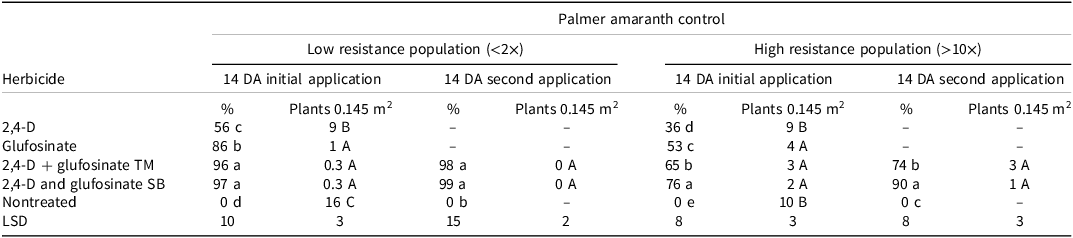
No difference in control or plant density was observed in the low-resistant population between the tank-mix and split-boom applications (Table 3). This suggests that combining 2,4-D and glufosinate, regardless of the application method, enhances control of Palmer amaranth when evaluated at 14 DAA relative to either herbicide applied alone.
Palmer amaranth control 14 d after initial and second applications of 2,4-D and glufosinate to weed populations with low and high resistance to auxinic herbicides, in 2024 and 2025.a-e

Table 3. Long description
This complex table shows Palmer amaranth weed control data, comparing a "Low resistance population (less than 2x)" and a "High resistance population (greater than 10x)". Data is collected at two intervals: "14 DA initial application" and "14 DA second application". For each interval, it measures control percentage (%) and weed density (Plants per 0.145 square meters), accompanied by statistical lettering.
a Abbreviations: DA, days after; LSD, least significant difference; SB, split boom; TM, tank mix.
b Resistance levels were determined based on information provided by Foster and Steckel (Reference Foster and Steckel2022).
c Palmer amaranth control across populations (%) and plant density per 0.145 m2 were determined based on visual observations.
d Lowercase letters indicate mean separation for percent Palmer amaranth control; uppercase letters indicate mean separation for Palmer amaranth plant density.
e High and low auxinic herbicide-resistant populations were designated based on research in those fields from 2022 and 2023.
In the low-resistant populations, 2,4-D (1.07 kg ae ha−1) applied alone provided limited Palmer amaranth control, averaging 56% at 14 DAA (Table 3). Glufosinate (0.66 kg ai ha−1) applied alone achieved greater control, by 86% on average. Control increased when 2,4-D and glufosinate were applied either as a tank mix (96%) or using the split-boom method (97%). Plant density was greatest in the 2,4-D alone treatment, whereas fewer weeds were counted after all other herbicide treatments (Table 3).
Following the initial 21 DAA rating, herbicides were applied a second time to examine the efficacy of sequential herbicide applications between the tank-mix and split-boom methods. Single-ingredient applications were excluded from the second spray application. In the low-resistant populations, no difference in Palmer amaranth control was observed 14 DAA after the second application. Both application methods, tank-mix (98%) and split-boom (99%), provided excellent control of low auxin-resistant Palmer amaranth (Table 3).
High-Resistant Auxin Populations
When applied alone at 1.07 kg ae ha−1, 2,4-D provided 36% control of high-resistant Palmer amaranth populations (Table 3). Control improved when glufosinate was applied alone (53%), although growers find this level to be unacceptable. When 2,4-D and glufosinate were tank-mixed, control increased to 65%. This level of control is not acceptable by growers either, but unfortunately, this level is consistent with their experience with applying 2,4-D and dicamba to those fields. However, the split-boom application produced the highest response, achieving 76% control of Palmer amaranth 14 DAA (Table 3). Growers may still find this level of control to be insufficient. Plant density was reflected in the visual ratings and was greatest in the treatment with 2,4-D alone, indicating poor control (Table 3). Plant density was similar for glufosinate applied alone, and in tank-mix and split-boom applications.
Overall, when 2,4-D or glufosinate were applied individually, weed control was <55%. Tank mixing improves the herbicides’ effectiveness but still fails to reach acceptable levels for economic control. In contrast, the split-boom application method provided a significant increase in Palmer amaranth control compared with the tank-mix application. This suggests the split-boom application method was more effective at managing highly resistant populations at 14 DAA. Although this level of control is better, it is still not acceptable to growers (C.F. personal experience).
Following the initial 21 DAA rating, herbicides were applied a second time to examine the efficacy of sequential herbicide applications between the tank-mix and split-boom methods. Single-ingredient applications were excluded from the second spray application. In the population of Palmer amaranth demonstrating high resistance to auxin herbicides, sequential split-boom applications provided greater control (90%) than tank-mixture applications (74%). These results indicate that split-boom applications may be necessary to achieve acceptable Palmer amaranth control in populations with reduced auxin sensitivity.
Carrier Volume
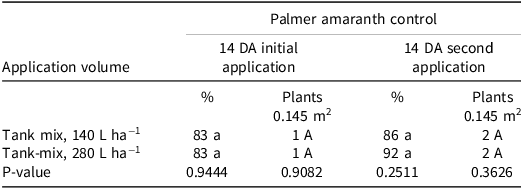
Across all locations in 2025 in western Tennessee, increasing the carrier volume from 140 to 280 L ha−1 did not improve control of auxin-resistant Palmer amaranth. Low- and high-resistant populations did not differ (P = 0.8347); therefore, data were pooled. No difference in control was observed between 140 L ha−1 (83%) and 280 L ha−1 (83%) at 14 DAA of the initial application (Table 4). Similarly, after the second application, no difference was observed between the 140 L ha−1 and 280 L ha−1 treatments at 14 DAA (P = 0.2511). Plant density was recorded for both initial and second applications using a 0.145-m2 quadrat. Average weed counts after the 140 ha−1 application did not differ from that of the 280 L ha−1 strength in either the initial or second application rating (Table 4). Overall, these results indicate that increasing the carrier volume from 140 to 280 L ha−1 provided no measurable advantage in Palmer amaranth control, suggesting that the standard 140 L ha−1 application volume is sufficient under these conditions.
Contrast statement for control of auxin-resistant Palmer amaranth comparing 140 L ha−1 with 280 L ha−1 carrier volume, pooled across four locations in western Tennessee, in 2024 and 2025.a–c

Table 4. Long description
This scientific data table presents Palmer amaranth weed control results based on different herbicide application volumes. The data is measured at two intervals: "14 DA initial application" and "14 DA second application". For each interval, it tracks the control percentage (%) and the weed density (Plants per 0.145 square meters), along with statistical grouping letters.
a Abbreviation: DA, days after.
b Palmer amaranth control across populations (%) and plant density per 0.145 m2 were determined based on visual observations.
c Lowercase letters indicate mean separation for percent Palmer amaranth control; uppercase letters indicate mean separation for Palmer amaranth plant density.
Practical Implications
The poor control of Palmer amaranth we observed when 2,4-D and glufosinate were applied alone at the experimental locations where the weeds exhibited high resistance to auxinic herbicides are consistent with reports from growers in the area. These results coupled with the 2023 research suggest that this Palmer amaranth population, which has been confirmed to be resistant to dicamba, may also be resistant to 2,4-D and glufosinate. Additionally, these results indicate that the best chance of success managing these multiple herbicide–resistant populations of Palmer amaranth is to apply 2,4-D and glufosinate simultaneously through separate spray booms as independent solutions followed by another application 21 d later. Many growers would find this to be logistically difficult to achieve. Therefore, not relying completely on postemergence applications is crucially necessary for managing these Palmer amaranth populations. In parts of Arkansas where glufosinate resistance has been documented (Priess et al. Reference Priess, Norsworthy, Godara, Mauromoustakos, Butts, Roberts and Barber2022) split-boom applications likely would not improve Palmer amaranth control. Growers might consider split-boom application if it was economical to do so and it would consistently provide acceptable control of resistant Palmer amaranth and other troublesome weeds.
Acknowledgments
We thank Jared Buck, David Cartwright, Maddie Douglas, Hayden Love, Ernest Merriweather, Sally Reed, and Julie Reeves for their help in conducting this research.
Funding
Cotton Incorporated provided partial financial support for this project.
Competing Interests
The authors declare they have no competing interests.



 Open access

