Introduction
Gastrointestinal helminthiasis has become an important factor in the world economy as it can cause heavy production losses in dairy and beef cattle. In Brazil, productivity indices are considered low, mainly because of the seasonal fluctuation in pasture production, especially in the dry season, and parasitic diseases (Souza et al., Reference Souza, Ramos, Bellato, Sartor and Schelbauer2008).
In countries of Oceania, Europe and South America, such as Brazil, Argentina and Uruguay, anthelmintic resistance in nematode parasites has become a serious problem in cattle production systems (Fiel et al., Reference Fiel, Saumell, Steffan and Rodriguez2001). In Brazil, Pinheiro & Echevarria (Reference Pinheiro and Echevarria1990) were the first to report resistance of Haemonchus contortus to albendazole and oxfendazole in cattle. Subsequently, helminth resistance in cattle in Brazil has been described, including the resistance of Trichostrongylus spp. and Ostertagia spp. to levamisole, Haemonchus spp. and Cooperia spp. to ivermectin and Cooperia spp. to albendazole sulphoxide (Souza et al., Reference Souza, Ramos, Bellato, Sartor and Schelbauer2008).
Non-chemotherapeutic approaches for the control of nematode parasites of livestock are no longer solely of academic interest and alternatives or adjuncts to anthelminthic drugs are now considered to be necessary (Araújo et al., Reference Araújo, Guimarães, Campos and Sá2004). Thus, biological control with nematophagous fungi in cattle can be a viable alternative, reducing environmental contamination by free-living stages of these parasites, reducing the frequency of chemical treatments and thus reducing dependence on anthelmintics.
Species of Monacrosporium (Hyphomycetales) can control phytonematodes, free-living nematodes and parasitic nematodes of cattle (Araújo et al., Reference Araújo, Guimarães, Lima and Lima1992, Reference Araújo, Guimarães, Campos and Sá2004; Gomes et al., Reference Gomes, Araújo and Ribeiro1999). However, there are no reports of studies with beef cattle in tropical climates, either in the rainy or the dry season.
The objective of the present study was to assess the viability of a formulation with the fungus Monacrosporium thaumasium in the biological control of beef cattle gastrointestinal nematode parasites in tropical Brazil.
Materials and methods
Fungal cultures
An isolate of M. thaumasium (NF34A), a nematode-trapping fungus belonging to the genus Monacrosporium, was maintained in test tubes containing 2% cornmeal–agar (2% CMA) in the dark at 4°C. Fungal mycelia were obtained by transferring 5 mm-diameter culture discs of fungal isolates in 2% CMA to 250 ml Erlenmeyer flasks with 150 ml liquid potato–dextrose medium (Difco, potato–dextrose, Interlab, Brazil) at pH 6.5. Cultures were incubated under agitation at 120 rpm, in the dark at 26°C, for 10 days. Mycelia were then removed and pellets were prepared by using sodium alginate, as described by Walker & Connick (Reference Walker and Connick1983) and modified by Lackey et al. (Reference Lackey, Muldoon and Jaffe1993).
In vivo experimental assay
The study was performed at the cattle experimental sector of the Education Center for Forestry and Agricultural Development, Florestal, Minas Gerais State, Brazil, latitude 19°53′22″S, longitude 44°25′57″W, from May 2010 to June 2011.
A total of 20 Nellore calves aged 6 months were previously treated with 7.5 mg albendazole/kg body weight (10%) (Ricovet, Valle, Brazil). At 14 days after the anthelmintic treatment, the calves were separated into two groups of ten animals each, to create the fungus-treated and control groups. Calves were allocated to two 2.5-ha paddocks of Brachiaria decumbens, which had been previously grazed by young and adult cattle and were naturally infected with third-stage trichostrongylid larvae (L3). Each calf of the fungus-treated group received 1 g pellets/10 kg body weight twice a week. The pellets were created from M. thaumasium mycelial mass combined with 1 kg of cattle commercial ration. The treatment was offered for 12 months, starting in May 2010. The control group received 1 g pellets/10 kg body weight without fungus.
Collection and examination of faecal and herbage samples
To observe fungal growth, samples of fresh faeces were collected once per week directly from the rectum to determine eggs per gram of faeces (EPG), according to the method of Gordon & Whitlock (Reference Gordon and Whitlock1939) and modified by Lima (Reference Lima1989). The faecal samples were plated on 2% aqueous agar with 100 cattle trichostrongylid larvae and incubated at 25°C for 10 days. Also, 20 g of faeces were mixed with soil and moist, autoclaved industrial vermiculite (Vermiculita, NS Barbosa Ind. Com., Brazil) and incubated at 26°C for 8 days to obtain trichostrongylid larvae. Larvae were identified to the genus level as described by Keith (Reference Keith1953). EPG and larvae recovered from coprocultures of calves in both the fungus-treated and control groups were recorded and the percentage of larval reduction was determined according to Mendoza-de-Gives et al. (1999), where reduction (%) = ((mean L3 recovered from control group – mean L3 recovered from fungus-treated group)/mean L3 recovered from control group) × 100.
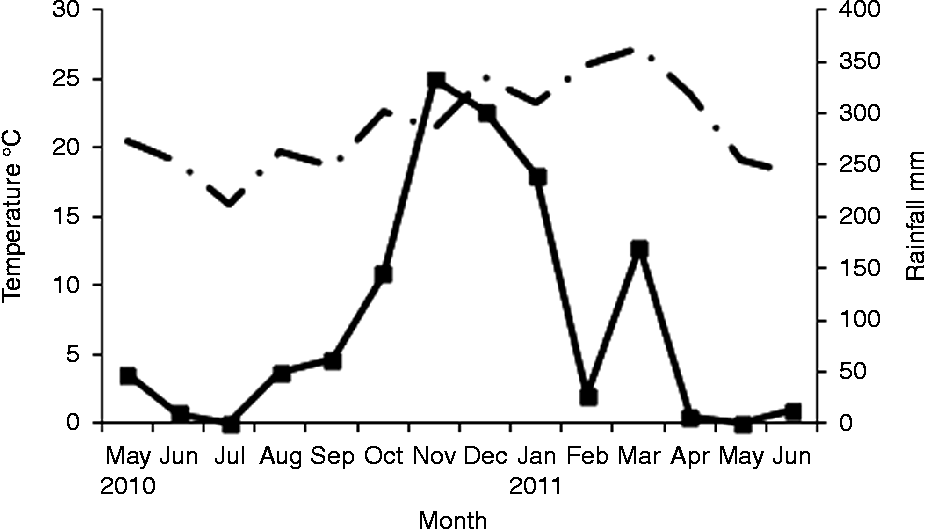
Every 15 days, two herbage samples were collected from each paddock, in a ‘W’ pattern from alternated points, 0–20 and 20–40 cm away from faecal pats, according to Amarante et al. (Reference Amarante, Padovani and Barbosa1996). A 500 g herbage sample was weighed, and parasitic nematode larvae were recovered following the procedure of Lima (Reference Lima1989). To determine dry matter, 500 g samples were incubated in a drying oven at 100°C, for 3 days. Data were transformed into larvae/kg of dry matter. Climate data (temperatures and rainfall) were recorded daily by a meteorological station in the area. The monthly median temperature ranged from 15.9°C in July 2010 to 27.2°C in March 2011, while monthly rainfall ranged from 0 mm in July 2010 to 333.6 mm in November 2010 (fig. 1).
Monthly mean values ( ± SD) of temperature (°C; – ● –) and rainfall (mm; –■–) recorded from May 2010 to June 2011, Florestal, Minas Gerais State, Brazil.

Data analysis
Egg counts originating from coprocultures and the number of L3 recovered from paddocks were compared over the experimental period. Data were analysed using Student's t-test at the 1% probability level.
Results
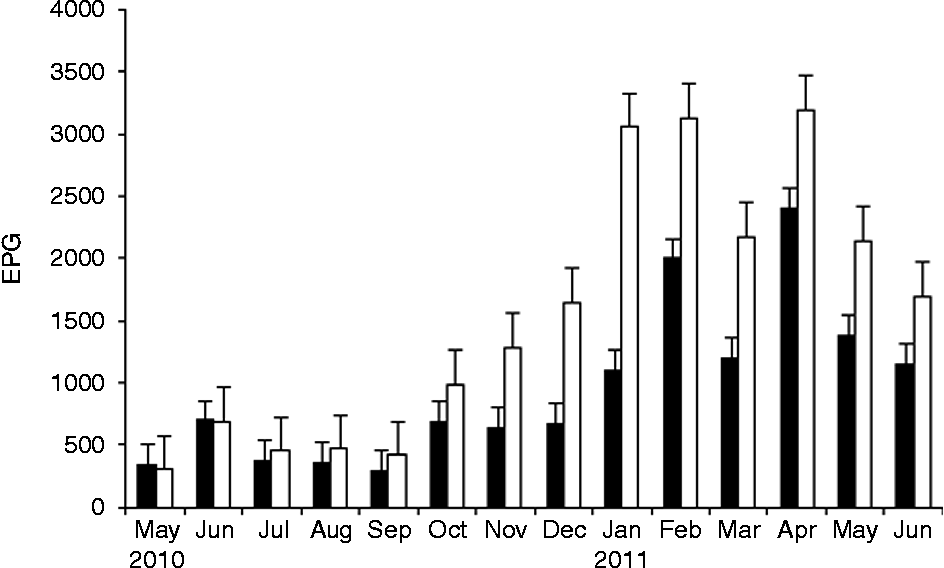
EPG counts in calves treated with M. thaumasium were significantly lower (P< 0.01) than those of the control group between August 2010 and June 2011 (fig. 2). At the end of the study, the total EPG difference between the groups was 47.8%. There was no significant difference between the fungus-treated and control groups during the first 3 months of the experiment. During June and July 2010, there was a negative reduction of 43% and 27%, respectively, during which the EPG count of the fungus-treated group was higher than that of the control group. In May 2010, the EPG count appeared to be affected by the previous anthelmintic treatment. The largest absolute difference of 1900 EPG and the highest percentage difference of 64% were found in January 2011, decreasing to 32.3% in June 2011. EPG counts started to rise from October 2010 and peaked in February and March 2011 at the end of the rainy season.
Monthly mean values of eggs/g of faeces (EPG) of fungus-treated (black bars) and control (white bars) calves from May 2010 to June 2011, in Florestal, Minas Gerais State, south-eastern Brazil. There were significant differences (P < 0.01) between treated and control groups except during May–July 2010 and June 2011.
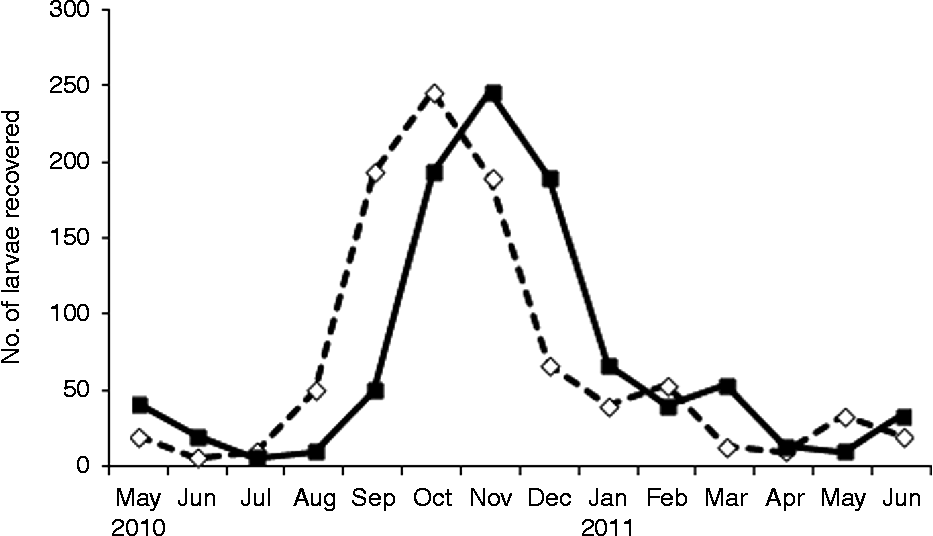
There was a significant difference between coproculture data of fungus-treated calves and the control group in October, November and December 2010 and January 2011, with a larval reduction of 50.2% after 1 year (fig. 3). Coprocultures showed that Cooperia sp. was the most frequently occurring gastrointestinal nematode in both groups of cattle, with values of 53.1% in the fungus-treated group compared with 44.1% in the control group, while Haemonchus comprised 34.7% and 43.4% and Oesophagostomum 10.9% and 10.4% of the parasitic population in the fungus-treated and control groups, respectively. Other species found in smaller quantities in the fungus-treated and control groups were Bunostomum sp., with values of 0.6% and 1.2%, and Strongyloides sp., with values of 0.7% and 0.9%, respectively. No difference (P> 0.01) was found in the proportion of different genera between the calves of the two groups.
Monthly mean values of trichostrongylid larvae recovered from coprocultures of fungus-treated (- ◇ -) and control (–■–) calves, collected from May 2010 to June 2011. There were significant differences (P < 0.01) between treated and control groups in October, November and December 2010 and in January 2011.
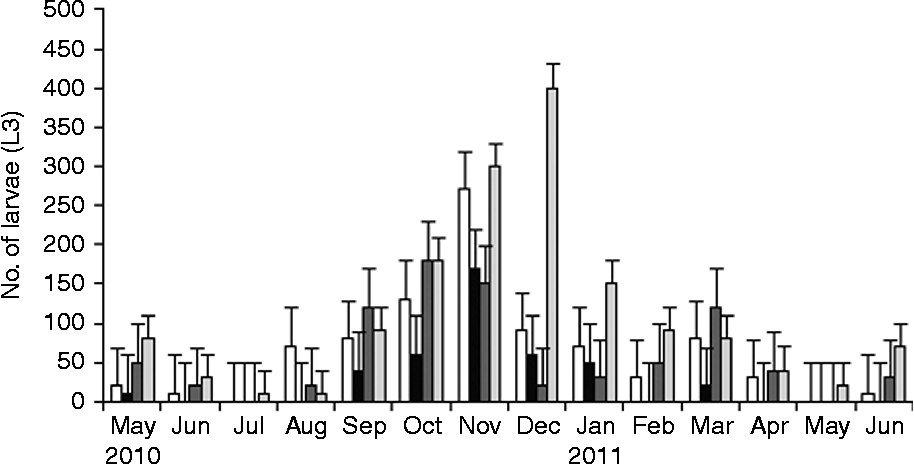
There were statistical differences in the number of L3 recovered from paddocks at the distances of 0–20 cm and 20–40 cm from faecal pats (fig. 4). At the end of the experiment, there was significant reduction in number of L3 recovered from the fungus-controlled group compared to the control group at 0–20 cm from the faecal pats (47.3%; P< 0.01), and at 20–40 cm from the faecal pats (58%; P< 0.01). From November 2010 to January 2011, there were significant differences between the fungus-treated and control groups at both distances of 0–20 cm and 20–40 cm. The number of larvae recovered up to 20 cm from faecal pats differed from that found between 20 and 40 cm (P< 0.01). In the fungus-treated group, a total of 91% of larvae were found up to 20 cm from faecal pats and only 9% from 20 to 40 cm. In the control group, the highest percentage of L3, 73%, was also found up to 20 cm from faecal pats, but there was a greater amount of L3 recovered, 27%, from 20 to 40 cm compared with the fungus-treated group. Larval numbers of Cooperia, Haemonchus and Oesophagostomum of the fungal-treated group recovered from the pasture (per kg dry matter) were reduced by 33.6%, 26.6% and 57.5%, respectively, compared with the control group.
Monthly mean values ( ± SD) of infective nematode larvae (third-stage infective larvae; L3)/kg of dry matter recovered from pastures of fungus-treated calves (white bars, 20 cm; black bars, 20–40 cm) and control calves (dark grey bars, 20 cm; light grey bars, 20–40 cm) collected at sampling distances up to 20 cm and 20–40 cm from faecal pats, from May 2010 to June 2011, Florestal, Minas Gerais State, Brazil. There were significant differences (P < 0.01) between treated and control groups in November and December 2010 and in January 2011.
Discussion
Species of the genus Monacrosporium, such as M. appendiculatum, M. ellipsosporum, M. sinense and M. thaumasium, have proved to be effective in the control of gastrointestinal nematodiasis of different animal species (Assis & Araújo, Reference Assis and Araújo2003; Melo et al., Reference Melo, Bevilacqua, Araújo and Melo2003; Araújo et al., Reference Araújo, Freitas, Vieira and Campos2006, Reference Araújo, Rodrigues, Silva and Vieira2007; Campos, Reference Campos2006). These reports corroborate the findings of the present study, in which a decrease in EPG count was found in calves treated with M. thaumasium.
Previously, Araújo et al. (Reference Araújo, Guimarães, Campos and Sá2004) reported a gradual EPG reduction in calves treated with the same formulation of M. thaumasium isolate in sodium alginate pellets as that used in the present study, obtaining significant reductions from the fourth month after the application. The authors reported that at the end of the 6-month study period, from September 2000 to August 2001, the difference between the EPG count of the treated group and the control group was almost 100%. This result differs from the findings of the present study, in which the EPG decrease was 47.8%. This difference was probably due to different climatic conditions between the study sites. Araújo et al. (Reference Araújo, Guimarães, Campos and Sá2004) conducted their study in a region of Brazil where the seasons of higher rainfall coincide with the best pasture conditions, while the conditions of the present study were low rainfall and high average temperatures (fig. 1).
Coproculture data indicate that M. thaumasium acted directly on the trichostrongylid infective larvae present on the pasture, leading to a lowering of parasitic infection in the calves treated with the fungus (fig. 3). Coprocultures showed the occurrence of different genera of trichostrongyles. Dias et al. (Reference Dias, Araújo, Campos, Braga and Fonseca2007) reported that Cooperia spp. and Haemonchus spp. are the most prevalent cattle parasite genera in Brazil, followed by Oesophagostomum spp. Over the experimental period from May 2010 to June 2011, Cooperia, Haemonchus and Oesophagostomum were the most common genera found in coprocultures and pasture. The importance of these parasites for cattle production is related directly to a reduction in weight gain, heavy production losses and the high resistance that these gastrointestinal nematode parasites have developed to routine anthelmintics (Araújo et al., Reference Araújo, Guimarães, Campos and Sá2004).
During May and June 2010 and from April to June 2011, the genus Cooperia was the most prevalent in the coprocultures of the two groups. From July 2010, there was an increase in the recovery of Haemonchus and Oesophagostomum in relation to Cooperia. The occurrence of Oesophagostomum was higher than Haemonchus during the rainy season in September and December 2010 and February 2011 in the two groups. These variations in the proportion of the genera are related to changes in rainfall and temperature. With respect to biological control, there were reductions in infective larvae of all genera when comparing the fungus-treated group with the control.
The number of larvae found within 0–20 and 20–40 cm from faecal pats is directly related to the action of nematophagous fungi against the L3 present in pastures, suggesting that M. thaumasium accounted for the satisfactory reduction in environmental contamination (fig. 4). According to Araújo et al. (Reference Araújo, Guimarães, Campos and Sá2004), oral administration of M. thaumasium pellets resulted in up to 100% control of larvae on pasture during February–August 2001. In the present study, the reductions in L3 recovered from pastures were 47.3% at 0–20 cm and 58% at 20–40 cm. The difference in these results may be explained by the low rainfall and higher temperatures prevalent in the region of our study, which may have reduced the efficiency of the fungus. The largest number of infective larvae was recovered within the distance of 0–20 cm away from the faecal pats. This finding corroborates the results of Dias et al. (Reference Dias, Araújo, Campos, Braga and Fonseca2007), who reported larger numbers of larvae recovered within 0–20 cm from faecal pats, confirming that few larvae that leave the faeces migrate to the herbage further than 0–20 cm. According to Saueressig (Reference Saueressig1980), larvae can survive in the pat, especially when the pat remains intact, if the environmental conditions are not favourable for transmission, i.e. when eggs reach the infective stage on herbage. Temperature, relative humidity and rainfall promoted the development of free-living stages and migration to the herbage. The optimum temperature range for the development of most Trichostrongylidae of cattle is between 20 and 30°C (O'Connor et al., Reference O'Connor, Walkden-Brown and Kahn2006) and the optimum temperature for growth and predatory activity of nematophagous fungi is between 20 and 30°C (Su et al., Reference Su, Hao, Mo and Zhang2007). Average temperatures from 16 to 20°C are suitable for the development of most larvae of cattle-parasitic nematodes in pastures. In the present study, temperature had no effect in limiting larval development, because the average temperatures favoured growth and action of the fungal isolate over almost all the experimental period, except during the months of July 2010, September 2010 and June 2011, when the average temperatures were relatively low, at 15.9, 18.6 and 18.2°C, respectively.
During the study period, the rainfall was below 50 mm from May to July 2010 and also from April to June 2011. The minimum rainfall required for larval development in the environment is 50 mm (Boom & Sheath, Reference Boom and Sheath2008). However, some previous studies in Brazil have shown that for some nematode larvae, the moisture content in faeces and rainfall from 5 to 7 mm would be sufficient for their development and subsequent migration to pasture (Lima, Reference Lima1989).
During June 2010 and June 2011, both temperature and rainfall were unfavourable for the development of eggs and larvae in pastures. Almost no larvae were recovered from the paddocks in these months. However, even when the monthly rainfall was very low or zero, there was reinfection of the calves because larvae were recovered in faeces. These results indicate that moisture in the faecal pat allows the development of free-living stages of nematodes and that low rainfall is sufficient for development and larval migration to the pastures. Under the conditions of this study, it is possible that the availability of water was the limiting condition for the occurrence of transmission, since the temperatures recorded in the period are notoriously favourable for it. The present data clearly show the close relationship between rainfall and the migration of infective larvae found in the stool to the pasture.
Van Dijk et al. (Reference Van Dijk, De Louw, Kalis and Morgan2009) reported that infection levels are highest during the rainy season and are related to higher humidity, which favours the development of free-living stages of the parasites and migration of infective larvae from faecal pats to adjacent herbage. The low occurrence of larvae on pasture during periods without precipitation, and higher occurrence in the rainy season, observed in this study, is consistent with these observations. The developmental stage from eggs to infective larvae occurred throughout the year and migration from faecal pats to pasture was proportional to rainfall. Months with restrictive rainfall hindered self-reinfection. Thus the number of larvae recovered from pasture was lower.
Van Dijk et al. (Reference Van Dijk, De Louw, Kalis and Morgan2009) also argued that calves might be infected throughout the year in tropical climates, since L3 are always present in the pastures, and the grass type can affect larval recovery. Langrova et al. (Reference Langrova, Jankovska, Borovsky and Fiala2003), in central Europe, suggested that L3 respond to rain through dispersion within the vegetation, with a moderate correlation between moisture and L3 number in the pasture. Baudena et al. (Reference Baudena, Chapman, Larsen and Klei2000) reported that the survival of these parasites in the environment is strongly related to temperature, and so few larvae would be found in faeces in the tropical summer. They recorded field data in southern Louisiana, a region with a subtropical climate in the USA, and found a larger number of infective larvae in the pasture in months with mild temperatures. This finding agrees with the results found in the present study, in which the largest number of larvae recovered in pastures was found during months of mild temperatures (fig. 4).
Treatment of beef cattle with pellets containing mycelial mass of the nematophagous fungus M. thaumasium was effective in the control of trichostrongyles in tropical south-eastern Brazil. This is the first report of biological control using M. thaumasium to control beef cattle trichostrongyles in a tropical climate. The treatment of beef calves with sodium alginate pellets containing mycelial mass, administered twice a week, reduced pasture infestation by infective larvae of nematodes during the rainy and dry seasons in south-eastern Brazil.
Financial support
This work was supported financially by Coordenação de Aperfeiçoamento de Nível Superior (CAPES), Conselho Nacional de Desenvolvimento Científico e Tecnológico (CNPq) and Fundação de Amparo à Pesquisa do Estado de Minas Gerais (FAPEMIG).
Conflict of interest
None.
Ethical standards
The Ethics Committee in Animal Use, University Federal of Viçosa, Brazil, certifies that the process number 65/2012, entitled ‘An isolate of the nematophagous fungus Monacrosporium thaumasium for the control of cattle trichostrongyles in south-eastern Brazil’ is in agreement with the Medical Veterinary Professional Ethics Code, with the Ethical Principles for Animal Research established by the Brazilian College for Animal Experimentation (COBEA/SBCAL) and with actual Brazilian legislation.