Introduction
“Literacy” refers to the ability to read and write. Learning to read and write is one of the most important contributors to the achievement of adequate cognitive functioning, social relationships, and cultural pursuits. Moreover, illiteracy and lower levels of education constitute risk factors for dementia. Those who are illiterate and less educated have demonstrated higher risk for the development of Alzheimer's disease, perhaps due to a vulnerability to cognitive deterioration (Stern et al., Reference Stern, Gurland, Tatemichi, Tang, Wilder and Mayeux1994; Ardila et al., Reference Ardila, Bertolucci, Braga, Castro-Caldas, Judd, Kosmidis and Rosselli2010).
A significant proportion of the world's population, especially in less developed countries, is illiterate (UNESCO, 2005). South Koreans older than 65 years of age, especially women, have had fewer opportunities to receive formal education due to the socioeconomic situation 50–60 years ago. Lack of opportunities in less developed countries to learn to read and write may contribute to the increase of dementia incidence in those nations. Because illiteracy and lack of formal educational attainment have dramatic effects on neuropsychological performance, investigation of illiteracy represents an important challenge for research into dementia.
The ability to read and write, two main aspects of language functioning, is known to be associated with the dominant hemisphere, primarily the left. The results of previous functional neuroimaging studies have supported that the brain areas crucial to reading and writing are left-side dominant (Powell et al., Reference Powell, Parker, Alexander, Symms, Boulby, Wheeler-Kingshott and Duncan2006; Sugihara, Kaminaga, & Sugishita, Reference Sugihara, Kaminaga and Sugishita2006). However, the results of neuropsychological tests of illiterate individuals reflect poor performance not only on tasks involving language functioning but also on tasks involving other domains such as memory (Nitrini et al., Reference Nitrini, Caramelli, Herrera, Porto, Charchat-Fichman, Carthery and Lima2004), visuospatial ability (Ardila, Rosselli, & Rosas, Reference Ardila, Rosselli and Rosas1989; Dansilio & Charamelo, Reference Dansilio and Charamelo2005), and praxis (Rosselli, Ardila, & Rosas, Reference Rosselli, Ardila and Rosas1990). Of interest, visuoconstructional ability was also diminished in those who were illiterate or less educated, although this function is known to be associated with the non-dominant hemisphere, primarily the right (Manly et al., Reference Manly, Jacobs, Sano, Bell, Merchant, Small and Stern1999). However, few researchers have attempted to study the association between illiteracy and visuoconstructional ability (Ardila et al., Reference Ardila, Rosselli and Rosas1989; Manly et al., Reference Manly, Jacobs, Sano, Bell, Merchant, Small and Stern1999; Dansilio & Charamelo, Reference Dansilio and Charamelo2005). Moreover, most studies have been unable to distinguish the impact of illiteracy from the impact of the lack of formal education.
Our study aimed to compare the visuoconstructional abilities of elderly non-demented individuals who were illiterate with those who were educated or uneducated but literate.
Methods
Subjects
The data were drawn from a cross-sectional, complete enumeration survey in Dae-Heung Dong, Mapo-Gu, Seoul. This was a population-based, epidemiological study conducted from July to September 2009 and designed to collect information about the socioeconomic and cognitive status of individuals 65 years of age or older. Data were collected from all participants by means of history-taking clinical interviews, neurological examinations, and administration of the Korean version of the Mini-Mental State Examination (K-MMSE; Kang, Na, & Hahn, Reference Kang, Na and Hahn1997), the Korean Dementia Screening Questionnaire (KDSQ; Yang, Cho, Chey, Kim, & Kim, Reference Yang, Cho, Chey, Kim and Kim2002), the Korean version of the Instrumental Activities of Daily Living Scale (K-IADL; Kang et al., Reference Kang, Choi, Lee, Kwon, Na and Han2002), the Christensen Health Exclusion Criteria test (Christensen, Moye, Armson, & Kern, Reference Christensen, Moye, Armson and Kern1992), and the Alzheimer's Disease Assessment Scale-cognitive subscale (ADAS-cog) for constructional ability (Rosen, Mohs, & Davis, Reference Rosen, Mohs and Davis1984). The KDSQ, K-IADL, and Christensen Health Exclusion Criteria were completed by a family member living with the participants.
The inclusion criteria were as follows: (1) 65 years of age or older; (2) absence of dementia and memory complaints; (3) scores of −1.5 standard deviations (SDs) above the age-, sex-, and education-matched norms on the K-MMSE; (4) scores below 7 on the KDSQ (the cutoff point of 7 had a sensitivity of 71% and a specificity of 86% for a diagnosis of dementia; Yang et al., Reference Yang, Cho, Chey, Kim and Kim2002); (5) scores below 0.43 on the K-IADL (the cutoff value of 0.43 had a sensitivity of 83% and a specificity of 82% for a diagnosis of dementia; Kang et al., Reference Kang, Choi, Lee, Kwon, Na and Han2002); and (6) the absence of a clinical history of events that may have caused cognitive problems according to the Christensen Health Exclusion Criteria (Parkinsonism, multiple sclerosis, cerebral palsy, Huntington's disease, encephalitis, epilepsy, stroke, brain surgery, drug intoxication, alcohol abuse, drug abuse, loss of consciousness for over 1 hr, and major psychiatric disorders). KDSQ and K-IADL were validated as diagnostic questionnaires for dementia and they assess the limitations of activities of daily living. Of the 1275 subjects who had participated in the entire enumeration survey (approximately 76.3% of the total subjects aged 65 years or older in Dae-Heung Dong, Mapo-Gu), 125 were recruited for this study. These were divided into three groups: educated literate (n = 53), uneducated literate (n = 36), and uneducated illiterate (n = 36). This study was approved by the Institutional Review Board and written informed consent was obtained from the subjects and their caregivers after provision of a complete description of the study.
Illiteracy
Data on illiteracy and formal educational level were collected in interviews and confirmed by reading and writing performances on the K-MMSE. Illiterate individuals were defined as those answering “no” to the following two questions: (1) Have you ever learned to read and write? (2) Can you communicate with others using reading and writing? This status was confirmed by the K-MMSE reading and writing tests. Subjects who could not read the phrase “Close your eyes” or could not write properly in the K-MMSE writing test were also considered to be illiterate even if they had answered “yes” to the aforementioned two questions. Assuming that the ability to write rests on the ability to read, illiterate individuals were divided into two groups: those with the ability to read and those without the ability to read. Uneducated literate individuals had learned to read and write from siblings at home or at informal educational settings.
Assessment of visuoconstructional ability
Drawings of interlocking pentagons on the MMSE are usually analyzed in terms of correct versus incorrect responses. However, this method is not sensitive to the degrees of visuoconstructional ability, which may be important in illiterate subjects. A score of 0 encompasses a wide range of visuoconstructional functioning, from the total absence of ability to the commission of subtle errors in performance. The Rey Complex Figure Copy, one of the most sensitive tests of visuoconstructional ability, can quantify ability more accurately, but might be difficult for illiterate elderly individuals to complete. Hence, we used a wider range of scales to measure drawings of interlocking pentagons and responses to the ADAS-cog constructional praxis test.
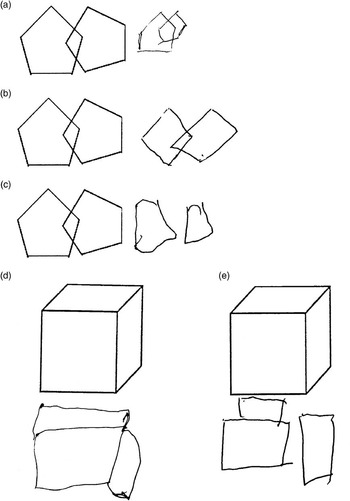
Thus, visuoconstructional ability was measured by drawings of interlocking pentagons on the K-MMSE and scores on the ADAS-cog constructional praxis test. Drawings of interlocking pentagons were scored on the 6-point hierarchical scale developed by Bourke, Castlenden, Stephen, and Dennis (Reference Bourke, Castlenden, Stephen and Dennis1995), where 6 represented a perfect drawing, and 1, the worst possible drawing (Bourke et al., Reference Bourke, Castlenden, Stephen and Dennis1995). Drawings for the ADAS-cog constructional ability test were rated using the original scale, where 5 represented a perfect drawing, and 0 represented the worst possible drawing. Drawings were scored by a neurologist who was blind to the literacy and educational status of subjects (Figure 1).
Examples of Interlocking pentagons drawing and ADAS-cog constructional praxis cube drawings in illiterates. a: Original score 0, Bourke scale 5; b: Original score 0, Bourke scale 4; c: Original score 0, Bourke scale 3; d and e: Examples of ADAS-cog constructional praxis cube drawings.

Statistical analysis
We used SPSS, version 12.0 (SPSS, version 12.0, Chicago, IL). All statistical tests were performed at the 5% confidence level in terms of significance. Age and scores on the K-MMSE, KDSQ, and K-IADL were compared by means of ANOVA and post hoc analysis. Bonferroni's method was used for post hoc analysis under the assumption of equal variance, and Dunnett's T3 method was used if equal variance was not assumed. Comparisons between men and women were performed using Pearson's χ2 analysis. Scores for drawings of interlocking pentagons and responses to the ADAS-cog constructional ability test were analyzed using an ANCOVA for the correction of sex differences. Non-parametric methods were used for the comparison of partial and total illiterate groups and the analysis of female only groups.
Results
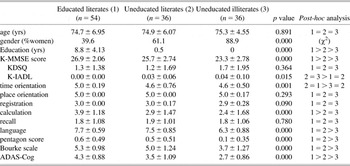
The subjects’ characteristics are presented in Table 1. The educational level of those who were educated and literate was 8.8 ± 4.13 years. According to the results of the K-MMSE, those who were educated and literate obtained the highest scores for time orientation, calculation, and language, whereas those who were illiterate obtained the lowest scores in these domains. On the other hand, scores on place orientation, registration, and recall did not differ among the three groups (Table 1).
Basic demographic data and visuoconstructional scores

K-MMSE; Korean version of Mini-Mental State Examination, KDSQ; Korean Dementia Screening Questionnaire, K-IADL; Korean version of Instrumental Activity of Daily Living, ADAS-cog; Alzheimer's Disease Assessment Scale-cognitive subscale.
The results of tests of visuoconstructional ability are presented in Table 1. According to the Bourke scale, the illiterate group obtained significantly lower scores than the other two groups on their drawings of interlocking pentagons. The scores for drawings of interlocking pentagons obtained by those who were educated and literate did not differ significantly from the scores obtained by those who were uneducated and literate on this measure. Scores on the ADAS-cog constructional praxis test were highest within the educated-literate group; this was followed by scores within the uneducated-literate group, and then by those within the uneducated-illiterate group.
We also divided those who were illiterate into two groups (partial illiteracy, n = 19; and total illiteracy, n = 17) according to their ability to read. The two groups had similar mean ages, sex distributions, and K-MMSE scores. Scores on drawings of interlocking pentagons and on the ADAS-cog test obtained by those with partial illiteracy (i.e., with reading ability) and by those with total illiteracy (i.e., without reading ability) did not differ significantly (data not shown).
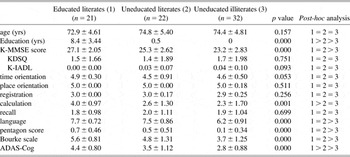
Moreover, we have additionally analyzed the subjects excluding the men for correction of gender differences (educated literate women [n = 21], uneducated literate women [n = 22], and uneducated illiterate women [n = 32]; there was no change in the results (Table 2).
Basic demographic data and visuoconstructional scores (female only)

K-MMSE; Korean version of Mini-Mental State Examination, KDSQ; Korean Dementia Screening Questionnaire, K-IADL; Korean version of Instrumental Activity of Daily Living, ADAS-cog; Alzheimer's Disease Assessment Scale-cognitive subscale.
Discussion
Drawings of interlocking pentagons and results on the ADAS-cog constructional praxis test were examined to evaluate visuoconstructional ability according to levels of literacy and formal education. We used the rating scales developed by Bourke et al. as well as the original scoring system for drawing interlocking pentagons because the original scoring scale for the K-MMSE may not have been sufficiently sensitive for conducting quantitative comparisons among groups. Our results showed consistent differences in visuoconstructional abilities between those who were and were not literate. These results are similar to those of previous studies, which demonstrated that individuals who were illiterate performed significantly more poorly than individuals who were educated and literate on visuospatial tasks (Ardila et al., Reference Ardila, Rosselli and Rosas1989; Manly et al., Reference Manly, Jacobs, Sano, Bell, Merchant, Small and Stern1999; Dansilio & Charamelo, Reference Dansilio and Charamelo2005).
Poor performance on visuoconstructional tasks by those who are illiterate may be explained in several ways. First, illiterate or less-educated subjects may have lower level of cognitive reserve than those who are more highly educated and literate (Stern et al., Reference Stern, Gurland, Tatemichi, Tang, Wilder and Mayeux1994). People with less access to cognitive reserve would be expected to perform more poorly in most neuropsychological tests. Second, learning to read and write develops not only language functions but also skills for interpreting and remembering graphic symbols. Those who are literate may have developed better skills than those who are illiterate for the organization and analysis of visuospatial information (Manly et al., Reference Manly, Jacobs, Sano, Bell, Merchant, Small and Stern1999). Changes in perception, logical reasoning, and memory caused by learning to read and write have also been reported in previous studies (Ardila et al., Reference Ardila, Bertolucci, Braga, Castro-Caldas, Judd, Kosmidis and Rosselli2010). A previous PET study (Castro-Caldas, Petersson, Reis, Stone-Elander, & Ingvar, Reference Castro-Caldas, Petersson, Reis, Stone-Elander and Ingvar1998) demonstrated that the functional neuroanatomy of language processing was altered in those who were illiterate and that learning to read and write may influence the functional organization of the adult human brain. Third, drawing interlocking pentagons and results on the ADAS-cog constructional praxis test may reflect not only visuoconstructional abilities but also skills related to cognitive processing, organization, and expression. A previous study using functional MRI reported that areas activated by imagined drawing are similar to those activated by imagined writing. Moreover, more extensive activations in the right inferior frontal gyrus and in the bilateral middle frontal, inferior frontal, parietal, and posterior inferior temporal gyri were observed during imagined drawing. We could expect that the imagined drawing activates not only the areas related to visuospatial function but also the areas related to broader cognitive functioning according to the results (Harrington, Farias, Davis, & Buonocore, Reference Harrington, Farias, Davis and Buonocore2007).
The ADAS-cog constructional praxis test includes four drawings that differentiated between the educated-literate and uneducated-literate groups, whereas both groups obtained similar scores on their drawings of interlocking pentagons, suggesting that the ADAS-cog constructional praxis test may be more sensitive for evaluations of visuoconstructional abilities. However, ADAS-cog constructional praxis test scores may be more influenced by literacy and educational level even in non-demented healthy subjects because most uneducated subjects did not draw the cube well.
On the other hand, the educated-literate and uneducated-literate groups obtained similar scores on drawings of interlocking pentagons, suggesting that illiteracy may have greater influence than formal educational attainment on visuoconstructional ability. However, the low educational level in our data may underestimate educational effect and the formal education may vary in quality, type, number of hours and method, hence the results need cautious interpretations. Additionally, comparisons between those with partial illiteracy (with reading ability) and those with total illiteracy (without reading ability) showed no significant differences in any of the scores, which may suggest that reading ability has less effect than writing ability on visuoconstructional functioning. However, this conclusion should be interpreted cautiously due to lack of formal assessment of reading ability.
Our study has several limitations. First, illiteracy was determined based on individual histories and on reading/writing performances on the K-MMSE rather than by detailed language tests because the study data were drawn from a complete enumeration survey that had aimed to gather information about the socioeconomic and cognitive status of those 65 years of age or older. Second, subjects with mild cognitive impairment (MCI) may have been included in this study due to the lack of comprehensive neuropsychological tests. We attempted to eliminate subjects with memory complaints to minimize the presence of this population in our sample. Another limitation in our data is that there may be interaction effects due to gender differences; there are few men in the uneducated illiterate group. We have analyzed the data after excluding men and there was no change in the results.
Despite these limitations, this is the first study to quantitatively examine the effects of illiteracy on drawings of interlocking pentagons and performance on the ADAS-cog constructional praxis test in the elderly over 65 years old. In the previous study, the subjects were more highly educated younger people (Ardila et al., Reference Ardila, Bertolucci, Braga, Castro-Caldas, Judd, Kosmidis and Rosselli2010), or the subjects were restricted to a very low level of formal education (Manly et al., Reference Manly, Jacobs, Sano, Bell, Merchant, Small and Stern1999). Our study is different from the previous two studies because it investigated elderly people aged 65 years old or older and divided all subjects into three groups according to illiteracy and formal educational level. However, our study again clarified that illiteracy influences not only language performance but also the visuoconstructional ability in the non-demented elderly using interlocking pentagons drawing and ADAS-cog constructional praxis test.
Further studies with larger sample sizes, additional socioeconomic factors that may be related with cognitive functioning, detailed language tests, and quantitative imaging analyses using 3D MRIs and functional brain imaging are needed to confirm the association between illiteracy and visuoconstructional ability and to trace the anatomical substrates of drawings of interlocking pentagons and results on the ADAS-cog constructional praxis test.
Acknowledgments
No financial or other relationships exist that could be interpreted as a conflict of interest pertaining to this manuscript. This study was supported by a grant of the Korea Healthcare Technology R&D Project, Ministry for Health, Welfare & Family Affairs, Republic of Korea (A050079) and financial aid from the Catholic Medical Center Research Foundation, made in the program year 2010.