




No CrossRef data available.
Article contents
- Abstract
- TWO APPROACHES TO MORPHOLOGICAL DIFFICULTIES
- A WORKING DEFINITION OF L2 COMPETENCE
- IN SEARCH OF AN EXPERIMENTAL METHOD
- EXPERIMENT 1
- EXPERIMENT 2
- EXPERIMENT 3
- GENERAL DISCUSSION
- CONCLUSION
- APPENDIX A
- TEST SENTENCES
- COMPREHENSION QUESTIONS
- APPENDIX B
- SSS AND SPS CONDITIONS
- PSP AND SSP CONDITIONS
- PRONOUN + BE CONDITIONS
- SUBCATEGORIZATION CONDITIONS
- APPENDIX C
- ACKNOWLEDGMENTS
- References
Morphological insensitivity in second language processing
Published online by Cambridge University Press: 01 October 2004
Article contents
- Abstract
- TWO APPROACHES TO MORPHOLOGICAL DIFFICULTIES
- A WORKING DEFINITION OF L2 COMPETENCE
- IN SEARCH OF AN EXPERIMENTAL METHOD
- EXPERIMENT 1
- EXPERIMENT 2
- EXPERIMENT 3
- GENERAL DISCUSSION
- CONCLUSION
- APPENDIX A
- TEST SENTENCES
- COMPREHENSION QUESTIONS
- APPENDIX B
- SSS AND SPS CONDITIONS
- PSP AND SSP CONDITIONS
- PRONOUN + BE CONDITIONS
- SUBCATEGORIZATION CONDITIONS
- APPENDIX C
- ACKNOWLEDGMENTS
- References
Abstract
Two competing explanations exist regarding the nature of morphological difficulty in adult second language acquisition: competence deficit versus performance deficiency. This study tested these explanations by examining English as a second language (ESL) learners' morphological performance in reading comprehension tasks. Chinese ESL speakers were asked to read English sentences for comprehension in three self-paced word by word reading experiments. Their reading times were measured to determine if they were sensitive to idiosyncrasies/disagreement in sentences that do and do not involve the number morpheme. The results show that they are not sensitive to number disagreement, but sensitive to other idiosyncrasies tested. This insensitivity to the number morpheme suggests that their morphological knowledge is not an integrated part of their automatic second language competence.
Information
- Type
- Articles
- Information
- Copyright
- © 2004 Cambridge University Press
Inflectional bound morphemes of English, such as third person singular -s, plurals, and past tense, are notoriously difficult for adult learners of English as a second language (ESL). Even very advanced ESL speakers who are otherwise considered highly proficient and effective users of the language often have difficulty in using these morphemes correctly in spontaneous communication. Such difficulty has been well documented in the second language acquisition (SLA) literature. First, a large number of studies have shown a low accuracy rate in the use of inflectional morphemes by adult ESL users in spontaneous communication across different first language (L1) backgrounds and different second language (L2) proficiency levels (e.g., Bailey, Madden, & Krashen, 1974; Ellis, 1988; Johnson & Newport, 1989; Krashen et al., 1977; Perkins & Larsen–Freeman, 1975; Shapira, 1978; Wei, 2000). With the exception of -ing, the accuracy rates for the use of inflectional morphemes in spontaneous speech are far from those of native speakers.
L2 learners' difficulty with inflectional morphemes can also be seen in their variable and inconsistent performance involving these morphemes. In Johnson, Shenkman, Newport, and Medin (1996), for example, native speakers and adult ESL learners were tested in an auditory grammaticality judgment test in two sessions separated by 3 weeks. More than 22% of adult ESL learners' responses were inconsistent between the two sessions, as compared to 2% by native speakers. That is, they often produced a yes response in one session, but a no response to the same sentence in the next session, or vice versa. Such inconsistency is quite common among ESL learners. It may occur between different test sessions such as in Johnson et al. (1996) and Perkins and Larsen–Freeman (1975), between different tasks (Ellis, 1987; Perkins & Larsen–Freeman, 1975; Rosansky, 1976; Salaberry, 2000), and even within the same sentence (Ellis, 1988).
Further evidence for morphological difficulty in L2 comes from longitudinal studies that examined ESL learners' English development over a period of time. These studies demonstrate that L2 learners' inflectional morphology tends to fossilize in spite of highly desirable learning environments. In two such studies, Long (1997) and Lardiere (1998) investigated English development of two ESL speakers over periods of 10 and 8.5 years, respectively. The two participants, native speakers of Japanese and Chinese, were each married to a native speaker of English. By the time of the last test, they had lived in the United States for 20 years or more. However, no significant improvement was found between the first and last tests in terms of their morpheme accuracy. They still made the same morphological errors as they had made many years ago. The lack of progress in the area of inflectional morphology can also be seen in other longitudinal studies (e.g., Schmidt, 1983; Shapira, 1978) and other case studies of ESL speakers with many years of residence in English and a high proficiency in the language (e.g., Aaronson & Ferres, 1987; Krashen & Pon, 1975).
TWO APPROACHES TO MORPHOLOGICAL DIFFICULTIES
Although ESL learners' morphological difficulties are widely recognized, there is no consensus regarding the nature or locus of these difficulties. Two different approaches can be identified in the SLA literature. The first one assumes such difficulties reflect a certain deficit in the learner's L2 competence. Thus, the difficulties are located at the representation or competence level. The second approach attributes such difficulties to a certain performance deficiency and thus the difficulties lie at the processing or control level.
According to the competence deficit approach (CDA), ESL learners' morphological difficulties are a sign of incomplete acquisition of morphological knowledge on the learner's part. They may know all the rules about inflectional morphemes, but, to borrow Hale's (1988) terms, such “conscious intellectual understanding” is not part of their “integrated linguistic competence.” Thus, such knowledge cannot always be put to use in spontaneous speech. Representing this view are Johnson and Newport, who take ESL learners' low accuracy rates and inconsistency in a grammaticality judgment task as evidence showing “adult learners' knowledge is qualitatively, as well as quantitatively, different from that of native speakers” (Johnson et al., 1996, p. 351). Based on their study of ESL learners and American Sign Language learners of different beginning ages, they consider such competence deficits as a critical period effect reflecting learners' maturational changes, particularly their more developed cognitive abilities (Johnson & Newport, 1989; Newport, 1990). This approach is also taken in Krashen's (1981, 1982) monitor model. According to this model, L2 learners can use conscious linguistic knowledge to monitor and modify L2 output before they have acquired subconscious competence for a structure. Morphological errors and variability in morpheme use in spontaneous speech are taken as an indication that “the performer has learned a rule, but has not acquired it” (Krashen, 1982, p. 86). He then attributes their correct use of morphemes to the application of explicit linguistic knowledge. Finally, this view is also endorsed in a transfer-based model of L2 vocabulary acquisition proposed by Jiang (2000) who suggests that inflectional morphology is not an integrated part of lexical representation in the L2 lexicon. He argues that morphological specifications are often language specific, and thus are not very likely to be transferred from L1 to L2. The correct use of inflectional morphemes is often the result of applying one's explicit linguistic knowledge.
The performance deficiency approach (PDA), on the other hand, considers such difficulties as difficulties in accessing, retrieving, or controlling what has already been internalized. They are thus not located at the representation or competence level. Representing this view is Sharwood Smith's competence/control model (1986). Sharwood Smith argues that L2 learning involves both “competence change and control change” (p. 13) and “some rule or principle may be acquired (in the competence sense) but suffer a long delay before full control is established” (p. 12). Thus, L2 learners may not always have control over their knowledge of the L2. Similarly, Sorace (1985) makes a distinction between L2 learners' internalized L2 knowledge and the procedural knowledge that is necessary for accessing internalized knowledge. She also takes production errors L2 learners make as indicating that “the development of procedural knowledge lags behind that of internalized knowledge” (p. 240). Thus, again, the problem lies at the performance level, not at the competence or representation level.
These two different approaches have also found their way to universal grammar (UG)-based SLA research. Some UG-based SLA researchers suggest that some aspects of adult L2 learners' competence may be impaired for maturation reasons. For example, Beck suggests that “the morphosyntactic features that require or prohibit thematic verb raising become impaired during the course of maturation” (1999, p. 316), which may be the cause of a number of problems adult L2 learners have, such that incorrect adverb positions and the failure to supply grammatical morphemes. However, other researchers (e.g., Haznedar & Schwartz, 1997; Prévost & White, 2000) argue that instances of correct use of grammatical morphemes suggest that related morphological knowledge have been internalized. They explain L2 learners' failure to use inflected forms by assuming that such knowledge may “become temporarily irretrievable…due to processing reasons or to communication pressure” (Prévost & White, 2000, p. 129). Thus, the problem lies in the realization of a particular form in a specific context, rather than in their abstract representation of related knowledge.1
The two variants of the performance deficiency approach, one by Prévost and White (2000) and the other represented by Sharwood Smith (1986), seem to differ in at least three ways. First, there is nothing built into the missing surface inflection hypothesis (MSIH) to deal with linguistic knowledge that learners have learned in formal instruction but cannot use in spontaneous communication. Everything an L2 learner knows is given the same status in terms of mental representation. In the competence/control model, the construct of control is employed to differentiate linguistic knowledge that can be used with different degrees of automaticity. Second, Prévost and White's MSIH takes a missed inflectional morpheme as a result of temporary on-site failure to access what has been internalized. Such failure may occur even when one has good control over one's internalized knowledge. In the competence/control model, on the other hand, an L2 speaker fails to use a morpheme because he or she is still in the process of developing the ability to control the morpheme. Thus, such failure occurs more regularly at a particular developmental stage of this morpheme and can persist over a period of time. To use Bialystok's (1990) distinction of synchronic and diachronic variability, the MSIH focuses on synchronic variability while the competence/control model deals more with diachronic variability. Third, the MSIH of Prévost and White seems to only deal with productive use of L2 which involves the retrieval of internalized knowledge. However, one may extend the concept of “control” in the competence/control model to receptive use of language, as Bialystok and Sharwood Smith (1985) seem to do.
A major difference between the CDA and the PDA is that the first approach believes that L2 learners do more than they really know with the help of explicit knowledge and the second approach assumes that L2 learners know more than they actually do because of their limited control over the developing interlanguage. The contrast between the two positions can be clearly shown by how the two approaches interpret the performance of the same subject (P) first described by Krashen and Pon (1975). Subject P, a native speaker of Chinese who had lived in the United States for more than 10 years and did very well at college, often made errors involving inflectional morphemes in casual speech. However, she had the linguistic knowledge to correct herself once the error was presented to her and was able to produce almost error-free English in writing. Krashen (1981, 1982) considers P a good “Monitor” user who is able to use her “learned” knowledge to monitor and modify her output. However, her errors in casual speech suggest that the morphemes have not been “acquired.” In the competence/control model, as Sharwood Smith (1986) argues, one can also consider that P is “correcting ‘by feel’, i.e. via her acquired competence in L2” and consider her errors in casual speech “control fossilization” (p. 17).
A WORKING DEFINITION OF L2 COMPETENCE
The ultimate difference between the two approaches lies in their definition of competence and acquisition. The CDA defines competence as the ability to use a structure correctly in spontaneous language production without paying attention to it. A structure is considered to have been acquired only when it can be used with consistent accuracy in spontaneous language use. On the other hand, PDA assumes a definition of competence that includes internalized linguistic representations only, regardless of the accuracy or suppliance percentage in natural communication. In this approach, another construct is often used to address the usability aspect, such as “control” in Sharwood Smith's (1986) model and “procedural knowledge” in Sorace's (1985) discussion.
Given the different definitions of competence used in the literature, it becomes necessary to have a working definition of L2 competence before one can pursue the issue further. In this paper, the term “competence” or “L2 competence” refers to any L2 knowledge that has been internalized and can be automatically put to use in spontaneous meaning-oriented L2 use. The activation and application of such knowledge is subconscious and does not require attentional resources. Such knowledge may become an integrated part of one's L2 competence directly through the exposure to L2 input, or it may be first obtained through explicit formal instruction and later integrated into one's L2 competence through extensive practice and use in spontaneous communication.
The emphasis on automaticity in this definition has three main reasons. First, automaticity is an intrinsic property of our ability in language use. The automatic nature of human language use has been well demonstrated in research findings such as the Stroop effect (Stroop, 1935), the nonselective activation of multiple meanings of homophones in biased context (e.g., Swinney, 1979), and the nonselective activation of both languages in a monolingual task in bilinguals (Jared & Kroll, 2001). The emphasis on automaticity in defining L2 competence is to reflect this important aspect of normal language use. If the ultimate goal of L2 learning is to develop such an ability in using an L2, automaticity is an indispensable part of the definition for L2 competence.
Second, in L1 acquisition, both the processes and the resulting linguistic knowledge are implicit in nature. The application of this knowledge is subconscious and automatic. Thus, one can equate native speakers' linguistic knowledge with automatic competence. As a result, automaticity may not be emphasized in defining linguistic competence in the L1. However, much of adult L2 learners' knowledge is obtained through formal instruction. Such knowledge often cannot be put to use in spontaneous communication. For example, one can teach a group of ESL learners all rules involving the formation of English relative clauses in one day, but that does not mean these learners have the competence to use all relative clauses correctly in natural communication. Because of this unique process associated with adult L2 learning, one cannot draw an equation between explicit L2 knowledge and L2 competence. Instead, it is necessary to make a distinction between explicit L2 knowledge and L2 competence. Automaticity is the characteristic to set them apart, and thus should be included in the definition of L2 competence.
Third, the distinction between explicit knowledge and automatic competence has been well recognized in the SLA literature. Automaticity is often the defining characteristic in these distinctions. Examples can be found in Bialystok's (1978) distinction between explicit linguistic knowledge and implicit linguistic knowledge, Ellis' (1984) distinction between automatic and nonautomatic forms of representation, and Hale's (1988) distinction between “integrated linguistic competence” and “conscious intellectual understanding,” and automatic processing as is applied to the study of SLA (e.g., Hulstijn, 1990; McLeod & McLaughlin, 1986; Schmidt, 1992).
One may argue that this definition of competence is different from how competence is defined in current linguistic theory. Chomsky defines competence as “the speaker-hearer's knowledge of the language” (1965, p. 4). Superficially, Chomsky seems to have drawn an equation between competence and knowledge. Some UG-based SLA researchers seem to have willingly adopted such a definition and used it in SLA research. However, the application of the definition to SLA research is simplistic. First, Chomsky's definition of competence is used to refer to the native speaker's internalized linguistic knowledge. It is not his intention to use the term to cover linguistic knowledge L2 speakers possesses, much of which is metalinguistic knowledge obtained through formal instruction. Furthermore, when Chomsky defines competence in terms of a language user's knowledge, he refers to “intrinsic tacit knowledge” (1965, p. 140), rather than explicit, metalinguistic knowledge. He also points out that the person who possesses such knowledge “is unaffected by such grammatically irrelevant conditions as memory limitations, distractions, shifts of attention and interest, and errors (random or characteristic) in applying his knowledge of the language in actual performance” (1965, p. 3). Thus, it is inappropriate to consider all knowledge an L2 speaker knows as part of his linguistic competence, even in Chomsky's sense of the word. Doing so ignores and obscures an important aspect of adult second language learning.
Given the above working definition of L2 competence, the issue of whether morphological difficulty is competence or performance related becomes an issue of whether L2 learners' knowledge about grammatical morphemes is automatically activated in spontaneous L2 use. The purpose of the present study was to examine this issue.
IN SEARCH OF AN EXPERIMENTAL METHOD
To investigate whether morphological knowledge is automatically activated in spontaneous communication, one needs a research method that allows us to examine L2 learners' performance under a condition in which their use of explicit, nonautomatic knowledge is minimized. In this case, a research method that involves productive use of L2 does not serve the purpose because it is very hard to determine whether an L2 learner is or is not using his or her explicit knowledge in L2 production. Furthermore, when an L2 learner achieves an accuracy rate of 80% in productive use of morphemes, which is very common, both approaches can offer an explanation. The competence deficit approach can take the less than perfect accuracy as a sign of incomplete representation and attributes the instances of correct use to the application of explicit knowledge. The performance deficiency approach on the other hand can consider the instances of correct use as a sign of acquired competence and accounts for the less than perfect accuracy rate in terms of retrieval or control deficiency.
Thus, one has to investigate this issue with a task that involves receptive use of L2. In a receptive task, there is no need for the L2 user to produce a morphological form. In contrast, the morphological form available in the input should activate the related knowledge through a bottom-up process if the knowledge has been internalized.
One study that examines receptive use of L2 is that of Johnson and Newport (1989). They employed an auditory grammaticality judgment task in which participants were asked to determine whether a sentence presented to them was grammatical or not. Both syntactic and morphological features were examined. They found that adult ESL learners' accuracy rates were far below that of native speakers on sentences involving all inflectional morphemes except -ing.
ESL learners' low accuracy rates in the grammaticality judgment task, which does not involve any productive use of morphemes, seems to indicate that their difficulties with inflectional morphology are deeply rooted at the representation level. However, one methodological feature of the study prevents such unequivocal interpretation, that is, auditory presentation of the materials. As Johnson (1992) points out, auditory presentation of materials requires more than just grammatical competence to complete the task successfully. For example, phonological decoding becomes critical for successful performance in such a task. However, phonological decoding is often a weak spot for many ESL speakers who learned English as a foreign language in classroom settings. Thus, their relatively poor performance may be a result of their phonological difficulties more than morphological difficulties. Indeed, when the same materials were presented to the same subjects in a written grammaticality judgment, significant improvements occurred (Johnson, 1992). Similar modality effects were also found in Murphy (1997) and Wong (2001), which provides further evidence for the potential role of phonological difficulties in such tasks.
However, while presenting materials in written form takes care of the phonological decoding problem, it creates another problem. That is, it allows participants to rely on their explicit linguistic knowledge, which is the very reason why Johnson and Newport (1989) adopted an auditory grammaticality judgment task, according to Johnson (1992). Thus, the grammaticality judgment task, whether in its written or auditory form, is not a good candidate for an experimental paradigm for the present purpose.
In this study, I explore a promising experimental paradigm that was initially used in examining the “broken agreement” phenomenon first investigated by Bock and colleagues (Bock & Cutting, 1992; Bock & Eberhard, 1993; Bock & Miller, 1991). In the first “broken agreement” study reported by Bock and Miller (1991), they gave sentence fragments such as Examples 1a and 1b to native speakers of English and asked them to complete the sentence.
1a. The key to the cabinet…
1b. The key to the cabinets…
In Pearlmutter et al. (1999), a self-paced word by word reading task was employed to examine if the same “broken agreement” effect would occur in reading comprehension. Sentences of the following four conditions were used. The uppercase letters in the parentheses represent the number, singular (S) or plural (P), of the head noun, the local noun, and the verb in that order:
2a. The key to the cabinet was rusty from many years of disuse. (SSS)
2b. The key to the cabinets was rusty from many years of disuse. (SPS)
2c. The key to the cabinets were rusty from many years of disuse. (SPP)
2d. The key to the cabinet were rusty from many years of disuse. (SSP)
Consistent with the results found in previous production studies, the participants in Pearlmutter et al. (1999) took longer to read the word after the verb (rusty) in SPS, SPP, SSP sentences than in SSS sentences. The difference in reading time between SPP, SSP on one hand and SSS on the other, the “disagreement effect,” is not surprising because the first two structures are not grammatical. What is interesting is the finding that native speakers also slowed down on SPS sentences whose head noun and the verb were both singular but they were separated by a plural local noun, thus resulting in a reading time difference between SPS and SSS sentences, or a “broken agreement effect.” The latter finding is consistent with what has been found in production tasks (e.g., Bock & Miller, 1991) and grammar-oriented reading tasks (Nicol et al., 1997).
While the specific causes of the broken agreement effect and disagreement effect may differ (see Nicol et al., 1997, for discussion), both require the processing of the plural morpheme -s in the noun phrases. Without processing the plural morpheme, different versions of these sentences would have been identical and no reading time difference would have been found. In addition, one has to be sensitive to the number of the verb be. That is, was is processed not just as a copular verb, but as a singular copular verb.
The sensitivity to the number morpheme in the local noun and the copular verb, which produced the reading time difference, is particularly noteworthy in this context when one considers the fact that the participants were engaged in a comprehension-based reading task and the processing of such inflectional morphemes is not critical for understanding these sentences. The findings suggest that native speakers are highly sensitive to such morphemes even when their attention is focused on comprehension rather than grammatical accuracy. This sensitivity in turn shows that morphological knowledge is a highly integrated part of native speakers' linguistic competence. It is automatically available to the language processor and affects language processing in real-time reading comprehension.
If the effects found in Pearlmutter et al. (1999) depend on and demonstrate highly integrated morphological knowledge in native speakers, then, one can use the same paradigm to determine whether morphological knowledge is also an integrated part of L2 learners' competence. If L2 learners show the same effects as native speakers do, one can reasonably conclude that inflectional morphology is an integrated part of their L2 competence. The difficulties they demonstrate in L2 production are control related. Otherwise, their morphological difficulties are likely to be competence driven.
This self-paced word by word reading paradigm offers two major advantages over the grammaticality judgment task or a production task. In a task involving the production of the plural morpheme, one may attribute the failure to produce the plural morpheme to retrieval or control difficulties (Prévost & White, 2000; Sharwood Smith, 1986). However, in a receptive task, retrieval difficulties are less of an issue because no production of the morpheme is required and the stimulus provides a strong visual cue that is not present in a production task. If ESL learners demonstrate no sensitivity to the morpheme in a comprehension task, in spite of the presence of the visual cue, then we can reasonably conclude that their insensitivity is not a result of control or retrieval difficulties, but an indication that such knowledge is not well integrated into their automatic L2 competence.
Furthermore, the use of explicit knowledge is minimized in such a task because of its emphasis on comprehension and reading speed and its transient nature of stimulus presentation. Because the task stresses understanding of meaning and reading speed, rather than grammatical correctness, it does not call for or benefit from the use of explicit knowledge. In addition, the sentence is presented word by word. The preceding word disappears as soon as the next word appears. Thus, participants do not have a complete sentence presented in front of them at any time so that they can go back and forth to check grammar. Therefore, when one does observe sensitivity to inflectional morphemes, one cannot attribute such sensitivity to the use of explicit language. Because of these two advantages, this paradigm allows more unequivocal interpretations of the results and thus offers a more objective way to determine whether certain linguistic knowledge is an integrated part of one's automatic competence.
EXPERIMENT 1
This experiment was a first attempt to determine whether ESL speakers are sensitive to the plural morpheme in a self-paced reading task. Their sensitivity was measured in terms of their reading times on sentences presented in different conditions. This sensitivity was then used as an indication of knowledge integration in these learners. Because of the exploratory nature of the experiment, only two conditions were included in the experiment, as is illustrated by the following sentences:
3a. The key to the cabinet was rusty from many years of disuse. (SSS condition)
3b. The key to the cabinets was rusty from many years of disuse. (SPS condition)
The sentences in the SSS and SPS conditions are identical until the local noun, which is the first measurement position. The difference at this position is that the same noun is singular in the SSS condition but plural in the SPS condition. This difference may or may not affect processing time. If it does, we would expect a longer reading time on the plural noun. However, such differences are not quite relevant to the purpose of the experiment. What is critical for our purpose is participants' reading times at the second and third positions. Based on the findings from the “broken agreement” studies reviewed earlier, and the findings of Pearlmutter et al. (1999) in particular, we expected native speakers to take longer to read the word at any one or both of these two positions when they notice the number disagreement between the local noun and the verb be. What we did not know and intended to find out was whether nonnative speakers would also produce this broken agreement effect. If nonnative speakers are also sensitive to the number morpheme and thus the disagreement between the local noun and be, they should also take longer to read sentences in the SPS condition. If they show no such differences, it means that they are not sensitive to the number morpheme. Thus, measuring nonnative speakers' reading times on sentences in these conditions provides a tool for determining L2 learners' morphological sensitivity in language processing, which will in turn shed light on the nature of their morphological difficulties.
Method
Participants
Thirty Chinese ESL speakers and 30 English native speakers participated in the experiment. All ESL speakers were graduate students studying at Auburn University at the time of testing. They all started learning English in school in China and all had a Test of English as a Foreign Language score higher than 550 when they were admitted to a graduate program at Auburn. They were all employed as a research or teaching assistant. They may be characterized as proficient ESL speakers who are able to use English as their working language. English learning background information and self-ratings of English proficiency of the 30 participants whose data were analyzed are presented in Table 1. The native speaking participants were students enrolled in an undergraduate course at the same university. The ESL participants were paid $5 each for their participation. The native speakers received bonus points toward a course grade for their participation.

Materials
Thirty-six sentences were used as critical stimuli. Each sentence was presented in two conditions as illustrated below,
4a. The key to the cabinet was rusty from many years of disuse. (SSS)
4b. The key to the cabinets was rusty from many years of disuse. (SPS)
Procedures
Participants were assigned to one of the two presentation lists randomly and tested individually. Each presentation list had the same number of participants. Instructions were given after they were seated in front of a computer monitor. They were told that they were participating in a sentence processing experiment and they would be reading sentences presented word by word on the computer monitor. They were asked to read the sentences as quickly as they could and then answer comprehension questions based on the sentence they just read as accurately as they could. They were told that their reading time and comprehension performance would be recorded by the computer and used as the data for this study.
The test sentences were presented on a computer monitor word by word. Each sentence began with an asterisk at the center of the screen. The participant was instructed to press a designated key on the keyboard to obtain the first word. They pressed the same key for the next word as soon as they finished reading a word, until they came to the end of a sentence (i.e., a word followed by a period). The participant then pressed the space bar to obtain the next item which might be the next test sentence or a comprehension question. Half of the test and filler items were followed by a comprehension question. All comprehension questions were yes/no questions they could answer by pressing one key for yes and another for no. Half of the questions required a positive response and the other half a negative one. The sentences were presented in a random order for each participant but the comprehension question, presented as a complete sentence, always followed the related sentence immediately. The participants' reading times at three locations in a sentence were measured. They were always the local noun, the verb be, and the word immediately following be, as illustrated by the italic words in 4a and 4b. The presentation of materials and collection of data were done with DMASTR, a software program developed by Kenneth Forster and Jonathon Forster at the University of Arizona.2
DMASTR is available for free download at its home page: http://www.u.arizona.edu/~kforster/dmastr/dmastr.htm
Ten practice items preceded the test items. The participants were allowed to repeat the practice items if they wanted to. The nonnative speakers were asked to complete an English learning questionnaire either before or after the experiment. The entire experiment took approximately 20 to 30 min.
Results and discussion
In this and the next experiments, only data from participants who had an error rate lower than 37% on comprehension questions were included. This cutoff rate was adopted in order to exclude data from those participants who were not reading for comprehension. Participants who had a higher error rate were replaced by additional participants. Nine additional participants, four native speakers and five nonnative speakers, were added for this reason in Experiment 1. The 60 participants' reading times (ms) in Experiment 1 are presented in Table 2. Overall, native and nonnative speaking participants had average error rates of 8.5 and 17.8%, respectively, on comprehension questions. Their comprehension scores suggest they were reading the sentences for comprehension and were able to understand the meanings and answer the questions correctly most of the time.

As the focus of the experiment was to determine whether native and nonnative speaker participants showed a difference in reading time between the SSS and SPS conditions, the analysis of the data involved the comparison of each group of participants' reading times between the two conditions at the three locations. Two analyses were conducted for each group, one treating participants as a random factor (subject analysis) and the other treating test items as a random factor (item analysis).3
In subject analysis, two means were calculated for each participant, one for each condition. The mean was the average of the participant's reading time on all sentences presented in the same condition. These two means from 30 participants were used in subject analysis. In item analysis, two means were calculated for each item, one for each condition. The mean was the average of the reading times of all participants who read the same sentence presented in the same condition. The two means from 36 items were used in item analysis. The item analysis is necessary for determining if the difference found in the experiment can be generalized beyond the items used in the experiment.

The native speakers' results replicated those of Pearlmutter et al. (1999). They took an average of 34 and 41 ms longer to read SPS sentences at the second and third positions, respectively, and the differences were significant by both subject and item analyses. These findings provide further evidence for native speakers' sensitivity to the number morpheme in reading comprehension.
The nonnative speakers' results were quite different from those of native speakers. First, there was a difference in reading time at the first position. They took longer to read plural nouns than singular nouns. One may consider this difference as an inflated word length effect. Longer words may take more time to read. This length effect has been well established in word recognition studies (Forster & Chambers, 1973; Frederikson & Kroll, 1976; Lee & Cochran, 2000). A one-letter difference may not affect processing time significantly in native speakers, as shown by the insignificant difference at the same position in native speakers' results. The same one-letter difference may, for reasons yet to be known, affect nonnative speakers in an inflated way, thus leading to a significant difference in processing time. Alternatively, one can also interpret the observed difference as a random effect of some unknown source, particularly when we consider the fact that the difference was not reliable in item analysis.
More important, no broken agreement effect was found in nonnative speakers. They showed a difference in the right direction at the second position, but the difference was not statistically significant. There was virtually no difference at the third position. The results suggest that nonnative speakers are not sensitive to the number morpheme in a comprehension-based reading task. The plural morpheme -s might have been perceived and processed, as shown by their reading time difference at the first position, but only as an orthographic unit, with little morphological ramification for sentence processing.
EXPERIMENT 2
The results of Experiment 1 provided initial evidence for morphological insensitivity in second language processing. However, several issues can be raised regarding such interpretation of the results. The purposes of Experiment 2 were to replicate the results of Experiment 1 and to address these issues.
The first issue is related to the fact that the sentences in both conditions tested in Experiment 1 were grammatical. In this sense, no reading time differences should be expected. The observed broken agreement effect in native speakers in Experiment 1 and in previous studies (Nicol et al., 1997; Pearlmutter et al., 1999) may involve certain sentence processing strategies that are unique to native language processing. Nicol et al. (1997), for example, attribute this effect to erroneous percolation of the number feature from the local noun, not the head noun, to the NP node, which leads to the perceived number disagreement between the subject NP and the verb. Such erroneous percolation, or other processes that may be responsible for the broken agreement effect, may for some unknown reason occur less often in nonnative speakers. Thus, the lack of the broken agreement effect in nonnative speakers may have little to do with morphological insensitivity.
To address this issue, and to further replicate nonnative speakers' insensitivity to morphological plurality, two new conditions, PSP and SSP, were included in Experiment 2, as illustrated by Examples 5a and 5b:
5a. The bridges to the island were about ten miles away. (PSP)
5b. *The bridge to the island were about ten miles away. (SSP)
A second issue has to do with the separation of the number morpheme and agreement. Because our test sentences all involve subject–verb or local noun–verb agreement, one can argue that it can be participants' agreement knowledge, not morphological knowledge, that has not been internalized, thus resulting in no effect. Using sentences such as 5b also makes it necessary to ensure that the self-paced reading task is sensitive to grammatical idiosyncrasies for nonnative speakers. For these purposes, two new conditions that involve pronoun–be agreement, pronoun–be grammatical (PBG) and pronoun–be ungrammatical (PBU), were included.
6a. I told you I am a professor of psychology. (pronoun plus be, grammatical, PBG)
6b. *I told you she am a professor of psychology. (pronoun plus be, ungrammatical, PBU)
Although a certain element of number agreement is involved in such subject–verb agreement, sentences in these conditions were so constructed that the ungrammatical sentences all involved person agreement violation such as 6a and 6b illustrate, not number agreement violation as in 5b. Such person agreement has seldom been reported as a persistent problem in adult ESL learners. Thus, we would expect our participants to produce a disagreement effect on these sentences. This effect in turn will demonstrate that these advanced learners have internalized agreement knowledge and that the task is sensitive to grammatical idiosyncrasies. An absence of such effect, on the other hand, would mean either the task is not sensitive to grammatical idiosyncrasies for nonnative speakers, or agreement knowledge has not been internalized. In either scenario, we have to reconsider our interpretation of the results of Experiment 1.
A third issue to consider is that agreement violation in 6b involves two words adjacent to each other while number agreement violation in 5b is distant in the sense that it involves two words separated by other words. To check if this paradigm can capture sensitivity to distant grammatical idiosyncrasies such as 5b in nonnative speakers, sentences that comply with (SUBG) or violate (SUBU) subcategorization specifications such as 7a and 7b were included.
7a. The teacher encouraged the children to mail the letter to the president. (SUBG)
7b. *The teacher insisted the children to mail the letter to the president. (SUBU)
Thus, this experiment included two conditions (SSS vs. SPS) from Experiment 1 and six new conditions in three comparisons (PSP vs. SSP, PBG vs. PBU, SUBG vs. SUBU).
Finally, a written subject–verb agreement test was included to make sure that nonnative participants did have explicit knowledge about the number morpheme and subject–verb agreement.
Method
Participants
Sixty different participants (30 native speakers, 30 nonnative speakers) recruited from the same participant pool served as participants in the experiment. Nonnative participants' English background information is summarized in Table 4. As in Experiment 1, nonnative speakers were paid $5 for their participation and native speakers received bonus credit.

Materials
The materials included 80 sentences, 20 for each of the four comparisons: SSS versus SPS, PSP versus SSP, PBG versus PBU, and SUBG versus SUBU (see Appendix B). Each of the 20 sentences had a grammatical/congruent version and an ungrammatical/incongruent version as illustrated below:
8a. The key to the cabinet was rusty from many years of disuse. (SSS)
8b. The key to the cabinets was rusty from many years of disuse. (SPS)
9a. The bridges to the island were about ten miles away. (PSP)
9b. The bridge to the island were about ten miles away. (SSP)
10a. I told you I am a professor of psychology. (PBG)
10b. I told you she am a professor of psychology. (PBU)
11a. The teacher encouraged the children to mail the letter to the president. (SUBG)
11b. The teacher insisted the children to mail the letter to the president. (SUBU)
As in Experiment 1, two counterbalanced presentation lists were constructed, each containing 80 sentences, 10 for each of the eight conditions. The same sentence never appeared twice in the same list. A sentence that appeared in one condition in one list was presented in the other related condition in the other list. Each list also included 40 comprehension questions.
Procedures
The procedures were the same as in Experiment 1 except (a) sentences were presented word by word or phrase by phrase,4
All phrases were infinitives, NPs or PPs of two to three words in length. A test sentence was divided into phrases in the same way when it was presented in different conditions and on different presentation lists. Some participants in Experiment 1 were found to press buttons at a very fast pace because they knew only one word would be presented each time. Adding phrases at a random order was intended to encourage participants to actually finish reading the word or phrase before they obtained the next word or phrase.
Results and discussion
All except three nonnative speakers identified the right verb form for all sentences in the written grammar test. The other three participants each made one error out of 10 sentences. The results of the test demonstrate that these participants did have the explicit knowledge related to the plural morpheme and subject–verb agreement. For the comprehension questions, native and nonnative speakers made an average of 18.9 and 24.8% errors, respectively. Although the error rates were higher than those of Experiment 1, they were nowhere close to chance performance (50%).
The participants' reading times on all conditions in Experiment 2 are presented in Table 5. The same statistical analysis procedures as in Experiment 1 were employed. Participants' reading times at each position for each comparison were compared using the paired sample t test. Both subject analyses and item analyses were performed. The results of the analyses are shown in Table 6.


As is clear from the tables, native speakers produced a significant difference in reading time in all four comparisons. Their reading times were longer at the second and/or third position for conditions involving local noun–verb disagreement (SPS) and grammatical idiosyncrasies (SSP, PBU, SUBU) than for their consistent or grammatical counterparts (SSS, PSP, PBG, SUBG). These results suggest native speakers are sensitive to all morphosyntactic idiosyncrasies tested.
Nonnative speakers' performance was significantly different. The major difference was that they showed neither a broken agreement effect (SSS vs. SPS) nor a disagreement effect (PSP vs. SSP). Even though they showed some differences in the right direction in these comparisons, the differences were not statistically significant. These results once again replicated the findings of Experiment 1. Furthermore, note that PSP and SSP conditions were included to address the issue of whether nonnative speakers' insensitivity to the number morpheme observed in Experiment 1 had to do with the use of two special conditions (i.e., SSS and SPS) in that experiment. It was suggested that the broken agreement effect found in native speakers in these conditions may be related to certain processing strategies unique to native speakers, such as erroneous percolation of number feature. The lack of morphological sensitivity observed in nonnative speakers in the PSP and SSP conditions in Experiment 2 helps to rule out such a possibility.
In contrast to their performance in the first two comparisons involving the number morpheme, nonnative speakers showed reliable grammaticality effects in the last two comparisons. It took them significantly longer to read ungrammatical sentences involving pronoun–verb disagreement and subcategorization violations than it did to read the grammatical counterparts. These results suggest two things. First, nonnative speakers are sensitive to pronoun–verb disagreement and subcategorization violations. Second, the self-paced word by word reading task is powerful enough to allow nonnative speakers to show their sensitivity to agreement violation and distant grammatical idiosyncrasies. In light of these results, one can reasonably conclude that the morphological insensitivity observed in nonnative speakers is not a result of a lack of integrated subject–verb agreement knowledge or because the task is not sensitive to grammatical idiosyncrasies for nonnative speakers.
The results from Experiment 2 taken together first replicated those of Experiment 1 in that native speakers showed a significant difference in reading time for the conditions involving the number morpheme (SSS vs. SPS and PSP vs. SSP) but nonnative speakers showed no difference. The nonnative speakers' performance on the new conditions included in this experiment further suggests that the lack of sensitivity shown by nonnative speakers is not limited to number disagreement between local nouns and verbs but is also found in sentences involving subject–verb number disagreement and that this morphological insensitivity cannot be attributed to their insensitivity to subject–verb agreement or to the self-paced reading task being not sensitive to grammatical idiosyncrasies for nonnative speakers.
A potential problem of the experiment is that there are two instances where the expected differences were significant in subject analysis only. They are native speakers' performance on PSP and SSP sentences (39-ms difference) and nonnative speakers' performance on subcategorization sentences (123-ms difference). This may mean that the effect found in these conditions was limited to the test items used and cannot be generalized beyond these items. The lack of reliable difference in item analysis may have to do with the small number of test items used in Experiment 2. Note that there were 18 items for each condition on a presentation list in Experiment 1 but only 10 items in Experiment 2. This change in test item number had no doubt reduced the power of Experiment 2. Experiment 3 was intended to address this issue.
EXPERIMENT 3
Experiment 3 was an attempt to replicate Experiment 2 with more test items. Two structures were under investigation, subject agreement in number and subcategorization. These were the structures on which no reliable difference was found in item analysis in Experiment 2.
Method
Participants
Twenty-four Chinese–English bilingual speakers and 22 English native speakers from the same population as that of the previous experiments participated in the experiment. None of them participated in the earlier experiments. The nonnative speakers' English learning background information is summarized in Table 7.

Materials
Thirty-six sentences of subject–verb agreement sentences and 36 subcategorization sentences were used. They were based on the sentences used in the first two experiments. Each sentence had a grammatical version and an ungrammatical version, illustrated below:
12a. The bridge to the island was about ten miles away. (SSS)
12b. The bridges to the island was about ten miles away. (PSS)
13a. The teacher encouraged the children to mail the letter to the president. (SUBG)
13b. The teacher insisted the children to mail the letter to the president. (SUBU)
Two counterbalanced presentation lists were constructed, each containing 18 grammatical and 18 ungrammatical sentences of each structure. Half of the sentences were followed by comprehension questions.
Procedures
The procedures were the same as those of Experiment 2.
Results and discussion
Native and nonnative speakers' reading times on the three measured position of each type of sentences are presented in Table 8. Their error rates for the comprehension questions were 6.3 and 15.2%, respectively. As in the first two experiments, paired sample t tests were done for all three positions of the two structures with both subject and item means. The results of the analyses can be found in Table 9. As is clear from both Table 8 and Table 9, with increased number of items, native speakers showed a significant difference at the critical position (second and/or third positions) for the two structures in both subject and item analyses. Nonnative speakers also showed a reliable difference on the subcategorization structure in both subject and item analyses.


GENERAL DISCUSSION
In the three experiments described above, L2 learners were found to show no difference in reading time between number agreement and number disagreement sentences. Unlike native speakers, nonnative speakers' processing time was not affected by number disagreement. The absence of a disagreement effect in nonnative speakers is particularly significant in light of two related findings. First, native speakers consistently demonstrated such disagreement effects. Second, nonnative speakers were able to show differences in reading time on the other types of grammatical idiosyncrasies tested. This latter finding is particularly important. Given the lack of reliable differences on sentences involving number agreement, one can argue that nonnative speakers typically show greater variations in their responses and reading times and thus it is harder to obtain reliable differences among nonnative speakers. The reliable differences in reading time found on sentences involving pronoun–be agreement and subcategorization suggest the assumed greater variance alone does not prevent the observation of significant differences among nonnative speakers.
Competence deficit or performance deficiency?
The findings of L2 speakers' insensitivity to the plural morpheme offer important insights for understanding the nature of L2 learners' difficulties with inflectional morphemes. As discussed in the introduction, two approaches have been taken to explain morphological difficulties L2 learners have. The CDA attributes such difficulties to incomplete competence on the learner's part while the PDA considers such difficulties as reflecting L2 learners' difficulties in accessing or controlling the competence they have already internalized.
The nonnative speakers' insensitivity to the number morpheme in a comprehension-based reading task creates difficulty for the PDA. Clearly these participants have the formal knowledge about the number morpheme and subject–verb agreement, as their performance on the written test showed (Experiment 2). If one treats whatever L2 learners know as their internalized knowledge and attributes their variability in L2 production to a failure in retrieving, accessing, or controlling the knowledge, as the performance deficiency hypothesis does, then one would expect them to demonstrate the disagreement effect, as native speakers do, in a comprehension task that requires no productive use of the morpheme. The lack of such effects in a comprehension task makes knowledge retrieval a less likely cause or locus of L2 learners' morphological difficulties.
Furthermore, evidence from the study of L2 production in highly proficient L2 learners also speaks against this approach. If L2 learners' morphological difficulties are related to knowledge retrieval or control, one would expect L2 learners to become more automatic in retrieval and control, thus, gradually eliminating such difficulties, when their experience in the language increases. This should be particularly true when one considers the fact that the rules related to the use of English inflectional morphemes such as third person singular -s and plural -s are simple and straightforward. However, there is substantial evidence to show that even highly proficient ESL speakers have difficulties with these morphemes. In addition to the two longitudinal studies mentioned in the introduction (Lardiere, 1998; Long, 1997), compelling evidence can also be found, for example, in the two Chinese participants in Aaronson and Ferres' (1987) study. One of them was born in the United States and the other immigrated to the United States at the age of 5, but both used Chinese as the primary language at home. These participants were tested at the age of 21 when they were studying at New York University. Both were highly proficient in English and successful academically, but both still made errors in past tense and plural forms in their written work. Such evidence suggests that extensive experience and increased proficiency in the second language do not always help put morphological knowledge under “control.” Thus, control or retrieval does not provide a plausible explanation for morphological difficulties in SLA.
However, the morphological insensitivity found in nonnative speakers in the comprehension task and their nearly perfect performance on the written grammar test are consistent with the CDA. These L2 speakers no doubt have explicit knowledge about the number morpheme and subject–verb agreement in English, as can be seen in their nearly perfect performance on the grammar test. However, such knowledge is not an integrated part of their L2 competence and thus is not automatically activated in reading comprehension. As a result, they are not sensitive to grammatical idiosyncrasies involving the number morpheme when they are engaged in a reading comprehension task.
An experimental paradigm for differentiating integrated and nonintegrated L2 knowledge
The findings of this study also provide empirical evidence for substantiating the distinction of two types of linguistic knowledge an adult L2 learner possesses. One such distinction was made by Bialystok (1978) between implicit linguistic knowledge and explicit linguistic knowledge. The former consists of intuitive knowledge that “is automatic and is used spontaneously in language tasks” (p. 72). The latter consists of conscious information that “does not necessarily imply an ability to use this information effectively” (p. 73). Other researchers have made similar distinctions, such as “acquisition” and “learning” by Krashen (1981), “unanalyzed/automatic and analyzed/non-automatic forms of representation” by Ellis (1984), “integrated linguistic competence” and “conscious intellectual understanding” by Hale (1988), “performative and propositional knowledge” by Crystal (2000), and integrated and nonintegrated knowledge by Jiang (2000). The findings of the study, which are the nearly perfect performance on the written grammar test and the lack of sensitivity to morphological idiosyncrasies in a reading comprehension task, clearly demonstrate and substantiate the existence of these two types of linguistic knowledge in L2 speakers.
More importantly, the findings of this study also demonstrate the usefulness of the experimental paradigm adopted in this study for empirically differentiating two types of linguistic knowledge in L2 speakers. Distinctions such as those mentioned above are undoubtedly important for understanding L2 competence and development. However, they have only played a limited role in SLA research. Most SLA studies do not make or operationalize such a distinction when they measure learning outcomes. A structure or a word is either learned, or not learned. The nature of the learner's linguistic knowledge is seldom considered.
A major reason for the limited role such distinctions have played is the difficulty in operationalizing such a distinction in terms of automaticity. In a small number of studies that did attempt to operationalize the distinction, it was done in terms of articulatability, not automaticity. Participants were considered to have explicit knowledge if they could correct errors and state the related rules. If they could correct an error but could not state the rule, they were considered to have implicit knowledge (Green & Hecht, 1992; Hu, 2002; Hulstijn & Hulstijn, 1984; Sorace, 1985). Defining implicit and explicit knowledge in terms of articulatability makes this distinction easier to operationalize but greatly reduces the significance of this distinction at the same time, because for both research and pedagogical purposes, we are less concerned with whether L2 learners are able to articulate a rule than whether they are able to apply their knowledge automatically. However, SLA researchers have yet to find a research method to determine what linguistic knowledge can be used automatically in spontaneous communication.5
The research method adopted by Favreau and Segalowitz (1983) focuses on the study of automatic lexical access in L2. Its application to the study of other aspects of SLA has yet to be seen. The self-paced reading task has been used to explore L2 issues not immediately related to automaticity and the differentiation of implicit and explicit L2 knowledge (Juffs, 1998; Juffs & Harrington, 1996).
With the availability of such a paradigm, we are able to explore many SLA issues that have rarely been investigated. One such issue is what linguistic knowledge can and cannot be integrated in adult SLA. The findings of the present study suggest that pronoun-verb agreement and subcategorization knowledge are well integrated in our participants' L2 competence, but an inflectional morpheme such as the plural -s is not. The same experimental paradigm can be used to examine the integrability of other aspects of language, such as word order in objective clauses, collocations, subcategorical preferences, to name just a few. Such research may further lead to the exploration of why only some linguistic knowledge can be integrated in adult SLA. In a sense, the importance of the present study is methodological, in showing how we can approach the issue of L2 morphological development in ways other than and beyond the measuring of production accuracy and variability.
CONCLUSION
Although both the findings and the experimental paradigm of this study may have important implications for studying L2 morphological development in particular, and L2 acquisition in general, it is also important to understand the exploratory nature and limitations of the study. For example, I focused on the plural morpheme in this study in the hope that what is found about this morpheme can shed light on morphological representation and development in general. It is yet to be seen whether the same findings can be extended to other inflectional morphemes such as regular and irregular past tense and third person singular.
A further issue is to examine to what extent the findings of the present study are not an outcome of adopting a particular experimental paradigm. For this purpose, one needs to search for other paradigms that can be used to differentiate integrated and nonintegrated linguistic knowledge and find out whether the findings of the study can be replicated in other tasks. Converging evidence obtained through the use of other experimental paradigms is needed before we can claim that the nonintegration of morphology in adult L2 learners is a viable finding.
Finally, it is also important to determine whether the morphological insensitivity found in Chinese ESL speakers in this study is a universal phenomenon or is specific to their first language. Newport's “less is more” hypothesis (1988, 1990) offers a universal explanation. She considers such morphological difficulties to be related to “maturational constraints.” Specifically, she argues that the ability to learn inflectional morphology the way young children learn it is lost as a result of increased language processing abilities of adults. According to the hypothesis (Newport, 1990, p. 24),
the more limited abilities of children may provide an advantage for tasks (like language learning) which involve componential analysis. If children perceive and store only component parts of the complex linguistic stimuli to which they are exposed, while adults more readily perceive and remember the whole complex stimulus, children may be in a better position to locate the components.
Alternatively, Chinese ESL participants' insensitivity to the English plural morpheme may have to do with the fact that grammatical number is seldom encoded in their L1, Chinese. Thus, there is no space, so to speak, in their mental representation or lexicon for storing grammatical number. It has to be stored elsewhere, a place where language processor does not normally go to in natural language communication. In this sense, it is no coincidence that many studies that demonstrate persistent morphological difficulties involve ESL speakers whose L1s do not encode grammatical number such as Chinese and Japanese (Aaronson & Ferres, 1987; Johnson & Newport, 1989; Krashen & Pon, 1976; Lardiere, 1998; Long, 1997). Testing ESL speakers from L1 backgrounds other than Chinese may help answer the question.6
In addition to the limitations mentioned in the conclusion, a further issue is the procedure. A fixed position presentation procedure was adopted in this study while many self-paced reading studies use a moving window procedure. An attempt was made to use the moving window procedure, but the differences failed to reach significance on number agreement sentences among native speakers. As the purpose of the study required the observation of an effect among native speakers, the fixed position procedure was adopted.
There are certainly other questions to ask and more issues to pursue in connection to this study. These questions and the present study are all related to a research topic that lies at the very center of adult SLA research: knowledge integration. That is, what are the processes involved in the integration or transformation of explicit knowledge obtained through formal instruction into automatic competence? Skill-oriented constructs such as restructuring or automatization are obviously insufficient to explain the integration processes, as practice does not seem to make perfect in L2 inflectional morphology. The discovery of a principled explanation of knowledge integratability in SLA will make a tremendous contribution to the understanding of the processes and mechanisms involved in adult SLA and of human cognition in general.
APPENDIX A
The following 36 test sentences and related comprehension questions were used in Experiment 1 (filler items and related questions not included).
TEST SENTENCES
- The slogan on the poster was designed to get attention.
- The picture on the postcard was of a village church in the south of France.
- The mistake in the program was disastrous for the small software company.
- The label on the bottle was a warning about the toxic effects of the drug.
- The problem in the school was solved by firing the superintendent.
- The name on the T-shirt was of a prominent local politician.
- The crime in the city was a reflection of the violence in today's society.
- The defect in the car was unknown to consumers and government regulators.
- The door to the office was left unlocked by the cleaning service.
- The memo from the accountant was about the delinquent tax return.
- The key to the cabinet was kept in the main office.
- The letter from the lawyer was received in San Francisco in late March.
- The entrance to the laboratory was hard to locate on the diagram.
- The warning from the expert was a shock to the residents of the city.
- The bridge to the island was about ten miles off the main highway.
- The gift from the boys was a box of chocolate.
- The attorney for the victim was invited to attend the press conference.
- The report from the agency was not very encouraging.
- The lady by the palm tree was asked to leave the scene.
- The offer to the manager was accepted without any further discussion.
- The fire in the apartment was caused by a cigarette end thrown on the carpet.
- The box for the toy was found in the backyard.
- The illustration in the manual was done by a well-known artist.
- The address on the envelope was not legible at all.
- The definition in the dictionaries was not very helpful for understanding the word.
- The badge on the uniform was made in China.
- The story in the magazine was unknown to her for many years.
- The drawing in the textbook was much better in this edition.
- The proposal by the committee was under consideration for a long time.
- The bag for the purchase was left on the counter by the customer.
- The message from the company was deleted by accident.
- The word on the screen was hard to recognize.
- The music in the play was composed by a German musician.
- The answer to the question was simpler than we had expected.
- The reason for the test was to make sure the effect was reliable.
- The design of the study was shown to be problematic in subsequent tests.
COMPREHENSION QUESTIONS
The picture was taken in France, wasn't it?
Was the label put on the bottle to provide instructions for patients?
Was the superintendent believed to be responsible for the problem?
Did consumers know the defect in the car?
Did someone forget to lock the door?
Did the accountant sent them a copy of the tax return?
Were the residents of the city surprised by the warning?
Was the gift from the parents?
Did the report contain encouraging information?
Did someone ask the lady to leave the scene?
Was the offer accepted immediately?
Everyone could read the address easily, right?
They did the test because they knew the effect was reliable, right?
Was there some improvement in the drawing in this edition?
The music was played by a German musician, wasn't it?
The customer forgot to take the bag with him, didn't he?
The message was about an accident in the company, wasn't it?
Were the design of the studies found to be problematic?
APPENDIX B
The following are test sentences used in Experiment 2.
SSS AND SPS CONDITIONS
The slogan on the poster(s) was designed to get attention.
The picture on the postcard(s) was of a village church in the south of France.
The mistake in the program(s) was disastrous for the small software company.
The label on the bottle(s) was a warning about the toxic effects of the drug.
The problem in the school(s) was solved by firing the superintendent.
The name on the T-shirt(s) was of a prominent local politician.
The crime in the city(ies) was a reflection of the violence in today's society.
The defect in the car(s) was unknown to consumers and government regulators.
The message from the company(ies) was deleted by accident.
The evidence from the lab(s) was questioned by several scientists.
The key to the cabinet(s) was kept in the main office.
The letter from the lawyer(s) was received in San Francisco in late March.
The entrance to the laboratory(ies) was hard to locate on the diagram.
The warning from the expert(s) was a shock to the residents of the city.
The bridge to the island(s) was about ten miles off the main highway.
The gift from the boy(s) was a box of chocolate.
The attorney for the victim(s) was invited to attend the press conference.
The report from the agency(ies) was not very encouraging.
The lady by the palm tree(s) was asked to leave the scene.
The offer to the manager(s) was accepted without any further discussion.
PSP AND SSP CONDITIONS
The fire(s) in the apartment were caused by a cigarette end thrown on the carpet.
The box(es) for the toy were found in the backyard.
The illustration(s) in the manual were done by a well-known artist.
The address(es) on the envelope were not legible at all.
The definition(s) in the dictionary were not helpful for understanding the word.
The badge(s) on the uniform were made in China.
The story(ies) in the magazine were unknown to her for many years.
The drawing(s) in the textbook were much better in this edition.
The door(s) to the office were left unlocked by the cleaning service.
The memo(s) from the accountant were about the delinquent tax return.
The proposal(s) by the committee were under consideration for a long time.
The bag(s) for the purchase were left on the counter by the customer.
The music(s) in the play were composed by a German musician.
The answer(s) to the question were simpler than we had expected.
The reason(s) for the test were to make sure the effect were reliable.
The design(s) of the study were shown to be problematic in subsequent tests.
The road(s) to the house were covered with water and mud.
The word(s) on the screen were hard to recognize.
The cause(s) of the accident were under investigation by the local police.
The cook(s) for the family were hired through an employment agency.
PRONOUN + BE CONDITIONS
I think I/she am going to win the contest.
Do you know if they/I are not going for the field trip next week?
The truth is she/I is harder to deal with than you thought.
I can't believe she/I is the one chosen to speak at the ceremony.
I suppose you/she are the only one who likes this music.
I come here every week because she/you is very nice to talk to.
They doubt whether I/she am able to make it to the final list.
I heard you/he are going to visit England next month.
I told you I/he am a professor of psychology.
I wonder if he/you is able to come to our gathering next month.
According to the speaker he/we is the first to have found this effect.
I am sure we/he are close to finding a cure for the disease.
I didn't know that I/they was never going to see her again.
We all know that she/you is used to running complex statistical tests.
No one knew that you/I were opposed to this plan.
It looks like they/I are trying to find an alternative.
At first he/you was very resistant to being relocated.
It is clear that he/I is quite open to this suggestion.
Finally she/we was willing to participate in the test.
When the decision was announced, we/she were all surprised.
SUBCATEGORIZATION CONDITIONS
Mike explained/dealt with his difficulty to the professor after class.
Joe's father didn't allow/show him to drive this car that day.
Her parents later married/found her to a millionaire in Thailand.
The committee chair introduced/refused the speaker to everyone in the room.
The first step is to familiarize/know yourself with the key concepts in the area.
The security guard said he didn't allow/see anyone to enter the building.
No one could prevent/avoid the mistake from occurring again.
Everyone considered/argued the girl innocent after they had heard her story.
They all felt/agreed the plan to be unwise under such circumstances.
You have to make/do your work known to other researchers in the field.
They did not have enough to keep/protect them warm throughout the winter.
The police would not permit/try the couple to leave the scene.
The mother asked/showed her son not to hurt himself while cooking.
The lady decided to buy/shop herself a necklace in the mall.
Your boss expected/supposed you to be there as early as possible.
The graduate advisor asked/suggested him to talk to his supervisor about it.
Their teacher encouraged/supported them to send the letter to the president.
John was asked to leave/repair the door open this weekend.
The company named/decided Susan the employee of the year this morning.
The editor wanted/warned the paper to be further revised by the author.
APPENDIX C
The following written subject–verb agreement test was used in Experiment 2. Complete the following sentences by circling the correct word in the parentheses:
- The key to the cabinet_________(was/were) kept in the main office.
- The drawings in the textbook_________(was/were) much better in this edition.
- The proposal by the committees_________(was/were) under consideration for a long time.
- The bags for the purchases_________(was/were) left on the counter by the customer.
- The message from the company_________(was/were) deleted by accident.
- The words on the screen_________(was/were) hard to recognize.
- The crime in the cities_________(was/were) a reflection of the violence in today's society.
- The defects in the car_________(was/were) unknown to consumers and government regulators.
- The doors to the offices_________(was/were) left unlocked by the cleaning service.
- The memo from the accountant_________(was/were) about the delinquent tax return.
ACKNOWLEDGMENTS
The research reported here was performed while the author was employed as an Assistant Professor in the Department of English, Auburn University. The research was partially supported by a discretionary research fund from the College of Liberal Arts, Auburn University. Part of the research was presented at the 42nd Annual Meeting of The Psychonomic Society, Orlando, FL, November 15–18, 2001. I am most grateful to Neal Pearlmutter and Janet Nicol for allowing me to use their materials, and to Nina Silverberg, Norman Segalowitz, and two anonymous reviewers for very helpful comments on an earlier version of the paper.
References
Aaronson D., &
Ferres S.
1987.
“The impact of language differences on language processing: An example from Chinese-English bilingualism,”
in P. Homet,
M. Palij, &
D. Aaronson (Eds.),
Childhood bilingualism: Aspects of linguistic, cognitive, and social development
(pp. 75–
119).
Hillsdale, NJ:
Erlbaum.
Bailey N.,
Madden C., &
Krashen S. D.
1974.
Is there a “natural sequence” in adult second language learning?
Language Learning,
24,
235–
243.Google Scholar
Beck M.-L.
1999.
L2 acquisition and obligatory head movement: English-speaking learners of German and the local impairment hypothesis.
Studies in Second Language Acquisition,
20,
311–
348.Google Scholar
Bialystok E.
1978.
A theoretical model of second language learning.
Language Learning,
28,
69–
84.Google Scholar
Bialystok E.
1990.
The competence of processing: Classifying theories of second language acquisition.
TESOL Quarterly,
24,
635–
648.Google Scholar
Bialystok E., &
Sharwood Smith M.
1985.
Interlanguage is not a state of mind: An evaluation of the construct for second language acquisition.
Applied Linguistics,
6,
101–
117.Google Scholar
Bock K., &
Cutting J. C.
1992.
Regulating mental energy: Performance units in language production.
Journal of Memory and Language,
31,
99–
127.Google Scholar
Bock K., &
Eberhard K. M.
1993.
Meaning, sound and syntax in English number agreement.
Language and Cognitive Processes,
8,
57–
99.Google Scholar
Chomsky N.
1965.
Aspects of the theory of syntax.
Cambridge, MA:
MIT Press.
Crystal D.
2000.
On competence and performance and related notions.
In F. Brown,
K. Malmkjaer, &
J. Williams (Eds.),
Performance and competence in second language acquisition
(pp. 11–
34).
Cambridge:
Cambridge University Press.
Ellis R.
1984.
Classroom second language development.
Oxford:
Pergamon Press.
Ellis R.
1987.
Interlanguage variability in narrative discourse: Style shifting in the use of the past tense.
Studies in Second Language Acquisition,
9,
1–
20.Google Scholar
Ellis R.
1988.
The effects of linguistic environment on the second language acquisition of grammatical rules.
Applied Linguistics,
9,
257–
274.Google Scholar
Favreau M., &
Segalowitz N. S.
1983.
Automatic and controlled processes in the first- and second-language reading of fluent bilinguals.
Memory & Cognition,
11,
565–
574.Google Scholar
Forster K. I., &
Chambers S.
1973.
Lexical access and naming time.
Journal of Verbal Learning and Verbal Behavior,
12,
627–
635.Google Scholar
Frederikson J. R., &
Kroll J. F.
1976.
Spelling and sound: Approaches to the internal lexicon.
Journal of Experimental Psychology: Human Perception and Performance,
2,
361–
379.Google Scholar
Green P. S., &
Hecht K.
1992.
Implicit and explicit grammar: An empirical study.
Applied Linguistics,
13,
168–
184.Google Scholar
Hale K.
1988.
Linguistic theory: Generative grammar.
In S. Flynn &
W. O'Neil (Eds.),
Linguistic theory in second language acquisition
(pp. 26–
33).
Dordrecht:
Kluwer Academic.
Haznedar B., &
Schwartz B.
1997.
Are there optional infinitives in child L2 acquisition?
In E. Hughes,
M. Hughes, &
A. Greenhill (Eds.),
Proceedings of the 21st Annual Boston University Conference on Language Development
(pp. 257–
268).
Somerville, MA:
Cascadilla Press.
Hu G.
2002.
Metalinguistic knowledge at work: The case of written production by Chinese learners of English.
Asian Journal of English Language Teaching,
12,
5–
44.Google Scholar
Hulstijn J. H.
1990.
A comparison between the information-processing and the analysis/control approaches to language learning.
Applied Linguistics,
11,
30–
45.Google Scholar
Hulstijn J. H., &
Hulstijn W.
1984.
Grammatical errors as a function of processing constraints and explicit knowledge.
Language Learning,
34,
23–
43.Google Scholar
Jared D., &
Kroll J. F.
2001.
Do bilinguals activate phonological representations in one or both of their languages when naming words?
Journal of Memory and Language,
44,
2–
31.Google Scholar
Jiang N.
2000.
Lexical representation and development in a second language.
Applied Linguistics,
21,
47–
77.Google Scholar
Johnson J. S.
1992.
Critical period effects in second language acquisition: The effect of written versus auditory materials on the assessment of grammatical competence.
Language Learning,
42,
217–
248.Google Scholar
Johnson J. S., &
Newport E. L.
1989.
Critical period effects in second language learning: The influences of maturational state on the acquisition of English as a second language.
Cognitive Psychology,
21,
60–
99.Google Scholar
Johnson J. S.,
Shenkman K. D.,
Newport E. L., &
Medin D.
1996.
Indeterminacy in the grammar of adult language learners.
Journal of Memory and Language,
35,
335–
352.Google Scholar
Juffs A.
1998.
Main verb versus reduced relative clause ambiguity resolution in L2 sentence processing.
Language Learning,
48,
107–
147.Google Scholar
Juffs A., &
Harrington M.
1996.
Garden path sentences and error data in second language sentence processing.
Language Learning,
46,
283–
326.Google Scholar
Krashen S. D.
1981.
Second language acquisition and second language learning.
Oxford:
Pergamon Press.
Krashen S. D.
1982.
Principles and practice in second language acquisition.
Oxford:
Pergamon Press.
Krashen S. D.,
Houck N.,
Guunchi P.,
Bode S.,
Birnbaum R., &
Strei J.
1977.
Difficulty order for grammatical morphemes for adult second language performers using free speech.
TESOL Quarterly,
11,
338–
341.Google Scholar
Krashen S. D., &
Pon P.
1975.
An error analysis of an advanced learner of ESL: The importance of the monitor.
Working Papers on Bilingualism,
7,
125–
129.Google Scholar
Lardiere D.
1998.
Case and tense in the “fossilized” steady state.
Second Language Research,
14,
1–
26.Google Scholar
Lee C. H., &
Cochran M. F.
2000.
Controlling two confounding variables in word length: “Vanished word-length effect.”
Reading Psychology,
21,
57–
66.Google Scholar
Long M.
1997, October.
Fossilization: Rigor mortis in living linguistic systems?
Paper presented at SLRF '97,
East Lansing, MI.
McLeod B., &
McLaughlin B.
1986.
Restructuring or automaticity? Reading in a second language.
Language Learning,
36,
109–
123.Google Scholar
Murphy V.
1997.
The effect of modality on a grammaticality judgment task.
Second Language Research,
13,
34–
65.Google Scholar
Newport E. L.
1988.
Constraints on learning and their role in language acquisition: Studies of the acquisition of American Sign Language.
Language Sciences,
10,
14–
17.Google Scholar
Newport E. L.
1990.
Maturational constraints on language learning.
Cognitive Science,
14,
11–
28.Google Scholar
Nicol J. L,
Forster K. I, &
Veres C.
1997.
Subject–verb agreement in comprehension.
Journal of Memory and Language,
36,
569–
587.Google Scholar
Pearlmutter N. J,
Garnsey S. M, &
Bock K.
1999.
Agreement processes in sentence comprehension.
Journal of Memory and Language,
41,
427–
456.Google Scholar
Perkins K., &
Larsen–Freeman D.
1975.
The effect of formal language instruction on the order of morpheme acquisition.
Language Learning,
25,
237–
243.Google Scholar
Prévost P., &
White L.
2000.
Missing surface inflection or impairment in second language acquisition? Evidence from tense and agreement.
Second Language Research,
16,
103–
133.Google Scholar
Rosansky E. J.
1976.
Methods and morphemes in second language acquisition research.
Language Learning,
26,
409–
425.Google Scholar
Salaberry M. R.
2000.
The acquisition of English past tense in an instructional setting.
System,
28,
135–
152.Google Scholar
Schmidt R. W.
1983.
Interaction, acculturation, and the acquisition of communicative competence.
In N. Wolfson &
J. Manes (Eds.),
Sociolinguistics and second language acquisition
(pp. 137–
174).
Rowley, MA:
Newbury House.
Schmidt R.
1992.
Psychological mechanisms underlying second language fluency.
Studies in Second Language Acquisition,
14,
357–
385.Google Scholar
Shapira R. G.
1978.
The non-learning of English: Case study of an adult.
In E. Hatch (Ed.),
Second language acquisition
(pp. 246–
255).
Rowley, MA:
Newbury House.
Sharwood Smith M.
1986.
The competence/control model, crosslinguistic influence and the creation of new grammars.
In E. Kellerman &
M. Sharwood Smith (Eds.),
Cross-linguistic influence in second language acquisition
(pp. 10–
20).
New York:
Pergamon Press.
Sorace A.
1985.
Metalinguistic knowledge and language use in acquisition-poor environments.
Applied Linguistics,
6,
239–
254.Google Scholar
Stroop J. R.
1935.
Studies of interference in serial verbal reactions.
Journal of Experimental Psychology,
28,
643–
662.Google Scholar
Swinney D. A.
1979.
Lexical access during sentence comprehension: (Re)consideration of context effects.
Journal of Verbal Learning & Verbal Behavior,
18,
645–
659.Google Scholar
Vigliocco G.,
Butterworth B., &
Garrett M. F.
1996.
Subject–verb agreement in Spanish and English: Differences in the role of conceptual constraints.
Cognition,
61,
261–
298.Google Scholar
Vigliocco G.,
Butterworth B., &
Semenza C.
1995.
Constructing subject–verb agreement in speech: The role of semantic and morphological factors.
Journal of Memory and Language,
34,
186–
215.Google Scholar
Vigliocco G.,
Hartsuiker R. J.,
Jarema G., &
Kolk H. H. J.
1996.
One or more labels on the bottles? Notional concord in Dutch and French.
Language and Cognitive Processes,
11,
407–
442.Google Scholar
Wei L.
2000.
Unequal election of morphemes in adult second language acquisition.
Applied Linguistics,
21,
106–
140.Google Scholar
Wong W.
2001.
Modality and attention to meaning and form in the input.
Studies in Second Language Acquisition,
23,
345–
368.Google Scholar
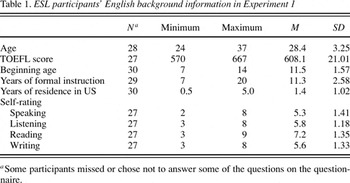
ESL participants' English background information in Experiment 1
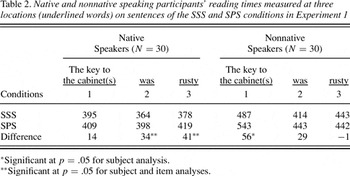
Native and nonnative speaking participants' reading times measured at three locations (underlined words) on sentences of the SSS and SPS conditions in Experiment 1
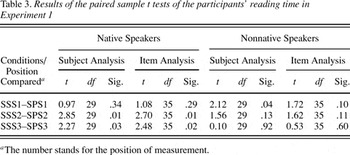
Results of the paired sample t tests of the participants' reading time in Experiment 1
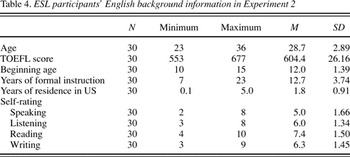
ESL participants' English background information in Experiment 2
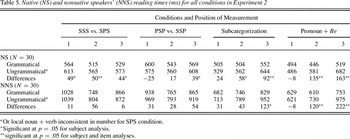
Native (NS) and nonnative speakers' (NNS) reading times (ms) for all conditions in Experiment 2
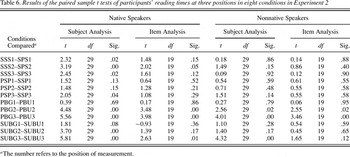
Results of the paired sample t tests of participants' reading times at three positions in eight conditions in Experiment 2
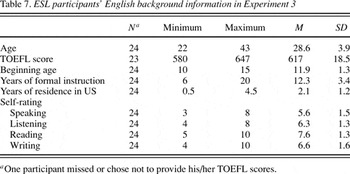
ESL participants' English background information in Experiment 3
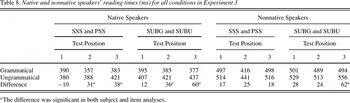
Native and nonnative speakers' reading times (ms) for all conditions in Experiment 3
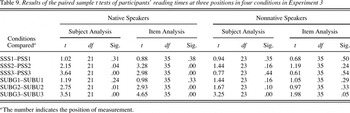
Results of the paired sample t tests of participants' reading times at three positions in four conditions in Experiment 3
 You have
Access
- 231
- Cited by