INTRODUCTION
Participatory plant breeding (PPB) combines the strengths of farmers and researchers and is particularly suited for breeding new varieties of crops for use by smallholders with low external inputs in developing countries (McGuire et al. Reference McGuire, Manicad and Sperling2003; Weltzien et al. Reference Weltzien, Smith, Meitzner and Sperling2003) and for organic or low external input farming systems in developed countries (Dawson et al. Reference Dawson, Murphy and Jones2008). It is considered to be highly client oriented (Baidu-Forson Reference Baidu-Forson1997; Witcombe et al. Reference Witcombe, Joshi, Gyawali, Musa, Johansen, Virk and Sthapit2005) and to be particularly appropriate for selecting cultivars for marginal agro-ecologies (Ceccarelli Reference Ceccarelli1994). Evolutionary PPB may be particularly useful for adapting to climate change (Ceccarelli et al. Reference Ceccarelli, Grando, Maatougui, Michael, Slash, Haghparast, Rahmanian, Taheri, Al-Yassin, Benbelkacem, Labdi, Mimoun and Nachit2010).
In Uganda, sweet potato is grown mainly for consumption as boiled roots by farming households and urban consumers. It is a smallholders’ crop and, apart from the pastoral north, it is grown throughout the country. Thus, the involvement of farmers in the process of breeding sweet potato was considered necessary. Researchers were also considered necessary because they could supply knowledge of the breeding process and also large quantities of seedlings, which rarely occur in farmers’ fields (Gibson et al. Reference Gibson, Jeremiah, Aritua, Msabaha, Mpembe and Ndunguru2000). A total of 53 useful varietal characteristics have been identified and ranked by sweet potato farmers in Uganda including those required for the physical environment, the existing cultivar diversity, market characteristics of the cultivar and other farmer-desired traits (Gibson et al. Reference Gibson, Byamukama, Mpembe, Kayongo and Mwanga2008). The majority of sweet potato farmers in Uganda are women (Bashaasha et al. Reference Bashaasha, Mwanga, Ocitti P'obwoya and Ewell1995), who often utilize a wider range of selective traits than men (Defoer et al. Reference Defoer, Kamara and De Groote1997). PPB is particularly appropriate due to the large number and diversity of desirable traits required (Sperling et al. Reference Sperling, Loevinsohn and Ntabomvura1993). This analysis led to the start of a PPB project in 2003 in Uganda (Gibson et al. Reference Gibson, Byamukama, Mpembe, Kayongo and Mwanga2008), culminating in the official release of a variety (Mwanga et al. Reference Mwanga, Kigozi, Namakula, Mpembe, Niringiye, Tumwegamire, Gibson and Yencho2010).
The variety, which was generated from true seed in 2003 and officially released in 2010 with the name of NASPOT 11, has been grown for some years by farmers, especially by those in the groups which participated in its breeding (Gibson et al. Reference Gibson, Byamukama, Mpembe, Kayongo and Mwanga2008). They named it Tomulabula, meaning, ‘Don't make anyone aware [that it is so good]’ and that name will be used in the current paper. Farmers were able to compare its suitability with that of other varieties including the popular researcher-bred cultivar NASPOT 1 (Mwanga et al. Reference Mwanga, Odongo, Turyamureeba, Alajo, Yencho, Gibson, Smit and Carey2003) and with their local landraces. This was done for each of the attributes identified by the farmers. Bishaw & Turner (Reference Bishaw and Turner2008) raised concerns that investments in PPB may not be fully realized unless the resulting cultivars were linked to both formal and informal seed systems. These were answered by the development of Tomulabula, involving a direct collaboration with Ugandan National Sweetpotato Program (UNSP) researchers from its outset.
MATERIALS AND METHODS
The individual seed from which Tomulabula was derived came from natural pollination of the Ugandan landrace cv New Kawogo, which is highly resistant to the sweet potato virus disease (SPVD), in the National Crops Resources Research Institute (NaCRRI)'s crossing blocks of elite exotic and local cultivars. It occurred within a population of 6000 seeds provided by NaCRRI UNSP researchers and germinated in 2003 by the Tusitukire wamu Kabulanaka Farmers’ Association (TUKAFA), a mixed-sex farmer group with particular interest in sweet potato, based in Luwero District. Plants obtained from cuttings of 2382 surviving seedlings had been selected down to 163, 67 and then 13 in clonal generations 1, 2 and 3, respectively, by the participating farmers. The 13 selected clones were then exchanged with 11 clones similarly obtained by a sister PPB farmer group, Balikyewunya Farmers Group (BFG) based in Mpigi District, and all 24 clones were trialled by both TUKAFA and BFG members in clonal generation 4 (Gibson et al. Reference Gibson, Byamukama, Mpembe, Kayongo and Mwanga2008). Based on the results of these trials, nine of the PPB clones were selected by UNSP and tested with other control cultivars (local controls, NASPOT 1, New Kawogo and/or Dimbuka) in on-farm trials planted in 2005–7 in five districts in Uganda at high- (Kabale) and mid-altitude and including agro-ecological zones with rainforest (Kiboga, Mpigi and Luwero) and tropical savannah (Soroti) climax vegetations. Six of the PPB clones were included in all on-station yield trials at four research stations covering similar agroecologies, at high- (Kachwekano) and mid-altitude including areas with rainforest (NaCRRI) and tropical savannah (Ngetta and Serere). Meanwhile, the farmers also continued testing the clones. These trials led to the official release of NASPOT 11 (Mwanga et al. Reference Mwanga, Kigozi, Namakula, Mpembe, Niringiye, Tumwegamire, Gibson and Yencho2010), otherwise known as Tomulabula.
Informal adoption and dissemination of Tomulabula by farmers involved in its selection occurred in Mpigi and Luwero, in the Central region of Uganda (Gibson et al. Reference Gibson, Byamukama, Mpembe, Kayongo and Mwanga2008). NASPOT 1, released in 1999 (Mwanga et al. Reference Mwanga, Odongo, Turyamureeba, Alajo, Yencho, Gibson, Smit and Carey2003), has become the most widely grown station-bred sweet potato cultivar in Uganda (Gibson et al. Reference Gibson, Byamukama, Mpembe, Kayongo and Mwanga2008) and also occurs commonly in these districts. In these districts, farmers always grew Dimbuka, a local landrace. Farmers in Mpigi and Luwero were asked to give their reasons for selecting or rejecting clones, for Tomulabula, NASPOT 1 and their main local landrace (Gibson et al. Reference Gibson, Byamukama, Mpembe, Kayongo and Mwanga2008), whether, in their experiences and experiments, the cultivar was: ‘Very Good’; ‘Good’; ‘Adequate’, ‘Bad’ or, ‘Very Bad’. The answers were recorded as: 2, 1, 0, −1, or −2, respectively. Frequencies of each score for each reason were compared between cultivars by the Chi-squared test. The farmers interviewed had either been involved in the selection of Tomulabula or lived nearby; 44 interviews involved women and 13 involved men farmers. Farmers also occasionally provided additional information about themselves and how Tomulabula had changed their lives. These were also recorded.
RESULTS
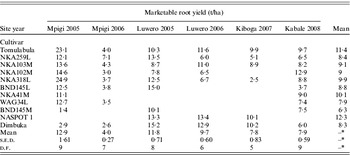
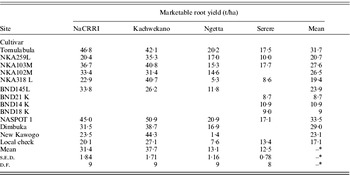
Tomulabula had a marketable yield that was as high as the researcher-bred variety, NASPOT 1, and sometimes higher (P=0·05) than Dimbuka and New Kawogo, two local landraces that have also been released by UNSP (Table 1). The other PPB-bred clones and the local check were generally lower (P=0·05) yielding.
Marketable yields on farm trials and on-station trials of Tomulabula, various other PPB clones, NASPOT 1, Dimbuka, New Kawogo and a local check
(a) On-farm trials in 2005, 2006, 2007 and 2008

* Please note no means, s.e.d. or d.f. in final column because layout is unbalanced: not all clones grown at all sites.
(b) On-station trials in 2006

(c) On-station trials in 2008

* Note no mean, s.e.d. or d.f. in final column because it is unbalanced: not all clones grown at all sites.
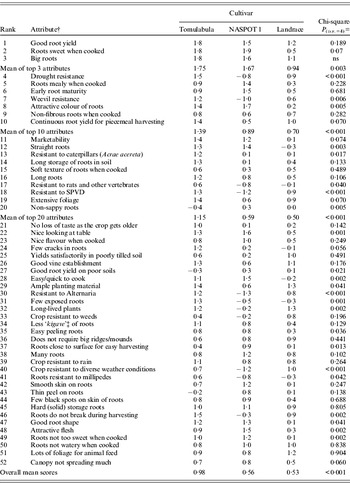
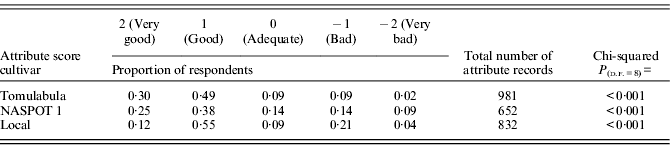
As regards the farmer-based attributes, Tomulabula had overall an average attributes score greater than that of either NASPOT 1 or the local cultivar (Table 2). Among the top three attributes, it was judged better for its roots being sweeter when cooked than the local cultivar. For the top 10 attributes, its score was greater than that of the local landrace and NASPOT 1 and it was greater than NASPOT 1 for such attributes as drought tolerance, weevil resistance and a continuous root yield for sequential harvesting. Its average for the top 20 attributes was also the greatest. Tomulabula was mostly (0·8 of respondents) given scores of 2 or 1 and seldom (0·02 of respondents) given a −2 score (Table 3); these last were for relatively lowly ranked attributes.
Average scores* given by farmers in Luwero and Mpigi districts to Tomulabula, NASPOT 1 and their main landrace, generally Dimbuka

* For each attribute, farmers were asked to score each cultivar as: Very Good (2), Good (1), Adequate (0), Bad (−1) or Very Bad (−2). Numbers of women and men farmers interviewed, Luwero, n=51 (13 men, 38 women); Mpigi, n=6 (all women). Total interviews: NASPOT 11=22, NASPOT 1=13, local check, mainly Dimbuka=22. Most farmers grew all three cultivars and so were interviewed sequentially for each.
† In the original listing and ranking of attributes, ‘Orange/yellow flesh’ was ranked 47th (Gibson et al. Reference Gibson, Byamukama, Mpembe, Kayongo and Mwanga2008). However, since none of the three cultivars is orange or yellow fleshed, this attribute was excluded from the comparison.
‡ ‘Kigave’ is a blackening in the roots when cooked.
The different proportions of scores for attributes given to each cultivar by farmers
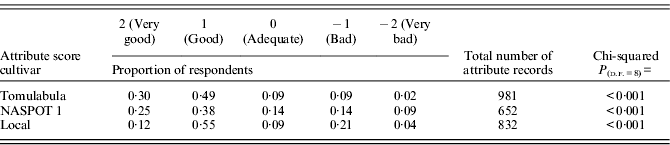
NASPOT 1 was not better than the local cultivar for the top 10 or 20 attributes or overall but it was better for the top three attributes (Table 2). For individual attributes it scored highly, for example, its early, good yield of attractive, sweet, mealy, non-fibrous, large roots. Although it had a similar score for these as Tomulabula, for several it scored higher than the local cultivar. However, it also scored very poorly for other attributes, 0·09 of respondents scoring −2 (Table 3).
The local cultivar had only a moderate performance for almost all attributes, most often being scored as ‘Good’ (1) among the cultivars but never gaining an average score >1·3 or <−0·3 for any individual attribute (Table 2) and being given relatively few individual scores of 2 (0·12 of respondents) or of −2 (0·04 of respondents) (Table 3). Noteworthy are its good scores for yield and for size of its roots, and for its robustness (good establishment; extensive, long-lived foliage providing ample planting material and animal feed; weed tolerance; drought and disease resistance).
Most of the scores given by farmers for different attributes of NASPOT 1, Tomulabula and the local cultivar were consistent with results from researchers’ field trials (Mwanga et al. Reference Mwanga, Kigozi, Namakula, Mpembe, Niringiye, Tumwegamire, Gibson and Yencho2010) if that attribute had been scored (most had not). An exception was the low score for SPVD resistance given only by farmers to NASPOT 1 and may have resulted from confusing Alternaria disease (to which it is very susceptible) and SPVD.
Observations made during interviews
Many of the individuals interviewed also mentioned economic benefits obtained from Tomulabula and customers were seen paying twice as much for roots of Tomulabula as for those of other varieties on sale in a local market. Two outstanding examples recounted that during one growing season:
• Two farmers jointly sold a total of 32 sacks (about 3·2 t) of sweet potato roots for 672 000 Ugandan Shillings (=US$363) as well as 50 sacks of vines to a Ugandan NGO (Buganda Cultural and Development Foundation: BUCADEF), yielding 250 000 shillings (=US$135);
• One farmer sold 29 sacks of roots for 580 000 shillings (=US$313) as well as 21 sacks of vines for 105 000 shillings (=US$57)
Of the two farmers from Luwero District, one bought a plot of land in Ntinda (a Kampala suburb) and the other bought land in Mukono town. The farmer who bought land in Mukono said: ‘I've made it; I'm no longer the type of person to push around like a devil because I'm now a landlord. Thanks for bringing us this high yielding sweet potato’. A woman farmer from Luwero said: ‘At the moment, conditions are not bad; I managed to start a food kiosk in Zirobwe from the cash I obtained from the sale of our sweet potato’. Another woman farmer said: ‘Now when the sweet potato season comes, it becomes unnecessary to beg for money from men for home necessities. Now I can easily buy myself clothing and the husband's money is used for other things’. Other benefits that accrued to the farmers included buying household items such as furniture, kitchen utilities, paying medical bills for the family and providing feed for animals such as cows and pigs. One pig farmer from Mpigi said: ‘Apart from being high yielding, this sweet potato cultivar known as Tomulabula has a lot of vegetation which we use to feed our animals’. Another farmer used her earnings to buy 16 corrugated iron sheets to roof her house, saying: ‘I am happy because I have recently roofed my house using the money obtained from the sale of sweet potato which we bred ourselves’. As well indicating economic benefits, many of these statements also identified the personal importance to the farmers of breeding Tomulabula.
DISCUSSION
Overall, Tomulabula appears to be a very good ‘all-rounder’ cultivar, scoring highly for most attributes (Tables 1 and 2) and rated ‘Very Bad’ for few attributes (Table 3). In contrast, NASPOT 1 appears to be a more ‘specialist’ cultivar, scoring highly for most of the highly ranked attributes such as an early, good yield of sweet, mealy, non-fibrous, large roots (Tables 1 and 2) but was also rated as ‘Very Bad’ for several attributes (Table 3), especially lower-ranked ones or those difficult to measure on-station. The local cultivar appears to be an adequate ‘all-rounder’, yielding less well (Table 1) and scoring lower than Tomulabula (Table 2), but having mostly ‘Good’ scores, few ‘Very Bad’ ones but also relatively few ‘Very Good’ scores (Table 3).
The ‘all-rounder’ aspects noted for Tomulabula and the local cultivar are consistent with farmers having the time, opportunity and experience to select the broad range of attributes they need in a cultivar for its production, household use and marketing. Some researchers, particularly when working on-station, may have the time and resources to evaluate only key and easily scored attributes or focus on particular attributes such as high early yield or those associated with disease susceptibility (Haugerud & Collinson Reference Haugerud and Collinson1990); this may partly explain why NASPOT 1 is less of an all-rounder. Conditions on-farm may also differ considerably from those on research stations, genotype×environment interactions potentially resulting in cultivars selected on-station being poorly adapted to conditions on-farm (Banziger & Cooper Reference Banziger and Cooper2001; Ceccarelli et al. Reference Ceccarelli, Grando, Singh, Michael, Shikho, Al Issa, Al Saleh, Kaleonjy, Al Ghanem, Al Hassan, Dalla, Basha and Basha2003).
The large number of ‘Very good’ scores given to Tomulabula and NASPOT 1 are also consistent with the benefits expected to be provided by the ample supply of superior seed stocks produced by researchers from a crossing block of carefully selected parental material (which compares starkly with the lack of natural seedlings in farmers’ fields and farmers’ general ignorance of breeding (Gibson et al. Reference Gibson, Jeremiah, Aritua, Msabaha, Mpembe and Ndunguru2000)). Most of the attributes for which NASPOT 1 scored particularly poorly are logistically difficult to evaluate by researchers, for example, ‘Continuous root yield for sequential harvesting’, ‘Long-lived plants’ and ‘Long storage of roots in soil’ before harvest (Gibson et al. Reference Gibson, Byamukama, Mpembe, Kayongo and Mwanga2008). Vice versa, most of the attributes for which NASPOT 1 scored particularly well are logistically easy to evaluate by researchers, for example, the quantity and qualities of its yield. As Sperling et al. (Reference Sperling, Loevinsohn and Ntabomvura1993) explain, ‘Breeders have access to ‘exotic’ materials and knowledge … They are able to screen a large range of international and national germplasm for yield potential, as well as for response to stresses, most particularly pathogens, which may not be fully comprehended by farmers. Farmers have the edge in much that is local, ‘indigenous’ or practical. They cultivate in several soil types, varying associations and different seasons. Further, farmers are astute judges of local socio-economic variability’. This view has, however, seldom been demonstrated numerically and the present data for the PPB-bred Tomulabula are therefore important in supporting it.
The efficacy of informal distribution of planting material farmer-to-farmer can be over-estimated (Almekinders et al. Reference Almekinders, Thiele and Danial2007) but, at least for short distances, seems to be quite effective for sweet potato in Uganda. Farmers often mentioned passing on or receiving planting material of Tomulabula, occasionally even mentioning transfers to relatives living in other counties or districts. Farmer sales of large quantities to an NGO for distribution to other farmers in Luwero also occurred. This situation seems to resemble that reported for farmer-selected rice cultivars in Nepal, farmer-to-farmer spread (often within extended families) being coupled with dissemination by NGOs prior to release (Joshi et al. Reference Joshi, Sthapit and Witcombe2001). Although official release of Tomulabula occurred only in 2010, some 7 years after it was generated from true seed, PPB allowed farmers very early access to the planting material and so they have been growing and distributing the clone widely for at least the last 4 years (Gibson et al. Reference Gibson, Byamukama, Mpembe, Kayongo and Mwanga2008), a benefit noted in other programmes (Joshi et al. Reference Joshi, Sthapit and Witcombe2001; Witcombe et al. Reference Witcombe, Joshi and Goyal2003; Manu-Aduening et al. Reference Manu-Aduening, Lamboll, Ampong Mensah, Lamptey, Moses, Dankyi and Gibson2006).
The large amount of planting material consequently now available to farmers is important as returns tend to increase as the time to release a cultivar to farmers is reduced (Brennan & Morris Reference Brennan, Morris, Reynolds, Ortis-Monasterio and McNab2001). For example, completing a rice-breeding cycle 2 years earlier gained US$18 million benefit for rice in Thailand (Pandey & Rajatasereekul Reference Pandey and Rajatasereekul1999). Release by NaCRRI provides a guaranteed source of planting material for government, NGO and commercial agents within Uganda. All these factors should help allay concerns that PPB cannot achieve maximum returns on the investment and in a short timescale (Bishaw & Turner Reference Bishaw and Turner2008). Its release also counters concerns about delays in institutionalization of PPB including barriers to release (McGuire Reference McGuire2008; Belay Reference Belay2009).
We particularly thank the farmers who contributed to the selection of Tomulabula. We also acknowledge the financial support of the McKnight Foundation, the UK Department for International Development (DFID) and the Biological and Biotechnology Science Research Council (BBSRC) through their Sustainable Agricultural Research for Development (SARID) programme project BB/F004028/1.