


Prior to the COVID-19 pandemic, respiratory viruses were responsible for >50% of lower respiratory tract infections (LRTIs) in adults. Reference Pavia1 Rapid diagnosis of viral LRTIs can expedite discontinuation of unnecessary antibiotics, inform antiviral use for influenza A/B infections, and guide infection control decisions. Reference Vos, Weehuizen, Hoepelman, Kaasjager, Riezebos-Brilman and Oosterheert2,Reference Barlam, Cosgrove and Abbo3 Accordingly, national guidelines for antimicrobial stewardship programs (ASPs) have recommended the use of rapid viral testing for detection of respiratory pathogens to improve antibiotic use, although the recommendation is weak. Reference Barlam, Cosgrove and Abbo3
Although some published evidence supports the use of molecular respiratory viral panels (RVPs) to reduce unnecessary antimicrobial use in LRTIs, guidance on how clinical microbiology laboratories should deploy RVPs to maximize their impact on ASP outcomes is limited. Additionally, the best way to maximize the impact of the newer “Pneumonia” panels that detect both bacterial and viral agents of LRTI remains unclear. Reference Sullivan and Dien Bard4,Reference Babady, England and Jurcic Smith5 We conducted a survey to describe the use of RVPs and their perceived impact on ASP outcomes among acute-care hospitals within the Society for Healthcare Epidemiology Research Network (SRN).
Methods
Survey design and administration
We developed a 32-item survey to explore diagnostic and antimicrobial stewardship practices related to rapid molecular respiratory diagnostics, defined in the survey as turnaround time of <8 hours. The survey recorded demographic characteristics of respondent institutions; laboratory practices pertaining to specimen collection and respiratory viral testing; ASP practices, and perceived impact on antibiotic use. Only 1 SHEA member at each Society for Healthcare Epidemiology Research Network (SRN) site completed the survey, but respondents were advised to consult their laboratory, infection prevention, and antimicrobial stewardship colleagues as needed. The survey was e-mailed to members of the SRN on 2 occasions, and responses were accepted between December 2019 and March 2020. Survey data were collected electronically through REDCap and were analyzed using Excel (Microsoft, Redmond, WA) and SAS version 9.4 software (SAS Institute, Cary, NC).
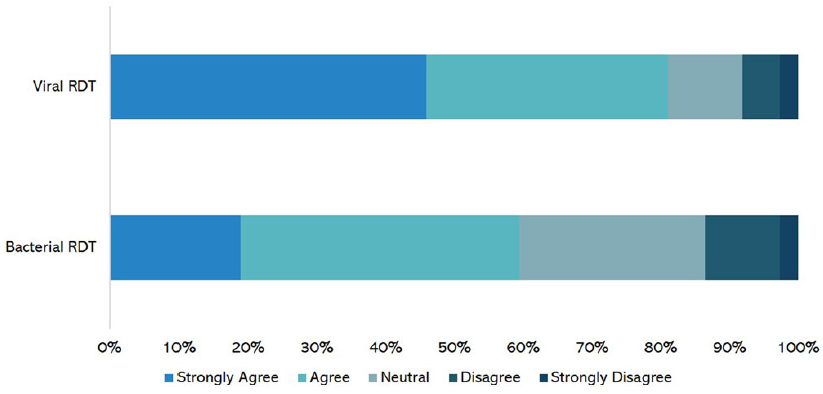
Perceived Importance of Molecular Respiratory Panels to Antimicrobial Stewardship Programs. Responses based on level of agreement with the following statements: Rapid diagnostic testing for the management of viral [or bacterial] respiratory infections is an important tool for Antimicrobial Stewardship Programs.

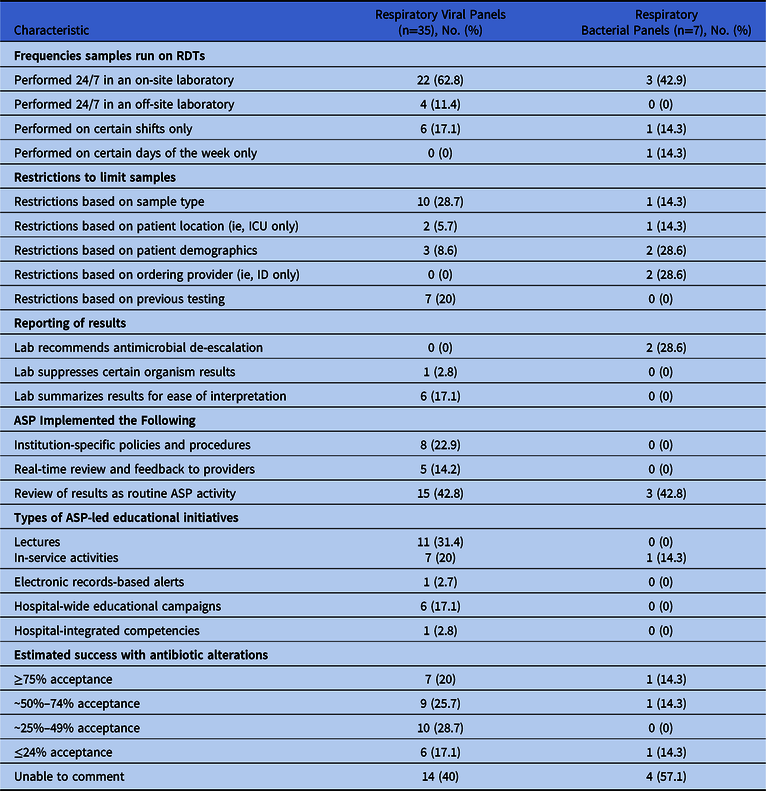
Respiratory Diagnostic and Antimicrobial Stewardship Practices Among Survey Respondents

Note. RDT, rapid diagnostic test; ASP, antimicrobial stewardship program.
Results
Survey demographics
Detailed survey results are summarized in the supplementary materials (online). The survey was completed by 37 of 70 eligible members of the SRN, for a response rate of 53%. Survey questions and response frequencies are summarized in the supplementary material (online). All respondents were based in the United States and Canada and most (n = 28, 75.6%) described their institution as an academic medical center with >400 adult beds. Among respondents, 13 (35.1%) were primarily involved in ASP activities; 13 (35.1%) in consultative infectious diseases service (n = 13, 35.1%); and 11 (29.8%) in infection prevention activities (n = 11, 29.8%).
Respiratory viral panel ordering and utilization
Most institutions reported using an RVP assay (n = 35, 94.5%), but few reported the availability of an expanded pneumonia panel (n = 7, 18.9%) (Table 1). BioFire FilmArray RVP (bioMérieux, Durham, NC) was the most common system in use (n = 25, 71.5%) followed by the Verigene RP system (Luminex, Northbrook, IL; n = 4, 11.4%). The remainder of responses are detailed in the supplementary material. Most respondents reported that their institution had published guidance about when to order RVP testing (n = 21, 60%) and reported restrictions to limit inappropriate testing (n = 19, 54%). Among these respondents, 10 (53%) indicated that restrictions were based on sample type (eg, NP swabs only) and 7 (37%) reported restrictions designed to reduce duplicate testing. Restrictions were enforced by the laboratory at 11 institutions (58%), and 4 respondents (21%) reported that orders were blocked at the ordering stage by the electronic health record or computerized physician order entry system.
Laboratory RVP specimen processing
Many respondents indicated that RVP is performed 24/7 on-site (n = 22, 62.9%), and 8 additional respondents (22.9%) reported that RVP processing was restricted to certain days or shifts. At almost all institutions, results were reported in the electronic health record (n = 34, 97.1%). Additional communications to the patient’s clinical team (n = 2, 5.7%); the ASP personnel (n = 2, 5.7%); or the infectious diseases team (n = 1, 2.9%) were uncommon.
Antimicrobial stewardship practices
Less than half of respondent institutions (n = 15, 42.9%) reported review of RVP results as part of routine ASP activities, and only 5 (14.3%) indicated that they perform real-time audit and feedback based on RVP results. Some (n = 15, 42.9%) reported ASP-led educational activities related to appropriate interpretation of RVPs. Of these, discrete education sessions were most common: lectures were described by 11 respondents (73.3%) and in-service activities were reported by 7 respondents (46.6%). Policies, procedures, or pathways to guide response to RVP test results were rare (n = 3, 8.6%). When asked how successful their institution was at de-escalating antibiotics based on RVP results, 14 (40%) indicated that they were “unable to comment” (Fig. 1).
Expanded pneumonia panels
All 7 institutions using an expanded pneumonia panel reported use of the Biofire FilmArray Pneumonia Panel (bioMérieux, Durham, NC). Only 4 institutions reported having written guidance stating how and when to obtain samples. Furthermore, 2 respondents (28.6%) reported that the clinical microbiology laboratory automatically performs cultures in addition to the molecular pneumonia test. Also, 5 respondents (71.4%) stated that results are reported directly in the patient electronic health record; 4 respondents reported some form of ASP-led response to pneumonia panel results; and 2 institutions (28.6%) reported ASP-led educational initiatives.
Discussion
Use of molecular RVPs was common among SRN hospitals, but antimicrobial stewardship activities in response to RVP results were not. Only 5 respondents reported real-time review and feedback based on RVP results. One-third of respondents indicated that testing was performed off-site or limited to certain shifts or days. In addition, 40% of respondents indicated that they were unable to comment on how successful their ASP was at leveraging RVP results to reduce antimicrobial use. One notable limitation of the current study is the limited representation of nonacademic affiliated hospitals.
Vos et al Reference Vos, Weehuizen, Hoepelman, Kaasjager, Riezebos-Brilman and Oosterheert2 recently published a meta-analysis that examined studies that had investigated the impact of RVPs on clinical outcomes in LRTIs. After statistically combining 63 studies, 15 of which included clinical outcomes, they reported that RVPs did not reduce antibiotic prescribing or duration of antibiotic administration. The negative results may have dampened enthusiasm toward the use of RVP to pursue ASP outcomes. One study that did show reduced antibiotic use had results of RVP prospectively reported by the investigative team who also actively questioned the ordering provider about planned changes in medical management based on the RVP results. Reference Echavarría, Marcone and Querci6,Reference Weiss, Cunha and Chambers7 In addition to a lack of active review and feedback, other possible reasons for the lack of impact of RVPs on ASP outcomes have been proposed, such as long testing turnaround times and a lack of institution-specific algorithms. Reference Weiss, Cunha and Chambers7 Finally, it is also possible that for RVPs to reduce unnecessary antibiotic use, a coordinated effort of a variety of different ASP initiatives may be required. With only 7 respondents reporting the use of an expanded pneumonia panel, it was difficult to draw conclusions about their utilization and clinical impact. Literature on the expanded bacterial panel is currently limited to theoretical assessments of potential impact. Reference Buchan, Windham and Balada-Llasat8
Although national guidelines for implementing ASPs recommend the use of molecular diagnostics for respiratory viruses to reduce inappropriate antibiotics, Reference Barlam, Cosgrove and Abbo3 the real-world impact of their use on ASP metrics such as antibiotic use, as assessed by our survey, appears to be limited. Control of inappropriate antibiotic use in adult LRTIs is becoming increasingly important in the era of COVID-19, with several reports of unnecessary use of broad-spectrum antibiotics. Reference Spernovasilis and Kofteridis9,Reference Langford, So and Raybardhan10 Going forward, molecular tests that detect both traditional respiratory viruses and SARS-CoV-2 may play a key role in reducing unnecessary antibiotic exposure; however, better integration with hospital ASP and clinical guidelines is required. Using this survey, we identified a number of important diagnostic and antibiotic stewardship opportunities that acute-care hospitals can leverage to control broad-spectrum antibiotic use.
Supplementary material
To view supplementary material for this article, please visit https://doi.org/10.1017/ice.2020.1328
Acknowledgments
Special thanks to Dr. Ana D Vega for review and suggestion of survey question content.
Financial support
No financial support was provided relevant to this article.
Conflicts of interest
K.C.C. received study supplies from BioFire and GenMark Diagnostics and served as a speaker for Luminex Corporation and GenMark Diagnostics. All other authors have no conflicts to report.