Introduction
Young people use the Internet and mobile phones as a means of communicating with others, for education and for entertainment. There are many advantages of cyber technology, such as relieving social anxiety and increasing social communication in young people, who otherwise would not engage in such social interaction (Subrahmanyam & Greenfield, Reference Subrahmanyam and Greenfield2008). The majority of Internet users are <25 years of age. It appears that middle childhood (8–12-year olds) and adolescents (10–16-year olds) are driving the market and development of cyber communication devices. Increasingly, younger children have their own mobile phones and are using voice, text, pictures and websites as means of communication.
However, research also suggests that Internet and mobile phone use among young people can contribute to problems such as cyberbullying (Wagner, Reference Wagner2007). Adolescence is a time when bullying is reported to be at its peak (Pellegrini etal. Reference Pellegrini, Bartini and Brooks1999). A person is being bullied (in the traditional sense), when he or she ‘is exposed repeatedly over time, to negative actions on the part of one or more people. The person who intentionally inflicts or attempts to inflict injury or discomfort upon someone else is engaging in negative actions’ (Olweus, Reference Olweus2003).
Traditional bullying in schools has been studied extensively in the last two decades, and as a result many schools have developed effective anti-bullying programmes. However less is known about cyberbullying, as it is a relatively new form of bullying (Li, Reference Li2007).
Definition of cyberbullying: ‘Cyberbullying involves the use of information and communication technologies such as e-mail, mobile phone and pager text messages, instant messaging, defamatory personal websites and defamatory online personal polling websites, to support deliberate, repeated and hostile behaviour by an individual or a group, that is intended to harm others (Belsey, Reference Belsey2000–2009).
Cyberbullying mechanisms have been classified by Willard (Reference Willard2007), Executive Director of The Centre for Safe and Responsible Internet Use. These are as follows:
Flaming: Rude messages sent to a group or victim themselves by text message or email.
Online harassment: Repeatedly sending rude or abusive messages to a victim by email or text messages.
Cyberstalking: Online harassment that includes threats of harm or is excessively intimidating.
Denigration(put-downs): Sending harmful or cruel statements about a person, to other people, or posting such material online.
Masquerade: Pretending to be someone else and sending or posting material that makes that person look bad.
Outing: Sending or posting material about a person that contains sensitive, private or embarrassing information, including forwarding private messages or images.
Exclusion: Cruelly excluding someone from an online group.
Cyberbullying in comparison with traditional bullying, can pose the added disadvantage for the victim in that the perpetrator can remain anonymous. The perpetrator is often unaware of the full effects of cyberbullying on the victim as there is no face-to-face contact. This makes the perpetrator less likely to regret his or her actions (Tani etal. Reference Tani, Greenman, Schneider and Fregoso2003). Victims of cyberbullying often feel alone and helpless, whereas perpetrators can become increasingly aggressive in the anonymity of cyberspace. Perpetrators of cyberbullying sometimes use fictitious usernames and anonymous websites. It can also be very difficult to take down certain websites under freedom of speech rights. Combating cyberbullying is becoming more difficult for parents and educators than initially expected. Schools today, while trying to preserve the significant contributions this technology has brought to education and social connection, are also trying to control the harmful uses of electronic media, while children are at school (Subrahmanyam & Greenfield, Reference Subrahmanyam and Greenfield2008).
Culture is related to bullying and young people from different cultures behave differently with regard to bullying. Cyberbullying is reported to be most prevalent in Europe, North America and Japan and is more prevalent in male students than female students (Pellegrini etal. Reference Pellegrini, Bartini and Brooks1999). In a study by Li (Reference Li2007), which was conducted in the University of Calgary in 2005, up to 1/3 of 12–14-year-old students had been cyberbullied and up to 80% knew someone who had been cyberbullied. Also in this study, 1 in 3 young people was cyberbullied, 1 in 5 was a perpetrator of cyberbullying, and >50% had experienced or heard about cyberbullying incidents.
In the United Kingdom (National Children's Home Survey, 2005), it was reported that 25% of young people aged between 11 and 19 had been cyberbullied. In the United States, it has been reported that 29% of eighth grade students admitted to being victims of cyberbullying, 24% had bullied someone online and 80% were aware of someone who was being cyberbullied (Winter & Leneway, Reference Winter and Leneway2007).
In a recent Irish Study, involving 876 teenagers aged 12–16, 6.3% said they had been cyberbullied in the previous 2–3 months. This compared with higher figures for Britain (22%) and Canada (55%). Social networking sites were more commonly used to cyberbully than email or mobile phones (Connor etal. Reference Connor, Corcoran and O'Moore2009).
In another Irish study on 2794 Irish students, 1 in 7 reported being cyberbullied in the previous 2 months, and 1 in 11 reported being involved in cyberbullying others in the previous 2 months (O'Moore & Minton, Reference O'Moore and Minton2010).
Up to half of those who are cyberbullied admit that this is accompanied by traditional bullying (Beran & Li, Reference Beran and Li2007). Engagement in bullying activities is hypothesised to predict cyberbullying and cybervictimisation. Victims of physical bullying are more likely to be the victims of cyberbullying and alternatively, those who have traditionally bullied people in the past are more likely to become cyberbullies (Li, Reference Li2007).
Bullying has an association with depression and suicidal behaviour in adolescents (Klomek etal. Reference Klomek, Marrocco and Kleinman2007). The risk of depression, suicidal ideation and suicide attempt is significantly higher for young people who are considered either a victim or a perpetrator of bullying, compared with young people who are not. The more frequent the bullying behaviour (either as a victim or perpetrator), the greater the risk of depression, suicidal ideation and suicide attempts (Wagner, Reference Wagner2007). Cyberbullying is associated with emotional problems, depression, suicidal thoughts and decreased academic performance (Beran & Li, Reference Beran and Li2005). Young people, who are the victims of cyberbullying, are more likely to participate in deviant or delinquent behaviour, as a means of coping with how they feel (Patchin, Reference Patchin2006). In a Swedish study by Olweus Reference Pellegrini, Bartini and Brooks(1993), 60% of boys who were bullied had one or more criminal convictions by the age of 24 and 35–40% had three or more criminal convictions.
There have been to date, no Irish studies looking at the effects of cyberbullying on the mental health of young people. This study is of particular importance in looking at cyberbullying and its association with mental health difficulties in young people in Ireland. The Strengths and Difficulties Questionnaire (SDQ) is the screening tool that has been used in this study to help establish its results.
Aim of study
To examine the prevalence and nature of Internet and mobile phone use in a community-based population of Irish adolescents. The main aim is to focus on in particular, cyberbullying and its potential effects on young people's mental health.
Hypothesis
It is hypothesised that cyberbullying can have a negative effect on the mental health of young adolescents. The SDQ can help detect mental health problems in children and adolescents. It is hypothesised that a higher proportion of pupils who are cyberbullied score in the Abnormal/Borderline range of the SDQ, compared with those who are not cyberbullied.
Methodology
Ethical Approval was granted for the study by the Local Hospital's Research Ethics Committee. Three secondary schools in an area of North Dublin were randomly selected using stratified randomisation, which included one all boys school, one all girls school and one co-educational school. All schools were located within an approximate 2-mile radius of each other in the vicinity of an urban area of North Dublin. Pupils in first and second year in each of the three schools were invited to participate in the study. Therefore those pupils not in first and second year in each school were excluded from the study. The researcher approached each school principal. Written information about the study was given to each school principal and to parents/guardians of all first and second year pupils aged 12–15 years. Written consent was sought from each principal and all parents/guardians of the pupils before their child's participation in the study.
Parents/guardians were asked to sign and return the consent forms to the school principal, if they agreed for their child to participate in the study. Each young person also gave their consent before participation in the study.
Two self-report questionnaires were completed by each participant in the classroom setting during school hours. The researcher was present while young people completed the survey. The participants completed the survey by themselves and the researcher was available to assist with any questions the participants had. The researcher was the only person to know the identity of the pupils. The instruments used were:
A Questionnaire on Cyberbullying
This questionnaire asked a total of 45 questions. Most questions required ‘yes or no’ answers and some questions were qualitative in nature.
There were 20 questions on Internet use, which asked about time spent on the Internet, supervision, sites accessed, whether the young person had been cyberbullied and what kind of cyberbullying occurred. Each participant if cyberbullied was asked whether they knew the identity of the perpetrator. Participants were also asked whether they knew anyone who had been cyberbullied or if they had cyberbullied anyone in the past.
There were 21 questions on mobile phone use, which were similar to the questions on Internet use. There was one question on both Internet and mobile phone use.
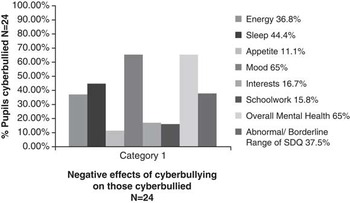
There were two questions focusing on the effects of cyberbullying on participants’ mental health. As illustrated in Fig. 1: one of these questions had five subsets, which asked the participant whether they thought that cyberbullying had a negative effect on their mood, interests, energy levels, sleep and appetite, and one question asked the participants whether they thought that cyberbullying had a negative impact on their overall mental health.
The percentages of participants who reported cyberbullying having a negative impact on areas of their mental health and schoolwork.

One question asked the participants whether they thought that cyberbullying had a negative effect on their schoolwork.
The Self-Report Version of the SDQ (Goodman, Reference Goodman1997)
The SDQ is a brief behavioural screening questionnaire suitable for young people aged 11–17. The SDQ can help detect mental health problems in children and adolescents and is a good screening tool for detecting generalised psychopathology in young people. It has good reliability with the range of test–retest value between 0.70 and 0.85, and the range of internal consistency ranging from 0.51 to 0.76. Criterion validity is also acceptable.
Several versions of the SDQ exist. For the purpose of this study, the self-report version was used. All versions of the SDQ ask five attributes divided between five scales, which include emotional symptoms, conduct problems, hyperactivity/inattention, peer relationship problems and pro-social behaviour. The SDQ also has a total score for the range of overall difficulties.
It was agreed that the researcher would liaise with a nominated professional in each of the schools if the researcher had concerns about any of the answers in the questionnaires. The pupils were made aware that they could speak to the nominated professional in their school about any concerns they had after completion of the survey. Appropriate follow-up could be arranged if necessary, for example contacting a participant's parents with the concern and offering advice on how to follow this up. Each participant and his/her parents were made aware of this before taking part in the study. Participants were aware that if there was a concern, this could affect their anonymity. No concerns were raised by the researcher, any nominated professional or the participants. All data collected from the study were placed in sealed envelopes and held by the researcher.
Statistical analysis
Statistical analysis included the use of independent samples t-tests and χ 2-tests. χ 2-tests of association were used to look at the association between cyberbullying and self-reported mental health difficulties on the cyberbullying questionnaire. T-tests were used to compare means of SDQ scores and their association with cyberbullying. Demographics analysed included gender, age, nationality, school attended and year in school.
Results of cyberbullying study
Prevalence and nature of cyberbullying
705 pupils were eligible to participate in the study. A total of 130 pupils completed the study (which was 18.5% of those who were eligible), which included 37 pupils from the all girls school (28.4% of participants), 55 pupils from the all boys school (42.3% of participants) and 38 pupils from the mixed school (29.2% of participants).
On average, participants spent 8 hours per week using the Internet and 12 hours using their mobile phones. The average age of a young person when they got their first mobile phone was 9.5 years of age.
A total of 28 (30%) participants reported being supervised when using the Internet. Of those, 26 (20% of all participants) said that they were supervised some of the time and 2 (1.5% of all participants) said that they were supervised all of the time when using the Internet.
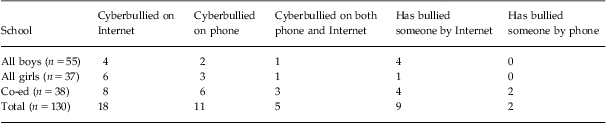
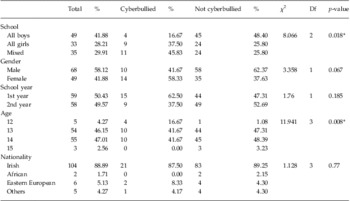
As shown in Table 1, a total of 24 pupils (18.46%) were cyberbullied. Of the 24 pupils who were cyberbullied, 15 were female and 9 were male. A total of 16 were in first year and 8 were in second year.
The number of pupils who were cyberbullied or cyberbullied others in each of the schools
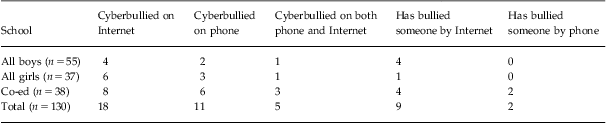
As illustrated in Table 2, the highest proportions of those cyberbullied were in the co-educational school (45.83%) and the all girls school (37.5%), compared with 16.67% in the all boys school. Overall, more female pupils than male pupils reported being cyberbullied: (M = 41.67% and F = 58.33%). Cyberbullying was most frequently reported in 13 and 14 year olds (41.67%) and those in 1st year. 3 of those who were cyberbullied were not of Irish ethnicity.
Demographic variables of participants compared with rates of cyberbullying

11 out of 130 (8.4%) participants said that they had cyberbullied someone in the past. 6 participants admitted that their reason for cyberbullying someone was because they were angry with the person. 3 participants said that they cyberbullied to take revenge on their victim. The Internet sites most frequently implicated in cyberbullying included MSN, Bebo, Facebook and Youtube. Of the 24 (18.46%) participants who were cyberbullied, 16 reported being cyberbullied in the previous 6 months and 5 reported being cyberbullied for more than 1 year.
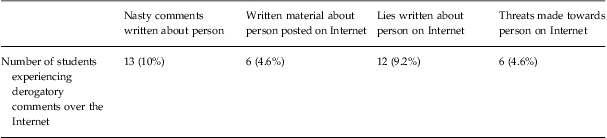
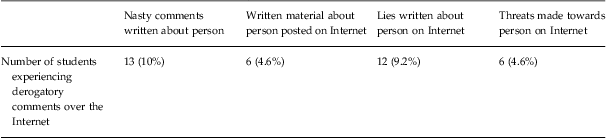
Table 3 below outlines the different types of cyberbullying experienced by participants.
Types of cyberbullying that occurred using the Internet
Of the participants, 36 (30.6%) said that they had been traditionally bullied in the past. Of those, 19 also reported being cyberbullied. Therefore, 52.7% of those who were traditionally bullied were also cyberbullied.
Of the participants who were cyberbullied, 62.5% reported that they had informed a parent, 20.8% informed a friend and 0.4% informed a sibling; 19 participants who reported being cyberbullied, knew the identity of the person who had bullied them and six of these participants said that the person who cyberbullied them was in their class at school.
Of the participants, 22 (16.9%) said that they knew of at least one person aged between 12 and 16 currently being cyberbullied on the Internet. Thirteen (10%) participants said that they knew of someone between the ages of 12 and 16 being cyberbullied by mobile phone.
Effects of cyberbullying on mental health of participants
As outlined in Fig. 1, of the participants who were cyberbullied, 13 (65%) said that it had a negative effect on their mood, 3 (16.7%) reported that it had a negative effect on their interests, 7 (36.8%) reported that it had a negative effect on energy levels, 8 (44.4%) said that it had a negative effect on their sleep, 2 (11.1%) reported that it had a negative effect on their appetite and 9 (45%) said that cyberbullying had a negative effect on their overall mental health. 3 (15.8%) participants said that cyberbullying had a negative effect on their schoolwork.
All 130 participants completed the SDQ. Out of the 24 young people who were cyberbullied, a total of 9 (37.5% of those cyberbullied) scored in the Abnormal/Borderline range of the SDQ. 8 of the 9 young people scored in the Abnormal range, and 1 of the 9 scored in the Borderline range. This compares with a total of 12 (13.2%) who scored within the Abnormal/Borderline range and said that they were not cyberbullied (6 in the Abnormal range and 6 in the Borderline range).
Statistical analysis
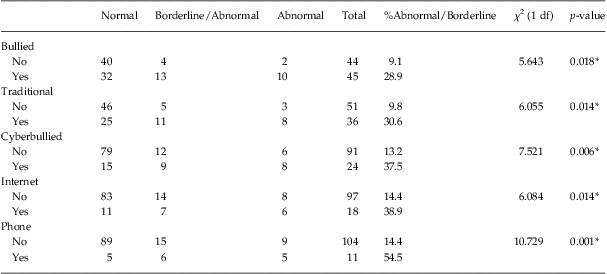
As illustrated in Table 4, a statistically significant proportion of participants who were cyberbullied scored in the Borderline/Abnormal range of the SDQ compared with those who were not cyberbullied (p = 0.006). Results were also statistically significant for those who were cyberbullied by Internet (p = 0.014), by phone (p = 0.001), traditionally bullied (p = 0.014) and bullied overall (0.018).
Statistical analysis of those bullied compared with SDQ results
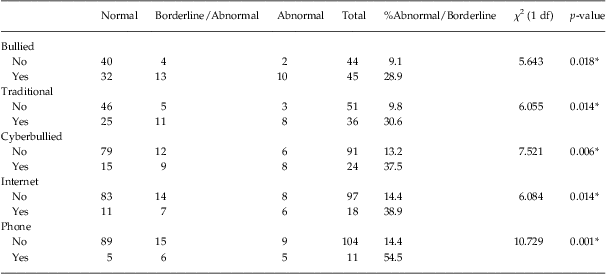
SDQ, Strengths and Difficulties Questionnaire.
t-tests are comparing Normal versus Borderline/Abnormal.
p-values indicate a different percentage of Normal and of Borderline/Abnormal scores of SDQ.
There were statistically significant differences between those cyberbullied and those not cyberbullied on the SDQ – Emotional Scale score [t(114) = 3.31, p = 0.001], the SDQ – Conduct Scale score [t(114) = 2.691, p = 0.008] and the SDQ – Total Difficulties Scale score [t(114) = 3.06, p = 0.003].
There was not a statistically significant difference between those cyberbullied and those not cyberbullied on the SDQ – Pro-Social Scale score [t(114) = 0.781, p = 0.436], the SDQ – Peer Scale score [t(114) = 1.34, p = 0.183] and the SDQ – Hyperactivity Scale score [t(114) = 1.14, p = 0.257].
There were statistically significant differences between those cyberbullied and those not cyberbullied on the self-reported questions on mood (p = 0.035), sleep (p = 0.027) and energy levels (p = 0.019).
Power calculations were much stronger for results of the SDQ compared with the cyberbullying questionnaire, as there were no missing data on the SDQ questionnaires; however, not all questions were answered by all participants on the cyberbullying questionnaire.
In summary, 24 out of 130 study participants (18.46%) reported being cyberbullied by Internet/mobile phone. Of all participants who reported being cyberbullied, 65% said that cyberbullying had a negative effect in their mood and 45% said that it had a negative effect on their overall mental health. Of the pupils who were cyberbullied, 9 out of 24 scored in the Abnormal/Borderline range of the SDQ (8 of which scored in the Abnormal range). Results were also statistically significant for those who were traditionally bullied. These results show that cyberbullying among young people is shown to have an association with having a negative impact on some aspects of their mental health, or indeed their overall mental health.
Discussion
In this study, 18.46% of participants reported being cyberbullied, which is comparable with figures in the United Kingdom (National Children's Home Survey, 2005), where 25% of young people reported being cyberbullied. The participants in the UK study were aged between 11 and 19, which may have contributed to the slightly higher figure in the UK study. Other possible reasons for this could have been the low response rate of eligible participants in this study (18.5%). It is possible that some of those who had been cyberbullied chose not to partake in this study.
Li (Reference Li2007) reported that one in 5 young people (20%) were perpetrators of cyberbullying, which compares with a lower figure in this study of 8.46%. Again, this may have been related to the lower response rate in this study and the possibility that perpetrators of cyberbullying may be less likely to have taken part in this study. Also anonymity was not guaranteed in this study and the researcher was aware of all participants’ names. This may have influenced people's willingness to partake in the study, or to answer honestly on the questionnaires.
The most common method of cyberbullying was through social networking sites, which were similar to the findings of other Irish studies (Connor etal. Reference Connor, Corcoran and O'Moore2009).
In previous studies, it has been reported that cyberbullying seems to be more prevalent in male pupils than female pupils. However in this study, cyberbullying was more prevalent in female students.
As reported in previous studies, up to half of those cyberbullied have also been traditionally bullied (Beran & Li, Reference Beran and Li2005) This study found that 30.6% of those who reported being cyberbullied also reported being traditionally bullied.
Cyberbullying can cause victims to suffer from emotional problems, depression and suicidal thoughts and have decreased academic performance (Beran & Li, Reference Beran and Li2005). This is the first Irish study to look at the effects of cyberbullying on young people's mental health. The findings in this study show that cyberbullying can have an adverse effect on young people's mental health in Ireland, on the basis of the results of the Cyberbullying Questionnaire and the SDQ. The results of the Cyberbullying Questionnaire showed that a high percentage of young people directly linked cyberbullying to their mental health difficulties, the most reported difficulties being negative effects on mood, sleep, overall mental health and energy levels. It is well known that symptoms of depression include decreased sleep, energy, appetite, interests, decreased academic achievement and lowering of mood. The statistically significant differences between those cyberbullied and not cyberbullied on the Emotional Subscale and Total Difficulties Subscale of the SDQ help to confirm this. The SDQ can help detect mental health problems in children and adolescents. It is concerning that in this study, a higher proportion of pupils who were cyberbullied scored in the Abnormal/Borderline range of the SDQ, compared with those who were not cyberbullied. Cyberbullying is known to have negative effects on academic achievement such as decreased concentration on schoolwork, decreased academic achievement levels, decreased interest in school and increased absences from school (National Association of State Boards of Education, 2003). This has also been replicated in this study, with 15.8% reporting cyberbullying as having a negative effect on their schoolwork.
Increasing awareness among educators, parents and pupils should help to reduce cyberbullying. Traditional bullying has been a problem for young people in schools for decades. Many studies have been conducted to look at this problem and following from this, very beneficial programmes have been put in place in schools to help combat this.
Anti-bullying programmes in schools need to focus more on cyberbullying as well as traditional bullying. The Department of Education's 1993 guidelines on addressing bullying does not focus on cyberbullying. This research and other research in Ireland to date, show that there is an urgent need to update these guidelines. Once educators, parents and pupils are aware that adequate guidelines are in place to address cyberbullying, pupils should find it easier to report cyberbullying.
Some countries have put additional measures in place to help address cyberbullying. For example in Britain, The Education and Inspections Act was passed in 2006. This includes legal powers that relate more directly to cyberbullying. It outlines the power of head teachers to regulate the conduct of pupils when they are offsite, and provide a defence in relation to the confiscation of mobile phones and other items. According to Strom & Strom (Reference Strom and Strom2005), ‘every school has a responsibility to determine the extent to which students are exposed to cyberbullying’. They state that educators need to determine the extent of cyberbullying in their schools and know what can be done about it. They are encouraged to share this information with students, parents and staff.
Parents need to have an awareness of cyberbullying and its effects on young people's mental health. It is important that parents educate themselves and their children about cyberbullying. Parents and educators need to be clear about the level of supervision young people are receiving while using these sites. There are many useful websites and manuals available to help educate parents and teachers about cyberbullying (McGuckin etal. Reference McGuckin, O'Moore and Crowley2009). In this study, 20% of participants reported being supervised when using the Internet some of the time and 1.5% reported being supervised all of the time. Parents also need to be aware of how much negative material is actually blocked by the use of filters. The Kaiser Family Foundation reported that Internet filters that were in place to reduce access to pornography sites, allowed access to pornography 38% of the time. In a survey by Wiseman, in 2007 (Wiseman, Reference Wiseman2007), only 15% of parents actually knew what cyberbullying was. The study also showed that some parents of those who had been cyberbullied did not get involved because they were afraid of invading their child's privacy or they thought that their filtering software was safe. Computer filters which help block some harmful material, are not always effective and do not block all harmful material.
In this particular study, parents’ views were not sought. This study aimed to survey young people only and to look at young people's willingness to discuss cyberbullying and how they feel it affects them.
Many young people may not have an awareness that they are being cyberbullied, or that they are cyberbullying someone else. Young people may not realise what they are doing is a form of bullying, or realise the damage it is doing to others. Research into bullying in the past two decades identifies awareness as one of the most important areas that can help reduce bullying (Campbell, Reference Campbell2005). This is identified as one of the most important areas that can help to reduce bullying. Educating students about safety approaches plays a major role in any effective anti-bullying programme. Bystanders of cyberbullying also play a very important part in helping to address cyberbullying. Focusing attention on empowering cyber victims and bystanders has the potential to prevent a significant amount of cyberbullying.
Parents and educators need to be aware of identifying potential mental health problems in young people. Mental Health Professionals traditionally ask young people about a history of bullying, if this information is not already volunteered to them. Young people who are experiencing mental health difficulties as a result of being cyberbullied or associated with cyberbullying may be less likely to tell someone about the cyberbullying. This could only exacerbate their difficulties, especially if the cyberbullying continues.
Strengths of the study
This study shows that there is an association between cyberbullying and mental health difficulties among young people in an Irish population. This association occurs in a significant proportion of those cyberbullied. It is hoped that this study will help highlight this and help promote future studies on cyberbullying and mental health in Ireland, as well as helping to promote useful ways of addressing this problem.
Limitations of the study
The main limitation of the study was the small sample size. The requirement to obtain informed written parental consent for each participant before his or her participation in the study reduced the sample size to approximately one-quarter of the original target population. A preferred option would have been to use opt out consents, however this option was not agreed upon by the Research Ethics Committee. Research suggests that there are higher rates of difficulties in those who refuse to consent to taking part in the research and this may well have been the case in this study. Therefore, it can be difficult to engage those young people who are often those at highest risk. It raises the question about some of the young people who did not participate in the study and whether their participation and feedback would have been the most useful.
The researcher knew participants’ identities and there was no total anonymity. This was to ensure that the researcher could adequately follow-up any potential concerns. Another limitation was that some young people did not answer all the questions on the questionnaire about cyberbullying, which led to some data being counted as ‘missing’. Therefore, the power calculations for the questions on whether cyberbullying affected aspects of mental health were low.
Conclusions of the study
Cyberbullying is a growing problem and given that it occurs without the face-to-face contact of traditional bullying and sometimes anonymously, this poses even greater obstacles to tackling this problem compared with traditional bullying. More comprehensive programmes need to be put in place in schools and in the community to help address cyberbullying. It is now more evident that cyberbullying is associated with mental health difficulties in young people, which needs to be addressed as a matter of urgency. More research is needed (with larger sample sizes) to look at mental health difficulties associated with cyberbullying in Ireland, and therefore adequate measures can be put in place to address these.
Acknowledgement
The authors would like to thank the staff and pupils of the 3 schools in North Dublin who very kindly participated in the study.