1. Introduction
Contemporary content and software markets enjoy abundant “free stuff.” Literary, musical, and visual content is widely available at a zero price, open-source software is widely distributed at no charge, and virtually all internet browsers and search engines are available for free. This continuous flow of free informational assets might appear to be a net welfare gain. Content and software markets apparently support robust output even when informational assets are widely unpriced, which raises doubt whether secure copyright protection is necessary to sustain creative output. Scholarly discussion often adopts this skeptical approach, welcoming or showing indifference to the unauthorized use of informational assets and advocating legal changes that would weaken (or resisting legal changes that would strengthen) copyright holders’ ability to exert control over those assets (Benkler, Reference Benkler2006; Boldrin and Levine, Reference Boldrin and Levine2008; Lessig, Reference Lessig2004). These arguments reflect observations that markets often develop adequate positive revenue models without secure copyright (Breyer, Reference Breyer1970; Lemley, Reference Lemley2010, Reference Lemley2015).
In this paper, I re-examine this “free is good” proposition. I argue that the commoditization of content – that is, the widespread distribution of content at a nominal or zero priceFootnote 1 – imposes a potentially significant social cost as compared to positively priced production and distribution models, even if some firms can develop “giveaway” business models that generate positive revenues in a weak copyright environment. Insecure property-rights institutions in digital content markets distort organizational choices by favoring aggregation services that adopt two-sided structures in which free content is bundled with paid advertising and data-collection services, while disfavoring content producers who employ one-sided structures that deliver paid content to intermediate and end-users. Content aggregation markets tend to converge on a handful of dominant platforms that enjoy high market shares protected by network effects, weak inventory constraints, scale economies, and learning effects. Those concentrated conditions may give rise to offsetting welfare consequences that result in a net social loss.
It is natural to assume that weakening copyright reduces access costs for users and lowers entry barriers for competitors. But this is only one of multiple possible outcomes. Content commoditization does not necessarily eliminate industry rents; rather, it may transfer rent-seeking opportunities from upstream content producers to downstream intermediaries that aggregate content within a difficult-to-replicate package of complementary goods and services.Footnote 2 Concentrated conditions in the intermediary services market may result in adverse welfare effects through output distortions in the advertising services market and, given the absence of secure copyright, in the content production market. Preliminary evidence suggests that widespread piracy may give rise to quantitative distortions in content segments involving substantial production and distribution costs and qualitative distortions in general. Even if some entities can capture returns through bundled revenue-generation mechanisms in the absence of copyright, there is no assurance that zero-price content environments result in a net welfare improvement relative to a more secure property-rights regime, taking into account efficiency effects within the broader market ecosystem.
The paper proceeds as follows. Section 2 describes giveaway strategies in informational goods markets. Section 3 identifies economic rationales for those strategies. Section 4 describes the process of “legal commoditization” that facilitates giveaway-based content aggregation platforms. Section 5 analyzes the link between commoditization and concentration in digital content markets. Section 6 discusses the resulting net welfare effects. Section 7 concludes.
2. Giveaway strategies: voluntary and involuntary
Content giveaways can take voluntary or involuntary forms. In the voluntary case, the copyright holder has technological or legal means to control the use of its informational assets but declines to deploy them. In the involuntary case, the copyright holder does not have access to such means.
Voluntary giveaways
Holders of valuable informational goods often voluntarily adopt giveaway strategies, even in reasonably secure intellectual property (“IP”) rights environments. In the content markets, broadcast television and terrestrial radio have commonly distributed content at no charge to listeners, while earning positive revenues from advertisers. In the technology markets, firms have distributed at zero or nominal royalties valuable innovations such as the Ethernet local area network technology (Xerox, Intel, DEC), the Universal Serial Bus (Intel), Bluetooth (IBM, Intel, Ericsson, Nokia, Toshiba), the Unix operating system (AT&T), and the Java programming language (Sun) (Barnett, Reference Barnett2011: 1864, 1871–2, 1891; on Bluetooth, see Barnett, Reference Barnett2014: 32). A striking example in a copyright-governed market is the Linux operating system (“OS”), which is released under an open-source, royalty-free copyright license and relies on code contributions by volunteer programmers. Contrary to common perceptions, however, a substantial majority of volunteer contributors are employees of large technology firms, which provide extensive financial and logistical support to the Linux project (Barnett, Reference Barnett2011: 1907–8, 1910, citing data in Linux Foundation, Reference Kroah-Hartman2009; Linux Foundation Reference Corbet2010; Reference Kroah-Hartman2016: 12). This too is a voluntary giveaway: rather than developing a proprietary OS, the corporate sponsors of Linux elected to invest in the development of a free, open-source OS.
Involuntary giveaways
Online environments exhibit widespread involuntary giveaways of copyright-protected assets (more popularly described as “piracy”), although the extent of involuntary giveaways can vary across content segments. The volume of infringing activity is apparently massive: from July 23, 2012 through August 7, 2017, Google's “Search” service reports that it removed over 2.9 billion allegedly infringing URLs (“uniform resource locators,” more commonly described as webpage addresses) in response to “takedown” requests from copyright holders (Google, 2017). High levels of unauthorized usage reflect technological and legal constraints. As a technological matter, the costs of copying and distributing digital content are low to nominal, often with little quality degradation relative to the original. As a legal matter, US copyright law provides copyright owners with limited tools to deter online infringement. While the maximum statutory penalties can be onerous, the expected penalties, when discounted to reflect the low probability of detection and enforcement, are nominal in the case of an individual user. Hence, it is not cost-effective to bring infringement lawsuits against individual users, and the music industry abandoned that strategy (Paine, Reference Paine2008). In theory, copyright owners could achieve some deterrence through indirect infringement suits against intermediaries that distribute infringing content posted by users. However, the safe harbor set forth in section 512(c) of the Digital Millennium Copyright Act (“DMCA”) effectively immunizes intermediaries under a broad range of circumstances. As I discuss subsequently (see sections 4 and 5), the intermediary most likely qualifies for the safe harbor so long as it does not actively encourage infringement and responds expeditiously to takedown requests from content holders who identify infringing content on the intermediary's site. Consequently intermediaries have little incentive to detect infringing usage, content holders must repeatedly send large volumes of takedown notices, and individual users are largely undeterred.
3. Rationales for giveaway strategies
Giveaway strategies in content and other informational goods markets promote two related objectives: (1) to generate a user base, which is a precondition for realizing the network effects that create value in informational asset markets; and (2) to shift the locus of profit extraction within the “value chain” to a segment in which the commoditizing firm enjoys a competitive advantage, which shifts value.
Installed base and credible commitment
A network good is defined as a good the value of which increases as a positive function of the number of users of the good. Any provider of a technology with network good characteristics must persuade intermediate and end-users to make the asset-specific investments required to adopt the technology. In particular, this requires that the firm commit to users that (1) it will attract a sufficient user base to generate network effects; and (2) once users have made specific investments in the technology, network effects have been realized, and the firm secures a dominant position, the firm will not unilaterally change the terms of access to its advantage. This commitment strategy can be implemented through free distribution coupled with contractual and reputational mechanisms that protect users against adverse changes in the terms of access (Barnett, Reference Barnett2011: 1884–8). The Linux project can again illustrate. The open-source license under which the Linux code is distributed prevents the project's corporate sponsors from limiting access to the source code (Barnett, Reference Barnett2011: 1905–6). By forfeiting exclusivity, the sponsors bind themselves against deviation from the zero-pricing policy, which encourages user adoption and promotes network effects.
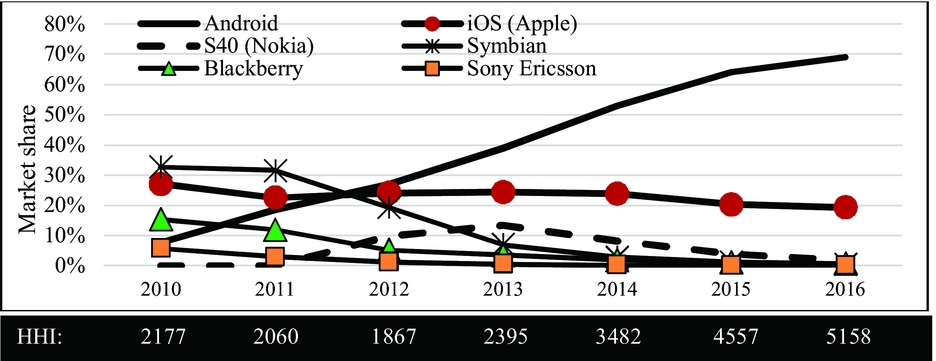
Free distribution strategies are potent tools for accelerating user adoption and securing large market shares. Linux has achieved significant penetration in the enterprise computing OS market (Enterprise Linux Insights, 2016) and, through the Linux-based Android OS (distributed under an open-source license), has rapidly overtaken Apple's closed-source iOS system in the smartphone OS market. As reflected by the Hirschman–Herfindahl (“HHI”) index,Footnote 4 the standard concentration measure in antitrust law, the free Android OS has rapidly secured high shares in the global smartphone OS market. As shown below, a market supporting multiple OS providers has evolved during 2010–16 into a market supporting only two competitors, with the leader (Android) now enjoying almost 70% market share (indicated on the vertical axis of Figure 1) and an HHI score over 5,000 (indicated below the horizontal axis). US antitrust agencies generally consider HHI scores above 2,500 to indicate a highly concentrated market, creating a rebuttable presumption of market power (US Department of Justice, 2010).
Market share in the global smartphone operating systems market (2010–6).

Bundling and revenue generation
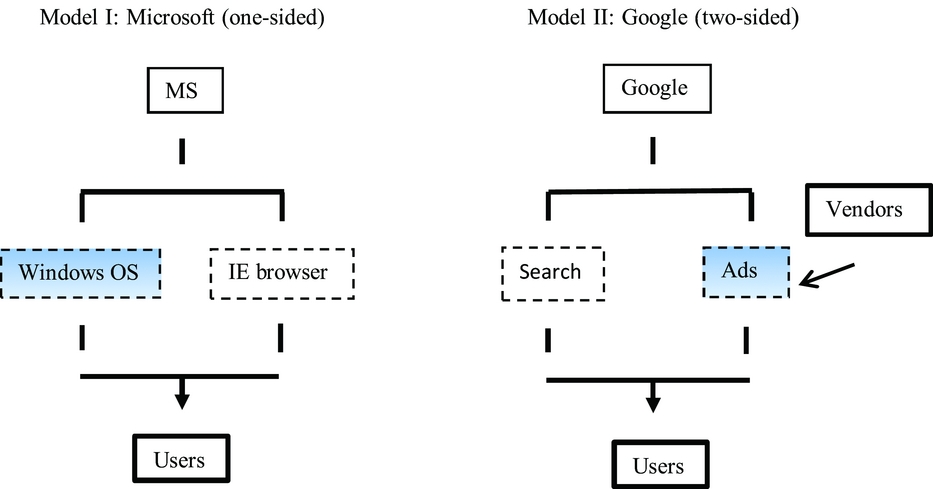
Free distribution, coupled with a contractual or reputational commitment that limits deviations from that policy, can enable a firm to secure the user base that is a precondition for generating network effects. However, without modification, this giveaway approach is incompatible with a positive revenue model. Hence, free distribution in informational goods markets is typically part of a bundling strategy in which the zero-priced good promotes sales of a positively priced good. By securing a user base through free distribution, the firm extracts revenues through the sale of excludable complementary goods, either to the same users to whom the free good is being distributed or to another set of users. The first variant (same users) is a one-sided bundling strategy; the second variant (different users) is a two-sided bundling strategy. Both strategies are depicted below – the first having been adopted by Microsoft in the PC OS market, the second by Google in the general-purpose search engine market.
Bundling strategies.

In a one-sided market strategy, the firm distributes both elements of the bundle to the same user population. To illustrate, consider the bundle at issue in the Microsoft antitrust case: (1) the Windows OS, distributed at a positive price; and (2) the Internet Explorer (“IE”) browser, distributed at a zero incremental price.Footnote 5 In a two-sided market strategy, the firm distributes each element of the bundle to a different population. To illustrate, consider the bundle constituted by Google's search engine and advertising services. This is a two-sided distribution model in which the firm provides (1) consumers with the search element of the bundle at a zero price and (2) vendors with the advertising element of the bundle at a positive price. This two-sided advertising-based model has long been used in terrestrial radio and broadcast television and is now the most prevalent distribution model for online content. (As will be discussed (see section 5), Google and certain other online intermediaries depart from the traditional radio and television model because they do not typically enter into licenses with holders of the content that is being copied and distributed through the intermediary's platform.)
Bundling and value shifting
Coupling free distribution of informational assets with positive pricing of complementary goods can do better than simply conforming free distribution with economic rationality. A bundling strategy can enable the commoditizing firm to shift revenue streams from other segments of the relevant market, so that it diverts the available rent pool from competitors.Footnote 6 Consider the “value stack” constituted by the PC and other essential components at issue in the Microsoft antitrust litigation. That stack consisted of (among other elements): (1) hardware (2) the microprocessor, and (3) the OS. Microsoft enjoyed a competitive advantage in the OS segment – Windows being protected by copyright, know-how and the installed base of users and developers – while Intel enjoyed a competitive advantage in the microprocessor segment. All hardware elements had been commoditized because the pioneer, IBM, was unable to block cloning of its PC hardware by second-movers, so all rents in the value chain flowed to Microsoft, as the owner of the OS, and Intel, as the owner of the microprocessor.
Netscape's innovation, the internet browser, threatened this skewed rent allocation. To preserve it, Microsoft executed a commoditization strategy: it introduced the Internet Explorer (“IE”) browser, which approximated the functionality of the Netscape browser and massively outperformed on price.Footnote 7 Just prior to Microsoft's entry, Netscape had priced the Navigator browser at approximately $50 to $70 for at least some users (CNET, 1998).Footnote 8 By contrast, Microsoft included IE in the Windows OS bundle at a zero incremental cost. As the government argued, the “OS+IE” bundle effectively neutralized Netscape, which lacked complementary products from which to extract significant revenue and therefore could not match Microsoft's zero-price strategy. In 1996, when Microsoft entered the market, Netscape represented 79% of the US browser market and Microsoft represented 18% (as measured by users); in 1999, Netscape represented 42% and Microsoft represented 56%; in 2004, Netscape represented 2.1% and Microsoft represented 90% (Noam, Reference Noam2009: 283, Table 12.4). Note how IE's rapid dominance of the browser market resembles Android's trajectory in the smartphone OS market: in both cases, free distribution enabled the late mover to rapidly seize market share from the pioneer.
4. Giveaway strategies in digital content markets
Commoditization strategies in technology and content markets have typically involved a firm's voluntary giveaway of its own informational goods in order to drive sales in another component in the value chain in which the firm enjoys a competitive advantage. By contrast, commoditization strategies in digital content markets typically involve an involuntary giveaway of other firms’ informational goods. In particular, content aggregators have undertaken litigation and lobbying strategies that, together with the unauthorized copying and distribution of content assets by aggregators and end-users, have substantially eroded effective copyright protections. Erosion of the property-rights infrastructure in digital content markets has facilitated advertising-based giveaway models adopted by aggregation platforms, which have enjoyed substantial immunity from copyright liability and minimal content acquisition costs.
Digital search engines rely on a two-sided giveaway model in which the firm distributes content to individual users at a zero priceFootnote 9 and advertising and data-collection services to business users at a positive price. In this two-sided model, the intermediary maximizes revenues by minimizing its content acquisition costs, which in turn maximizes its content inventory and the user base and associated data assets that the intermediary can “sell” to advertisers. Content acquisition costs are a function of licensing costs, which are in turn a function of the content's commercial value and the strength of content holders’ IP rights, financial resources, and resulting litigation threat. The intermediary can undertake three primary strategies to distribute content at a zero or low price that maximizes the user base available to advertisers. First, the intermediary can acquire or develop content and then give it away. Content acquisition can occur voluntarily subject to a contractual payment, as had been the case in terrestrial radio, or involuntarily, as is often or typically the case in search engines and other aggregation platforms.Footnote 10 Second, the intermediary can elect not to obstruct users’ unauthorized distribution and consumption of content on its platform. Third, the intermediary can pursue political-influence activities to weaken IP protections, which reduces content owners’ litigation threat and the fees they can demand from users.
The first and second strategies rely on the success of the third. If content owners can wield a credible legal threat against infringing users, or against intermediaries indirectly, that would raise the effective price to the intermediary (in the first strategy) and users (in the second strategy) of accessing content. That in turn would limit the size of the user base on the free side of the market and the revenues that can be extracted from advertisers on the pay side. As interpreted by the courts at the onset of digitization, copyright law was applied so that content holders wielded a meaningful legal threat against online intermediaries that engaged in or facilitated infringement. Court decisions (for example, the 2001 decision in A&M Records, Inc. v. Napster, Inc.)Footnote 11 shut down file-sharing websites that had encouraged or facilitated user distribution of infringing content. These decisions culminated in the Supreme Court's 2005 ruling in MGM Studios, Inc. v. Grokster, Ltd.,Footnote 12 which largely repealed the “Sony” safe harbor against infringement liability for firms that distributed technologies having infringing and non-infringing uses. Subsequently, however, successful defenses by aggregation intermediaries against copyright infringement lawsuits have yielded generous judicial understandings of the “DMCA” safe harbor and “fair use” exemption that now largely shield those intermediaries from liability.
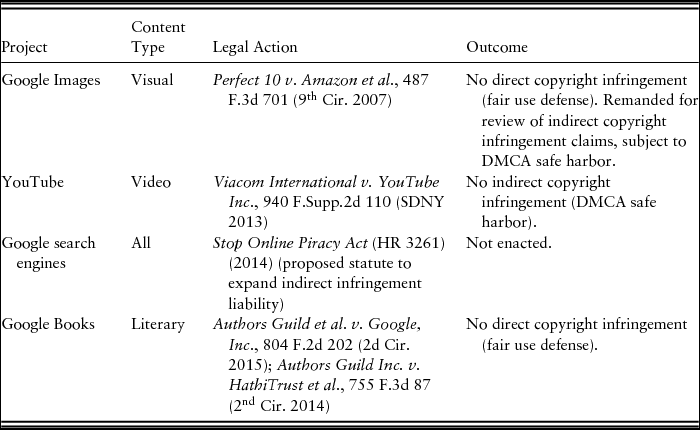
Legal commoditization supplies the foundation for content commoditization. Weak copyright facilitates intermediaries’ giveaway strategies, which exploit zero pricing to attract a large user base that can be “sold” to advertisers (in a two-sided revenue model) or to which excludable complementary goods can be sold (in a one-sided revenue model). A string of landmark litigations involving Google and its subsidiaries, as shown below, illustrates this strategic dilution of property-rights protections. In each case, Google secured legal precedents that limit the litigation threat posed by content holders. As I discuss in more detail subsequently (see section 5), the Google Books cases, decided in 2014 and 2015, and the Google Images case, decided in 2007, adopted expansive understandings of the fair use exemption to copyright infringement that largely shield search engines from infringement liability. In 2012, Google and other prominent technology firms led a lobbying effort to block the “SOPA” legislation, then being considered in the US Congress, which would have increased online platforms’ exposure to infringement liability (Fahrenthold, Reference Fahrenthold2012). In 2013, Google defended its YouTube subsidiary against copyright infringement, securing a legal precedent that endorsed a broad definition of the DMCA's section 512(c) safe harbor from indirect infringement liability.
Legal commoditization

These legal actions have substantially weakened the property-rights institutions that govern digital content markets. Given content owners’ high costs in identifying specific acts of infringement, users’ low costs of engaging in infringement, and the courts’ broad understanding of the fair use and DMCA safe harbors, the copyright laws exert a weak deterrent effect on individual users of file-sharing sites and the intermediaries that operate those sites. The legal unraveling of copyright in digital content markets (mitigated to varying degrees by copy-protection technologies in certain media) enables dominant aggregation platforms to “bid down” the price of content held by upstream suppliers. Two examples can illustrate. First, record labels now often waive their statutory takedown rights under the DMCA in exchange for a share of advertising revenue offered by dominant intermediaries such as YouTube (Owsinski, Reference Owsinski2016; Miller, Reference Miller2010) – effectively, a preemptive settlement of the content holder's weak litigation threat given the DMCA safe harbor.Footnote 13 Second, Google reportedly “advises” subscription news websites to provide users with access to at least three free articles per day, subject to being featured less prominently in search rankings (Dave, Reference Dave2017).Footnote 14 Both practices illustrate the rent-shifting objective behind commoditization strategies: while free content distribution undermines the upstream holder's efforts to sell content at a positive price, it reduces the downstream platform's content acquisition costs, reduces users’ consumption costs, and expands the user base and associated data assets that can be offered to advertisers.
5. Commoditization and concentration
It is intuitive to suppose that commoditizing content through zero-price distribution lowers entry barriers and relieves market concentration by eliminating input costs for intermediate users. However, the history of technology markets shows that the opposite outcome may arise. This is illustrated by Microsoft's IE browser in the browser market and Google's Android OS in the smartphone market. Both products were distributed under zero-price strategies, displacing early movers and generating high and stable market shares for the prevailing platform. That same pattern recurs in digital content markets. Those markets tend to follow a three-step sequence in which (1) legal and technological exclusivity falters in the content market (2) firms adopt bundled structures in which zero-priced content is deployed to drive sales in a complementary goods market, and (3) a single firm, or a handful of firms, secure unusually high shares in the complementary goods market.Footnote 15
Concentration in content aggregation markets
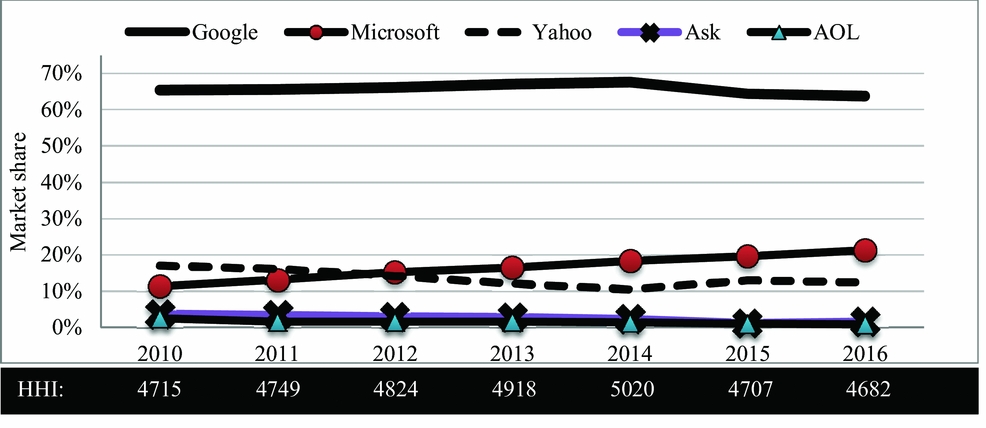
In commoditized content environments, consumers incur zero consumption costs but significant search and evaluation costs given the abundance of content that results from weak copying, display and storage constraints. Users’ search-cost burden invites entry by intermediaries that specialize in supplying aggregation services that reduce those costs. Content aggregation markets widely exhibit two characteristics: (1) the use of two-sided bundling strategies comprising zero-priced content distribution and curatorial services coupled with positively priced advertising and data-collection services, and (2) high concentration levels in the aggregation intermediary segment. As shown below, the US core search engine market has exhibited high concentration, as indicated by the HHI index, at least since 2010 through the present, and in all years well above the HHI threshold at which US antitrust agencies determine a market to be highly concentrated (US Department of Justice, 2010). As shown by reference to the vertical axis in the Figure below, Google's market share is large and stable, having maintained almost 70% market share throughout this period. Google does not dominate certain special-purpose search engine markets (Manne and Wright, Reference Manne and Wright2011: 32–3), although, as some scholars and regulators argue, Google's dominance in the core search market may provide it with the ability to disadvantage firms in those specialized search markets (Edelman, Reference Edelman2015; European Commission, 2016).
High concentration levels in the core search engine market appear to be shared by other digital content markets, as described below. Note that, in each case, rigorous analysis would be required to clarify these shorthand market definitions.Footnote 16
(1) Online social networking: Facebook (including Instagram, acquired in 2012) overwhelmingly dominates, having displaced the pioneer, MySpace, which had been the market leader as of 2008 (Kallas, Reference Kallas2016). As of 2016, Facebook is used by almost 78% of US smartphone users (comScore, 2016b).
(2) Online video and music services: Google's subsidiary, YouTube (used by more than 59% of US smartphone users as of 2015 (comScore, 2016b)), dominates the online video market. For higher-valuation users, it may face some competition from paid music and video streaming services (for example, Pandora or Apple Music (iTunes), used by 42% and 31%, respectively, of US smartphone users as of 2016 (comScore, 2016b)).
(3) Online mapping services: Google Maps (including Waze, acquired in 2013) dominates online mapping services for consumers, being used by almost 48% of US smartphone users (as compared to 28% for Apple Maps) (comScore, 2016b). In the consumer market, Google Maps displaced the pioneers, including MapQuest, an online service (Vuong, Reference Vuong2014; Weber and Sutton, Reference Weber and Sutton2014), and Garmin and Tom-Tom, hardware manufacturers (Gurley, Reference Gurley2009). Those firms suffered the fate of Netscape in the browser market: faced with a free service, they were unable to compete using a business model in which revenue derives directly from sale of the mapping service or device.
It is worthwhile considering whether these estimated concentration levels are high compared to the concentration levels in content markets at the advent of digitization (often associated with the launch of the Napster file-sharing service in 1999). While there is no clear analogue between intermediaries in digital and pre-digital markets, the US music industry can reasonably illustrate. Noam (Reference Noam2009) shows that music distributors (that is, “record labels”) exhibited increasing HHI scores in the years approaching digitization, reaching 1,552 in 2000. After the advent of digitization, the HHI score for the music distribution market increased more rapidly, reaching approximately 2,226 in 2008 (Noam, Reference Noam2009: 128–9), well below the HHI range of 4682–5020 in the US core search engine market during 2010–6. If local radio stations are deemed a more appropriate analogue, the differences are comparable: as of 2002, the HHI score for radio stations in large, medium and small cities was 2,139, 2,798, and 2,330 respectively (Noam, Reference Noam2009: 62). If music retailers are used as an analogue, the differences are stark: as of 2000, the HHI score for music retailers stood at only 275 (Noam, Reference Noam2009: 131), indicating a very unconcentrated market at the onset of digitization.
Does commoditization promote concentration?
The recurrent pairing of zero-priced bundling and extreme concentration in significantly commoditized content markets is not accidental. Commoditization promotes concentration in two steps. First, zero pricing of content assets distorts the survival probabilities of different types of organizational forms. In evolutionary terms, a zero-price environment selects against entities that derive revenue principally from the stand-alone delivery of content goods and selects for intermediaries that adopt a bundled strategy in which the intermediary supplies zero-priced content aggregation services coupled with positively priced advertising services. Second, content aggregation markets that thrive in zero-price environments tend to converge upon winner-take-all outcomes in which the market is dominated by one or two platforms that enjoy substantial protection against entry.
These winner-take-all outcomes reflect network effectsFootnote 18 that can arise directly and indirectly on different sides of a content aggregation platform.Footnote 19 On the free side of the platform, network effects arise directly in the case of platforms with predominately “social” functions (such as Facebook): users prefer the site with the greatest number of users (or certain types of users) and are rationally disinclined to independently migrate to another platform. In the case of services with predominately search functions, network effects can arise indirectly. Users are likely to prefer the service with the greatest number of users (or certain types of users), either because the accuracy of the service's search results is directly a function of user input (as in Yelp's rating service) or indirectly a function of user volume, which generates data that improves the site's search algorithms (Bracha and Pasquale, Reference Bracha and Pasquale2008: 1181; Patterson, Reference Patterson2013: 6–7). On the pay side of the platform, network effects arise indirectly to the extent that advertisers value most highly the platform that is most popular with users (or with certain types of users) and, assuming budget constraints, are disinclined to advertise (or to advertise to the same extent) on other platforms that lack a comparable user base (Evans, Reference Evans2008: 368–9, 372–5).
Network effects, and the market's resulting tendency to converge upon a single dominant platform, are compounded by weak inventory constraints and weak copyright. Suppose (1) a single platform can feasibly host extremely large volumes of content (due to weak inventory constraints) and (2) all platforms have zero-cost access to approximately the same pool of content (due to weak copyright). Users will then minimize search costs by accessing content through one platform, rather than navigating multiple channels with exclusive content (as was the case in pre-digital content markets that operated under strong inventory constraints and strong copyright). Other characteristics of content aggregation markets further promote winner-take-all outcomes. Search markets exhibit scale economies: the intermediary incurs a substantial fixed cost to assemble the infrastructure required to locate, index, store, and deliver content but a low variable cost for each additional content asset, user, and advertiser (Haucap and Stühmeier, Reference Haucap, Stühmeier, Bauer and Latzer2017: 186). The costs incurred by a search engine to develop the search algorithms, assemble the web index, and construct data storage and delivery centers run into the estimated billions of dollars (Engels, Reference Engels2016).Footnote 20 Lastly, the incumbent search intermediary holds a difficult-to-replicate stock of user data, which enhances the accuracy of the matching technology it can offer users and advertisers. Replicating that data inventory and associated learning effects may inflate substantially the investment required to attempt entry (Bracha and Pasquale, Reference Bracha and Pasquale2008: 1181; Haucap and Stühmeier, Reference Haucap, Stühmeier, Bauer and Latzer2017: 190–91; Patterson, Reference Patterson2013: 6–7).Footnote 21
Strategic commoditization
Firms that adopt advertising-based aggregation strategies promote content commoditization through two related strategies: (1) zero-price content distribution; and (2) lobbying and litigating for legal changes that raise content holders’ enforcement costs. Strategic commoditization achieves two objectives for the intermediary. First, it minimizes the intermediary's content acquisition costs and users’ content consumption costs, which expands the user base available to advertisers. Second, it shifts profit extraction from the content production segment of the value chain, in which the intermediary has a competitive disadvantage, to the content aggregation, advertising services and data-collection markets, in which the intermediary has an advantage.
This commoditization plus rent-shifting strategy is illustrated below by three Google search services. Each service pursued the same three-step sequence: (1) unauthorized replication of copyright-protected content; (2) a giveaway of that content to users; and (3) a successful defense against copyright infringement that extinguished liability for actions taken in steps (1) and (2).
(1) Google Images. In a 2007 infringement litigation, the court's broad understanding of the “fair use” exemption enabled Google to escape liability for reproducing and displaying “thumbnails” of copyright-protected images without having obtained the owners’ consent.Footnote 22 The court's “fair use” analysis relied on a determination that thumbnail images would not compete commercially with the full-size, high-resolution images on the owners’ websites. Since 2013, Google Images has nonetheless reportedly displayed full-size, high-resolution images. Content holders took no legal action in US courts against Google's expanded use, reportedly due to a perceived adverse legal climate (Digital Media Licensing Association, 2013). This steady erosion of copyright has pushed the market toward pricing levels consistent with a commoditized environment. In 2014, in response to the widespread availability of free, high-quality images online, Getty Images, the largest firm in the stock photography market, elected to distribute a large portion of its portfolio at a zero price for noncommercial purposes (Brandom, Reference Brandom2014).
(2) YouTube. This popular website (acquired by Google) has facilitated widespread replication and distribution of video content without owners’ consent. As observed by Viacom and co-plaintiffs in their copyright infringement litigation against YouTube, when users upload unlicensed videos to YouTube, the site makes a copy of uploaded videos to facilitate user searches, streams videos selected by users, and enables users to distribute copies of uploaded videos (Complaint, 2007: 10–2). Based on disclosures in that litigation, internal memoranda show that YouTube management, in the early years of the site, was aware that most content on the site was infringing and resisted adopting technologies to identify and remove infringing content (Plaintiffs’ Memorandum of Law, 2013: 17–25).Footnote 23 Google nonetheless successfully defended its subsidiary against copyright infringement, securing a legal precedent that broadly defined the DMCA section 512(c) safe harbor.Footnote 24
(3) Google Books. Commencing in 2002, Google expended considerable resources to digitize over 20 million books owned by university libraries. These books included both public domain and in-copyright titles, portions of which were then made freely available for certain search purposes in the HathiTrust and Google Books websites (including display in “snippet” form in the latter service).Footnote 25 In 2014 and 2015, Google successfully defended its actions against infringement lawsuits, securing favorable precedents that broadly defined the “fair use” safe harbor as applied in the search engine context.Footnote 26 By contrast, prior digitization efforts by Microsoft and Yahoo! had only covered public domain works or in-copyright works for which consent had been obtained from copyright owners (Mills, Reference Mills2005).
In all three cases, Google (or its subsidiary) incurred the costs of unilaterally acquiring (and, in the case of Google Books, digitizing) a large mass of content assets, distributing them to users at no charge and then defending those actions in court. These “take, giveaway and litigate” strategies have attracted a large user base that generates advertising revenue while Google has successfully defended its actions in litigation that has eroded substantially the legal threat posed by copyright holders. Going beyond the free distribution model used historically by the radio and broadcast TV industries (which always licensed content at a fee from upstream creators or, in the case of broadcast TV, incurred internal development costs), Google's actions dramatically illustrate how a single firm has used distribution and litigation strategies to commoditize a large stock of content assets covered by legally recognized property rights.
6. Digital dictators or benign monopolists?
The above discussion has identified a potential link between, on the one hand, zero-price distribution and legal commoditization of content assets and, on the other hand, extreme concentration in content intermediary markets. It remains to consider whether these structural effects give rise to adverse net welfare effects. Specifically, the question is whether the vertical shift of industry rents from content producers to content aggregators, which is otherwise merely a distributive effect, is likely to yield net efficiency losses in the broader market ecosystem encompassing upstream content production and downstream intermediary services segments.
Why digital monopolies may be harmless
Two factors may mitigate welfare concerns relating to high concentration in digital intermediary markets. First, assuming the dominant intermediary does not alter its zero pricing policy on the free side of the market, a monopoly position would not translate into adverse pricing effects for individual users. This is not a satisfactory observation, however, since it does not address potential pricing power exerted by the intermediary in the advertising services, data-collection or other complementary goods markets. Second, even extreme market shares held by digital intermediaries may not be a sound proxy for pricing power if entry barriers are low and large market shares are therefore short-lived or threatened. Multiple incumbents have rapidly fallen from dominance in online and other technology markets: AOL (internet portal), Blackberry (smartphone), Palm Pilot (portable media device), and Netscape (browser) (Barnett, Reference Barnett2011: 1877–88). Transient dominance can be observed in the US internet browser market, where the leading position has moved from Netscape (estimated 79% market share in 1996) to Microsoft (estimated 90% market share as of 2004) (Noam, Reference Noam2009: 283, Table 12.4) to Chrome (Google) (estimated 44% market share in 2016).Footnote 27 However, market power in digital intermediary markets is sometimes especially durable, which suggests that competitive discipline may be weak for a substantial period. MS Windows has maintained its dominance of the US PC operating systems market since at least 1999 (estimated in excess of 80%)Footnote 28 through 2016 (estimated 74%).Footnote 29 As shown previously in Figure 3, Google has similarly maintained its dominance in the US core search engine market, consistently enjoying a market share approaching 70% from (at least) 2010 through 2016. As discussed above (see section 5), that market share may be protected to some extent by network effects, compounded by weak copyright, weak inventory constraints, economies of scale and learning effects.
Market share in the US core search engine market (2010–6).

Why digital monopolies may be harmful
Both sound antitrust analysis and technology history reject any conclusory view that dominant aggregation intermediaries enjoy market power, or otherwise give rise to adverse welfare effects, simply by virtue of holding large market shares over substantial time periods. Nonetheless there remain two important grounds for concern, in each case subject to further empirical inquiry.
The first concern, which I do not address, is the extent to which a dominant aggregation platform can inefficiently block entry into its market or other complementary markets. In particular, there is an ongoing debate whether Google's dominance in the core search market enables it to “illegitimately” disadvantage competitors in special-purpose search and other complementary markets. Other commentators have addressed these antitrust concerns (Edelman, Reference Edelman2015, finding significant ground for concern; Manne and Wright Reference Manne and Wright2011, finding no material ground for concern), as did the Federal Trade Commission in its now-closed investigation of Google (Federal Trade Commission, 2013), and the European Union in its prosecutions of, and investigations into, certain Google practices (Haucap and Stühmeier, Reference Haucap, Stühmeier, Bauer and Latzer2017: 191–4). As a policy matter, any such concern would recommend a response through antitrust law.
The second concern is whether commoditized content markets, in which copyright is weak, copy-protection technologies are limited, and market rents mostly flow to aggregation intermediaries, can support the efficient production and commercialization of content assets. Any such concern would recommend a response through copyright or other IP rights. Existing research relating to this question primarily examines output effects in the popular music market, which presents the best “test case” since it has experienced the most substantial decline in effective protections against unauthorized use. Empirical studies now confirm that mass unauthorized use has substantially reduced sales of recorded music (Liebowitz, Reference Liebowitz2014; Waldfogel, Reference Waldfogel, Lerner and Stern2012a). Total recorded music sales as of 2016 (including streaming) were approximately 50% lower as compared to the industry's peak just prior to the onset of digitization in 1999 (Recording Industry Association of America 2016). Notwithstanding this dramatic revenue decline, the key policy issue is whether weakened copyright has reduced musical output on a quality-adjusted basis. Using various proxies for commercial importance, Waldfogel (Reference Waldfogel, Lerner and Stern2012a, Reference Waldfogel2012b) finds no decline in “economically meaningful” new output since 1999. Lunney (Reference Lunney2014: 127–31) uses the number of “covers” (new recordings of existing songs) in the Billboard “Hot 100” as an inverse measure of quality (fewer covers implies higher originality) and finds no evidence of a decline in quality. By contrast, Telang and Waldfogel (Reference Telang and Waldfogel2014) find evidence of a decline in both quantity and quality in the “Bollywood” film industry following an increase in piracy during 1985–2000. Importantly, as Waldfogel (Reference Waldfogel, Lerner and Stern2012a: 107) notes and as the findings of Telang and Waldfogel (Reference Telang and Waldfogel2014) illustrate, the absence of quality-adjusted declines in musical output in response to piracy may not apply to media that involve higher production and distribution costs (for example, motion pictures or television).
There is no empirically validated consensus concerning the extent to which weak-copyright environments induce distortions in content output relative to a more secure property-rights environment. Forward progress will require tackling four principal tasks. First, building on the studies mentioned above, it is necessary to refine objective measures for assessing quality-adjusted reductions in output. Second, it is necessary to consider the extent to which a weak copyright regime reduces the variety of content output by rewarding an even smaller number of superstar artists relative to pre-digital content markets. Several studies already support this concern: Elberse (Reference Elberse2008), who finds increased concentration in content consumption patterns in online markets; Barnett (Reference Barnett2013), who finds that live concert revenues in the “Top 20” North American tours flowed in increasing proportions to older artists (who presumably had acquired goodwill in the pre-digital copyright environment); and Lunney (Reference Lunney2014), who finds a smaller number of new artists appearing in the “Top 100” chart after the onset of digital file-sharing. Third, it is necessary to consider whether a weak copyright environment may distort content production by favoring projects that are more readily monetized through complementary excludable goods (such as live performance, merchandise, or advertising). That would constitute a resource misallocation across content projects even if total output were unaffected. Finally, as emphasized in Barnett (Reference Barnett2013), it is necessary to understand the extent to which a weak copyright regime disrupts contract-based relationships among the multiple non-creative entities that fund and execute the commercialization of creative assets in media markets.
Is the case for copyright so “uneasy”?
The rise of digital markets, and the continued robust flow of content even under a weakened copyright regime, challenges conventional incentive justifications for copyright. As noted in the Introduction, scholars now widely question whether the social costs inherent to copyright (or at least, robust copyright) are justified if creative output persists. This type of argument has a long pedigree and is often attributed to an article by Stephen Breyer (now a US Supreme Court Justice), who argued that the conventional incentive case for copyright was “uneasy” due to the ability to earn a “reasonable” profit even without copyright (Breyer, Reference Breyer1970). Specifically, Breyer observed that, during the late 19th century, foreign works were unprotected by US copyright but yet US publishers made payments to British authors and earned profits from the sale of those works. Breyer attributed this outcome to lead-time advantages and predatory pricing (so-called “fighting editions”) to deter copiers (Breyer, Reference Breyer1970: 299–302).
This widely cited argument is incomplete. That is because it fails to ask whether the alternative revenue models that content holders adopt by necessity under zero or weak copyright regimes result in net welfare gains as compared to the stand-alone sale of content assets that remains viable under secure copyright regimes. In fact, Breyer's historical example raises precisely this concern. Khan (Reference Khan2005: 280–3) and Liebowitz (Reference Liebowitz2016: 554–6) show (expanding upon Plant (Reference Plant1934: 171–2) that the largest US publishers adhered to a “trade courtesy” regime under which the first publisher of a work by a British author was informally protected from copying by other large publishers that adhered to this custom-based regime.Footnote 30 This regime recognized publishers’ exclusive rights not just to a particular work, but to the author of that work. This suggests that the largest publishers were only able to enjoy profits from the sale of unprotected foreign works because they entered into an informal cartel that allocated among its members quasi-exclusive rights to literary talent, enforced by predatory pricing to deter threats to cartel stability (Khan and Sokoloff, Reference Khan and Sokoloff2001). This rent-allocation mechanism anticipates in certain respects a private quasi-IP regime implemented during 1932–41 by “high-end” fashion designers in response to the proliferation of “knock-off” designs and courts’ resistance to copyright infringement claims against those designs. This arrangement, which involved certifying original designs and boycotting retailers who carried non-certified merchandise, was terminated by an antitrust prosecution (Fashion Originators’ Guild of America v. FTC, 312 US 457 (1941)).
In both the 19th-century book publishing market and the 20th-century fashion industry, the absence of robust copyright did not eliminate industry rents; rather, it induced firms to secure rents through alternative – and potentially, more socially costly – mechanisms that relied on other barriers to entry. Firms that produce and distribute original content must secure supracompetitive rents through some exclusionary mechanism in order to earn a net positive return. Without further analysis, there is no reason to believe that the publishers’ or fashion designers’ cartel-like arrangements yielded positive welfare effects as compared to a market in which copyright would have been more secure and those substitute mechanisms, which rely on forms of market cooperation that inherently raise collusion risk, would have been unnecessary. This observation can be generalized. A priori it is inherently ambiguous whether the relaxation of copyright, and the resulting commoditization of content, results in net positive welfare effects without considering the efficiency characteristics of alternative rent-capture mechanisms that firms adopt in response.
7. Conclusion
Digital content markets exhibit two recurrent characteristics: abundant free content and extreme concentration among content aggregation intermediaries. These two characteristics are linked. Zero-price content distribution promotes concentration by shifting rent-extraction opportunities from content production markets to content aggregation markets characterized by network effects, scale economies, weak inventory constraints and learning effects that promote winner-take-all outcomes. It remains an open question whether those concentrated conditions, and the vertical reallocation of industry rents from content producers to content aggregators, translate into net adverse welfare effects as compared to a more secure property-rights environment in which stand-alone content-delivery structures constitute a viable revenue-generation mechanism. At a minimum, it is clear that content commoditization is not “free” from a social point of view. Weakening property-rights institutions in content markets distorts the menu of viable organizational structures for extracting returns on content production and commercialization, which may result in output distortions in the content production and intermediary services markets. The growing enthusiasm for relaxed copyright protections in digital content markets deserves a closer look.
Acknowledgments
I appreciate valuable comments from David Harper, three anonymous referees, and participants at the Symposium on Innovation and Institutions from the Bottom Up, held at New York University, and the Mallen Economics of Filmed Entertainment Conference, held at Yeshiva University. I thank Justin Bongco for research assistance.