Introduction
Insects are highly successful organisms with a global distribution that is aided by their ability to survive seasonally cold or dry extremes. This is achieved through evolved traits that promote survival in these extremes via dormancy and cold tolerance mechanisms, of which overwintering is a commonly discussed context. There has been extensive work done on the natural history of invasive insect overwintering and cold tolerance (e.g., Ward and Masters Reference Ward and Masters2007; Bale and Hayward Reference Bale and Hayward2010; Morey et al. Reference Morey, Venette, Nystrom Santacruz, Mosca and Hutchison2016).
Koštál (Reference Koštál2006) defined two main sub-classifications of dormancy: quiescence and diapause. Quiescence is an immediate response to a change in a limiting factor, such as temperature, above or below a threshold. Once the limiting factor returns to favourable levels there is an equally immediate response for the resumption of normal development. Diapause is a centrally regulated response that alters the developmental programme during a specific phase in the life cycle. A series of physiological events induce a diapause state as well as terminate the diapause state. The response precedes the onset of unfavourable conditions and terminates once favourable conditions are sufficient.
The diamondback moth, Plutella xylostella Linnaeus (Lepidoptera: Plutellidae), is a globally distributed pest of brassicaceous (Brassicaceae) crops, causing economic damage of up to US$ 5 billion annually (Zalucki et al. Reference Zalucki, Shabbir, Silva, Adamson, Shu-Sheng and Furlong2012; Zhang et al. Reference Zhang, Wangm, Jing, Zhuang and Wu2015). In western Canada, diamondback moth is an occasional pest of canola where crop losses associated with outbreak years can be devastating (Dosdall et al. Reference Dosdall, Soroka and Olfert2011), with losses of up to CAD $67.0–77.5 million (calculated to 2017 dollars) (Western Committee on Crop Pests 1995). Diamondback moth is also resistant to all major classes of insecticides and was one of the first species to develop resistance against Bacillus thuringiensis Berliner (Bacillaceae) in the field (Furlong et al. Reference Furlong, Wright and Dosdall2013). In equatorial climates, the diamondback moth reproduces year-round, producing up to 20 generations when it has continuous access to host plants (Dosdall et al. Reference Dosdall, Soroka and Olfert2011). In temperate climates, the diamondback moth has been documented to produce four to six generations; however, the number of generations can increase due to increases in temperature, availability of host plants, and seasonality (Harcourt Reference Harcourt1954; Harcourt and Cass Reference Harcourt and Cass1966). There is general agreement that diamondback moth infestations in northern latitudes often result from massive long-distance dispersal events originating in the more southerly parts of its range (Honda Reference Honda1992; Honda et al. Reference Honda, Miyahara and Kegasawa1992; Dosdall et al. Reference Dosdall, Mason, Olfert, Kaminski and Keddie2001; Hopkinson and Soroka Reference Hopkinson and Soroka2010; Wei et al. Reference Wei, Shi, Gong, Jin, Chen and Meng2013; Yang et al. Reference Yang, Tian, Xu, Xie, Wang and Zhang2015). However, there is controversy in the literature about the ability of the diamondback moth to overwinter successfully in climates typical of southern Canada and the northern United States of America (Talekar and Shelton Reference Talekar and Shelton1993).
Although the diamondback moth persists year-round in the tropics and milder temperate regions, the highest latitudes for overwintering have been estimated to be 36.0–38.5°N in Japan (Kimura et al. Reference Kimura, Fujimura and Araya1987a; Honda Reference Honda1992), 30.5–32.2°N in China (Li et al. Reference Li, Feng, Liu, You and Furlong2016), and 37.0–38.0°N in South Korea (Kim et al. Reference Kim, Choi, Park, Cha, Jung and Lee2014, Reference Kim, Park, Park, Kim and Kim2015). Harcourt (Reference Harcourt1957) approximated the limit of year-round persistence in North America to be 36°N. This estimate was also demonstrated in the Climex model created by Zalucki et al. (Reference Zalucki, Shabbir, Silva, Adamson, Shu-Sheng and Furlong2012). Key overwintering studies (e.g., Marsh Reference Marsh1917; Dosdall et al. Reference Dosdall, Mason, Olfert, Kaminski and Keddie2001) in North America were conducted at higher latitudes, 38–53°N, with sporadic observations of probable successful overwintering. These observations, beyond the year-round distribution of the diamondback moth, suggest that this species may have the potential to overwinter in southern Canada and the northern United States of America.
In addition to climate, food and habitat availability are among the most important factors limiting insect distributions (Musolin Reference Musolin2007). Canada is the one of the largest producers in the world of canola, Brassica napus Linnaeus and B. rapa Linnaeus (Brassicaceae) (United States Department of Agriculture, Foreign Agricultural Service 2017). Increasing demand for canola in the European Union, the United States of America, and China for industrial, biodiesel, and food applications (United States Department of Agriculture, Economic Research Service 2017) will ultimately lead to increased acreage. This will result in more land dedicated to growing canola in Canada. An expansion of canola crop acreage will provide a vast resource of suitable host plant material for the diamondback moth in its northernmost range. In parallel, climate change is altering the duration and severity of winters. Gradual increases in mean annual temperatures could result in the range expansion of diamondback moth into more northerly temperate regions, potentially increasing incidence of outbreak years and the possibility for overwintering. To date, research attempting to induce diapause or to determine the diapause stage of the diamondback moth has been unsuccessful. Studies have largely concluded that the diamondback moth does not overwinter in a diapause state, but only speculate as to its probable overwintering strategy.
Our objective here is to review the literature and outline the limits and mechanisms of cold tolerance of the diamondback moth by summarising the available literature. We further interpret the available data to provide a framework describing the overwintering strategy used by the diamondback moth and the potential of this global pest to survive year-round in northern temperate climates by overwintering.
Cold tolerance in the diamondback moth
Cold tolerance by life stage
Although numerous studies have addressed cold tolerance and the supercooling capacity of the diamondback moth, a consensus has never been reached with respect to survivorship at colder temperatures. This is because past studies have used a variety of methods to test for cold tolerance and overwintering capacity, leading to variable results. The studies reviewed in this section focused on temperature treatments below the lower developmental threshold of the diamondback moth, estimated to be between 7.0 °C and 7.8 °C (Umeya and Yamada Reference Umeya and Yamada1973; Butts and McEwen Reference Butts and McEwen1981; Liu et al. Reference Liu, Chen and Zalucki2002; Golizadeh et al. Reference Golizadeh, Kamali, Fathipour and Abbasipour2007).
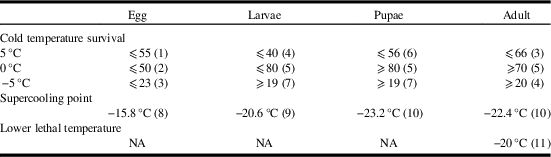
The earliest study on survivorship of diamondback moth eggs in cold temperatures was done by Hardy (Reference Hardy1938), who found that eggs remained viable after 14 days at 0 °C. Later studies assessing the number of days until 100% mortality reported even longer periods of viability of eggs at low temperatures (Supplementary Material Table 1). Liu et al. (Reference Liu, Chen and Zalucki2002) found that eggs remained viable for up to 55 days at 4 °C and 6 °C, and Butts (Reference Butts1979) also reported evidence of development after 42 days when eggs were kept at 2 °C. When dissected after complete mortality was reached, there was evidence of development that had occurred within the eggs in the form of pharate (transitional stage preceding emergence) first instars (Liu et al. Reference Liu, Chen and Zalucki2002). Liu et al. (Reference Liu, Chen and Zalucki2002) also reported the development time of eggs at warmer temperatures was reduced the longer they were exposed to 4 °C or 6 °C, providing further evidence for development below the estimated lower developmental threshold. Eggs of diamondback moth survive for about 55 days at temperatures at or slightly above 0 °C but only for 23 days at temperatures just below 0 °C (Table 1).
The longest reported number of days that various life stages of diamondback moth, Plutella xylostella, survived at 5 °C, 0 °C, and −5 °C, including lowest reported supercooling temperature for each life stage and lower lethal temperature.

References: (1) Liu et al. (Reference Liu, Chen and Zalucki2002); (2) Honda (Reference Honda1992); (3) Saito (Reference Saito1994b); (4) Gu (Reference Gu2009); (5) Kimura and Fujimura (Reference Kimura and Fujimura1988); (6) Smith and Sears (Reference Smith and Sears1982); (7) Kim et al. (Reference Kim, Choi, Park, Cha, Jung and Lee2014); (8) Supplementary material for Park and Kim (Reference Park and Kim2014); (9) Hayakawa et al. (Reference Hayakawa, Tsutsui and Goto1988); (10) Kaneko (Reference Kaneko1995); (11) Nguyen et al. (Reference Nguyen, Bahar, Baker and Andrew2014).
There is also evidence of diamondback moth larvae continuing to develop at temperatures below the estimated lower developmental threshold (Supplementary Material Table 2). On average, each instar took ~28.9 days at 6 °C and 46.5 days at 4 °C to develop into the next instar (Liu et al. Reference Liu, Chen and Zalucki2002). Gu (Reference Gu2009) reported high survivorship in fourth instars beyond 60 days in temperatures alternating between 0 °C and 5 °C, with a third of the individuals pupating. Consistently within each study, fourth instars appear to survive the longest in cold conditions out of all instars (Supplementary Material Table 2).These studies suggest that diamondback moth larvae can survive at 0 °C for almost 80 days and for ~19 days at sub-zero temperatures (Table 1).
Historically, the hypothesised overwintering stage of diamondback moth was thought to have been the pupal stage (Kanervo Reference Kanervo1936; Hardy Reference Hardy1938; Razumov Reference Razumov1970). Under the assumption that the diamondback moth overwintered in diapause, investigations on pupal overwintering were led by Harcourt (Reference Harcourt1954) and Butts (Reference Butts1979). Outdoors at ~0 °C, pupae survived for 80 days or more (Kimura and Fujimura Reference Kimura and Fujimura1988) (Supplementary Material Table 3). These authors reported that adults emerging from pupae that had survived for 30 days at 0 °C were relatively healthy and could fly; however, adults emerging from pupae that had survived for 40 days died soon after emerging. They also noted that mortality of pharate adults increased, with fewer capable of eclosing, as their study continued. Liu et al. (Reference Liu, Chen and Zalucki2002) showed that pre-pupae continued to develop into pupae at 4 °C (12 days) and 6 °C (9.8 days), which are temperatures below the estimated lower developmental threshold. Pupae survived for about 80 days at 0 °C and ~19 days at −5 °C (Table 1).
The adult stage has also been proposed to be the overwintering stage of the diamondback moth with both historical and contemporary support (Marsh Reference Marsh1917; Frost Reference Frost1949; Harcourt Reference Harcourt1954; Smith and Sears Reference Smith and Sears1982; Saito Reference Saito1994b). In conditions alternating between 0 °C and 5 °C, Gu (Reference Gu2009) found that adults survived ⩾60 days, with mating observed (Supplementary Material Table 4). Adults have also been observed to oviposit at 5 °C (Ohtomo and Chiba Reference Ohtomo and Chiba2001). Adults that had survived exposures at −5 °C produced viable eggs after being placed in warmer conditions (Saito Reference Saito1994b; Gu Reference Gu2009). Kimura and Fujimura (Reference Kimura and Fujimura1988) reported that in field conditions under snow cover, approximated to be 0 °C, 50% of the adults survived ⩾70 days with viable eggs. In laboratory conditions, Honda (Reference Honda1992) found that adults can survive 60 days or more at 0 °C; however, eggs were no longer viable in adults that survived past 50 days. Adults survived ⩾70 days at 0 °C and for at least 20 days at −5 °C (Table 1).
Cold tolerance strategy
Cold-tolerant insects can be broadly divided into freeze-tolerant and freeze-avoidant species. Park and Kim (Reference Park and Kim2014) concluded that the diamondback was a freeze-avoidant species based on this dichotomous concept of cold tolerance. However, this division has been widely criticised (Sinclair Reference Sinclair1999; Lee Reference Lee2010). There are three recognised categories of insect cold-tolerance: freeze-tolerant, freeze-avoidant, and chill-susceptible (Lee Reference Lee2010). Broadly, the categorisations correspond to susceptibility to different types of cold injury – freezing injury, cold shock injury, and cumulative chill injury (Nedvěd Reference Nedvěd2000; Lee Reference Lee2010). To narrow down the cold-tolerance strategy of diamondback moth the supercooling point, lower lethal temperature, and rapid cold hardening must also be discussed.
Cold tolerance strategy can be inferred by using the supercooling point and lower lethal temperature (Sinclair et al. Reference Sinclair, Alvarado and Ferguson2015). Supercooling is the process whereby insects can avoid ice formation in their tissues, and thus survive being cooled to sub-zero temperatures by concentrating solutes (e.g., ions, amino acids, proteins) in their hemolymph (Lee Reference Lee2010). The point at which ice spontaneously forms in their tissues is known as the supercooling point or freezing point of the organism (Lee Reference Lee2010). The lower lethal temperature is the temperature at which mortality occurs as a result of cold-shock injury during brief exposures to sub-zero temperatures (Nedvěd Reference Nedvěd2000; Lee Reference Lee2010).
Three studies (Kimura and Fujimura Reference Kimura and Fujimura1988; Kaneko Reference Kaneko1995; Park and Kim Reference Park and Kim2014) examined supercooling in the diamondback moth. The lowest supercooling point values reported for each stage are shown in Table 1; however, there was variation depending on treatment and study, with supercooling points ranging from −10.1 °C to −23.2 °C (Supplementary Material Table 5). The lower lethal temperature was found to be −20 °C for two-hour exposures (Nguyen et al. Reference Nguyen, Bahar, Baker and Andrew2014) using ecologically relevant cooling and thawing rates of 0.25 °C/minute (Lee Reference Lee2010; Sinclair et al. Reference Sinclair, Alvarado and Ferguson2015). Generally, discrimination of cold tolerance strategy using supercooling point and lethal temperature where 50% mortality occurs (LT50) involves the relative difference between the two measurements (Bale Reference Bale1996; Sinclair Reference Sinclair1999; Nedvěd Reference Nedvěd2000). However, this method becomes imprecise when the differences between the supercooling point and lower lethal temperature are small (Sinclair et al. Reference Sinclair, Alvarado and Ferguson2015). For diamondback moth the measures of supercooling point from the literature are highly variable, as a result the supercooling point is the same or lower than the LT50. This makes it difficult to discern the exact cold tolerance strategy using this method; however, freeze tolerance can be excluded as a potential strategy as the lower lethal temperature is not markedly lower than supercooling point (Sinclair et al. Reference Sinclair, Alvarado and Ferguson2015). Instead, the diamondback moth is likely freeze avoidant or chill susceptible.
Cold shock injury and cumulative chill injury are additional measures used to narrow down cold tolerance strategy (Bale Reference Bale1996; Nedvěd Reference Nedvěd2000). Accumulated chilling injury occurs during extended periods of exposure (days to weeks) to temperatures just below or above 0 °C and cold shock injury occurs after a brief exposure to cold temperatures. Both often result in mortality or decreased biological function if the insect is susceptible (Lee Reference Lee2010).
Rapid cold hardening is an induced response that protects insects from non-freezing injuries such as chilling injury or cold shock injury (Denlinger and Lee Reference Denlinger and Lee2010). Although rapid cold hardening is a plastic trait documented in many insect groups (Denlinger and Lee Reference Denlinger and Lee2010), chill injury and prolonged exposure to extreme temperatures can nevertheless result in mortality, even for insects with the capability to be supercooled (Chown and Sinclair Reference Chown and Sinclair2010). To induce a rapid cold hardening response in diamondback moth, exposure at 4 °C need to be in excess of five hours (Park and Kim Reference Park and Kim2014). After induction of rapid cold hardening, fourth instar diamondback moths can still experience fatal temperature exposures as warm as −10 °C (Park and Kim Reference Park and Kim2014) despite having a supercooling point reported at −10 °C or lower (see Hayakawa et al. Reference Hayakawa, Tsutsui and Goto1988; Kaneko Reference Kaneko1995; Supplementary Material for Park and Kim Reference Park and Kim2014). Nguyen et al. (Reference Nguyen, Bahar, Baker and Andrew2014) also reported that at temperatures below −10 °C mortality of adult diamondback moth increased at all exposure times (10-minute intervals) up to two hours with decreasing survivorship approaching the lowest reported supercooling point temperatures, indicating cold shock injury.
As noted in section 2.1, exposure to sub-zero temperatures near 0 °C results in mortality after less than one month of exposure and exposure at 0 °C and 5 °C ultimately results in mortality occurring before completion of a winter season. In addition, studies have reported reduction in fecundity of adult moths (Kimura and Fujimura Reference Kimura and Fujimura1988) and reduced eclosion rates from pupae (Honda Reference Honda1992) for individuals surviving long exposures at 0 °C; these are indicators of accumulating chill injury. Chill injury and cold-shock injury result in mortality over short periods of time thus; the diamondback moth is likely chill susceptible and therefore susceptible to all three types of cold injury. With a chill susceptible strategy, supercooling point is not an ecologically relevant indicator for cold temperature survival in the diamondback moth. Instead, the lower lethal temperature may be a more informative measure of low temperature survival (Sinclair et al. Reference Sinclair, Alvarado and Ferguson2015). However, the exposure time used in Nguyen et al. (Reference Nguyen, Bahar, Baker and Andrew2014) to determine lower lethal temperature was very brief (⩽two hours). Data on survivorship under longer exposure times would be more ecologically relevant.
Diamondback moth larvae can continue to develop and feed at temperatures below the estimated lower development threshold, potentially incurring chill injury (Kimura et al. Reference Kimura, Fujimura and Araya1987c; Saito Reference Saito1994b; Liu et al. Reference Liu, Chen and Zalucki2002). Kimura et al. (Reference Kimura, Fujimura and Araya1987c) removed second instars from snow cover at 0 °C and placed them at 20 °C for a day before being returned to snow cover developed to fourth instar and survived beyond 80 days. This suggests that diamondback moth can opportunistically use warm periods when temperatures are fluctuating to potentially recover from cold shock or chill injury to prolong survival (Koštál et al. Reference Koštál, Renault, Mehrabianova and Bastl2007; Colinet et al. Reference Colinet, Sinclair, Vernon and Renault2015). This ability only applies to species that are freeze avoidant or chill susceptible (Colinet et al. Reference Colinet, Sinclair, Vernon and Renault2015). Additional testing is needed to confirm the cold tolerance strategy of the diamondback moth.
Cold tolerance mechanisms
Cryoprotectant synthesis in insects involves converting glycogen to polyols or sugars (Storey and Storey Reference Storey and Storey2012). Glycerol, composed of two polyols, is one of the main cryoprotective agents used by insects to increase cold hardiness (Leather et al. Reference Leather, Walters and Bale1993). Glycerol decreases the supercooling point in freeze-avoidant species and prevents the formation of intracellular ice in freeze-tolerant species (Storey and Storey Reference Storey and Storey2012). Glycerol was determined to be the main cryoprotective agent in the diamondback moth, using a glycerol kinase and glycerol-3-phosphate biosynthesis pathway (Park and Kim Reference Park and Kim2014). Fourth instar diamondback moths that were induced with rapid cold hardening had significantly increased glycerol concentrations in hemolymph as well as increased survival at sub-zero temperatures than individuals without rapid cold hardening. Injections of glycerol also significantly increased the survivorship of fourth instars at sub-zero temperatures without prior rapid cold hardening, resulting in a rapid-cold-hardening-like response (Park and Kim Reference Park and Kim2014).
Heat shock proteins are molecular chaperones that protect cells from harmful agents to help an organism maintain homeostasis under stress (Kregel Reference Kregel2002; Sørensen et al. Reference Sørensen, Kristensen and Loeschcke2003; King and MacRae Reference King and MacRae2015). Many insect families exhibit increased expression of heat shock proteins during their overwintering and diapause stages and there appears to be a relationship between heat shock protein expression and thermotolerance in insects (Denlinger Reference Denlinger2002; Rinehart et al. Reference Rinehart, Li, Yocum, Robich, Hayward and Denlinger2007; Choi et al. Reference Choi, Hepat and Kim2014; Wang et al. Reference Wang, Shi, Shen, Xu, Wang and Meng2017). Studies conducted on heat shock protein expression in diamondback moth have focussed on heat shock treatments with HSP70 and HSC70 found to be highly expressed in adult and larval stages (Sonoda et al. Reference Sonoda, Ashfaq and Tsumuki2006; Sonoda and Tsumuki Reference Sonoda and Tsumuki2008; Bahar et al. Reference Bahar, Hegedus, Soroka, Coutu, Bekkaoui and Dosdall2013). A few studies have been conducted on diamondback moth heat shock proteins and their expression related to cold temperature exposures. Chen and Zhang (Reference Chen and Zhang2015) found that expression of 12 small heat shock proteins increased when fourth instars underwent a cold shock treatment, with HSP22.1 being the most prominently expressed. Comparison of basal expression of heat shock proteins among developmental stages revealed that the majority of heat shock proteins were highly expressed in the pupal and adult stages (Chen and Zhang Reference Chen and Zhang2015). The expression of these protective and restorative chaperones during different stages of development could play a role in how diamondback moth prepares for, and recovers from, cold stress and overwintering. Additional cold tolerance mechanisms have yet to be studied in the diamondback moth.
Photoperiod
Changes in photoperiod can trigger physiological changes in insects to prepare, through dormancy or migration, for upcoming unfavourable conditions (Hodkova and Hodek Reference Hodkova and Hodek2004; Saunders Reference Saunders2009). Studies of photoperiod control of insect dormancy have been conducted on insects from many families and have revealed induction of rapid cold hardening and diapause in some species (Jungreis Reference Jungreis1978; Hodkova and Hodek Reference Hodkova and Hodek2004; Koštál Reference Koštál2006). As the growing season progresses and daylength shortens, diamondback moth females become less fecund, consistent with preparation for reproductive diapause and migration (Harcourt and Cass Reference Harcourt and Cass1966). In a minimally replicated experiment (n=2 replicates), Harcourt and Cass (Reference Harcourt and Cass1966) showed that fecundity was reduced with shorter light regimes; the mean number of eggs laid per female in the 12-hour treatment was half the number laid in the 16-hour treatment. Atwal (Reference Atwal1955) and Shirai (Reference Shirai1993) found that larval development was slower under shorter (9:15 hours, 8:16-hour light:dark photoperiods, respectively) photoperiods compared with longer (15:9, 16:8-hour photoperiods, respectively). Atwal (Reference Atwal1955) noted female moths that had developed slowly from winter simulations could not oviposit, but were full of eggs when dissected. In a more recent study comparing life-history parameters under five different photoperiods ranging from 8 to 16-hour light, Campos (Reference Campos2008) found no effect of photoperiod on survival, development time, weight, adult size, or adult fecundity in Brazilian populations of diamondback moth. He argued that because the seasonal effects on development time and fecundity observed in the field appear to accumulate over successive generations, photoperiod is likely affecting these parameters only indirectly. Seasonal changes in temperature, habitat, and host plants are the more plausible explanations for decreased fecundity and increased development time (Atwal Reference Atwal1955; Campos Reference Campos2008). Although studies in the past have demonstrated extended development time and decreased fecundity as a result of photoperiod, Campos (Reference Campos2008) proposed that indirect effects of photoperiod is the likeliest explanation for these observations. In addition, there is the potential for the effects to be population dependent; the effects of photoperiod should be revisited in the context of temperate and tropical populations as well as, overwintering.
Population genetic work on temperate overwintering populations
Molecular genetics can reveal variation within and among populations that explains traits that have been favoured by selection. Mild winters could favor adaptations for overwintering and cold tolerance. Kim et al. (Reference Kim, Choi, Park, Cha, Jung and Lee2014, Reference Kim, Park, Park, Kim and Kim2015) found that winter conditions in South Korea in 2013–2014 were more than suitable for the overwintering survival of the diamondback moth, with average winter temperatures from 0.7 °C to 1.6 °C and an average of only 45 days below or at 0 °C at the most northern sample sites. In contrast, conditions in North American studies where diamondback overwintering was reported were much colder, with average temperatures from November to March at 0.0 °C (Harcourt Reference Harcourt1954) in Ithaca, New York, United States of America and −1.6 °C (Idris and Grafius Reference Idris and Grafius1996) in Lansing, Michigan, United States of America, with 57 and 76 days at or below 0 °C, respectively.
Consensus data from three markers using a random amplified polymorphic DNA analysis demonstrated distinctive clustering by sampling region in South Korea of individuals from the overwintering generation (Kim et al. Reference Kim, Choi, Park, Cha, Jung and Lee2014). This molecular evidence demonstrated that populations of diamondback moth faced a genetic bottleneck before winter, resulting in genetically distinct regional groups. The genetic distinction between groups became diluted during the following spring and summer, likely due to mixing with migrant populations (Kim et al. Reference Kim, Park, Park, Kim and Kim2015).
In contrast, Kim et al. (Reference Kim, Bae, Choi, Jin, Lee and Sohn2000) analysed COI haplotypes in diamondback moth in South Korea and found no differentiation among populations, as well as high gene flow likely due to migration and dispersal. Endersby et al. (Reference Endersby, McKechnie, Ridland and Weeks2006) found no genetic differentiation among populations sampled in Australia and New Zealand, indicating high genetic homogeneity. Juric et al. (Reference Juric, Salzburger and Balmer2017) analysed COI haplotypes in diamondback moth worldwide, and found that samples from China, South Korea, and India were grouped together, with no apparent differentiation among African, Asian, and European samples. Furthermore, these authors found that differentiation among populations of diamondback moth was detected only over large distances, mainly among populations from Africa/Asia/Europe, Australia/New Zealand, and North America (Endersby et al. Reference Endersby, McKechnie, Ridland and Weeks2006; Juric et al. Reference Juric, Salzburger and Balmer2017). This lack of genetic differentiation at smaller scales suggests a species characterised by high levels of gene flow through migration, rather than one in which founder effects are common (Endersby et al. Reference Endersby, McKechnie, Ridland and Weeks2006).
In the South Korean populations studied by Kim et al. (Reference Kim, Park, Park, Kim and Kim2015), there were also significantly different levels of resistance to insecticides when comparing regional groups with a laboratory control. The detectable genetic variability in the overwintering population in South Korea indicates strong selection associated with both seasonal variation and localised pesticide resistance. This resistance could potentially spread via high gene flow, and persist in the population if insecticide use remains a constant selection pressure (Talekar and Shelton Reference Talekar and Shelton1993; Endersby et al. Reference Endersby, McKechnie, Ridland and Weeks2006; Kim et al. Reference Kim, Park, Park, Kim and Kim2015). The persistence of pesticide resistance into the next growing season is an ultimate consequence to successful overwintering of diamondback moth. This can have strong implications on early season pest management and crop protection.
North American studies on diamondback moth overwintering
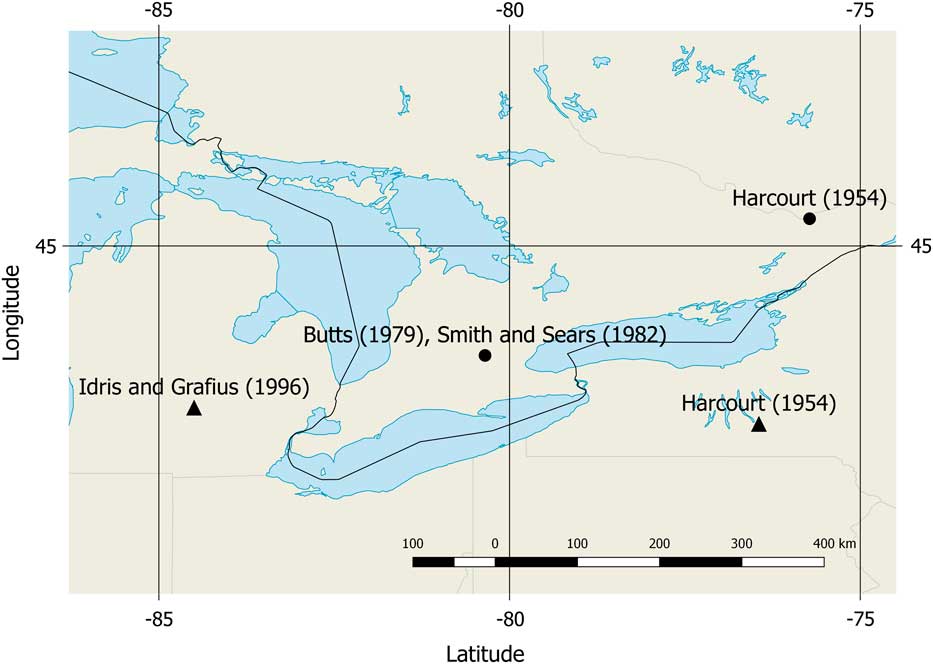
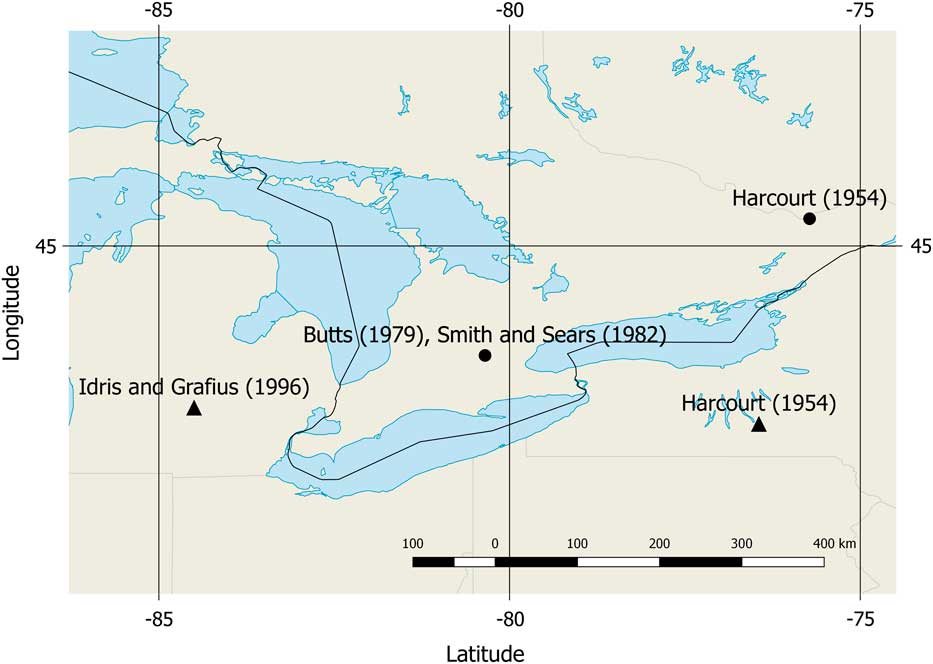
Cold tolerance literature on the diamondback moth can aid in placing several key North American studies into a modern context (Fig. 1). In this section, we review these studies and discuss observations of overwintering using weather data. Snow cover would provide the best information about the probability for diamondback moth overwintering; however, historically weather stations have not collected these data routinely or reliably, if at all. Therefore, for comparing and discussing past overwintering studies, the only data available and consistent across sites are daily air temperature values, with the exception of Dosdall et al. (Reference Dosdall, Mason, Olfert, Kaminski and Keddie2001) where gaps in recording from 1993 to 1995 were supplemented with data from a nearby station. Daily average air temperatures were gathered from government weather stations as close as possible to the study sites (Supplementary Material Tables 6–8). Temperatures from October to May were used, as this is the period of time when diamondback is typically reported to no longer be in flight and potentially overwintering (Harcourt Reference Harcourt1957). The following sections have key studies roughly divided by climatic region and ecozone. Calculations of accumulated degree days were made with an assumed lower development threshold of 7.3 °C (Butts and McEwen Reference Butts and McEwen1981) to estimate potential diamondback moth development in spring assuming successful overwintering. One-way analysis of variance tests were used to analyse daily winter temperatures across study years and sites (Tables 2 and 3); all analyses were done in JMP 13 (SAS Institute 2017).
Locations of key diamondback moth, Plutella xylostella, overwintering studies in southeastern Canada and the northeastern United States of America. Symbols indicate status of overwintering as reported by respective authors; ▴=evidence for successful diamondback moth overwintering; ●=little to no evidence of diamondback moth overwintering. Butts (Reference Butts1979) and Smith and Sears (Reference Smith and Sears1982): Cambridge Research Station, Cambridge, Ontario (43.4°N, 80.3°W). Harcourt (Reference Harcourt1954): Liddell Field Station, Ithaca, New York (42.5°N, 76.4°W) and Merivale Research Station, Ottawa, Ontario (45.4°N, 75.7°W). Idris and Grafius (Reference Idris and Grafius1996): Michigan State University Collins Road Entomology Research Farm, Lansing, Michigan (42.7°N, 84.5°W). The map was generated in QGIS v 2.18 (Quantum GIS Development Team 2017) using Natural Earth map data set.
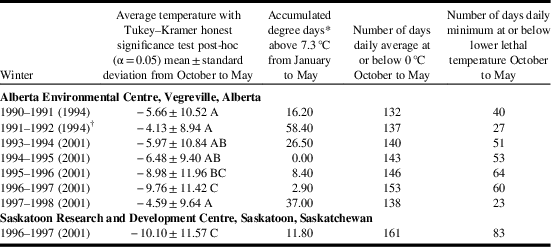
Comparison of daily average winter air temperatures across different years of the overwintering studies for diamondback moth, Plutella xylostella, conducted by Dosdall (Reference Dosdall1994) and Dosdall et al. (Reference Dosdall, Mason, Olfert, Kaminski and Keddie2001).
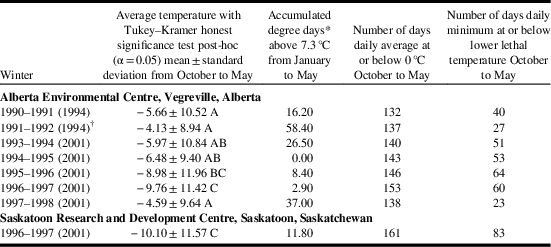
One-way analysis of variance was used and determined a significant difference in daily average winter temperature between study years denoted by different letters following the mean and standard deviation (F(7,1690)=10.35, *P<0.0001).
* Daily accumulated degree days were calculated using the formula: Mean temperature – 7.3 °C=degree days. Lower developmental threshold temperature used from Butts and McEwen (Reference Butts and McEwen1981).
† Year where overwintering of diamondback moth was reported.
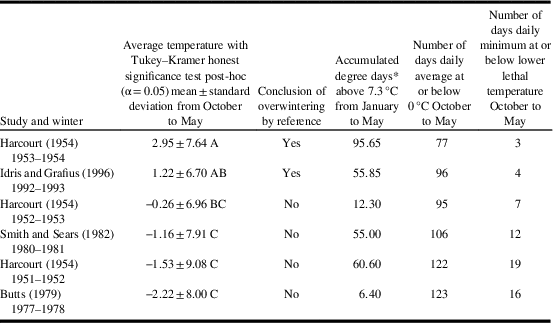
Comparison of daily average winter air temperatures across different overwintering studies for diamondback moth, Plutella xylostella.
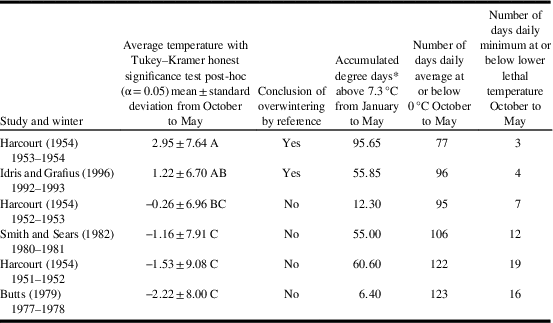
One-way analysis of variance was used and determined a significant difference in daily average winter temperature between studies denoted by different letters following the mean and standard deviation (F(5,1267)=13.22, *P<0.0001).
* Daily accumulated degree days were calculated using the formula: mean temperature – 7.3 °C=degree days. Lower developmental threshold temperature used from Butts and McEwen (Reference Butts and McEwen1981).
Great plains
Marsh (Reference Marsh1917) at Rocky Ford, Colorado, United States of America (38.0°N, 103.7°W) was the first to study overwintering of the diamondback moth in North America. Marsh (Reference Marsh1917) noted adults surviving the winter in field debris. Average winter temperature for Rocky Ford from 1914 to 1916 was 3.5±5.0 °C (November to May). In May, Marsh (Reference Marsh1917) collected adult moths that he believed had emerged from overwintering. The average temperature in the preceding months (March–April) was 8.4±4.1 °C. Therefore, it is possible that overwintered moths emerged as early as March rather than May. Average temperature in May (16.0±1.5 °C) was warm enough for moths to resume active flight (Goodwin and Danthanarayana Reference Goodwin and Danthanarayana1984), as well as mating (Ohtomo and Chiba Reference Ohtomo and Chiba2001) and oviposition (Gu Reference Gu2009). The moths Marsh (Reference Marsh1917) observed in the field could also have been migrants, as Colorado is close to the southern parts of the United States of America where diamondback moth persists year-round (36°N).
Dosdall (Reference Dosdall1994) was the first to report apparent diamondback moth overwintering in western Canada, when he collected 13 adult moths from emergence traps in late June to early July at Vegreville, Alberta (53.5°N, 112.1°W) after the winter of 1991–1992. Follow-up studies over six years at sites in Vegreville, Alberta and Saskatoon, Saskatchewan, Canada (52.1°N, 106.6°W) found no further evidence of overwintering (Dosdall et al. Reference Dosdall, Mason, Olfert, Kaminski and Keddie2001). Average winter temperatures decreased over the period from 1991–1992 to 1997–1998, although the winter of 1991–1992 was one of the warmer winters during this period (Table 2). One treatment in 1997–1998 provided additional insulation via a styrofoam cover; however, there was no evidence that populations overwintered that year (Dosdall et al. Reference Dosdall, Mason, Olfert, Kaminski and Keddie2001). It is possible the explanations provided in Dosdall (Reference Dosdall1994) for successful overwintering in 1991–1992, such as timing of first snowfall and life stage of the cohort in the field, were important determining factors for diamondback overwintering in Alberta. Winter conditions experienced during 1991–1992 appear to be beyond the physiological tolerance of the diamondback moth (see Cold tolerance by life stage). Average winter air temperatures for all years in the studies by Dosdall (Reference Dosdall1994) and Dosdall et al. (Reference Dosdall, Mason, Olfert, Kaminski and Keddie2001) were significantly colder on average (F(13,2957)=39.1, P<0.0001, data not shown) than temperatures associated with observations of diamondback overwintering in the northeastern United States of America (Table 3). Thus, the purported successful diamondback moth overwintering in Alberta and Saskatchewan in the above studies would have represented an extremely rare event.
Great lakes and St. Lawrence Basin
A cage study in Ithaca, New York, United States of America (42.5°N, 76.4°W) in 1953–1954, where diamondback moth was provided with plant material for shelter, claimed that adults survived the winter in outdoor conditions (Harcourt Reference Harcourt1954). However, there was very little detail provided concerning the cage setup and observation. Talekar and Shelton (Reference Talekar and Shelton1993) studied pupal overwintering in upstate New York in the winter of 1990–1991 and found no evidence for overwintering. Average air temperature for the winter of 1990–1991 in Ithaca, New York was 3.1±7.5 °C with 77 days at or below 0 °C and two days where minimum temperatures were at or below the lower lethal temperature, similar to that of the winter of 1953–1954 (Table 3). Talekar and Shelton (Reference Talekar and Shelton1993) also monitored adult activity using pheromone traps and reported no adult catches in upstate New York. However, there were adults caught in traps located on Long Island, New York during the same winter, where the average winter air temperature was 6.8±6.4 °C with 25 days at or below 0 °C, with no daily minima approaching the lower lethal temperature during the winter.
In Ottawa, Ontario, Canada (45.4°N, 75.7°W), Harcourt (Reference Harcourt1954) found no evidence of pupae overwintering during the winter of 1951–1952 or 1952–1953. Other studies have demonstrated that pupae survived up to 80 days at 0 °C (e.g., Kimura and Fujimura Reference Kimura and Fujimura1988), although successful eclosion of adults from pupae exposed beyond 80 days was unlikely (Kimura and Fujimura Reference Kimura and Fujimura1988). Therefore, the conditions during the Harcourt (Reference Harcourt1954) study were unsuitable for pupal survival with 122 and 95 days at or below 0 °C during that two-year study. Based on air temperature alone there may have been potential for larvae or adults to survive the winter of 1952–1953 in Ottawa; however, Harcourt (Reference Harcourt1954) did not include observations of those stages in his original study.
At Cambridge, Ontario (43.4°N, 80.3°W), Butts (Reference Butts1979) placed 250 diamondback moth pupae into an overwintering cage. Inadvertently, 40% of the pupae emerged as adults before the winter, some of which subsequently oviposited, thus the experiment also included adult moths and eggs. The following spring there was no evidence for successful overwintering of any stage, likely due to the number of days ⩽0 °C (123 days). However, Butts (Reference Butts1979) reported that 6.2% of pupae kept at 2±1 °C were viable after six months, with adult moths successfully eclosing. This high survivorship has never been replicated in studies since (Supplementary Material Table 3). Smith and Sears (Reference Smith and Sears1982), working at the same site, used more individuals in different life stages, and removed the cage after the first snowfall and replaced it in early spring. Removal of the cage may have allowed snow to accumulate and insulate the individuals placed in the field. Successful overwintering of one individual out of 5000 was reported. Due to this low survivorship, coupled with the previous results from Butts (Reference Butts1979), Smith and Sears (Reference Smith and Sears1982) hypothesised that Cambridge, Ontario was near the northern limit for overwintering of the diamondback moth. Snow cover in 1977–1978 was 126 days, whereas in 1980–1981 it was 82 days. Average air temperature during the study by Smith and Sears (Reference Smith and Sears1982) was significantly colder than in other studies where diamondback moth overwintering was reported (Table 3). Despite significantly colder average air temperatures, the accumulated degree days and number of days at or below 0 °C were similar to the conditions in studies where diamondback moth overwintering was observed (Table 3). With only 82 days of snow cover and rapidly warming spring temperatures, the potential for diamondback moth to have overwintered in Cambridge in the study by Smith and Sears (Reference Smith and Sears1982) is physiologically plausible.
The study of Idris and Grafius (Reference Idris and Grafius1996) in Lansing, Michigan (42.7°N, 84.5°W), provides a very compelling case for diamondback moth overwintering. They found fourth instars in early May, although there was no evidence for survival of any other stage of diamondback moth. These authors suggested that the number of accumulated degree days leading up to the discovery of fourth instars was insufficient for development from egg to fourth instar if the observed larvae were the F1 generation from overwintered adults (Table 3). They also noted that the accumulated degree days were sufficient for pupation if fourth instars had overwintered. Poor food quality, in the form of overwintered plant material, may have delayed further development of fourth instars. Saito (Reference Saito1994b) noted risk of starvation increases at 0 °C because frozen plant material is inaccessible for larval feeding. The circumstances in the study by Idris and Grafius (Reference Idris and Grafius1996) could be an extreme case of overwintering or may involve the influence of other variables to explain the observed larval survival.
Overwintering strategy
The consensus in the literature is that the diamondback moth does not overwinter in diapause (Hardy Reference Hardy1938; Frost Reference Frost1949; Atwal Reference Atwal1955; Harcourt and Cass Reference Harcourt and Cass1966; Butts Reference Butts1979; Smith and Sears Reference Smith and Sears1982; Kimura et al. Reference Kimura, Fujimura and Araya1987a; Saito Reference Saito1994b; Campos Reference Campos2008; Kim et al. Reference Kim, Park, Park, Kim and Kim2015); instead it likely survives unfavourable conditions in a state of quiescence (Honda et al. Reference Honda, Miyahara and Kegasawa1992; Campos Reference Campos2008). This is demonstrated by: (1) the slowing of development in response to decreasing temperature with no indication of arrested development (Atwal Reference Atwal1955; Liu et al. Reference Liu, Chen and Zalucki2002); (2) the ability to become active immediately when placed back in favourable conditions despite long durations at 0 °C (Kimura et al. Reference Kimura, Fujimura and Araya1987c); and 3) evidence of continual feeding at temperatures near 0 °C (Kimura et al. Reference Kimura, Fujimura and Araya1987c; Saito Reference Saito1994b; Liu et al. Reference Liu, Chen and Zalucki2002; Gu Reference Gu2009).
The diamondback moth is likely capable of overwintering in temperate climates via plastic responses under particular abiotic conditions. Park and Kim (Reference Park and Kim2014) demonstrated decreasing supercooling points after the induction of rapid cold hardening. In addition, generations leading into the winter season had slightly lower supercooling points (Hayakawa et al. Reference Hayakawa, Tsutsui and Goto1988; Kaneko Reference Kaneko1995) this could represent an acute response associated with rapid cold hardening (Sinclair and Roberts Reference Sinclair and Roberts2005). However, the ecological relevance of the supercooling point remains debatable in the diamondback moth. Honda (Reference Honda1992) was the first to incorporate acclimation in the cold tolerance study design; however, a constant temperature treatment was not used for comparison. Gu (Reference Gu2009) included a fluctuating temperature regime from 0 °C to 5 °C to assess survival. This resulted in asynchronous development of individuals in a cohort, where some developed into the next life stage while others did not. Unfortunately, these individuals were not subjected to colder conditions to assess potential effects of acclimation compared with individuals at constant temperatures. There is currently no study or suite of studies that have explored the set of experiments suggested by Sinclair et al. (Reference Sinclair, Alvarado and Ferguson2015) to detect phenotypic plasticity at low temperatures. This includes treatments involving: induction of rapid cold hardening, acclimation, low temperature development with a short photoperiod, and low temperature development with decreasing temperature and photoperiod. However, the induction of rapid cold hardening and the associated changes in low temperature survivorship (Park and Kim Reference Park and Kim2014), changes in supercooling points (Hayakawa et al. Reference Hayakawa, Tsutsui and Goto1988; Kaneko Reference Kaneko1995), and asynchronous development at cold temperatures (Atwal Reference Atwal1955; Butts Reference Butts1979; Gu Reference Gu2009) can represent some evidence for plastic responses to cold. This could result in survival by a portion of the population capable of passing short durations of extreme temperatures until the return of more favourable conditions.
The observed overwintering stages of the diamondback moth include late instars (Idris and Grafius Reference Idris and Grafius1996), pupae (Kanervo Reference Kanervo1936; Hardy Reference Hardy1938; Razumov Reference Razumov1970), and adults (Marsh Reference Marsh1917; Frost Reference Frost1949; Harcourt Reference Harcourt1954; Smith and Sears Reference Smith and Sears1982). Our review suggests that all the above observations likely involve overwintering in quiescence, with the adult stage being the most capable of tolerating temperate winters. It is conceivable that the diamondback moth can pass the entire duration of a short and mild winter season in any of the three stages. The duration of cold conditions appears to be an important factor, with stages of the insect generally experiencing increased mortality only after about 40 days (Kimura and Fujimura Reference Kimura and Fujimura1988) but with the potential for some survivorship beyond 80 days in conditions near 0 °C (see Cold tolerance by life stage). In summary, favourable conditions for diamondback moth overwintering include the following: (1) the moth should be in a later developmental stage (fourth instar, pupa, adult) before the first snowfall and seek shelter in crop debris (Marsh Reference Marsh1917; Dosdall Reference Dosdall1994) or manufactured structures, such as greenhouses (Razumov Reference Razumov1970; Kimura et al. Reference Kimura, Fujimura and Araya1987b; Saito Reference Saito1994a; Kim et al. Reference Kim, Choi, Park, Cha, Jung and Lee2014); (2) the winter would average 0 °C with occasional dips into sub-zero temperatures or have consistent snow cover; and (3) unfavourable conditions would not last longer than 50–80 days (Kimura and Fujimura Reference Kimura and Fujimura1988; Saito Reference Saito1994b).
Survivorship among different life stages of the diamondback moth in cold temperatures appears to vary (Table 1). However, with the lack of standardisation between different cold tolerance studies, it is difficult to say if the variation seen reflects the true physiology of the species or the variable physiology of geographically (and thus genetically) distinct populations. In addition, a few authors have discussed how they evaluated mortality for each life stage. The literature does, however, support the longstanding view that the adult stage of the diamondback moth is the most cold tolerant and the most likely stage to overwinter successfully (Kimura and Fujimura Reference Kimura and Fujimura1988; Honda Reference Honda1992; Honda et al. Reference Honda, Miyahara and Kegasawa1992; Saito Reference Saito1994b).
Discussion
Availability of crop or wild brassica plants early in the spring may play a role in the overwintering success of the diamondback moth. Yellow rocket, Barbarea vulgaris Aiton (Brassicaceae), is a native North American species that grows and flowers early in the spring (April–May) that often provides the first evidence of diamondback moth early in the season (Harcourt Reference Harcourt1957; Idris and Grafius Reference Idris and Grafius1996). Canola is a commercial oilseed Brassica, and is a major crop attacked by the diamondback moth (Dosdall Reference Dosdall1994). Fully commercial varieties of canola were released in the 1970s (Slinkard and Knott Reference Slinkard and Knott1995) and production in Ontario only began in 1983 (Kulasekera Reference Kulasekera2014). Overwintering studies before the 1980s focussed on cruciferous vegetables. Since then, canola has been planted at a large scale in Canada at 9 306 500 ha, with 18 200 ha in the province of Ontario in 2017 (Statistics Canada Reference Statistics Canada2017), making canola a CAD $26.7 billion industry in Canada (Canola Council of Canada 2016). The significant change in the crop landscape with the introduction of canola in Ontario and the rest of Canada may provide a major annual food source for the diamondback moth, increasing the magnitude of selective pressure on traits that improve overwintering capacity. However, in the United States of America, canola is not grown at the same scale, with only 874 525 ha planted in 2017 (United States Department of Agriculture, National Agricultural Statistics Service 2017). Canola can represent a large food source for migrating populations of diamondback moth providing numerous opportunities for adaptation to Canadian winters. One such event may have resulted in the Dosdall (Reference Dosdall1994) observation of diamondback overwintering in Alberta. Further study is required to examine the life history of the diamondback moth in Ontario and western Canada due to the significant change in agricultural landscapes.
Observations of diamondback overwintering in north temperate North America have been sporadic and tend to be associated with milder average temperatures and rapidly warming spring temperatures. By considering the results of overwintering studies conducted from 1953 to 1993 between 42.41°N and 45.38°N, the overwintering limit for diamondback moth in eastern North America is ~43°N. However, the northern limit of diamondback moth in more central regions could exist at much higher latitudes due to a continental climate. In addition, climate change has likely affected the seasonality of these climatic regions that may result in the limit being further north at present day. This could lead to earlier incidences of diamondback moth infestation with the potential for pesticide-resistant populations establishing from previous years.
Despite the potential of the diamondback moth to survive in southeastern regions of Canada, northern migration in the spring from southern climates is still the major contributing factor of diamondback moth populations in Canada, as demonstrated by Dosdall et al. (Reference Dosdall, Mason, Olfert, Kaminski and Keddie2001), Hopkinson and Soroka (Reference Hopkinson and Soroka2010), and to a certain extent by Smith and Sears (Reference Smith and Sears1982). Air trajectory models can accurately predict incoming populations of diamondback moth, with several studies demonstrating that the diamondback moth can travel distances up to 3000 km (Chu Reference Chu1986; Talekar and Shelton Reference Talekar and Shelton1993; Chapman et al. Reference Chapman, Reynolds, Smith, Riley, Pedgley and Woiwod2002; Coulson et al. Reference Coulson, Hodkinson, Webb, Mikkola, Harrison and Pedgley2002). Unfortunately, extensive regional-scale molecular genetic work on the diamondback moth has been conducted only in Asia and Australia (Endersby et al. Reference Endersby, McKechnie, Ridland and Weeks2006; Wei et al. Reference Wei, Shi, Gong, Jin, Chen and Meng2013; Kim et al. Reference Kim, Park, Park, Kim and Kim2015; Yang et al. Reference Yang, Tian, Xu, Xie, Wang and Zhang2015) and has yet to be done on a similar scale in North America. Studies that have examined variation and gene flow among populations between continents or countries use North American samples from select regions (Capriol and Tabashnik Reference Capriol and Tabashnik1992; Chang et al. Reference Chang, Tabashnik, Artelt, Malvar, Ballester, Ferré and Roderick1997; Roux et al. Reference Roux, Gevrey, Arvanitakis, Gers, Bordat and Legal2007; Juric et al. Reference Juric, Salzburger and Balmer2017). Unfortunately, samples were derived from one population representing each country or continent and may not provide the best representation of the variation found in diamondback moth populations in North America. Refining molecular genetic techniques and sampling to differentiate diamondback moth populations in a meaningful way is critical. Molecular tools could resolve the original source populations of migrants from southern regions of North America, which is essential to future management of this pest species. In addition, the ability to discriminate between regional and migrant populations in the field can aid in determining whether populations have overwintered.
Future directions
In future studies, recording parameters such as duration of snow cover, temperature under the snow, and extreme temperature events would provide better indicators of diamondback moth overwintering potential. Although these types of data are not available from the past studies and across all study sites, there appears to be a detectable trend when observing air temperature and the associated parameters calculated from it such as degree days and the number of days minimum temperatures reach the lower lethal temperature. Management strategies in the future should include the duration and temperature of winters as part of their pest monitoring programmes.
For overwintering experiments, the most important factor determining successful overwintering and initiation of the subsequent spring generation is the viability of the insect. This is usually reported as successful hatching, eclosion and, more critically, the ability of adult females to lay eggs that are themselves viable. Future cold tolerance studies should be cautious in how they report physiological survivorship and should distinguish between cold-period durations allowing viability to be maintained and durations in which viability is no longer possible. In addition, winter conditions can permit brassicaceous plant material to be suitable feeding material for larvae; however, early spring carbohydrate sources for overwintering adults in the field are more of a challenge, although early flowering volunteer canola may provide such a source. Measures of survivorship in the laboratory and field must consider energy provisions available to adults in the wild to be applicable to real-world scenarios.
Physiological changes and phenotypic responses to seasonal cues in the diamondback moth must also be explored via investigations on the direct effects of photoperiod, dehydration/desiccation, low temperature energetics/metabolism, low temperature oxygen consumption, location of intracellular ice formation, upper and lower limits of cold injury, identification of antifreeze proteins, role of ice-nucleating bacteria, and more in-depth assessments of developmental plasticity of generations leading into winter. In addition, there is no consensus on the lower developmental threshold for the diamondback moth. The lower developmental threshold was extrapolated from data taken at higher temperatures (Umeya and Yamada Reference Umeya and Yamada1973; Butts and McEwen Reference Butts and McEwen1981; Golizadeh et al. Reference Golizadeh, Kamali, Fathipour and Abbasipour2007) resulting in different values between studies. However, Butts (Reference Butts1979) and Liu et al. (Reference Liu, Chen and Zalucki2002) have shown development continues to occur below these estimated thresholds indicating the reported values are likely inaccurate. Future work should reassess the lower developmental threshold using a physiological approach directly at these lower temperatures. The expression of additional heat shock proteins during and after cold temperature exposures and including the induction of rapid cold hardening in the diamondback moth should also be examined. This would aid in differentiating heat shock proteins that are involved in a thermotolerance role, which is critical to determining cold temperature survival and subsequent ability to recover from potential chill injury. Equally important is the comparison of responses to potential overwintering cues between tropical and temperate populations of diamondback moth. Gene flow and potential for insecticide resistance to proliferate within suspected overwintering populations and migrant populations must also be examined.
Bioclimatic models can be useful to predict the world distribution, year-round persistence and migration potential of the diamondback moth. These models rely heavily on the parameters listed above and would benefit from additional assessment of these parameters at low temperatures to improve predictive power. A model projecting potential overwintering ranges using cold tolerance data has yet to be developed. Diamondback moth overwintering limits in higher latitudes have been mainly anecdotal. The aid of an overwintering model can predict areas of potential risk and persistence of overwintered populations, and could further inform timing of outbreaks and management action in at-risk areas.
Conclusion
With climate change, it is urgent that we obtain better knowledge on the overwintering ability of the diamondback moth. Climate change has been implicated as the primary driver of poleward range expansion in butterflies (Parmesan Reference Parmesan2001) and Heteropteran species (Musolin Reference Musolin2007). A barrier that insects must overcome in the context of range expansion due to climate change is the asynchrony in timing of seasonal development and overwintering (Musolin Reference Musolin2007; Bale and Hayward Reference Bale and Hayward2010). As presented in this review, the diamondback moth is multivoltine, with the number of annual generations determined by food availability and the length of the growing season. It is potentially chill susceptible with the ability for rapid cold hardening to increase cold tolerance. The diamondback moth likely overwinters in quiescence in no specific stage, with the adult stage being the most capable of surviving short and mild winter seasons. With the aid of new genetic tools, and rigorous temperature data and tracking models, the set of parameters necessary for diamondback moth overwintering may not remain elusive for much longer.
Acknowledgements
The authors would like to thank Paul Abram for his comments on an earlier version of the manuscript, and two anonymous reviewers for their valuable feedback in improving this manuscript. Agriculture and Agri-Food Canada provided funding for this project.
Supplementary material
To view supplementary material for this article, please visit https://doi.org/10.4039/tce.2018.2