During the general election campaign of November 1935, the Labour Party produced a rather infamous poster. Its message was simple: “Stop War! Vote Labour.” The visual content was startling: a baby, face encased in a gas mask, lying helplessly on its back, an arm extended to the words “STOP WAR!”Footnote 1 The baby in the gas mask haunted the interwar imaginary, motivating antimilitarist campaigns for disarmament. But the infant anti-gas helmet's larger significance lies in the ways in which this object embodied the total nature of the Second World War.
The device originated in the unprecedented use of chemical arms and air power during the First World War. The deployment of such weapons forced interwar governments to reckon with a new threat to their civilian populations: the prospect of combining these two innovations in war making and unleashing them on vulnerable populations. The British state's response was to create the official apparatus of civil defense, starting with the establishment in 1924 of a subcommittee of the cabinet-level Committee of Imperial Defence that was devoted to air raid precautions. This entity agreed (at least theoretically) to create “a defensive organisation designed to protect the civil population against the effects of gas,” largely because of the “serious effect that the employment of gas may have on the moral of a population ignorant of the subject.”Footnote 2 This effort was not merely about education, however. As discussions and debates proceeded in secret across the decade of 1925–1935, one cornerstone of the policy became the development of individual anti-gas protection and its distribution to the entire civilian population. That this policy came to include inhabitants of all ages makes it a stunning recognition of the totality of modern war. Thus, by tracing the history of this thing—the babies’ protective anti-gas helmet—we can see how total war became normalized in modern Britain during the 1930s and 1940s.
By the mid-1930s, the government had determined that gas masks would be made available for free to its civilian population. Officials at the Chemical Defence Research Department regularly consulted with planners charged with air raid precautions and developed the general civilian respirator as the basic model. Protecting those unable to utilize the standard adult gas mask, however, proved an additional challenge. A special problem was what to do about infants.Footnote 3
Despite the implications of the 1935 Labour Party poster, no official baby gas mask had yet been developed when the British government first unveiled air raid precautions in the summer of 1935. Indeed, that was the year when scientists and engineers scrambled behind the scenes to figure out what kind of device could work for infants, coming up with plans for a gas-proof pram, a gas-proof baby bag, and a range of other designs that eventually had to be discarded. Nor were there any officially sanctioned devices ready for anyone under the age of four when anti-gas protection took center stage during “Gas Mask Sunday,” which occurred in the midst of the Munich Crisis of late September 1938.Footnote 4 As the world waited tensely to see what would become of the conference reacting to Nazi Germany's demands regarding Czechoslovakia, Britain conducted its first mass exercise in civil defense on 25 September as people lined up across the nation to be fitted with gas masks. The event was carefully stage-managed as the media published photos of entire households kitted out in masks as representative of “typical English famil[ies] taking precautions and taking them calmly—with faith in Britain prepared and Britain strong.”Footnote 5
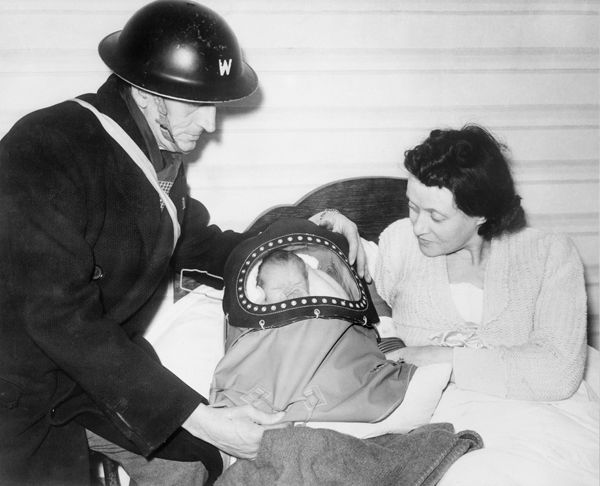
But Britain was not yet entirely prepared to protect all of its citizens, for during the summer and autumn of 1938 researchers were still testing a variety of devices to safeguard babies against poison gas. Trials of infant gas masks observed the efficacy of devices and the physical and emotional states of babies—and, to a lesser extent, of the mothers accompanying them. One trial in Holborn concluded, “The fact that most of the babies cried during the test must not be given undue weight since this is to be expected to some extent with any device.”Footnote 6 The prototype that was eventually manufactured was the baby anti-gas helmet, which had among its benefits the ability for mothers to hold and see the infant.
The “Babies’ Protective Helmet” offered, in the words of its 1939 instruction manual, “complete protection for any child between birth and school age.” But it required the “attention of an older person for the provision of air by means of a pump.”Footnote 7 The government promoted its use by issuing the following reassurances: “Most babies and children quite readily take to the Helmet and soon become accustomed to being inside, in fact it is common for them to go to sleep. In the case of young children who are rebellious of control it is possible for one adult quickly to place the child in the Helmet and thus to protect it from gas in spite of its resistance. Once inside, such children usually cease to resist and appear contented.”Footnote 8 Combating such resistance and pumping continually to ensure the flow of clean air to a baby was assigned to an “older person,” clearly imagined as the mother. Thus, one additional role for women in wartime became orchestrating the anti-gas protection of their infants. When officials were preparing in December 1938 to launch the babies’ protective helmet, they agreed that the training of “mothers in the use of the device” required careful consideration. Moreover, “for obvious reasons the demonstrations [of how to use the device] should be given by an individual in the Medical officers of Health Department, accustomed to handling babies” rather than by the local civil defense instructors.Footnote 9
Despite the careful assurances about infant protection and the portrayal of this object as a benevolent, life-saving gift, the British public had varying responses. One mother who participated in trials for prototypes validated not only the design of the helmet but also the entire government effort, declaring that it “inspires confidence when one has practical demonstrations of the precautions being taken.”Footnote 10 Drama critic James Agate offered his thoughts in the Daily Express in his “Lullaby for a Baby Wearing a Gas-Mask”:
The poem has more in common with the terror meant to be evoked by the 1935 Labour campaign poster: the sense that, rather than trying to take comfort in being able to protect babies from the harrowing weapons of modern war, perhaps more should be done to prevent such scenarios from ever taking place.
The mixed reactions to the babies’ protective helmet prior to the start of the Second World War did not stop officials from continuing to emphasize the necessity of the device for practical reasons and for sustaining morale. Yet from the moment of its first appearances, the targets of such reassurances did not always respond with the confidence that the mother above expressed during the infant gas mask trials. In her memoir, Hilda Casey remembers her mother's reaction to this one British thing: “Mum wasn't adverse to accepting gas masks for us but she was dismayed when shown the peculiar contraption offered for her baby's protection against gas attack. About the size of a large suitcase with mica porthole, it was impossible for her to consider putting our baby into it. She burst into tears.”Footnote 12 Both at the time and in popular memory, the babies’ protective helmet represented the stark reality of modern, total war: the fundamental vulnerability of entire populations to weapons of mass destruction.
The baby anti-gas protective helmet in action, 15 November 1939, photograph from the Imperial War Museums. ©Imperial War Museum (HU 55685). Reprinted by permission.