Transcatheter closure of the arterial duct is well established. Over the years, many different devices and techniques have been used.Reference Porstmann, Wierny and Warnke1–Reference Masura, Walsh and Thanopoulous5 The Rashkind umbrella, initially widely used for the procedure, necessitated repeated aortography to ensure a satisfactory position for the device. The devices now most frequently deployed are either Cook detachable coils, marketed by Cook Cardiology, Bloomington, Indiana, United States of America, or the Amplatzer plug, produced by AGA Medical Corporation, Golden Valley, Minnesota, United States of America. Despite technical advances in design, which have hugely simplified the procedure, most institutions continue to use arterial access so as to perform the repeated aortography considered necessary to assess the size of the duct, the position of the device, and to confirm ductal occlusion subsequent to release of the device. Femoral arterial catheterisation in children, however, carries potentially serious risks, including thrombosis, haemorrhage, dissection, formation of pseudoaneurysms, claudication and abnormalities in subsequent growth of the limbs.Reference Kulkarni and Naidu6–Reference Balaguru, Dilawar, Ruff and Radtke12 Because of all these potential problems, an arterial approach should be avoided unless essential. With this in mind, we have analysed our experience, over a 10 year period, of transcatheter occlusion of the arterial duct, avoiding femoral arterial catheterisation whenever possible.
Materials and methods
We reviewed data collected prospectively from 389 consecutive patients undergoing transcatheter closure of a patent arterial duct between 1994 and 2004. We used either the Amplatzer duct occluder, in 101 procedures, or Cook detachable coils, deployed in 288 procedures. We assessed the route used for vascular access, the device deployed, the success of the procedure, any complications, and the need for reintervention.
Procedure
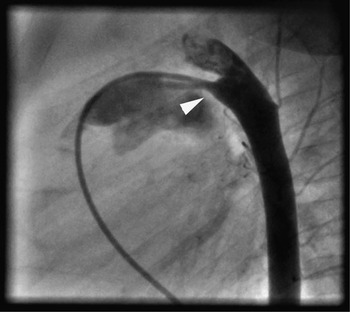
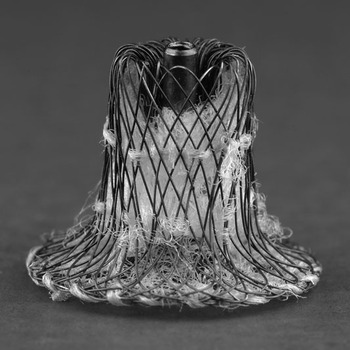
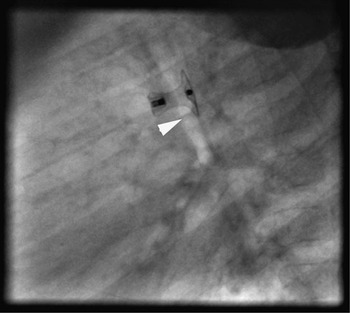
After a brief learning experience with these devices when arterial access was used routinely, arterial catheterisation was used only when there was difficulty crossing the duct using the venous approach. Using femoral venous access, usually with a 4 French sheath and a 4 French multipurpose catheter, the duct was crossed, if necessary using a hydrophilic .035 inch guide wire, and an aortogram performed in the lateral projection only (Fig. 1). On the rare occasions when recoil of the catheter produced poor quality angiography, the multipurpose catheter was exchanged for a 5 French Pigtail catheter, and the aortogram repeated. The size of the duct was estimated relative to the known diameter of the catheter. Following the introduction of the Amplatzer ductal occluder, we used Cook flipper coils for patients having ducts of less than 2.5 millimetres diameter. Prior to this time, we frequently used multiple coils to occlude large ducts. They were introduced through the same 4 French multipurpose catheter, using either a Cook 4 French HBP multipurpose device, or the Cordis Infiniti 4 French multipurpose A2, both chosen for their small side holes but large .038 inch lumen. The positioning of the coil was guided by its shape on deployment, along with its anatomical relationship to other structures such as the trachea, using lateral fluoroscopy. An echocardiogram was performed 5 minutes after deployment to assess residual shunting, and a further coil or coils were then implanted as necessary. The Amplatzer ductal occluder was generally deployed in patients having ducts larger than 2.5 millimetres in diameter. After exchanging the 4 French catheter for an appropriately sized long sheath, the plug was positioned in a similar manner to the coils, using anatomical landmarks as well as the shape of the deployed device. We relied in particular on the site of the waist on the device (Figs 2 and 3). Echocardiography was repeated the following morning, at 1 month, and at 1 year after the procedure.
Aortography via the arterial duct shows the size of the arterial duct and its relationship to the trachea (arrow).

The appearance of the Amplatz plug prior to its deployment. The widest part of the stalk is adjacent to the disc.

The appearance of a satisfactorily positioned Amplatz plug. The position of the disc in relation to the trachea is seen clearly (arrow). The area immediately proximal to the disc is now the narrowest part. This change of configuration to the appearance of a champagne cork, along with its position relative to the trachea, indicates that the plug is held securely within the duct, that the disc is appropriately positioned adjacent to the narrowest part of the duct, and that the disc is not protruding into the aortic lumen.

Results
We deployed either 243 single or 66 multiple coils during 309 procedures undertaken in 288 patients. Of these deployments, 303 (98%) were successful, the coils being inserted without displacement. Within the overall experience, 232 of the procedures (75%) were achieved using venous access alone. The median time required for fluoroscopy was 5.4 minutes, with a range from 0.9 to 57.5 minutes. After the first 12 months of our experience using coils, we used venous access alone in 211 of 271 procedures (78%), compared to 55% in the first 12 months. In 60 patients over this period, it proved necessary to resort to arterial access. In 45 of these patients, this was due to an inability to cross the duct, of small size, from the right heart. We had intended to use venous access alone in 94% of the patients. The median period of fluoroscopy fell from 7.7 minutes, with a range from 3.7 to 57.5 minutes, during the first year to 5.1 minutes thereafter, the range then being 0.9 to 50 minutes. Complete occlusion as judged echocardiographically was achieved in 240 of the procedures (78%) by the following day. At a median follow up of 1.15 yrs, with a range from 0.04 to 8.34 years, complete occlusion has been achieved in 303 of the procedures (98%). We noted trivial stenosis of the left pulmonary artery in 3 patients, with Doppler velocities of less than 2.5 m/s. Reintervention was necessary in 25 of the 288 patients (9%), because of haemolysis in 5 (1.7%), all these patients having large ducts closed with multiple coils before the availability of the Amplatzer plug. Residual shunting was noted in 14 patients (4.9%), with over nine-tenths of these patients having coils inserted into larger ducts before the Amplatzer plug was available. Embolisation of the coils occurred in 6 patients (2.1%). There was no significant difference in rates of embolisation between those patients undergoing entirely venous closure, embolisation being observed in 4 of 232 patients (1.7%), or those undergoing occlusion using the arterial approach, with 2 of 77 patients (2.6%) having embolisation.
When using Amplatzer ductal occluders, success was achieved in 99 of 101 patients (99%) without displacement of the device. Of this number, 83 (82%) were deployed using venous access alone, with a median period of fluoroscopy of 4.6 minutes, and a range from 1.6 to 66.1 minutes. After the first year of our experience, the ability to insert the plug using an entirely venous approach rose to 92%. Arterial access was required in 8 patients, 5 were because of an inability to cross the duct from the right heart, due to an awkward angle on the pulmonary arterial side and an unusual ductal course, leaving an intended venous approach of 97%. The median time of fluoroscopy remained the same at 4.6 minutes, with a range from 1.6 to 50 minutes. Complete occlusion was noted echocardiographically the following day in 92 patients (91%). At a median follow up of 1.09 years, with a range from 0.08 to 4.98 years, we found trivial stenosis of the left pulmonary artery in 2 patients, both having Doppler velocities of less than 2.5 m/s. There were no cases of iatrogenic coarctation. Complete occlusion was revealed echocardiographically in all patients after 12 months. Displacement after deployment requiring reintervention occurred in 2 patients, with one occurring in the first year of our study. In this patient, after retrieval of a coil embolised to the pulmonary artery, we deployed an Amplatzer plug using both venous and arterial access. It immediately embolised to the aorta. Although it was snared back into the duct, it could not be retrieved, and surgical removal was required. In the second case, a plug deployed using venous access only had embolised to the left pulmonary artery the following morning. It was retrieved at repeated cardiac catheterisation, and replaced successfully with a larger plug.
Discussion
Since the initial report of transcatheter closure of the persistently patent arterial duct in 1967,Reference Porstmann, Wierny and Warnke1 devices and techniques have evolved so that now this approach provides high rates of occlusion with very low rates of complication.2–Reference Kulkarni and Naidu6 Most centres in the western world now use the Cook detachable coil to occlude small ducts, and the Amplatzer ductal occluder for larger ducts, attempted occlusion using coils having a higher rate of embolisation and residual shunting in this latter setting. Routine practice involves arterial access for angiography before, during, and after deployment of the device.Reference Masura, Walsh and Thanopoulous5, Reference Magee, Huggon, Seed, Qureshi and Tynan13 The reasons for using arterial access is that it allows initial aortography to be performed without crossing the duct, supposedly minimising the risk of ductal spasm and consequent underestimation of the size of the duct, and that it permits subsequent aortography to confirm a good position of the device prior to release and to exclude iatrogenic coarctation. It is our experience, and that of others,Reference Tzifa, Tulloh and Rosenthal14 that ductal spasm may occur whether the duct is crossed or not. In one of our patients, complete ductal occlusion due to spasm occurred on the induction of anaesthesia, prior to achieving femoral vascular access. It is of particular importance to maintain a high index of suspicion of spasm if there are discrepancies between previous clinical and echocardiographic appearances when interpreting angiography in these patients, whether or not arterial access has been used. With careful attention to the site of the waist on the deployed plug and the relevant anatomical landmarks, we did not find repeated aortography necessary confidently to exclude the possibility of aortic obstruction by the device.
Arterial access in children is reported to have an early rate of complication rate ranging between 3.7 and 16%, with a significant proportion of complications requiring intervention.Reference Kulkarni and Naidu6, Reference Vitiello, McCrindle, Nykanen, Freedom and Benson7, Reference Rothman15 Complications such as arterial disruption, or acute occlusion, may be life or limb- threatening. Surgical intervention has sub-optimal results in children less than 2 years of age.Reference Lin, Dodson and Bush8 Although the use of thrombolytics has been found to be effective in treating femoral arterial thrombosis,Reference Balaguru, Dilawar, Ruff and Radtke12 a proportion of children still have absent or diminished pulses in the feet at the time of discharge, and the drugs themselves are not risk free.
Chronic occlusion of the ilio-femoral arteries after catheterisation can result in claudication, inequality in the length of the legs, and disturbance of gait that is particularly important in children with growing epiphyses.Reference Macnicol and Anagnostopoulos11 Surgery may be required later to treat such disturbances, pseudoaneurysms, arterio-venous fistulas, or symptoms of chronic vascular insufficiency.Reference Lin, Dodson and Bush8, Reference Taylor, Troutman, Feliciano, Menashe, Sunderland and Porter10
Because of these potential problems, we prefer to use femoral venous access when seeking to occlude the arterial duct. In our study, after our learning experience over the first 12 months, we intended to use femoral venous access alone in 94% of our patients. This proved impossible only when we had difficulty in entering small ducts from the venous side. In this regard, we differ from the routine practice in many institutions in the western world.Reference Masura, Walsh and Thanopoulous5, Reference Magee, Huggon, Seed, Qureshi and Tynan13
Our median times for fluoroscopy when inserting either coils or a plug were below previously published values.Reference Masura, Walsh and Thanopoulous5, Reference Thanopoulos, Hakim and Hiari16–Reference Pass, Hijazi, Hsu, Lewis and Hellenbrand18 When inserting coils, our rate of successful deployment was 98%, and we had achieved complete occlusion in 78% of the patients as judged after 24 hours, and 98% at a median follow-up of 1.5 years. This again compares well with previous experience, with rates of occlusion of between 90 and 95% reported on late follow-up.Reference Uzun, Dickinson, Parsons and Gibbs4, Reference Magee, Huggon, Seed, Qureshi and Tynan13 Our incidence of embolisation, at 2%, is also comparable with previous reports,Reference Galal17 and was similar irrespective of the use of arterial or venous access. This suggests that the popular concern that crossing the duct induces more spasm than might be seen otherwise is unfounded.
In keeping with published experience,Reference Masura, Walsh and Thanopoulous5, Reference Thanopoulos, Hakim and Hiari16, Reference Galal17 we achieved successful deployment of the Amplatzer ductal occluder in 99% of our patients, with complete occlusion seen in all at a median follow-up of 1.09 years. The rate of displacement of the device was the same irrespective of the use of arterial or venous access. We found a very low incidence of trivial left pulmonary artery stenosis, and observed no cases of aortic obstruction on mid-term follow-up.
We submit, therefore, that ductal closure can be achieved using a venous approach, thus avoiding the significant morbidity of femoral arterial catheterisation. The venous approach is safe and effective, does not compromise complete ductal occlusion, nor increase the rate of procedural complications. On this basis, we suggest that the routine use of arterial catheterisation for ductal occlusion should be abandoned.