Introduction
When George Sarton launched his Isis in 1912, it remained to be shown that the history of science was a discipline. By the time he relinquished his editorship, some four decades later, the demonstration had been given and the discipline established.
Arnold Thackray (Isis 1985, 467)
Following in the footsteps of prominent scholars, such as Thomas Kuhn and Robert K. Merton, the history of the history of science has already often been characterized as a transition from an “undisciplined subject” to a disciplined one (Isis 1984, 29–30; Isis 1985, 470; Isis 2013, 90–95).Footnote 1 During a period of about one hundred years, a specialized scientific community devoted to the history of science has been formed and disciplined. Its own members have evaluated this history in quite consistent ways. For some, their discipline is “approaching maturity,” and their professional associations are “coming of age” (e.g., Isis 1947, 7; Isis 1975, 454–467; Isis 1999, S28-S42). Others speak of “a well-established if small university discipline” (Isis 2013, 132). While the limited number of stand-alone departments of history of science at the university level is decried, it is also added that “our institutional heterogeneity has kept our field intellectually supple and perennially reflexive” (Isis 2013, 92). Such self-descriptions may be important for the field. But empirical research about the processes of discipline-building has hitherto remained scarce. In this paper, we present an analysis of the morphogenesis of the disciplinary communication structures within the “epistemic community” devoted to the history of science.
Building upon some of Rudolf Stichweh's contributions, we argue that analyses of specialized communication media allow us to shed light on the formation and transformation of epistemic communities (Stichweh Reference Stichweh1984, 394–441; idem 1992; idem 1994, 84–98). Analyses of journals and journal publications may be of particular relevance. Specialized scientific journals reveal the collective character of the scientific practice, as they consist of a collection of different articles by different authors. They channel the communication within the epistemic community and thereby also “control” its formation and transformation. The authors of submitted material accept the specialization chosen by the journal, but also continually modify this specialization by the cumulative effect of the published research findings. The journals endorse what the community takes to be certified knowledge; the editorial system of quality control puts up a barrier, but also grants a minimal form of recognition to what is published. Its evaluation structures stimulate individuals to define themselves in relation to the disciplinary project. Following Stichweh, the scientific journals are of constitutive relevance for the “self-organization” of disciplinary specializations (see also Bazerman Reference Bazerman1988, 128–150; Gross, Harmon, and Reidy Reference Gross, Harmon and Reidy2007; Jacobs Reference Jacobs2013).
The first specialized scientific journals appeared in the last decades of the eighteenth century; they were characterized by an orientation on such subjects as chemistry, physics, mineralogy, and philology (e.g., McKie Reference McKie and Meadows1979; Atkinson Reference Atkinson1999). Thousands of other specialized scientific journals have since been established. In the decades around 1900, there have also emerged the first periodicals devoted to the history of science or the history of particular scientific specializations (e.g., Leven Reference Leven, Beretta, Pogliano and Redondi1998). They include Janus: Archives internationales pour l’histoire de la médecine et pour la géographie médicale (1896–1990); Mitteilungen zur Geschichte der Medizin und der Naturwissenschaften (1902–1942); Archiv für die Geschichte der Naturwissenschaften und der Technik (1909–1922), Isis: Revue consacrée à l’histoire de la science (1913-present); and Archeion: Archivio di storia della scienza (1919–1934). For various reasons – such as lack of subscriptions, lack of contributions, logistical problems caused by war, conflicts among board members – most of them did not survive. But they have all contributed to what is now commonly depicted as a (relatively) successful process of discipline-building or disciplinary “self-organization” (see also Pyenson Reference Pyenson1993; idem 2007).
At present, there exists a substantial number of journals specializing in the history of science. The subject category History and Philosophy of Science of Thomson Reuters’ 2012 Journal Citation Reports (Web of Knowledge), for example, comprises 41 scientific journals; the authoritative Current Bibliography of the journal Isis lists 123 periodicals devoted to the history of science and related fields (Isis 2013, xi-xiii). Isis arguably is the oldest journal in this field that is still published. It has in 2013 celebrated its centenary; since 1924, it also is the official journal of the History of Science Society. Moreover, its leading role in the field has never been disputed. According to its official websites, it remains “the widest circulation journal in the history of science.”Footnote 2 Based upon both this historical record and comparative analyses of publication networks in the broader field of science studies, we will in this paper focus on the history of this scientific journal and present a detailed case-study of the morphogenesis of its communication structures in order to shed new light on the formation and transformation of the history of science as a scientific discipline (see also Vandermoere and Vanderstraeten Reference Vandermoere and Vanderstraeten2012).
After a brief historical overview of the journal itself, we will discuss three distinctive aspects of the scholarly communication in the journal and the specialization: its international vs. national (i.e. American) orientation, its structures of author-ity, authorship and editorship, and its forms of self-organization via citations and biographical references. We will address these aspects on the basis of a substantial body of broad quantitative material on Isis’ publications in the period between 1913 and 2012. On the one hand, we will present data on all the articles published in this journal, with the exception of book reviews, administrative documents, conference reports, obituaries or eulogies, letters to the editor, editorials or introductions to special issues. On the other hand, we will analyze the citation environment of Isis by using the journal relatedness data included in the Journal Citation Reports (JCR) of the Social Science Citation Index (SSCI) for the period 2003–2012.
The rise of disciplines is connected with the formation of networks of specialists. It is connected with the emergence of scientific or epistemic communities. Scholarly journals play a key role in bringing together such a community of specialists; journal articles have become basic units of scientific communication in a discipline. Against this background, we analyze in this paper the evolution of a leading scholarly journal in the field of history of science. Our historical and quantitative analyses allow us to highlight basic characteristics of the patterns of communication and the constitution of a distinct scholarly identity in this discipline.
Sarton's Isis
Isis was founded almost exactly a century ago by the Belgian-born George Sarton. Its subtitle specified its remit: Revue consacrée à l’histoire de la science, publiée par George Sarton, D.SC. In the programmatic opening essay of Isis’ first issue, Sarton argued that intellectual investments in the history of science were necessary in order to counterbalance the growing specialization in science or what he called the “division du travail scientifique” (Isis 1913, 4, 12). In his view, the history of science had to provide a trait d’union between the increasing number of scientific specializations; it had to shed light on the various interactions and interdependencies, on the many commonalities, on “all the bonds that unite the different sciences” (Isis 1913, 9, 12). The growing cultural divide between scientific perspectives had at that time – i.e. in the aftermath of the famous Methodenstreit between deductive and inductive approaches – already become an issue of considerable concern. Somewhat paradoxically, Sarton thus claimed that a new discipline – the history of science – was able to counteract the increasing specialization and differentiation within the system of science (see also Isis 1924, 6; Isis 2013, 131–139). For Sarton, his scientific review had to constitute one of the main “organs” of this new interdisciplinary discipline, this general specialization.
The first issues of Isis were published in Sarton's place of residence in Belgium (Wondelgem-lez-Gand). Almost immediately, however, the First World War interrupted its publication. After the German invasion of Belgium, Sarton emigrated via England to the United States. The second issue of the second volume of his journal could only be published in 1919. Isis’ subtitle also changed to An International Review Devoted to the History of Science and Civilization, Founded and Edited by George Sarton. For Sarton, studies on the history of civilization could serve to shed light on the social benefits of the diffusion of scientific principles and scientific findings (Pyenson Reference Pyenson1993; idem 2007, 186–191; see also Isis 2009, 94–102).
From the outset, Sarton tried to secure support for his brainchild. Already during the Great War, he looked for society sponsorship in order to ensure the continuity of his journal. He also looked at the possibility of merging his journal with other publication series (see Pyenson Reference Pyenson2007). A few years after the war, Sarton became one of the founders of the History of Science Society (HSS).Footnote 3 HSS was closely tied to the journal Isis. Its primary purpose was “to promote the study of the History of Science, and more particularly to support the publication of Isis, which has become its official organ”; it had to “aid in maintaining and in assuring the future of a journal that is recognized at home and abroad as a powerful factor in stimulating the study of the history of science” (Isis 1924, 4, 6). Although it has often been said that HSS long predominantly operated as a “subscription agency” for Isis (e.g., Isis 1975, 448; Isis 1999, S28; Isis 1999, S135-S181), it did not solve Isis’ financial problems. Nor was it, according to Sarton, in that period able to secure a stable foundation for the institutionalization of scientific research in the history of science.
The membership figures of HSS did fall substantially during the Great Depression. Following the accounts published in Isis, membership had grown to 620 at the end of 1928, but dropped to 509 in 1932 and to 472 in 1933 (and 22 per cent of these members were delinquent). In this period, Sarton personally paid the usual annual deficit of Isis. It remained, in his view, his personal journal, his private property – despite the sponsorship of HSS and some other institutions (especially the Carnegie Institution).Footnote 4 Although Sarton had chosen a relatively broad English subtitle for Isis, which included the history of civilization, he nevertheless objected to the demands of a popular “amateur society.” In his editorials, he repeatedly stressed the differences between scientific specialization and broad public interest. He focused on “the scientific value of our journal” (Isis 1935, 444), rather than on the popularization of the history of science. In fact, he frequently claimed in uncompromising ways to embody this disciplinary specialization. For example:
Isis is the property of the Editor, who is anxious to insure its continuation but only if its scholarly character can be guaranteed. . . The number of professional historians of science is so small that the HSS is not and cannot be a professional society or a society of experts in the way that the Mathematical and Astronomical Societies are. Most members are of necessity amateurs, and the executive committee itself may consist largely of amateurs. Hence it is clear that the ownership of Isis cannot be transmitted to the HSS without special safeguards. I hope these matters may soon be adjusted, but in any case the responsibility of continuing the traditions of Isis and of improving them, would rest primarily upon the board of associate editors and that board should preserve a large amount of independence with regard to the HSS. (Isis 1935, 444)
In May 1940, however, Sarton was forced to turn again to HSS. Partly for financial reasons, he always had had his journal copy-edited, typeset, and printed in Belgium. But after the German invasion of Belgium, the publication of Isis came to an abrupt end. In order to survive, Isis had to find another – American – printer. Following I. B. Cohen, who succeeded Sarton as editor of Isis, Sarton was personally unable to deal with the ensuing demands and insecurities and “wanted to turn over all these [financial and editorial] problems to the History of Science Society” (Isis 1999, S31). The publication of Isis could indeed be continued under the flag of the History of Science Society. In the years during and after the Second World War, Sarton's Isis was re-established as the American Isis. In 1952, after four decades, Sarton would also resign as editor. Afterwards, Isis’ subtitle was changed to An International Review Devoted to the History of Science and Its Cultural Influences, founded by George Sarton. At present, this subtitle is still in use – although the addition “founded by George Sarton” disappeared in 1979.
Membership figures of HSS and subscriptions to Isis grew on the whole quite steadily during the second half of the twentieth century. HSS counted some 800 members in the years immediately after the Second World War, some 1,000 individual members around 1960, and more than 2,000 members in the early 1980s (see Isis 1948, 204–205; Isis 1962, 433–435; Isis 1984, 9). At present, HSS counts some 900 institutional and 2,300 individual members (about one-third of whom live outside the US).Footnote 5 Since 1991, the journal is published by the University of Chicago Press (see also Isis 1999, S28-S42). But its strong institutional ties with the History of Science Society remain; subscriptions to Isis are still concurrent with membership in HSS.
In the 1950s and 1960s, the history of science was a clear beneficiary of the university expansion (in the US especially). The ensuing disciplinary professionalization drove the amateurs out of the field (Isis 2013, 88–101; Isis 2013, 131–139). The growth of the number of scholars interested in the history of science has also been reflected in the growth of the number of specialized journals. Especially during the second half of the twentieth century, there have emerged a substantial number of other cognate scholarly journals and learned societies. Some of them have a national or regional orientation, while others solicit contributions from all over the world; some accept only the national language, while many opt for the lingua franca of modern science (English); some limit their scope by focusing on particular disciplines, eras or regional traditions, while others aim at a broad, “encompassing” subject coverage. As mentioned before, there now exist more than one hundred journals that publish work in the history of science. Without doubt, Isis has remained a – if not the – flagship journal of this field of research.Footnote 6 In the following sections, we present our analyses of the forms of scholarly communication and collaboration, which have emerged in this publication medium in a period of one hundred years.
Languages and Affiliations
From the outset, Sarton tried to address an international, globalized audience with Isis (see also Isis 2009, 60–78). In 1913, his journal appeared as a multi-lingual quarterly review – with contributions in French (Sarton's own native language), German, Italian, and English. In 1919, however, when the publication of Isis was resumed in the United States (with a new, English subtitle), Sarton made a plea for one lingua franca in science. After a short French-language “Avant-Propos,” he reiterated in an English-language text Isis’ commitment to the formation of a globalized community devoted to the history of science, but also communicated his intention to henceforth “restrict its publication to one language instead of four” (Isis 1919, 321). For Sarton, Isis’ “poly-glottism” had been “a serious and unnecessary obstacle to its circulation and consequently to the diffusion of the history of science” (Isis 1919, 321). He concluded by stating that he himself would from now on only write and publish in English.
Assisted by his English wife Mabel Elwes, George Sarton continued to publish in English until the end of his life. Throughout his editorship, he also continued to defend the choice for one language in order to support the international character of (the history of) science. Shortly after the Second World War, in a comment revealingly entitled “The Tower of Babel,” he observed that “during the last decades, the number of languages employed for scientific purposes has considerably increased” (Isis 1948, 14). But he immediately added his own point of view: “In the field of science the excessive multiplicity of languages is not only objectionable, but stupid and wicked. The scientific needs of mankind are served best by the monopoly or quasi-monopoly of a few languages” (Isis 1948, 14). The material published in Isis allows us to shed light on the transformations of Isis’ internationalist aspirations.Footnote 7
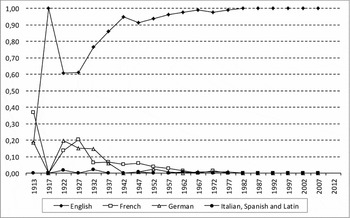
Fig. 1 provides an overview of the language of all articles published in Isis in the period 1913–2012. As this figure shows, Isis would continue to publish a limited number of contributions in other European languages for quite some years after the Great War. The explanation for this multi-lingual trajectory was probably rather prosaic. In the interwar period, the journal often had little or no backlog of articles (Isis 1999, S36). Quite the contrary, Sarton often had to actively solicit submissions within his own personal network (which in part was still situated in Europe). He not only felt obliged to print the solicited manuscripts, but also had difficulty rejecting unsolicited ones. Altogether, contributions in six – not four – “international” languages were published. There appeared one Latin text in Isis: a reprint of a fourteenth-century treatise on trigonometric methods (Isis 1923, 99–115). Sarton also included a few publications in Italian or Spanish. In the 1920s, one out of five published articles could be written in either French or German. There was nevertheless a relatively sharp increase in the number of articles written in English during the interwar period. The last non-English-language article was included some 40 years ago; it was a French-language contribution by a Québec-based historian of science (Isis 1974, 212–228). During the last four decades, Isis has been an English-language journal.
Language of the articles published in Isis, 1913–2012.

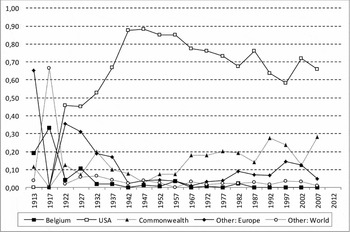
Fig. 2 should be read in conjunction with fig. 1. For the 100-year period 1913–2012, fig. 2 provides an overview of the countries of residence of the first author of the articles published in Isis. It thus displays changes in the geographical distribution of the members of the epistemic community who have been able to publish in Isis. After Sarton and his Isis had left Europe for the United States (during the First World War), the amount of American contributions increased strongly. Around the middle of the twentieth century, almost 90 per cent of the contributors were affiliated with American institutions. Of course, this shift also reflected practical problems caused by the Second World War, such as the problems of obtaining publishable material from the occupied territories. But after the Second World War, the American dominance decreased only gradually. At present, two-thirds of the contributors list institutional addresses within the United States. Concomitant with the rise of the number of US contributions, there was a sharp decrease in the number of European contributions in the first decades after Isis’ foundation. Only from the 1970s onwards have European authors again become more visible on the pages of Isis. But from the middle of the twentieth century onwards, most non-US contributions have come from authors from other English-speaking countries, such as Canada, England, and Australia. Seen in this light, Isis thus has not only become an English-language journal, but also a journal of the English-language world (see also Steinke and Lang Reference Steinke and Lang2011; Isis 2013, 337–347; Isis 2013, 348–359).Footnote 8
Country of residence of the first author of the articles published in Isis, 1913–2012.

In the field of history of science, Isis is not only the most widely circulating journal. It is also a journal that particularly features research conducted at American universities and research institutions. In 1980, the Isis editor remarked: “Isis remains far more than simply the oldest national journal, but it is vain to consider it as truly cosmopolitan. . . . The willingness to print an occasional review in a foreign language cannot disguise how, over the last generation, Isis has become a journal that primarily publishes the research of the English-speaking world” (Isis 1980, 9). As both fig. 1 and fig. 2 show, that situation has not changed remarkably during the last decades. In this sense, the postwar expansion of the history of science has also reinforced the scientific authority of communication media and individuals with American credentials. For the American Sarton, “the scientific needs of mankind are served best by the monopoly or quasi-monopoly of a few languages” (Isis 1948, 14), but the preceding analyses of the contributions published in the journal also indicate that certainly not all of mankind is to the same degree able to actively participate in the disciplinary communication in an English-language Isis.
Editors and Authors
As we have seen, Sarton was the editor of Isis during a period of four decades (1913–1952). Initially, he tried to secure support for his venture from a range of prominent scientists. Isis’ original Comité de Patronage included prominent figures with diverse disciplinary orientations, such as Emile Durkheim, Karl Lamprecht, Henri Poincaré, and Arnold van Gennep. In 1924, the first associate editors of Sarton were appointed. Their number increased over the years. In 1942, for example, Isis counted 18 associate editors. All of them had their own “field of study,” but all of their input also had to contribute to “the field of Isis” (e.g., Isis 1935, 444; Isis 1947, 79–80). However, the role of the associate editors remained rather marginal under Sarton's editorship. Following I. B. Cohen, who became managing editor of Isis during the Second World War and editor in the 1950s, Sarton did not often seek their advice:
Although he [Sarton] appointed various colleagues to be members of his editorial board, he did not regularly consult them about articles submitted to Isis. Nor did the board ever meet – to my knowledge. . . I was astonished to learn that most of the articles accepted for publication had not been sent out to a referee for a critical reading, that only in rare cases did Sarton send out articles for review before deciding whether to accept them for publication. The reason was not that Sarton was so vain as to believe that he had a critical opinion on any subject whatsoever relating to the history of science. Rather, he generally accepted for publication any article that was written by a reputable scholar or by someone whose work was known to him personally. (Isis 1999, S34)Footnote 9
Only from the Second World War onwards, when HSS had taken over financial responsibility for Isis, could Sarton be “convinced” to send out articles to referees on a more or less regular basis. But, according to Cohen, it lasted until the 1950s – under his own editorship – before all articles accepted for publication in Isis had first been read and reviewed “by at least one authority, often a member of our editorial board” (Isis 1999, S35).
Some standardization of publication formats also took place in this period (see also Bazerman Reference Bazerman1988, 257–288; Gross, Harmon, and Reidy Reference Gross, Harmon and Reidy2007, 214–228). Already in 1919, Sarton indicated that Isis would give preference to articles of less than 10 pages (Isis 1919, 314). Volume 21 of Isis, published in 1934, contained an inserted notice to contributors informing them that the journal would no longer accept articles longer than about ten thousand words (see Isis 1975, 456). But only in the years after the Second World War did Isis start to publish regularly its “Notes for Contributors,” which set forth desiderata in matters of style and modes of bibliographic citation (e.g., Isis 1948, 140–141; Isis 1949, 410–411; Isis 1951, 168–169). From 1979 onwards, Isis started to publish an updated set of instructions entitled “Suggestions for Contributors.” From 1980 onwards, these suggestions also asked for the submission of an abstract of approximately 150 words. In the second half of the 1980s, the system of double-blind reviewing was introduced. Potential authors were accordingly asked to prepare their manuscripts for anonymous peer review.
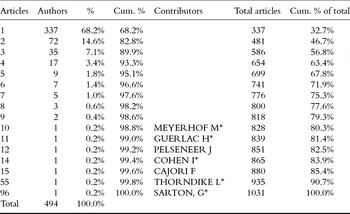
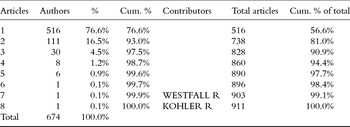
The average number of authors per article did not change significantly in the period between 1913 and 2012. Typically, at least 9 out of 10 articles in Isis have been single-authored ones. Table 1 and Table 2 provide an overview of the changes in the “distribution” of these authorship roles, for the first and the second semi-centennial of Isis respectively. The first column of both tables lists the number of articles written by individual authors; the second column lists the corresponding number of authors. Column 3 and 4 display the evolution in terms of percentages. The names of the most productive authors are given in column 5. An asterisk identifies the members of the editorial board among these productive authors. The last columns show the total number of articles (in absolute figures and percentages respectively). Following Table 1, for example, there is one author (0.2 per cent of the total number of authors) who was able to publish ten articles in the period between 1913 and 1962 (M. Meyerhof, who was also on Isis’ editorial board); 98.8 per cent of the authors published fewer than 10 articles each, but as a group these authors only contributed 80.3 per cent of the total number of articles published during this period in Isis (in absolute numbers: 828 out of a total of 1031 “regular” articles).
The distribution of authorship in Isis, 1913–1962.

* = member of the editorial board.
The distribution of authorship in Isis, 1963–2012.

There are clear differences between the data presented in these two tables. In the first half of its existence, Isis was characterized by an oligarchic publication pattern. A select group of authors was very visible in the journal and the scientific community. Sarton himself was a very prolific author; he published no fewer than 96 regular articles (as well as hundreds of short notes, reviews, and administrative documents). A few of his fellows were very productive, too. Altogether, approximately 10 per cent of all the articles published in Isis between 1913 and 1962 were written by one single person (G. Sarton), while another 10 per cent were written by six other prolific authors (L. Thorndike, F. Cajori, I. B. Cohen, J. Pelseneer, H. Guerlac and M. Meyerhof). In total only 1.4 per cent of the authors (7 out of 494) wrote more than 20 per cent of all the articles published during the period 1913–1962.
In the last 50 years, this picture has changed substantially. Between 1963 and 2012, nobody has been as visible as one of the aforementioned prolific Isis’ authors of the first generation. Very few authors were able to publish on a more or less regular basis in Isis. During this period, 93 per cent of all its contributors published only once or twice in Isis; only three authors were able to publish more than five times in Isis. Moreover, Table 2 also shows that there appeared fewer scholarly articles in Isis in the second half of its existence; there is a decrease of about 11 per cent (from 1031 to 911). But in spite of the decreasing number of individual articles, there has been an increase in the number of contributors of around 36 per cent (from 494 to 674). Authorship thus became more widely distributed. Instead of filling the pages of the journal with their own contributions, the members of the editorial board became increasingly engaged as gatekeepers of this communication channel (see also Gieryn Reference Gieryn1999).
Etymologically, there exists a close relationship between the words “author” or “authorship,” on the one hand, and “authority,” on the other (see also Foucault Reference Foucault and Foucault1995; Pontille Reference Pontille2004). Isis’ editors and referees not only embodied a specific form of scholarly authority; they were also in the position to grant authority and authorship to individual researchers. Author-ity in the field of history of science depends on the publication of submitted papers; inclusion in an authorial role in this epistemic community depends on acceptance and publication of submitted material. The preceding tables make clear that the discipline and its journal have gradually become less reliant on prominent figures with their particular individual interests since the latter part of the twentieth century. The work of a larger epistemic community has come to the fore in Isis. The discipline has become less dependent on the achievements of a few “extraordinary” founding figures, but more on the epistemic or intellectual force of its scientific community. Against this background, we now discuss in more detail the characteristics of this “collective character” of the history of science on the basis of an analysis of its changing citation practices.
Citations and Citation Networks
In Isis, there existed no single style for citations in the decades prior to the Second World War. Authors could use their own style (see also Isis 1999, S29). Sarton himself mostly provided detailed biographical information in the footnotes to his text; others only gave bibliographical references in abbreviated form in their footnotes; still others did not include references in their text but added extensive bibliographies at the end of their article (for an illustration of these different styles, see for example the 1919 issue of Isis). Only after the Second World War did the “Notes for Contributors to Isis” start to specify desiderata in modes of bibliographic citation. References had to be provided in footnotes. But much standardization was not yet envisaged: “The amount of bibliographical detail to be included in references is left to the discretion of each contributor” (e.g., Isis 1948, 140–141; Isis 1949, 410–411; Isis 1951, 168–169). In the following decades, however, Isis adopted and implemented a single style for citations, which is largely concordant with the modern historical apparatus of footnotes and references (see also Cronin Reference Cronin1984; Grafton Reference Grafton1997, 223–235; Abbott Reference Abbott1999, 144–147; Gross, Harmon, and Reidy Reference Gross, Harmon and Reidy2007, 214–228; Vanderstraeten Reference Vanderstraeten2011).
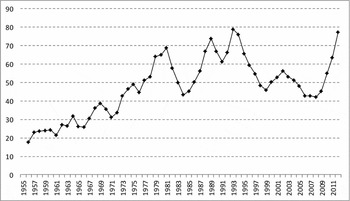
Fig. 3 provides an overview of the average number of citations per article per year. Despite a number of fluctuations, the overall trend is clear and unambiguous.Footnote 10 There is a ballooning of reference lists in the second half of the twentieth century. The introduction of the double-blind refereeing system in the 1980s did not seem to have added to this trend. Overall, one might say that the changing citation practices in Isis support the image of a cumulative field of study. Authors do not only have to stand on the shoulders of giants; they also have to display familiarity with the existing body of specialized knowledge and present their own work as a small contribution to this body. The articles published in Isis interact with other publications – not only by incorporating into their own line of reasoning arguments developed in preceding publications, but also by inviting reactions and hence further publications. A more detailed understanding of the kind of expertise to which historians of science aim to contribute can be provided if the quantitative changes are complemented with analyses of the relevant citation environment of Isis.
Average number of references in articles published in Isis, 1956–2012.

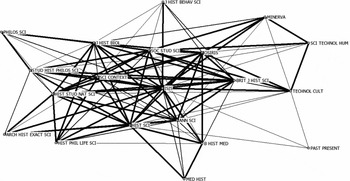
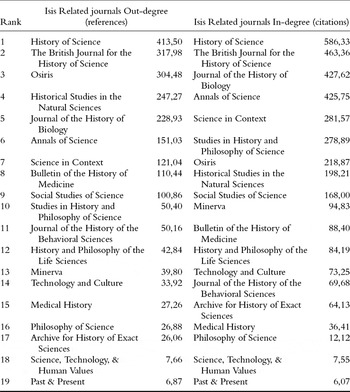
To provide a more nuanced picture, fig. 4 and Table 3 present an overview of the citation environment of Isis. For this analysis, we have used the relatedness data of the Social Sciences Edition of the Journal Citation Reports (Web of Knowledge). We collected the relatedness scores for Isis, as well as the relatedness scores among all the other journals in Isis’ environment. While our focus is on structural characteristics of scientific communication networks, we calculated the average relatedness scores for all available years, i.e. the period 2003–2012.Footnote 11 Journals which happened to have only one relation to Isis during this period of ten years were excluded from the analysis. Table 3 contains the cited and citing data (in-degrees and out-degrees) of Isis. Although the JCR-database is not entirely comprehensive (it does not include all academic journals, and it does not include citations that appear in books), we believe that it allows us to sketch an overview of the relevant citation environment of the journal Isis.
The citation network of Isis, 2003–2012: weak, moderate, and strong ties.

The citing and cited data of Isis (2003–2012), N = 19

The final network of Isis consists of 19 journals. As visualized by the thickness of the lines in fig. 4, the results first show that the relations between Isis and most other journals are moderate or strong.Footnote 12 Further, when we look at the overall network of Isis, which also includes the relations among the other journals, we notice a relatively high density level with almost 50 per cent of all possible journal pairs related to each other. Considering the journals to which Isis is connected, we mainly see other history of science journals. Of all possible journals in the JCR (Science and Social Sciences Editions), the journals History of Science and The British Journal for the History of Science have the strongest links to Isis (see Table 3). Next to these more general history of science journals, journals devoted to the history of particular specializations, such as the history of biology, medicine, or technology, play an important role in the network.
The network also includes a few journals that claim to provide an integrated approach to the history, philosophy, and sociology of the sciences (e.g., Studies in the History and Philosophy of Science). But one of the key journals in the field of philosophy of science (i.e. Philosophy of Science) is only weakly related to Isis, while The British Journal for the Philosophy of Science is even unrelated to Isis over this period of ten years. This is consistent with a recent study by Wray (2010), which suggested that philosophy of science is most properly conceived of as a sub-field of philosophy rather than as part of an interdisciplinary field, the history and philosophy of science (HPS). Similar yet different conclusions can be drawn when we look at some of the relations between the history of science and science and technology studies (STS). Whereas Social Studies of Science is strongly related to Isis, the official journal of the Society for Social Studies of Science (4S) – i.e. Science, Technology, & Human Values – relates weakly to the official journal of the History of Science Society. Although their potential for valuable synergy has been discussed on the pages of Isis (2010, 759–774), at present the history of science and STS seem to live together apart rather than apart together.
The network analysis further reveals that Isis established during the last decade only one link to a generalist journal within the historical discipline (i.e. Past & Present); it is moreover the weakest of all possible ties with Isis. No other relations to generalist disciplinary journals can be detected. The “coming of age” of the history of science and its disciplining apparently made interchanges with neighboring (sub)disciplines largely redundant. Overall, the Isis-network is characterized by a relative strong cohesion. However, it is also closed and apparently self-sufficient; it is mainly constituted by other journals with a similar interest, namely the history of science or particular of its specializations. In this sense, its publication network does not fit well with the “Web of Science” imagery. In a recent issue of Isis, however, Ken Alder not only claimed that “our institutional heterogeneity has kept our field intellectually supple and perennially reflexive” (Isis 2013, 92). He also added that these heterogeneous institutional contexts “haven't just made our field attentive to different sorts of interdisciplinarity; they have kept us open to new intellectual questions and methods (which is not the same thing!)” (ibid., 92–93). Our analyses clearly contrast with this self-description of the history of science. In this field, high levels of internal communication now go hand in hand with limited direct contact with other disciplines.
Conclusion
As mentioned in the introduction, the history of the history of science is mostly depicted as a discipline-building historical process. In this paper, we have argued that discipline-building is a complex historical process, which not only depends on changes in the departmental organization of universities or research centers, but also on the institutionalization of specific communication structures and communication practices (see also Vanderstraeten Reference Vanderstraeten2006). In the preceding pages, we have focused on the morphogenesis of these communication forms and the ways in which they motivate individual practitioners to define themselves in relation to the disciplinary project. More particularly, we have tried to provide a picture of forms of continuity and change in the communication structures and communication practices within the flagship journal of the emerging discipline of the history of science. On the basis of our analyses, we are able to highlight some of the changing differentia specifica of this epistemic community within the disciplinary system of science.
In the course of about one century, Isis and its successive editors have worked to open up and maintain a space devoted to the communication of high-quality research in the history of science. In a kind of feedback loop, the communication structures and practices have also exercised pressure on the scientific production process. In our analyses, we have more particularly directed attention to three aspects of the publication practices in Isis: its skewed global orientation despite its internationalist ambitions, its historical redistribution of authority and authorship, and its closure at the level of citation practices. As the preceding analyses of this journal suggest, the communication networks in the history of science have given primacy to particular audiences and interests – at the expense of other audiences and other projects. The process of discipline-building in the history of science has led its amateurs and practitioners to be socialized and sensitized in relatively strong intra-disciplinary terms – with minimal interdisciplinary openness. While we of course cannot claim that the communication practices in the largely Anglophone Isis are exemplary of those in the entire field of history of science, the history of Isis and its scientific standards shows in our view how historians of science who aim to publish in Isis have become disciplined by their discipline in a period of about hundred years.
When George Sarton launched his Isis in 1912, it indeed remained to be shown that the history of science was a discipline (Isis 1985, 467; see the epigraph of this paper). In his programmatic statements, Sarton objected to the disciplinary differentiation of the system of science. He focused on the various interactions and interdependencies between the different disciplines; he claimed that the history of science would be able to counteract the processes of increasing differentiation and specialization and provide for unity and cohesion within the system of science. One hundred years later, similar claims are still made by historians of science. Such claims have become part of the habitual presentation of self of historians of science. At present, it might indeed be maintained that the history of science has successfully established itself as a scientific discipline. It is supported by a relatively large and stable globalized epistemic community; it has its own research groups (if not its stand-alone departments), associations, and journals; it has acquired considerable prestige within the academic world. But our analyses also bring some of the serendipities in the history of Isis and the history of science to the fore. In the course of about one century, its flagship journal shows how the discipline has become inward-looking and largely insulated from other scientific perspectives. It has left the bridging, interdisciplinary orientations to other journals and other scientific specializations.
Epigraph
The history of the history of science is often characterized as a transition from an “undisciplined subject” to a disciplined one. This paper presents an analysis of the disciplinary communication structures within this epistemic community. We particularly focus on its flagship journal, Isis. Isis arguably is the oldest journal in this field that still appears. Since 1924, it also is the official journal of the History of Science Society. On the basis of quantitative material on all articles published in Isis in the period between 1913 and 2012, we discuss three distinctive aspects of scholarly communication: its international vs. national (i.e. American) orientation, its structures of author-ity, authorship and editorship, and its forms of self-organization via citations. In a period of about one hundred years, our findings suggest, the process of discipline-building in the history of science has led its amateurs and practitioners to be socialized and sensitized in relatively strong intra-disciplinary terms – with minimal interdisciplinary openness.