INTRODUCTION
Cereal grains and grain legumes provide the major source of calories and protein for a large proportion of the world's population. Particularly, grain legumes have an important role in many agricultural production systems and in sustainable crop production worldwide. In addition, grain legumes and their products are relatively cheap sources of dietary protein, vitamins and minerals for humans and animals in developing countries around the Mediterranean region. Faba bean (Vicia faba L.) is the most important food legume grown and consumed globally, including the entire Maghreb region in Northwestern Africa. In Tunisia, faba bean is cultivated on about 0·74 of the total area reserved for cultivation of grain legume crops (Kharrat & Ouchari Reference Kharrat and Ouchari2011). The national average yield (1·38 t/ha for the small-seed faba bean and 1·03 t/ha for the large-seed type) is below global, Asian and European averages (1·5, 1·7 and 2·2 t/ha, respectively) and characterized by its fluctuations from 1 year to another, particularly during drought years (Kharrat & Ouchari Reference Kharrat and Ouchari2011). Indeed, the low-yield potential in faba bean is partly caused by drought susceptibility. According to Amede et al. (Reference Amede, Schubert and Stahr2003), V. faba is more sensitive to osmotic stress compared with other legumes such as Cicer arietinum, Phaseolus vulgaris and Pisum sativum.
Environmental abiotic stresses severely affect plant growth and productivity worldwide. In Mediterranean countries, drought and salt have been considered as the most important environmental stresses limiting the growth, development and production of crop plants. In general, drought and salt challenge cause a decrease in photosynthetic performance and consequently lead to marked reductions in biomass and yield (Valifard et al. Reference Valifard, Mohsenzadeh and Kholdebarin2015). Indeed, drought and salt induce a range of morphological, physiological and biochemical responses in plants such as reduction in leaf area and rate of cell expansion, stomatal closure, loss of turgor, reduction in leaf water potential, osmotic adjustment and increase in antioxidant enzyme activities (Srivastava & Srivastava Reference Srivastava and Srivastava2014; Ghahfarokhi et al. Reference Ghahfarokhi, Mansurifar, Taghizadeh-Mahrjardi, Saeidi, Jamshidi and Ghasemi2015; Le Gall et al. Reference Le Gall, Philippe, Domon, Gillet, Pelloux and Rayon2015). Plants also respond at molecular levels in order to cope and adapt to water deficit and salt excess (Batool et al. Reference Batool, Noor, Ilyas and Shahzad2015; Čereković et al. Reference Čereković, Jarret, Pagter, Cullen, Morris, Hedley, Brennan and Petersen2015). The effects of osmotic pressure on molecular responses have been studied in a number of plant species such as Lotus japonicus (Liu et al. Reference Liu, He, Vitali, Visentin, Charnikhova, Haider, Schubert, Ruyter-Spira, Bouwmeester, Lovisolo and Cardinale2015), Hordeum vulgare (Habte et al. Reference Habte, Müller, Shtaya, Davis and von Korff2014) and P. vulgaris (Cabrall et al. Reference Cabrall, dos Santos, Vieira, Soares, Bremenkamp and Rodrigues2014). To date, osmotic adjustment in response to water deficit and the effect of osmotic stress on growth and development of faba bean plants has been less well studied (Siddiqui et al. Reference Siddiqui, Al-Khaishany, Al-Qutami, Al-Whaibi, Grover, Ali, Al-Wahibi and Bukhari2015). Unfortunately, little is known about the molecular mechanisms underlying the acclimation of this species to drought and salt stresses.
Drought and salt tolerance are complex agronomic traits and molecular mechanisms are typically under multigenic control. Osmotic-responsive genes encode proteins involved in regulation of signal transduction, gene expression and protection of cellular structures against stresses (Kohan-Baghkheirati & Geisler-Lee Reference Kohan-Baghkheirati and Geisler-Lee2015). Abscisic acid (ABA) is a phytohormone playing an important role in plant growth, development and plant water balance (Tuteja Reference Tuteja2007). In addition, ABA regulates abiotic stress responsive genes and consequently osmotic stress tolerance (Terzi et al. Reference Terzi, Kadioglu, Kalaycioglu and Saglam2014). Various transcription factors (TFs) involved in ABA-independent (DREB, NAC and ZFHD) and in ABA-dependent pathways (MYB, MYC and AREB/ABF) were found and characterized in different plant species, including Arabidopsis thaliana (Nakashima et al. Reference Nakashima, Fujita, Katsura, Maruyama, Narusaka, Seki, Shinozaki and Yamaguchi-Shinozaki2006). Overexpression of TFs regulating ABA-dependent/independent stress response gene expression confers multiple stress tolerance in different species such as Triticum aestivum (Jiang et al. Reference Jiang, Hu, Zhang and Ma2014), A. thaliana (Dai et al. Reference Dai, Xu, Ma, Xu, Wang, Xue and Chong2007) and Solanum lycopersicum cvar Micro-Tom (Hu et al. Reference Hu, Tang, Yan, Bouzayen and Li2014). Among the various TFs, those from the WRKY family play a key role in the transcriptional regulation of stress-related genes. The WRKY-type TFs constitute one of the largest families of transcriptional regulators found in plant genomes with 74 members in A. thaliana, 45 in H. vulgare, 109 in Oryza sativa, 81 in L. esculentum, 25 in Coffea arabica, 68 in Sorghum bicolor and 80 in Pinus monticola (Mingyu et al. Reference Mingyu, Zhengbin, Shouyi, Jinsong and Hongbo2012; Bakshi & Oelmüller Reference Bakshi and Oelmüller2014). Indeed, a large number of WRKY TFs have been identified and characterized in various plant species, but not yet in faba bean. WRKY TFs are implicated in the regulation of plant and seed development, sugar metabolism and plant defence responses to pathogens. Interestingly, WRKY TFs play an important role in the transcription regulation for increasing tolerance to abiotic stress such as drought, salinity, low and high temperatures (Chen et al. Reference Chen, Song, Li, Zhang, Zou and Yu2012). Overexpression of AtWRKY30, SlWRKY39 and DnWRKY11 results in up-regulation of several stress-inducible genes and improves drought and salt tolerance in A. thaliana, L. esculentum and Nicotiana tabacum (Scarpeci et al. Reference Scarpeci, Zanor, Mueller-Roeber and Valle2013; Xu et al. Reference Xu, Pan, Wang, Ying, Song and Wang2014; Sun et al. Reference Sun, Gao, Li, Yang and Liu2015).
In the present study, the partial isolation of two faba bean WRKY TF genes is reported for the first time. Also, the expression patterns of VfWRKY1 and VfWRKY2 genes in different organs and under drought and salt treatments were characterized. Also, the possible role of VfWRKY1 and VfWRKY2 in drought and salt stress response and tolerance of faba bean is discussed.
MATERIALS AND METHODS
Plant materials, growth conditions and stress applications
Two faba bean (V. faba L. var. minor) cultivars, Giza 3 (provided by the International Center for Agricultural Research in the Dry Area, ICARDA) and Hara (a local cultivar grown in semi-arid areas of El Kef region in Tunisia) were used in the present study. Giza 3 is known as a genotype most sensitive to water deficit, used as a standard for the drought-tolerance faba bean evaluation test worldwide (Abdellatif et al. Reference Abdellatif, El Absawy and Zakaria2012). Seeds of the two cultivars were surface sterilized in 10% sodium hypochlorite (NaOCl) for 10 min and then washed four times with a large volume of sterile distilled water.
Seeds were soaked in sterile distilled water overnight before sowing in pots filled with 5 kg soil (pH: 8·15, nitrogen: 0·28%, phosphorus: 16 (ppm), potassium: 120 (ppm), electrical conductivity: 413·50 ms/cm) in a controlled growth chamber at 23 ± 2 °C, humidity 70% and a photoperiod of 16 h light/8 h dark. Half-strength Hoagland's solution (Hoagland & Arnon Reference Hoagland and Arnon1950) was used for irrigation.
For organ-specific expression study using semi quantitative real-time polymerase chain reaction (RT–PCR), cotyledons (10 days after sowing), leaves (30 days after sowing), roots (30 days after sowing), stems (30 days after sowing), flowers (0 days after pollination) and seeds (7 days after pollination) were harvested from cvar Hara, frozen immediately in liquid nitrogen and stored at −80 °C until analysis.
For the sample preparation for the qRT–PCR analysis, plants of both genotypes (Hara and Giza 3) were cultivated in pots, one plant in each pot. At 30 days after sowing, plants of similar size were divided into two groups. For group one, plants were carefully removed from the soil, washed, fixed in plastic foam and immersed in water for 1-day recovery prior to being cultured hydroponically in the water containing 20% polyethylene glycol 6000 (PEG-6000). Similarly, for group two, plants were cultured in water containing 200 mm of sodium chloride (NaCl). In the present study, faba bean plants that had not been treated by PEG and NaCl stresses (immersed in water only), were used as the control (CK). Leaves were collected at 0 (CK), 3, 6, 12 and 24 h in PEG and NaCl stress treatments. Leaf samples were frozen immediately in liquid nitrogen and stored at −80 °C prior to RNA extraction. Each set of experiments was conducted at least three times.
DNA isolation and degenerate primer polymerase chain reaction amplification conditions
Genomic DNA from cvar Hara was isolated from 2 g fresh weight of leaves as described by Murray & Thompson (Reference Murray and Thompson1980). The quantity and purity of the isolated DNA was assessed with a NanoPhotometer® P-Class (IMPLEN GmbH, München, Germany). The nucleic acid quality was checked on 1% (w/v) agarose gel. For PCR amplification, DNA was diluted to 50 ng/μl and a pair of degenerate oligonucleotide primers (WRKY-F and WRKY-R) described by Borrone et al. (Reference Borrone, Kuhn and Schnell2004) was used to amplify faba bean WRKY genes (Table 1). The PCR was accomplished using iCycler Thermal Cycler (Biorad) in 50 µl reaction volume containing total genomic DNA (50 ng), 5 µl of 10× PCR buffer (100 mm Tris–HCl, pH 8·8, 500 mm potassium chloride (KCl), 0·8% Nonidet P40), 2·5 mm magnesium chloride (MgCl2), 200 µm of each deoxynucleotide (dNTP), 0·3 µm each primer and 1 U of Taq DNA polymerase (Thermo Fisher Scientific, Waltham, MA, USA). The PCR was performed for 35 cycles as follows: 94 °C for 30 s, 55 °C for 1 min, 72 °C for 2 min and the final extension was performed for 7 min at 72 °C. The PCR products were separated by electrophoresis in 2% (w/v) agarose gel in Tris-acetate–EDTA buffer and visualized with ethidium bromide.
Degenerate WRKY primers according to Borrone et al. (Reference Borrone, Kuhn and Schnell2004) used for the isolation of faba bean WRKY genes

* The nucleotide sequence is given in the 5′–3′ direction using the standard IUB codes: M = A or C; R = A or G; Y = C or T; B = T, C or G; D = A, T or G; N = A, T, C or G; I = Inosine.
† Deg: Overall degeneracy of the primer omitting inosine.
Cloning and DNA sequencing
The target DNA fragments were excised and purified using GeneJET Gel Extraction Kit (Thermo Fisher Scientific) and cloned into a pJET1·2/blunt vector using the Clone JET™ PCR Cloning Kit (Thermo Fisher Scientific) according to the manufacturers’ instructions and subsequently transformed into competent Escherichia coli (DH5α). Recombinant plasmids were extracted using GeneJET Plasmid Miniprep Kit (Thermo Fisher Scientific). The sequencing of selected clones was performed in both directions via universal pJET primers (pJET1·2D and pJET1·2R) and GenomeLab DTCS Quick Starter Kit (Beckman-Coulter, Brea, CA, USA) on GenomeLab CEQ/GeXP DNA analysis system (Beckman-Coulter) capillary sequence analyser. Sequence homology searches were conducted using the BLASTN, BLASTX and TBLASTX search algorithms available at GenBank (http://www.ncbi.nlm.nih.gov/BLAST/).
Phylogenetic analysis and identification of conserved motifs
Plant WRKY protein sequences were obtained from the National Center for Biotechnology Information (NCBI; www.ncbi.nlm.nih.gov/) protein database with VfWRKY1 and VfWRKY2 (Table 2) as the query search using BLASTP and 60% identity was taken as the threshold. Fifty-seven WRKY sequences from various plant species were retrieved for the phylogenetic analysis and conserved motifs identification. Multiple alignment analysis of 52 WRKY protein and VfWRKY1 and VfWRKY2 was carried out via the ClustalW algorithm (Vector NTI Suite 6·0, Life Technologies, Carlsbad, CA, USA). A phylogenetic tree was constructed using the MEGA6·1 software package (http://www.megasoftware.net/) using the Neighbour-Joining (NJ) method (Tamura et al. Reference Tamura, Stecher, Peterson, Filipski and Kumar2013). A bootstrap analysis of 1000 replications was employed to evaluate the reliability of tree branching.
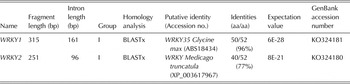
Sequencing results of the WRKY-F/WRKY-R amplification

bp, base pairs; aa, amino acid.
Total RNA isolation and semi-quantitative real time polymerase chain reaction
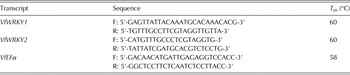
Total RNA from the different organs (leaves, cotyledons, roots, stems, flowers and seeds) of the control plants and from drought- and salt-stressed plants was isolated following a cetyl trimethylammonium bromide (CTAB) method (Chang et al. Reference Chang, Puryear and Cairney1993). The RNA pellets were air dried and re-suspended in 50 µl of diethylpyrocarbonate-treated water. The RNA concentration was determined spectrophotometrically using UV-2700 (Shimadzu, Tokyo, Japan) and its integrity was assessed by electrophoresis in 1·2% agarose gels. To eliminate any genomic DNA contamination, all RNA samples were treated, prior to cDNA synthesis, with 1 U DNase I, RNase-free (Biomatik; Wilmington, Delaware, USA) at 37 °C for 30 min. First-strand cDNA was synthesized from 5 µg of total RNA using 200 U Turbo-I reverse transcriptase (Biomatik) according to the manufacturers’ instructions. Polymerase chain reaction was performed for all genes in a final volume of 20 µl containing 50 ng of cDNA, 0·6 µl of each primer (10 µm) and 1 U of Taq DNA polymerase (Biomatik). Gene-specific primers were designed for the amplification of VfWRKY1 and VfWRKY2 using the Primer3 Input (version 0.4·0) software (Rozen & Skaletsky Reference Rozen, Skaletsky, Krawetz and Misener2000) (http://frodo.wi.mit.edu/primer3/) and using default criterion of the software with amplified products ranging from 80 to 150 base pairs (bp) and melting temperature (Tm) about 60 °C. Vicia faba elongation factor alpha (VfEFα) was used to evaluate the relative amounts of cDNAs as an internal control. The primer sequences are listed in Table 3. Polymerase chain reactions were performed in an Applied Biosystems® 2720 thermal cycler (Applied Biosystems, Foster City, CA, USA). Samples were amplified using different cycle numbers: VfEFα, 25 cycles (annealing at 58 °C) and VfWRKY1 and VfWRKY2, 33 cycles (annealing at 60 °C) each. The PCR profile consisted of denaturation at 94 °C for 3 min, followed by 25–33 cycles of 94 °C for 30 s, 58–60 °C for 30 s and 72 °C for 30 s, with a final extension at 72 °C for 3 min. Polymerase chain reaction products (15 µl) were electrophoresed on 1·5% (w/v) agarose gel, visualized under ultraviolet light after ethidium bromide staining and scanned using an image analyser.
Primers used for semi quantitative real-time polymerase chain reaction (RT–PCR) and quantitative RT–PCR assays. VfEfα was used as the internal control gene

T m, melting temperature.
Quantitative real time polymerase chain reaction
VfWRKY1 and VfWRKY2 transcript accumulations under drought and salt stress were assayed by quantitative RT–PCR (qRT–PCR) performed in an 7300 Real-Time PCR System (Applied Biosystems) using the Maxima SYBR Green/ROX qPCR Master Mix (2×) kit (Biomatik). The reaction of 20 µl contained 10 µl Maxima SYBR Green/ROX qPCR Master Mix (2×), 1 µl of each primer at 10 µm (Table 3), 6 µl ddH2O and 2 µl cDNA (25 ng). VfEFαF and VfEFαR primers were used as a control to normalize the samples. The reactions were performed in triplicate for each sample with the following settings: initial denaturation at 95 °C for 5 min followed by 40 cycles at 95 °C for 30 s and 60 °C for 1 min. StepOne™ Software v2·2·2 (Applied Biosystems) was used for the analysis of qRT–PCR results. Relative quantification was performed according to the comparative 2−∆Ct method as described previously by Schmittgen & Livak (Reference Schmittgen and Livak2008).
Statistical analyses
Statistical analyses were performed using a two-way Analysis of Variance (ANOVA, P < 0·05), followed by the Tukey's test in the SYSTAT 8·0 software. All data in figures are presented as mean ± standard deviation (s.d.).
RESULTS
Identification of faba bean WRKY genes
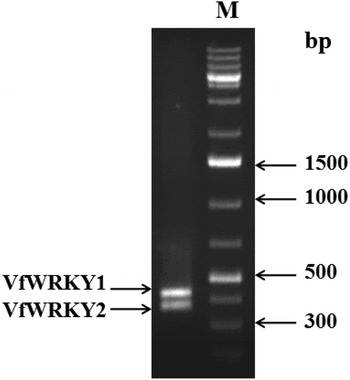
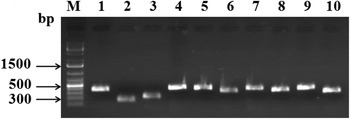
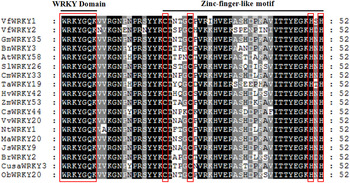
Degenerate primers WRKY-F and WRKY-R (Table 1) and genomic faba bean DNA were used for WRKY amplification. A possibility to amplify larger than the expected DNA fragments exists due to the possible presence of introns inside the WRKY domains (Dong et al. Reference Dong, Chen, Liu, Wei, Jiang, Li, Nevo, Liu and Zheng2012). Two distinctive bands were successfully amplified (Fig. 1) and subsequently cloned. In total, 96 clones were obtained, and the following colony PCR showed that the size of these inserts ranged from 300 to 500 bp (Fig. 2). Only clones containing a single insert have been subjected to further sequencing (in total 16 clones). The expressed sequence tag (EST) cluster analysis indicated that the selected clones represented two unique sequences. These sequences were 251 and 315 bp long and have been submitted to GenBank under the accession numbers KO324180 and KO324181 for VfWRKY2 and VfWRKY1, respectively (Table 2). During the annotation analysis of the sequences, it was found that both putative VfWRKY1 and VfWRKY2 genes contained an intron in their WRKY domain (Table 2). The sequences were translated and subjected to motif analysis. BLASTX analysis confirmed that DNA sequences encoding for the WRKY domains were obtained. Only 62% of identity was found between VfWRKY1 and VfWRKY2 sequences. Sequence of VfWRKY1 displays the highest degree (96%) of identity with GmWRKY35 from Glycine max and 81% identity with AtWRKY58 from A. thaliana. The sequence of VfWRKY2 exhibited high level (77%) of identity to Medicago truncatula WRKY (Table 2). All sequences analysed showed the presence of the highly conserved WRKYGQK motif and the same type of potential Zinc-finger-like motifs (Fig. 3).
Polymerase chain reaction amplification of faba bean WRKY sequences using degenerate primers. The first lane indicates the VfWRKY1 and VfWRKY2 genes; second lane: GeneRuler 1 kb Plus DNA Ladders (Thermo Fisher Scientific, formerly Fermentas, Germany).

Polymerase chain reaction (PCR) analysis of the clones. Lane 1–10: PCR products from different clones. Lane M: GeneRuler 1 kb Plus DNA Ladders (Thermo Fisher Scientific, formerly Fermentas, Germany).

WRKY domain comparison of VfWRKY1 (KO324181) and VfWRKY2 (KO324180) proteins with GmWRKY35 (ABS18434), BnWRKY3 (ACI14395), AtWRKY58 (NP_186757), SlWRKY26 (XP_004241755), CmWRKY33(XP_008457300), TaWRKY19 (ACD80362), HvWRKY42 (ABI13407), ZmWRKY53 (NP_001147551), CsWRKY44 (XP_006480562), VvWRKY20 (AFJ54619), NtWRKY1 (BAA82107), MaWRKY20 (XP_009396395), JsWRKY9 (AGJ52155), BrWRKY2 (XP_009132317) and ObWRKY20 (XP_006658743). Alignment analysis was performed using Vector NTI program. The conserved motif (WRKYGQK) and zinc-finger patterns C-X4-C-X23-H-X-H are boxed in the diagram. Colour online.

Phylogenetic analysis and classification of faba bean WRKY
To resolve the phylogenetic relationships of the faba bean WRKY family, an unrooted phylogenetic tree was generated using the conserved WRKY domain spanning about 52 amino acids of the VfWRKY1 and VfWRKY2 and other known WRKYs from monocot species as T. aestivum, H. vulgare, O. sativa and Zea mays and dicot species as A. thaliana, Gossypium hirsutum, Cucumis sativus, Jatropha curcas and Brassica rapa. Representative Arabidopsis WRKY members from each subgroup were selected to facilitate the group assignments. Multiple alignment was performed using the MEGA6·1 software. In total, 57 WRKY domains were included in the final alignment for phylogenetic relationships (Fig. 4). Sequence comparisons and phylogenetic analyses showed that the WRKY domains could be classified into three large groups and could be clearly classified into corresponding pre-defined subgroups I, II and III (Ia, Ib, IIa, IIb, IIc, IId, IIe, IIIa and IIIb) (Bakshi & Oelmüller Reference Bakshi and Oelmüller2014). As shown in Fig. 4, VfWRKY1 and VfWRKY2 were classified into group I according to the results of the phylogenetic analyses and could be clearly assigned into the predefined subgroups Ia and Ib, respectively (Fig. 4).
Phylogenetic tree of WRKY domains among various plant species. The amino acid sequences of the WRKY domain of different plant species were aligned with Clustal W and the phylogenetic tree was constructed using the neighbour-joining method with bootstrap test (1000 replicates) in MEGA 6·0. The accession numbers of the WRKY genes are: AtWRKY63 (NP_176833), AtWRKY62 (NP_195810), BrWRKY38 (XP_009120648), AtWRKY38 (AAS79542), GmWRKY70 (XP_006599732), CaWRKY70 (XP_004510907), StWRKY53 (XP_006352253), AtWRKY41 (NP_192845), NsWRKY53 (XP_009768979), AtWRKY55 (NP_181606), GhWRKY27 (AIE43832), SlWRKY53 (XP_004244630), AtWRKY70 (NP_191199), CsWRKY65 (XP_010478290), AtWRKY65 (NP_174222), AtWRKY14 (BAA13689), MdWRKY14 (XP_008383367), AtWRKY35 (NP_181029), ZmWRKY14 (XP_008668957), AtWRKY69 (NP_851020), AtWRKY29 (NP_194086), CsWRKY22 (NP_001267532), SlWRKY22 (XP_004248063), JcWRKY45 (AGQ04236), AtWRKY11 (NP_849559), CiaWRKY17 (XP_004501235), AtWRKY21 (NP_565703), AtWRKY7 (NP_194155), CsWRKY15 (XP_004141905), TaWRKY16 (ACD80360), SlWRKY7 (XP_004231871), AtWRKY40 (NP_178199), AtWRKY18 (NP_567882), GhWRKY24 (AGV75937), GmWRKY17 (NP_001240986), HvWRKY3 (ABR87001), CmWRKY40 (XP_008465152), OsWRKY28 (DAA05093), ZmWRKY76 (ACG27932), AtWRKY31 (NP_567644), GhWRKY1 (AGV75928), CiaWRKY31 (XP_004506257), AtWRKY9 (NP_176982), VfWRKY2 (KO324180), JcWRKY4 (XP_012084759), BrWRKY3 (NP_001288910), CaWRKY2 (ABA56495), MaWRKY4 (XP_009411083), VfWRKY1 (KO324181), AtWRKY33 (NP_181381), MdWRKY33 (XP_008350561), TaWRKY17 (ACD80361), HvWRKY46 (AGM37864), PdWRKY20 (XP_008800639), GhWRKY17 (AIE43818), AtWRKY26 (NP_196327) and ZmWRKY53 (NM_001154477).

Expression profiles of VfWRKY1 and VfWRKY2
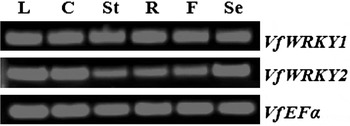
The expression profiles of VfWRKY1 and VfWRKY2 in various faba bean tissues were investigated by semi-quantitative RT–PCR (Fig. 5). The expression analysis showed that both VfWRKY1 and VfWRKY2 mRNA were clearly detected in the vegetative organs, including the leaf, root, cotyledon or stem and in the reproductive organs, including the flower or seed. High expression of VfWRKY1 in vegetative and reproductive organs was found. It should be noted that the VfWRKY1 expression level was equal in all organ tissues studied. VfWRKY2 was clearly detected in all six organs and showed the highest expression in leaves, cotyledons and seeds.
Expression profiles of VfWRKY1 and VfWRKY2 in different tissues of faba bean by semi-quantitative real-time polymerase chain reaction analysis. (L) Leaves, (F) Flowers, (St) Stems, (R) Roots, (C) Cotyledons, (Se) Seeds. VfEFα expression was used as a control.

Expression profile of VfWRKY1 and VfWRKY2 genes under drought and salt stress
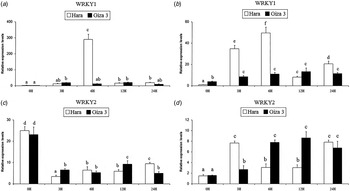
A qRT–PCR analysis was conducted to examine the expression profile of VfWRKY1 and VfWRKY2 genes in leaf and root tissues of Hara and Giza 3 cultivars under salt and drought stress. Figure 6 shows that VfWRKY1 and VfWRKY2 gene expressed differentially in leaves and roots tissues during the whole period under drought stress. As a result of analysis, it was observed that expression of VfWRKY1 in leaf and root tissues was up-regulated in Hara at 6 h under the drought treatment (Figs 6(a) and (b)). In leaves, the expression profile of VfWRKY1 showed weak expression patterns in Giza 3 at all-time points (Fig. 6(a)). However, in root tissues of Hara, VfWRKY1 was gradually up-regulated and peaked at 12 h (Fig. 6(b)). The results of the present study show that the highest transcript accumulation of VfWRKY2 in leaves of both Hara and Giza 3 cultivars was observed at 0 h (control condition), then expression was down-regulated at subsequent time points from 3 to 24 h (Fig. 6(c)). Expression of VfWRKY2 in roots tissues was up-regulated at 6, 12 and 24 h in Giza 3, and at 3 h as an early response and then at 24 h in Hara (Fig. 6(d)).
Expression profiles of VfWRKY1 and VfWRKY2 genes under drought stress treatment. (a, b) Expression profile of VfWRKY1 in leaves and roots, respectively. (c, d) Expression profile of VfWRKY2 in leaves and roots, respectively. Significant differences (P < 0·05) detected by Tukey's multiple comparison test are shown by different letters above the bars.

In general, qRT–PCR data showed that expression of VfWRKY1 in cvar Hara was induced by PEG treatments at 6 h in leaves and in roots at 3 and 6 h. On the other hand, expression of VfWRKY2 was down-regulated in leaves and significantly up-regulated in roots in both Hara and Giza 3 cultivars by PEG treatments.
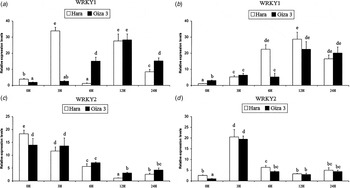
The effect of salt stress on expression profile of VfWRKY1 and VfWRKY2 genes in leaf and root tissues of Hara and Giza 3 is shown in Fig. 7. VfWRKY1 had a low expression level at 0 h in leaf and root tissues while VfWRKY2 showed low level at 0 h only in root tissues. Expression analysis in leaf tissues revealed that VfWRKY1 was up-regulated at 3 and 12 h in cvar Hara (Fig. 7(a)). In Giza 3, VfWRKY1was also differentially expressed. Indeed, VfWRKY1 had a low expression level at 0 and 3 h, and then transcripts of VfWRKY1 were induced at 6 h and accumulated at a very high level by 12 h. At 24 h expression of VfWRKY1 showed similar level to that at 6 h (Fig. 7(a)). In Hara root tissues, the expression level of VfWRKY1 was gradually increased under salt stress, peaking at 12 h then decreased at 24 h. In Giza 3, transcript levels were increased slightly at 3 and 6 h and reach the highest levels at 12 and 24 h (Fig. 7(b)). Surprisingly, VfWRKY2 was found to be gradually down-regulated from 0 to 24 h in Hara and Giza 3 leaf tissues (Fig. 7(c)). Expression of VfWRKY2 in Hara root tissues was dramatically up-regulated and peaked at 3 h in response to salt stress and then significantly decreased at 6, 12 and 24 h. A similar pattern of expression was revealed in Giza 3 (Fig. 7(d). In general, VfWRKY1 and VfWRKY2 were differentially expressed in leaf and root in Hara and Giza 3 under drought and salt stress.
Expression profiles of VfWRKY1 and VfWRKY2 genes under salt stress treatment. (a, b) Expression profile of VfWRKY1 in leaves and roots, respectively. (c, d) Expression profile of VfWRKY2 in leaves and roots, respectively. Significant differences (P < 0·05) detected by Tukey's multiple comparison test are shown by different letters above the bars.

In general, expression of VfWRKY1 was induced in leaves and roots by salt treatments in both Hara and Giza 3. On the other hand, expression of VfWRKY2 was down-regulated in leaves and significantly up-regulated in roots in both Hara and Giza 3.
DISCUSSION
Drought and soil salinity are among the most important environmental factors causing osmotic stress for faba bean, and they seriously limit growth and crop productivity. Drought and salt tolerance are complex molecular mechanisms. Indeed, several genes, especially TFs, regulate the expression level of many downstream genes to impart abiotic stress tolerance (Rabara et al. Reference Rabara, Tripathi and Rushton2014). The WRKY family is a large group of TFs that are involved in numerous plant biological processes including defence responses of plants against both biotic and abiotic stresses (Rushton et al. Reference Rushton, Somssich, Ringler and Shen2010). A large number of WRKY genes have been found and characterized in various crop plants including legumes species such as Glycine max (Yin et al. Reference Yin, Xu, Xiao, Qin, Li, Yan and Hu2013). To date, identification and characterization of the faba bean WRKY gene family have not yet been reported despite the fact that this would open an avenue for molecular breeding towards faba bean drought and salt tolerance.
WRKY TFs have a distinct WRKY domain containing a highly conserved amino acid sequence, WRKYGQK, at the N-terminus and a metal-chelating zinc finger motif, either C2H2 (CX4–5-C-X22–23-H-X1-H) or C2HC (C-X7- C-X23-H-X1-C), at the C-terminus. These TFs regulate gene expression by interacting with the cis-element W-box (TTGAC[T/C]) sequence. Members of the WRKY family can be divided into three groups (groups I, II and III) based on the number of WRKY domains and the pattern of the zinc finger motif (Bakshi & Oelmüller Reference Bakshi and Oelmüller2014). Group I contains two WRKY domains, whereas groups II and III contain only one (Li et al. Reference Li, Li, Shao and Lu2015). Furthermore, members of group II can be divided into five subgroups (IIa, IIb, IIc, IId and IIe) based on the primary amino acid sequence of the domain. Based on phylogenetic analysis, groups I and III could be further divided into two subgroups.
In the present study, for the first time two partial sequences sharing significant homology with WRKY genes (named VfWRKY1 and VfWRKY2) were isolated from leaves of faba bean cvar Hara and characterized. Moreover, their response to drought and salt stress has been studied. VfWRKY1 and VfWRKY2 showed the presence of conserved WRKY domain and the zinc finger-like motif (C-X4-C-X23-H-X-H). Phylogenetic analysis showed that both VfWRKY1 and VfWRKY2 genes encode group I WRKY proteins.
A super-family of WRKY proteins have been characterized in various angiosperm species. Actually, 93, 72 and 66 WRKY genes are present in O. sativa, A. thaliana and Capsicum annuum genomes, respectively. Of these, 14, 15 and 16, respectively, belong to group I (Schluttenhofer et al. Reference Schluttenhofer, Pattanaik, Patra and Yuan2014). Using WRKY-F and WRKY-R degenerate primers, Dong et al. (Reference Dong, Chen, Liu, Wei, Jiang, Li, Nevo, Liu and Zheng2012) identified five members of group I in wild emmer wheat (Triticum dicoccoides). In the current work, WRKY-F and WRKY-R revealed only two members in faba bean. These data could suggest a lower WRKY member abundance in faba bean compared to other plants. VfWRKY1 showed 62% identity to VfWRKY2. Homologous sequences of VfWRKY1 and VfWRKY2 are also present in other plant species and share different levels of sequence similarities, which suggest different levels of evolutionary relationships among these proteins. Additionally, phylogenetic analysis separate VfWRKY1 and VfWRKY2 proteins into two subgroups which suggest that VfWRKY loci were distinct from one another. These data would presume that VfWRKY1 and VfWRKY2 could also be related to various functions.
WRKY TFs are found to be involved in the regulation of expression of genes in response to different biotic and abiotic stresses. Many WRKY genes have been reported in several plant species such as A. thaliana (Jiang et al. Reference Jiang, Liang and Yu2012) and T. aestivum (Wang et al. Reference Wang, Deng, Chen, Wang, Ma, Hu, Yao, Feng, Chai, Yang and He2013) and shown to confer significant drought and salt tolerance in transgenic plants. Phylogenetic analysis revealed that the obtained VfWRKY1 encoding protein and the WRKY of monocotyledon T. aestivum, H. vulgare and Z. mays belong to the same category, indicating that these WRKY may have evolved from a common ancestor through different pathways. Interestingly, VfWRKY1 showed the highest similarity with the abiotic stress-related WRKY proteins GhWRKY17 from G. hirsutum, which was involved in response to drought and salt stress through ABA signalling and the regulation of cellular reactive oxygen species production in plants (Yan et al. Reference Yan, Jia, Chen, Hao, An and Guo2014). VfWRKY2 showed the highest homology with MaWRKY4 from Musa acuminata. In addition, phylogenetic analysis showed that VfWRKY1 and AtWRKY33 genes belong together in subgroup Ia. AtWRKY33 was reported to be important for plant resistance to necrotrophic pathogens and involved in regulation of the heat-induced ethylene-dependent response (Li et al. Reference Li, Fu, Chen, Huang and Yu2011). Furthermore, according to these authors overexpression of AtWRKY33 conferred salt tolerance in Arabidopsis. Interestingly, the presence of phylogenetic relationships between faba bean and other plant species such as cotton and Arabidopsis makes the use of WRKY sequences in these species to identify and isolate orthologous genes in faba bean possible.
To assess the functions of VfWRKY1 and VfWRKY2, their expression was investigated in various organ tissues and in leaf and root tissues under drought and salt stress using quantitative RT–PCR method. Transcripts of the VfWRKY1 and VfWRKY2 genes were detected in cotyledons, roots, stems, flowers, leaves and seeds. These results suggested that VfWRKY1 and VfWRKY2 may play various roles at the early and late stages of faba bean plant development.
The expression patterns of VfWRKY1 and VfWRKY2 in two faba bean cultivars (Hara and Giza 3) with contrasting responses to drought were compared in order to investigate whether VfWRKY1 and VfWRKY2 genes are associated with drought and salt tolerance. The expression level of VfWRKY1 and VfWRKY2 was differentially expressed in leaf and root tissues in Hara and Giza 3 under drought and salt stress. The expression of VfWRKY1 was induced by PEG treatment at 6 h in leaf tissues but not in Giza 3 and at 3 and 6 h in roots. In general, transcript levels of VfWRKY1 in Hara were higher than Giza 3. Under salt treatment, expression of VfWRKY1 was induced at 3 h (not in Giza 3) and 12 h in leaves and at 6 h (not in Giza 3), 12 and 24 h in roots. Down-regulation of VfWRKY2 was found in leaf tissues in both cultivars under drought and salt stress. These results could suggest that VfWRKY1 and VfWRKY2 are related to faba bean plant response and tolerance to salt and drought stress and abiotic stress signalling. Furthermore, differences in expression level of VfWRKY1 and VfWRKY2 in drought-tolerant (Hara) and -sensitive (Giza 3) cultivars could be linked to their response to drought and salt stress. Interestingly, the current data are in accordance with other studies, which found that in T. aestivum, a drought-tolerant cultivar exhibited a higher extent of up-regulation of TaWRKY10 gene in response to drought and salt stress (Baloglu et al. Reference Baloglu, Inal, Kavas and Unver2014).
Transgenic Arabidopsis overexpressing OsWRKY45 and OsWRKY72 increased tolerance to salt and drought stresses, which was attributed to the activation of stress-related genes (Qiu & Yu Reference Qiu and Yu2009; Yu et al. Reference Yu, Ligang, Liping and Diqiu2010). Similar data were revealed in transgenic rice overexpressing OsWRKY30 (Shen et al. Reference Shen, Liu, Zhang, Meng, Zhou, Chu and Wang2012). According to Chen et al. (Reference Chen, Song, Li, Zhang, Zou and Yu2012), early modification of the expression patterns of WRKY genes contributes to the elaboration of various signalling pathways and regulatory networks and consequently confers plant tolerance against multiple abiotic stresses. Exceptionally, in leaf tissues, under salt and drought stress conditions, expression of VfWRKY2 was gradually decreased in Hara and Giza 3 at all-time points. It was concluded that VfWRKY2 was negatively regulated by both treatments. It is known that WRKY proteins may act as transcription activators or repressors, and some WRKY TFs appear to possess both functions (Rushton et al. Reference Rushton, Somssich, Ringler and Shen2010). The VfWRKY2 degradation profile under salt and drought conditions could be correlated either negatively or positively with the expression pattern of the salt and drought-response genes. Consequently, downexpression of VfWRKY2 could enhance some drought- and salt-responsive gene expression, and thereby increase osmotic stress tolerance in faba bean. This idea is supported by the tolerance to osmotic stress in A. thaliana that is conferred by loss-of-function mutations in AtWRKY54 and AtWRKY70 genes. The wrky54 and wrky70 double mutants exhibited clearly enhanced tolerance to osmotic stress. Indeed, AtWRKY54 and AtWRKY70 act as negative regulators, resulting in reduction of induction of some osmotic stress-responsive genes and accumulation of the osmoprotectant proline. Besides this negative role, they activate other osmotic stress-responsive genes involved in improvement of water retention and increasing stomatal closure (Li et al. Reference Li, Besseau, Toronen, Sipari, Kollist, Holm and Palva2013).
CONCLUSION
The result of the current work has provided basic information about the VfWRKY1 and VfWRKY2 genes and their possible role in drought and salt stress response and tolerance in faba bean. To date, WRKY genes have been cloned from several plant species but not in faba bean. In the present study, for the first time two WRKY genes from faba bean were characterized. VfWRKY1 and VfWRKY2 showed significant homology with WRKY genes of other plant species and differentially expressed in leaf and root tissues of faba bean under PEG and NaCl treatments. Altogether, the genomic differences between both faba bean cultivars were evident, by the differential expression patterns of VfWRKY1 and VfWRKY2 genes under drought and salt stress conditions in leaf and root tissues. Therefore, VfWRKY1 and VfWRKY2 might play important roles in faba bean drought and salt stress tolerance and could be used in faba bean genetic engineering with the aim of improving osmotic stress tolerance. Further studies should isolate, clone and sequence the full length cDNA of VfWRKY1 and VfWRKY2. Moreover, overexpression of these genes in A. thaliana and analysis of their expression under drought and salt stress conditions might confirm their potential role in drought and salt stress response and tolerance.