Zoobank identifier: LSID urn:lsid:zoobank.org:pub:D884DFC9-C823-4A26-A59E-64F6ED39486E
Introduction
The Lumbrineridae Schmarda, Reference Schmarda1861 have more than 200 valid species across 19 genera and are a globally abundant and diverse family of polychaetes that are common in the muddy and sandy bottoms of continental shelves (Carrera-Parra, Reference Carrera-Parra2006; Gómez et al., Reference Gómez, Carrera-Parra, Mas, Freitas and Martins2016; Zanol et al., Reference Zanol, Carrera-Parra, Steiner, Amaral, Wiklund, Ravara and Budaeva2021). Lumbrinerids are typically burrowers but can also be found in association with other invertebrate groups (i.e. sponges, bryozoans and sea urchins), and are regarded as having a simple body shape and reduced external features (Carrera-Parra & Orensanz, Reference Carrera-Parra and Orensanz2002; Aguirrezabalaga & Carrera-Parra, Reference Aguirrezabala and Carrera-Parra2006; Carrera-Parra, Reference Carrera-Parra2006). Ninoe Kinberg, Reference Kinberg1865 is a genus that comprises 32 valid species, easily recognized by the branchiae associated with the parapodia on anterior segments (Carrera-Parra, Reference Carrera-Parra2006; Read & Fauchald, Reference Read and Fauchald2018). Characteristics associated with its maxillary apparatus such as pigmentation, placement and arrangement of teeth may further diagnose species within this genus (Carrera-Parra, Reference Carrera-Parra2006).
At least 13 valid lumbrinerid species are known to occur in Namibia (see Day, Reference Day1967; Miura, Reference Miura1980; Read & Fauchald, Reference Read and Fauchald2022). Among them, only one species belonging to this family has ever been described from Namibian waters, Ninoe desbruyeresi Miura, Reference Miura1980 (see Day, Reference Day1967; Miura, Reference Miura1980; Read & Fauchald, Reference Read and Fauchald2022). Considering that over the last two decades alone six new genera have been erected and more than 40 new species described globally within Lumbrineridae (Aguirrezabalaga & Carrera-Parra, Reference Aguirrezabala and Carrera-Parra2006; Cai & Li, Reference Cai and Li2011; Carrera-Parra et al., Reference Carrera-Parra, Çinar and Dagli2011; Martins et al., Reference Martins, Carrera-Parra, Quintino and Rodrigues2012; Arias & Carrera-Parra, Reference Arias and Carrera-Parra2014; D'Alessandro et al., Reference D'Alessandro, Consentino, Giacobbe, Andaloro and Romeo2014; Kurt-Sahin et al., Reference Kurt-Sahin, Çinar and Gonulal2016; Katsiaras et al., Reference Katsiaras, Rousou, Carrerra-Parra, Garcia-Gomez, Simboura, Louizidou, Chintiroglou and Martins2018; Borisova & Budaeva, Reference Borisova and Budaeva2020; Borisova & Budaeva, Reference Borisova and Budaeva2022), at least four of which belong to Ninoe (Carrera-Parra, Reference Carrera-Parra2001; Hernandez-Alcantra et al., Reference Hernández-Alcántara, Pérez-Mendoza and Solís-Weiss2006), the diversity within this region may be underestimated. Further, exploitation of mineral resources, especially the extraction of diamonds off southern Namibia, continues to reveal species that cannot be identified using local or regional guides thereby highlighting the limited research conducted in describing faunal communities in this region and the anticipation that many more undescribed species may be found (see Glasby & Alvarez, Reference Glasby and Alvarez1999; Hutchings & Kupriyanova, Reference Hutchings and Kupriyanova2018; Simon et al., Reference Simon, Kara, Clarke and Sedick2022). Here, a new species of Ninoe is described from samples collected during a survey conducted by Anchor Environmental Consultants (Pty) Ltd and Debmarine Namibia. This species represents the first new record of Ninoe from Namibia in four decades.
Methods and materials
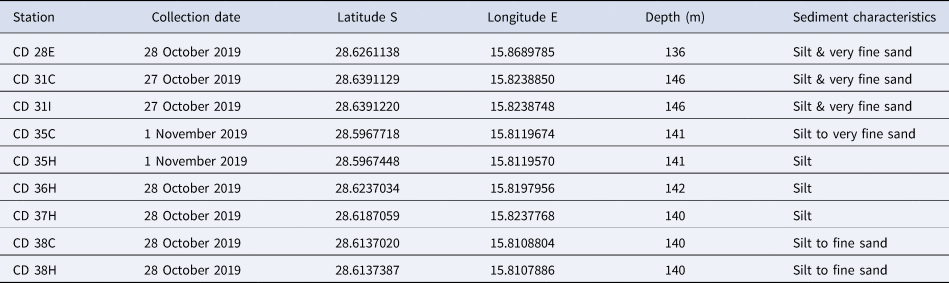
Materials were collected from 9 stations during a benthic grab-sampling survey conducted along the southern coast of Namibia in October 2019 (Table 1). A Van Veen grab with a sample area of 0.2 m2 which penetrates to 20 cm depth was used to collect sediment samples. The samples were sieved through a 1 mm sieve bag and rinsed with filtered seawater. Freshly collected specimens were sorted under a dissecting microscope and preserved in 90% ethanol. Fixed individuals were stained with rose Bengal and examined under either a compound (Leica DM 1000) or dissecting microscope (Leica MZ75). To better examine the details of the jaw structure, the maxillae and mandible were extracted by making an anteroventral dissection, placed on a temporary mount and examined under a compound and dissecting microscope. Photographs were taken of preserved individuals using a Leica MC190 HD camera attached to a Leica DM4B LED compound microscope and a Leica S9i dissecting microscope. Permanent slides of parapodia were prepared in DPX mounting medium and sealed with clear nail varnish. Morphological line drawings were prepared using a camera lucida attached to a dissecting microscope. Associated camera software, Leica LAS EZ. V1.5.0, was used to take length and width measurements of specimens on each photograph. Tissue samples preserved in 99% ethanol were submitted to the African Centre for DNA Barcoding for sequencing. For scanning electron microscopy (SEM), specimens were dehydrated through a series of washes in 80 and 100% ethanol for a few hours respectively, then one wash in hexamethyldisalazane (HDMS) for 15 min, without critical point drying. The specimens were then left overnight for residual HMDS to evaporate off. Specimens were placed directly into the environmental chamber and scanned using the Iziko South African Museum's Hitachi TM4000 Plus Desktop SEM. All the material collected on behalf of Debmarine Namibia was deposited at the Iziko South African Museum, Cape Town. We describe the holotype with variation in paratypes indicated in parentheses where different. Body length measurements begin at the anteriormost point of the prostomium.
Characteristics of the sample sites in southern Namibia where Ninoe namibiensis sp. nov. were collected

Results
Systematics
Family LUMBRINERIDAE Schmarda, Reference Schmarda1861
Genus Ninoe Kinberg, Reference Kinberg1865
Ninoe namibiensis sp. nov.
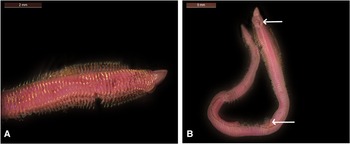
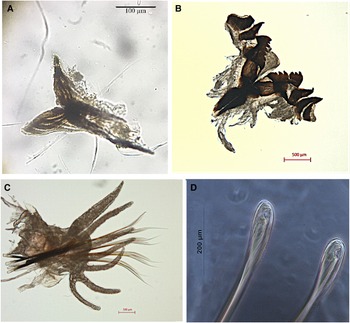
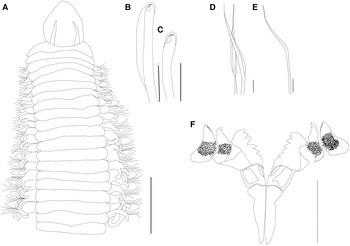
(Figures 1–3)
Ninoe namibiensis sp. nov. (A) Anterior end, dorsal view, stained with rose Bengal; (B) whole specimen, ventral view, showing dissection scars for jaw examination and tissue sampling for DNA sequencing. All from holotype.

Ninoe namibiensis sp. nov. Dorsal view of (A) mandible, (B) maxillae and (C) parapodium with maximum number of branchiae from chaetiger 19 showing limbate chaetae, aciculae, branchiae, posterior chaetal lobe. (D) Multidentate hooded hook with short hood from posterior chaetiger. A from paratype, B–D from holotype.

Ninoe namibiensis sp. nov. (A) Anterior end, dorsal view indicating dorsal slit-like organs; (B) multidentate hooded hook with long hood from branchial region; (C) multidentate hooded hood with short hood from posterior chaetiger; (D) limbate chaetae from anterior region; (E) extended filiform limbate chaetae from posterior region; (F) maxillae. Scale: A = 1 mm; B, C = 200 μm; D, E = 20 μm; F = 500 μm. All from holotype.

Material Examined
Holotype: Complete specimen, silt and very fine sand, 136 m depth (SAMC-A094450), preserved in ethanol. Off southern Namibia, SE Atlantic Ocean (28.626°S 15.868°E), 28 October 2019, Coll. Anchor Environmental Consultants (Pty) Ltd, det. S. Sedick, D. Clarke. Paratypes: Complete specimens (2), silt, 140–146 m depth (SAMC-A094456, SAMC-A094457), dried and prepared for scanning electron microscopy. Off southern Namibia, SE Atlantic Ocean (28.6137°S 15.8107°E), 28 October 2019, Coll. Anchor Environmental Consultants (Pty) Ltd, det. S. Sedick, D.Clarke. Additional material: (8) incomplete specimens (SAMC-A094451) and 1 complete specimen (SAMC-MB-A094460), preserved in ethanol, data as for holotype.
Diagnosis
Ninoe namibiensis sp. nov. is characterized by a prostomium that is longer than broad, simple multidentate hooded hooks (SMHH) with long hood appearing after chaetiger 18, branchiae from chaetigers 1–2 to 38 (with up to 7 filaments) and maxillary apparatus: MX III with a prominent tooth followed by a knob and MX IV unidentate with a finely denticulate cutting edge (11 teeth).
Description
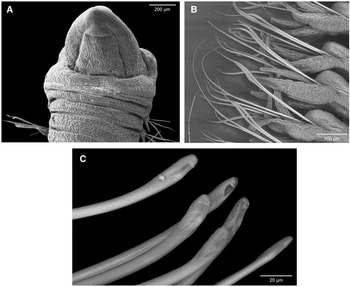
Live specimens iridescent light brown but pale after preservation. Holotype complete with 178 chaetigers: 35 mm long and 2 mm wide at chaetiger 10, including parapodia (20–25 mm for 102–130 chaetigers) (Figures 1A, B & 3A). Body long, slender. Prostomium with pointed distal end, longer than broad. Dorsal longitudinal furrows diverge posteriorly (dorsal slitlike organs sensu Orensanz, Reference Orensanz1990), 3/4 length of prostomium (Figures 1A & 3A). No eyes. Peristomium two apodous rings, distinct dorsally and laterally, first ring dorsally 1.5 times wider than the second ring (Figures 1A, 3A & 4A). Maxillary apparatus: MI unidentate, curved, MII with 6 teeth, MIII unidentate, 1 prominent tooth followed by a knob, no cutting edge, MIV unidentate with finely denticulate cutting edge comprising 11 small teeth (10–12 small teeth) (Figures 2B & 3F). Mandibles slender, anterior ends slightly flared (Figure 2A). Parapodia well-developed, single lobe, pre-chaetal lobe low and rounded throughout, post-chaetal lobe tapering. Branchiae attached posterior to chaetae from chaetiger 1–2 to 38, 2–7 filaments from chaetiger 3 onward (2–4 to 32–40; 2–7 filaments from chaetiger 3–4 onwards) (Figure 2C). Limbate chaetae with well-developed brim from chaetiger 1–37, up to 12 per parapodia in anterior body region (Figures 2C, 3D & 4B) becoming thinner and filliform capillary chaetae from chaetiger 15, extending to posteriormost chaetigers (limbate from chaetiger 1–2, 8–12 per parapodia; capillary chaetae from chaetiger 15–16) (Figures 3E & 4B). Simple multidentate hooded hooks (SMHH) with long hood from chaetiger 18–41, 4–5 small teeth and one prominent tooth (18–34, 5–6 small teeth) (Figure 3B). SMHH with short hood from chaetiger 42 with 6–8 small teeth (from chaetiger 35) (Figures 2D & 3C). Chaetae after branchial region with 1 winged limbate chaetiger, 2–3 filiform chaetae, 1–2 SMHH with short hood having 9 small teeth. Posterior chaetae with 4 SMHH with short hood having 6–8 small teeth. Aciculae black, tapering to a point, up to three in anterior parapodia, 1–2 in midbody and posterior parapodia (Figure 2C). Pygidium with two anal cirri, unarticulated, swollen base.
Ninoe namibiensis sp. nov. Dorsal view of (A) anterior end indicating dorsal slit-like organs; (B) four parapodia from anterior body showing postchaetal parapodial lobes, branchiae and limbate chaetae; (C) multidentate hooded hooks with short hood from branchial region, chaetiger 19. All from paratype.

DNA Barcode
Southern Namibia: Minimal infraspecific variation observed. A total of 22 individuals, including the holotype and paratypes were sequenced. Sequences trimmed to 549–673 bp fragment of the universal COI gene. Edited and uploaded to the Barcode of Life Database (BOLD) and blasted on GenBank using the BLAST algorithm. Queried sequences were matched with low identity.
Habitat
Muddy sediments, 136–146 m.
Distribution
Southern Namibia, SE Atlantic Ocean.
Etymology
This species was named after the region where it was discovered.
Remarks
Ninoe desbruyeresi, Ninoe dibranchia Hartman & Fauchald, Reference Hartman and Fauchald1971, Ninoe digitissima Augener, Reference Augener1918, Ninoe falklandica Monro, Reference Monro1936, Ninoe saeva Intes & Le Loeuff, Reference Intes and Le Loeuff1975, Ninoe oculata Kinberg, Reference Kinberg1865, Ninoe nigripes Verrill, Reference Verrill1873 and Ninoe lagosiana Augener, Reference Augener1918 all either have a type locality or are distributed in the Atlantic Ocean. While they may all resemble each other at the generic level, at the species level some of the differences between these and N. namibiensis sp. nov. become obvious: N. dibranchia has two different types of branchiae (i.e. small, triangular lobe with vascular loop and, papillated tufts with a vascular loop); N. digitissima is yellow-grey to brown with yellow-brown needle-like aciculae; N. falklandica has anterior parapodia that appear to have two bundles of chaetae; N. oculata has two eyes and no obvious dorsal slitlike organs (Kinberg, Reference Kinberg1865; Augener, Reference Augener1918; Monro, Reference Monro1936; Hartman & Fauchald, Reference Hartman and Fauchald1971); whereas the new species has only one type of branchiae (i.e. finger-like projections that extend from the posterior parapodial lobe), is pale after preservation, has one to three black aciculae in parapodia, is without eyes and with obvious distinct dorsal slit-like organs.
The differences between the remaining species and N. namibiensis sp. nov. are subtle and require closer examination. While N. desbruyeresi is described from the same region but in sediments at a greater depth (>1000 m), it differs from the former in having a more conical prostomium, mandibles with shorter shafts and u-shaped tips, unidentate maxillary apparatus (MX III & MX IV), SMHH with long hood appearing on chaetiger 1 and four SMHH with long hood appearing in parapodia with the maximum number of branchiae (Miura, Reference Miura1980). The new species has a subglobular prostomium, mandibles with long shafts and flared, pigmented tips, and maxillary apparatus that are crenulate with small teeth.
Ninoe saeva differs from the new species in that branchiae appear later (on 4th chaetiger), SMHH with long hood appear earlier (on chaetiger 12) and bear 6 teeth, SMHH with short hood have about ten teeth (Intes and Le Loeuff, Reference Intes and Le Loeuff1975). The branchial region for the new species begins on chaetiger 1–2 and persists to chaetiger 38, SMHH with long hood appear after chaetiger 18 (4–5 small teeth and one prominent tooth) and SMHH with short hood have 9 small teeth.
Ninoe lagosiana and N. nigripes are both pigmented in the anterior region and have chaetae with a black core from the base to near the tip and mandibles with two internal black bands, respectively (Verrill, Reference Verrill1873; Augener, Reference Augener1918) whereas N. namibiensis is pale after preservation and unpigmented. The branchiae begin later in both the former species (on the 15th and 3rd chaetiger, respectively with up to five branchial filaments) whereas the branchiae of the new species begin on the first or second chaetiger and have up to seven branchial filaments. SMHH with short hood are comb-like in N. lagosiana having 12 marginal teeth whereas N. namibiensis has up to 9 apical teeth.
Despite the extensive sampling survey that was conducted, it seems that the new species is found almost exclusively in unconsolidated sediments at greater sampling depths (>100 m). This is consistent with the most recent descriptions of new species of Ninoe from elsewhere in the world. For example, Ninoe jessicae Hernández-Alcántara et al., Reference Hernández-Alcántara, Pérez-Mendoza and Solís-Weiss2006 and Ninoe marthae Hernández-Alcántara et al., Reference Hernández-Alcántara, Pérez-Mendoza and Solís-Weiss2006 from the Mexican Pacific were recorded in silty sands and muddy sands at depths of 20–120 m and, 85 and 600–2700 m, respectively (Hernández-Alcántara et al., Reference Hernández-Alcántara, Pérez-Mendoza and Solís-Weiss2006). Similarly, Ninoe vargasi Carrera-Parra, Reference Carrera-Parra2001 and Ninoe wardae Carrera-Parra, Reference Carrera-Parra2001 were described from the Grand Caribbean in sediments at depths of 22–221 and 175 m, respectively (Carrera-Parra, Reference Carrera-Parra2001). This, together with the fact that the deeper waters around southern Africa are under-sampled (Griffiths et al., Reference Griffiths, Robinson, Lange and Mead2010) suggests that there may be more undescribed taxa off the southern African coast.
Key to Ninoe Species from Southern Africa
With the new species reported here, there are now two Ninoe species that are indigenous to southern Africa. Below we provide a key to the Ninoe fauna of southern Africa:
(1) Simple multidentate hooded hooks with long hood present from chaetiger 1…Ninoe desbruyeresi Miura, 1980
• Simple multidentate hooded hooks with long hood present on or after chaetiger 18…2
(2) Prostomium longer than broad, simple multidentate hooded hooks with long hood appear on chaetiger 18, simple multidentate hooded hooks with short hood having nine apical teeth, branchia begin on first or second chaetiger and end on chaetiger 38….Ninoe namibiensis sp. nov.
– Prostomium conical, simple multidentate hooded hooks with long hood appear on chaetiger 37, simple multidentate hooded hooks with short hood comb-like with 12 marginal teeth, branchia begin on the 15th chaetiger and end on chaetiger 36…..Ninoe lagosiana Augener, Reference Augener1918
Data availability
The authors confirm that the data used to support this study are available.
Acknowledgements
We would like to acknowledge Debmarine Namibia for funding this research and for allowing us to publish data contained within this manuscript. Many thanks to De Beers Marine (Pty) Ltd for facilitating the collection of samples. Thank you to Dr Luis F. Carrera-Parra from El Colegio de la Frontera Sur, Chetumal, Mexico for providing valuable input during the initial stages of identification. The University of Cape Town is thanked for their assistance with compound microscope imagery. The Iziko South African Museum is thanked for access to the polychaete collection and the use of their scanning electron microscope. Reviewers are also thanked for their valuable comments that greatly improved the manuscript.
Author contributions
SS and DC examined specimens and compiled the description of the new species. AB and KG conducted all fieldwork and preliminary labwork (sorting samples, preliminary identification and preservation of specimens). All authors contributed to the design of the study. All authors have read and approved the final version of the manuscript.
Financial support
This work was funded by Debmarine Namibia.
Conflict of interest
The authors confirm that there are no conflicts of interest.