1. INTRODUCTION
The call for political freedom was one of the main messages in the recent “Arab Uprisings,” with the Egyptian and Tunisian revolutions especially being key events. Some argue that these protests were the first signs of a democratic wave in the Islamic Middle East, but to continue on from democratization toward sustained democracy, a deeper popular support for democracy might be crucial, and many fear the influence of Islam and Islamism will nip the process in the bud (see Blad and Koçer Reference Blad and Koçer2012; Spierings Reference Spierings2011).
Basically all studies of democratic attitudes in the Middle East deal with this theoretical, “culturalist” idea that Islam is incompatible with democracy, but most conclude that support for democratic systems is high in the region (e.g., Hofmann Reference Hofmann2004; Inglehart and Norris Reference Inglehart and Norris2003; Jamal and Tessler Reference Jamal and Mark2008; Meyer, Rizzo, and Ali Reference Meyer, Rizzo and Ali2007; Rizzo, Abdel-Latif, and Meyer Reference Rizzo, Abdel-Latif and Meyer2007; Tessler Reference Tessler2002; Tessler and Gao Reference Tessler and Gao2005; see also Bratton Reference Bratton2007; Rose Reference Rose2002). When discussing the impact of more specific Islamic attitudes on this support, however, the outcomes range from arguing that more religious and more fundamentalist Muslims are less supportive of democracy (e.g., Inglehart and Norris Reference Inglehart and Norris2003; Moaddel Reference Moaddel2006) to findings that there is a positive relationship between Islam and democratic attitudes (e.g., Rizzo, Abdel-Latif, and Meyer Reference Rizzo, Abdel-Latif and Meyer2007). Based on a closer look at the literature, several possible explanations for these differences can be suggested: the conceptual ambiguity of religion, the absence of a systemized assessment of context-specificity, and the problematic nature of measuring democratic support while ignoring the underlying civic values. This means the question central to this study remains unanswered: Do (or: Which) Islamic attitudes influence the support for democracy and for values fundamental to democracy in the Middle East?
Consequently, this study focuses on the general “support for democracy” which is the modus vivendi in the Middle East literature, and on political and religious tolerance as a civic value fundamental to democracy (e.g., Bratton Reference Bratton2010; Przeworski and Teune Reference Przeworski and Teune1966; Rawls Reference Rawls2003). Additionally, applying insights from the more general sociology of religion, I will systematically distinguish between the impacts of five different dimensions of Islamic attitudes: affiliation, religiosity, orthodoxy, Muslim political attitudes, and individual-level political Islamism. Finally, I will compare results across socio-political contexts to assess the robustness, generalizability, and/or context-dependency of the relationship between Islam and democratic support.
Empirically, the relationships are tested by applying pooled and survey-specific regression models to World Values Survey (WVS) survey data for Egypt, Iraq, Jordan, Morocco, and Saudi Arabia. Democratic support and tolerance act as dependent variables, and the five religious attitudes and socio-economic and demographic characteristics as explanatory factors. It turns out that being a more committed or orthodox Muslim and holding stronger Muslim political attitudes do not consistently lead to lower political tolerance and “democratic support.” The effects of these religious orientations are negligible, which undermines the culturalist thesis. Political Islamist views, however, strongly affect tolerance in a negative way. They influence the support for democracy as well, but in several cases positively. If the opposition in an authoritarian country is Islamic, political Islamist attitudes actually strengthen the support for democracy. These outcomes support the instrumentalist view on Islam and democratic support.
2. LITERATURE BACKGROUND
2.1. Islam and Democratic Support in the Arab Middle East
To date, the lion's share of studies on the support for democracy in Arab Muslim countries focuses on the influence of Islam. These studies either propose or dispute the idea that the more Islamic or religious people are, the less supportive of democracy they are. If the theoretical why is addressed, authors give historical and theological arguments: Islam prioritizes the collective over the individual; Islam rules over both private and public life; Islam resolves conflicts with violence, not deliberation; and Allah's will cannot be questioned, resulting in a submissive people (e.g., Inglehart and Norris Reference Inglehart and Norris2003; Norris and Inglehart Reference Norris and Inglehart2012; Rizzo, Abdel-Latif, and Meyer Reference Rizzo, Abdel-Latif and Meyer2007; Tessler Reference Tessler2002; Tessler and Gao Reference Tessler and Gao2005). Others also add that religious opposition to democracy in Middle Eastern countries might be linked to perceiving democracy as a Western concept (Fish Reference Fish2011; Jamal Reference Jamal2012; Spierings Reference Spierings2014b).
Theoretical counter-arguments to this “culturalist” thesis often refer to scriptural text and religious practices as well, showing that democracy can fit an Islamic ideological perspective: the prophet deliberately did not appoint a successor; Islamic theology is egalitarian; and Islamic concepts underpinning democracy, such as ijthihad — people's duty to form their own judgment — and shura — the consultative deliberation in decision-making practiced by Muhammad — (Abou El Fadl Reference Abou El Fadl2004; Esposito and Voll Reference Esposito and Voll1996; Rizzo, Meyer, and Ali Reference Rizzo, Meyer and Ali2002).
These arguments are tested with various concepts of religion and the results are mixed. Religiosity and personal piety are found to have a negative impact (Meyer, Rizzo, and Ali Reference Meyer, Rizzo and Ali2007; Moaddel Reference Moaddel2006; Norris and Inglehart Reference Norris and Inglehart2012; Tessler Reference Tessler2002; also Tezcür et al. [Reference Tezcür, Azadarmaki, Bahar and Nayebi2012] on Iran), no effect at all (Jamal and Tessler Reference Jamal and Mark2008; Tessler Reference Tessler2002), or to make people more supportive of democracy (Rizzo, Abdel-Latif, and Meyer Reference Rizzo, Abdel-Latif and Meyer2007). And Islamic orthodoxy and a support for political Islam showed hardly any effect on supporting democracy (Jamal and Tessler Reference Jamal and Mark2008; Meyer, Rizzo, and Ali Reference Meyer, Rizzo and Ali2007; Tessler Reference Tessler2002; Tessler and Gao Reference Tessler and Gao2005; also Tezcür et al. [Reference Tezcür, Azadarmaki, Bahar and Nayebi2012] on Iran); only Moaddel (Reference Moaddel2006, 102) finds a negative effect for the desire to introduce Shari'a law. Pooled analyses of Muslim-majority countries find no clear effects either (Ciftci Reference Ciftci2010).
2.2. Measuring Democratic Support in the Middle East
While some Middle East scholars acknowledge the complexity of measuring democratic support (e.g., Jamal and Tessler Reference Jamal and Mark2008; Rizzo, Abdel-Latif, and Meyer Reference Rizzo, Abdel-Latif and Meyer2007), most empirical research is still based on general survey items such as “democracy may have problems, but it's better than any other form of government” and “having a democratic system is desirable” (cf. Hofmann Reference Hofmann2004). Talking to people in the Middle East and taking a closer look at some of these studies (e.g., Esposito and Mogahed Reference Esposito and Mogahed2007; Jamal and Tessler Reference Jamal and Mark2008) suggest that these very general questions tap into a desire for modernization or elections, but not liberal democracy per se.
This observation and the incongruence between democratic support and the level of democracy in these countries (e.g., Fish Reference Fish2011) has led some scholars to focus on civic values to measure the true support for liberal democracy. Applying this argument, scholars studied the impact of religion on sexual liberalization (Fish Reference Fish2011; Inglehart and Norris Reference Inglehart and Norris2003), dishonesty and fraud (Fish Reference Fish2011), and social capital (Achilov Reference Achilov2013), with the result that Muslim affiliation and religiosity are associated with lower civic values, but inconclusively (see also Spierings Reference Spierings2014b). Achilov (Reference Achilov2013), for instance, shows a positive effect of religiosity in Egypt.
Moreover, the arguably most important civic value has hardly received any attention: religious and political tolerance (i.e., the tolerance for ideologies and world views one disagrees with [Al Sadi and Basit Reference Al Sadi and Basit2013; Gibson Reference Gibson2013; Robinson Reference Robinson2010; Sarkissian Reference Sarkissian2012; Stouffer Reference Stouffer1955; Williams, Nunn, and St. Peter Reference Williams, Nunn and Peter1976). Studies on the Middle East show that tolerance can lead to democratic support (Cifti Reference Ciftci2010) and that it can be increased by education if that focuses on similarities between religions (Al Sadi and Basit Reference Al Sadi and Basit2013, 447), but no study answers the question how religious attitudes influence tolerance, as a value fundamental to democracy.Footnote 1
2.3. Diagnosing the Middle East literature
In sum, our picture of Islamic-religious orientations' impact on democratic support in the Arab Middle East is rather incomplete. This is partly due to the (1) lack of systematic multi-country studies; (2) conceptual ambiguity on micro-level religion variables; and (3) the absence of simultaneous assessments of general democratic support and underlying civic values, particularly political tolerance. Below, I will use insights from studies on other countries — mainly Western and democratic — to further the debate on the Middle East.
3. A CONCEPTUAL-THEORETICAL FRAMEWORK
3.1. Conceptualizing the Support for Democracy
Theoretically, “support for democracy” refers to democracy as the concept central to the democratization literature: the Dahlian definition of democracy (Dahl Reference Dahl1982) focusing on free and fair elections that influence government formation and are facilitated by freedom of opinion, press, and association, as operationalized by Freedom House and Polity. Measuring the individual-level support for liberal democracy is more problematic. “Democracy” is a contested and normative term (Bratton Reference Bratton2010, 106), and people's responses to general questions about the desirability of democracy might be understood quite differently across countries (Bratton Reference Bratton2010; Przeworski and Teune Reference Przeworski and Teune1966; Tezcür et al. Reference Tezcür, Azadarmaki, Bahar and Nayebi2012), particularly in countries with little democratic history, where citizens have mixed and vacuous ideas about what democracy is (Schedler and Sarsfield Reference Schedler and Sarsfield2007). In the Arab Middle East, a region with a legacy of authoritarian rule,Footnote 2 the understanding of democracy has been linked to electoral procedures (Jamal and Tessler Reference Jamal and Mark2008; Moaddel Reference Moaddel2006; Rizzo, Abdel-Latif, and Meyer Reference Rizzo, Abdel-Latif and Meyer2007), modernity (Mernissi Reference Mernissi2002), Westernization (Fish Reference Fish2011), economic performance and development (Jamal and Tessler Reference Jamal and Mark2008; Tezcür et al. Reference Tezcür, Azadarmaki, Bahar and Nayebi2012), and satisfaction with government (Tezcür et al. Reference Tezcür, Azadarmaki, Bahar and Nayebi2012; see also Bratton and Mattes Reference Bratton and Mattes2001; Mattes and Bratton Reference Mattes and Bratton2007).
These different associations question the validity of the results of general support questions (Schedler and Sarsfield Reference Schedler and Sarsfield2007). In defense of these general survey items however, some conceptions do seem more dominant. Studies using the more detailed African barometer data have shown that between half and two-thirds of the people think of democracy as being about government by the people, elections, and electoral freedoms (Bratton Reference Bratton2003; Reference Bratton2007), and less about peace, equality, justice, and socio-economic development (Bratton Reference Bratton2010, 107). Still, as Gibson (Reference Gibson1998) observed more generally, people who strongly endorse “democracy” might actually not endorse underlying elements; including unpopular dissidents' human rights or the rule of law (see also Bratton Reference Bratton2007, 106).
3.2. Political Tolerance
An alternative is to measure civic values that are necessary for a sustained and free democracy. Arguably most fundamental here is political tolerance (see Sullivan and Transue Reference Sullivan and Transue1999). Political theorists since Mill (Reference Mill2007[1859/1863]) have highlighted the importance of political tolerance to the functioning of democracy. The accepted operational definition of political tolerance in empirical work defines it as the acceptance that citizen rights should be extended to members of groups that are considered objectionable, in other words, the acceptance that people who think and act differently have the same rights as you (e.g., Eisenstein Reference Eisenstein2006; Gibson Reference Gibson1992; Reference Gibson2013; Kim and Zhong Reference Kim and Zhong2010; Marcus et al. Reference Marcus, Sullivan, Theiss-Morse and Wood1995; Mondak and Sanders Reference Mondak and Sanders2005; Robinson Reference Robinson2010; Stouffer Reference Stouffer1955; Williams, Nunn, and St. Peter Reference Williams, Nunn and Peter1976). The political theoretical definition and that of the international community is less focused on rights, but more on the general tolerance for conflicting worldviews. For instance, United Nations Educational, Scientific and Cultural Organization's definition of tolerance encompasses “full acceptance, respect, affirmation, and appreciation of diversity in religion, ethnic opinion and ways of life” (Al Said and Basit Reference Al Sadi and Basit2013, 450). Political tolerance allows for social and political interaction (Sarkissian Reference Sarkissian2012) and is crucial to political pluralism (and thus democracy) (Furedi Reference Furedi2011; Moaddel Reference Moaddel2006). In the words of Rawls: “the principle of toleration (…) lay[s] down the fundamental basis to be accepted by all citizens as fair and regulative of the rivalry between doctrines” (2003, 151–152). Without tolerance, “support for democracy” is easily diverted into an instrument solely used to gain power.
In democratic and affluent countries (mainly the United States), exposure to diversity is discussed as a main contributor to tolerance, and explanatory variables for more tolerance include education, younger age, and gender (Djupe and Calfano Reference Djupe and Calfano2012; Gibson Reference Gibson2013; Golebiowska Reference Golebiowska1999; Kim and Zhong Reference Kim and Zhong2010; Stouffer Reference Stouffer1955; Williams, Nunn, and St. Peter Reference Williams, Nunn and Peter1976). Religion is also seen as an important force and “well-trodden ground” (Djupe and Calfano Reference Djupe and Calfano2013, 769), but there is a need for more detailed knowledge of the impact of religion on (political) tolerance in Western democratic contexts (Eisenstein Reference Eisenstein2006) and in less free Muslim-Majority countries (Sarkissian Reference Sarkissian2012, 619).
3.3. Islamic Attitudes
Different religious attitudes differently impact people's democratic support and tolerance (e.g., Ben-Nun Bloom Arikan Reference Ben-Nun Bloom and Arikan2012a; Djupe and Calfano Reference Djupe and Calfano2012; Glock and Stark Reference Glock and Stark1965). Starting from this larger — ongoing — debate might help understand Islam's impact in the Middle East.
First of all, the literature distinguishes between behavioral and attitudinal aspects of religion (see Cornwall et al. Reference Cornwall, Albrecht, Cunningham and Pitcher1986; Fleischman Reference Fleischman2011; Kellstedt et al. Reference Kellstedt, Green, Guth and Smidt1996; Tezcür et al. Reference Tezcür, Azadarmaki, Bahar and Nayebi2012). Often religiosity is measured in terms of attendance (behavioral) but interpreted as the strength of one's beliefs, also in Middle East studies (e.g., Moaddel Reference Moaddel2006; Tessler Reference Tessler2002). Since behavioral religion is highly intertwined with social capital (being active in religious communities) and social pressure (going to services because it is what should be done), attendance says relatively little about beliefs and theological messages (see Spierings Reference Spierings2014a). From here onward, I will thus focus on the attitudinal religion.
Religious attitudes contain cognitive as well as affective elements (e.g., Cornwall et al. Reference Cornwall, Albrecht, Cunningham and Pitcher1986), subjective religiosity (e.g., Gungor, Fleischmann, and Phalet Reference Güngör, Fleischmann and Phalet2011; Fleischmann Reference Fleischman2011), and beliefs as well belonging (e.g., Ben-Nun Bloom and Arikan Reference Ben-Nun Bloom and Arikan2012a; Reference Ben-Nun Bloom and Arikan2012b). I will first distinguish belonging or cognitive religiosity: the (strand of) religion or denomination to which someone is affiliated. Though in comparative studies this is strongly present as an instrument to contrast Islam with other religions, it makes for a very crude and an empirically flawed indication of ideology (see Spierings Reference Spierings2014a). “Belief” as an overarching concept seems more useful, as it relates to the type of message one adheres to, the “social theology” concerning the relationship between society, the divine, and the individual (Ben-Nun Bloom and Arikan Reference Ben-Nun Bloom and Arikan2012a; Reference Ben-Nun Bloom and Arikan2012b; Spierings Reference Spierings2014a). Belief in the context of Middle East literature directs our attention to a second important religious attitude: orthodoxy, the degree to which religious beliefs are related to orthodox-conservative, literal interpretations of for instance the Quran and the Hadith (see Meyer, Rizzo, and Ali Reference Meyer, Rizzo and Ali2007). Indicators are opinions on wearing a veil or beard and abstaining from alcohol. Third, subjective and affective religiosity draws attention to commitment and piety. It refers to the strength of beliefs, not the beliefs as such.
Not part of the general literature but certainly highlighted in Middle East studies are people's attitudes toward the combination of religion and politics (e.g., Fish Reference Fish2011; Meyer, Rizzo, and Ali Reference Meyer, Rizzo and Ali2007; Spierings Reference Spierings2014b; Tessler Reference Tessler2002; Reference Tessler and Gao2005; 2008). This dimension should be seen as part of the “social theology,” but focusing explicitly on politics, not society at large. The existing Middle East studies, however, collapse an important difference under this label, and ignore the diverse ways in which the secular and religious are differentiated and fused (see Casanova Reference Casanova1994). Each of these diverse ways refers to Islam being a guideline for decision-making and makes Islam a public religion, but the hierarchical order of the two elements can differ: (1) is politics subservient to religion or (2) is religion delimited by the political system? The first is a typical example of a strong fusion of politics and religion, which I label individual-level (political) Islamism. The term “Islamism” here should not to be confused with the popular usage of the term or one of the specific strands of Islamism such as Wahhabism and the official theology of the Islamic Republic of Iran. Fundamentalist Islam is highly diverse in itself (Roy Reference Roy1996).Footnote 3 Here Islamism is used more generally to indicate people who believe that political decisions should be made within the boundaries set by Islam and religious dogma, mostly orthodox interpretations of scripture (see Anderson, Seibert, and Wagner Reference Andersen, Seibert and Wagner2012, 147–148). Klausen (Reference Klausen2007, 160), for instance, refers to Islamism if Shari'a defines the limits of rule by the people, and Spierings, Smits, and Verloo (Reference Spierings, Smits and Verloo2009) include reserving the position of head of state to Muslims. On the other hand, there is the combination of Islam and politics whereby the system itself is secular and accepted. Islam is a public religion then as well, since it is an ideology that provides answers to social questions and as such informs policies within the existing political (and if present: democratic) framework. However, the system itself is not Islamic. In those cases, I talk about “Muslim politics”, analoguous to Christian Democracy in Europe.
3.4. Islamic Attitudes and the Support for Democracy (Including Political Tolerance)
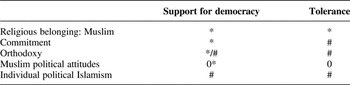
The expectations regarding the impact of the different dimensions of religion are summarized in Table 1. As behavioral aspects of religion are not the focus here, neither table nor discussion includes expectations about them, which should not be interpreted as a claim that these do not impact democratic support and tolerance (see Ben-Nun Bloom and Arikan Reference Ben-Nun Bloom and Arikan2012a; Reference Ben-Nun Bloom and Arikan2012b; Djupe and Calfano Reference Djupe and Calfano2012; Gibson Reference Gibson2013; Heath et al. Reference Heath, Fisher, Rosenblatt, Sanders and Sobolewska2013; Strømsnes Reference Strømsnes2008).
Expectation influence on support for democracy and tolerance

*No effect is expected; #A negative effect is expected
Despite the strong focus on affiliation in studies on Islam, the larger literature regards it to be causally non-decisive as an indicator of beliefs (Ben-Nun Bloom and Arikan Reference Ben-Nun Bloom and Arikan2012a). Concerning political tolerance, differences have been found between affiliations in democratic systems (Eisenstein Reference Eisenstein2006; Kim and Zhong Reference Kim and Zhong2010) and Muslims in Africa are found to be particularly intolerant (Bratton Reference Bratton2003), but again it is unclear whether this is due to the social theology of Islam (see Al Sadi and Basit Reference Al Sadi and Basit2013). Ethno-religious cleavages might, for instance, also be the underlying mechanism (cf. Kim and Zhong Reference Kim and Zhong2010). If social theology is the causal mechanism, the effect of belonging (measured by affiliation) should disappear after including better measures of beliefs. Based on this literature, I thus expect that belonging — identifying as Muslim — has no real (negative) impact on the support for democracy and tolerance.Footnote 4
Following earlier work, Ben-Nun Bloom and Arikan (Reference Ben-Nun Bloom and Arikan2012a, 253) argue that commitment can dampen the support for democracy because it is associated with conservativeness and not being open to change. They however do not distinguish between commitment and the beliefs themselves (orthodoxy, Muslim political attitudes, and individual political Islamism). I expect that commitment should make no difference for the support for democracy, because ideological support depends on the religious message. In line with most of the existing Western literature, though, I expect that commitment in the Middle East has a direct negative effect on tolerance. A stronger conviction in one's beliefs often implies that other people's “wrong” beliefs are valued less or that the threat perception is higher, translating into intolerance toward these different views (e.g., Djupe and Calfano Reference Djupe and Calfano2012; Stouffer Reference Stouffer1955). Eisenstein (Reference Eisenstein2006) finds both negative and positive effects for commitment among Christians in the United States, but she collapses the concept with attendance.
Generally, religious orthodoxy is rather strongly associated with intolerance. Moral traditionalism and more extreme or dogmatic viewpoints lead to feeling more threatened by other viewpoints and less accepting of them (Eisenstein Reference Eisenstein2006; Golebiowska Reference Golebiowska1999; Robinson Reference Robinson2010). This is for instance reflected in the somewhat negative impact of interpreting the Quran literally among United States Muslims (Djupe and Calfano Reference Djupe and Calfano2012; see also Al Sadi and Basit Reference Al Sadi and Basit2013, 451). On the “support for democracy,” similar but less extensive arguments are provided. Lower support for democracy is ascribed to conservative and traditional values, which feed an appreciation of unchanging order incompatible with core democratic values (Ben-Nun Bloom and Arikan Reference Ben-Nun Bloom and Arikan2012b; Feldman Reference Feldman2003; Gibson Reference Gibson1992). As this expectation is based on undivided beliefs in which political Islamism is not treated separately, Islamism can be expected to capture the “anti-democratic” conservative belief system better. It after all comes closer to a social theology's view on the relationship between the divine and political. Overall, Islamic orthodoxy can be expected to negatively impact tolerance and possibly also support for democracy.
This brings us to the two specific views on the link between religion and politics. Following the theoretical logic behind the impact of orthodoxy, it might be expected that attitudes more in favor of linking religion to politics are associated with lower support for democracy and political tolerance, as is also suggested (if not shown empirically) by the literature on the Middle East (e.g., Jamal and Tessler Reference Jamal and Mark2008; Tessler Reference Tessler2002). The literature's mixed results on the impact of attitudes toward religion and politics on the support for democracy might be due to not acknowledging the distinction between political Islamism and the support for Muslim politics (see above). People who prefer politicians inspired by Islam (Muslim politics) can be expected to have no objections to democracy, as they accept the political system setting the boundaries for religion. As Islam here is a possible source of guidance, not a systematic feature, this also allows for other worldviews or ideologies to exist. I expect that Muslim political attitudes have no direct negative influence on the support for democracy or tolerance. On the other hand, if people think Islam sets the boundaries for politics — “political Islamism” — they are expected to be less democratic and tolerant. As they do not tolerate certain views, rule by the people might lead to outcomes they could not accept.
3.5. An Alternative Perspective: Context-Dependency
The expectations on attitudinal religion either point to a negative impact of stronger and more orthodox religious attitudes or the absence of an effect (Table 1), reflecting the debate in Middle East literature (see Section 2). The empirically different relations found in that literature might also suggest a context dependency of religious attitudes' influence, not only between democratic and non-democratic regimes (e.g., Schedler and Sarsfield Reference Schedler and Sarsfield2007) but also among the highly different authoritarian regimes. While this has not been explicitly theorized in the literature, I build an argument on several hints that could serve as an alternative theory under the label of “instrumentalism” (as opposed to the “culturalist” explanations discussed above).
Tezcür et al. (Reference Tezcür, Azadarmaki, Bahar and Nayebi2012) argue that religious Iranians are more politically satisfied because the regime is Islamic, and Bratton (Reference Bratton2003, 497) suggests that in Tanzania, Muslims are less supportive of democracy because they are marginalized. Both implicitly suggest that the support for democracy is instrumental. Instrumental support is also suggested for the Middle East (Inglehart and Norris Reference Inglehart and Norris2003; Jamal and Tessler Reference Jamal and Mark2008) but not clearly linked to religious attitudes. Based on these hints, the broad alternative expectation would be that the relationships hypothesized above are dependent on how the authoritarian regime is related to Islam: if Islam or Islamic politics is suppressed, it can be expected that this religion becomes linked to support for a democratic system, as it would facilitate greater political power. This also resonates with theories on minority groups stating that discrimination leads to tolerance because people want to prevent others from receiving similar discriminatory treatment (Djupe and Calfano Reference Djupe and Calfano2012). If, on the other hand, (orthodox) Islam is allied with the authoritarian regime, greater democracy constitutes a threat to the power position of the orthodox people, and instrumentalism would thus predict a negative relationship.
4. DATA AND MEASUREMENTS
The WVS and Arab Barometer data are the only generally accessible, nationally representative data on attitudes in the Middle East.Footnote 5 Measuring complex phenomena with survey data does run into limitations (see Bratton Reference Bratton2007, 99), especially when the surveys are not designed with a particular study in mind: not all concepts here are optimally operationalized. Nevertheless, this study uses the same data as most other studies and spurs on the literature by presenting a comparative design and a systematic cross-country operationalization of concepts.
The empirical analyses are based on WVS survey (WVS 2009) data from Egypt (2000), Iraq (2004, 2006), Jordan (2001, 2007), Morocco (2007), and Saudi Arabia (2003). I have chosen the WVS over the Arab barometer data because the former include more usable country-years as well as religion variables that are closer to the theoretical concepts discussed above. However, similar models have been run using Arab Barometer data and these confirm the main conclusions.Footnote 6
The countries studied here represent various political systems such as single-party regimes, family-ruled Islamic monarchies, constitutional monarchies, and parliamentary or presidential republics (Long, Reich, and Gasiorowski Reference Long, Reich, Gasiorowski, Long, Reich and Gasiorowski2011; Owen Reference Owen2004), as well as different economic systems: oil economies poor in other resources, mixed oil economies, and non-oil economies (Moghadam Reference Moghadam2003, 11). This allows for testing the generalizability and context-dependency of the studied relationships.
Using exploratory factor analyses, indicators are selected to measure the religion dimensions. To maximize the number of surveys, a survey is included if at least one of the indicators of a dimension derived from the factor analysis is present.Footnote 7 Since models are estimated per country-year, differences due to variations in operationalization will surface. All models include standard control variables: gender, education, income, age, and Socio-economic status (SES) (online Appendix A).Footnote 8 In the pooled models, country dummies are also included. An alternative strategy would be to apply multilevel models with random intercepts and random effects of religion and cross-level interactions. Since the arguments on context-dependency are rather explorative and limited to only seven country-year observations, separate country models are preferable. Nevertheless, the pooled models have also been estimated in a multilevel setting (Statistical Package for the Social Sciences mixed procedure). The results only differing in thousandths of the coefficients.Footnote 9
4.1. Dependent Variables
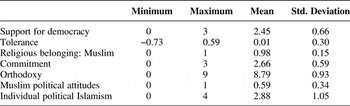
Descriptive statistics of all core variables are provided in Table 2. Footnote 10 As discussed elaborately above, the measurement of democratic support and tolerance is subject to much discussion (e.g., Bratton Reference Bratton2010; Gibson Reference Gibson2013; Mondak and Sanders Reference Mondak and Sanders2005). Regarding the support for democracy, I follow the dominant practice in the Middle East literature, despite its drawbacks, for three reasons: (1) the WVS data do not allow more refined measurements, (2) now my results are comparable to those of previous studies, and (3) it allows for contrasting the results with the outcomes for tolerance. A factor analysis on six items indicates that two tap into the general support of democracy (online Appendix B): “Democracy may have problems but is better” and the desire for “having a democratic political system.” Both items have similar scales (0–3), means, and spreads. If both were present, I took the average; otherwise a single score. A higher score indicates greater support.
Descriptive statistics

N = 8,332
Source: WVS (Egypt, 2000; Iraq, 2001, 2006; Jordan, 2001, 2007; Morocco, 2007; Saudi Arabia, 2003).
Data on the Middle East does not include items on the toleration of specific acts or extending civil rights to disliked groups, the typical “Western ways” of measuring political tolerance (e.g., Djupe and Calfano Reference Djupe and Calfano2012; Gibson Reference Gibson1992; Reference Gibson2013; Mondak and Sanders Reference Mondak and Sanders2005). However, I can use an alternative measurement also present in other comparative or non-West studies: the toleration of neighbors with different worldviews or from different cultures (e.g., Ciftci Reference Ciftci2010; Guerin, Petry, and Crete Reference Guerin, Petry and Crete2004; Hutchison and Gibler Reference Hutchison and Gibler2007; Moaddel Reference Moaddel2006; Tov and Diener Reference Tov and Diener2009). I combined the available “neighbor” items on religion, ethnicity, nationality, and language. These identities are often understood interchangeably and it has been argued that, for the Middle East, these are good indicators of tolerance, and better than using sexual liberalization (Moaddel Reference Moaddel2006; Rizzo, Abdel-Latif, and Meyer Reference Rizzo, Abdel-Latif and Meyer2007). While this does not measure the tolerance of other worldviews directly, it does present a reasonable approximation given the state of the field, and the results might help identify the most important data challenges.
At least three of the “neighbor” items are included for each country (online Appendix C).Footnote 11 I have centered the indicators around the country mean and calculated the average. This accounts for differences in popularity of some groups that are not included in all countries.Footnote 12 I scaled the scores running from 0 (intolerant) to 1 (tolerant). A Pearson correlation of people's “democratic support” and tolerance scores shows that the two dependent variables cannot be used interchangeably and clearly measure separate concepts.Footnote 13
4.2. Islamic Orientations
Theoretically, I have distinguished five attitudinal aspects of religion. The first was belonging, reflected in the widespread usage of affiliation or denomination in comparative studies. Given this prominence in the literature, I include affiliation here as well (1 = Muslim; 0 = not Muslim), even though only the sub-samples for Egypt and Jordan enable robust comparisons. Rerunning models without this variable or without the non-Muslims does not change the conclusions.Footnote 14
I selected seven items possibly tapping into commitment and orthodoxy (online Appendix D).Footnote 15 The factor analysis produces two factors that are congruent with the theoretical concepts. Commitment — the importance of religion — includes three items: being a religious person, whether religion is important in life, and whether religious faith is an important quality for children.Footnote 16 Dichotomous versions of the variables are summed.Footnote 17 The commitment scale runs from 0 (low) to 3 (high). The two items on the justifiability of haram (prohibited) actions — drinking alcohol and suicide — serve as indicators of being less orthodox; while not ideal these items come closest to the concept or orthodox attitudes. I used the average of the available items.Footnote 18 A higher score reflects more orthodox attitudes.
Five items related to how people think about the connection between Islam and politics. A factor analysis (online Appendix E) shows two underlying factors that largely overlap my distinct theoretical concepts. Two items cluster together and resemble individual-level political Islamism: the desire for Shari'a-based laws and for public officials with strong religious beliefs.Footnote 19 In both, political decision-making is subordinated to religious principles or ideology. Where possible, I took the average of the two five-point items (4 = highly Islamist). Two other items are used to measure the support for Muslim Politics; the concept in which Islam is seen as a source of inspiration, but the boundaries set by political decision-making rules are still respected (e.g., democracy). The degree to which people believe that religious institutions hold answers to social problems reflects whether they think Islam can serve as policy-making inspiration. The degree to which they prefer politicians that are religious indicates whether respondents think religion should be a source of inspiration in politics (without saying that politicians must be Muslim).Footnote 20 One is dichotomous, the other is rescaled to a 0–0.5–1 variable, and then the average is calculated (1 = fully “Muslim Political”).
Evidently the different religious attitudes are correlated, all significantly (p < 0.001). The Pearson's correlations are however well below 0.8, which does not indicate multi-collinearity (see Allison Reference Allison1999). Moreover, the regression tolerance (VIF) statistics are all well below 1.5, whereas the critical value for multi-collinearity is generally considered to be 2.5 (Allison Reference Allison1999).Footnote 21
5. EXPLANATORY ANALYSIS
5.1. Support for Democracy
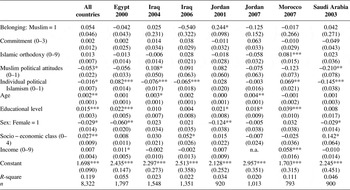
Table 3 gives the results for “support for democracy.” The control variables show rather consistent patterns. Older people, men, and people with higher SES and education support democracy more. Education has the greatest impact, as has been found for Muslim-majority African countries (Bratton Reference Bratton2007). The sex gap is not unique to this study and is generally attributed to women's higher level of traditionalism or to their fear that Islamist parties will come to power via elections and erode women's rights (e.g., Spierings Reference Spierings2014b). Of course, women hold fundamentalist views as well — 30–40% of Egyptian, Jordanian, and Moroccan women are estimated to be fundamentalist — but this cannot explain the sex gap, as fundamentalism is about twice as prevalent among men (Blaydes and Linzer Reference Blaydes and Linzer2008; see also Hofmann Reference Hofmann2004; Rizzo, Abdel-Latif, and Meyer Reference Rizzo, Abdel-Latif and Meyer2007). Women are not found to be more Islamist in this study either.
Regression models on the “support for democracy”
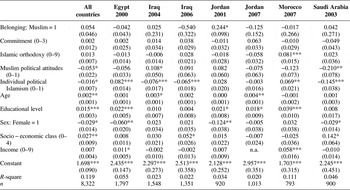
* <0.05; ** <0.01; *** <0.001; The standard errors are given between brackets; The coefficients are unstandardized B-coefficients. Source: WVS.
On religious belonging, commitment, and orthodoxy, the pooled and country-specific models produce clear results: they have no consistent significant effect on the “support for democracy.” Only in Jordan (2001) do Muslims support democracy somewhat more than other people (belonging), and in Morocco (2007) more orthodox people support democracy somewhat more. The other 22 relationships are not statistically significant. The unexpected effect in Morocco reflects the results on political Islamism and supports the context-dependency argument (see below). Additional modeling does not indicate the religious attitudes have an indirect effect (e.g., through education) on democratic support either, further undermining culturalists ideas on Islam's negative impact.
Regarding attitudes on the politics-religion interrelatedness, an overall negative impact of Muslim political attitudes is found, but that is mainly caused by the Saudi sample and in Iraq (2004) the effect is even positive. No other significant relationship was found, and whether people want Islam to be a political source of inspiration is also largely unrelated to people's support of democracy, as was expected. Individual political Islamism, however, does impact the support for democracy in five out of seven surveys, and in those cases it actually is the most influential variable.Footnote 22 Because of the lack of a unidirectional pattern, these results refute culturalist expectations. In Iraq (2004, 2006) and Saudi Arabia negative effects are found, for Egypt and Morocco positive effects. This difference does not align with operationalization differences, but they do seem to reflect the religious-political state relations.
In Egypt and Morocco, the authoritarian regimes prohibited and suppressed Islamic parties; (consequently) the opposition was often mobilized under the flag of Islam, and it often included fighting poverty and pleading for more popular say in policies. The Egyptian Muslim Brotherhood even enacted social security programs (El-Ghobashy Reference El-Ghobashy2005). In this context, greater democracy provides Islamic groups a route to power, feeding a desire for democracy among people with politically Islamist attitudes. The Egyptian post-revolution elections (2012) illustrated how democracy empowered the Muslim Brotherhood. Whether the later intervention by the Egyptian army against the Brotherhood politicians further strengthened the call for democracy among people with strong political Islamist attitudes or made them lose faith in democratic elections has to be seen.
Contrastingly, in Saudi Arabia and Iraq, Islam and authoritarianism was an associative pair as was secularism-democracy, so Islam and democracy were linked negatively. The Saudi royal family is considered to be the custodian of the Islamic community, and puritanical Wahhabism is the official Saudi political ideology (Andersen, Seibert, and Wagner Reference Andersen, Seibert and Wagner2012, 157–160; Maisel Reference Maisel, Long, Reich and Gasiorowski2011, 115–116; Owen Reference Owen2004, 98). In Iraq, Hussein's authoritarianism was not constantly and strongly associated with Islam, but the United States-British invasion rhetoric tied bringing freedom and democracy to an anti-Islamist stance in their “war on terror.” Hence, Islamism became a force against neo-colonialism and was constructed as the opposite to “Western democracy.” For more detailed analyses of anti-Americanism's role in the Middle Eastern democratization process see Jamal (Reference Jamal2012) and Spierings (Reference Spierings2014b).
5.2. Tolerance
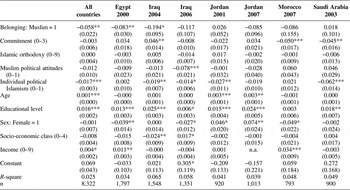
The socio-demographic explanatory variables of tolerance (Table 4) only show a robust effect for education: the higher educated are significantly more tolerant. Women were less tolerant, with exceptions for both Jordanian samples. This resonates with the exceptionally high education but low employment of women in Jordan (Spierings, Smits, and Verloo Reference Spierings, Smits and Verloo2010), suggesting that more in-depth study of Jordanian gender patterns is needed.
Regression models on the level of tolerance

* < 0.05; ** < 0.01; *** < 0.001; The standard errors are given between brackets; The coefficients are unstandardized B-coefficients. Source: WVS.
Regarding religion, a significant negative relationship of Muslim belonging was found for Egypt and Iraq (2004). Together with three insignificant negative relationships, this leads to a significant negative overall effect. Given the inclusion of more precise belief variables, this effect seems to draw attention to minority status. Religious minorities were most tolerant in societies with religio-ethnic tensions. Of the two countries with sizeable samples of non-Muslims, the tensions in Jordan were not very severe, whereas Egypt has been troubled by (violent) conflicts between Muslims and Christian Coptic groups throughout the last decades (Owen Reference Owen2004: 174–176). Suppressed religious groups might be more tolerant because it benefits them most or because, knowing intolerance themselves, they would not want others to experience it (cf. Al Sadi and Basit Reference Al Sadi and Basit2013; Ben-Nun Bloom and Arikan Reference Ben-Nun Bloom and Arikan2012a; Reference Ben-Nun Bloom and Arikan2012b; Djupe and Calfano Reference Djupe and Calfano2012). Disentangling these mechanisms lies beyond this study's scope.
Against expectations, but in line with the results for democratic support, commitment and orthodoxy show no clear impact.Footnote 23 In Iraq (2004), however, commitment had a positive effect, and in Morocco (2007) and Saudi Arabia (2003) a negative one. The (unexpected) positive effect in Iraq might be explained by the political context again: more religious people might have become more tolerant because Hussein oppressed partly on religious grounds (e.g., campaigns against religious leaders and negative interference with the Hajj — religious pilgrimage to Mecca and Medina) and because the people might have experienced the foreign-installed secular “Coalition Provisional Authority” (April 2003–June 2004) as suppression. This explanation is suggestive as best though; more detailed study is needed.
A strong statistically significant negative relationship was found for individual political Islamism and tolerance. The pooled effect is the second largest one after educationFootnote 24 and it was also found in four out of seven samples. Supporting Muslim Politics has no clear independent effect, but additional analyses do suggest that supporting Muslim politics should not be ruled out in shaping tolerance, as people that support Muslim politics seem more receptive to political Islamism as well.Footnote 25 The former might thus have an indirect influence on tolerance.
6. DISCUSSION AND CONCLUSION
Systematic studies of the impact of Islamic orientations on democratic support in the Arab Middle East were largely lacking and theoretical and conceptual knowledge from studies on other geographic areas and affluent democracies had not been applied to the Middle East. Consequently, the reported support for democracy in the Middle East might be misleading (e.g., Hofmann Reference Hofmann2004; Inglehart and Norris Reference Inglehart and Norris2003; Jamal and Tessler 2007; Meyer, Rizzo, and Ali Reference Meyer, Rizzo and Ali2007; Moaddel Reference Moaddel2006; Tessler Reference Tessler2002; Rizzo, Abdel-Latif, and Meyer Reference Rizzo, Abdel-Latif and Meyer2007; Tessler and Gao Reference Tessler and Gao2005) and Islam's influence misunderstood.
This study focused on support for “democracy,” like most Middle East studies do, but also on tolerance as a crucial democratic civic value. This focus substantiated prior claims that Middle Eastern democratic support might be somewhat superficial or instrumental (cf. Inglehart and Norris Reference Inglehart and Norris2003; Jamal and Tessler Reference Jamal and Mark2008; Norris and Inglehart Reference Norris and Inglehart2012). On a scale of 0 to 1, the average level of tolerance here is 0.56,Footnote 26 lower in each country than in 21 major Western democracies,Footnote 27 whereas “support for democracy” levels in Arab countries are similar to Western ones. So it seems “support for democracy” is not strongly associated with tolerance towards other world views and liberal democracy in the Middle East, as has been shown for African countries before as well. Political tolerance is crucial for a sustainable democratic system. If tolerance is not widespread, democratization attempts are undermined, as we have seen after the Arab uprisings. In this respect, it would have been interesting to see whether the level of tolerance is actually highest in Tunisia, where the revolution has led to a more stable electorally democratic system.
Democracy might thus be seen as a way to gain power (see below), suggesting that elections are more at the core of the Middle Eastern interpretation of democracy than suggested by the African literature (Bratton Reference Bratton2003; Reference Bratton2007; Reference Bratton2010). Such instrumentalism has also been shown for Islamic political leaders and organizations in the region (e.g., El-Ghobashy Reference El-Ghobashy2005; Esposito and Voll Reference Esposito and Voll1996; Long, Reich, and Gasiorowski Reference Long, Reich, Gasiorowski, Long, Reich and Gasiorowski2011; Owen 2003), and deserves more attention, as it might explain both the relatively low levels of liberal democracy in the region (e.g., Fish Reference Fish2002; Donno and Russett Reference Donno and Russett2004; Spierings, Smits, and Verloo Reference Spierings, Smits and Verloo2009) and the gap between that and the reported desire for democracy.
The question that generally follows the assessment of democratic support in the Middle East is how Islam influences it. The existing Middle East literature uses theoretically ill-defined conceptualizations of “Islam” and empirical results differ considerably. I applied insights from the larger literature on religion and political attitudes to provide systematic tests. Due to data limitations, this study suffers from some of the same inaccuracies as previous Middle East studies,Footnote 28 but it does provide more detailed and structured analyses for multiple countries. The results further substantiated the rejection of the culturalist expectations of Islam's negative impact (Table 1). It does not hold for belonging, commitment, orthodoxy, and Muslim political attitudes (supporting Islam as a source of inspiration for policy choices) (also Jamal and Tessler 2007; Tessler Reference Tessler2002; Tessler and Gao Reference Tessler and Gao2005).
For tolerance, any widespread Islamic influence is found absent as well. The results seem to indicate even fewer effects than found for Western countries (see Ben-Nun Bloom and Arikan Reference Ben-Nun Bloom and Arikan2012a; Djupe and Calfano Reference Djupe and Calfano2012; Eisenstein Reference Eisenstein2006; Golebiowska Reference Golebiowska1999; Robinson Reference Robinson2010; Stouffer Reference Stouffer1955). The alternative operationalization of tolerance might be responsible for this, or it might be due to the inclusion of variables measuring more specific beliefs on the linkages between politics and religion (variables hardly used in Western countries). Using similar survey items across regions might shed light on this: questions about citizen's rights for disliked groups in Middle East surveys and about politico-religious orthodoxy (e.g., “political Christianism”) in democratic and Western countries.
My strict focus on attitudes might explain why some results seem to differ from those in other studies. They often include behavioural dimensions (e.g., attendance) under labels like commitment and conclude that commitment has an influence (Ben-Nun Bloom and Arikan Reference Ben-Nun Bloom and Arikan2012b; Eisenstein Reference Eisenstein2006; Moaddel Reference Moaddel2006; Tessler Reference Tessler2002; Tezcür et al. Reference Tezcür, Azadarmaki, Bahar and Nayebi2012), while I only use attitudes, as attendance is not the best indicator of beliefs. This observation and the relevance of distinguishing different beliefs dimension shown here support the claim that religion is a multidimensional concept and should be treated as such when explaining democratic support (Ben-Nun Bloom and Arikan Reference Ben-Nun Bloom and Arikan2012a; Reference Ben-Nun Bloom and Arikan2012b). Still, this study, like the whole Middle East literature, is limited by not including minority positions, aspects of communal and individual behavior, and threat perception. Including those is a next step in understanding the complex impact of religion.
Nevertheless, this study was the first to introduce the individual-level political attitude of political Islamism (defined as the view that Islam should be the framework that delimits political decision-making) and to distinguish it from Muslim political attitudes. Individual-level political Islamism was the most important religious factor explaining support for democracy and tolerance. On tolerance, it fitted the theoretical expectations of an overall negative impact, supporting the idea that more extreme views lead to intolerance because of a higher threat perception and greater distance to other people's views (Djupe and Calfano Reference Djupe and Calfano2012; Eisenstein Reference Eisenstein2006; Golebiowska Reference Golebiowska1999; Robinson Reference Robinson2010). Future work could focus on these mechanisms, which could not be studied using the current data. Regarding “extreme views,” it is important to note that extreme attitudes are not rare in this case: about 60% of the respondents in the surveys scores 3 or higher on the political Islam scale that runs from 0 to 4.
Though culturalists expect individual political Islamism to have a negative impact on support for democracy, the alternative framework of context dependency provided a better interpretation of results. While suggested by others (Jamal and Tessler Reference Jamal and Mark2008; Meyer, Rizzo, and Ali Reference Meyer, Rizzo and Ali2007; Tessler Reference Tessler2002; Tessler and Gao Reference Tessler and Gao2005), this study was the first to provide a systematic comparison that enabled grasping the dynamics. It seems that the linkage between Islamism and democratic support depends on whether elections help (politically suppressed) Islamists to gain political power. If so, positive relationships are found. If authoritarian rule is Islamic, (neo-colonial) secularism is associated with democracy, or democracy marginalizes Muslim populations, the relationship is negative. All statistically significant relationships could be explained by this logic (also in the AB data-robustness test). This instrumentalist interpretation presents a more precise argument for the general idea that demands for democracy are mainly made when people become dissatisfied with authoritarian regimes (e.g., Tezcür et al. Reference Tezcür, Azadarmaki, Bahar and Nayebi2012).
To refine and test the context-dependency arguments put forward here, better country-level variables on the Islam-state connection are needed (see Spierings Reference Spierings2014a; Spierings, Smits, and Verloo Reference Spierings, Smits and Verloo2009). As more than 25 Middle Eastern surveys will be available in the near future, multilevel models can be applied (Paterson and Goldstein Reference Paterson and Goldstein1991) — current multilevel studies compare countries across the world and are limited to rather crude country-level variables (e.g., Fish Reference Fish2011; Norris and Inglehart Reference Norris and Inglehart2012). Efforts in this direction are crucial as results from single-country studies (Meyer, Rizzo, and Ali Reference Meyer, Rizzo and Ali2007 [Kuwait]; Moaddel Reference Moaddel2006 [Saudi Arabia]) are simply not generalizable to the Arab Middle East if one ignores the relationship between Islam, Islamic groups and authoritarian regimes.
Supplementary materials and methods
To view supplementary material for this article, please visit http://dx.doi.org/10.1017/S1755048314000479.