







1. Introduction and main results
The present paper deals with planar polynomial ordinary differential systems and we study the qualitative properties of the period function of centres. A singular point of a planar differential system is a centre if it has a punctured neighbourhood that consists entirely of periodic orbits surrounding it. The largest neighbourhood with this property is called the period annulus of the centre and we denote it by $\mathscr P.$ The period function assigns to each periodic orbit in $\mathscr P$
 its period. If the period function is constant then the centre is called isochronous. The study of the period function is a nontrivial problem and questions related to its behaviour have been extensively studied. Let us quote, for instance, the problems of isochronicity (see [Reference Christopher and Devlin4, Reference Cima, Ma-osas and Villadelprat5, Reference Xingwu and Zhang25]), monotonicity (see [Reference Chicone1, Reference Villadelprat24, Reference Zhao27]) or bifurcation of critical periods (see [Reference Chicone and Jacobs2, Reference Gasull, Liu and Yang12, Reference Grau and Villadelprat13]). Aside from the intrinsic interest of these problems, the study of the period function is also important in the analysis of nonlinear boundary value problems and in perturbation theory. Indeed, for instance, under the condition of non-criticality of the period function, zeros of appropriate Melnikov functions guarantee the persistence of subharmonic periodic orbits of a Hamiltonian system after a small periodic non-autonomous perturbation (see [Reference Fonda, Sabatini and Zanolin8, Reference Guckenheimer and Holmes15]). Most of the work on planar polynomial differential systems, including the present paper, is related to questions surrounding the well-known Hilbert's 16th problem (see [Reference Françoise and Pugh9, Reference Gasull, Ma-osa and Ma-osas11, Reference Roussarie22, Reference Ye26] and references therein) and its various weakened versions.
Chicone [Reference Chicone3] has conjectured that if a quadratic differential system has a centre with a period function which is not monotonic then, by an affine transformation and a constant rescaling of time, it can be brought to the Loud normal form

and that the period function of these centres has at most two critical periods. In fact, there is much analytic evidence that the conjecture is true (see [Reference Coppel and Gavrilov6, Reference Villadelprat24, Reference Zhao27] for instance). On the other hand, it is proved in [Reference Gasull, Guillamon and Villadelprat10] that if $B=0$ then the period function of the centre at the origin of system (1.1) is globally monotonous. So, from the point of view of the study of the period function, the most interesting stratum of quadratic centres is the family (1.1) with $B\neq 0,$
 which can be brought to $B=1$
 by means of a rescaling. Thus, using the vector field notation, in this paper we consider

Following the terminology in [Reference Chicone and Jacobs2], we shall refer to this family as the dehomogenized Loud's centres.
Compactifying $ {\mathbb {R}}^{2}$ to the Poincaré disc, see for instance [Reference Dumortier, Llibre and Artés7], the boundary of the period annulus $\mathscr P$
 of the centre has two connected components, the centre itself and a polycycle. We call them, respectively, the inner and outer boundary of the period annulus. Since period function is defined on the set of periodic orbits in $\mathscr P,$
 usually the first step is to parametrize this set, let us say $\{\gamma _s\}_{s\in (0,1)},$
 so that one can study the qualitative properties of the period function by means of the map $s\mapsto \mbox {period of } \gamma _s,$
 which is analytic on $(0,\,1).$
 The critical periods are the critical points of this function and its number, character (maximum or minimum) and distribution do not depend on the particular parametrization of the set of periodic orbits used. The dehomogenized Loud's family (1.2) depends on a two-dimensional parameter $a$
 and our aim is to decompose $ {\mathbb {R}}^{2}=\!\cup V_i$
 so that if $a_1$
 and $a_2$
 belong to the same set $V_i,$
 then the corresponding period functions are qualitatively the same (i.e. their critical periods are equal in number, character and distribution). A parameter $a_0\in {\mathbb {R}}^{2}$
 is a regular value if it belongs to the interior of some $V_i,$
 otherwise it is a bifurcation value. The set of bifurcation values is $\mathscr B\!:=\cup \,\partial V_i$
 and, roughly speaking, it consists of those parameters $a_0\in {\mathbb {R}}^{2}$
 for which some critical period emerges or disappears as $a\to a_0.$
 There are three different situations to consider:
(a) Bifurcations of critical periods from the inner boundary (i.e. the centre).
(b) Bifurcations of critical periods from the interior of the period annulus.
(c) Bifurcations of critical periods from the outer boundary (i.e. the polycycle).
We refer the reader to [Reference Mardešić, Marín and Villadelprat18] for the definition of these notions.
With regards to the dehomogenized Loud's centres (1.2), the bifurcation from the centre was already solved by Chicone and Jacobs [Reference Chicone and Jacobs2]. Our goal is to study the bifurcation from the polycycle and to this end, together with P. Mardešić, we have devoted a series of papers (see [Reference Mardešić, Marín and Villadelprat17–Reference Marín and Villadelprat21, Reference Saavedra23]). The polycycle consists of regular trajectories and singular points with a hyperbolic sector, which after the desingularization process give rise to hyperbolic saddles and saddle-nodes. Most of the cases studied so far correspond to hyperbolic polycycles, i.e. such that all the singularities at its vertices are hyperbolic saddles. Although this is the generic case in the family under consideration, in order to solve the problem we must tackle the non-hyperbolic polycycles as well. Among them there are two cases in which the polycycle has saddle-nodes, namely $(D,\,F)\in [-1,\,0]\times \{1\}$ and $(D,\,F)\in [-1,\,0]\times \{0\}$
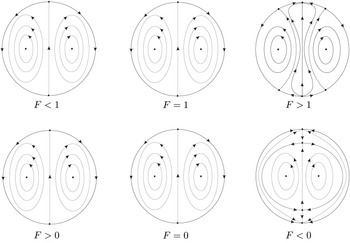
 . In both cases the saddle-node bifurcation occurs at infinity, so one needs to extend the vector field to infinity by using, for instance, the Poincaré compactification (see Figure 1).
Phase portrait of $L_a$ in the Poincaré disc for $D\in (-1,\,0)$
 and $F\approx 1$
 (top) and for $D\in (-1,\,0)$
 and $F\approx 0$
 (bottom), where the centre at the origin is shifted to the left for convenience and the vertical line is $u=1.$
 The saddle-node singularity occurs for $F=1$
 and $F=0$
 , respectively, and is placed at the intersection between the line at infinity (the boundary of the disc) and $u=1$
 .

We treated the first case in [Reference Mardešić, Marín, Saavedra and Villadelprat20], where we proved a general result addressed to study the local passage through a singularity unfolding a saddle-node bifurcation. In the present paper we study the second case by adapting the general tools obtained in [Reference Mardešić, Marín, Saavedra and Villadelprat20]. Let us briefly explain the similarities and differences between both cases. The key point is that the vector field $L_a$ has a Darboux first integral, which enables to find local changes of coordinates that bring each unfolding to a suitable normal form. In the first case, see the proof of [Reference Mardešić, Marín, Saavedra and Villadelprat20, theorem C], the saddle-node unfolding $L_a$
 for $D\in (0,\,1)$
 and $F\approx 1$
 can be brought locally to

and $y=0$ corresponds to the line at infinity. (In its regard we remark that the polar factor can be neglected to draw the phase portrait but this cannot be done to study the time.) In this case the hyperbolic saddles at $\partial \mathscr P$
 bifurcating from the saddle-node are placed at infinity for $F<1$
 and $F>1$
 (see the three phase portraits at the top of Figure 1). In the present paper, by using the same techniques, we will show that the saddle-node unfolding $L_a$
 for $D\in (0,\,1)$
 and $F\approx 0$
 can be brought locally to

Here, the line at infinity corresponds to $x=0$ . Unlike the previous case, the hyperbolic saddles at $\partial \mathscr P$
 bifurcating from the saddle-node are located at infinity for $F>0$
 but they are not for $F<0$
 (see the three phase portraits at the bottom of Figure 1). Thus, besides the saddle-node bifurcation, in this case there is a second geometric phenomenon, namely, that the hyperbolic saddles at $\partial \mathscr P$
 which bifurcate from the saddle-node located at infinity come to the finite plane for $F<0$
 . In this paper we deal with this more intricate case and our main result states that there is no bifurcation of critical periods.
In order to present our results in its full generality we adopt the framework introduced in [Reference Mardešić, Marín, Saavedra and Villadelprat20]. We consider the unfolding of saddle-node

parametrized by $(\varepsilon,\,a)$ with $\varepsilon \approx 0$
 and $a$
 in an open subset $A$
 of $ {\mathbb {R}}^{\alpha }$
 , and where
• $\mu \in {\mathbb {N}},$

• $(x,\,y,\,a)\mapsto U_a(x,\,y)$
is analytic on $[-r,\,r]^{2}\times A$. Moreover, for each $a\in A,$ $U_a(0,\,0)>0$ and the Taylor series of $U_a(x,\,y)$ at $(0,\,0)$ is absolutely convergent on $[-r,\,r]^{2}.$• $(x,\,a)\mapsto V_{a}(x)$
is analytic on $[-r,\,r]\times A$ and, for all $a\in A,$ $V_a(0)>0.$


By rescaling, we can assume that $r=1$ and $V_{a}(x)>0$
 for all $(x,\,a)\in [-1,\,1]\times A.$
 In what follows we denote by $\vartheta _{\varepsilon }$
 the largest real root of $x(x^{\mu }-\varepsilon )=0$
 , i.e.

Observe then, see (1.3), that $(x,\,y)=(\vartheta _\varepsilon,\,0)$ is a hyperbolic saddle of $X$
 for $\varepsilon \neq 0.$
 We are interested in the Dulac time $\mathcal {T}(\,\cdot \,;\varepsilon,\,a)$
 of the saddle-node unfolding (1.3) between the transverse sections $\{ y=1\}$
 and $\{ x=1\}$
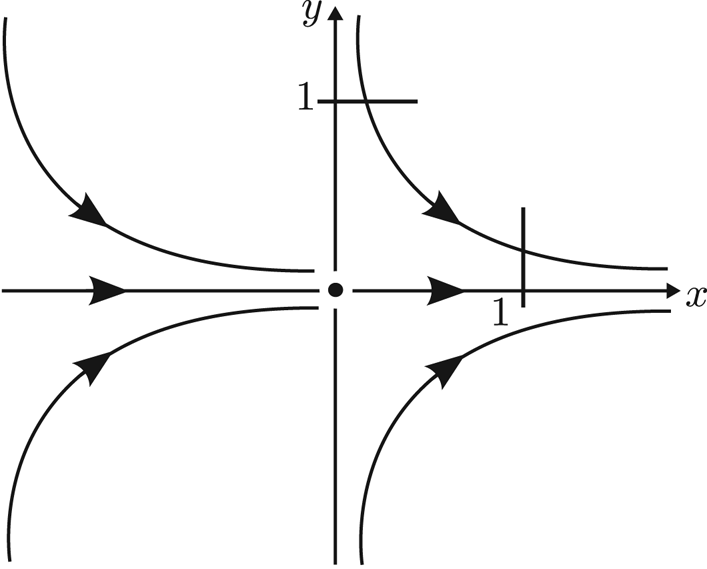
 . More concretely, see Figure 2, for each $s>0$
 small enough, we define $\mathcal {T}(s;\varepsilon,\,a)$
 to be the time that spends the trajectory.
Theorem 1.1 The Dulac time $\mathcal {T}(s;\varepsilon,\,a)$ of the saddle-node unfolding (1.3) between the transverse sections $\{ y=1\}$
 and $\{ x=1\}$
 verifies that

uniformly $($ with respect to $a)$
 on every compact subset of $A$
 .
Transverse sections associated to the Dulac time $\mathcal {T}(s;\varepsilon,\,a)$ of the saddle-node unfolding (1.3) for $\varepsilon =0$
 (and taking $\mu$
 odd).

In the next result we consider the family of dehomogenized Loud's centres (1.2), whose study is the main motivation of the present paper.
Theorem 1.2 Setting $a=(D,\,F)$ , let $\{L_{a},\,a\in {\mathbb {R}}^{2}\}$
 be the family of vector fields in (1.2) and consider the period function of the centre at the origin. Then every $a=(D,\,F)\in (-1,\,0)\times \{0\}$
 is a local regular value of the period function at the outer boundary of the period annulus.
For a precise definition of local regular value we refer the reader to [Reference Mardešić, Marín and Villadelprat18, definition 2.4], but roughly speaking it means that no critical period bifurcates from these parameter values.
2. Proofs of theorems 1.1 and 1.2
Proof of theorem 1.1. Let $y=y(x;s)$ be the trajectory of the vector field $x(x^{\mu }-\varepsilon )\partial _x-V_a(x)y\partial _y$
 with initial condition $y(s+\vartheta _{\varepsilon };s)=1.$
 Then there exist $s_0,\,\varepsilon _0>0$
 small enough such that the Dulac time of (1.3) between $\{y=1\}$
 and $\{x=1\}$
 is given by

for all $s\in (0,\,s_0]$ and $\varepsilon \in [-\varepsilon _0,\,\varepsilon _0]$
 . Next, by applying the Weierstrass Division theorem (see for instance [Reference Greuel, Lossen and Shustin14, theorem 1.8] or [Reference Krantz and Parks16, theorem 6.1.3]), we write

where $\hat U_a(x,\,y)$ is an analytic function on $(x,\,y,\,a)\in [-1,\,1]^{2}\times A$
 . Accordingly it turns out that $\mathcal {T}(s;\varepsilon,\,a)=\mathcal {T}_0(s;\varepsilon,\,a)+\mathcal {T}_1(s;\varepsilon,\,a)$
 with

Note, and this is the key point, that $\mathcal {T}_1(s;\varepsilon,\,a)$ is the Dulac time of the saddle-node unfolding

which is in the hypothesis of [Reference Mardešić, Marín, Saavedra and Villadelprat20, corollary B]. Thus, by applying that result with $\ell =k=1$ , we obtain functions $c_{0}(\varepsilon,\,a)$
 and $c_{1}(\varepsilon,\,a)$
 , satisfying that for every compact set $K_{a}\subset A$
 , there exists $\varepsilon _{1}>0$
 such that $c_{0}$
 and $c_{1}$
 are continuous on $[-\varepsilon _{1},\,\varepsilon _{1}]\times K_{a}$
 and

where the function $h$ in the remainder verifies $\lim _{s\to 0^{+}}h(s;\varepsilon,\,a)=0$
 and $\lim _{s\to 0^{+}}s\partial _sh(s;\varepsilon,\,a)=0$
 uniformly on $[-\varepsilon _{1},\,\varepsilon _{1}]\times K_{a}$
 . Observe on the other hand that

Thus, the hypothesis $U_a(0,\,0)>0$ for all $a\in A$
 and the fact that $\vartheta _\varepsilon$
 tends to $0$
 as $\varepsilon \to 0$
 , imply that for each compact set $K\subset A$
 there exist positive constants $M,$
 $s_0$
 and $\varepsilon _0$
 such that $U_a(s+ \vartheta _{\varepsilon },\, 0) > M$
 for all $s \in (0,\,s_0]$
 , $\varepsilon \in [-\varepsilon _{0},\, \varepsilon _{0}]$
 and $a \in K$
 . Accordingly

uniformly on every compact subset of $A.$ Consequently, taking (2.1) also into account,

as $(s,\,\varepsilon )\to (0^{+},\,0)$ uniformly on $K_a.$
 This concludes the proof of the result.
Proof of theorem 1.2. For the sake of convenience we reverse time in the original dehomogenized Loud family (1.2) and consider the vector field $-L_a$ instead. To study the saddle-node bifurcation that occurs at infinity we work in the projective plane $ {\mathbb {RP}}^{2}$
 and perform the change of coordinates

The meromorphic extension of $-L_a$ in these coordinates is given by

Some long but easy computations show that the local analytic change of coordinates given by

where

brings the vector field $\bar X_a$ in (2.2) to

where

Indeed, one can verify that $\Psi ^{*}X_a=(D\Psi )^{-1}(X_a\circ \Psi )=\bar X_a.$ For reader's convenience let us briefly explain how we obtain this normalizing change of coordinates. The idea arises from the fact that $\bar I(z,\,w)=\frac {w}{z}( 1+2F\frac {g(z,\,w)}{z^{2}})^{-{1}/{2F}}$
 is a first integral of $\bar X_a$
 for $F\neq 0$
 , and that the change of coordinates in (2.3) brings it to $I(x,\,y)=\frac {y}{x}(1+\frac {2F}{x^{2}})^{-{1}/{2F}}$
 . Thus, since the $1$
 -form $\textrm {d}I$
 is proportional to $x(x^{2}+2F)\textrm {d}y-y(x^{2}+2F-2)\textrm {d}x$
 , we deduce that the coordinate change brings $\bar X_a$
 to

so that the problem reduces to find this factor $\kappa _a.$
We are now in position to apply theorem 1.1 because, taking

observe that we can write the vector field in (2.4) as

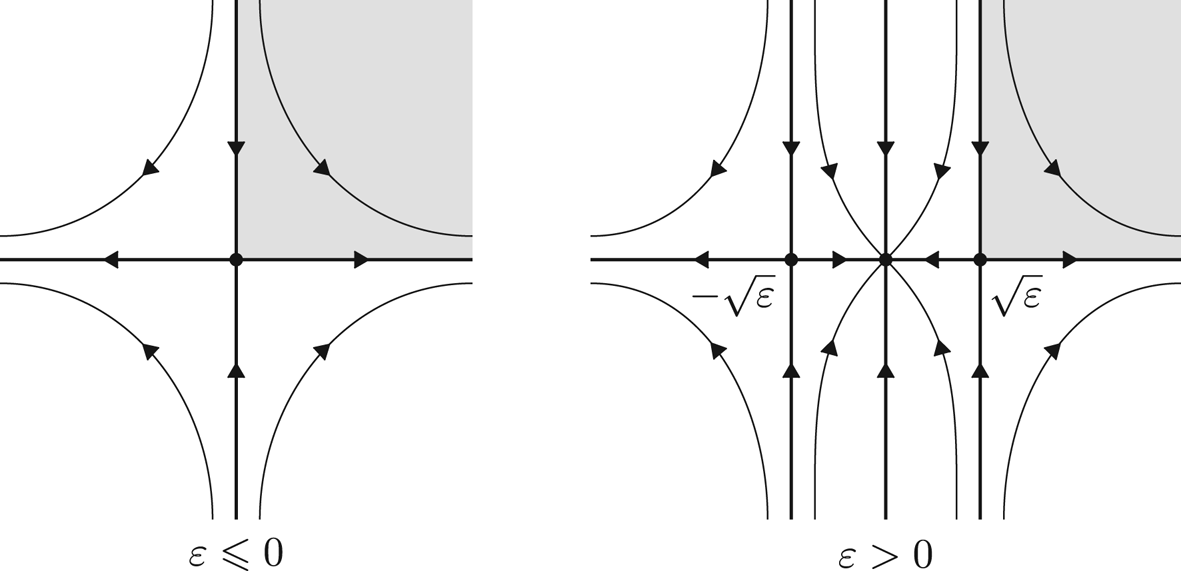
Note also, see the period annulus $\mathscr P$ in the phase portraits at the bottom of Figure 1, that the points $\{(u,\,v)\in \mathscr P:u>0,\,v>0\}$
 which are sufficiently close to the saddle-node bifurcation are mapped by $(u,\,v)\mapsto (x,\,y)=\Psi (\frac {1}{v},\,\frac {1-u}{v})$
 to the quadrant $\{x > \vartheta _{\varepsilon },\,y> 0\},$
 see Figure 3, where $\vartheta _{\varepsilon }$
 is given in (1.4) with $\mu =2$
 . Following the notation in theorem 1.1 we also take

Then $U_a(0,\,0)>0$ and $V_a(0)>0$
 for all $a\in A$
 . Furthermore, working on any compact subset $K_{a}$
 of $A$
 , we see that the Taylor series of $U_{a}(x,\,y)$
 at $(0,\,0)$
 is absolutely convergent for $(x,\,y)\in [-r,\,r]^{2}$
 for some $r>0$
 depending only on $K_a.$
 By rescaling the local coordinates $(x,\,y)$
 we can assume that $r=1.$
 This will change $U_a$
 , $V_a$
 and $\varepsilon$
 in terms of $a$
 but it will be clear that the proof does not depend on their particular expression, provided that the new $\varepsilon$
 tends to zero as $F\to 0,$
 which one can verify that this is the case.
Phase portrait of the orbital normal form $x(x^{2}-\varepsilon )\partial _x-V_a(x)y\partial _y$ .

Next we proceed to study the period function of the centre near the polycycle at the boundary of its period annulus. To this end we first note that the vector field in (1.2) is invariant with respect to the symmetry $(u,\,v)\to (u,\,-v)$ , and so is $-L_a.$
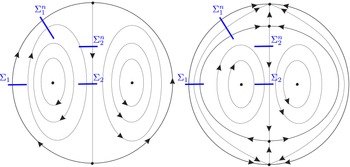
 Consequently, see Figure 4, its period function is twice the time that the solutions of $-L_a$
 spend for going from $\Sigma _{1}\!:=\{u \approx -\infty,\, v=0\}$
 to $\Sigma _{2}\!:=\{u \approx 1,\, v=0\}$
 .
Phase portrait of the vector field $-L_a$ for $D\in (0,\,1)$
 and $F\approx 0$
 in the Poincaré disc. On the left, for $F\geqslant 0$
 , and on the right, for $F<0$
 . By symmetry, the period of a periodic orbit is twice the time that spends the solution for going from $\Sigma _1$
 to $\Sigma _2$
 . The auxiliary transverse sections $\Sigma _1^{n}$
 and $\Sigma _2^{n}$
 are defined by means of the normalizing change of coordinates $\Psi$
 that brings, locally, the saddle-node unfolding at infinity to the normal form in (1.3), so that theorem 1.1 applies.

In order to study this, let us say, half period function we introduce two auxiliary transverse sections near the saddle-node bifurcation, $\Sigma _{1}^{n}\!:=\Psi ^{-1}(\{y=1\})$ and $\Sigma _{2}^{n}\!:=\Psi ^{-1}(\{x=1\})$
 , parameterized by $s\mapsto \Psi ^{-1}(s+\vartheta _{\varepsilon },\,1)$
 and $s\mapsto \Psi ^{-1}(1,\,s),$
 respectively. Here, $\Psi$
 is the (local) normalizing change of coordinates given in (2.3) and we work with the projective coordinates $(z,\,w)$
 . Then we define $T(s;a)$
 to be half of the period of the periodic orbit $\gamma _{a,s}$
 of $-L_a$
 passing through the point $\Psi ^{-1}(s+\vartheta _{\varepsilon },\,1)\in \Sigma _1^{n}$
 and we decompose it as

where (see Figure 4 again)
• $T_{1}(s;\varepsilon,\,a)$
is the time that spends $\gamma _{a,s}$ for going from $\Sigma _1$ to $\Sigma _1^{n}$,• $\mathcal {T}(\,\cdot \,;\varepsilon,\,a)$
and $\mathscr D(\,\cdot \,;\varepsilon,\,a)$ are the Dulac time and Dulac map from $\Sigma _1^{n}$ to $\Sigma _2^{n}$, respectively,• and $T_2(\,\cdot \,;\varepsilon,\,a)$
is the transition time form $\Sigma _2^{n}$ to $\Sigma _2$.


(Here, the dependence on $\varepsilon$ is redundant because it is a function of $a=(D,\,F)$
 but we keep it to be consistent with the notation of theorem 1.1.) We next study each one of these summands. To this end, given any compact subset $K_a$
 of $A$
 , we denote by $\mathcal {I}(K_a)$
 the space of functions $h(s;a)$
 , analytic on $s\in (0,\,s_{0}),$
 verifying

It is clear that $\mathcal {I}(K_a)$ is stable under addition and multiplication.
Let us observe first that we can write $T_1(s;a)=f(s+\vartheta _{\varepsilon },\,a)$ where $f$
 is an analytic function at $\{0\}\times A$
 , whereas the transition time $T_2(s;a)$
 is analytic at $\{0\}\times A.$
 Accordingly, for $i=1,\,2$
 , we have that

and where $c_{i,0}$ and $c_{i,1}$
 are continuous functions on $K_a$
 . At this point we fix any $D_0\in (-1,\,0)$
 and choose the compact set $K_a$
 to be a disc centred at the parameter $(D,\,F)=(D_0,\,0)$
 . We note moreover that

is the Dulac map of the singular point at $(\vartheta _\varepsilon,\,0)$ of the vector field $x(x^{2}-\varepsilon )\partial _x-V_a(x)y\partial _y$
 between the transverse sections $\{y=1,\,x>\vartheta _\varepsilon \}$
 and $\{x=1,\,y>0\}$
 . Since $\mathscr D(s;\varepsilon,\,a)=g(s+\vartheta _\varepsilon ;a)$
 , by applying $(b)$
 in [Reference Mardešić, Marín, Saavedra and Villadelprat20, corollary A] with $\{\mu =2,\,\ell =k=1,\,\lambda =2-2F\}$
 , and shrinking the radius of $K_a$
 if necessary, we deduce that $\mathscr D(s;\varepsilon,\,a)=s h_{0}(s;a)$
 with $h_{0}\in \mathcal {I}(K_a)$
 . Consequently, $T_{2}(\mathscr D(s;\varepsilon,\,a);\varepsilon,\,a)=c_{2,0}(a)+s\hat h_2(s;a)$
 where $\hat h_{2}(s)\!:=c_{2,1}h_{0}(s)+h_{0}(s)h_{2}\bigl (sh_{0}(s)\bigr ).$
 We claim that $\hat h_{2}\in \mathcal {I}(K_a).$
 Indeed this is so because, using that $h_0$
 and $h_2$
 belong to $ {\mathcal {I}}(K_a)$
 , it follows easily that $\nu (s)\!:=(h_2\circ (sh_0(s)))h_0(s)$
 and

tend to zero as $s\to 0^{+}$ uniformly on $K_a$
 . Hence $\nu \in {\mathcal {I}}(K_a)$
 and then, since $h_0\in {\mathcal {I}}(K_a)$
 as well, we get that $\hat h_2=c_{2,1}h_0+\nu \in {\mathcal {I}}(K_a)$
 as desired. Summing up we can write

where $c_0:=c_{1,0}+c_{2,0}$ and $c_1\!:=c_{1,1}$
 are continuous functions on $K_a$
 and $h\!:=h_1+h_2+\hat h_2\in \mathcal {I}(K_a)$
 . Taking this into account, since $a=(D,\,F)$
 , the application of theorem 1.1 to $\mathcal {T}(s;\varepsilon,\,a)$
 shows that the derivative $\partial _s T(s;D,\,F)$
 tends to $-\infty$
 as $(s,\,D,\,F)\to (0^{+},\,D_0,\,0)$
 . Consequently, there exists $\delta >0$
 such that $\partial _s T(s;D,\,F)\neq 0$
 for all $(s,\,D,\,F)$
 with $s\in (0,\,\delta ),$
 $|D-D_0|<\delta$
 and $|F|<\delta.$
 Since the period of the periodic orbit $\gamma _{s,a}$
 is $2T(s;D,\,F)$
 , this concludes the proof of the result.
Acknowledgments
This work has been partially funded by the Ministry of Science, Innovation and Universities of Spain through the grants PGC2018-095998-B-I00 and MTM2017-86795-C3-2-P, and by the Agency for Management of University and Research Grants of Catalonia through the grants 2017SGR1725 and 2017SGR1617.