The quantitative reconstruction of book production can help shed new light on the long-term development of the European economy in the centuries before the Industrial Revolution. Books, it can be argued, were strategic commodities. They were a crucial part of the information infrastructure and, in a way, the “hardware” which stored all ideas. The production and accumulation of books can therefore be used as a proxy for the production and accumulation of ideas—an important variable in endogenous growth theory.Footnote 1 Also, the demand for books will to a large extent be determined by the level of literacy in a given society, although other variables such as income per capita and the relative price of books will also play a role, along with cultural influences such as religion. In short, the production of books is linked to a number of variables used in new growth theory, such as human capital and knowledge production.
WHY STUDY BOOK PRODUCTION?
Books and manuscripts are also luxury products whose demand increases with income. Economic prosperity will therefore generally cause this industry to prosper; depression (and warfare, invasions, and civil unrest) will result in declining demand and production. This relationship is of course more complex, and we will show that cultural and political variables also influence the level of book production, without fundamentally changing the correlation between income and book production.Footnote 2 Finally, books and manuscripts are real artifacts from the period itself, many of which have been preserved in libraries and private collections and which therefore can be counted and analyzed. There exists a large literature about the production of books in this period, which helps to date and catalogue them; for manuscripts and printed books, information about where and when they were transcribed or published is often available, making it possible to create data sets containing this information. As will be explained shortly, these data sets form the basis of estimates of the total number of manuscripts and printed books produced in the period from 500 to 1800.
These arguments suggest that the number of manuscripts and printed books produced in a given society are complex measures of economic performance and societal capabilities, and are therefore a valuable guide to the study of long-term economic change. This was probably already true for the Carolingian period, as is, for example, argued by Rosamond McKitterick:
“Such an investment of wealth cannot be ignored. Book ownership as much as land ownership was a mark of social status and means. As part of the trade in luxury items (which many would have regarded as necessities), the book trade deserves to be recognized as a crucial indication of what men and women were prepared to spend their money on. Furthermore, the books surviving from the Carolingian period are a clear and rarely fully appreciated index of Carolingian prosperity. No historian can afford to ignore the evidence of the books produced and owned when assessing the level and the range of economic activity under the Carolingian rulers. It was an economy in which the cultivation of literacy and learning played a fundamental part.”Footnote 3
If this is true for this early period, which, as we will show, had a relatively low level of “investment” in books, it must be equally true for later periods, when an increased portion of income was spent on this luxury product. Therefore, a quantification of book production makes it possible to address some of the larger debates in the economic history of Europe. These relate to the timing of growth: When, for example, was the European economy at its lowest point after the collapse of the Roman Empire? Was it during the sixth and seventh centuries, or did recovery only start in the tenth century? How dynamic was this industry (and the economy at large) during the High Middle Ages, and how did book production react to the famous “crisis” of the late medieval period? Or was the period after the Black Death, by contrast, a period of economic prosperity? What effects did the invention of the printing press have on book production?
Equally important are issues related to the pattern of the European economy in different countries: When did the center of gravity move from the Mediterranean to the North Sea? Was it a single shift, or can we discern a number of shifts in the Latin West? When do the Scandinavian countries appear on the scene—and how does central Europe (Poland, for example) enter in this context? An important question here concerns patterns of convergence and divergence in European history: When do differences in book production in the various countries point to increased economic homogeneity, and when do they point to divergence between regions?
Further, there is a series of questions related to the reasons why book production increased so dramatically over the very long term. How did income growth and urbanization affect this growth? Was there a link to the rise of universities (during the Middle Ages) and the growth of Protestantism (from the sixteenth century on)? How do we explain continuous strong growth of book production and consumption per capita, if other indicators of human welfare do not show long-term progress, as the evidence collected by Nikola Koepke and Joerg Baten on the heights of Europeans suggests?Footnote 4 Studying book production does not provide any final answers to these questions, of course, but the estimates presented here do shed a new light on these issues.
We begin by presenting our data estimates of book production and then analyze temporal and spatial patterns found. Next, we try to determine what explained the growth in book production during the Middle Ages and the early modern period. Finally, we turn to the world outside the West, and discuss the unusual features of book production in Europe in the centuries before the Industrial Revolution.
DATA SETS AND ESTIMATES
The aim of this section is to present our estimates of the output of manuscripts and printed books from 500 to 1800. The data set consists of two parts: estimates of manuscripts produced between 500 and 1500 and of books printed between 1454 and 1800. The unit of analysis of the first part is the individual manuscript, the unit of analysis of the second part is the (new) title or edition; we have made additional estimates of average print runs from 1454 to 1800, resulting in estimates of total book production for that period as well. The region studied is Western Europe; we use the current boundaries for the following countries: British Isles (for printed books a distinction is made between Ireland and Great Britain), the Netherlands, Belgium, Germany, Switzerland, Italy, France, the Iberian Peninsula (for printed books only Spain), Austria, Bohemia (Czech Republic), and Central Europe (comprising Hungary, Slovakia, Poland, and the Scandinavian countries). For printed books Poland, Sweden, and (very tentatively) Russia have been analyzed separately, but the Russian figures are not included in the estimates for Western Europe.
In separate appendices, we lay out the method for estimating the output of manuscripts and printed books in greater detail, Appendix I giving details of the production of manuscripts from the sixth to the fifteenth centuries.Footnote 5 For the manuscripts, we constructed (on the basis of literature references), a database of 17,352 manuscripts produced in eleven regions of Western Europe between 501 and 1500. The representativeness of the database was tested by comparing its results with detailed studies of, among other things, Latin gospel books from the fifth to eighth centuries, ninth-century monastic catalogues, Latin bestiaries from the eleventh to fifteenth centuries, and the entire European corpus of more than 15,000 dated manuscripts (Catalogue des Manuscrits Datés, housed in libraries in Austria, Belgium, France, Germany, Great Britain, Italy, the Netherlands, Sweden, Switzerland, and Vatican City).
Then we performed a number of mathematical operations to correct for the inevitable geographical and selection biases in the database. First, we standardized the spatial distribution of the manuscripts in the database by applying a spatial calibration factor that quantifies the relative geographical over- or underrepresentation as compared to the overall average in the database. Next, we determined the relative temporal distribution of manuscripts in the database and divided this by the distribution over time of manuscripts presented by Neil Ker; the resulting reciprocal factor was multiplied by the above-obtained spatially calibrated geographical distribution.Footnote 6 The now produced temporal distribution is still a relative one, which has to be scaled for the different centuries to find the absolute numbers of surviving manuscripts from the Latin West. For the sixth, seventh, and eighth centuries, we determined the value of the scaling factor by using the absolute numbers of surviving manuscripts presented by Elias A. Lowe in the series Codices Latini Antiquiores and their addenda.Footnote 7 For the ninth century, we determined the value of the scaling factor form the estimated survival of continental manuscripts from the Latin West presented by Bernhard Bischoff and Birgit Ebersperger, to which we added the numbers of surviving ninth-century Visigoth and Anglo-Saxon manuscripts.Footnote 8 For the thirteenth century, we determined the value of the scaling factor by using the numbers of surviving English bestiaries presented by Ron Baxter and by comparing those with the distributions of Ker and the database.Footnote 9 For the tenth to twelfth centuries, we interpolated the scaling factors between those of the ninth and thirteenth centuries, while we extrapolated them for the fourteenth and fifteenth centuries.
When the now obtained absolute distributions of surviving manuscripts are multiplied by a century specific factor to compensate for the fraction that was lost since their manufacture, we can estimate the original production. We arrived at the (geometric) average loss rates for the twelfth to the sixteenth centuries from data presented by Ker.Footnote 10 For the loss rates before the twelfth century, we estimated a medieval loss per century of some 25 percent for each extra century backwards in time. With these values of the loss rates, we calculated the fraction that was not lost and by dividing the surviving numbers of manuscripts per century by this fraction we finally estimated the medieval production of manuscript books. Of the values presented, only the first one or two digits are relevant. The other digits up to six have, however, been presented to prevent a propagation of errors due to rounding off.
As for printed books, the estimates of their numbers are based on the number of titles or editions that appeared in Western Europe from 1454 to 1800, multiplied by estimates of the average size of print runs. The definition of title and edition (and reedition) is derived from the OECD, which collects this kind of data for the present.Footnote 11 A title is “a printed publication which forms a separate whole, whether issued in one or several volumes. Different language versions of the same title published in a particular country should be considered as individual titles”; this includes first editions and reeditions. Titles may be books (which have by definition more than 49 pages) or pamphlets (smaller publications). The first printing of Gutenberg's Bible is one title, and new editions of the Bible will again be counted, but a reprint of exactly the same manuscript would not be included.
The most important sources for counting new titles are meta-catalogues (or short title catalogues) that are based on books in library catalogues and are inventories of editions published in different countries and languages. Such meta-catalogues are available for incunabula (all books printed in Western Europe before 1500), for books printed in the Netherlands and Belgium, for books in English (covering not only Great Britain but also Ireland, the United States, Canada, etc.), and—although this catalogue is sometimes incomplete—for books published in Western Europe from 1454 to 1830 (the so-called Hand Press Book File). For a few countries—in particular Sweden and Switzerland—the latter catalogue appears to be complete. For other countries, the degree to which this source underestimates new titles can be estimated by comparing it with the much more complete Incunabula Short Title Catalogue for the period 1454–1500. The comparison suggests that the Hand Press Book File underestimates book production by an amount that varies from 27.5 percent (France) to 48.4 percent (Italy). The number of books in the Hand Press Book File has been corrected by this ratio, yielding annual estimates for total output from 1455 to 1800. The problem with this procedure is that it assumes that the extent of underestimation in the Hand Press Book File is constant over time, which may not be the case; for example, there appears to be a discontinuity in the number of Spanish titles included in the file, as the number suddenly drops from 742 in 1700 to 175 in 1701 and 133 in 1702. So we checked the results of this procedure on a country-by-country basis, using the available literature on book production in those countries.Footnote 12
The same method for estimating new titles can be applied to Germany, Poland, and Russia, but the resulting estimates are lower than the number of new titles mentioned in the catalogues of the Leipzig and Frankfurt Bookfairs (Buchmesse), which begin in 1565. Even with the correction, the Hand Press Book File must seriously underestimate the output of new titles for Germany, Poland, and Russia. For these countries we have therefore relied on the figures from the book fairs, although these are also low estimates, because not all books were presented there.Footnote 13 The data on the book fairs also made it possible to estimate book exports and imports of the most important producing and consuming countries, which for the post–1450 period allowed for the conversion of production estimates into consumption estimates.Footnote 14
For a number of reasons, our figures should be interpreted as low estimates: we do not correct where all trace of a book has been lost, nor for the fact that at the book fairs only part of the production was presented. Serial publications are not included either. The estimates of print runs are also conservative: we follow the literature, which suggests that average sizes of editions from the 1450s to 1500 probably increased from 100 to 700; there is ample evidence that this increase continued after 1500, but at a slower pace. We tentatively estimate that it went up to 1,000 in 1800; again, this is a conservative estimate; Michael Harris, for example, assumed that this level had already been reached during the sixteenth century, but that is probably an overestimate.Footnote 15 For small
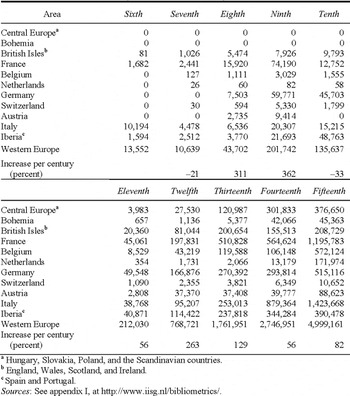
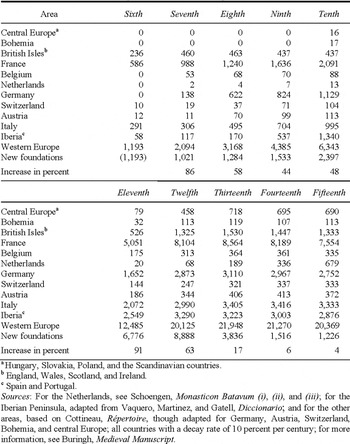
MANUSCRIPT PRODUCTION IN ABSOLUTE NUMBERS PER CENTURY (sixth to fifteenth centuries)

a Hungary, Slovakia, Poland, and the Scandinavian countries.
b England, Wales, Scotland, and Ireland.
c Spain and Portugal.
Sources:
See appendix I, at http://www.iisg.nl/bibliometrics/.
markets such as Poland and Russia, these estimates of print runs are high, but the overestimate compensates for the fact that the figures of new titles for these countries are probably too low.
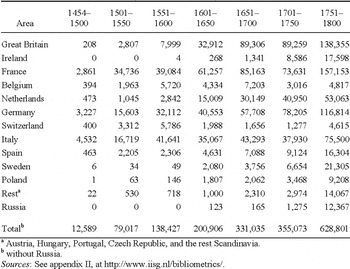
One way to test the accuracy of our results is to look at what they tell us about the production of manuscripts and printed books in the second half of the fifteenth century, when both techniques coexisted. As can be seen from a comparison of Tables 1 and 2, there is a correlation
PRODUCTION OF PRINTED BOOKS PER HALF CENTURY, 1454–1800: (in thousands of books)

a Austria, Hungary, Portugal, Czech Republic, and the rest Scandinavia.
b without Russia.
Sources:
See appendix II, at http://www.iisg.nl/bibliometrics/.
(R 2 = 0.71) between the structure of manuscript production during the fifteenth century and the output of incunabula from 1454–1500. Margins of error for our estimates are no doubt relatively large, especially for the earlier periods. The incunabula of the second half of the fifteenth century are perhaps the most intensely studied kind of books, and the data for these are particularly good. This period can therefore be seen as an anchor for the two sets of estimates of printed books and manuscripts.
LONG-TERM PATTERNS
European book production increased enormously in the period under study, from somewhat more than 12,000 manuscripts per century (or 120 per year) from 500 to 700, to more than one billion books published during the eighteenth century (the peak year in the period 500–1799 is 1790, when more than 20 million copies were printed). Because such a long period is covered here, the average rate of growth does not seem excessive: slightly more than 1 percent per year for Western Europe as a whole. Tables 1 and 2 also show the ups and downs of book production. First, there is a decline in the seventh centuries, the lowest point in the series, which is consistent with recent interpretations of the long-term development of the Western European economy following the disintegration of the western Roman Empire.Footnote 16 Then came the Carolingian Renaissance of the eighth and ninth centuries, which is one of the periods with the most rapid growth of book production, albeit starting from a very low level.Footnote 17 Then follows another dip in the tenth century, most apparent in France and Austria, presumably as a result of the disintegration of the Carolingian Empire and invasions from the north and east (by Vikings and Magyars).Footnote 18 The eleventh century shows a recovery to the level of the ninth century, which is sustained through the strong expansion of the medieval economy during the next 250 years. What is especially impressive are the leaps from the eleventh to thirteenth centuries.
The decline of population levels after the Black Death of 1348 had a complex effect on book production. In the short term, output probably declined significantly, as is shown in Figure 1, which contains more detailed (decade by decade) estimates of dated manuscripts from German-speaking countries from 1300 to 1500.Footnote 19 The rapid growth of the first half of the fourteenth century suddenly stopped, and the number of new manuscripts fell by some 50 percent between 1340–1349 and 1360–1369, while population probably dropped by about a third. But, after this temporary decline, production rebounded, ushering in an even sharper increase in output with an almost tenfold increase over the next hundred years. The average rate of growth was 2.2 percent per year between 1360–1369 and1460–1469, whereas it had been 1.8 percent during the first half of the fourteenth century.Footnote 20 The sharp decline in manuscript production after 1470 shown in Figure 1 reflects the invention of printing and can be found everywhere in Europe. But it is clear that production of textual output per capita continued to grow during the century and a half following the Black Death, a period sometimes referred to as the “crisis of the late medieval period”;Footnote 21 it probably accelerated after 1370, and again after 1470 as a result of the invention of the printing press. The number of incunabula (printed books produced during the second half of the fifteenth century) was already 150 percent higher than manuscript production during the entire fifteenth century, which was in turn almost twice the manuscript production of the fourteenth century (see Table 2).
ESTIMATED MANUSCRIPT PRODUCTION IN CENTRAL EUROPE,: 1300–1309 TO 1490–1499 (1300–1309 = 100)

The acceleration of book output after 1454 continued until the end of the sixteenth century; in the year 1550 alone, for example, some 3 million books were produced in Western Europe, more than the total number of manuscripts produced during the fourteenth century as a whole. During the rest of the early modern period growth continued, but at a slightly slower pace (somewhat under 1 percent per year).
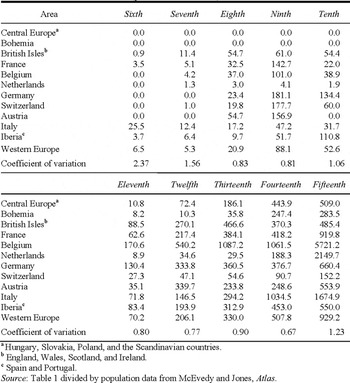
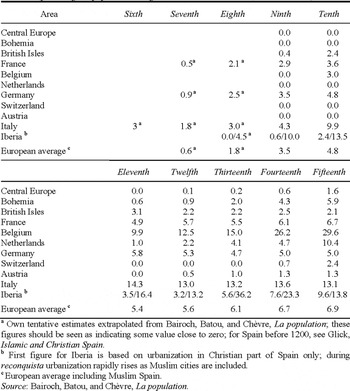
PER CAPITA PRODUCTION OF MANUSCRIPT BOOKS ANNUALLY, SIXTH TO FIFTEENTH CENTURIES: (per million inhabitants)

a Hungary, Slovakia, Poland, and the Scandinavian countries.
b England, Wales, Scotland, and Ireland.
c Spain and Portugal.
Source:
Table 1 divided by population data from McEvedy and Jones, Atlas.
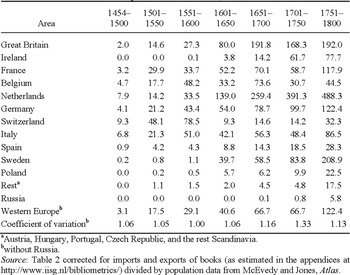
We will now look at Tables 3 and 4: which countries produced the greatest fraction of book output—usually the largest countries—and which ones produced the most books per capita (here small countries stand out).Footnote 22 One of the problems with this approach is of course the unequal size of the countries; if we could isolate data on, for example, northern Italy or the north of France (including Paris), these regions rank much higher in output per capita.
PER CAPITA CONSUMPTION OF PRINTED BOOKS ANNUALLY, 1454–1500 and 1751–1800: (per thousand inhabitants)

a Austria, Hungary, Portugal, Czech Republic, and the rest Scandinavia.
b without Russia.
Source:
Table 2 corrected for imports and exports of books (as estimated in the appendices at http://www.iisg.nl/bibliometrics/) divided by population data from McEvedy and Jones, Atlas.
During the first two centuries (sixth and seventh), levels of book production largely reflect the extent to which the information infrastructure of the ancient economy remained intact during the mass migrations that followed the disintegration of the Roman Empire. Italy in the sixth century was still the most important center of book production, both in absolute terms (it produced about two-thirds of total output) and output per capita. This was arguably the last flowering of the Roman Empire, or in fact the Ostrogothic “client” state of Byzantium headed by Theodoric in the north, with Ravenna as its capital city.Footnote 23 During the seventh century book production in Italy dropped substantially, and the decline was only partially compensated by growth in France, Spain, and on the British Isles. In per capita terms Ireland probably became the leading producer in the eighth and ninth centuries, since it produced, according to our database, 36 percent (seventh century) to 28 percent (ninth century) of the total manuscripts of this area, whereas it had a population of perhaps no more than 20 percent of that of the British Isles as a whole.Footnote 24
The new structure of book production that emerged during the Carolingian period consisted of the core region of Charlemagne's empire—northern France, Belgium, and western Germany—producing the bulk of the manuscripts, with additional output coming from Switzerland, Austria, and Spain. Spain was temporarily the European “leader” in the tenth century, reflecting the flowering of the (Islamic part of the) Spanish economy in this period.Footnote 25 Again, in the twelfth and thirteenth centuries, France and Germany were the most important centers, and neighboring Belgium had the highest output per capita. So the period from 800 to 1300—with the exception of the crisis of the tenth century—shows a remarkable degree of continuity in which the core area of the Carolingian Empire dominated the industry.
During the Renaissance, Italy emerged again as the most important center of book production, whereas output in Germany and France stagnated in the fourteenth century, and even declined in the British Isles and Belgium, although Belgium did remain the leader in per capita production. The same pattern is clear from the production of incunabula (from 1454 to 1500): although Gutenberg made his innovations in southern Germany, Italy (Venice in particular) soon became the most important producer. Italy was also the only large country that, from 1454 to 1500, could compete with small countries such as Switzerland and the Netherlands in per capita output. The growth spurt of (northern) Italy thus leads to a new pattern linking Italy to the core area of Carolingian Europe (Belgium, the western and southern parts of Germany, and eastern and northern France). It is the urban belt of Western Europe, stretching from northern Italy, through southern Germany to the Low Countries.Footnote 26
During the sixteenth century, Switzerland has the highest per capita output of books, by and large because of printing for the Reformation in cities such as Basel and Geneva.Footnote 27 During the seventeenth century, the northern Netherlands comes to the fore within this urban belt. The belt then extends to include Great Britain, which became the most important producing area from 1650 to 1750.Footnote 28 In the second half of the eighteenth century, France regained the lead, because of the Enlightenment. Per capita, the Dutch had no rivals during the period from 1600 to 1800; Britain was often a close second, but in the second half of the eighteenth century it was overtaken in this respect by a newcomer, Sweden, where the policy of increasing the literacy of the population led to a growing demand for books and an “explosion” in the printing industry.
Two regions failed to continue their once strong performance: Ireland and Spain. Although Ireland probably ranked first in manuscript output per capita in the seventh and eight centuries, it disappeared from the bookmaking scene in the next millennium—one of the most striking developments revealed by our data. During the early medieval period, Irish monasteries were focal points in the religious infrastructure of Western Europe and storehouses of knowledge and literacy. But, for reasons not fully understood, Ireland does not seem to have participated in the great expansionary boom that characterized the economies and societies of Western Europe from 1000 to 1300, and its relative contribution to European book production clearly declined in the centuries after 1000.Footnote 29
The decline of Spain was almost equally dramatic. Its share in European production dropped from roughly a third in the tenth century to only 2 to 2.5 percent from 1600 to 1800. Spain did participate in the boom from 1000 to 1300 and maintained a level of book production not far below the Western European average in the high Middle Ages. But per capita book production slipped to less than a quarter of the European average in the fifteenth and sixteenth centuries. Spain's decline as a publishing center thus coincided with the “Golden Age” of Spanish economy and society.
Against these two examples of decline, there are comparable examples of progress: in per capita production, Switzerland, the Netherlands (very marginal before the fourteenth century), Great Britain, and, perhaps most surprisingly, Sweden (again very marginal until the seventeenth century) become important centers of book production; it is probably not a coincidence that these were also the countries where the Reformation of the sixteenth century was most successful.
These comparisons also show that the shift in Europe's cultural and economic center of gravity from south to north was not really a single process. Instead, there were several complex movements during this thirteen-century period. The most decisive perhaps was the shift from Italy, the political and commercial core area before and during the sixth century, to the Carolingian core area of northern France, southern Germany, and Belgium, which took place between 700 and 800. This new core maintained its position from 800 to 1300, although Ireland, Britain, and Spain were also important centers during part of this period. During the Renaissance, the center of gravity returned to northern Italy, and the then final shift to the north occurred only after 1600, when Italy lost its leading position in the book industry to the Netherlands, France, and England. The strong performance of Sweden in the eighteenth century further added to this shift in the center of gravity of the European economy.
Finally, if we calculate coefficients of variation for the figures in Tables 3 and 4, two long-term processes stand out. First of all, inequality between countries diminished between 600 and 900, as new centers of book production emerge in once peripheral parts of Western Europe such as the British Isles, Germany, Switzerland, and Austria. The zeros in Tables 3 and 4 disappear, and book production spreads from the south to the most distant corners of the Latin West. It reflects the process of Christianization and “Europeanization” that occurred during the Middle Ages, as a result of which Western Europe acquired a certain homogeneity in cultural attitudes, institutions, and perhaps even levels of economic development, although important differences continued to exist.Footnote 30
The early modern period saw, by contrast, an increase in inequality among the various countries, although differences within Europe remained rather limited (including Russia in the calculations would, of course, significantly affect the coefficient). The cause was the gradual divergence of the northwestern part of Europe, in particular the Netherlands and Great Britain, which could also boast of higher real wages and GDP per capita.Footnote 31
CONVERGENCE IN LEVELS OF BOOK PRODUCTION, 500–1500
One way to look at the spectacular growth of book production in the centuries before 1500 is to think of the book as an innovation that matured in the centuries from 300 to 800. From the second to fourth centuries, the codex, the bound book, was “invented” and gradually replaced the “unwieldy scroll.”Footnote 32 Around 600 Irish monks developed a system of writing that separated individual words, which greatly facilitated reading. Finally, around 800, modern punctuation, uniform script, and division into paragraphs were introduced, all also greatly helping the reader to understand the text quickly.Footnote 33 In sum, a new information technology was created, which, as Ulrich Blum and Leonard Dudley argued, helped launch the European economy in the period that followed. The growth of book production shown in Tables 1 and 3 is generally consistent with such a view: initially growth rates are spectacular, especially during the eighth and ninth centuries, a growth that is accompanied by the spread of book production from a small core region in Italy to Western Europe as a whole. Moreover, thanks to other innovations in the high Middle Ages (in particular, the substitution of paper for parchment, but also the spread of more efficient ways of hand copying manuscripts, such as the pecia system) and the fifteenth century (the printing press), the price of books was greatly reduced, providing additional impulse to the growth process.Footnote 34 What is striking in Figure 2, which shows the long-term trends in per capita book production in three different regions and in Western Europe as a whole, is how synchronized the long-term changes in these different parts were, at least from the seventh century on. The spectacular growth of book production occurred in all regions (with only one or two exceptions, such as Ireland after 1000) at approximately the same pace, testifying to the unity of the Western European experience.
BOOK PRODUCTION PER CAPITA IN WESTERN EUROPE, 501–600 TO 1701–1800
A closer look reveals, however, that the process was more complex. Supply and demand changed fundamentally in the millennium from 500 to 1500. During a large part of the Middle Ages, a close link existed between the monastic movement and book production: monasteries were not only the most important sources of supply, but also of demand. Performing their religious duties and studying the word of God were the core business of these powerhouses of prayer. Because, from early Christian times, even minor deviations from official formulae were believed to render a religious service ineffective, written instructions for the correct wording were essential, and hence the permanent monastic and ecclesiastical emphasis on written texts. In the early Middle Ages, when markets were scarce, books had to be made in-house from the monastic surplus of agricultural products. These links are illustrated by Michael Gorman, whose writing on the production of manuscripts in Monte Amiata, one of the most important monasteries in eleventh-century Tuscany, Italy, describes the close interconnection between the financial position of a monastery and its library:
“It is worthwhile to highlight the abbey's economic history because manuscript production coincides with favorable economic factors. An active scriptorium depends upon a great library, full of exemplars, and both require significant financial resources. Many peasants must work hard to raise the sheep, make the parchment and produce the wealth to be consumed by the monks toiling away in the abbey's library and scriptorium.”Footnote 35
We may therefore hypothesize that during the early Middle Ages book production was to a large extent driven by the number and size of monasteries, which was in turn determined by the share of the agricultural surplus that regions and countries directed to this part of the economy.
To test this hypothesis, we derived estimates of the numbers of monasteries in the different regions and centuries from several sources (Table 5), which can be plotted against book production in the same
ESTIMATED NUMBERS OF MONASTERIES IN WESTERN EUROPE: (sixth to fifteenth centuries)

a Hungary, Slovakia, Poland, and the Scandinavian countries.
b England, Wales, Scotland, and Ireland.
c Spain and Portugal.
Sources:
For the Netherlands, see Schoengen, Monasticon Batavum (i), (ii), and (iii); for the Iberian Peninsula, adapted from Vaquero, Martinez, and Gatell, Diccionario; and for the other areas, based on Cottineau, Répertoire, though adapted for Germany, Austria, Switzerland, Bohemia, and central Europe; all countries with a decay rate of 10 percent per century; for more information, see Buringh, Medieval Manuscript.
time and place (see Figure 3).Footnote 36 The correlation between the two variables is fairly consistent, stressing the important role monasteries played in this period.
BOOK PRODUCTION AND THE NUMBER OF MONASTERIES SIXTH TO FIFTEENTH CENTURIES (log-scale)
The development of monasteries in the Middle Ages shows a pattern of continuous growth during the first half of the period, when more than a thousand were added to the stock each century, followed by a boom in the tenth to twelfth centuries. The boom is partially explained by the reform movement begun by Cluny in the early tenth century, which gradually spread to other parts of the Latin West. Apparently, these reforms enhanced trust in monasteries and in the services they supplied, such as prayers for the souls of the deceased, resulting in increased investment in this form of religious overhead. In addition, after the demise of the Carolingian Empire, parts of Western Europe went through a political crisis, with states collapsing and law and order vanishing; to some extent the church and its institutions (such as the monasteries) became an alternative center of power, which tried to pacify the countryside.Footnote 37 This may also have enhanced the status of monasteries and drawn funds to their activities. Increased powers of local lords (such as monasteries) vis-à-vis the rural population may have also played a role, by allowing monasteries to claim a greater share of the agricultural surplus. The tenth and eleventh centuries witnessed the rise of the local lords who were increasingly able to control the countryside around their castle and who used their power to impose new taxes and duties or to reimpose old ones.Footnote 38 Monasteries often acted as local lords. The combination of these changes caused a dramatic growth in the monastic movement from 900 to 1300, which greatly increased the production of books. After about 1300 this rapid growth came to a halt, and thereafter the number of monasteries in the Latin West stabilized at some 21,000 until 1500.Footnote 39
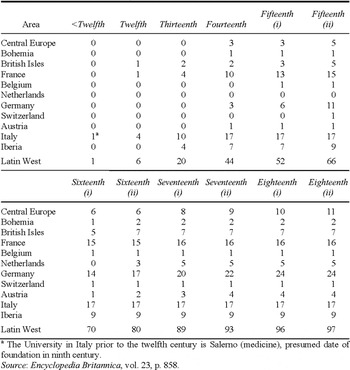
During the height of the Middle Ages other sources of demand—the cities, universities, and more generally, the growth of literacy among the lay population—were becoming increasingly important.Footnote 40 To test the ideas that book production before the eleventh to twelfth centuries was driven by the monastic movement and that afterwards urban factors took over, we have tried to perform a regression for book production on the following explanatory variables: the number of monasteries (as shown in Table 5), estimated urbanization ratios from Paul Bairoch, Jean Batou, and Pierre Chèvre (Table 6) and the number of universities (Table 7).Footnote 41 One of the problems with these regressions is that some observations are zero, making it difficult to use logs. On the other hand, the growth of book production is so spectacular that it would normally be preferable to specify the model in log terms so that observations about the later period do not dominate the regressions. Two different sets of regressions were carried out: panel data regressions using only the nonzero observations, and a procedure that makes it possible to integrate the zeros, Tobit regressions.Footnote 42 Moreover, two different versions of the hypothesis were
ESTIMATES OF URBANIZATION RATIO, SIXTH TO FIFTEENTH CENTURIES: (percentage of population living in cities with more than 10,000 inhabitants)

a Own tentative estimates extrapolated from Bairoch, Batou, and Chèvre, La population; these figures should be seen as indicating some value close to zero; for Spain before 1200, see Glick, Islamic and Christian Spain.
b First figure for Iberia is based on urbanization in Christian part of Spain only; during reconquista urbanization rapidly rises as Muslim cities are included.
c European average including Muslim Spain.
Source:
Bairoch, Batou, and Chèvre, La population.
tested: the first model estimated all coefficients for the period 500–1500 as a whole, the second tested for changes in the coefficients of monasteries and the urbanization ratio before and after 1000 (Table 8).Footnote 43
CUMULATIVE DISTRIBUTION OF FOUNDATION DATES OF UNIVERSITIES IN WESTERN EUROPE, TWELFTH TO EIGHTEENTH CENTURIES

a The University in Italy prior to the twelfth century is Salerno (medicine), presumed date of foundation in ninth century.
Source:
Encyclopedia Britannica, vol. 23, p. 858.
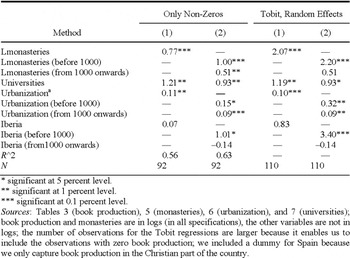
Table 8 shows the results of these regressions, which explain the log of per capita book production in country x in period y by the log of the number of monasteries (per capita), the number of universities (again per capita), the urbanization ratio, and a dummy for Spain. If we take the Middle Ages as a whole, the three factors we have data for—universities, monasteries, and urbanization—together explain almost 60 percent of the variation in per capita book production (first two columns). All coefficients show the expected signs, independent of the specification. Dividing the period in two shows the changes in the determinants for book production: the link to monasteries is very strong in the first half of the period but less so during the Late
PANEL DATA REGRESSION ON PER CAPITA PRODUCTION OF MANUSCRIPT BOOKS

* significant at 5 percent level.
** significant at 1 percent level.
*** significant at 0.1 percent level.
Sources:
Tables 3 (book production), 5 (monasteries), 6 (urbanization), and 7 (universities); book production and monasteries are in logs (in all specifications), the other variables are not in logs; the number of observations for the Tobit regressions are larger because it enables us to include the observations with zero book production; we included a dummy for Spain because we only capture book production in the Christian part of the country.
Middle Ages. In both periods the coefficient of the urbanization index is positive; it is somewhat surprising that this coefficient is larger for the early period than for the second half of the Middle Ages (but levels of urbanization are much lower in the first half of the period). The regressions confirm the hypotheses found in the literature about the importance of monasteries during the early Middle Ages and of universities and cities from 1000 to 1500, but they also show that even before 1000 urbanization mattered for book production.
BOOK PRODUCTION AND LITERACY: FROM 1450 TO 1800
How to explain the significant increase in book production and consumption in the centuries following the invention of moveable type printing in the 1450s? The effect of the new technology (and important technological changes in the production of paper) was thatfrom the 1470s on, book prices declined very rapidly. This had a number of effects: consumption per literate individual increased, but it also became more desirable and less costly to become literate. Moreover, economies of scale in the printing industry led to further price reductions stimulating even more growth in book consumption.
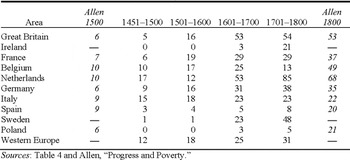
Given these interactions between supply and demand, it is difficult to separate the different factors involved. One way to at least partially circumvent the problem is by using the figures of book consumption to estimate the development of literacy. The rapid growth of book consumption can be explained by the increase of literacy and the change in the number of books consumed per literate person. Data for development of literacy in the period before 1800 and quite weak, as the recent set of estimates produced by Robert Allen demonstrate; for 1500, for example, his estimates are based on the urbanization rate of the various countries, in combination with the assumption that literacy in the countryside was 5 percent and in the cities 23 percent.Footnote 44 His literacy rate for 1500 is therefore a direct function of the urbanization rate, which may help to explain why it does not add to the explanation of economic performance in the early modern period. Joerg Baten and Jan Luiten van Zanden have argued that more sophisticated measures of human capital formation, such as book consumption, do a much better job in explaining growth in this period.Footnote 45 Because literacy will probably continue to play an important role in this debate, we aim to convert the figures of per capita book consumption into estimates of the literacy rate in this period. We used the demand equation b = α * β * p ε to translate the figures for b—book consumption per capita in different countries and periods—into estimates of β, the rate of literacy. The other variables were: estimates of the development of p, the relative book prices (book prices deflated by a cost of living index, taken from van Zanden and Gregory Clark;Footnote 46) and an estimate of the price elasticity of demand for books (of 1.4) taken from contemporary literature;Footnote 47 α is a constant derived for the Netherlands in the eighteenth century, because we have independent estimates of the level of literacy there.Footnote 48 A into limitation of this approach is that income effects are not taken account. In large parts of Europe, real wages did decline in the long run,
ESTIMATES OF THE DEVELOPMENT OF THE RATE OF LITERACY COMPARED WITH THOSE OF ALLEN, 1451–1500 TO 1751–1800

Sources:
Table 4 and Allen, “Progress and Poverty.”
the exceptions being the Low Countries and England where the decline was limited and per capita real incomes probably increased. Ignoring this effect means that we perhaps overestimate the growth of literacy in the North Sea area, or alternatively underestimate its increase in the rest of Europe.
The long-term trends also identified by Allen—a rise of literacy from about 10 percent in 1500 to one-third three centuries later—is also evident from these estimates, but there are a differences between the two sets of estimates. The comparison suggests that Allen may have overestimated literacy in Spain and Poland at about 1500, and probably underestimated it in the Low Countries and Italy in the same period.Footnote 49 Other long-term trends known from the literature, such as the significant rise of literacy in Great Britain during the sixteenth and seventeenth centuries, followed by stagnation during the eighteenth century, are also clearly found in the estimates in Table 9.Footnote 50 Perhaps most worrying is the estimated decline of literacy in Belgium in the eighteenth century, which may be due to the underestimation of consumption per capita; because of the growing importance of the international trade in books, the consumption estimates for the small countries are weaker than the estimates of production there. The overall pattern shows a strong increase in the North Sea area (including Sweden), stagnation on the southern periphery (Spain), and slow increases in Italy and Poland.Footnote 51 A related conclusion that can be derived from this is that the thirtyfold increase in European per capita production from 1450–1500 to 1700–1800 can be decomposed in two elements: a tenfold increase caused by falling book prices and a (slightly less than) threefold increase in literacy.
Falling book prices dominated the growth of book production, but the pattern of increased divergence within Western Europe cannot be explained by this, because book prices declined everywhere. In the working paper version of this article, we have attempted to explain this “little divergence” within Europe, but due to the limitations of the data set and problems of endogeneity of the independent variables (is income growth leading to higher levels of literacy, or is literacy leading to income growth?), the results are difficult to interpret. One variable that correlated very strongly with literacy and book consumption was Protestantism, which in itself was able to explain almost all of the difference in literacy between northwestern Europe (England, the Netherlands, and Sweden) and the rest of the subcontinent. The question remains to what extent the growth of book production and consumption was driven by cultural or by economic factors. This was the period of the “Little Divergence,” during which the economies of the Low Countries and Great Britain continued to expand, whereas the rest of Western Europe more or less stagnated. These diverging trends are in particular clear from the estimates of real wages constructed by Allen.Footnote 52 The “Little Divergence” is clearly present in the estimates of book consumption, but Catholic Belgium more or less falls out of the region of high demand for books, whereas in economically “backward” but Protestant Sweden book production expands very strongly. On the other hand, Switzerland, another (partially) Protestant nation, is a leading publisher only during the sixteenth century, but falls back dramatically during the next two centuries. This also leaves open the question if the Reformation was an external factor—an exogenous shock—or should be considered endogenous, the result of, for example, growing literacy at the grass roots level during the late medieval period, creating favorable conditions for the message of Luther and Calvin.Footnote 53
BOOK PRODUCTION OUTSIDE EUROPE
So far we have seen that a number of processes led to a very rapid growth in book production in Western Europe: first there was the flowering of the monastic movement; second, the growth of urban demand and related institutions (such as the universities) during the twelfth to fifteenth centuries, and third, the invention of the printing press, leading to a dramatic decline in book prices that further stimulated the growth of the market. Were these changes—and the corresponding levels of book production and consumption—unique to Europe, or do we find a similar expansion of the printing industry elsewhere?Footnote 54
During the Middle Ages, the level of literacy and book production in the Middle East may easily have equaled and possibly surpassed that in Western Europe, but the region did not make the transition to mass production of books using the printing press—nor did India, another highly developed and literate society. Toby Huff, in his comparative study of “the rise of early modern science,” analyzed resistance to the printing press in Islamic countries, which was ultimately based on a “distrust in the common man” and “to prevent his gaining access to printed materials.”Footnote 55 The sultan of the Ottoman Empire, for example, banned the possession of printed material after he discovered what the invention of the printing press meant for Western Europe.Footnote 56 The fact that the new technology could so easily be suppressed probably also suggests that the demand for books was rather limited in the Ottoman Empire.Footnote 57
The two candidates for a level of book production similar to Western Europe are China and Japan, both of which developed a commercial printing industry during the centuries before 1800. Recently, the literature on the Chinese printing industry has been growing rapidly, which makes detailed comparisons with Western Europe possible. What emerges from this literature is that during the late Ming and the Qing Dynasties, book production in China expanded rapidly; it was during the sixteenth century in particular, that printed books largely replaced manuscripts; the growth of the commercial printing industry in the Yangtze delta played an important role in this transformation.Footnote 58 The best evidence collected recently about the volume of output of the Chinese book industry is for the second half of the Ming Dynasty (1522–1644), which was probably the most dynamic period. The two main centers of production, Jianyang (in Fujian) and Nanjing (in Jiangsu) produced about 1,000 and 700 editions, respectively.Footnote 59 The estimates for the other cities and provinces are much lower; according to Zhang Xiumin's estimates, discussed by Brokaw, not more than 1600 titles were published in the rest of China, of which about half was also concentrated in the Yangtze delta. Combining these figures yields a total of about 3,300 new titles, or 27 titles annually.Footnote 60 Other recent estimates by Lucille Chia for the whole of China during the 1505–1644 period indicate a level that is almost double this figure, 47 titles annually.Footnote 61 As with the European estimates, these figures are based on books still available in libraries, and therefore underestimate real output. But even if we multiply these figures by a factor of 10, they are low compared to the estimates for Western Europe, which had a similar population size; the average annual book production in Western Europe from 1522 to 1644 can be estimated at about 3,750 titles, or about 40 times higher than the highest estimates for China in the same period.
For Qing China, much less recent work has been done; the only estimate available is that a total of about 126,000 new editions were published from 1644 to 1911, which means that the average annual output was 474.Footnote 62 Again, this was much lower than output in Europe (which produced close to 6,000 titles in 1644 alone), even lower than the output for a small country like the Netherlands during much of the seventeenth and eighteenth centuries. The difference is all the more striking given the efficiency of the Chinese, which turned out books with relatively low prices (although perhaps not as low as in Europe); it may indicate that the demand for books was much more limited than in Western Europe.Footnote 63
For Japan, the best estimates are that book production in “the three cities of Edo, Osaka, and Kyoto” was about 400 new titles between 1727–1731 and almost 600 between 1750–1754.Footnote 64 Again, these estimates are low by European standards. France, which had a slightly smaller population, produced more than 1,500 books annually between 1727 and 1731 and 2,350 per year between 1750 and 1754. These cities produced the bulk of the Japanese books in the seventeenth and eighteenth centuries.Footnote 65 The Japanese level of book production was considerably below that of France and of most other European countries, but it exceeded the level in China or anywhere else in the world.
CONCLUSION
The estimates of book production presented in this article show a remarkable and consistent rate of growth during the long period studied here, a strong testimony of the dynamic development of the European economy during these 13 centuries. In our view, book production is one of the few more or less reliable guides to the long-term development of the European economy in this period, since it matches not only periods of growth and decline, but also regional patterns of economic performance. Book production reveals how dynamic the Middle Ages were; rates of growth during the Carolingian Renaissance of the eighth and ninth centuries, during the High Middle Ages (eleventh to thirteenth centuries), and during the “crisis of the late medieval period” (1350–1500) are very high. After 1454 the invention of movable type caused output growth to accelerate even more. Whereas during the sixth and seventh centuries on average only about 120 books were produced annually in Western Europe, in the peak year of 1790 total production was more than 20 million books.
This spectacular growth occurred on a pan-European scale, but some regions were more dynamic than others, reflecting both economic and sociocultural changes. In the sixth century, Italy was still the dominant producer of manuscripts, but during the Carolingian Renaissance the center of production shifted to the region of northern France, western Germany, and Belgium, which remained the center of book production until the fourteenth century, although other countries—Ireland, Britain, and Spain—did contribute to manuscript production. During the Renaissance of the fourteenth and fifteenth centuries, the core again shifted to the south, to Italy, and it was only during the seventeenth century that the “decisive” shift to the North Sea region, to the Low Countries, and England occurred. During the seventeenth and eighteenth centuries, the Dutch Republic dominated per capita production, Great Britain became the largest producer of books, and Sweden also emerged as a country with high levels of book production and consumption.
Sociocultural factors—the spread of Christianity and the growth of the monastic movement—have had a major impact on growth during the first half of the Middle Ages; these processes lead to a cultural homogenization of Western Europe, with relatively low regional differences in per capita consumption and production of books from the tenth century onwards. Once this process of homogenization was complete—say by 1200—the estimates of book production reflect rather accurately levels of economic development and rates of economic growth within Europe in the years 1200 to 1500 (if we take into account the gradual decline of book prices). When we find, for example, that the Netherlands develops from a region with a very low level of book production during the eleventh and twelfth centuries into one of the leading nations in the fifteenth century, this clearly reflects its relative development as an economy.Footnote 66 In the early modern period, however, a new process of divergence begins, both in the economic sphere (the North Sea area moves ahead of the rest of Western Europe) and in the sociocultural and religious sphere, with the spread of Protestantism. It appears therefore book production and consumption—and the accumulation of knowledge that was linked to it—during large parts of the period understudy, in the early Middle Ages and in the early modern period, was affected by sociocultural and religious changes such as the expansion of Christianity in the Middle Ages and the spread of the Reformation after 1517.
Books and manuscripts were a “luxury,” purchased after the first essentials of life; they also required a minimal level of education. Who was buying and who was producing the books changed radically between 500 and 1800. In the earliest period, the church and its institutions shaped manuscript production; its expansion was probably related to the increase of landed wealth of the church.Footnote 67 Monasteries dominated manuscript production, and only in Spain and perhaps in Italy was urban demand important. Market forces played a limited role: Carolingian production was based on the orders of ecclesiastical and worldly dignitaries and had a primarily spiritual function.
From the eleventh to twelfth centuries on, however, the market took over the role of the monasteries. Demand from cities and universities drove the continuous growth of the book industry in the late medieval and early modern periods. The universities are indicators of a complex interplay of factors. On the one hand they provide an index of higher levels of schooling, and on the other hand they also mark the emergence of education not directly controlled by the authorities, since universities were often relatively free from state or ecclesiastical interference. The growing literacy of the urban population, the long-term increase in their incomes, and, in particular after 1454, rapid technological change in the production of books, dominated the process in the early modern period. The regional variation in these patterns seem to be linked to regional differences in income levels and the level of urbanization, but they were to a large extent also dominated by the rise of Protestantism, which had a strong positive impact on literacy.
The long-term increase in book consumption also reflected the significant decline in book prices, particularly after 1454. Already during the twelfth and thirteenth centuries, the use of paper (transferred to the Latin West from Muslim countries via Italy and Spain) led to lower production costs and increased production. The price of manuscripts was also reduced by other medieval developments, such as smaller letters, abbreviations, and double columns. When universities introduced the academic pecia system of manuscript production in the Middle Ages, it too made it possible for students and scribes to copy manuscripts at lower cost. But the most radical change occurred during the fifteenth century, when Gutenberg's inventions revolutionized the industry. It is striking how fast the new technology spread across Europe; within one generation printing presses appeared in the most distant corners of Western Europe, and the cost of books had been cut by two-thirds or more. Demand reacted strongly. More subtle and indirect was the long-term change in literacy. The net effect was the growth of a mass market for books, especially in Protestant countries like Switzerland, the Netherlands, Great Britain, and Sweden. The result was a level of book consumption that seems to have been much higher than anywhere else in the world, including the two other main centers of printing, China and Japan. One possible implication is that levels of human capital formation were higher in Western Europe than in East Asia (or in the rest of the world economy), which may conceivably help to explain the “Great Divergence.”68
One final question is: Why did book consumption increase so spectacularly despite the fact that at its height the standard of living of the majority of the population did not increase at all?Footnote 69 During most of this period, books were luxury products consumed by the elite—the religious elite at first, but after 1100 increasingly the urban and academic elites. They were, apparently, able to mobilize a growing portion of total income to spend on such items of luxury consumption. Urbanization probably led to a significant increase in income inequality, favoring the class of merchants and professionals who became the main consumers of the product.Footnote 70 Increased income inequality may therefore be part of the explanation. Moreover, books are another example of a luxury of which the prices declined much more than the consumer price index, favoring the development of the real purchasing power of the rich.Footnote 71 At the same time, in the early modern period books came within the reach of the lower middle classes. This development began with the rise of “mass” literacy in the late fourteenth and fifteenth centuries, when new religious movements (such as the Devotio Moderna) began to encourage all believers to read the Bible. European citizens in 1800 may not have been better fed than in 600, but their access to books and their capabilities for reading them had changed fundamentally.